
Nitration and Sulfonation of Benzene Nitration and sulfonation
�Nitration and Sulfonation of Benzene �Nitration and sulfonation of benzene are two examples of electrophilic aromatic substitution. The nitronium ion (NO 2+) and sulfur trioxide (SO 3) are the electrophiles and individually react with benzene to give nitrobenzene and benzenesulfonic acid respectively. �Nitration of Benzene �The source of the nitronium ion is through the protonation of nitric acid by sulfuric acid, which causes the loss of a water molecule and formation of a nitronium ion. Because the nitronium ion is a good electrophile, it is attacked by benzene to produce Nitrobenzene.
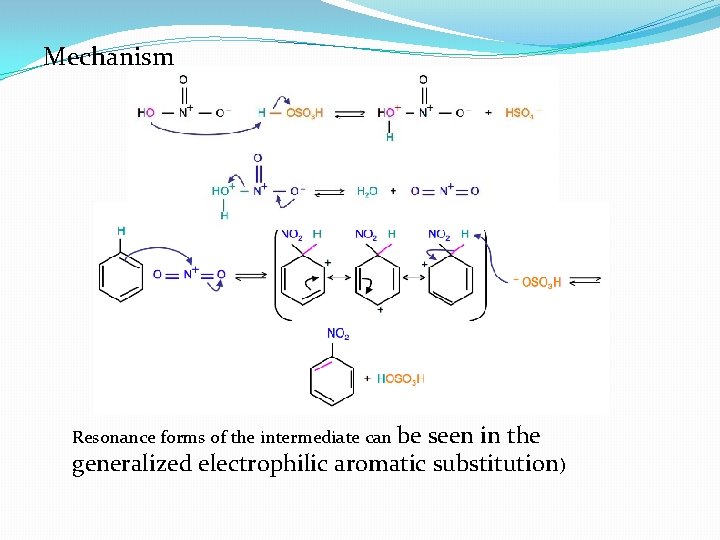
Mechanism Resonance forms of the intermediate can be seen in the generalized electrophilic aromatic substitution)

Sulfonation of Benzene Sulfonation is a reversible reaction that produces benzenesulfonic acid by adding sulfur trioxide and fuming sulfuric acid. The reaction is reversed by adding hot aqueous acid to benzenesulfonic acid to produce benzene.
�Mechanism �To produce benzenesulfonic acid from benzene, fuming sulfuric acid and sulfur trioxide are added. Fuming sulfuric acid, also refered to as oleum, is a concentrated solution of dissolved sulfur trioxide in sulfuric acid. The sulfur in sulfur trioxide is electrophilic because the oxygens pull electrons away from it because oxygen is very electronegative. The benzene attacks the sulfur (and subsequent proton transfers occur) to produce benzenesulfonic acid. �Reverse Sulfonation �Sulfonation of benzene is a reversible reaction. Sulfur trioxide readily reacts with water to produce sulfuric acid and heat. Therefore, by adding heat to benzenesulfonic acid in diluted aqueous sulfuric acid the reaction is reversed.
�Further Applications of Nitration and Sulfonation � Nitration is used to add nitrogen to a benzene ring, which can be used further in substitution reactions. The nitro group acts as a ring deactivator. Having nitrogen present in a ring is very useful because it can be used as a directing group as well as a masked amino group. The products of aromatic nitrations are very important intermediates in industrial chemistry. � Because sulfonation is a reversible reaction, it can also be used in further substitution reactions in the form of a directing blocking group because it can be easily removed. The sulfonic group blocks the carbon from being attacked by other substituents and after the reaction is completed it can be removed by reverse sulfonation. Benzenesulfonic acids are also used in the synthesis of detergents, dyes, and sulfa drugs. Bezenesulfonyl Chloride is a precursor to sulfonamides, which are used in chemotherapy.
An alkyl group can be added to a benzene molecule � by an electrophile aromatic substitution reaction called the Friedel‐Crafts alkylation reaction. One example is the addition of a methyl group to a benzene ring. The mechanism for this reaction begins with the � generation of a methyl carbocation from methylbromide. The carbocation then reacts with the π electron system of the benzene to form a nonaromatic carbocation that loses a proton to reestablish the aromaticity of the system.
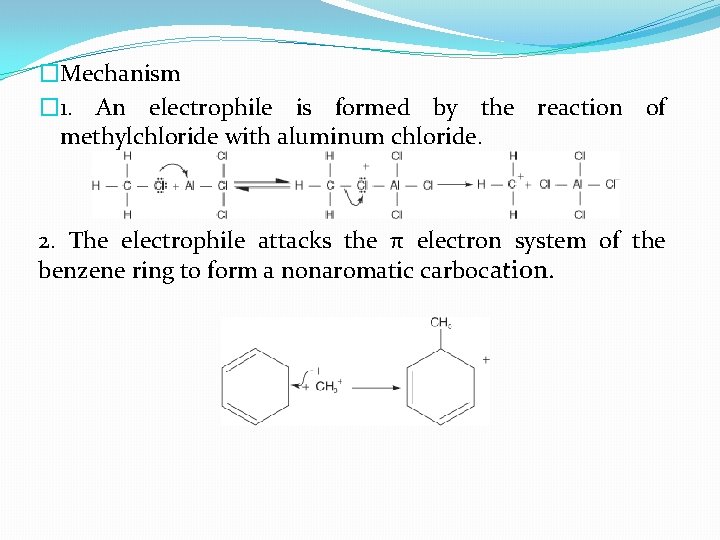
�Mechanism � 1. An electrophile is formed by the reaction of methylchloride with aluminum chloride. 2. The electrophile attacks the π electron system of the benzene ring to form a nonaromatic carbocation.
- Slides: 7