
NISTs PostQuantum Cryptography Project Rene Peralta NIST PQC

- Slides: 11
NIST's Post-Quantum Cryptography Project Rene Peralta NIST PQC team Real World Cryptography 2017
The Problem • “Large” quantum computers would break most of our public-key crypto – RSA, Diffie-Hellman key exchange, elliptic curve crypto • Symmetric crypto would be affected, but not broken – Keys will have to be longer. • Full transition to alternatives takes a long time (possibly > 10 years). • Long-term privacy and security implications …
NIST’s PQC project • To monitor progress in quantum computers and quantum algorithms. • To find and standardize quantum-resistant alternatives for PKE, key-agreement, and digital signatures. • To ensure transparency of the process and legitimacy of the outcome.
Not a Competition • We hope at the end of the day there will be significant community consensus. • We may standardize several algorithms. • The evaluation criteria is not set in stone, it will probably evolve during the next few years.
The Call For Proposals • Candidate algorithms may now be submitted http: //csrc. nist. gov/groups/ST/post-quantumcrypto/cfp-announce-dec 2016. html • Deadline is November 30, 2017
The PQC Forum • The wording of the CFP followed public discussion on the pqc-forum (pqc-forum@nist. gov). • This is also where submissions and germane issues such as evaluation criteria - will be discussed. • To join send mail to pqc-forum-request@nist. gov with subject=subscribe
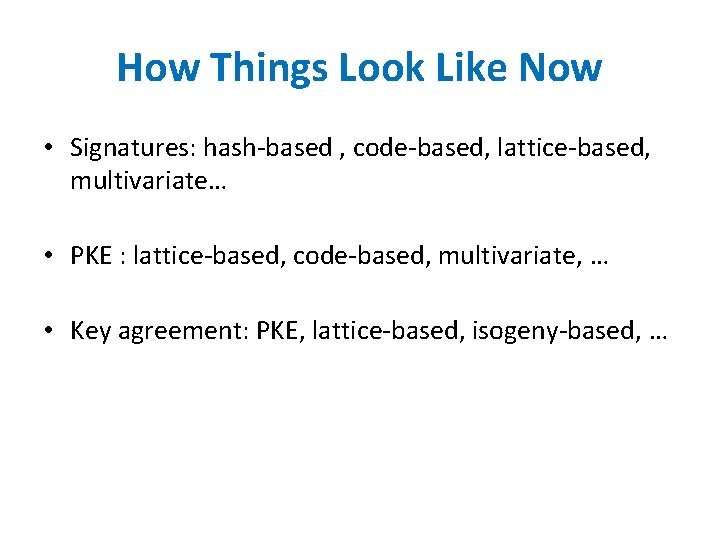
How Things Look Like Now • Signatures: hash-based , code-based, lattice-based, multivariate… • PKE : lattice-based, code-based, multivariate, … • Key agreement: PKE, lattice-based, isogeny-based, …
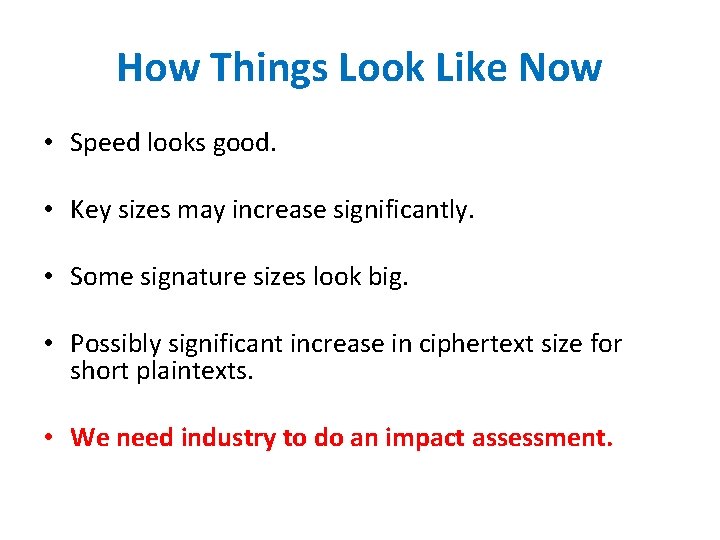
How Things Look Like Now • Speed looks good. • Key sizes may increase significantly. • Some signature sizes look big. • Possibly significant increase in ciphertext size for short plaintexts. • We need industry to do an impact assessment.
Public Discussion • Ongoing discussion regarding “security-levels” and derived parametrization. • Suspicion that NIST is just doing NSA’s bidding. • Demands that future standards make bad implementations harder.
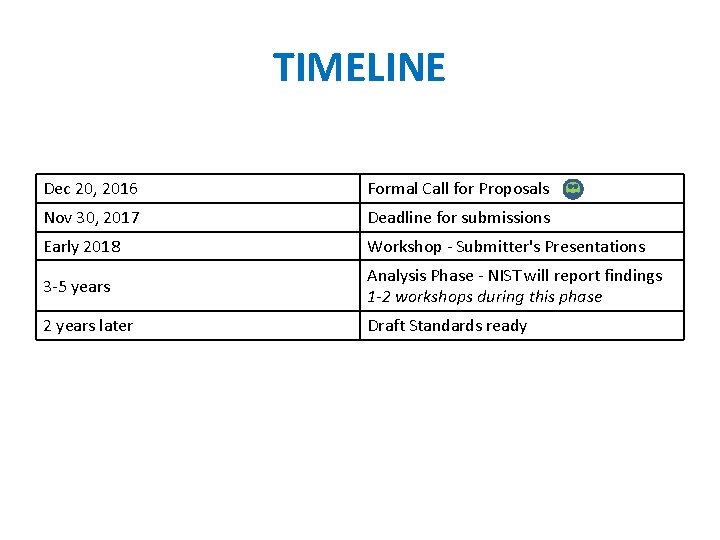
TIMELINE Dec 20, 2016 Formal Call for Proposals Nov 30, 2017 Deadline for submissions Early 2018 Workshop - Submitter's Presentations 3 -5 years Analysis Phase - NIST will report findings 1 -2 workshops during this phase 2 years later Draft Standards ready
THANKS