
NIST traceable photocurrent measurements George P Eppeldauer H
NIST traceable photocurrent measurements George P. Eppeldauer H. W. Yoon, D. G. Jarrett, and T. C. Larason CORM Gaithersburg, May 8, 2013
Problems and objectives Present problems 1. Photometric and color measurements are traceable only to the watt SI unit 2. The SI traceability for the detector electrical output signals was not established Objectives To develop detector output signal-measurement sub-scale by 1. Developing reference I-V converters 2. In-situ calibration of feedback resistors against NIST standard resistors (up to 10 GW) 2. Measuring DC current from commercial current source 4. Signal-gain calibrations against the calibrated current source(s)
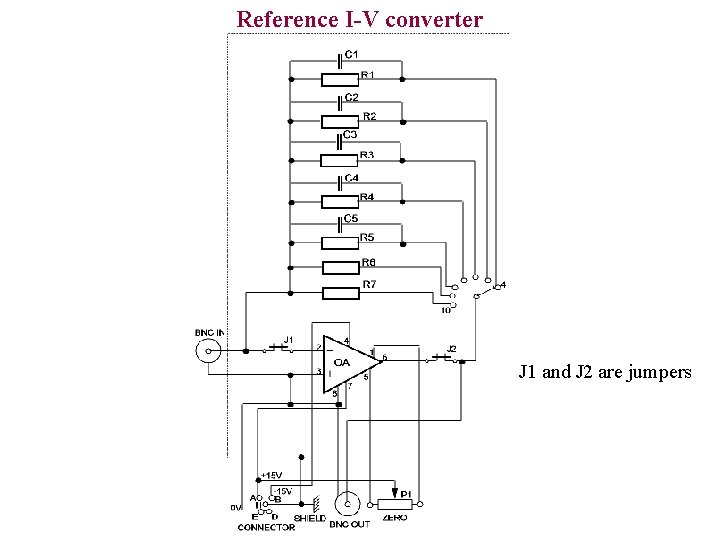
Reference I-V converter J 1 and J 2 are jumpers
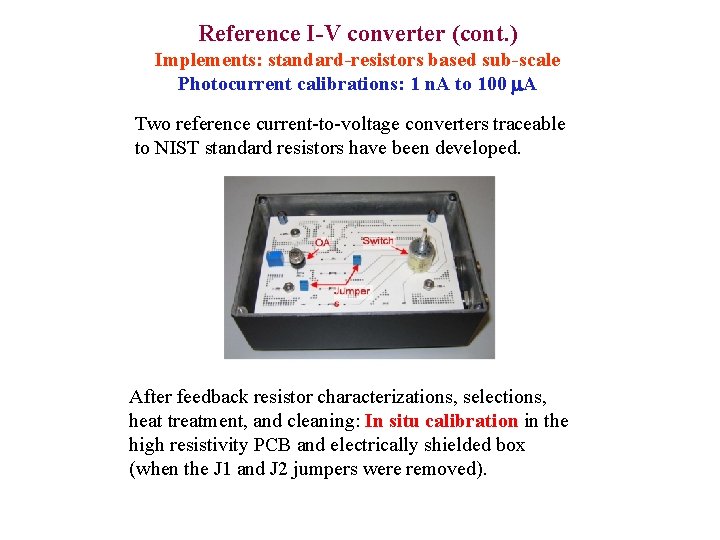
Reference I-V converter (cont. ) Implements: standard-resistors based sub-scale Photocurrent calibrations: 1 n. A to 100 m. A Two reference current-to-voltage converters traceable to NIST standard resistors have been developed. After feedback resistor characterizations, selections, heat treatment, and cleaning: In situ calibration in the high resistivity PCB and electrically shielded box (when the J 1 and J 2 jumpers were removed).
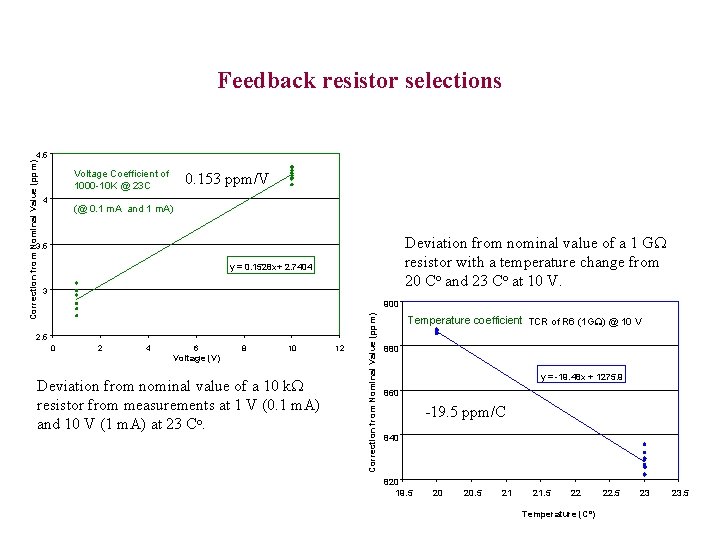
Feedback resistor selections Correction from Nominal Value (ppm) 4. 5 Voltage Coefficient of 1000 -10 K @ 23 C 4 0. 153 ppm/V (@ 0. 1 m. A and 1 m. A) Deviation from nominal value of a 1 GW resistor with a temperature change from 20 Co and 23 Co at 10 V. 3. 5 y = 0. 1528 x+ 2. 7404 3 2. 5 0 2 4 6 8 10 Voltage (V) Deviation from nominal value of a 10 k. W resistor from measurements at 1 V (0. 1 m. A) and 10 V (1 m. A) at 23 Co. 12 Correction from Nominal Value (ppm) 900 Temperature coefficient TCR of R 6 (1 GW) @ 10 V 880 y = -19. 48 x + 1275. 9 860 -19. 5 ppm/C 840 820 19. 5 20 20. 5 21 21. 5 22 Temperature (Co) 22. 5 23 23. 5
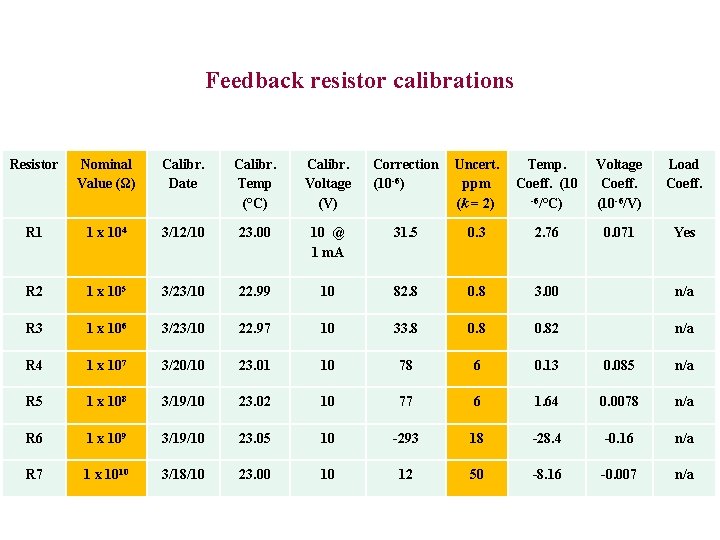
Feedback resistor calibrations Resistor Nominal Value (Ω) Calibr. Date Calibr. Temp (°C) Calibr. Voltage (V) Correction (10 -6) Uncert. ppm (k = 2) Temp. Coeff. (10 -6/°C) Voltage Coeff. (10 -6/V) Load Coeff. R 1 1 x 10⁴ 3/12/10 23. 00 10 @ 1 m. A 31. 5 0. 3 2. 76 0. 071 Yes R 2 1 x 10⁵ 3/23/10 22. 99 10 82. 8 0. 8 3. 00 n/a R 3 1 x 10⁶ 3/23/10 22. 97 10 33. 8 0. 82 n/a R 4 1 x 10⁷ 3/20/10 23. 01 10 78 6 0. 13 0. 085 n/a R 5 1 x 10⁸ 3/19/10 23. 02 10 77 6 1. 64 0. 0078 n/a R 6 1 x 10⁹ 3/19/10 23. 05 10 -293 18 -28. 4 -0. 16 n/a R 7 1 x 10¹⁰ 3/18/10 23. 00 10 12 50 -8. 16 -0. 007 n/a
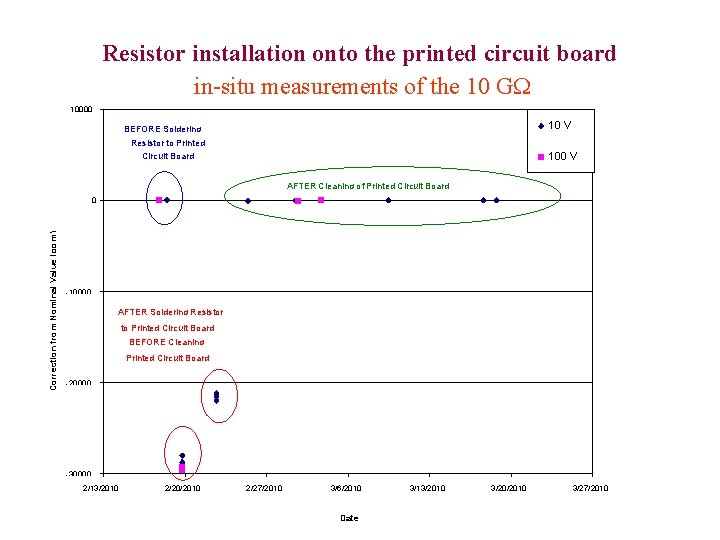
Resistor installation onto the printed circuit board in-situ measurements of the 10 GW 10000 10 V BEFORE Soldering Resistor to Printed Circuit Board 100 V AFTER Cleaning of Printed Circuit Board Correction from Nominal Value (ppm) 0 -10000 AFTER Soldering Resistor to Printed Circuit Board BEFORE Cleaning Printed Circuit Board -20000 -30000 2/13/2010 2/20/2010 2/27/2010 3/6/2010 Date 3/13/2010 3/20/2010 3/27/2010
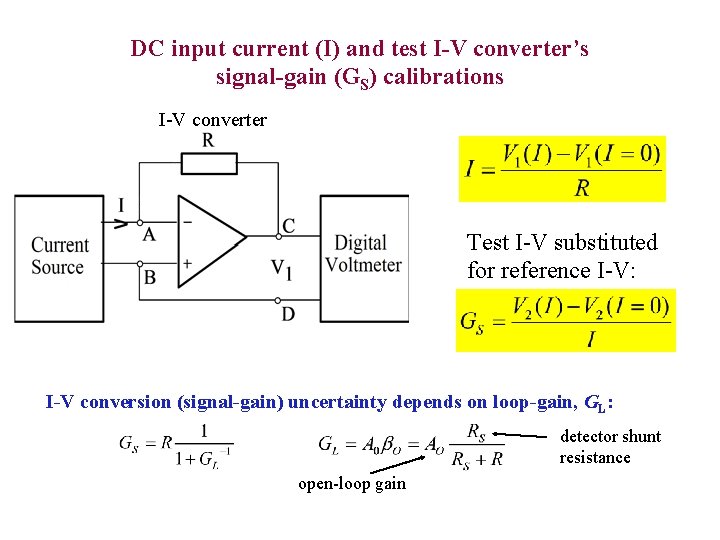
DC input current (I) and test I-V converter’s signal-gain (GS) calibrations I-V converter Test I-V substituted for reference I-V: I-V conversion (signal-gain) uncertainty depends on loop-gain, GL: detector shunt resistance open-loop gain
![Difference: Keithely from ADS and SDX sn 1000 [%] Comparison of DC current measurements](http://slidetodoc.com/presentation_image_h2/6af85bd9496d2c7ed4f81da5cb6b2789/image-9.jpg "Difference: Keithely from ADS and SDX sn 1000 [%] Comparison of DC current measurements")
Difference: Keithely from ADS and SDX sn 1000 [%] Comparison of DC current measurements Keithley 6430 Measured Current Difference from Calibrated Current 1, 000 0, 100 0, 010 40 ppm 0, 001 0, 000 4 5 6 7 8 9 Set Current Range (10^-x) [A] Difference: Keithely from ADS Cal [%] Difference: Keithely from. SDX sn 1000 [%] Keithley Current rel exp uncert (k=2) [%] ADS_IV_1 Current rel exp uncert (k=2) [%] SDX sn 1000 Current rel exp uncert (k=2) [%] The expanded uncertainties (k = 2) of commercial low level current measurements of 0. 15 % could be reduced by a factor of 10 to 100 by utilizing the NIST converter design and calibration method.
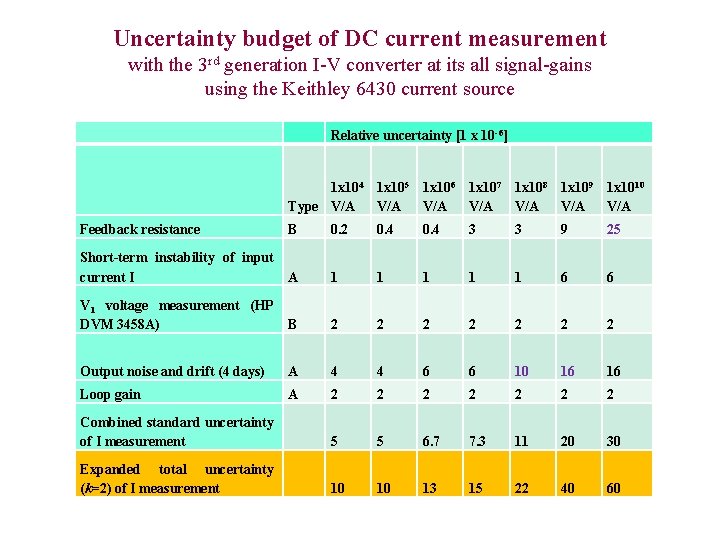
Uncertainty budget of DC current measurement with the 3 rd generation I-V converter at its all signal-gains using the Keithley 6430 current source Relative uncertainty [1 x 10 -6] 1 x 10⁴ 1 x 10⁵ 1 x 10⁶ 1 x 10⁷ 1 x 10⁸ 1 x 10⁹ 1 x 10¹⁰ Type V/A V/A Feedback resistance B 0. 2 0. 4 3 3 9 25 Short-term instability of input current I A 1 1 1 6 6 V 1 voltage measurement (HP DVM 3458 A) B 2 2 2 2 Output noise and drift (4 days) A 4 4 6 6 10 16 16 Loop gain A 2 2 2 2 Combined standard uncertainty of I measurement 5 5 6. 7 7. 3 11 20 30 Expanded total uncertainty (k=2) of I measurement 10 10 13 15 22 40 60
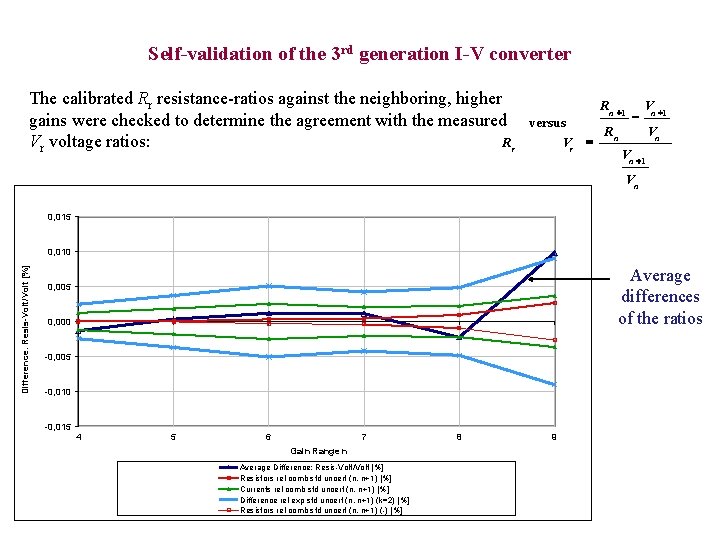
Self-validation of the 3 rd generation I-V converter The calibrated Rr resistance-ratios against the neighboring, higher gains were checked to determine the agreement with the measured Rr Vr voltage ratios: R n +1 versus Vr = - Vn +1 Rn Vn Vn +1 Vn 0, 015 Difference: Resis-Volt/Volt [%] 0, 010 Average differences of the ratios 0, 005 0, 000 -0, 005 -0, 010 -0, 015 4 5 6 7 Gain Range n Average Difference: Resis-Volt/Volt [%] Resistors rel comb std uncert (n, n+1) [%] Currents rel comb std uncert (n, n+1) [%] Difference rel exp std uncert (n, n+1) (k=2) [%] Resistors rel comb std uncert (n, n+1) (-) [%] 8 9
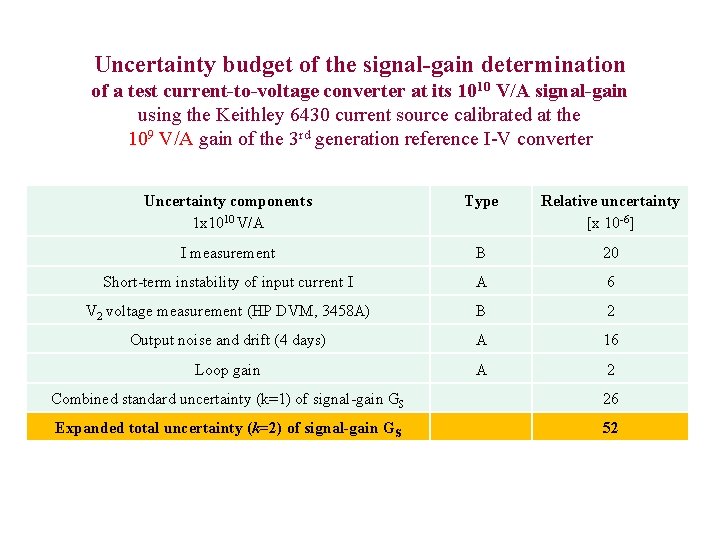
Uncertainty budget of the signal-gain determination of a test current-to-voltage converter at its 1010 V/A signal-gain using the Keithley 6430 current source calibrated at the 109 V/A gain of the 3 rd generation reference I-V converter Uncertainty components 1 x 10¹⁰ V/A Type Relative uncertainty [x 10 -6] I measurement B 20 Short-term instability of input current I A 6 V 2 voltage measurement (HP DVM, 3458 A) B 2 Output noise and drift (4 days) A 16 Loop gain A 2 Combined standard uncertainty (k=1) of signal-gain GS 26 Expanded total uncertainty (k=2) of signal-gain GS 52
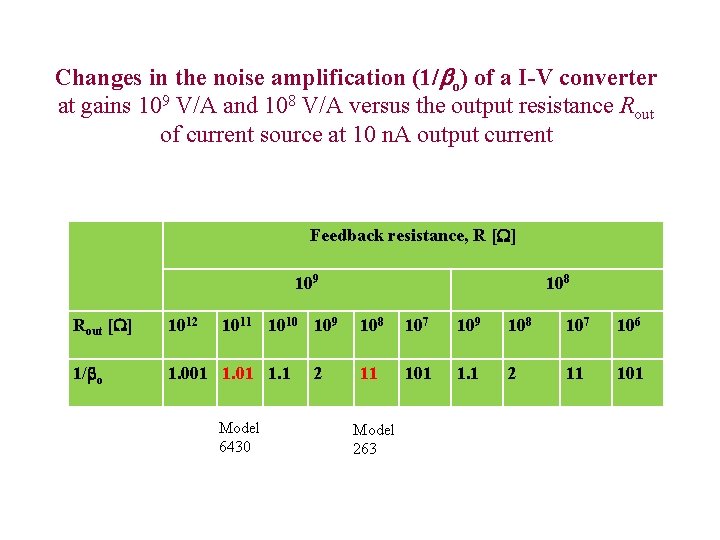
Changes in the noise amplification (1/bo) of a I-V converter at gains 109 V/A and 108 V/A versus the output resistance Rout of current source at 10 n. A output current Feedback resistance, R [W] 109 Rout [W] 1012 1011 1010 109 1/bo 1. 001 1. 1 Model 6430 2 108 107 109 108 107 106 11 101 1. 1 2 11 101 Model 263
Conclusions NIST electrical standard (resistor) based sub-scale was realized to perform low uncertainty detector output current measurements • by developing reference I-V converters and • introducing in-situ feedback resistor calibration method Traveling calibrated I-source can be used for gain-calibrations of test I-V converters.
- Slides: 14