
NIRS applications in sport science Skeletal muscle oxygenation
- Slides: 12
NIRS applications in sport science Skeletal muscle oxygenation during isometric and dynamic exercises Paiziev A. A. Institute of Ion-Plasma and Laser Technologies Uzbek Academy of Science
Introduction To maximize training for wrestling competition, coaches and wrestlers are interested in improving the physiologic capacities that are most important for successful performance. One of most important performance parameters are oxygen consumption (m. VO 2) and maximal aerobic power (VO 2 max) upper and lower body muscles of wrestlers. To measure VO 2 max need to use an incremental treadmill running protocol and gas exchange of CO 2 and O 2 on systemic level. But accepted methods to measure systemic aerobic power can not to reveal separate skeletal muscles performances of upper and lower body on local level. In the present work we are offering tissue oximetry (Oxy. Prem) to measure hemodynamic parameters of skeletal muscles (O 2 Hb, HHb, t. Hb, St. O 2, VO 2, reoxygenation rate) in rest and exercise.
What is the NIRS and for what it used • NIRS- Near Infrared Spectroscopy (NIRS) is one of biophotonic techniques which can be used to monitor oxygenation and haemodynamics in a variety of human tissues, including skeletal muscle. • New elaborated NIRS device is - Oxy. Prem, which specifically designed for non-invasive measurement of localized tissue oxy- and deoxyhaemoglobin concentration ([O 2 Hb], [HHb]) and tissue oxygenation (St. O 2) by means of near-infrared spectroscopy.
State of the art of SM investigation by NIRS technology • In last 8 years published about 400 papers devoted NIRS applications in sport science. • So far, only about 20 of human body skeletal muscles investigated by NIRS (general number of skeletal muscles -600). • Mainly most of papers devoted hemodynamic changing and oxygenation of separate SM in upper and lowest extremities in local area of skin in rest and under exercise. • Limited number of papers devoted to measurements of hemodynamic response of brain to moving stimuli. • There are two kind of exercise stimuli: dynamic stimuli (muscle contraction) and isometric stimuli (static loading). There is not researches, devoted brain response on to muscle dynamic and isometric stimuli.
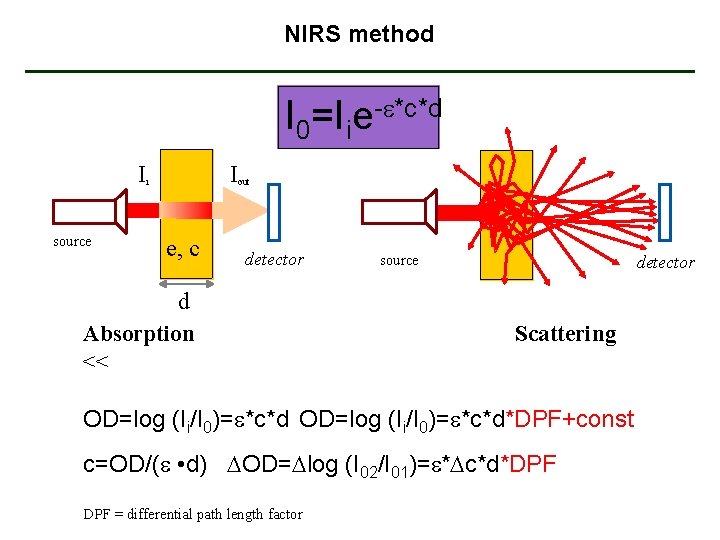
NIRS method I 0=Iie-e*c*d I source I i e, c out detector d Absorption << source detector Scattering OD=log (Ii/I 0)=e*c*d*DPF+const c=OD/(e • d) DOD=Dlog (I 02/I 01)=e*Dc*d*DPF = differential path length factor
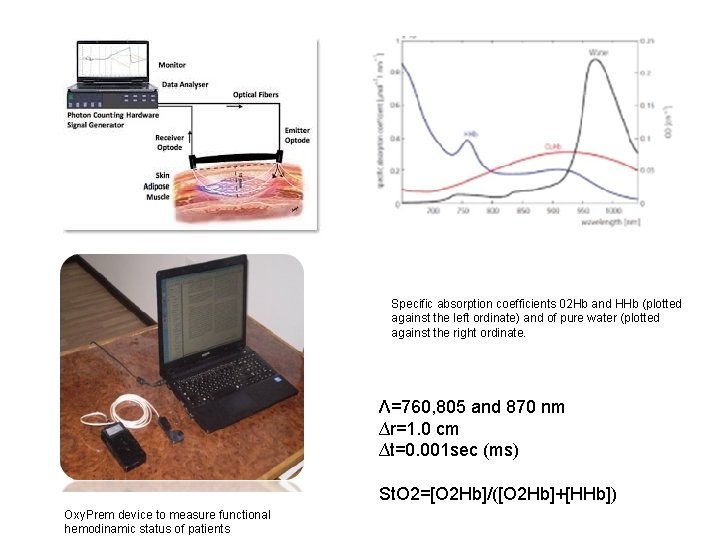
Specific absorption coefficients 02 Hb and HHb (plotted against the left ordinate) and of pure water (plotted against the right ordinate. Λ=760, 805 and 870 nm ∆r=1. 0 cm ∆t=0. 001 sec (ms) St. O 2=[O 2 Hb]/([O 2 Hb]+[HHb]) Oxy. Prem device to measure functional hemodinamic status of patients
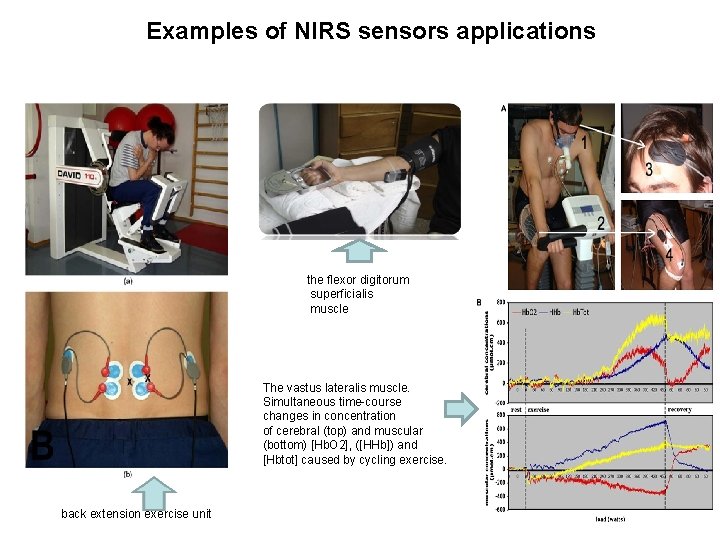
Examples of NIRS sensors applications the flexor digitorum superficialis muscle The vastus lateralis muscle. Simultaneous time-course changes in concentration of cerebral (top) and muscular (bottom) [Hb. O 2], ([HHb]) and [Hbtot] caused by cycling exercise. back extension exercise unit
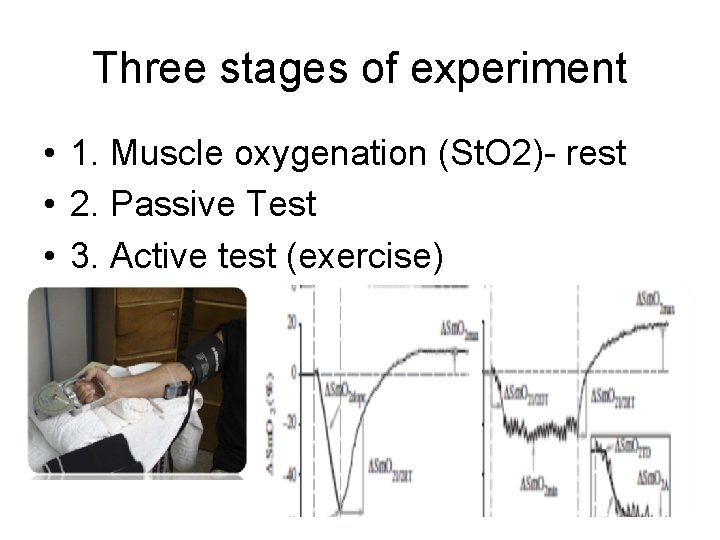
Three stages of experiment • 1. Muscle oxygenation (St. O 2)- rest • 2. Passive Test • 3. Active test (exercise)
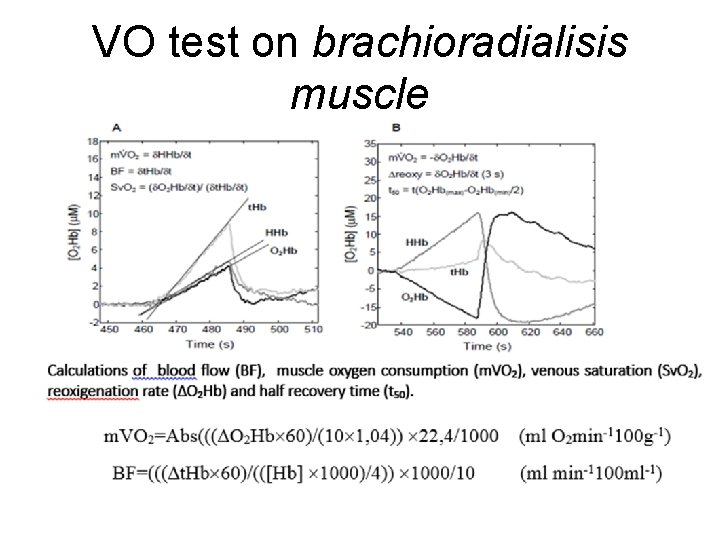
VO test on brachioradialisis muscle
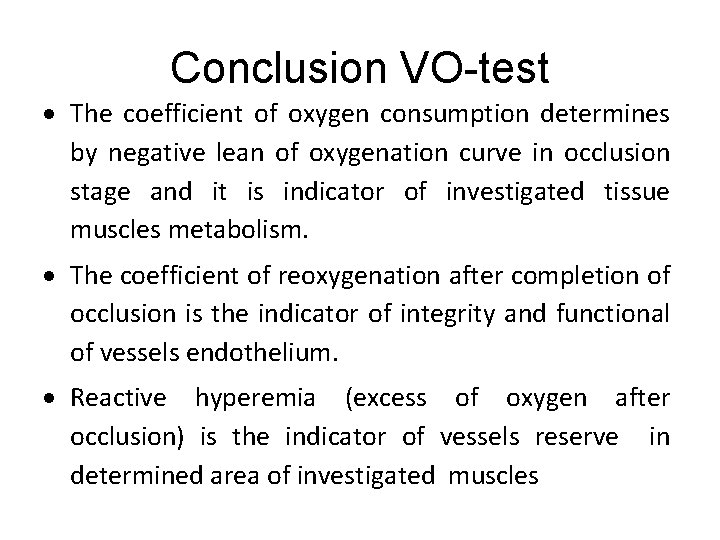
Conclusion VO-test The coefficient of oxygen consumption determines by negative lean of oxygenation curve in occlusion stage and it is indicator of investigated tissue muscles metabolism. The coefficient of reoxygenation after completion of occlusion is the indicator of integrity and functional of vessels endothelium. Reactive hyperemia (excess of oxygen after occlusion) is the indicator of vessels reserve in determined area of investigated muscles
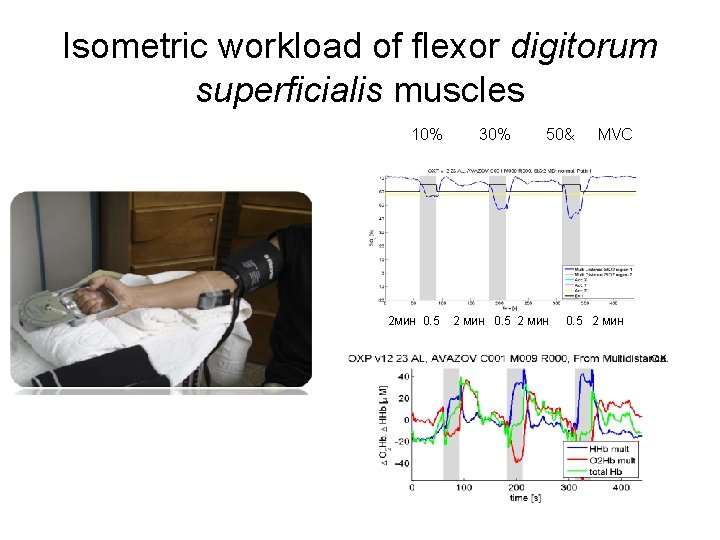
Isometric workload of flexor digitorum superficialis muscles 10% 2 мин 0. 5 30% 50& 2 мин 0. 5 2 мин MVC 0. 5 2 мин
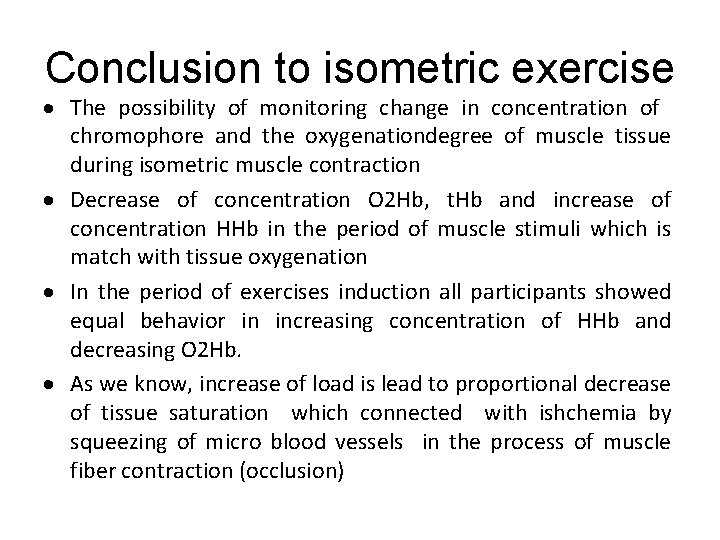
Сonclusion to isometric exercise The possibility of monitoring change in concentration of chromophore and the oxygenationdegree of muscle tissue during isometric muscle contraction Decrease of concentration O 2 Hb, t. Hb and increase of concentration HHb in the period of muscle stimuli which is match with tissue oxygenation In the period of exercises induction all participants showed equal behavior in increasing concentration of HHb and decreasing O 2 Hb. As we know, increase of load is lead to proportional decrease of tissue saturation which connected with ishchemia by squeezing of micro blood vessels in the process of muscle fiber contraction (occlusion)