
NIR OFFAXIS ICOS SPECTRUM OF THE NITRATE RADICAL
- Slides: 18
NIR OFF-AXIS ICOS SPECTRUM OF THE NITRATE RADICAL: DOES THE VIBRATIONLESS Ã2 E STATE OF NO 3 UNDERGO STATIC JAHN-TELLER DISTORTION? David J. Robichaud Kana Takematsu and Mitchio Okumura California Institute of Technology Pin Chen and Herbert Pickett John F. Stanton Jet Propulsion Laboratory, California Institute of Technology University of Texas *WJ 10
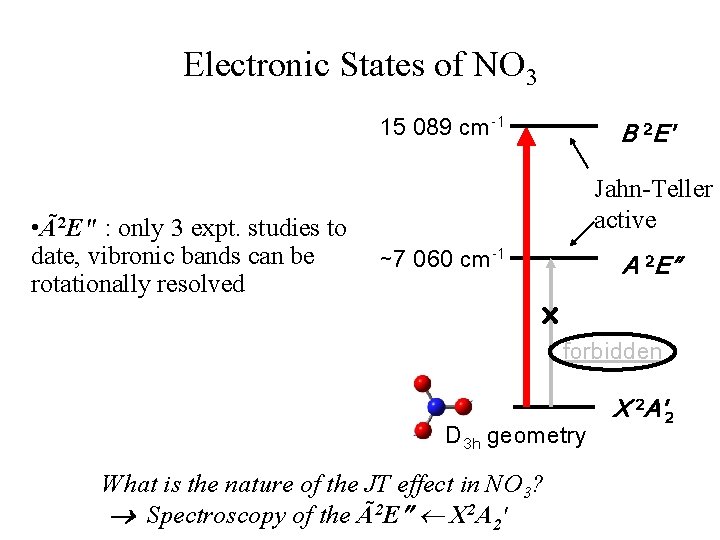
Electronic States of NO 3 • B 2 E : well studied; spectrum is 15 089 cm-1 broadened by vibronic interactions • Ã2 E″ : only 3 expt. studies to date, vibronic bands can be rotationally resolved • X 2 A 2 : only recently confirmed D 3 h geometry; uncertainty in the fundamental assignments B 2 E' Jahn-Teller active ~7 060 cm-1 A 2 E″ forbidden D 3 h geometry What is the nature of the JT effect in NO 3? Spectroscopy of the Ã2 E X 2 A 2′ X 2 A'2
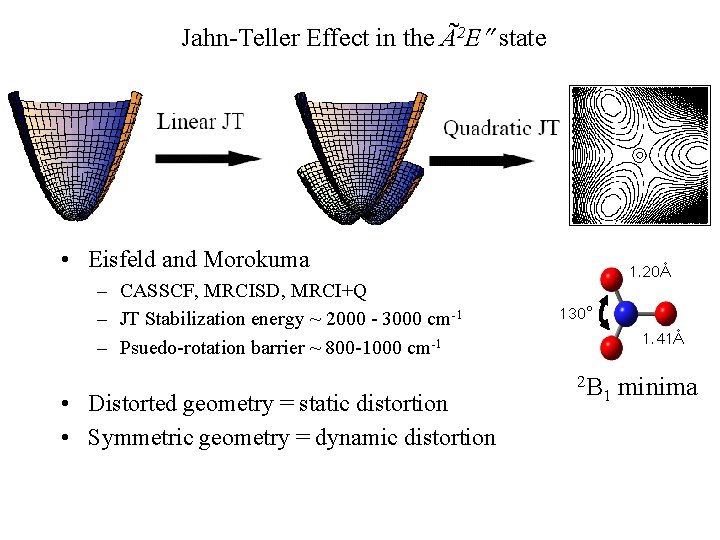
Jahn-Teller Effect in the Ã2 E state • Eisfeld and Morokuma – CASSCF, MRCISD, MRCI+Q – JT Stabilization energy ~ 2000 - 3000 cm-1 – Psuedo-rotation barrier ~ 800 -1000 cm-1 • Distorted geometry = static distortion • Symmetric geometry = dynamic distortion 1. 20Å 130° 1. 41Å 2 B 1 minima
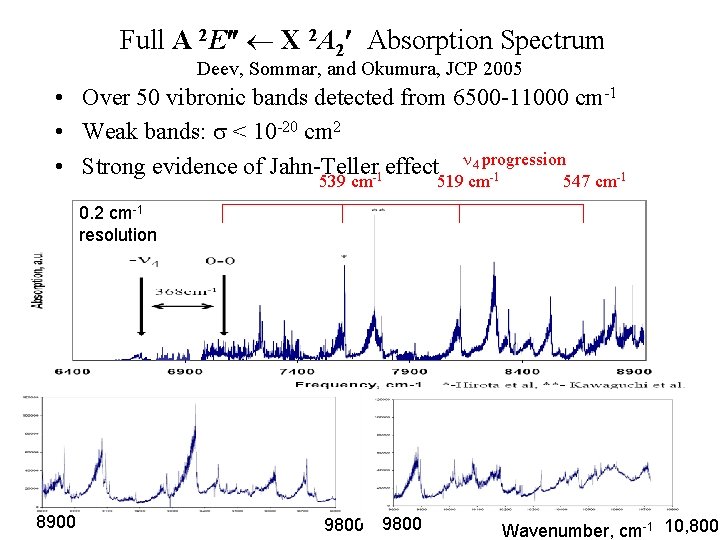
Full A 2 E X 2 A 2 Absorption Spectrum Deev, Sommar, and Okumura, JCP 2005 • Over 50 vibronic bands detected from 6500 -11000 cm-1 • Weak bands: < 10 -20 cm 2 • Strong evidence of Jahn-Teller-1 effect 4 progression -1 -1 539 cm 519 cm 547 cm 0. 2 cm-1 resolution 8900 9800 Wavenumber, cm-1 10, 800
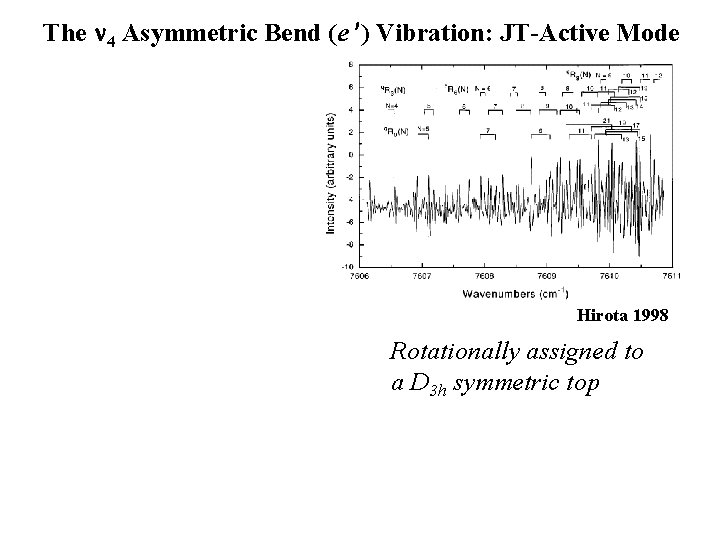
The 4 Asymmetric Bend (e ) Vibration: JT-Active Mode Hirota 1998 Rotationally assigned to a D 3 h symmetric top
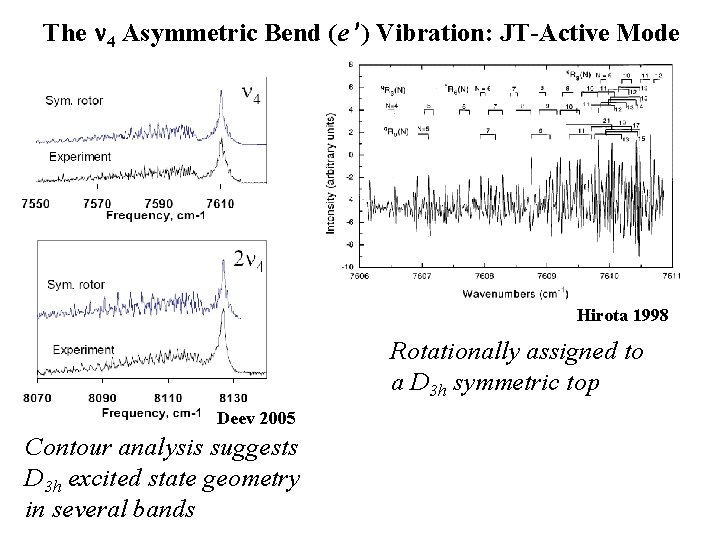
The 4 Asymmetric Bend (e ) Vibration: JT-Active Mode Hirota 1998 Rotationally assigned to a D 3 h symmetric top Deev 2005 Contour analysis suggests D 3 h excited state geometry in several bands
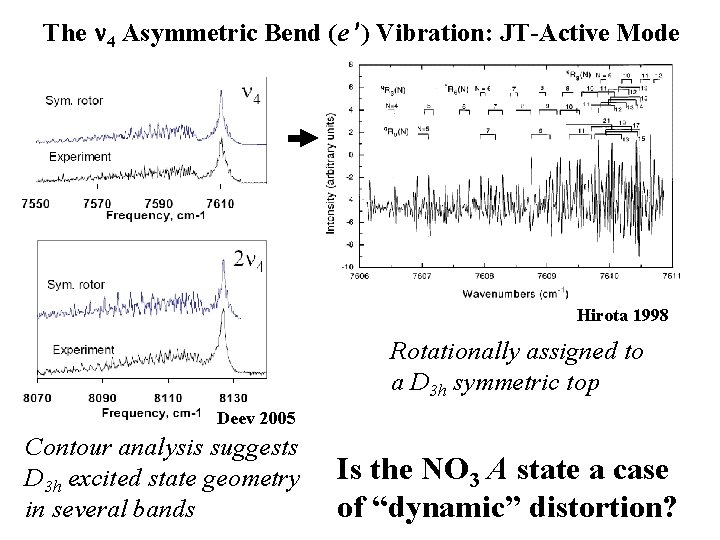
The 4 Asymmetric Bend (e ) Vibration: JT-Active Mode Hirota 1998 Rotationally assigned to a D 3 h symmetric top Deev 2005 Contour analysis suggests D 3 h excited state geometry in several bands Is the NO 3 A state a case of “dynamic” distortion?
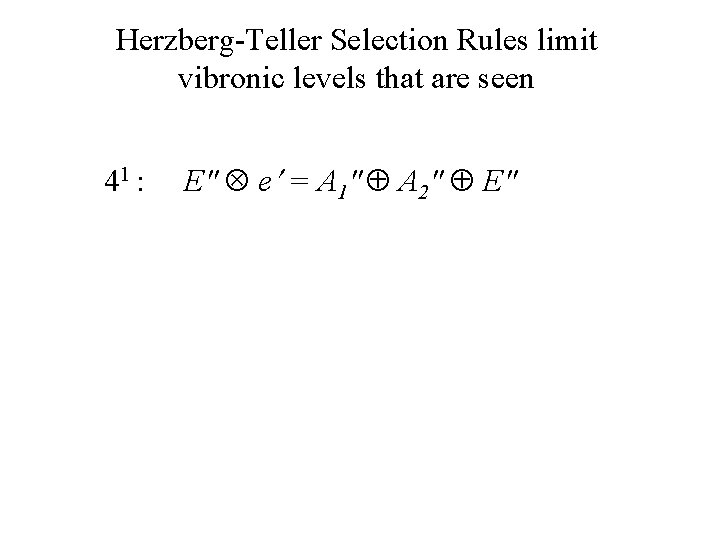
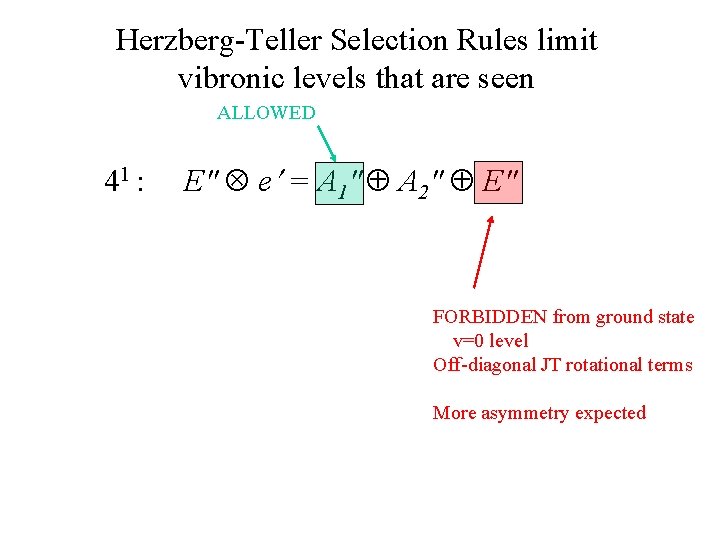
Herzberg-Teller Selection Rules limit vibronic levels that are seen 41 : E″ e = A 1″ A 2″ E″
Herzberg-Teller Selection Rules limit vibronic levels that are seen ALLOWED 41 : E″ e = A 1″ A 2″ E″ FORBIDDEN from ground state v=0 level Off-diagonal JT rotational terms More asymmetry expected
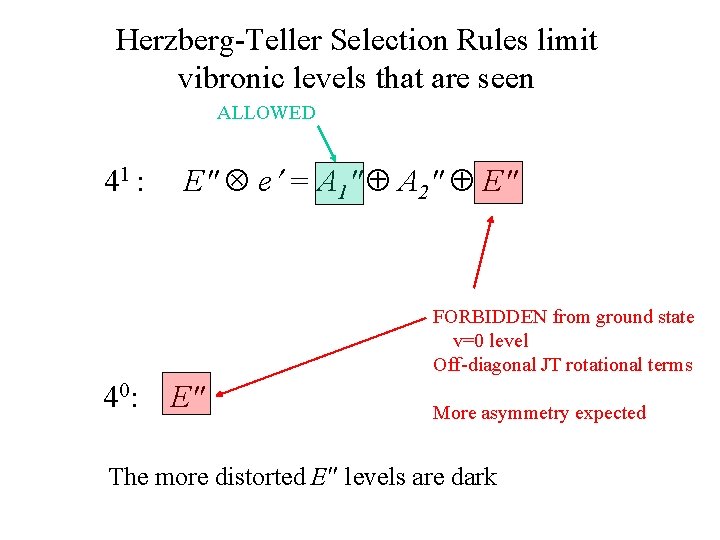
Herzberg-Teller Selection Rules limit vibronic levels that are seen ALLOWED 41 : E″ e = A 1″ A 2″ E″ FORBIDDEN from ground state v=0 level Off-diagonal JT rotational terms 40: E″ More asymmetry expected The more distorted E levels are dark
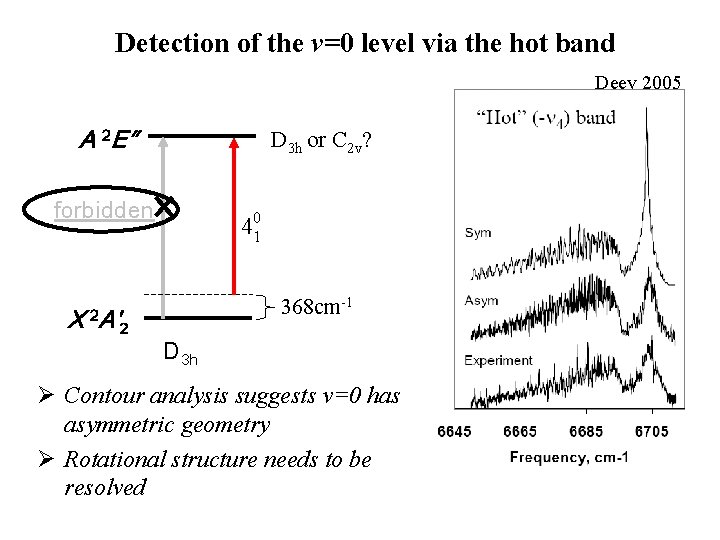
Detection of the v=0 level via the hot band Deev 2005 A 2 E″ D 3 h or C 2 v? forbidden X 2 A'2 401 368 cm-1 D 3 h Ø Contour analysis suggests v=0 has asymmetric geometry Ø Rotational structure needs to be resolved
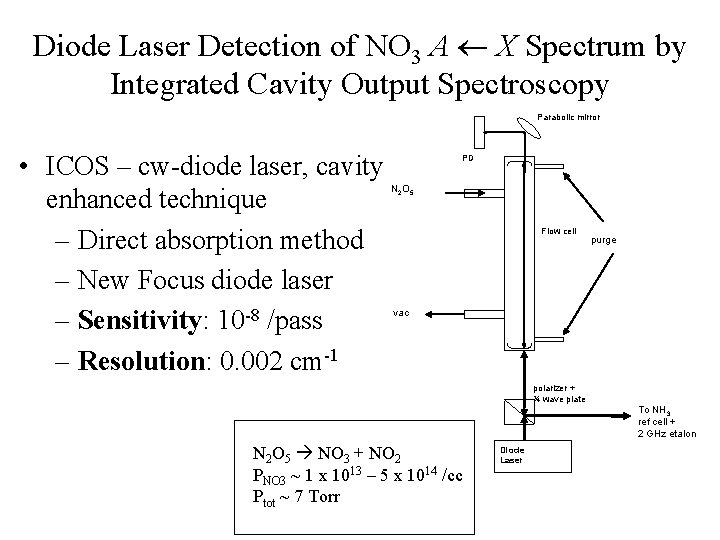
Diode Laser Detection of NO 3 A X Spectrum by Integrated Cavity Output Spectroscopy Parabolic mirror • ICOS – cw-diode laser, cavity enhanced technique – Direct absorption method – New Focus diode laser – Sensitivity: 10 -8 /pass – Resolution: 0. 002 cm-1 PD N 2 O 5 Flow cell purge vac polarizer + ¼ wave plate To NH 3 ref cell + 2 GHz etalon N 2 O 5 NO 3 + NO 2 PNO 3 ~ 1 x 10¹³ – 5 x 10¹⁴ /cc Ptot ~ 7 Torr Diode Laser
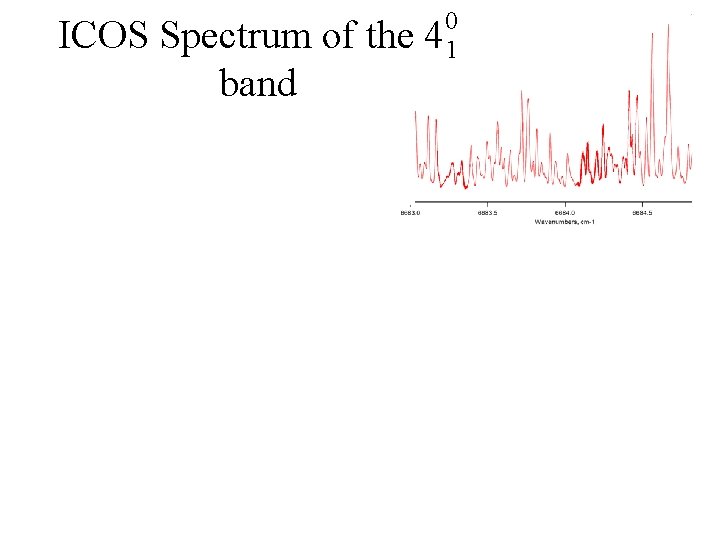
ICOS Spectrum of the band 0 41
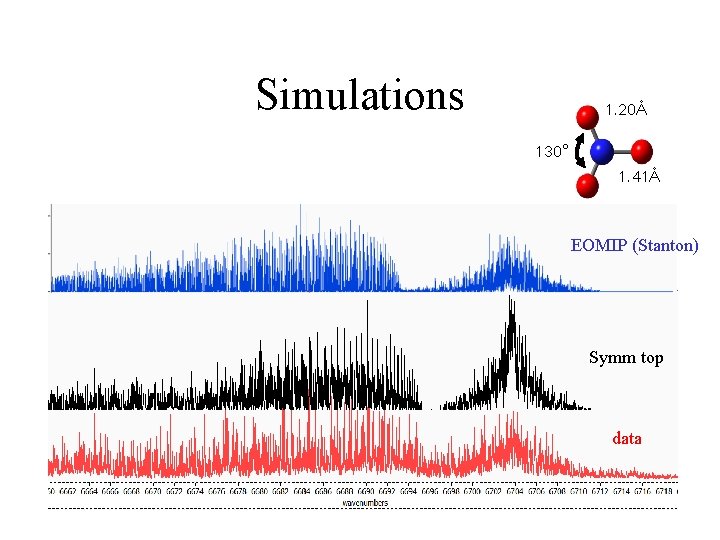
Simulations 1. 20Å 130° 1. 41Å EOMIP (Stanton) Symm top data
Preliminary Observations on 0 41 Band • Evidence that symmetry is broken in v=0 level: – High density of lines compared to previous v 4 spectrum of Hirota et al (1998) assigned to D 3 h upper state – Contour analysis inconsistent with D 3 h geometry in upper level • Complications – Lower 41 state (368 cm-1) has not been rotationally resolved; Coriolis coupling, PJT effects present – Hot band spectra recorded at higher temperatures have better S/N but are much more congested
Future Work • Rotational analysis of the spectrum using SPFIT – Program is general enough to allow for fitting of spectra to a Jahn-Teller Hamiltonian of arbitrary order – Hindered Rotor basis set is more appropriate for intermediate level of coupling than free rotor or D 3 h • Comparison with ab initio EOMIP calculations – Stanton (UT Austin) – Adiabatic surface and nonadiabatic couplings
Thanks • • Prof. Jaron Hansen (BYU) Okumura Group JPL Spectroscopy Group P. Chelin, N. Ibrahim, C. Fellows, J. Orphal (CNRS-LISA) • $$$ NASA & UARP **Reminder, check out Stanton Talk Tomorrow WJ 10**
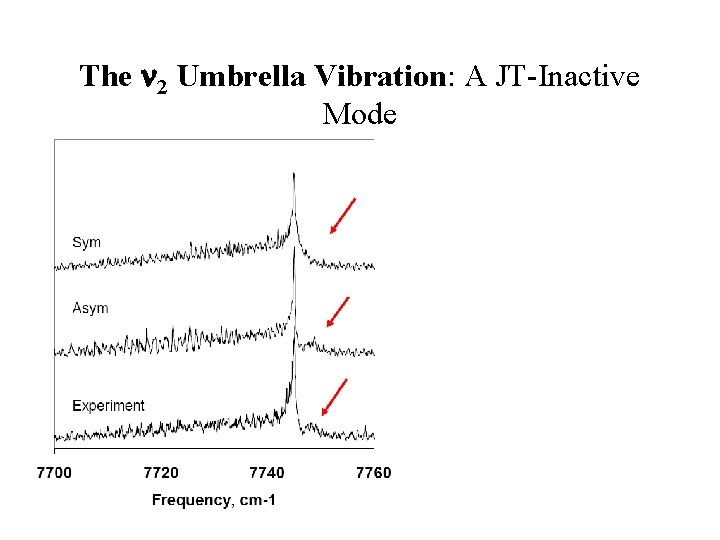
The 2 Umbrella Vibration: A JT-Inactive Mode