
Nip it in the bud Becoming a proactive
Nip it in the bud: Becoming a proactive and reflective classroom manager Dr. Allen Guidry East Carolina University
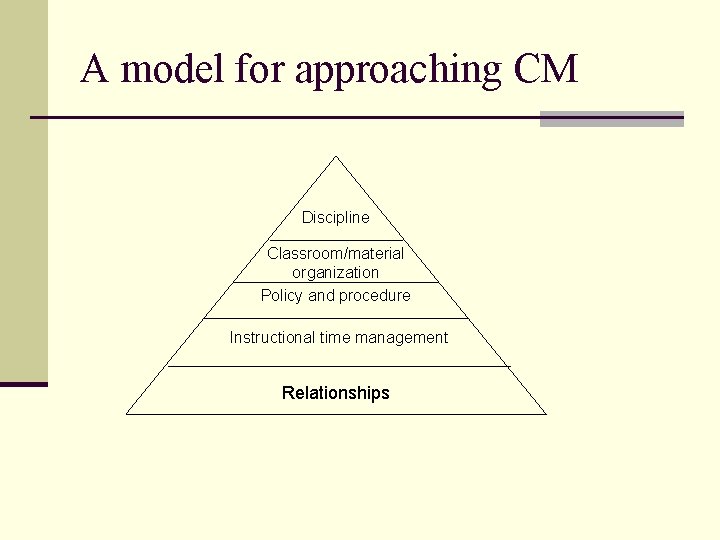
A model for approaching CM Discipline Classroom/material organization Policy and procedure Instructional time management Relationships
The basic principle of effective classroom management n The best way to deal with a classroom management problem is to not have a classroom management problem in the first place
What we must remember… n You are the only person you can control in that classroom n Remember this when diagnosing and prescribing interventions for classroom management problems.
Management of instructional time n Classroom management begins with a well- planned, engaging lesson n High time on task requires three elements: n Preventing misbehavior n n Managing movement n n Withitness and overlapping of activities (teaching and handling admin matters) Momentum and smoothness in lesson Maintaining group focus n Group alerting and encouraging accountability
Management of instructional time (cont. ) n Most problems occur when (1) there is a “lull” in the lesson and (2) when transitions occur n So what does that mean for you as you diagnose classroom management problems?
Kounin’s principles of group management n Preventing misbehavior n Withitness n Overlapping n Managing movement n Momentum n Smoothness n Maintaining group focus n Group alerting n Encouraging accountability n Higher participation formats
Common problems (momentum and smoothness) n Dangle – topics left to do or talk about something else n Flip-flop – coming back to topic left from dangle n Thrust – intrusion on activity with some (often irrelevant) information n Stimulus bound – teacher distracted from outside stimulus and attention drawn from lesson
How should I teach? n Jones says that classroom management problems start with two problems: Massive time wasting n Misbehavior during independent practice n n Many teachers teach like this: Teacher input, teacher input, independent practice n The remedy – “Say, see, do” teaching n I teach my new teachers “My time, our time, their time” with a strong focus on “our time”
Policy and procedure can save the day! n Wong says to focus on the very first seconds of the very first day of school – set the stage for the rest of the term n This focus should be on teaching policy and procedure n Start the first and every subsequent day with an assignment on the board (same place, same way every day) n Teach them the procedure (Explain, model, rehearse, rehearse) n Remember, if you have procedures, you limit the need for rules
The two most basic procedures… n Some sort of “bell-ringer” n Whole-class prompt
What if I haven’t used procedure effectively n Identify the area of instruction that most needs procedure n Design a step-by-step procedure for that task n Teach the procedure to students n n n Explain it to students Model it with students Rehearse it with students Reinforce it with students n Go to your next procedure
Some additional basic proactive strategies n Meet them at the door n Keep them engaged (teach from “bell to bell”) n Plan more than you intend to teach n Use your eyes Train yourself to see both inappropriate and appropriate action (this will help us get a feel for behavior – this helps us ID action that stands out) n Catch them being good n Check to make sure you have set the child up for success (physical arrangement; developmentally appropriate material) n
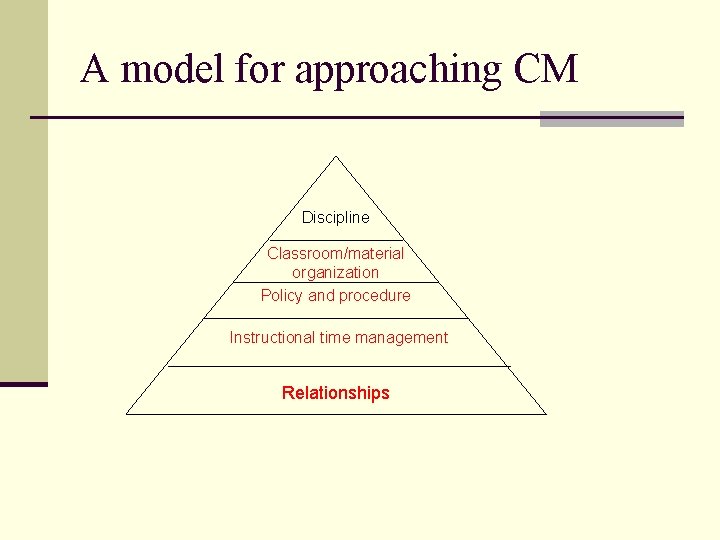
A model for approaching CM Discipline Classroom/material organization Policy and procedure Instructional time management Relationships
Some people to look for n B. F. Skinner - behaviorism n Jacob Kounin - momentum and smoothness n Fred Jones – positive discipline n Harry Wong – procedure n Rudolph Dreikurs – identify goals of misbehavior n Linda Albert – cooperative discipline n Lee Canter – assertive discipline
- Slides: 15