
NIOSH Occupational Exposure Banding Decision Logic Lauralynn Taylor
NIOSH Occupational Exposure Banding Decision Logic Lauralynn Taylor Mc. Kernan, Sc. D. , CIH National Institute for Occupational Safety and Health Centers for Disease Control and Prevention 1

NIOSH Occupational Exposure Banding Team Charles Barton, Ph. D. , DABT Steve Gilbert, M. S. George Holdsworth, Ph. D. T. J. Lentz, Ph. D. Eileen Kuempel, Ph. D. Andy Maier, Ph. D. , CIH, DABT Lauralynn Taylor Mc. Kernan, Sc. D, CIH Melissa Seaton, M. S. Christine Whittaker, Ph. D. Christine Uebel, B. S. Donna Heidel, M. S. , CIH (formerly NIOSH)

The findings and conclusions in this presentation have not been formally disseminated by the National Institute for Occupational Safety and Health and should not be construed to represent any agency determination or policy

Overview Background Value of Occupational Exposure Bands (OEB) NIOSH framework and decision logic OEB Tier 1 process OEB Tier 1 Validation process Case studies OEB Tier 2 process Tier 2 Examples Next Steps

Question: What are some challenges of our profession? Do we always have the OELs we need?

Chemicals in Commerce New Occupational Exposure Limits • Approximately 1, 000 chemicals with authoritative OELs • NIOSH RELs • OSHA PELs • California PELs • TLVs • WEELs • MAKs
How do we handle all the new chemicals? Mechanism to quickly and accurately assign chemicals into “categories” or “bands” based on their health outcomes and potency considerations, is needed Occupational Exposure Bands (OEBs) 7
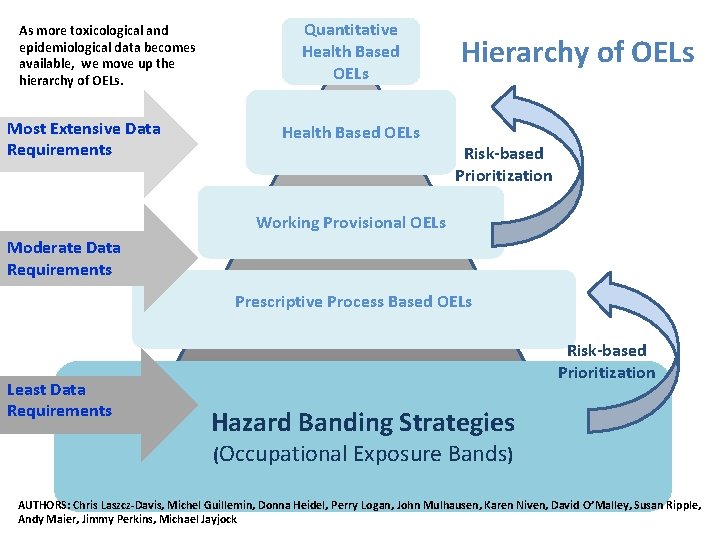
As more toxicological and epidemiological data becomes available, we move up the hierarchy of OELs. Most Extensive Data Requirements Quantitative Health Based OELs Hierarchy of OELs Risk-based Prioritization Working Provisional OELs Moderate Data Requirements Prescriptive Process Based OELs Least Data Requirements Risk-based Prioritization Hazard Banding Strategies (Occupational Exposure Bands) AUTHORS: Chris Laszcz-Davis, Michel Guillemin, Donna Heidel, Perry Logan, John Mulhausen, Karen Niven, David O’Malley, Susan Ripple, Andy Maier, Jimmy Perkins, Michael Jayjock
OEB value NIOSH Facilitates more rapid evaluation of health risk Used with minimal data Highlights areas where data are missing Supports the definition of OELranges for families of materials Provides a screening tool for the development of RELs Stakeholders Provides guidance for materials without OELs Identifies hazards to be evaluated for elimination or substitution Aligned with GHS for hazard communication Facilitates the application of Prevention through Design principles
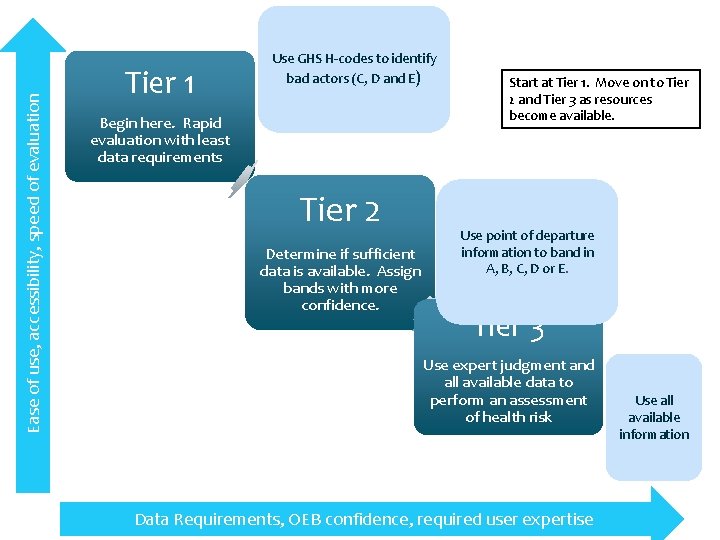
Ease of use, accessibility, speed of evaluation Tier 1 Use GHS H-codes to identify bad actors (C, D and E) Begin here. Rapid evaluation with least data requirements Tier 2 Determine if sufficient data is available. Assign bands with more confidence. Start at Tier 1. Move on to Tier 2 and Tier 3 as resources become available. Use point of departure information to band in A, B, C, D or E. Tier 3 Use expert judgment and all available data to perform an assessment of health risk Data Requirements, OEB confidence, required user expertise Use all available information
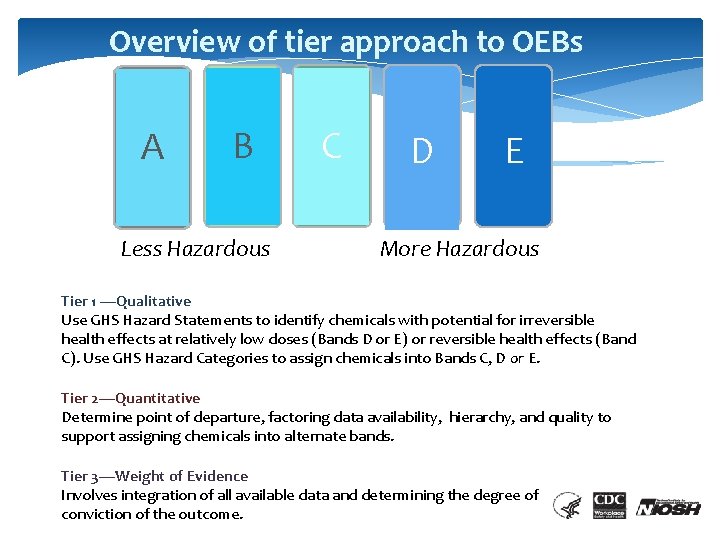
Overview of tier approach to OEBs A B Less Hazardous C D E More Hazardous Tier 1 —Qualitative Use GHS Hazard Statements to identify chemicals with potential for irreversible health effects at relatively low doses (Bands D or E) or reversible health effects (Band C). Use GHS Hazard Categories to assign chemicals into Bands C, D or E. Tier 2—Quantitative Determine point of departure, factoring data availability, hierarchy, and quality to support assigning chemicals into alternate bands. Tier 3—Weight of Evidence Involves integration of all available data and determining the degree of conviction of the outcome.

Health Hazards/ Endpoints Hazard Class Acute Toxicity Hazard Category 1 2 3 4 1 A 1 B 1 C 2 Serious Eye Damage/ Eye Irritation 1 2 A 2 B Respiratory or Skin Sensitization 1 Skin Corrosion/Irritation Germ Cell Mutagenicity 1 A 1 B 2 Carcinogenicity 1 A 1 B 2 Reproductive Toxicity 1 A 1 B 2 1 2 Specific Target Organ Toxicity (STOT) – Repeated Exposure * Slide courtesy of OSHA Lactation 13
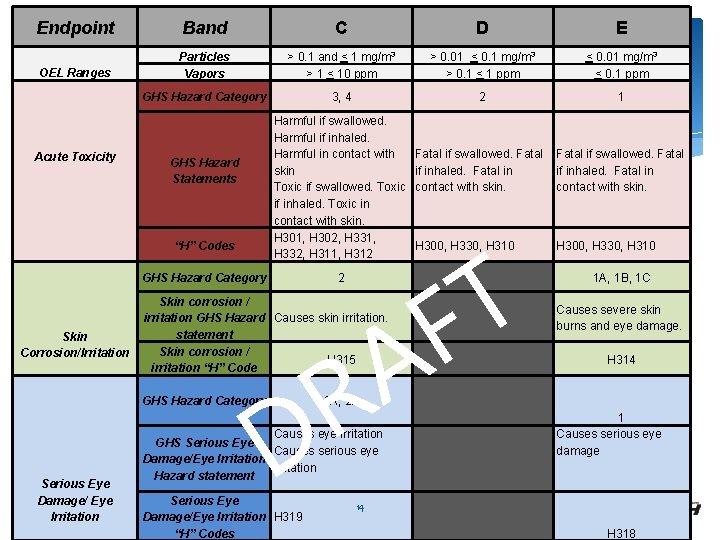
Endpoint Band C OEL Ranges Acute Toxicity Particles Vapors GHS Hazard Category GHS Hazard Statements “H” Codes GHS Hazard Category Skin Corrosion/Irritation Serious Eye Damage/ Eye Irritation D E > 0. 1 and < 1 mg/m 3 > 1 < 10 ppm > 0. 01 < 0. 1 mg/m 3 > 0. 1 < 1 ppm < 0. 01 mg/m 3 < 0. 1 ppm 3, 4 2 1 Harmful if swallowed. Harmful if inhaled. Harmful in contact with skin Toxic if swallowed. Toxic if inhaled. Toxic in contact with skin. H 301, H 302, H 331, H 332, H 311, H 312 R D 2 A, 2 B H 300, H 330, H 310 T F A 2 Skin corrosion / irritation GHS Hazard Causes skin irritation. statement Skin corrosion / H 315 irritation “H” Code GHS Hazard Category Fatal if swallowed. Fatal if inhaled. Fatal in contact with skin. Causes eye irritation GHS Serious Eye Causes serious eye Damage/Eye Irritation irritation Hazard statement Serious Eye 14 Damage/Eye Irritation H 319 “H” Codes H 300, H 330, H 310 1 A, 1 B, 1 C Causes severe skin burns and eye damage. H 314 1 Causes serious eye damage H 318
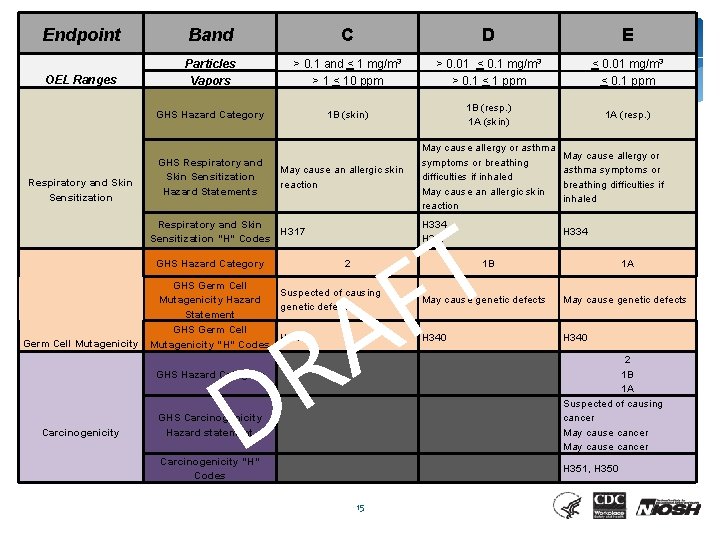
Endpoint Band C D E OEL Ranges Particles Vapors > 0. 1 and < 1 mg/m 3 > 1 < 10 ppm > 0. 01 < 0. 1 mg/m 3 > 0. 1 < 1 ppm < 0. 01 mg/m 3 < 0. 1 ppm GHS Hazard Category 1 B (skin) 1 B (resp. ) 1 A (skin) 1 A (resp. ) Respiratory and Skin Sensitization GHS Respiratory and Skin Sensitization Hazard Statements May cause an allergic skin reaction Respiratory and Skin H 317 Sensitization “H” Codes Germ Cell Mutagenicity Carcinogenicity GHS Hazard Category A R D Carcinogenicity “H” Codes May cause allergy or asthma symptoms or breathing difficulties if inhaled H 334 1 B GHS Germ Cell Suspected of causing Mutagenicity Hazard genetic defects Statement GHS Germ Cell H 341 Mutagenicity “H” Codes GHS Carcinogenicity Hazard statement T F H 334 H 317 2 GHS Hazard Category May cause allergy or asthma symptoms or breathing difficulties if inhaled May cause an allergic skin reaction May cause genetic defects H 340 15 1 A 2 1 B 1 A Suspected of causing cancer May cause cancer H 351, H 350
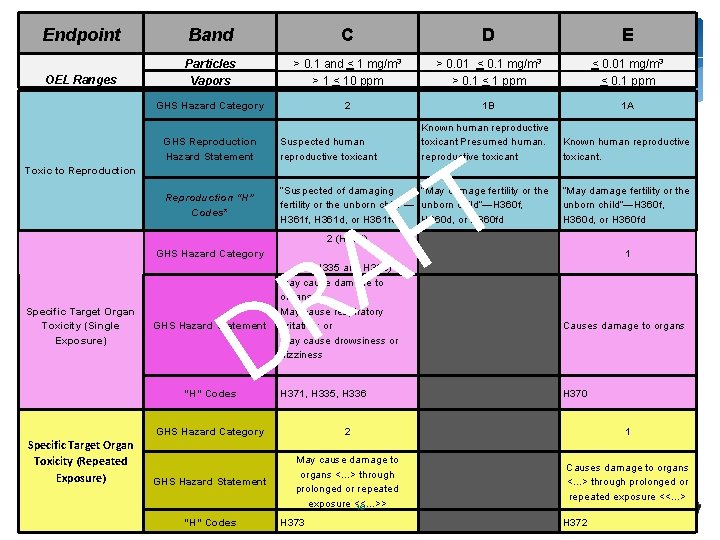
Endpoint Band C D E OEL Ranges Particles Vapors > 0. 1 and < 1 mg/m 3 > 1 < 10 ppm > 0. 01 < 0. 1 mg/m 3 > 0. 1 < 1 ppm < 0. 01 mg/m 3 < 0. 1 ppm GHS Hazard Category 2 1 B 1 A GHS Reproduction Hazard Statement Suspected human reproductive toxicant Known human reproductive toxicant Presumed human. reproductive toxicant Known human reproductive toxicant. Reproduction “H” Codes* “Suspected of damaging “May damage fertility or the unborn child”—H 360 f, H 361 f, H 361 d, or H 361 fd H 360 d, or H 360 fd “May damage fertility or the unborn child”—H 360 f, H 360 d, or H 360 fd Toxic to Reproduction Specific Target Organ Toxicity (Single Exposure) GHS Hazard Statement “H” Codes Specific Target Organ Toxicity (Repeated Exposure) A R D GHS Hazard Category 2 (H 371) 3 (H 335 and H 336) May cause damage to organs May cause respiratory irritation; or May cause drowsiness or dizziness H 371, H 335, H 336 GHS Hazard Category 2 GHS Hazard Statement May cause damage to organs <. . . > through prolonged or repeated exposure <<. . . >> 16 “H” Codes H 373 T F 1 Causes damage to organs H 370 1 Causes damage to organs <. . . > through prolonged or repeated exposure <<. . . > H 372
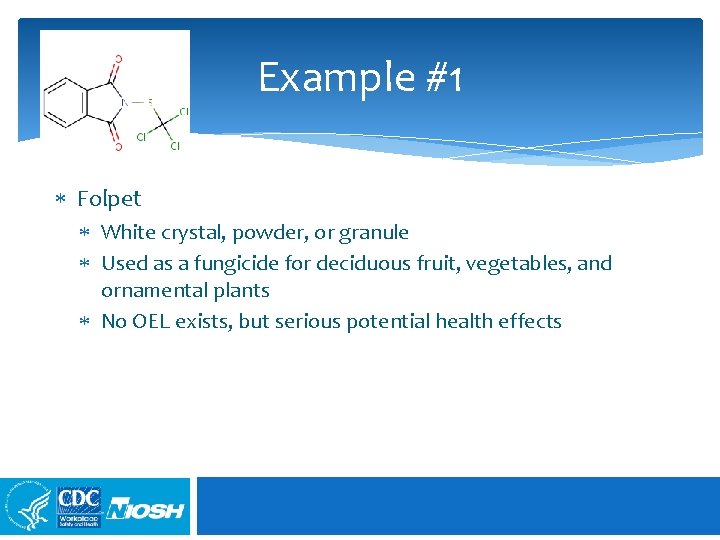
Example #1 Folpet White crystal, powder, or granule Used as a fungicide for deciduous fruit, vegetables, and ornamental plants No OEL exists, but serious potential health effects 17
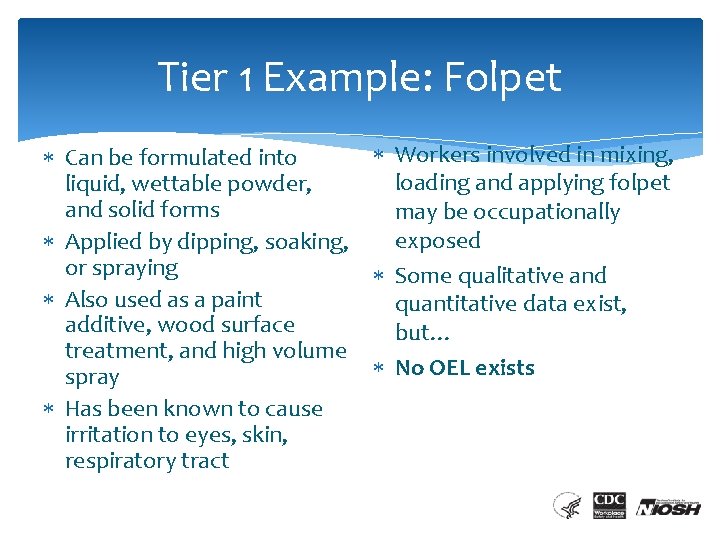
Tier 1 Example: Folpet Workers involved in mixing, Can be formulated into loading and applying folpet liquid, wettable powder, and solid forms may be occupationally exposed Applied by dipping, soaking, or spraying Some qualitative and Also used as a paint quantitative data exist, additive, wood surface but… treatment, and high volume No OEL exists spray Has been known to cause irritation to eyes, skin, respiratory tract

Examples of Data SDS
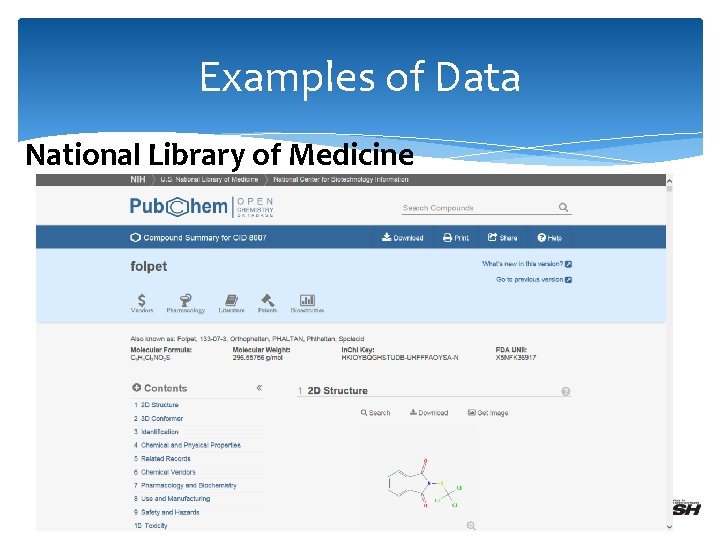
Examples of Data National Library of Medicine
Reliable sources for Tier 1 GESTIS www. dguv. de/ifa/gestis-database ECHA Annex VI to CLP
Does Tier 1 process solve everything? • No. • But it does provide a quick and easy look at the chemical using a few information sources 22
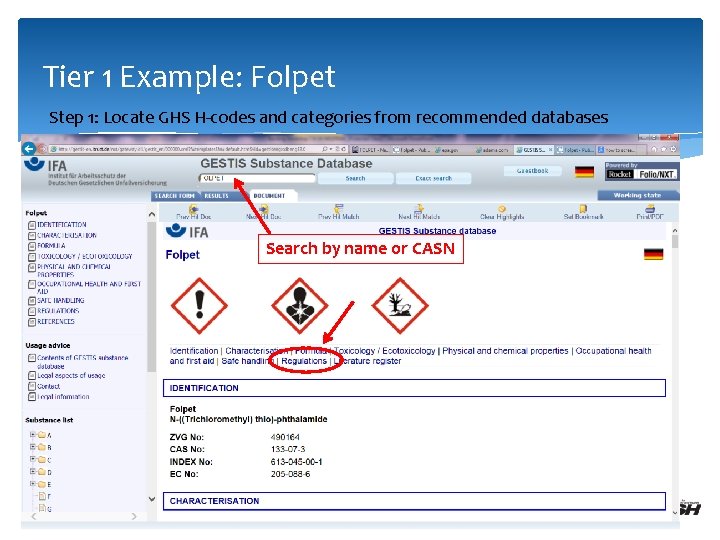
Tier 1 Example: Folpet Step 1: Locate GHS H-codes and categories from recommended databases Search by name or CASN
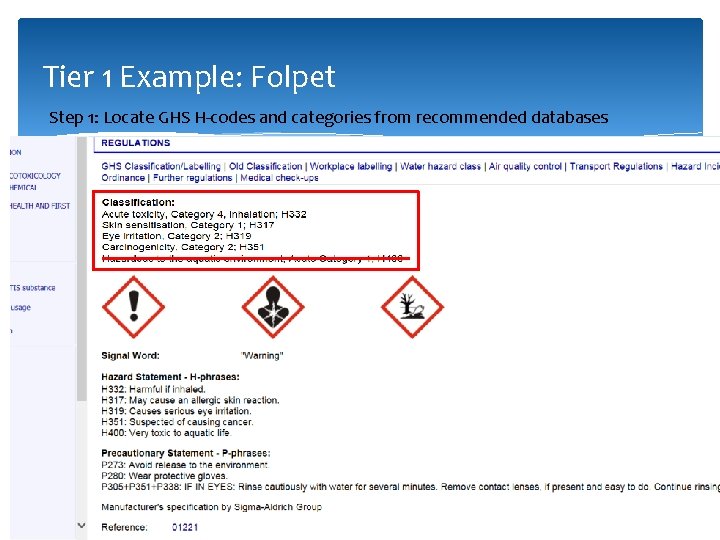
Tier 1 Example: Folpet Step 1: Locate GHS H-codes and categories from recommended databases
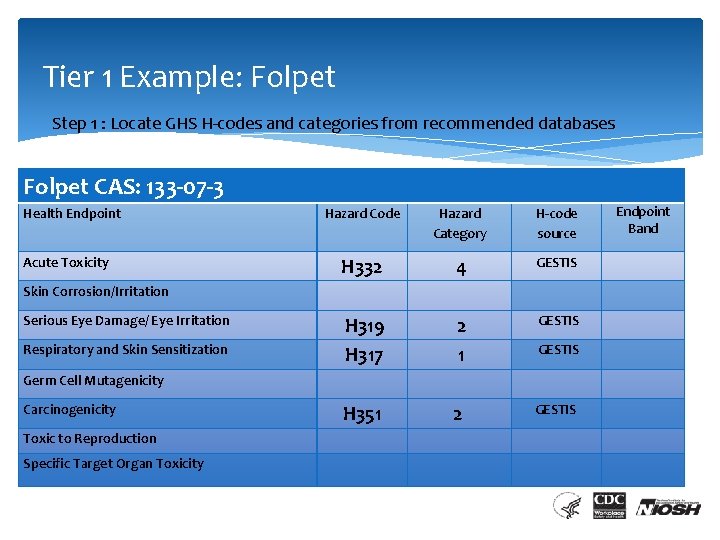
Tier 1 Example: Folpet Step 1 : Locate GHS H-codes and categories from recommended databases Folpet CAS: 133 -07 -3 Health Endpoint Hazard Code Hazard Category H-code source H 332 H 319 H 317 4 2 1 GESTIS H 351 2 Acute Toxicity Skin Corrosion/Irritation Serious Eye Damage/ Eye Irritation Respiratory and Skin Sensitization Germ Cell Mutagenicity Carcinogenicity Endpoint Band GESTIS Toxic to Reproduction Specific Target Organ Toxicity
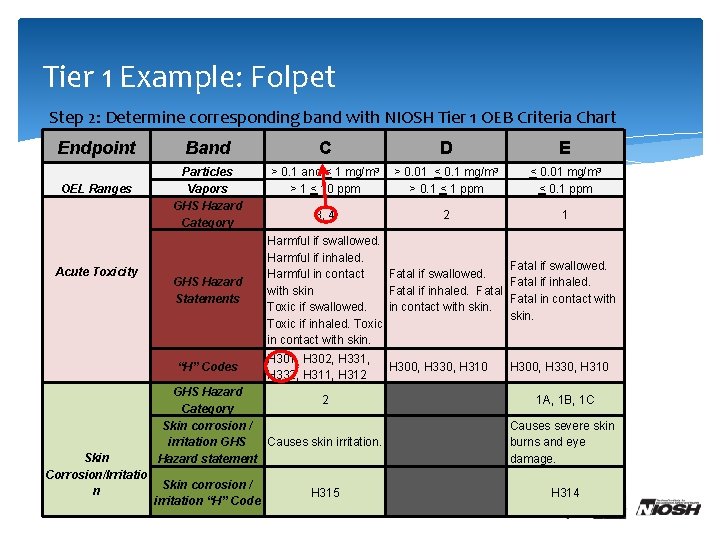
Tier 1 Example: Folpet Step 2: Determine corresponding band with NIOSH Tier 1 OEB Criteria Chart Endpoint Band C D E OEL Ranges Acute Toxicity Particles Vapors GHS Hazard Category > 0. 1 and < 1 mg/m 3 > 1 < 10 ppm > 0. 01 < 0. 1 mg/m 3 > 0. 1 < 1 ppm < 0. 01 mg/m 3 < 0. 1 ppm 3, 4 2 1 GHS Hazard Statements “H” Codes Skin Corrosion/Irritatio n Harmful if swallowed. Harmful if inhaled. Fatal if swallowed. Harmful in contact Fatal if inhaled. with skin Fatal if inhaled. Fatal in contact with Toxic if swallowed. in contact with skin. Toxic if inhaled. Toxic in contact with skin. H 301, H 302, H 331, H 332, H 311, H 312 H 300, H 330, H 310 GHS Hazard 2 Category Skin corrosion / irritation GHS Causes skin irritation. Hazard statement Skin corrosion / irritation “H” Code H 315 H 300, H 330, H 310 1 A, 1 B, 1 C Causes severe skin burns and eye damage. H 314
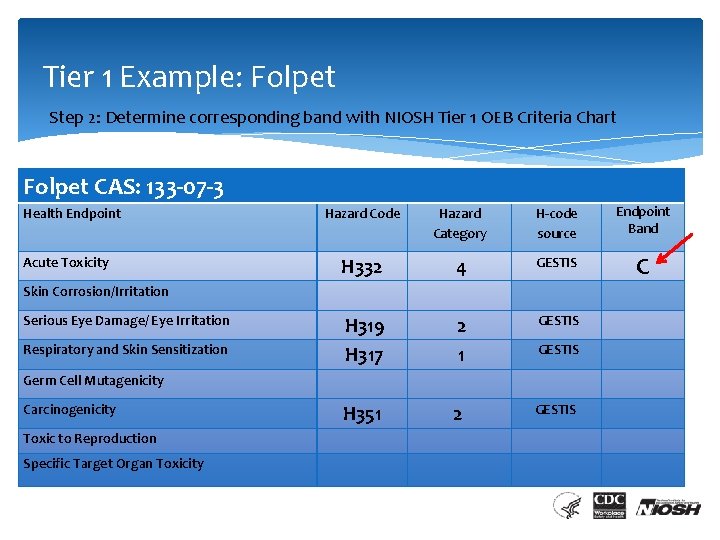
Tier 1 Example: Folpet Step 2: Determine corresponding band with NIOSH Tier 1 OEB Criteria Chart Folpet CAS: 133 -07 -3 Health Endpoint Hazard Code Hazard Category H-code source Endpoint Band H 332 H 319 H 317 4 2 1 GESTIS C H 351 2 Acute Toxicity Skin Corrosion/Irritation Serious Eye Damage/ Eye Irritation Respiratory and Skin Sensitization Germ Cell Mutagenicity Carcinogenicity GESTIS Toxic to Reproduction Specific Target Organ Toxicity
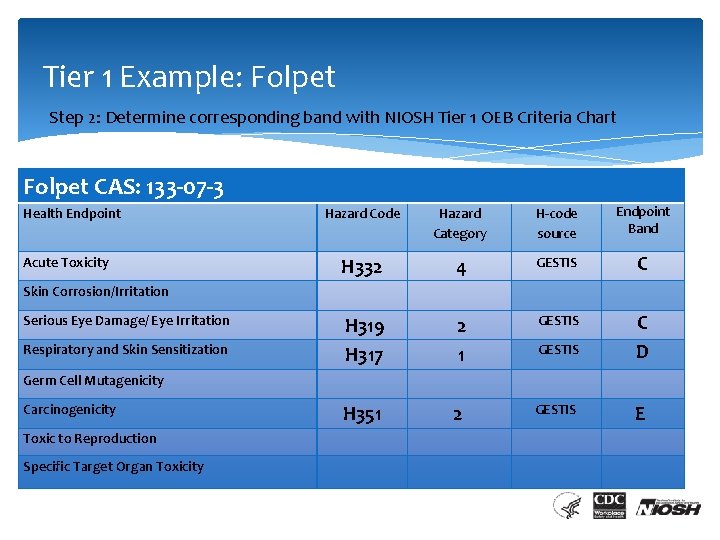
Tier 1 Example: Folpet Step 2: Determine corresponding band with NIOSH Tier 1 OEB Criteria Chart Folpet CAS: 133 -07 -3 Health Endpoint Hazard Code Hazard Category H-code source Endpoint Band H 332 H 319 H 317 4 2 1 GESTIS C D H 351 2 Acute Toxicity Skin Corrosion/Irritation Serious Eye Damage/ Eye Irritation Respiratory and Skin Sensitization Germ Cell Mutagenicity Carcinogenicity GESTIS E GESTIS Toxic to Reproduction Specific Target Organ Toxicity
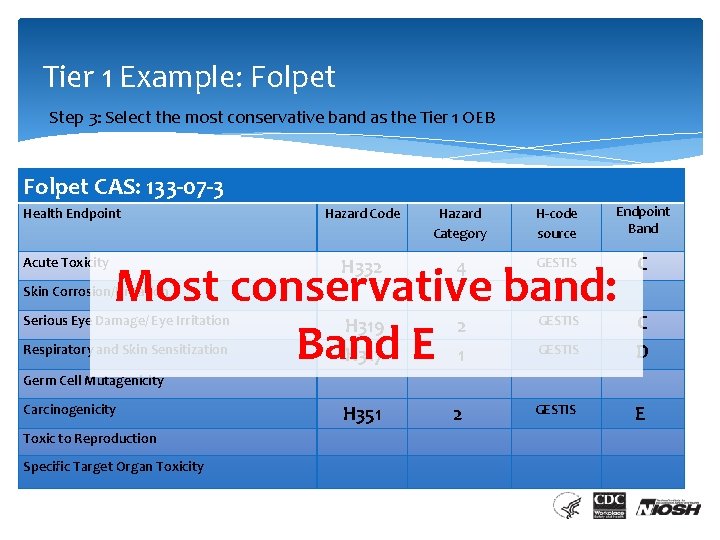
Tier 1 Example: Folpet Step 3: Select the most conservative band as the Tier 1 OEB Folpet CAS: 133 -07 -3 Health Endpoint Acute Toxicity Hazard Code Hazard Category H-code source Endpoint Band H 332 H 319 H 317 4 2 1 GESTIS C D H 351 2 Most conservative band: Band E Skin Corrosion/Irritation Serious Eye Damage/ Eye Irritation Respiratory and Skin Sensitization Germ Cell Mutagenicity Carcinogenicity GESTIS E GESTIS Toxic to Reproduction Specific Target Organ Toxicity
Based upon the Tier 1 banding process, the chemical should be in Band E Tier 2 could be completed.
Banding Chemicals in Tier 2
Tier 2 - Semi-Quantitative Skilled industrial hygienist Based on readily available secondary data from authoritative sources (government, professional health agencies, authoritative toxicological benchmarks) Needs sufficient data to generate reliable OEB Prescriptive analytical strategy to ensure consistency Potential for chemicals to moved from the Tier 1 OEB to a more or less protective OEB 32
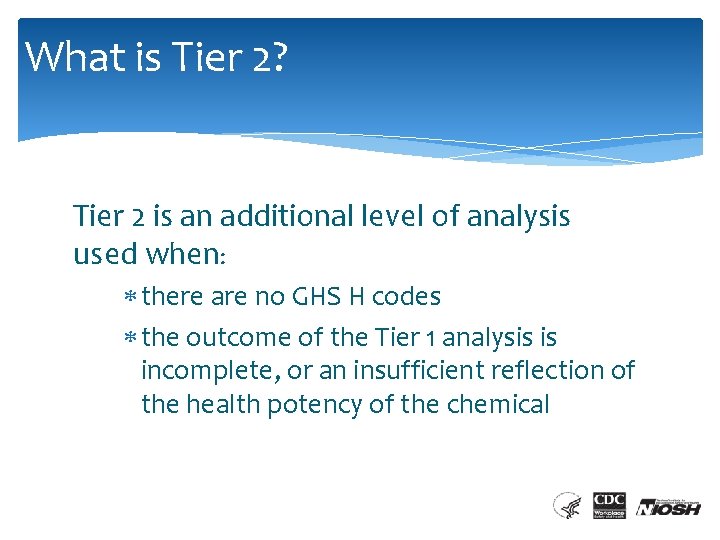
What is Tier 2? Tier 2 is an additional level of analysis used when: there are no GHS H codes the outcome of the Tier 1 analysis is incomplete, or an insufficient reflection of the health potency of the chemical
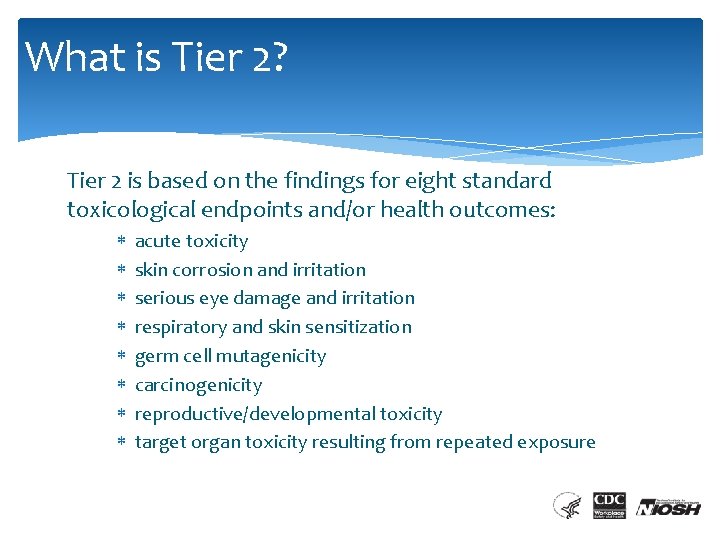
What is Tier 2? Tier 2 is based on the findings for eight standard toxicological endpoints and/or health outcomes: acute toxicity skin corrosion and irritation serious eye damage and irritation respiratory and skin sensitization germ cell mutagenicity carcinogenicity reproductive/developmental toxicity target organ toxicity resulting from repeated exposure
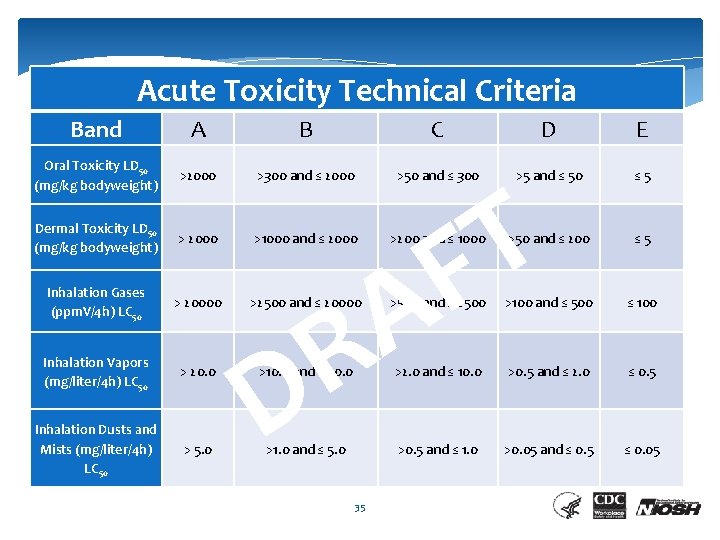
Acute Toxicity Technical Criteria Band A B C D E Oral Toxicity LD 50 (mg/kg bodyweight) >2000 >300 and ≤ 2000 >50 and ≤ 300 >5 and ≤ 50 ≤ 5 Dermal Toxicity LD 50 (mg/kg bodyweight) > 2000 >1000 and ≤ 2000 >200 and ≤ 1000 >50 and ≤ 200 ≤ 5 Inhalation Gases (ppm. V/4 h) LC 50 > 20000 >2500 and ≤ 20000 >500 and ≤ 2500 >100 and ≤ 500 ≤ 100 Inhalation Vapors (mg/liter/4 h) LC 50 > 20. 0 >10. 0 and ≤ 20. 0 >2. 0 and ≤ 10. 0 >0. 5 and ≤ 2. 0 ≤ 0. 5 Inhalation Dusts and Mists (mg/liter/4 h) LC 50 > 5. 0 >1. 0 and ≤ 5. 0 >0. 5 and ≤ 1. 0 >0. 05 and ≤ 0. 5 ≤ 0. 05 T F A R D 35
What is Tier 2? Some of the endpoints draw on categorical health outcomes (mild, moderate, severe) Others are based on quantitative toxicity information and/or potency data (LD 50 s, LC 50 s, NOAELs)
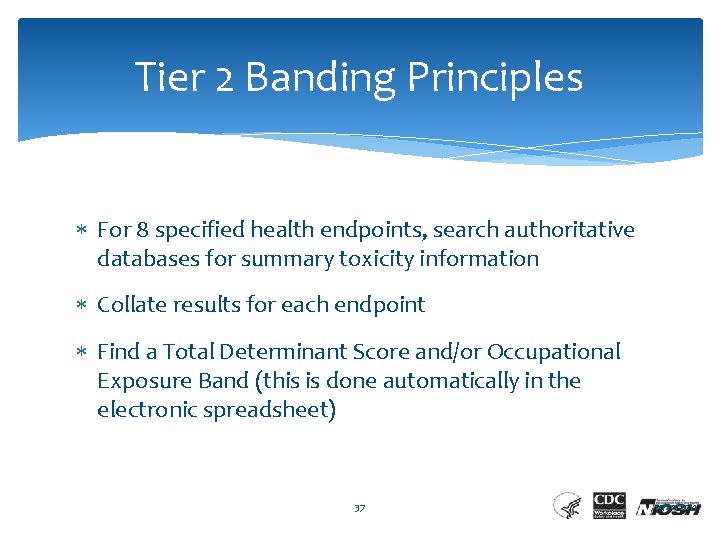
Tier 2 Banding Principles For 8 specified health endpoints, search authoritative databases for summary toxicity information Collate results for each endpoint Find a Total Determinant Score and/or Occupational Exposure Band (this is done automatically in the electronic spreadsheet) 37 10/20/2014
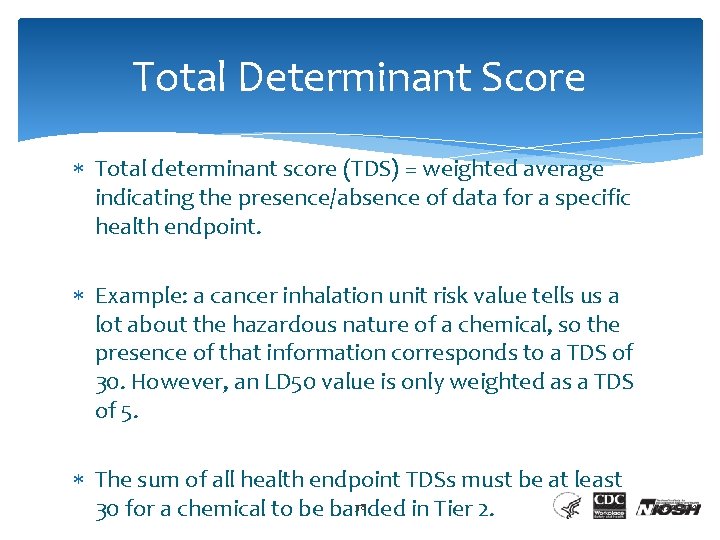
Total Determinant Score Total determinant score (TDS) = weighted average indicating the presence/absence of data for a specific health endpoint. Example: a cancer inhalation unit risk value tells us a lot about the hazardous nature of a chemical, so the presence of that information corresponds to a TDS of 30. However, an LD 50 value is only weighted as a TDS of 5. The sum of all health endpoint TDSs must be at least 38 30 for a chemical to be banded in Tier 2. 10/20/2014
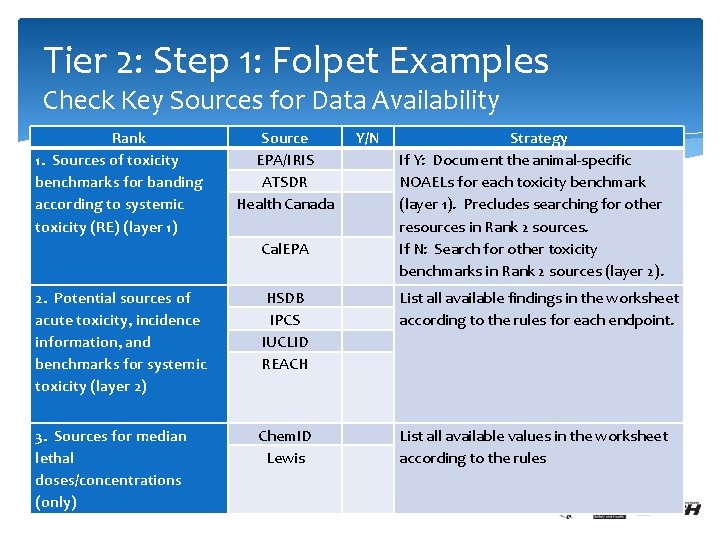
Tier 2: Step 1: Folpet Examples Check Key Sources for Data Availability Rank 1. Sources of toxicity benchmarks for banding according to systemic toxicity (RE) (layer 1) Source EPA/IRIS ATSDR Health Canada Y/N Strategy If Y: Document the animal-specific NOAELs for each toxicity benchmark (layer 1). Precludes searching for other resources in Rank 2 sources. If N: Search for other toxicity benchmarks in Rank 2 sources (layer 2). Cal. EPA 2. Potential sources of acute toxicity, incidence information, and benchmarks for systemic toxicity (layer 2) HSDB IPCS IUCLID REACH List all available findings in the worksheet according to the rules for each endpoint. 3. Sources for median lethal doses/concentrations (only) Chem. ID Lewis List all available values in the worksheet according to the rules
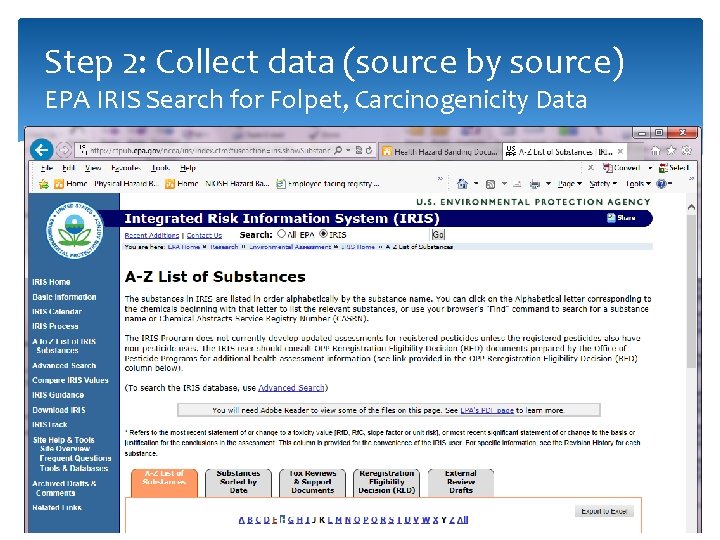
Step 2: Collect data (source by source) EPA IRIS Search for Folpet, Carcinogenicity Data
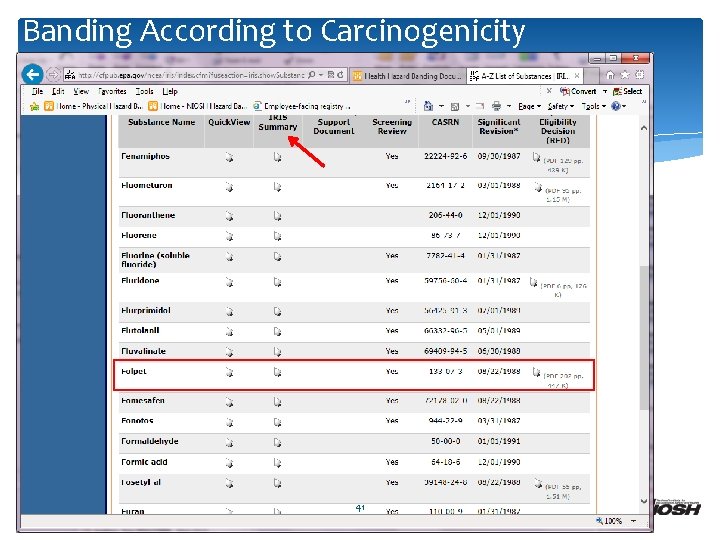
Banding According to Carcinogenicity 41
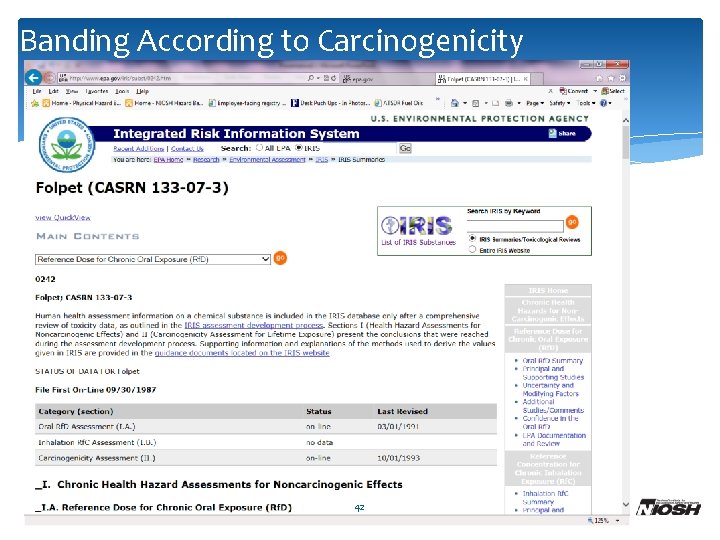
Banding According to Carcinogenicity 42
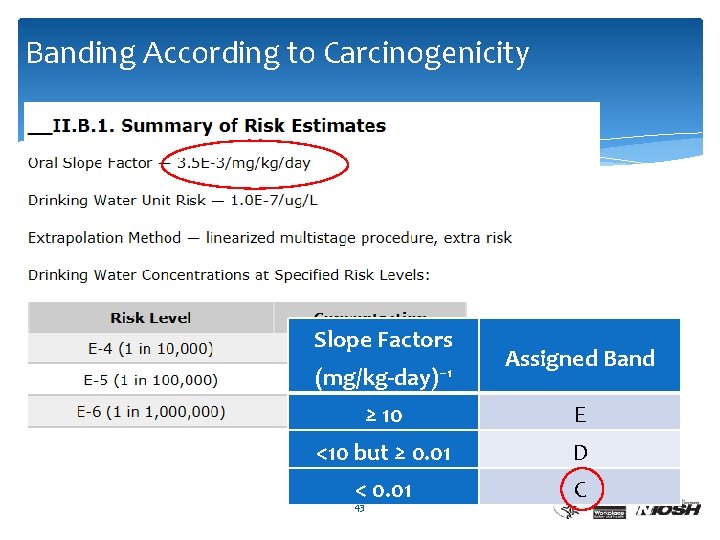
Banding According to Carcinogenicity Slope Factors (mg/kg-day)− 1 Assigned Band ≥ 10 E <10 but ≥ 0. 01 D < 0. 01 C 43
Putting it all together Each endpoint subscore is summed to find the Total Determinant Score (TDS). Banding is only valid if there is a TDS of 30 or greater. UNLESS, if any individual valid endpoint band corresponds to band E, the overall band is determined to be band E, regardless of the TDS. This can only be modified by a Tier 3 assessment. The Tier 2 worksheet will calculate 44 10/20/2014
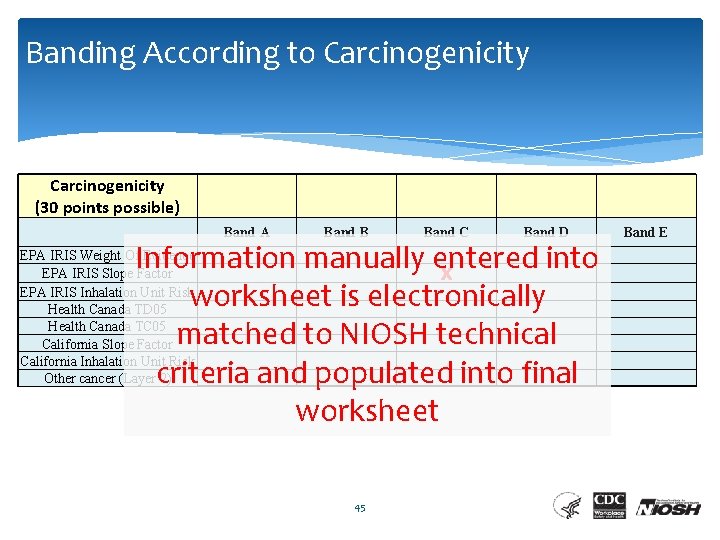
Banding According to Carcinogenicity (30 points possible) Band A Band B Band C Band D Band E Information manually entered into X worksheet is electronically matched to NIOSH technical criteria and populated into final worksheet EPA IRIS Weight Of Evidence EPA IRIS Slope Factor EPA IRIS Inhalation Unit Risk Health Canada TD 05 Health Canada TC 05 California Slope Factor California Inhalation Unit Risk Other cancer (Layer 2) 45
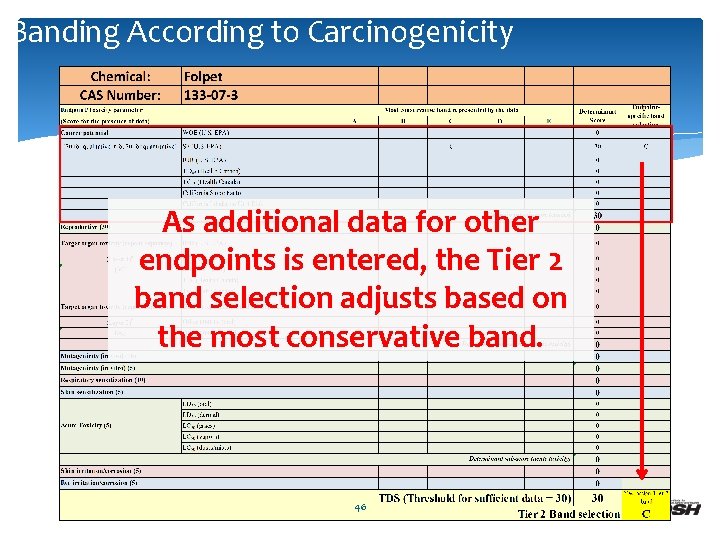
Banding According to Carcinogenicity As additional data for other endpoints is entered, the Tier 2 band selection adjusts based on the most conservative band. 46
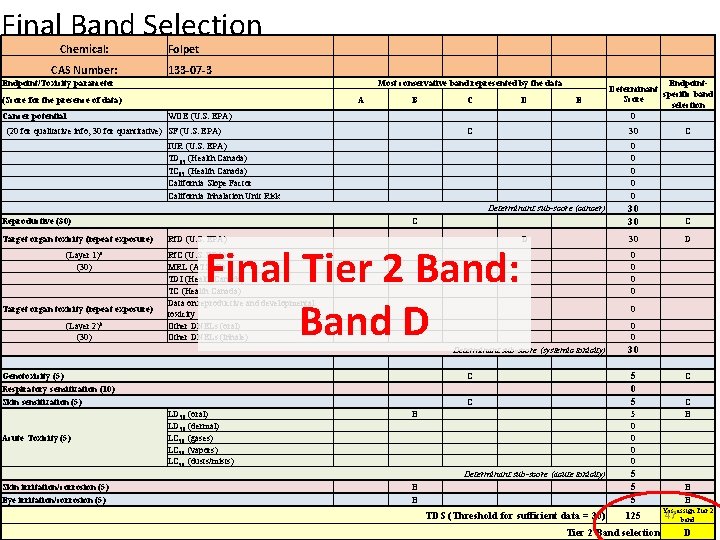
Final Band Selection Chemical: CAS Number: Folpet 133 -07 -3 Endpoint/Toxicity parameter Target organ toxicity (repeat exposure) (Layer 2)b (30) Skin irritation/corrosion (5) Eye irritation/corrosion (5) E C Rf. D (U. S. EPA) D Rf. C (U. S. EPA) MRL (ATSDR) TDI (Health Canada) TC (Health Canada) Data on reproductive and developmental toxicity Other DNELs (oral) Other DNELs (inhale) B B LD 50 (oral) LD 50 (dermal) LC 50 (gases) LC 50 (vapors) LC 50 (dusts/mists) Endpoint. Determinant specific band Score selection 0 30 C 0 0 0 30 30 C 30 D 0 0 0 Determinant sub-score (cancer) Final Tier 2 Band: Band D Genotoxicity (5) Respiratory sensitization (10) Skin sensitization (5) Acute Toxicity (5) D Reproductive (30) C IUR (U. S. EPA) TD 05 (Health Canada) TC 05 (Health Canada) California Slope Factor California Inhalation Unit Risk (Layer 1)a B (20 for qualitative info, 30 for quantitative) SF (U. S. EPA) Target organ toxicity (repeat exposure) A WOE (U. S. EPA) Most conservative band represented by the data (Score for the presence of data) Cancer potential Determinant sub-score (systemic toxicity) C C Determinant sub-score (acute toxicity) TDS (Threshold for sufficient data = 30) 30 5 C C B B B 5 0 0 5 5 5 125 Tier 2 Band selection Yes, assign Tier 2 band 47 D
Tier 2 Band After a Tier 2 evaluation, the chemical is assigned Band D. Tier 1 uses a very conservative approach, due to fewer data requirements. By performing a Tier 2 evaluation, the user can incorporate quantitative data and refine the band assignment. Following Tier 2, an additional level of evaluation can be performed if the necessary data and user expertise are available. 48
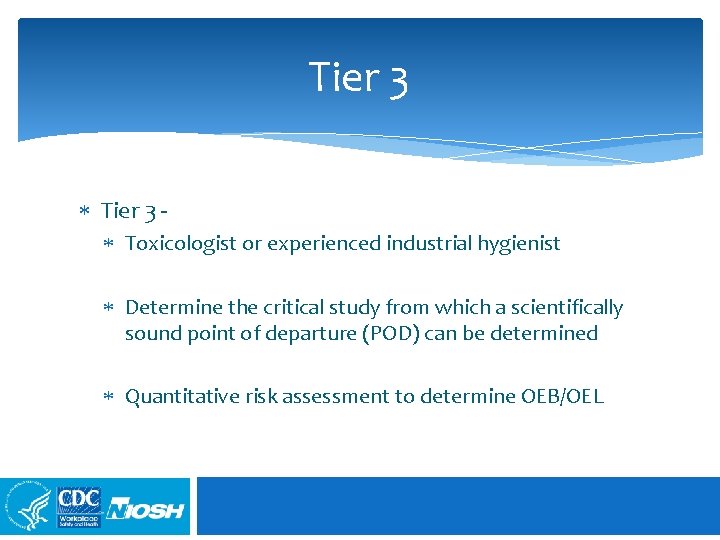
Tier 3 Toxicologist or experienced industrial hygienist Determine the critical study from which a scientifically sound point of departure (POD) can be determined Quantitative risk assessment to determine OEB/OEL 49
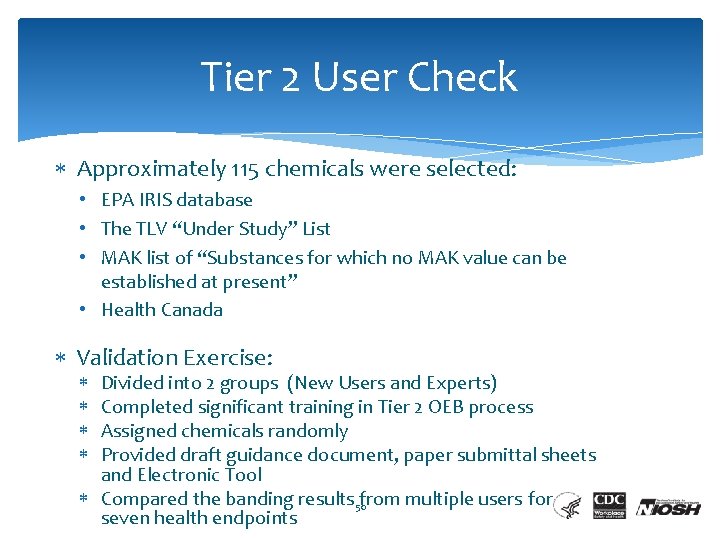
Tier 2 User Check Approximately 115 chemicals were selected: • EPA IRIS database • The TLV “Under Study” List • MAK list of “Substances for which no MAK value can be established at present” • Health Canada Validation Exercise: Divided into 2 groups (New Users and Experts) Completed significant training in Tier 2 OEB process Assigned chemicals randomly Provided draft guidance document, paper submittal sheets and Electronic Tool Compared the banding results from multiple users for 50 seven health endpoints
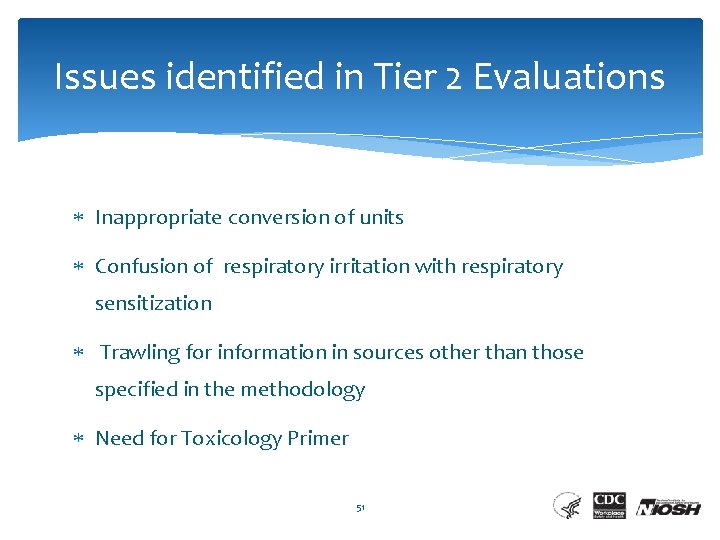
Issues identified in Tier 2 Evaluations Inappropriate conversion of units Confusion of respiratory irritation with respiratory sensitization Trawling for information in sources other than those specified in the methodology Need for Toxicology Primer 51

Next Steps Evaluate how validation staff conducted reviews and identify where confusion occurred in the details Improve criteria and guidance document Peer review and Public Comment Computer tools 52
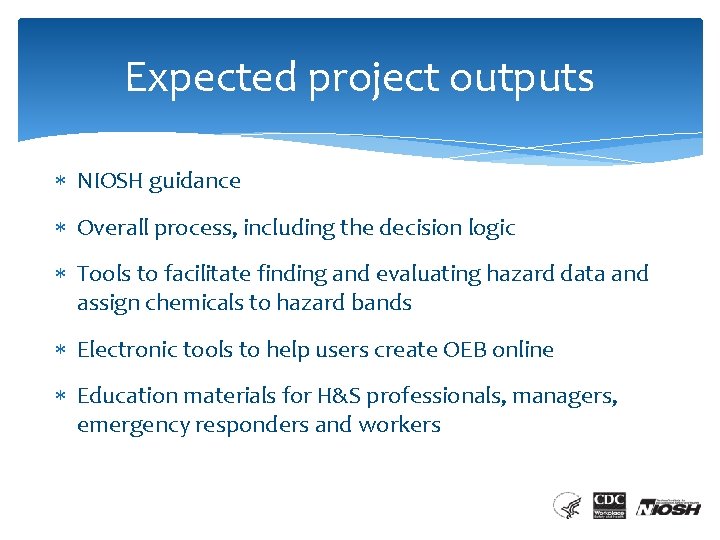
Expected project outputs NIOSH guidance Overall process, including the decision logic Tools to facilitate finding and evaluating hazard data and assign chemicals to hazard bands Electronic tools to help users create OEB online Education materials for H&S professionals, managers, emergency responders and workers
Acknowledgements Bernard Gadagbui, Ph. D. , DABT Chuck Geraci, Ph. D. Steve Gilbert, M. S. Donna Heidel, M. S. , CIH (formerly NIOSH) George Holdsworth, Ph. D. Thomas Lentz, Ph. D. Eileen Kuempel, Ph. D. Michael A. Maier, Ph. D. , CIH, DABT Melissa Seaton, M. S. Christine Sofge, Ph. D. Christine Uebel, A. S. Lutz Weber, Ph. D. , DABT CDC OPHPR Funding
Looking for Bandits Volunteer to help verify the NIOSH OEB decision logic Provide a business card or email LMc. Kernan@cdc. gov
Tier 1 Validation Compared bands obtained from Tier 1 process for 744 chemicals with full shift OELs from the following authoritative bodies: National Institute for Occupational Safety and Health (NIOSH) – Recommended Exposure Limits (RELs) Occupational Safety and Health (OSHA) – Permissible Exposure Limits (PELs) American Conference of Governmental Industrial Hygienists (ACGIH) – Threshold Limit Values (TLVs) American Industrial Hygiene Association (AIHA) – Workplace Environmental Exposure Levels (WEELs) California OSHA Program (Cal/OSHA) – PELs German Commission for the Investigation of Health Hazards of Chemical Compounds in the Work Area – Maximale Arbeitsplatz-Konzentration (MAK, translated as Maximum Workplace Concentration)
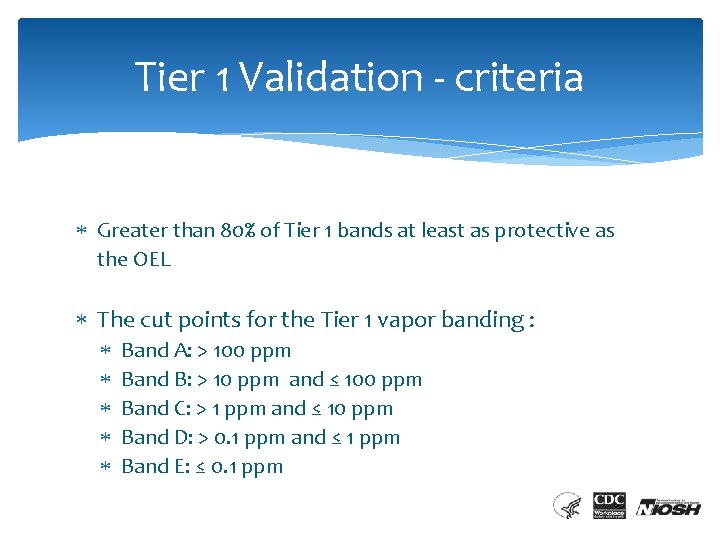
Tier 1 Validation - criteria Greater than 80% of Tier 1 bands at least as protective as the OEL The cut points for the Tier 1 vapor banding : Band A: > 100 ppm Band B: > 10 ppm and ≤ 100 ppm Band C: > 1 ppm and ≤ 10 ppm Band D: > 0. 1 ppm and ≤ 1 ppm Band E: ≤ 0. 1 ppm
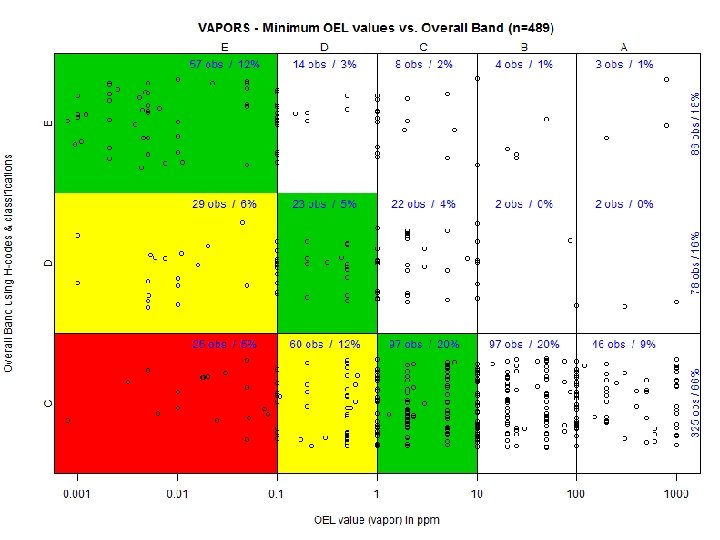
Tier 1 Validation - Vapors 76. 7% of chemicals had Tier 1 Bands equally or more protective than corresponding OEL-based bands 23. 3% of chemicals had Tier 1 Bands less protective than the corresponding OEL-based bands
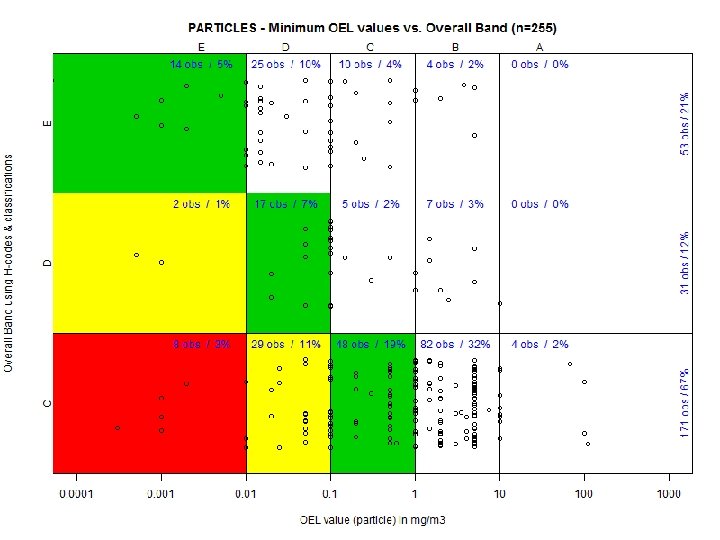
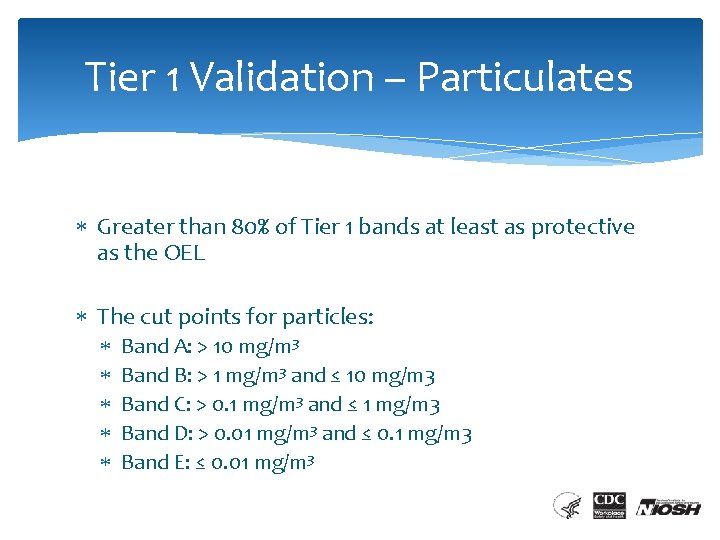
Tier 1 Validation – Particulates Greater than 80% of Tier 1 bands at least as protective as the OEL The cut points for particles: Band A: > 10 mg/m 3 Band B: > 1 mg/m 3 and ≤ 10 mg/m 3 Band C: > 0. 1 mg/m 3 and ≤ 1 mg/m 3 Band D: > 0. 01 mg/m 3 and ≤ 0. 1 mg/m 3 Band E: ≤ 0. 01 mg/m 3
Tier 1 Validation Results 84. 7 % of chemicals had Tier 1 bands equally or more protective than the corresponding OEL-based bands 15. 3% of chemicals had Tier 1 bands less protective than the corresponding OEL-based bands
Tier 1 Validation –Thoughts The overall rate of Tier 1 bands being at least as protective as the OEL was 79. 4% ( combined vapor and particulate) Recommend always doing a Tier 2 assessment since about 20% of the time the Tier 1 band is not as protective as the OEL Possible to skip the Tier 2 process if you get band E in Tier 1
- Slides: 62