
ninth edition STEPHEN P ROBBINS MARY COULTER Planning
ninth edition STEPHEN P. ROBBINS MARY COULTER Planning and Decision-making Dr Muhammad Nadeem Anwar (AP), Deptt of Edu All rights reserved. Power. Point Presentation by Charlie Cook The University of West Alabama

Watchwords for Organizations

Change • Too much change = chaos • Too little change = stagnation Threat Opportunity How do you view change?
Internal Factors New products, services or requirements Integration of new technology Changes in the nomenclature/structure External Factors Legal Frameworks Appearance of new technology or ideas Competition Social changes Politics 2– 4
Resistance to Change Status-Quo: Someone get status, privilege from system and they feel threat. Trustworthy: People have no trust on you and your voice. Conservatism: Old beliefs, ideas and not ready to change themselves. No need to change, every thing is quite right. 2– 5
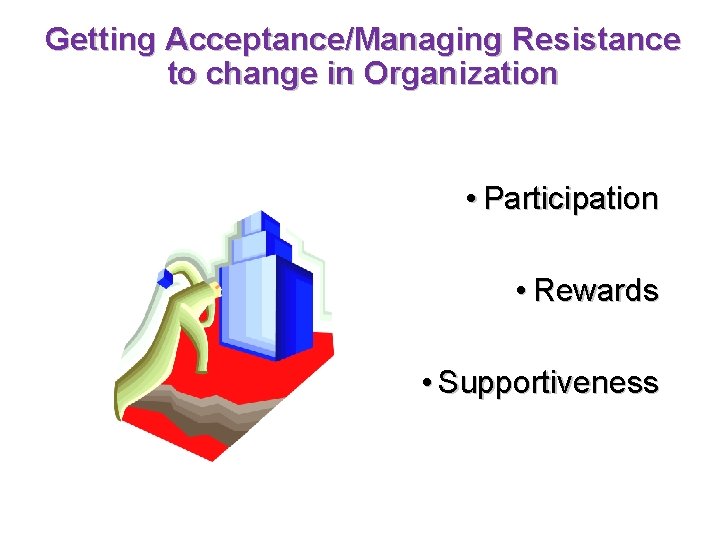
Getting Acceptance/Managing Resistance to change in Organization • Participation • Rewards • Supportiveness

Planning is often called the primary management function because it establishes the basis for all other functions. Planning is the systematic process of establishing a need and then working out the best way to meet the need. Planning is to setting goals and deciding how best to achieve them. 2– 7
The Planning is a Process? In the "Planning Process, " we said the key questions of planning and management were: (1) What do we want? (2) What do we have? (3) How do we use what we have to get what we want? and (4) What will happen when we do? They can be modified, using "where, " instead of "what, " while the principles are the same. The questions become: . Where are we? . Where do we want to go? . How do we get there? and. What happens as we do? 2– 8
Addressing the Basic Qs Planning is identifying: üWhere you want to go? üWhy you want to go there? üWhen you want to go there? üWho you take there? üHow you will get there? üWhat you need in order to get there? and üHow you will know if you're there or not? 2– 9
The process of choosing What, Why, How, When, Where, Who. (5/7 Ws) It involves defining the organization’s goals, establishing an overall strategy for achieving these goals, and developing a comprehensive set of plans to integrate and coordinate organizational work. Planning is the process of identification of objectives, formulation of policies and strategies and procedure to meet them. It’s concerned with both ends (what’s to be done) and means (how it’s to be done) 2– 10
Planning can be defined as the process of setting goals, developing strategies, outlining the implementation arrangements and allocating resources to achieve those goals. It is important to note that planning involves looking at a number of different processes: 1. Identifying the vision, goals or objectives to be achieved. (Defining Goals) 2. Formulating the strategies needed to achieve the vision and goals (Establishing Strategy/Plan) 2– 11
3. Determining and allocating the resources (financial and other) required to achieve the vision and goals (Resources Allocation) 4. Outlining implementation arrangements, which include the arrangements for monitoring and evaluating progress towards achieving the vision and goals (Implementing Strategy and Fixing Standards/Criteria for Evaluation) 2– 12

üPlanning involves two important elements: goals and plans • Goal is the desired future outcome that someone seeks to achieve • Plan is the outline how goals are going to be met (means for attempting to reach that goal)(Strategy)

Purpose of Planning 1. Planning gives direction to the organization 2. Planning reduces the impact of change 3. Planning establishes a coordinated effort 4. Planning reduces uncertainty 5. Planning reduces overlapping and wasteful activities 6. Planning establishes Objectives or Standards that are used in controlling 2– 14
Short-term and Long-term Plans • Short-term plans are plans that cover less than one year. • Long-term plans are plans that extend beyond five years. • Their differences lie in the length of future commitments and the degree of variability organizations face.

Single-use and Standing Plans Single-use plans are used to meet the needs of particular or unique situation. • Standing plans are ongoing, and provide guidance for repeatedly performed actions in an organization. •
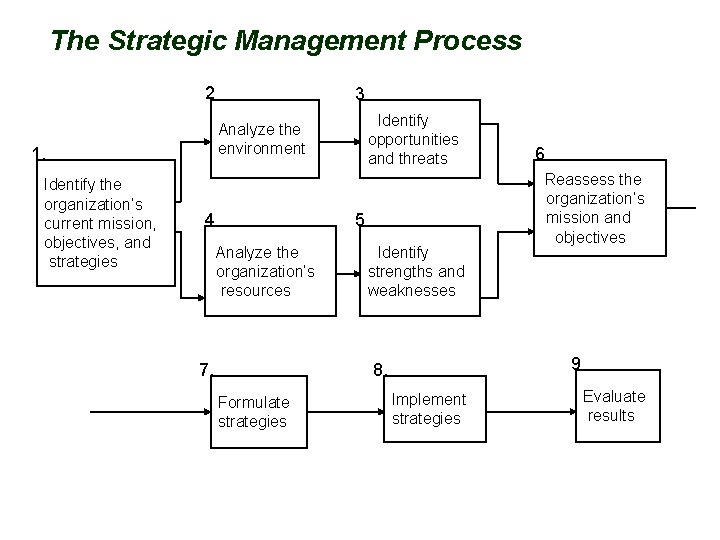
The Strategic Management Process 2 Identify opportunities and threats Analyze the environment 1. Identify the organization’s current mission, objectives, and strategies 3 4 5 Analyze the organization’s resources 7. Identify strengths and weaknesses Reassess the organization’s mission and objectives 9 8. Formulate strategies 6 Implement strategies Evaluate results
The Strategic Management Process 2 3 1. 6 4 7. 5 8. 9

Planning Cycle 1. Decide to Plan 2. Plan for planning 8. Monitor Performance 3. Trends and Scenario Analysis 7. Implementing Plan 6. Obtain Approval (Public/Employees) 4. Create Goals/ Objectives 5. Selection Implementing Tool 2– 19
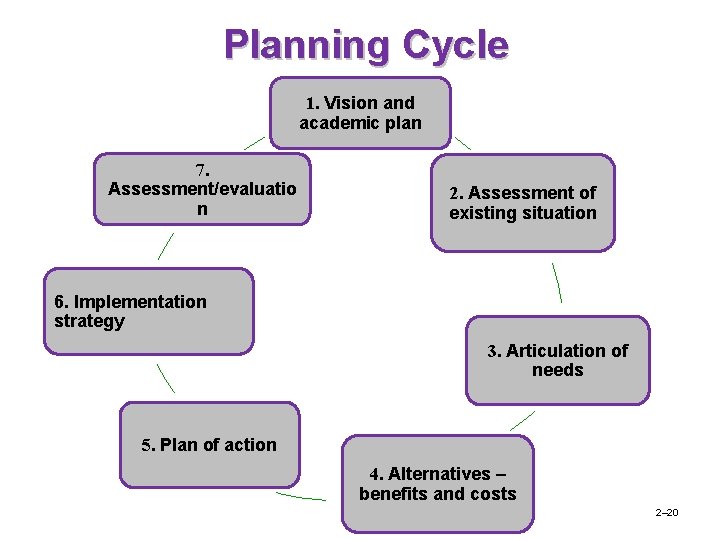
Planning Cycle 1. Vision and academic plan 7. Assessment/evaluatio n 2. Assessment of existing situation 6. Implementation strategy 3. Articulation of needs 5. Plan of action 4. Alternatives – benefits and costs 2– 20
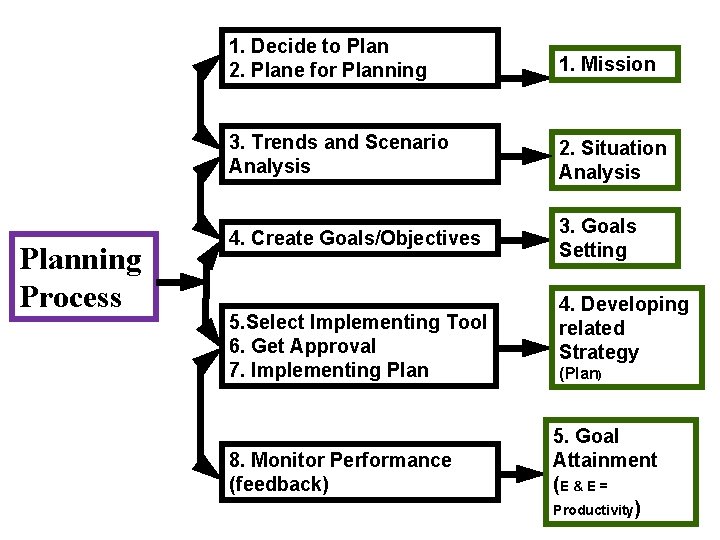
Planning Process 1. Decide to Plan 2. Plane for Planning 1. Mission 3. Trends and Scenario Analysis 2. Situation Analysis 4. Create Goals/Objectives 3. Goals Setting 5. Select Implementing Tool 6. Get Approval 7. Implementing Plan 8. Monitor Performance (feedback) 4. Developing related Strategy (Plan) 5. Goal Attainment (E & E = Productivity)
1. Mission and Vision: A mission is the purpose of the organization. It is why the organization exists. Thus, planning begins with clearly defining the mission of the organization. Organizations summarize their goals and objectives in mission and vision statements. Both of these serve different purposes for a company but are often confused with each other. While a mission statement describes what a company wants to do now, a vision statement outlines what a company wants to be in the future. 2– 22
• The Mission Statement concentrates on the present; it defines the customer(s), critical processes and it informs you about the desired level of performance. • The Vision Statement focuses on the future; it is a source of inspiration and motivation. • HOW you will get to where you want to be. (Mission) • WHERE you want to be. (Vision) For Example: Healthy People in a Healthy World (Vision) To promote health and quality of life by preventing and controlling disease, injury, and disability. (Mission) 2– 23
2. Situation Analysis This asks the question, "Where are we? " (What do we have? ). Situation analysis is a process through which the general characteristics of situation and problems are identified. Situation analysis is done through collecting information necessary to understand the people and problem. Information should be collected on what happened in the past, what is currently happening, and what is expected to happen in the future. 2– 24
Some of the following techniques could be used: Documents review Surveys Discussions with individuals, specific groups and the community as a whole Interviews Observations Listening to people Brainstorming Informal conversations Problem tree and etc 2– 25
2. Analysis of Situation: Conduct SWOT analysis. S= Strengths that are internal characteristics of Org W= Weakness that are internal deficiencies of Org O= Opportunities that are external prospects for Org T= Threats that are external fears/conditions 2– 26
2. Setting Goals and Objectives: Goal setting asks the question, "Where do we want to go? " (What do we want? ). Before any attempts to implement a project, the planners, implementers and beneficiaries should set up goals and objectives. See Brainstorm for a participatory method to do this. A goal is a general statement of what should be done to solve a problem. It defines broadly, what is expected out of a project. 2– 27
Setting Goals: Process that includes SMART, Goals should be: S = Specific that indicates what needs to be done? (clear the direction, written in terms of outcomes) M = Measurable that indicate evaluation (in terms of Quality and Quantity) A = Acceptable/Attainable/Achievable (but challenging) R = Realistic that based on available limits and resources (in terms of communication to all members who need to know) T = Time that achieve within specific time frame (clear as to time frame) 2– 28
4. Develop Related Strategies: Giving plan of Action that includes PPMR P = A Policy is a general statement designed to guide employees' actions P = A Procedure is a sequence of steps or operations describing how to carry out an activity or performing a task. M = A Method sets up the manner/way in accomplishing a sequence of steps or operations. R= A Rule includes definite things to do and not to do. 2– 29
To achieve the objectives of a project, it is essential to assess the resources available within the community and those that can be accessed from external sources. See Revealing Hidden Resources. The planners, implementers and community members/stakeholders should also identify the constraints they may face in executing the project and how they can overcome them. Based on the extent of the constraints and positive forces, the implementers may decide to continue with the project or to drop it. The goals and objectives provide the basis for monitoring and evaluating a project. They are the yardsticks upon which project success or failure is measured. 2– 30
5. Generating Structures and Strategies: This aspect asks the third key question, "How do we get there? " (How do we get what we want with what we have? ). The planners and implementers (communities and their enablers) should decide on how they are going to implement a project, which is the strategy. Agreeing on the strategy involves determining all items (inputs) that are needed to carry out the project, defining the different groups or individuals and their particular roles they are to play in the project. 2– 31
These groups and individuals that undertake particular roles in the project are called "actors. " Generating the structures and strategies therefore involves: Discussing and agreeing on the activities to be undertaken during implementation; Defining the different actors and outside the community, and their roles; and Defining and distributing costs and materials necessary to implement the project. 2– 32
After establishing the appropriateness of the decisions, the executive should discuss and agree with all actors on how the project will be implemented. This is called designing a work plan. (How do we get what we want? ). A work plan is a description of the necessary activities set out in stages, with rough indication of the timing. 2– 33
In order to draw a good work plan, the implementers should: List all the tasks required to implement a project; Put the tasks in the order in which they will be implemented; Show allocation of the responsibilities to the actors; and Give the timing of each activity. 2– 34
The work plan is a guide to project implementation and a basis for project monitoring. It therefore helps to: Finish the project in time; Do the right things in the right order; Identify who will be responsible for what activity; and Determine when to start project implementation. 2– 35
The implementers and planners have to agree on monitoring indicators. Monitoring indicators are quantitative and qualitative signs (criteria) for measuring or assessing the achievement of project activities and objectives. The indicators will show the extent to which the objectives of every activity have been achieved. Monitoring indicators should be explicit, pertinent and objectively verifiable. 2– 36
Monitoring Indicators are of four types, namely: Input indicators: describe what goes on in the project (eg number of bricks brought on site and amount of money spent); Output indicators: describe the project activity (eg number of classrooms built); Outcome indicators: describe the product of the activity (eg number of pupils attending the school); and Impact indicators: measure change in conditions of the community (eg reduced illiteracy in the community). 2– 37
6. Implementation: Monitoring implementation asks the fourth key question "What happens when we do? " Implementation is the stage where all the planned activities are put into action. Before the implementation of a project, the implementers (spearheaded by the project committee or executive) should identify their strength and weaknesses (internal forces), opportunities and threats (external forces). . 2– 38
The strength and opportunities are positive forces that should be exploited to efficiently implement a project. The weaknesses and threats are hindrances that can hamper project implementation. The implementers should ensure that they devise means of overcoming them. 2– 39
7. Monitor the Plan: Feedback 1. What extent goals have been achieved? 2. Performance appraisal of personnel's. 3. What difficulties have been encountered during formative and summative evaluation process 4. Checking standardization 5. Helpful in re-planning 2– 40
Monitoring is important at this implementation phase to ensure that the project is implemented as per the schedule. This is a continuous process that should be put in place before project implementation starts. As such, the monitoring activities should appear on the work plan and should involve all stake holders. If activities are not going on well, arrangements should be made to identify the problem so that they can be corrected. 2– 41
Monitoring is also important to ensure that activities are implemented as planned. This helps the implementers to measure how well they are achieving their targets. This is based on the understanding that the process through which a project is implemented has a lot of effect on its use, operation and maintenance. Therefore implementation of the project on target is not satisfactory hence a need for implementers to ask themselves and answer the question, "How well do we get there? " (What happens when we do? ). 2– 42
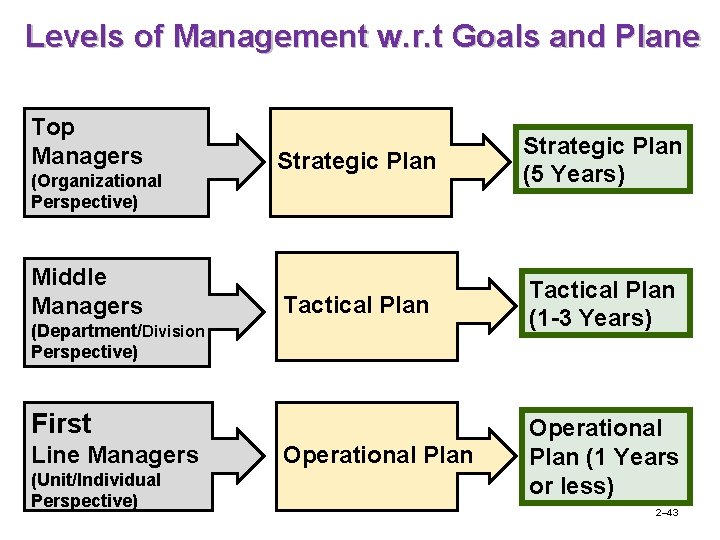
Levels of Management w. r. t Goals and Plane Top Managers (Organizational Perspective) Middle Managers Strategic Plan (5 Years) Tactical Plan (1 -3 Years) Operational Plan (1 Years or less) (Department/Division Perspective) First Line Managers (Unit/Individual Perspective) 2– 43
Decisions and Decision Making Decision making is part of all four managerial functions. In performing these functions, managers are often called decision makers. • Decision = choice made from available alternatives • Decision Making = process of identifying problems and opportunities and resolving them. Decision making is the selection of best course of action (Alternatives) among many (Alternatives) 44
ØPlanning is nothing more than thinking about future but in Advance, so it is advance decision making. ØDecision making vs Decision taking o. One is the Process and other is the Outcome (implementation) o. Both are important 2– 45
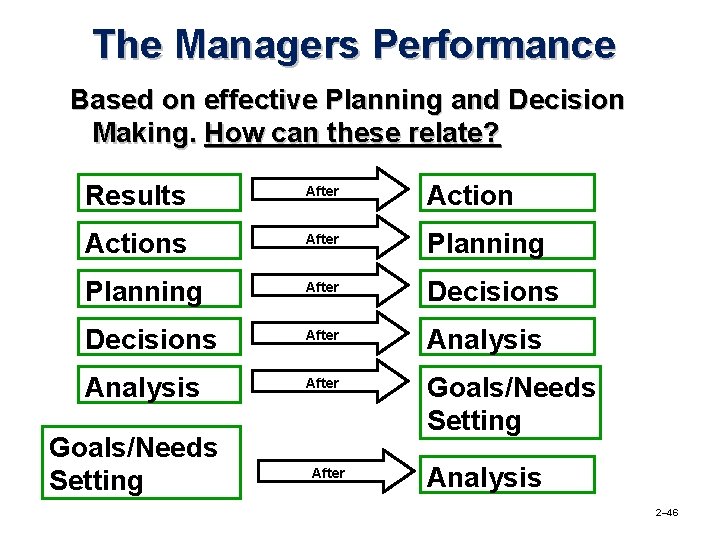
The Managers Performance Based on effective Planning and Decision Making. How can these relate? Results After Actions After Planning After Decisions After Analysis After Goals/Needs Setting After Analysis 2– 46
What is Problem? A manager uses Decision Making to solve a problem A problem is a condition in which the existing situation differs significantly from the desired situation Issue need to b addressed © 2007 Prentice Hall, Inc. All rights reserved. 2– 47
Types of Problems 1. Crisis Problems: When there is a critical situation that demands an immediate decision 2. Non-Crisis Problems: Need to be resolved but there is no urgency 3. Opportunity Problems: Problem that give the organization to some significant advantage. © 2007 Prentice Hall, Inc. All rights reserved. 2– 48
Types of Decisions 1. Programmed Decisions 2. Non-Programmed Decisions © 2007 Prentice Hall, Inc. All rights reserved. 2– 49
Conditions of Decision Making 1. Information needed to clearly understand the problem, 2. Have complete information about possible alternative and 3. Knowledge/predication about likely/possible consequences of the alternatives Certainty (All high level of 1, 2, 3) Risk ( 1 high, 2 low, 3 low predictable) Uncertainty ( 1 high, 2 very little, 3 very low) Ambiguity (All no) © 2007 Prentice Hall, Inc. All rights reserved. 2– 50

The Decision-Making Process Identification of a problem Identification of decision criteria Evaluation of decision effectiveness Allocation of weights To criteria Development of alternatives Implementation of the alternative Analysis of alternatives Selection of an alternative
- Slides: 51