
ninth edition STEPHEN P ROBBINS Chapter 15 2007
ninth edition STEPHEN P. ROBBINS Chapter 15 © 2007 Prentice Hall, Inc. All rights reserved. MARY COULTER Understanding Groups and Teams Power. Point Presentation by Charlie Cook The University of West Alabama
© 2007 Prentice Hall, Inc. All rights reserved. 2
Peter Drucker on Teams…. “[One] problem is that management is becoming ever more fashion-conscious. Managers implement strategies like down-sizing and reengineering just because they seem like thing to do. Managers are fashion-conscious because, in reality, 90% of running an organization is routine. Teenagers are fashion-conscious because most of what goes on at school is boring. The same goes for managers. Perhaps the worst example of this is the emphasis on teams. It takes years to build a successful team, but companies are rushing into it expecting instant results. In most cases, teams don’t even work. Teams are difficult to manage. Who is the boss? The team leader or the engineering boss that assigns the project to the team? It’s never a good idea to create a conflict of interest and loyalties. Teams are the right strategy only for a very small number of situations. ” © 2007 Prentice Hall, Inc. All rights reserved. 3
Team Effectiveness: Some Impressive Results • • • Wilson Sporting Goods Kodak Customer Service Corning Sealed Air Exxon Carrier Xerox Westinghouse Texas Instruments - © 2007 Prentice Hall, Inc. All rights reserved. • • • Avg. annual cost savings: $5 million Response accuracy increase: 100% Defect reduction: 1, 800 ppm to 3 ppm Waste reduced by 50% $10 million saved in 6 months Unit turnaround: 2 weeks to 2 days Productivity increased by 30% Product costs down 60% Cost reduction: over 50% 4
Understanding Groups • Group Ø Two or more interacting and interdependent individuals who come together to achieve specific goals. Ø Formal groups v Work groups defined by the organization’s structure that have designated work assignments and tasks. – Appropriate behaviors are defined by and directed toward organizational goals. Ø Informal groups v Groups that are independently formed to meet the social needs of their members. © 2007 Prentice Hall, Inc. All rights reserved. 5
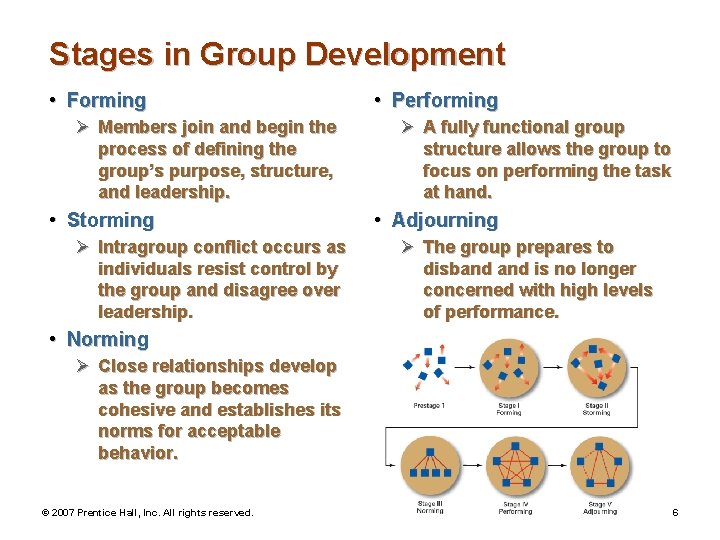
Stages in Group Development • Forming Ø Members join and begin the process of defining the group’s purpose, structure, and leadership. • Storming Ø Intragroup conflict occurs as individuals resist control by the group and disagree over leadership. • Performing Ø A fully functional group structure allows the group to focus on performing the task at hand. • Adjourning Ø The group prepares to disband is no longer concerned with high levels of performance. • Norming Ø Close relationships develop as the group becomes cohesive and establishes its norms for acceptable behavior. © 2007 Prentice Hall, Inc. All rights reserved. 6
Groupthink Symptoms • An illusion of invulnerability, which leads to unwarranted optimism and excessive risk taking by the group. • Unquestioned assumption of the group’s morality and therefore an absence of reflection on the ethical consequences of group action. • Collective rationalization to discount negative information or warnings. • Stereotypes of the opposition as evil, weak, or stupid. • An illusion of unanimity such that greater consensus is perceived than really exists. • Direct pressure on dissenting members, which reinforces the norm that disagreement represents disloyalty to the group. • Mindguards, who protect the group from adverse information. © 2007 Prentice Hall, Inc. All rights reserved. 7
Group Structure: Group Size • Small groups Ø Complete tasks faster than larger groups. Ø Make more effective use of facts. • Large groups • Social Loafing Ø The tendency for individuals to expend less effort when working collectively than when work individually. Ø Solve problems better than small groups. Ø Are good for getting diverse input. Ø Are more effective in factfinding. © 2007 Prentice Hall, Inc. All rights reserved. 8
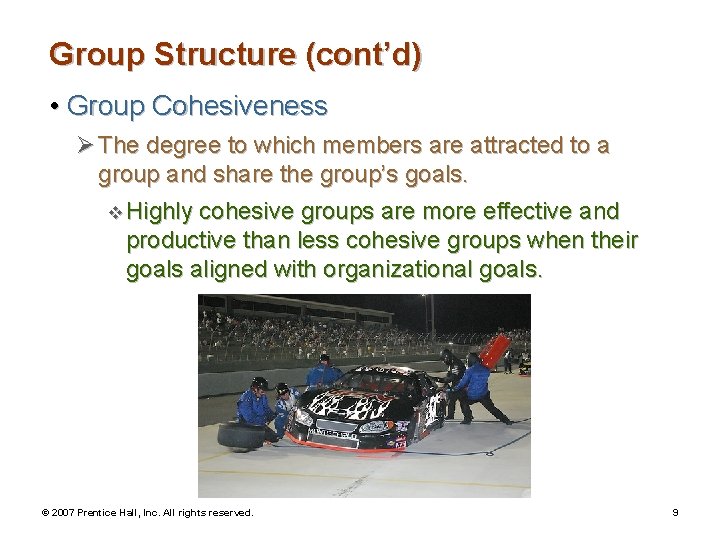
Group Structure (cont’d) • Group Cohesiveness Ø The degree to which members are attracted to a group and share the group’s goals. v Highly cohesive groups are more effective and productive than less cohesive groups when their goals aligned with organizational goals. © 2007 Prentice Hall, Inc. All rights reserved. 9
Group Processes: Group Decision Making • Advantages Ø Generates more complete information and knowledge. Ø Generates more diverse alternatives. • Disadvantages Ø Time consuming Ø Minority domination Ø Pressures to conform Ø Ambiguous responsibility Ø Increases acceptance of a solution. Ø Increases legitimacy of decision. © 2007 Prentice Hall, Inc. All rights reserved. 10
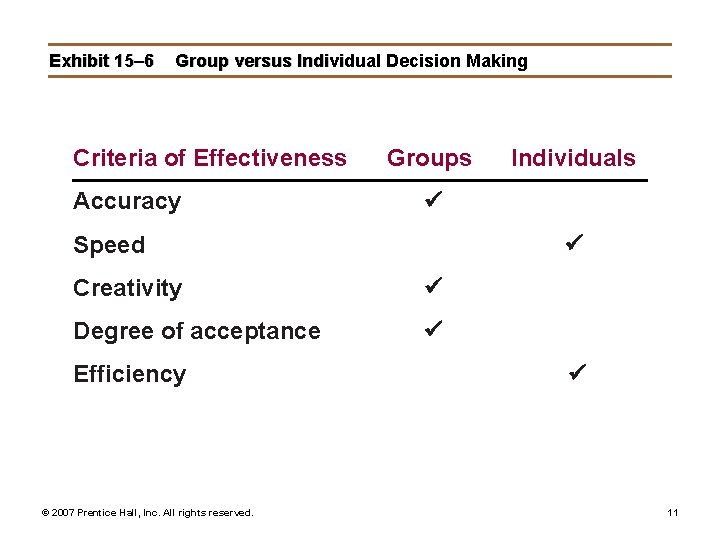
Exhibit 15– 6 Group versus Individual Decision Making Criteria of Effectiveness Accuracy Groups Speed Creativity Degree of acceptance Efficiency © 2007 Prentice Hall, Inc. All rights reserved. Individuals 11
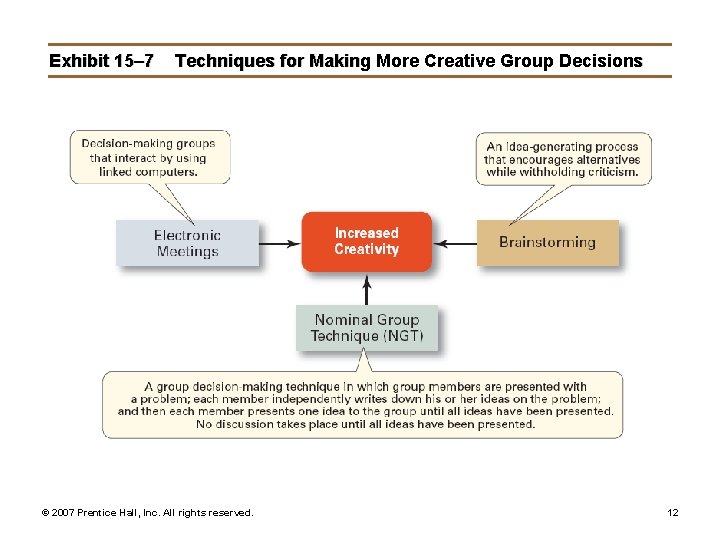
Exhibit 15– 7 Techniques for Making More Creative Group Decisions © 2007 Prentice Hall, Inc. All rights reserved. 12
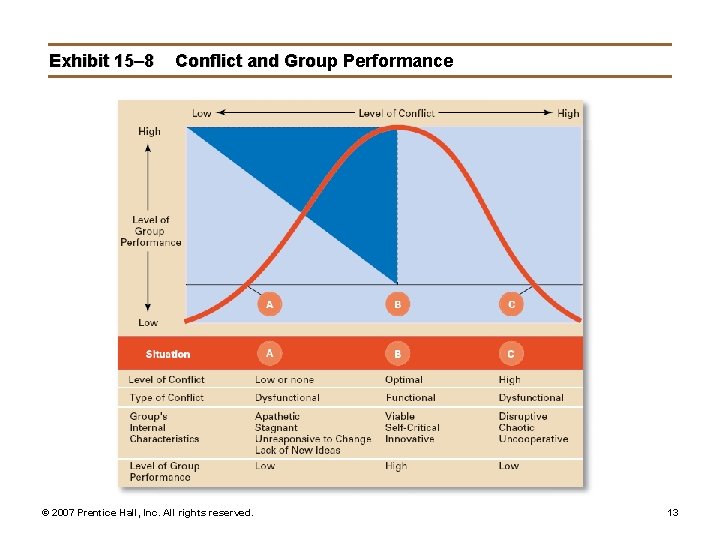
Exhibit 15– 8 Conflict and Group Performance © 2007 Prentice Hall, Inc. All rights reserved. 13
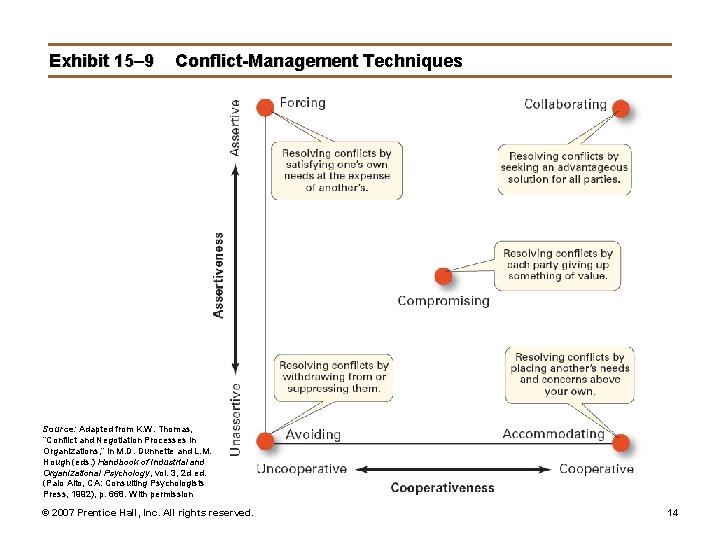
Exhibit 15– 9 Conflict-Management Techniques Source: Adapted from K. W. Thomas, “Conflict and Negotiation Processes in Organizations, ” in M. D. Dunnette and L. M. Hough (eds. ) Handbook of Industrial and Organizational Psychology, vol. 3, 2 d ed. (Palo Alto, CA: Consulting Psychologists Press, 1992), p. 668. With permission © 2007 Prentice Hall, Inc. All rights reserved. 14
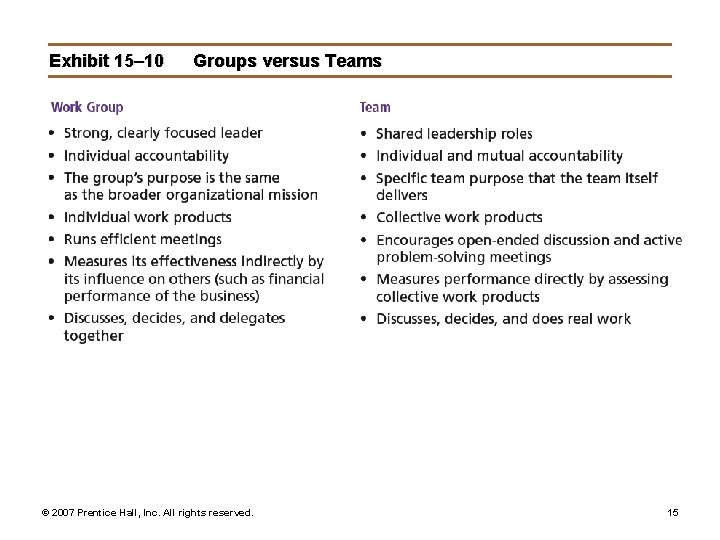
Exhibit 15– 10 Groups versus Teams © 2007 Prentice Hall, Inc. All rights reserved. 15
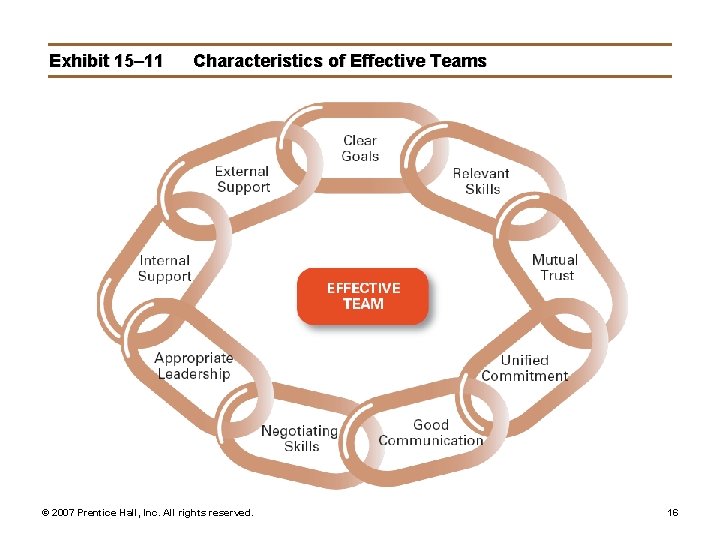
Exhibit 15– 11 Characteristics of Effective Teams © 2007 Prentice Hall, Inc. All rights reserved. 16
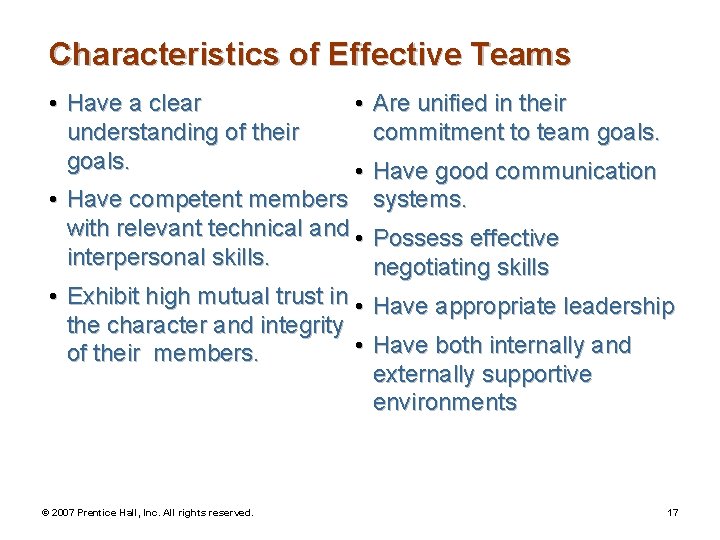
Characteristics of Effective Teams • Have a clear understanding of their goals. • Are unified in their commitment to team goals. • Have good communication • Have competent members systems. with relevant technical and • Possess effective interpersonal skills. negotiating skills • Exhibit high mutual trust in • Have appropriate leadership the character and integrity • Have both internally and of their members. externally supportive environments © 2007 Prentice Hall, Inc. All rights reserved. 17
- Slides: 17