
Ninth Edition CHAPTER 7 VECTOR MECHANICS FOR ENGINEERS

- Slides: 39
Ninth Edition CHAPTER 7 VECTOR MECHANICS FOR ENGINEERS: STATICS Ferdinand P. Beer E. Russell Johnston, Jr. Lecture Notes: J. Walt Oler Texas Tech University Forces in Beams and Cables © 2010 The Mc. Graw-Hill Companies, Inc. All rights reserved.
Ninth Edition Vector Mechanics for Engineers: Statics Contents Introduction Internal Forces in Members Sample Problem 7. 1 Various Types of Beam Loading and Support Shear and Bending Moment in a Beam Sample Problem 7. 2 Sample Problem 7. 3 Relations Among Load, Shear, and Bending Moment © 2010 The Mc. Graw-Hill Companies, Inc. All rights reserved. Sample Problem 7. 4 Sample Problem 7. 6 Cables With Concentrated Loads Cables With Distributed Loads Parabolic Cable Sample Problem 7. 8 Catenary 7 - 2
Ninth Edition Vector Mechanics for Engineers: Statics Introduction • Preceding chapters dealt with: a) determining external forces acting on a structure and b) determining forces which hold together the various members of a structure. • The current chapter is concerned with determining the internal forces (i. e. , tension/compression, shear, and bending) which hold together the various parts of a given member. • Focus is on two important types of engineering structures: a) Beams - usually long, straight, prismatic members designed to support loads applied at various points along the member. b) Cables - flexible members capable of withstanding only tension, designed to support concentrated or distributed loads. © 2010 The Mc. Graw-Hill Companies, Inc. All rights reserved. 7 - 3
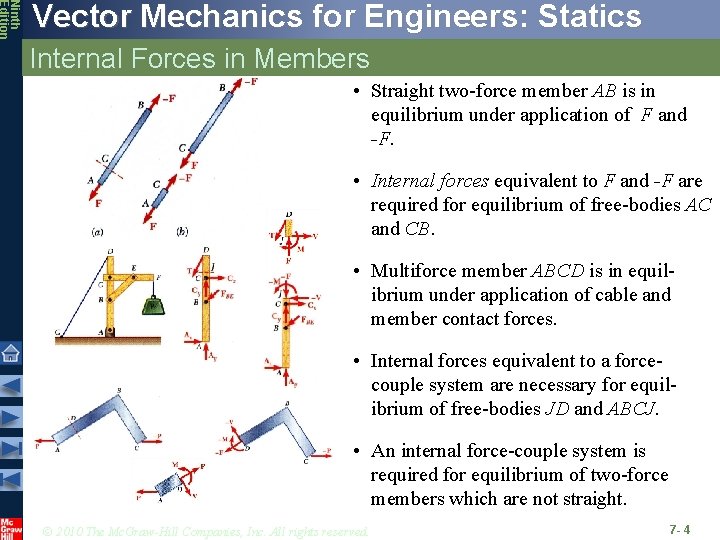
Ninth Edition Vector Mechanics for Engineers: Statics Internal Forces in Members • Straight two-force member AB is in equilibrium under application of F and -F. • Internal forces equivalent to F and -F are required for equilibrium of free-bodies AC and CB. • Multiforce member ABCD is in equilibrium under application of cable and member contact forces. • Internal forces equivalent to a forcecouple system are necessary for equilibrium of free-bodies JD and ABCJ. • An internal force-couple system is required for equilibrium of two-force members which are not straight. © 2010 The Mc. Graw-Hill Companies, Inc. All rights reserved. 7 - 4
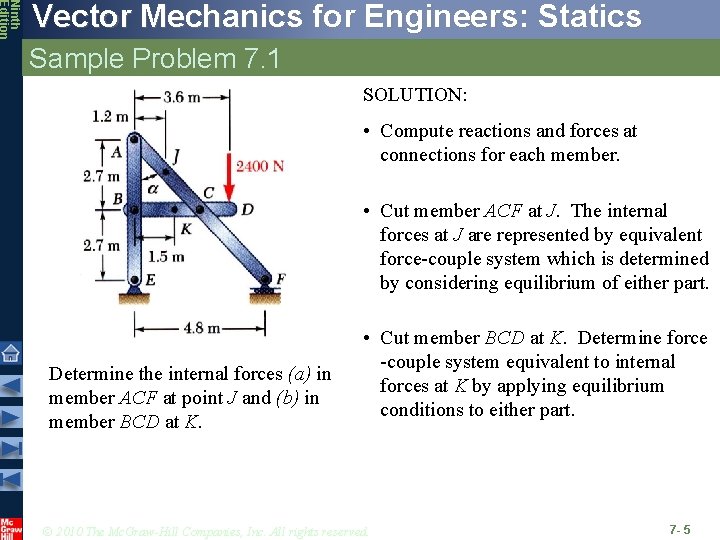
Ninth Edition Vector Mechanics for Engineers: Statics Sample Problem 7. 1 SOLUTION: • Compute reactions and forces at connections for each member. • Cut member ACF at J. The internal forces at J are represented by equivalent force-couple system which is determined by considering equilibrium of either part. Determine the internal forces (a) in member ACF at point J and (b) in member BCD at K. • Cut member BCD at K. Determine force -couple system equivalent to internal forces at K by applying equilibrium conditions to either part. © 2010 The Mc. Graw-Hill Companies, Inc. All rights reserved. 7 - 5
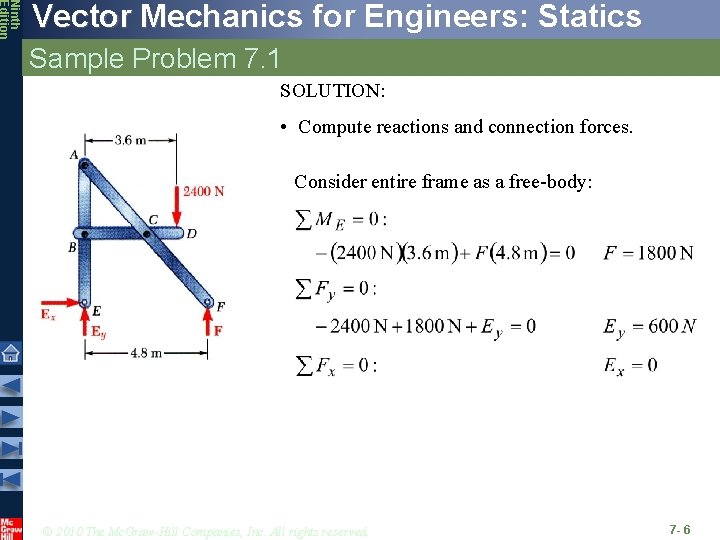
Ninth Edition Vector Mechanics for Engineers: Statics Sample Problem 7. 1 SOLUTION: • Compute reactions and connection forces. Consider entire frame as a free-body: © 2010 The Mc. Graw-Hill Companies, Inc. All rights reserved. 7 - 6
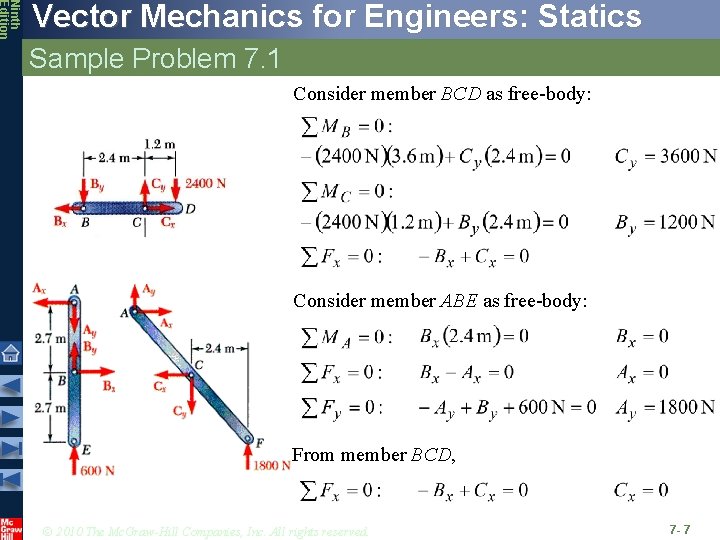
Ninth Edition Vector Mechanics for Engineers: Statics Sample Problem 7. 1 Consider member BCD as free-body: Consider member ABE as free-body: From member BCD, © 2010 The Mc. Graw-Hill Companies, Inc. All rights reserved. 7 - 7
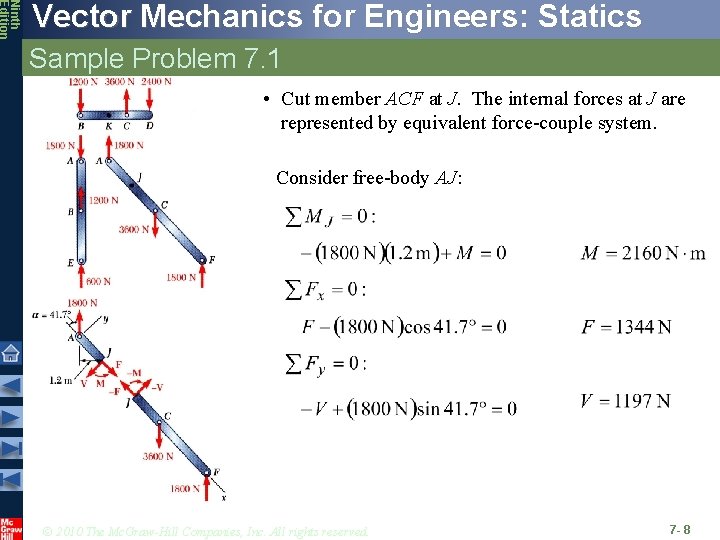
Ninth Edition Vector Mechanics for Engineers: Statics Sample Problem 7. 1 • Cut member ACF at J. The internal forces at J are represented by equivalent force-couple system. Consider free-body AJ: © 2010 The Mc. Graw-Hill Companies, Inc. All rights reserved. 7 - 8
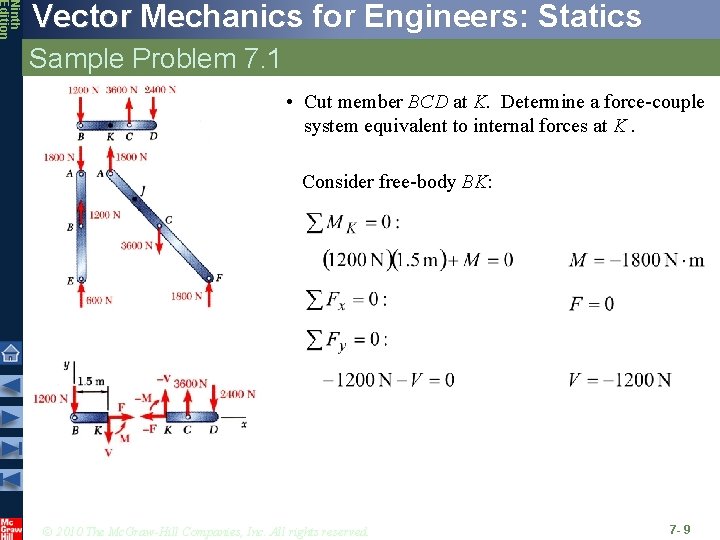
Ninth Edition Vector Mechanics for Engineers: Statics Sample Problem 7. 1 • Cut member BCD at K. Determine a force-couple system equivalent to internal forces at K. Consider free-body BK: © 2010 The Mc. Graw-Hill Companies, Inc. All rights reserved. 7 - 9
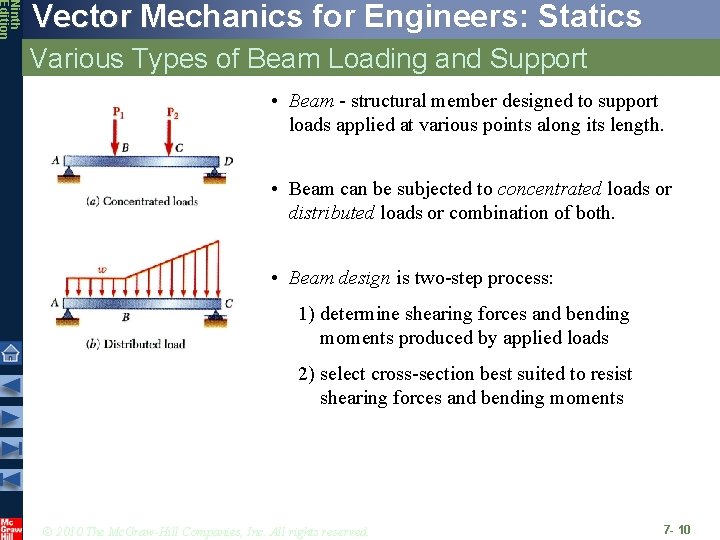
Ninth Edition Vector Mechanics for Engineers: Statics Various Types of Beam Loading and Support • Beam - structural member designed to support loads applied at various points along its length. • Beam can be subjected to concentrated loads or distributed loads or combination of both. • Beam design is two-step process: 1) determine shearing forces and bending moments produced by applied loads 2) select cross-section best suited to resist shearing forces and bending moments © 2010 The Mc. Graw-Hill Companies, Inc. All rights reserved. 7 - 10
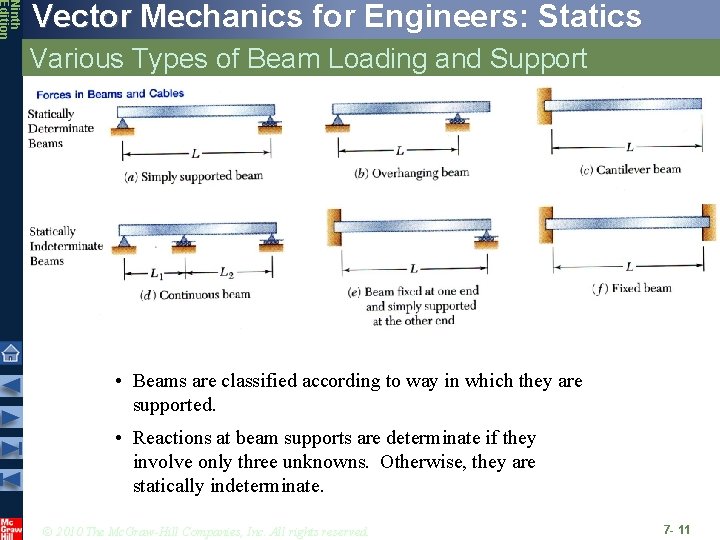
Ninth Edition Vector Mechanics for Engineers: Statics Various Types of Beam Loading and Support • Beams are classified according to way in which they are supported. • Reactions at beam supports are determinate if they involve only three unknowns. Otherwise, they are statically indeterminate. © 2010 The Mc. Graw-Hill Companies, Inc. All rights reserved. 7 - 11
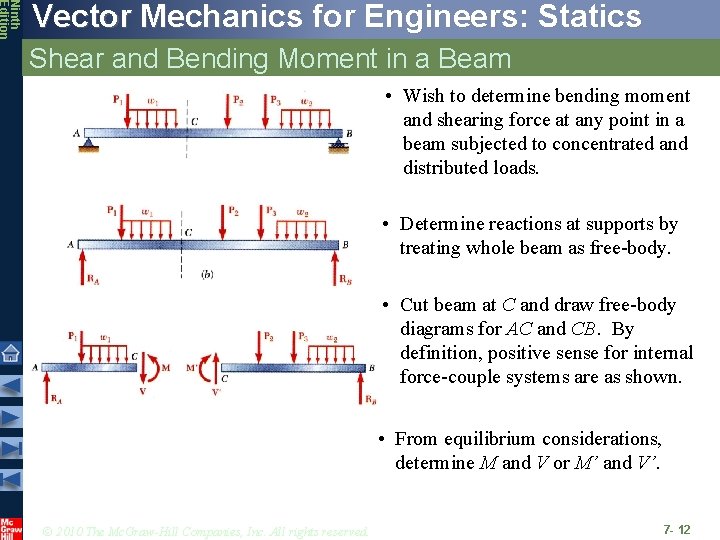
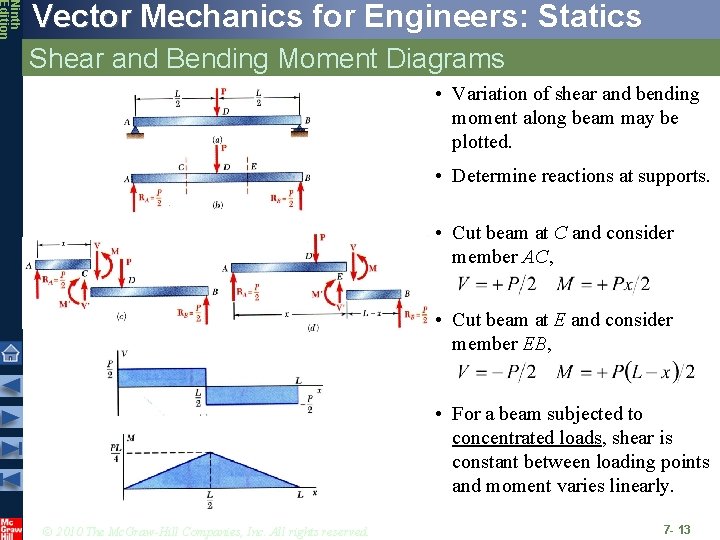
Ninth Edition Vector Mechanics for Engineers: Statics Shear and Bending Moment in a Beam • Wish to determine bending moment and shearing force at any point in a beam subjected to concentrated and distributed loads. • Determine reactions at supports by treating whole beam as free-body. • Cut beam at C and draw free-body diagrams for AC and CB. By definition, positive sense for internal force-couple systems are as shown. • From equilibrium considerations, determine M and V or M’ and V’. © 2010 The Mc. Graw-Hill Companies, Inc. All rights reserved. 7 - 12
Ninth Edition Vector Mechanics for Engineers: Statics Shear and Bending Moment Diagrams • Variation of shear and bending moment along beam may be plotted. • Determine reactions at supports. • Cut beam at C and consider member AC, • Cut beam at E and consider member EB, • For a beam subjected to concentrated loads, shear is constant between loading points and moment varies linearly. © 2010 The Mc. Graw-Hill Companies, Inc. All rights reserved. 7 - 13
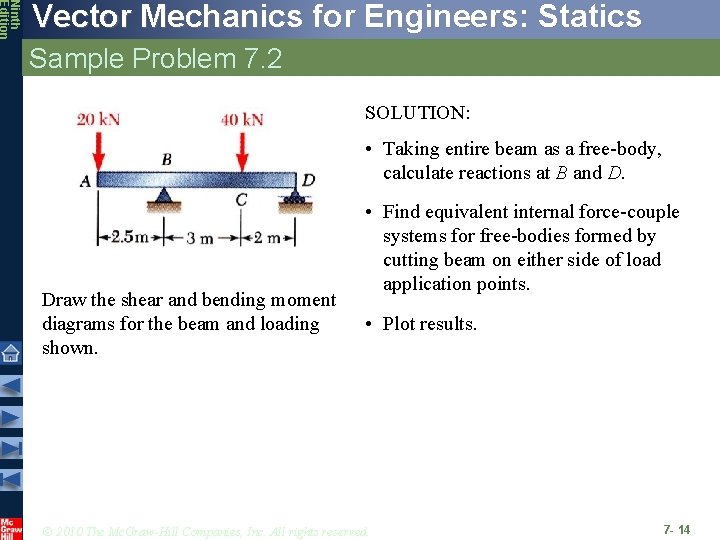
Ninth Edition Vector Mechanics for Engineers: Statics Sample Problem 7. 2 SOLUTION: • Taking entire beam as a free-body, calculate reactions at B and D. Draw the shear and bending moment diagrams for the beam and loading shown. • Find equivalent internal force-couple systems for free-bodies formed by cutting beam on either side of load application points. • Plot results. © 2010 The Mc. Graw-Hill Companies, Inc. All rights reserved. 7 - 14
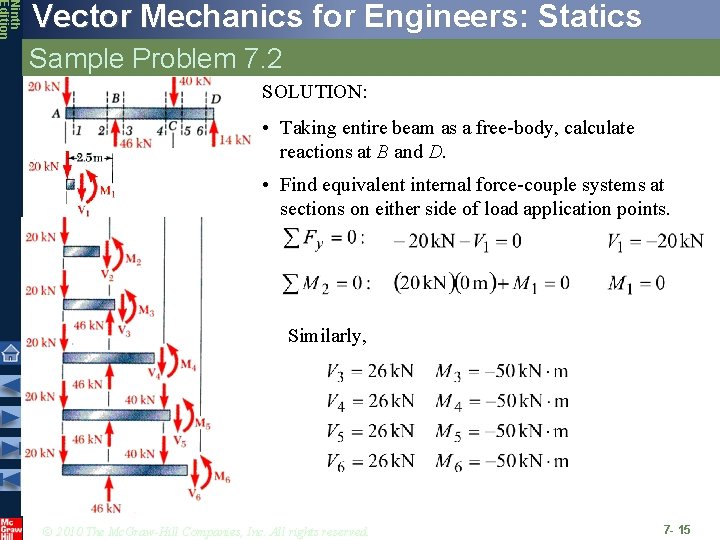
Ninth Edition Vector Mechanics for Engineers: Statics Sample Problem 7. 2 SOLUTION: • Taking entire beam as a free-body, calculate reactions at B and D. • Find equivalent internal force-couple systems at sections on either side of load application points. Similarly, © 2010 The Mc. Graw-Hill Companies, Inc. All rights reserved. 7 - 15
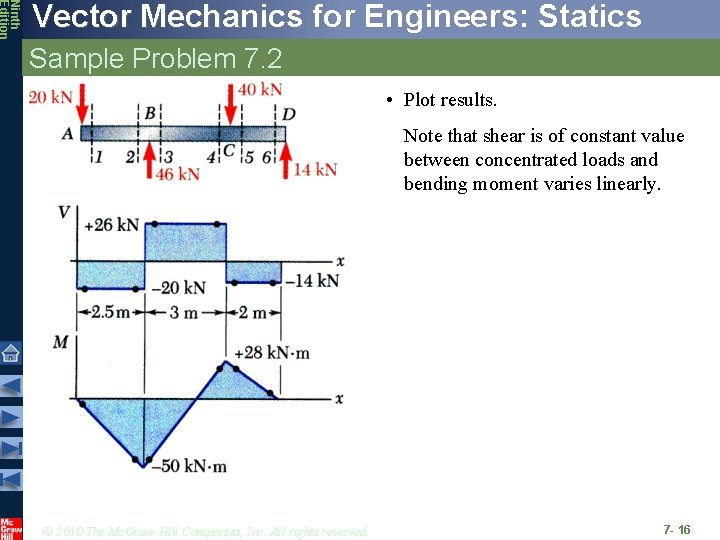
Ninth Edition Vector Mechanics for Engineers: Statics Sample Problem 7. 2 • Plot results. Note that shear is of constant value between concentrated loads and bending moment varies linearly. © 2010 The Mc. Graw-Hill Companies, Inc. All rights reserved. 7 - 16
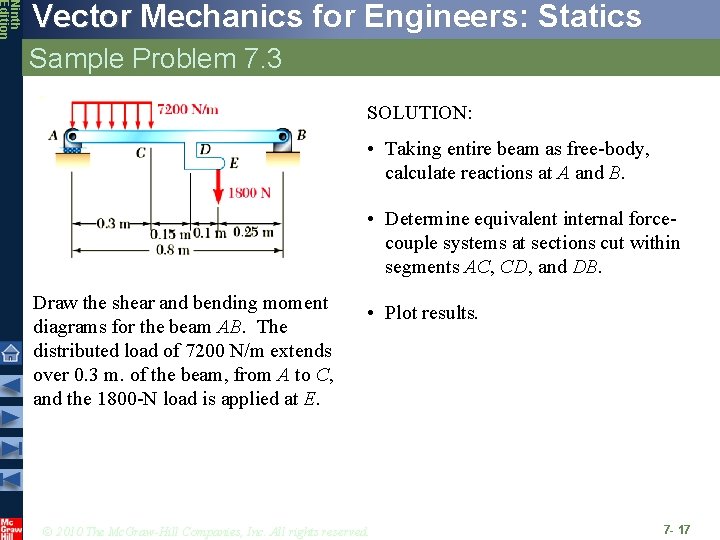
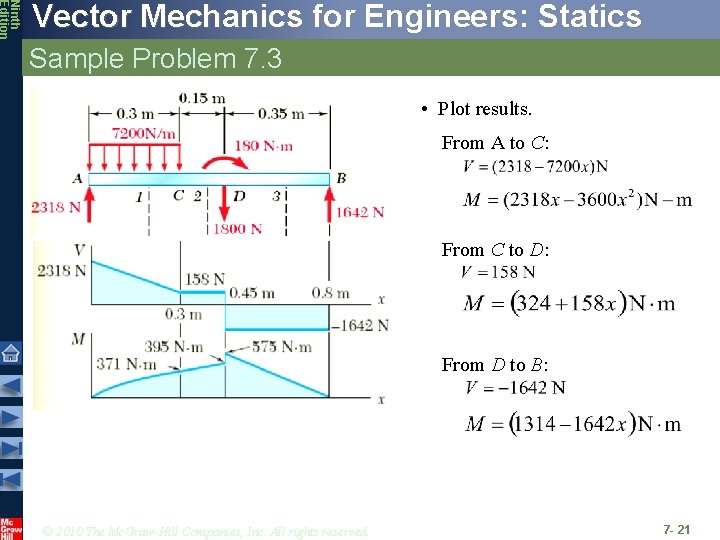
Ninth Edition Vector Mechanics for Engineers: Statics Sample Problem 7. 3 SOLUTION: • Taking entire beam as free-body, calculate reactions at A and B. • Determine equivalent internal forcecouple systems at sections cut within segments AC, CD, and DB. Draw the shear and bending moment diagrams for the beam AB. The distributed load of 7200 N/m extends over 0. 3 m. of the beam, from A to C, and the 1800 -N load is applied at E. • Plot results. © 2010 The Mc. Graw-Hill Companies, Inc. All rights reserved. 7 - 17
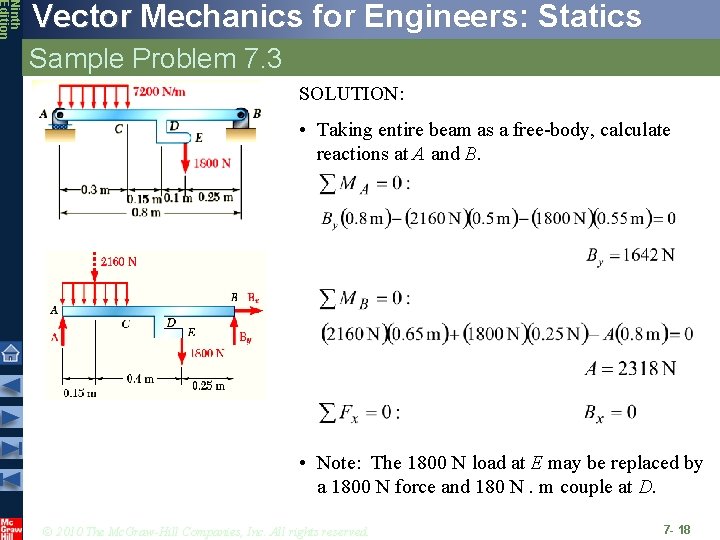
Ninth Edition Vector Mechanics for Engineers: Statics Sample Problem 7. 3 SOLUTION: • Taking entire beam as a free-body, calculate reactions at A and B. • Note: The 1800 N load at E may be replaced by a 1800 N force and 180 N. m couple at D. © 2010 The Mc. Graw-Hill Companies, Inc. All rights reserved. 7 - 18
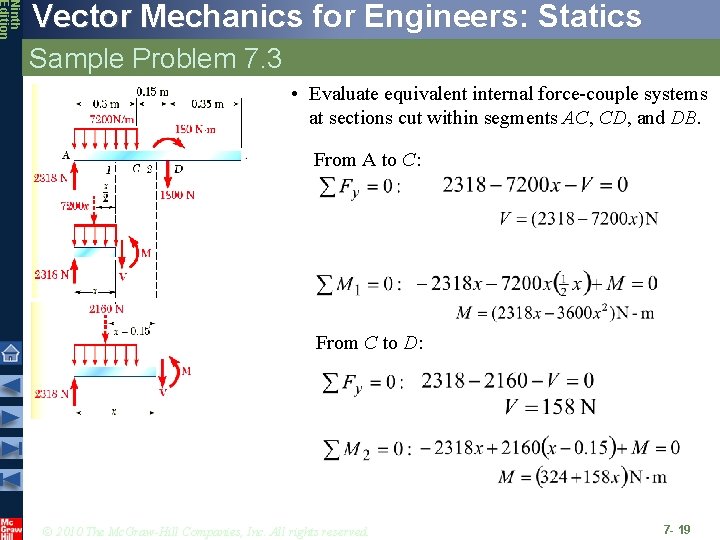
Ninth Edition Vector Mechanics for Engineers: Statics Sample Problem 7. 3 • Evaluate equivalent internal force-couple systems at sections cut within segments AC, CD, and DB. From A to C: From C to D: © 2010 The Mc. Graw-Hill Companies, Inc. All rights reserved. 7 - 19
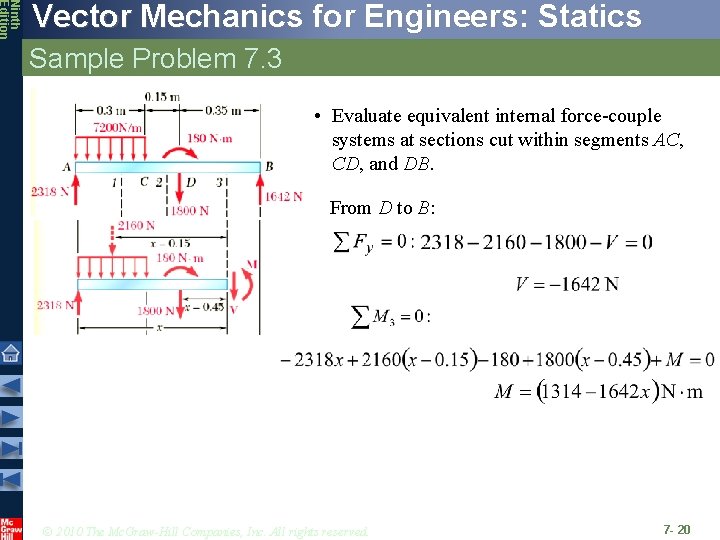
Ninth Edition Vector Mechanics for Engineers: Statics Sample Problem 7. 3 • Evaluate equivalent internal force-couple systems at sections cut within segments AC, CD, and DB. From D to B: © 2010 The Mc. Graw-Hill Companies, Inc. All rights reserved. 7 - 20
Ninth Edition Vector Mechanics for Engineers: Statics Sample Problem 7. 3 • Plot results. From A to C: From C to D: From D to B: © 2010 The Mc. Graw-Hill Companies, Inc. All rights reserved. 7 - 21
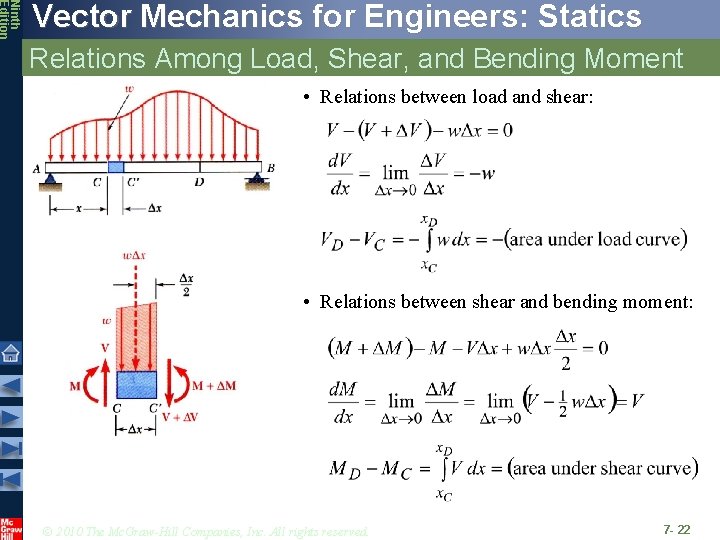
Ninth Edition Vector Mechanics for Engineers: Statics Relations Among Load, Shear, and Bending Moment • Relations between load and shear: • Relations between shear and bending moment: © 2010 The Mc. Graw-Hill Companies, Inc. All rights reserved. 7 - 22
Ninth Edition Vector Mechanics for Engineers: Statics Relations Among Load, Shear, and Bending Moment • Reactions at supports, • Shear curve, • Moment curve, © 2010 The Mc. Graw-Hill Companies, Inc. All rights reserved. 7 - 23
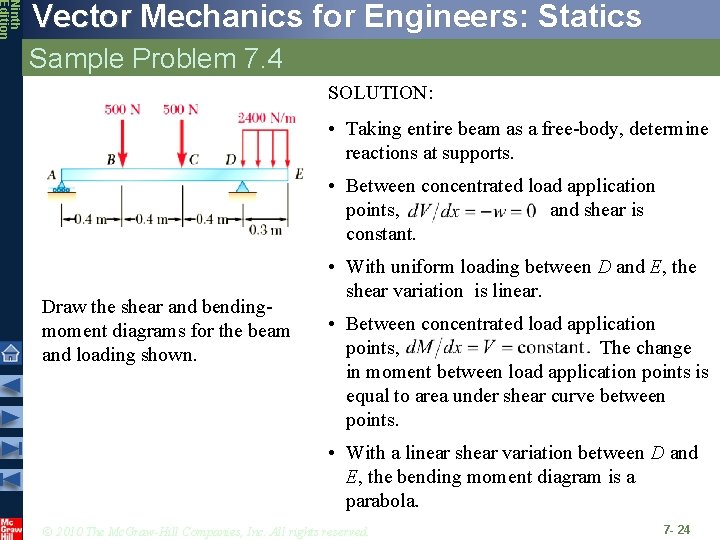
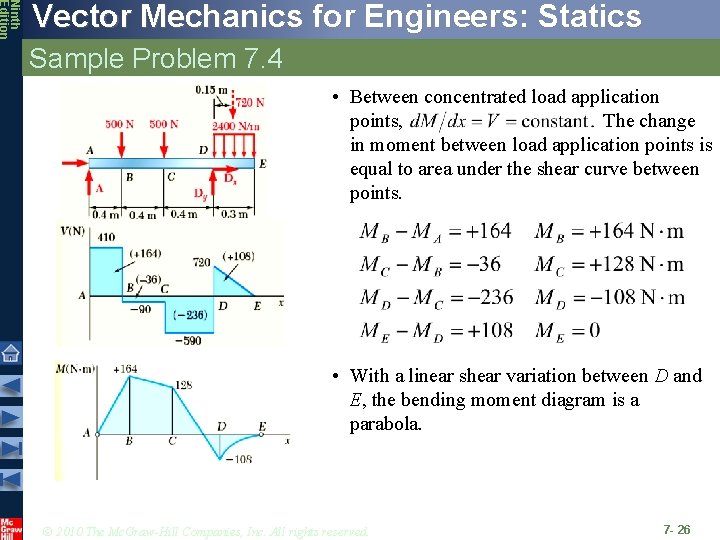
Ninth Edition Vector Mechanics for Engineers: Statics Sample Problem 7. 4 SOLUTION: • Taking entire beam as a free-body, determine reactions at supports. • Between concentrated load application points, and shear is constant. Draw the shear and bendingmoment diagrams for the beam and loading shown. • With uniform loading between D and E, the shear variation is linear. • Between concentrated load application points, The change in moment between load application points is equal to area under shear curve between points. • With a linear shear variation between D and E, the bending moment diagram is a parabola. © 2010 The Mc. Graw-Hill Companies, Inc. All rights reserved. 7 - 24
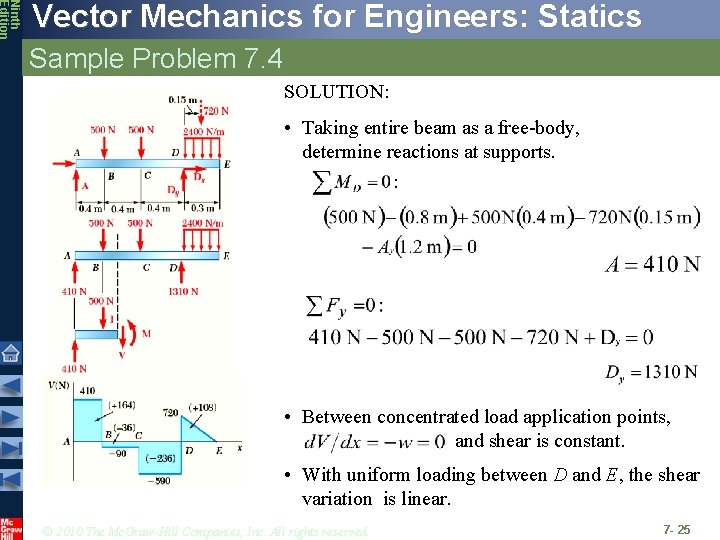
Ninth Edition Vector Mechanics for Engineers: Statics Sample Problem 7. 4 SOLUTION: • Taking entire beam as a free-body, determine reactions at supports. • Between concentrated load application points, and shear is constant. • With uniform loading between D and E, the shear variation is linear. © 2010 The Mc. Graw-Hill Companies, Inc. All rights reserved. 7 - 25
Ninth Edition Vector Mechanics for Engineers: Statics Sample Problem 7. 4 • Between concentrated load application points, The change in moment between load application points is equal to area under the shear curve between points. • With a linear shear variation between D and E, the bending moment diagram is a parabola. © 2010 The Mc. Graw-Hill Companies, Inc. All rights reserved. 7 - 26
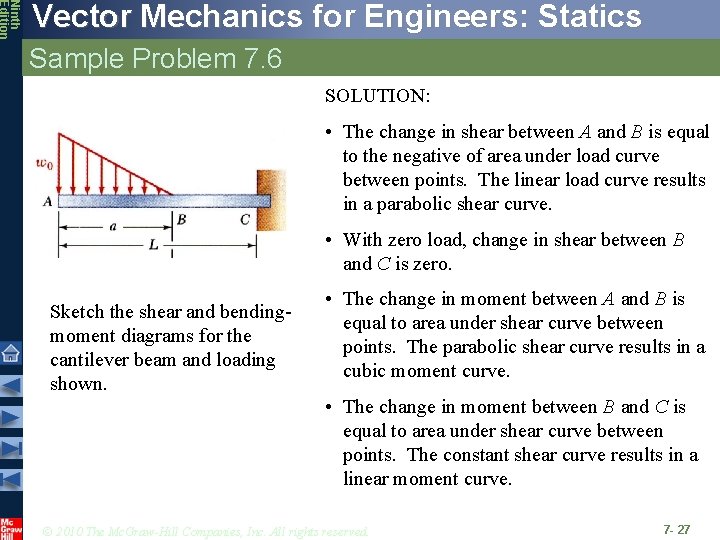
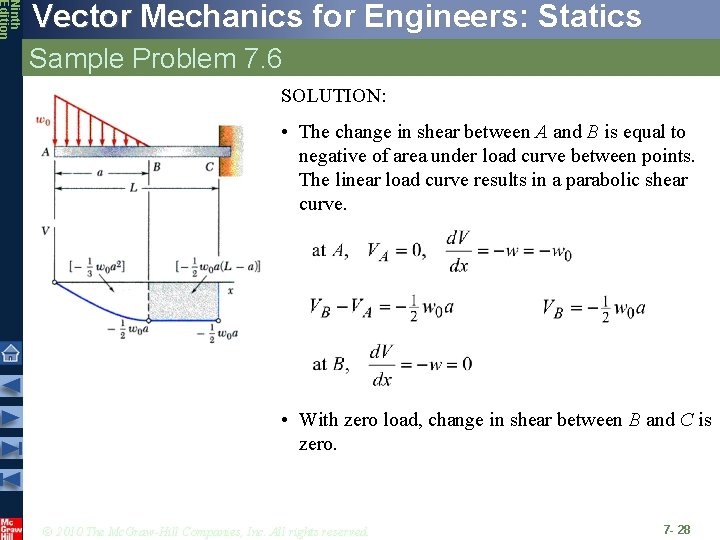
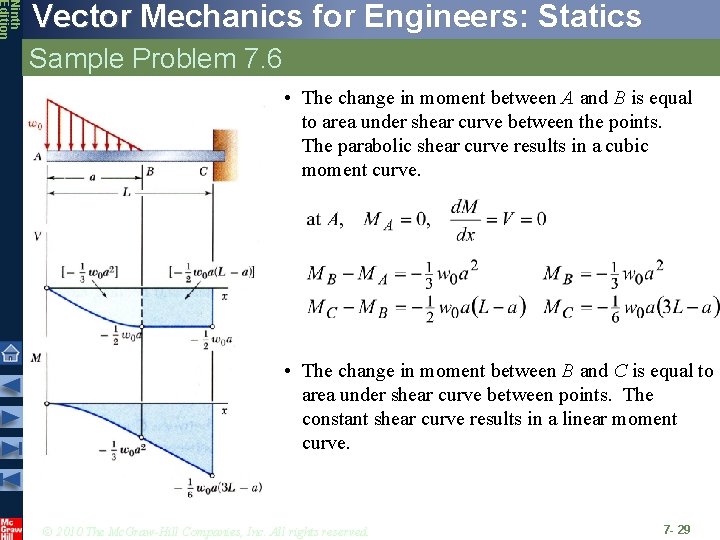
Ninth Edition Vector Mechanics for Engineers: Statics Sample Problem 7. 6 SOLUTION: • The change in shear between A and B is equal to the negative of area under load curve between points. The linear load curve results in a parabolic shear curve. • With zero load, change in shear between B and C is zero. Sketch the shear and bendingmoment diagrams for the cantilever beam and loading shown. • The change in moment between A and B is equal to area under shear curve between points. The parabolic shear curve results in a cubic moment curve. • The change in moment between B and C is equal to area under shear curve between points. The constant shear curve results in a linear moment curve. © 2010 The Mc. Graw-Hill Companies, Inc. All rights reserved. 7 - 27
Ninth Edition Vector Mechanics for Engineers: Statics Sample Problem 7. 6 SOLUTION: • The change in shear between A and B is equal to negative of area under load curve between points. The linear load curve results in a parabolic shear curve. • With zero load, change in shear between B and C is zero. © 2010 The Mc. Graw-Hill Companies, Inc. All rights reserved. 7 - 28
Ninth Edition Vector Mechanics for Engineers: Statics Sample Problem 7. 6 • The change in moment between A and B is equal to area under shear curve between the points. The parabolic shear curve results in a cubic moment curve. • The change in moment between B and C is equal to area under shear curve between points. The constant shear curve results in a linear moment curve. © 2010 The Mc. Graw-Hill Companies, Inc. All rights reserved. 7 - 29
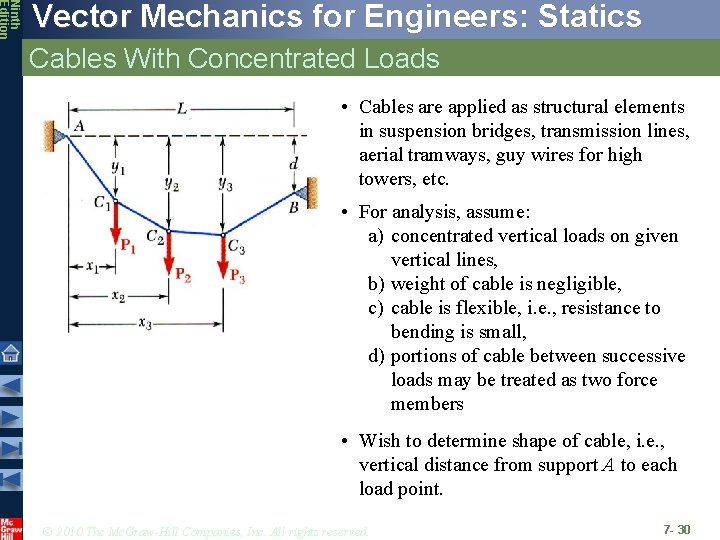
Ninth Edition Vector Mechanics for Engineers: Statics Cables With Concentrated Loads • Cables are applied as structural elements in suspension bridges, transmission lines, aerial tramways, guy wires for high towers, etc. • For analysis, assume: a) concentrated vertical loads on given vertical lines, b) weight of cable is negligible, c) cable is flexible, i. e. , resistance to bending is small, d) portions of cable between successive loads may be treated as two force members • Wish to determine shape of cable, i. e. , vertical distance from support A to each load point. © 2010 The Mc. Graw-Hill Companies, Inc. All rights reserved. 7 - 30
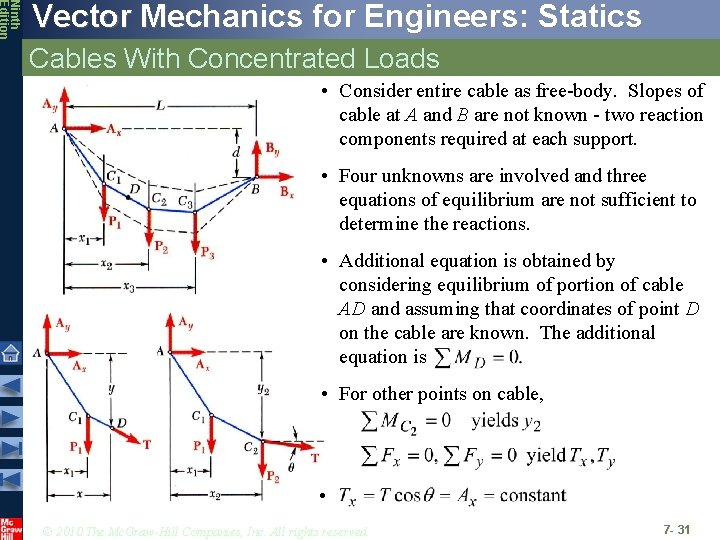
Ninth Edition Vector Mechanics for Engineers: Statics Cables With Concentrated Loads • Consider entire cable as free-body. Slopes of cable at A and B are not known - two reaction components required at each support. • Four unknowns are involved and three equations of equilibrium are not sufficient to determine the reactions. • Additional equation is obtained by considering equilibrium of portion of cable AD and assuming that coordinates of point D on the cable are known. The additional equation is • For other points on cable, • © 2010 The Mc. Graw-Hill Companies, Inc. All rights reserved. 7 - 31
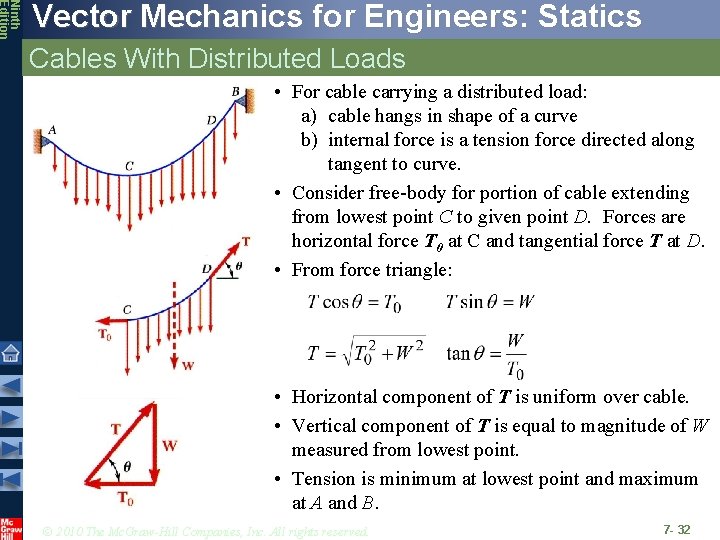
Ninth Edition Vector Mechanics for Engineers: Statics Cables With Distributed Loads • For cable carrying a distributed load: a) cable hangs in shape of a curve b) internal force is a tension force directed along tangent to curve. • Consider free-body for portion of cable extending from lowest point C to given point D. Forces are horizontal force T 0 at C and tangential force T at D. • From force triangle: • Horizontal component of T is uniform over cable. • Vertical component of T is equal to magnitude of W measured from lowest point. • Tension is minimum at lowest point and maximum at A and B. © 2010 The Mc. Graw-Hill Companies, Inc. All rights reserved. 7 - 32
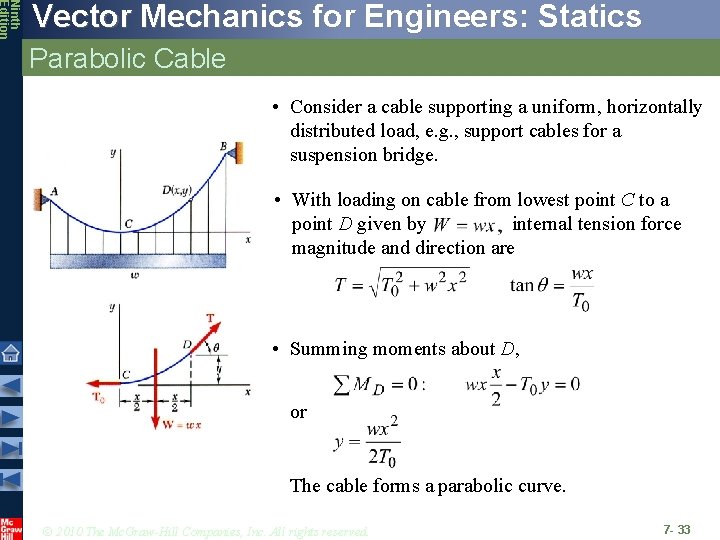
Ninth Edition Vector Mechanics for Engineers: Statics Parabolic Cable • Consider a cable supporting a uniform, horizontally distributed load, e. g. , support cables for a suspension bridge. • With loading on cable from lowest point C to a point D given by internal tension force magnitude and direction are • Summing moments about D, or The cable forms a parabolic curve. © 2010 The Mc. Graw-Hill Companies, Inc. All rights reserved. 7 - 33
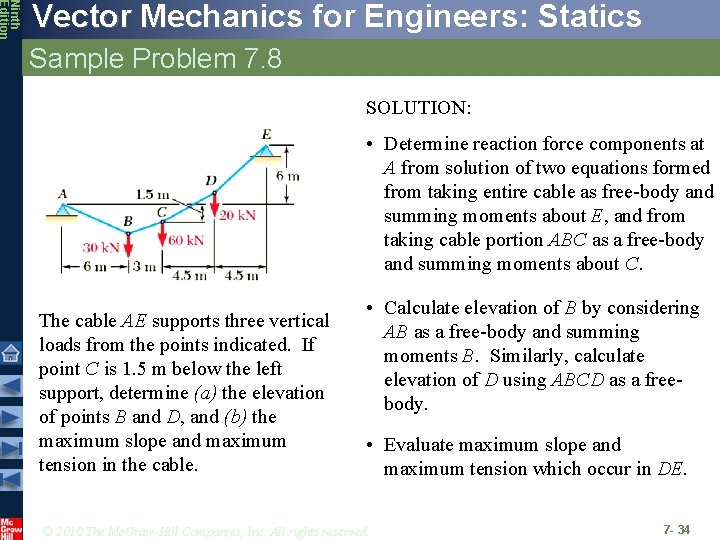
Ninth Edition Vector Mechanics for Engineers: Statics Sample Problem 7. 8 SOLUTION: • Determine reaction force components at A from solution of two equations formed from taking entire cable as free-body and summing moments about E, and from taking cable portion ABC as a free-body and summing moments about C. The cable AE supports three vertical loads from the points indicated. If point C is 1. 5 m below the left support, determine (a) the elevation of points B and D, and (b) the maximum slope and maximum tension in the cable. • Calculate elevation of B by considering AB as a free-body and summing moments B. Similarly, calculate elevation of D using ABCD as a freebody. • Evaluate maximum slope and maximum tension which occur in DE. © 2010 The Mc. Graw-Hill Companies, Inc. All rights reserved. 7 - 34
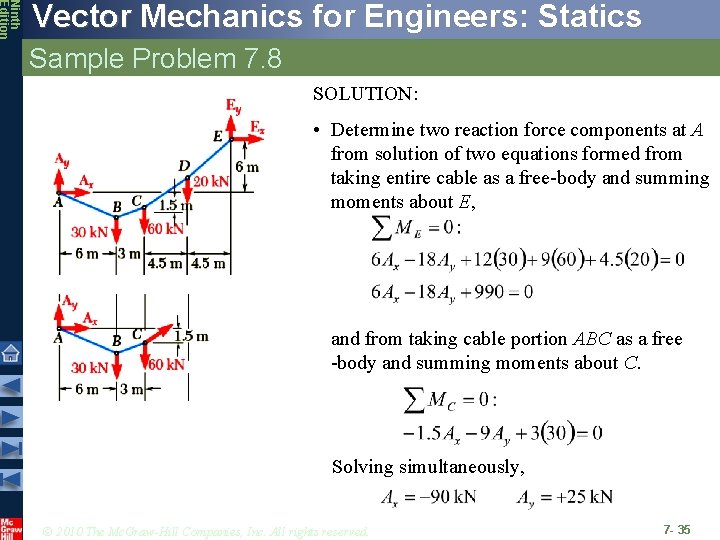
Ninth Edition Vector Mechanics for Engineers: Statics Sample Problem 7. 8 SOLUTION: • Determine two reaction force components at A from solution of two equations formed from taking entire cable as a free-body and summing moments about E, and from taking cable portion ABC as a free -body and summing moments about C. Solving simultaneously, © 2010 The Mc. Graw-Hill Companies, Inc. All rights reserved. 7 - 35
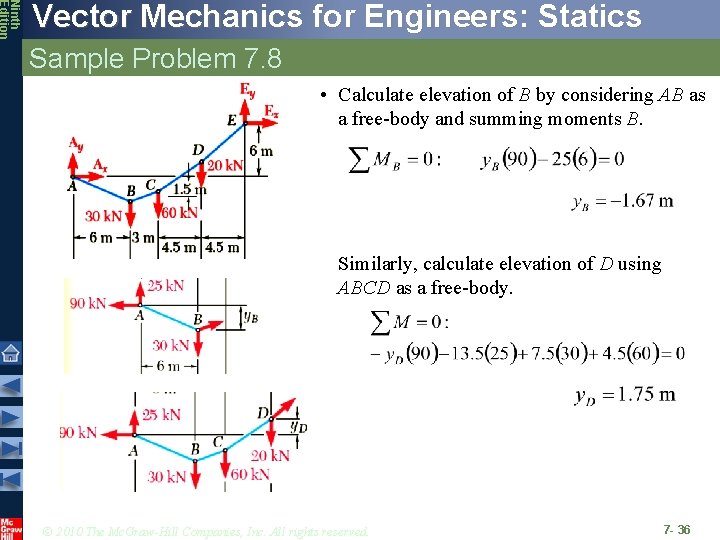
Ninth Edition Vector Mechanics for Engineers: Statics Sample Problem 7. 8 • Calculate elevation of B by considering AB as a free-body and summing moments B. Similarly, calculate elevation of D using ABCD as a free-body. © 2010 The Mc. Graw-Hill Companies, Inc. All rights reserved. 7 - 36
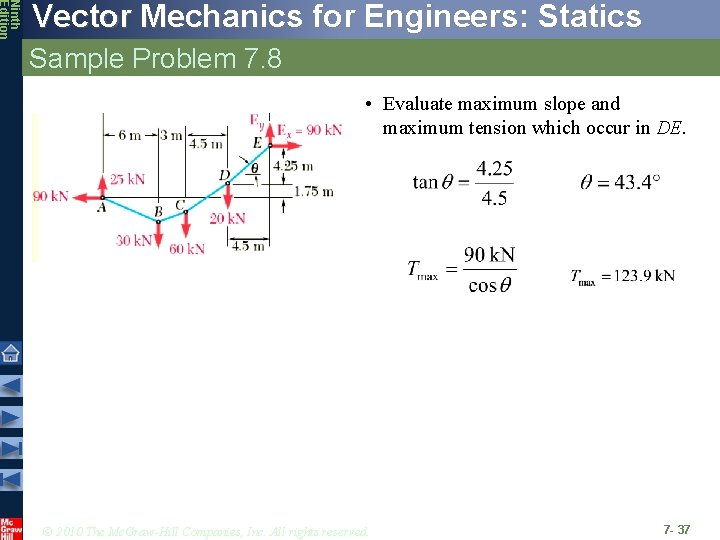
Ninth Edition Vector Mechanics for Engineers: Statics Sample Problem 7. 8 • Evaluate maximum slope and maximum tension which occur in DE. © 2010 The Mc. Graw-Hill Companies, Inc. All rights reserved. 7 - 37
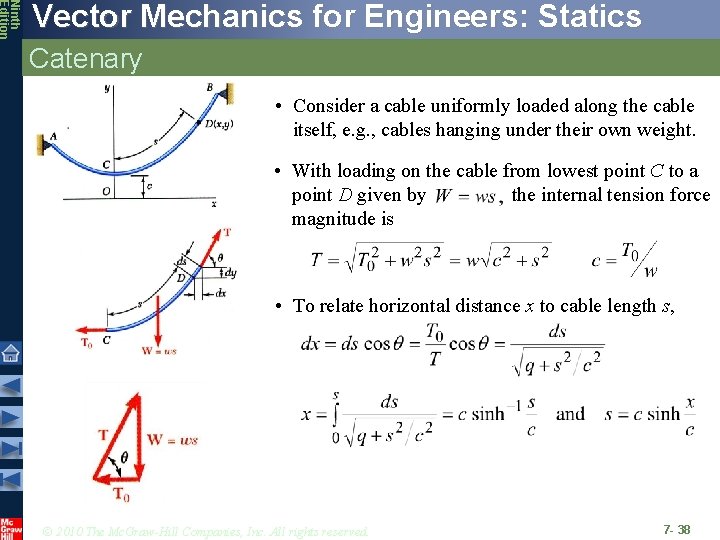
Ninth Edition Vector Mechanics for Engineers: Statics Catenary • Consider a cable uniformly loaded along the cable itself, e. g. , cables hanging under their own weight. • With loading on the cable from lowest point C to a point D given by the internal tension force magnitude is • To relate horizontal distance x to cable length s, © 2010 The Mc. Graw-Hill Companies, Inc. All rights reserved. 7 - 38
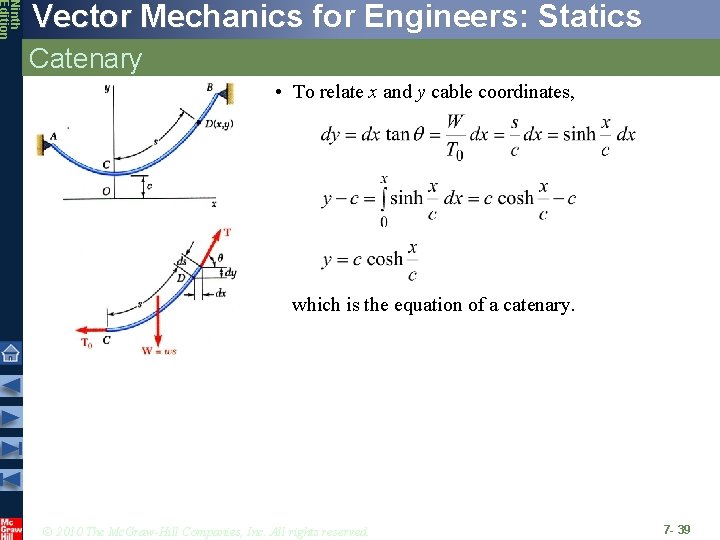
Ninth Edition Vector Mechanics for Engineers: Statics Catenary • To relate x and y cable coordinates, which is the equation of a catenary. © 2010 The Mc. Graw-Hill Companies, Inc. All rights reserved. 7 - 39