
NineteenthCentury European Romantic Nationalism Russian Peasant Villages later
- Slides: 73
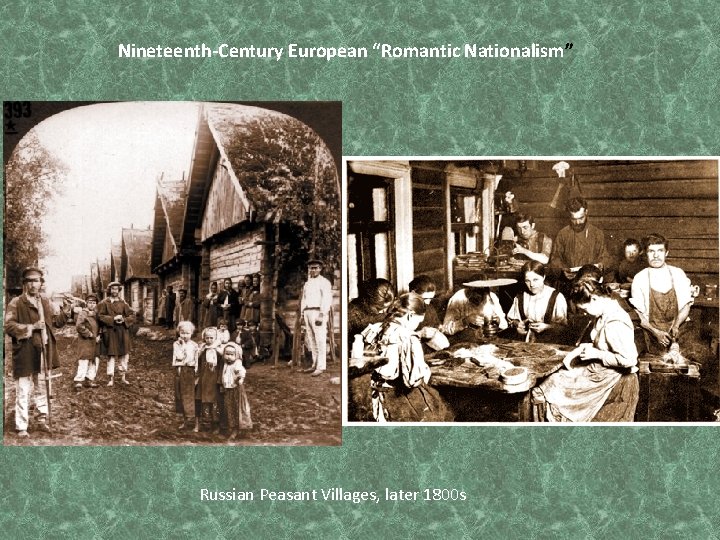
Nineteenth-Century European “Romantic Nationalism” Russian Peasant Villages, later 1800 s
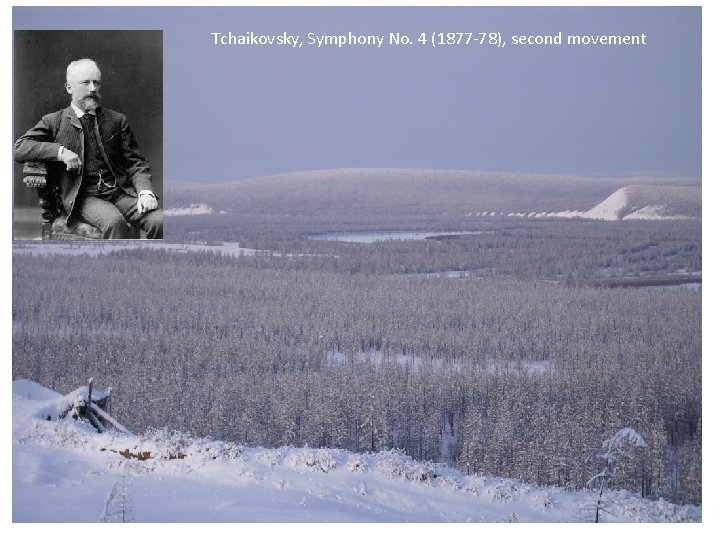
Tchaikovsky, Symphony No. 4 (1877 -78), second movement
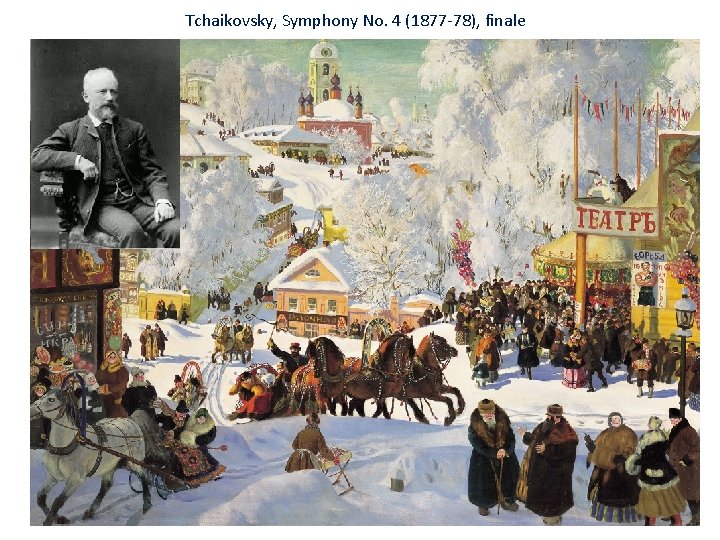
Tchaikovsky, Symphony No. 4 (1877 -78), finale
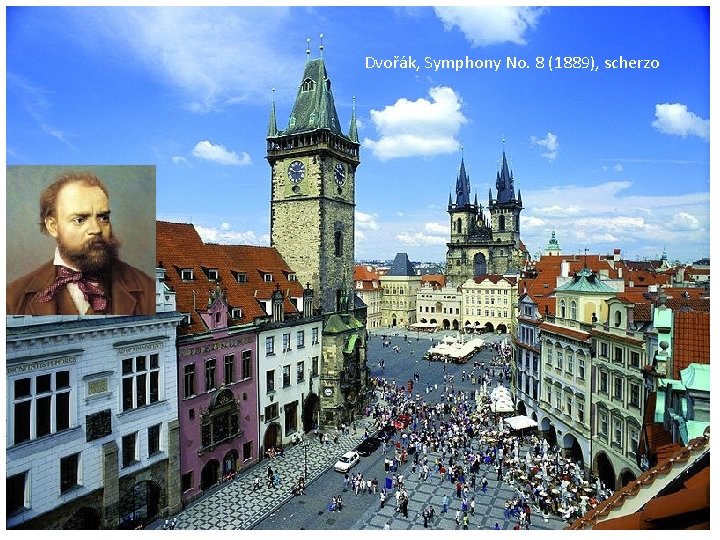
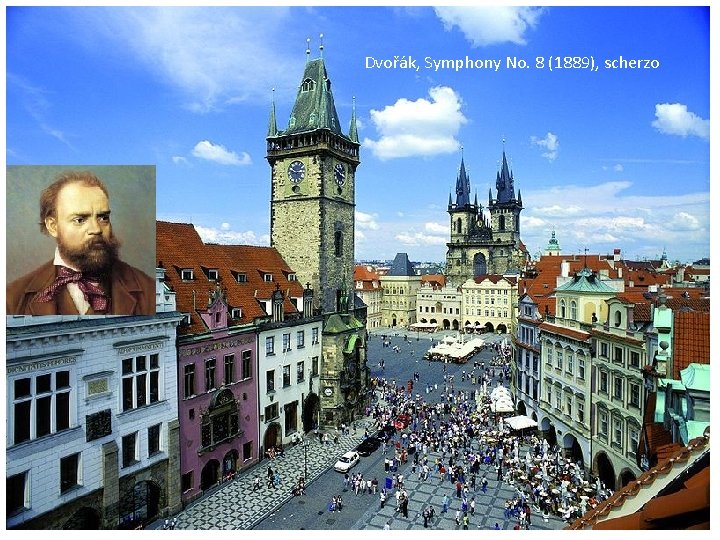
Dvořák, Symphony No. 8 (1889), scherzo
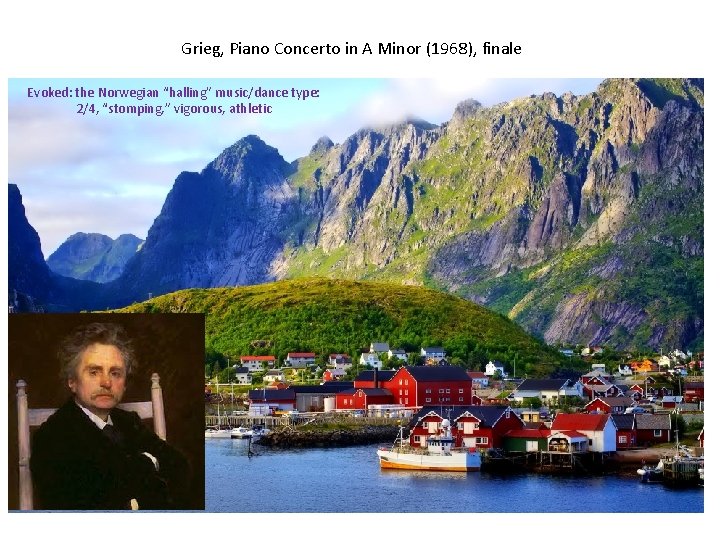
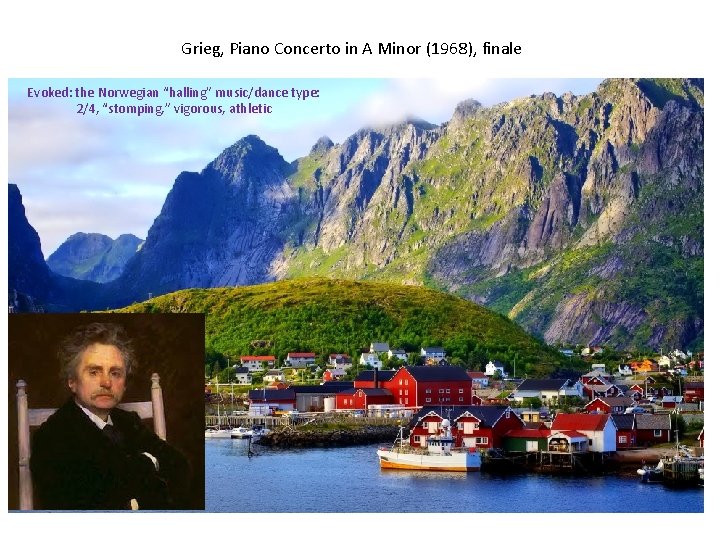
Grieg, Piano Concerto in A Minor (1968), finale Evoked: the Norwegian “halling” music/dance type: 2/4, “stomping, ” vigorous, athletic
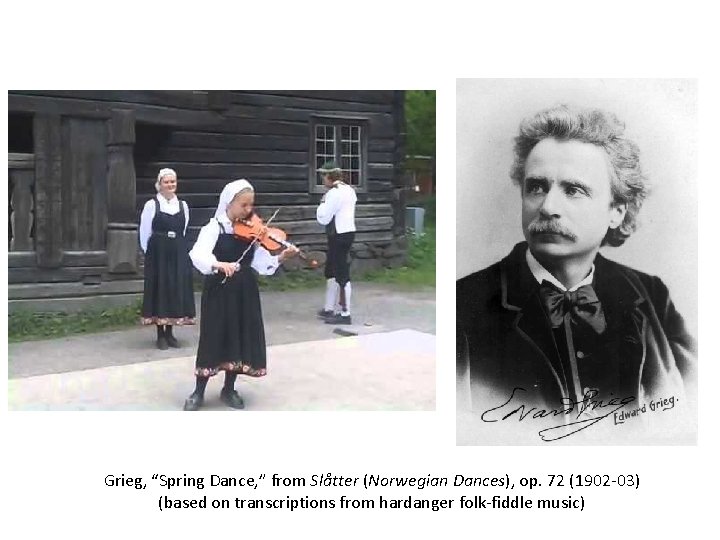
Grieg, “Spring Dance, ” from Slåtter (Norwegian Dances), op. 72 (1902 -03) (based on transcriptions from hardanger folk-fiddle music)
Nineteenth-Century European “Romantic Nationalism”
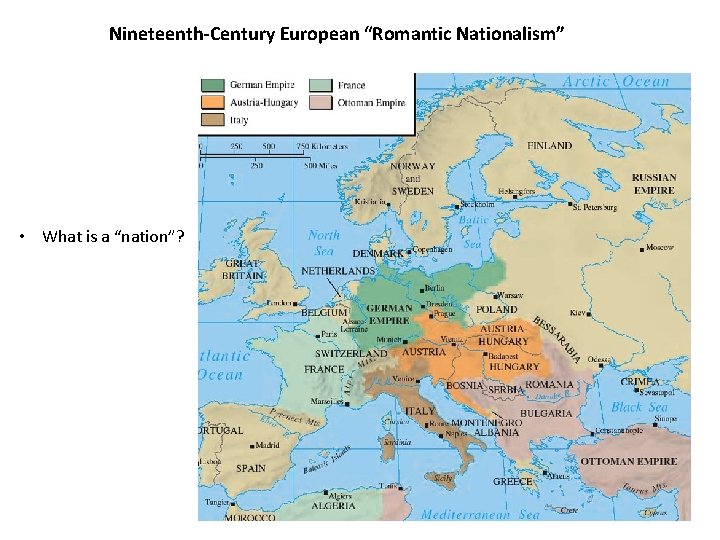
Nineteenth-Century European “Romantic Nationalism” • What is a “nation”?
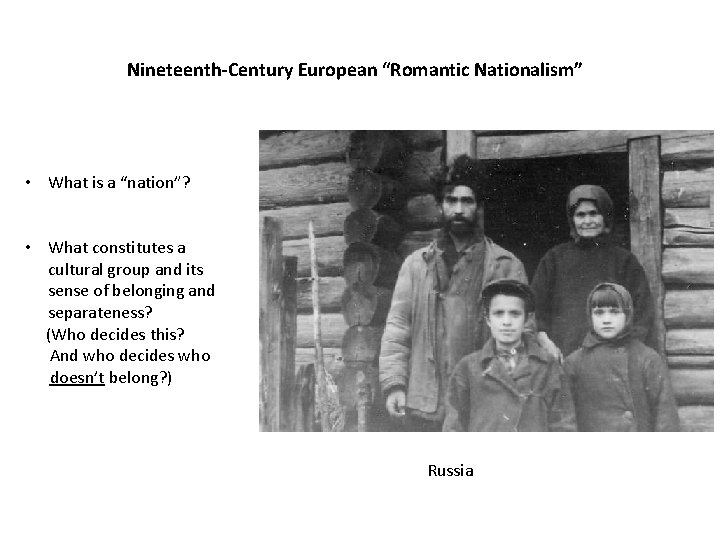
Nineteenth-Century European “Romantic Nationalism” • What is a “nation”? • What constitutes a cultural group and its sense of belonging and separateness? (Who decides this? And who decides who doesn’t belong? ) Russia
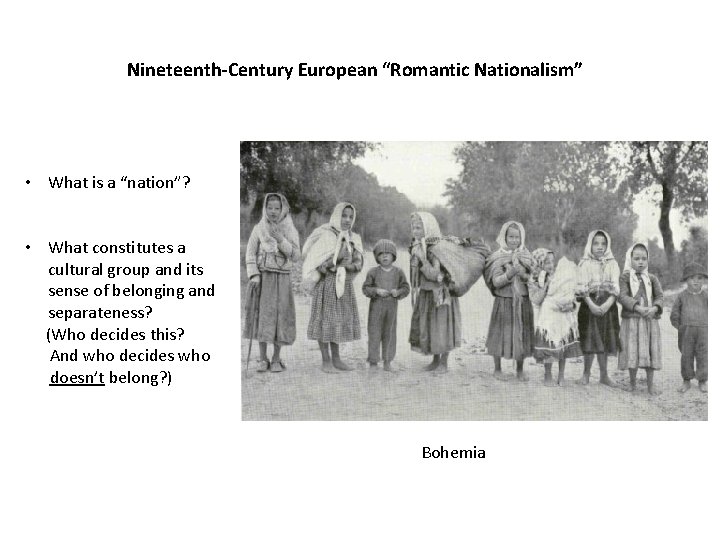
Nineteenth-Century European “Romantic Nationalism” • What is a “nation”? • What constitutes a cultural group and its sense of belonging and separateness? (Who decides this? And who decides who doesn’t belong? ) Bohemia
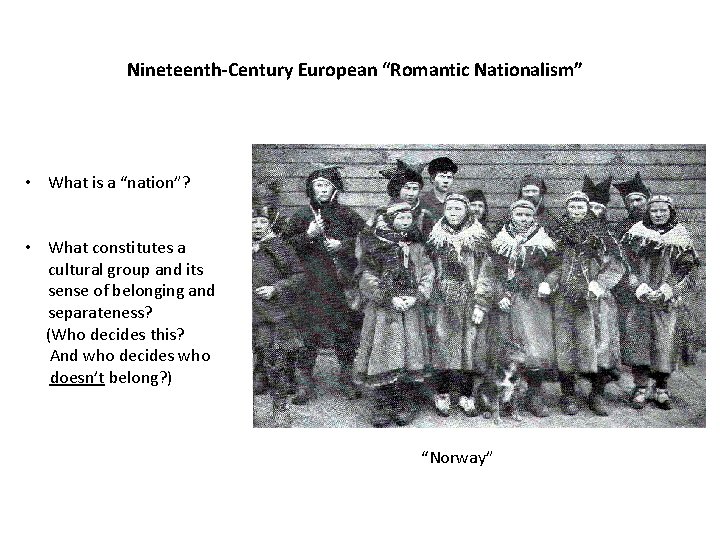
Nineteenth-Century European “Romantic Nationalism” • What is a “nation”? • What constitutes a cultural group and its sense of belonging and separateness? (Who decides this? And who decides who doesn’t belong? ) “Norway”
Why did this nationalistic/folkloric surge (”Romantic nationalism”) well up so powerfully in the nineteenth century?
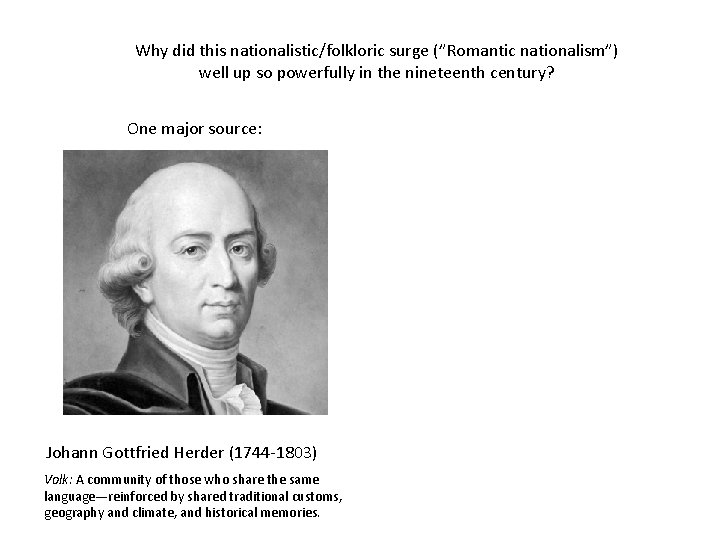
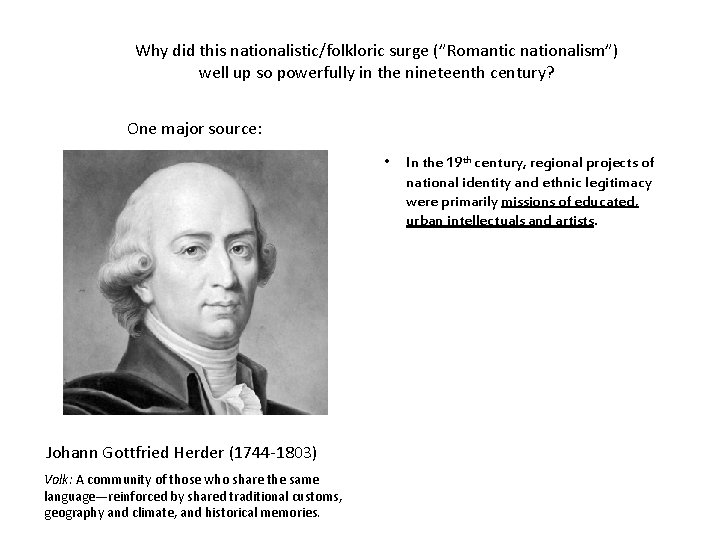
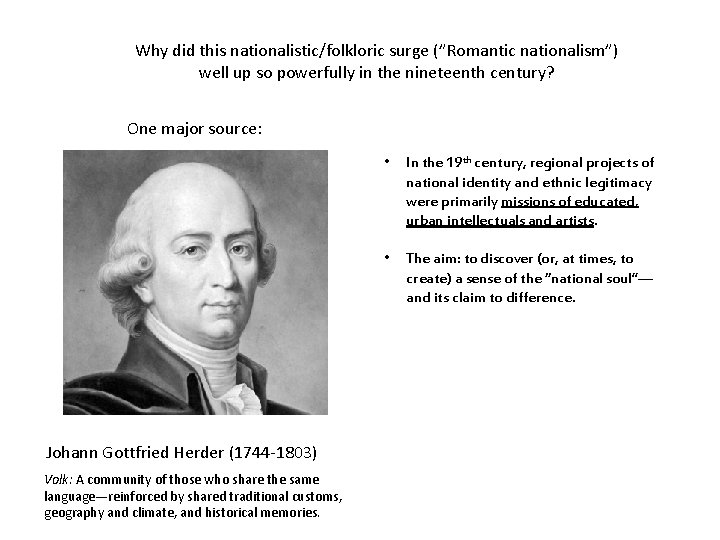
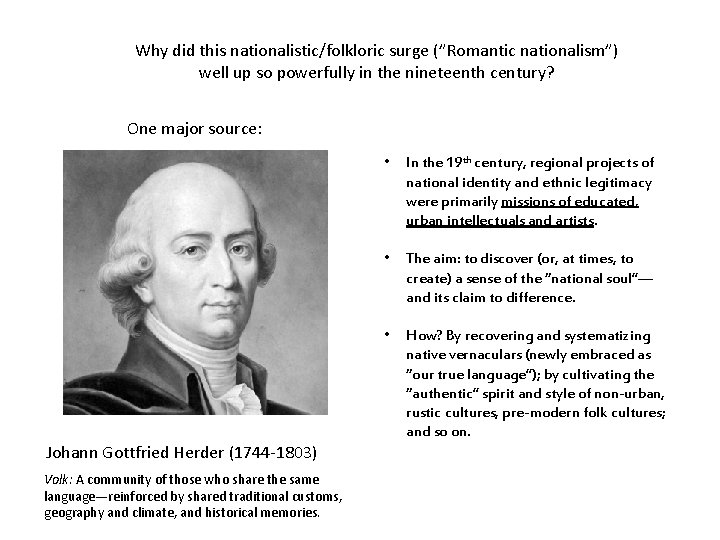
Why did this nationalistic/folkloric surge (”Romantic nationalism”) well up so powerfully in the nineteenth century? One major source: Johann Gottfried Herder (1744 -1803) Volk: A community of those who share the same language—reinforced by shared traditional customs, geography and climate, and historical memories.
Why did this nationalistic/folkloric surge (”Romantic nationalism”) well up so powerfully in the nineteenth century? One major source: • Johann Gottfried Herder (1744 -1803) Volk: A community of those who share the same language—reinforced by shared traditional customs, geography and climate, and historical memories. In the 19 th century, regional projects of national identity and ethnic legitimacy were primarily missions of educated, urban intellectuals and artists.
Why did this nationalistic/folkloric surge (”Romantic nationalism”) well up so powerfully in the nineteenth century? One major source: Johann Gottfried Herder (1744 -1803) Volk: A community of those who share the same language—reinforced by shared traditional customs, geography and climate, and historical memories. • In the 19 th century, regional projects of national identity and ethnic legitimacy were primarily missions of educated, urban intellectuals and artists. • The aim: to discover (or, at times, to create) a sense of the “national soul”— and its claim to difference.
Why did this nationalistic/folkloric surge (”Romantic nationalism”) well up so powerfully in the nineteenth century? One major source: Johann Gottfried Herder (1744 -1803) Volk: A community of those who share the same language—reinforced by shared traditional customs, geography and climate, and historical memories. • In the 19 th century, regional projects of national identity and ethnic legitimacy were primarily missions of educated, urban intellectuals and artists. • The aim: to discover (or, at times, to create) a sense of the “national soul”— and its claim to difference. • How? By recovering and systematizing native vernaculars (newly embraced as “our true language”); by cultivating the “authentic” spirit and style of non-urban, rustic cultures, pre-modern folk cultures; and so on.
“Ethnic Nationalism” • “The main task of an ethnic intelligentsia [is] to mobilize a formerly passive community into forming a nation around the new vernacular historical culture that it has recovered” (64)
“Ethnic Nationalism” • “The main task of an ethnic intelligentsia [is] to mobilize a formerly passive community into forming a nation around the new vernacular historical culture that it has recovered” (64) • The method: “ethnosymbolism”: “summoning intellectuals everywhere to transform ‘low’ into ‘high’ cultures, oral into written. . . in order to preserve for posterity its fund of irreplaceable culture values” (84)
“Ethnic Nationalism” • “The main task of an ethnic intelligentsia [is] to mobilize a formerly passive community into forming a nation around the new vernacular historical culture that it has recovered” (64) • The method: “ethnosymbolism”: “summoning intellectuals everywhere to transform ‘low’ into ‘high’ cultures, oral into written. . . in order to preserve for posterity its fund of irreplaceable culture values” (84) Cf. the concept of French writer Pierre Nora: cultural artifacts, monuments, museums, symbols, etc. , as “sites of memory (lieux de mémoire)
Nineteenth-Century European “Romantic Nationalism” (Capturing and Promoting the “National Soul”)
Nineteenth-Century European “Romantic Nationalism” (Capturing and Promoting the “National Soul”) • Defining oneself by difference (language, history of one’s people, folk traditions and customs, culture)
Nineteenth-Century European “Romantic Nationalism” (Capturing and Promoting the “National Soul”) • Defining oneself by difference (language, history of one’s people, folk traditions and customs, culture) • “Insiders”: markedly different from all other “outsider” cultures (especially from those who have political or cultural power over you)
Nineteenth-Century European “Romantic Nationalism” (Capturing and Promoting the “National Soul”) • Defining oneself by difference (language, history of one’s people, folk traditions and customs, culture) • “Insiders”: markedly different from all other “outsider” cultures (especially from those who have political or cultural power over you) • Therefore: a self-other binary (Taruskin)
Nineteenth-Century European “Romantic Nationalism” (Capturing and Promoting the “National Soul”) • Defining oneself by difference (language, history of one’s people, folk traditions and customs, culture) • “Insiders”: markedly different from all other “outsider” cultures (especially from those who have political or cultural power over you) • Therefore: a self-other binary (Taruskin) • Insistence: “‘They’ cannot define who ‘we’ are, authentically! ‘We’ will not fully assimilate into the ‘they!’”
Nineteenth-Century European “Romantic Nationalism” (Capturing and Promoting the “National Soul”) • Defining oneself by difference (language, history of one’s people, folk traditions and customs, culture) • “Insiders”: markedly different from all other “outsider” cultures (especially from those who have political or cultural power over you) • Therefore: a self-other binary (Taruskin) • Insistence: “‘They’ cannot define who ‘we’ are, authentically! ‘We’ will not fully assimilate into the ‘they!’” • Among the badges of ethnic identity and difference: rural music, folk music (regarded as a “truth language, ” as yet uncontaminated by the urban)
Nineteenth-Century European “Romantic Nationalism” (Capturing and Promoting the “National Soul”) • Defining oneself by difference (language, history of one’s people, folk traditions and customs, culture) • “Insiders”: markedly different from all other “outsider” cultures (especially from those who have political or cultural power over you) • Therefore: a self-other binary (Taruskin) • Insistence: “‘They’ cannot define who ‘we’ are, authentically! ‘We’ will not fully assimilate into the ‘they!’” • Among the badges of ethnic identity and difference: rural music, folk music (regarded as a “truth language, ” as yet uncontaminated by the urban)
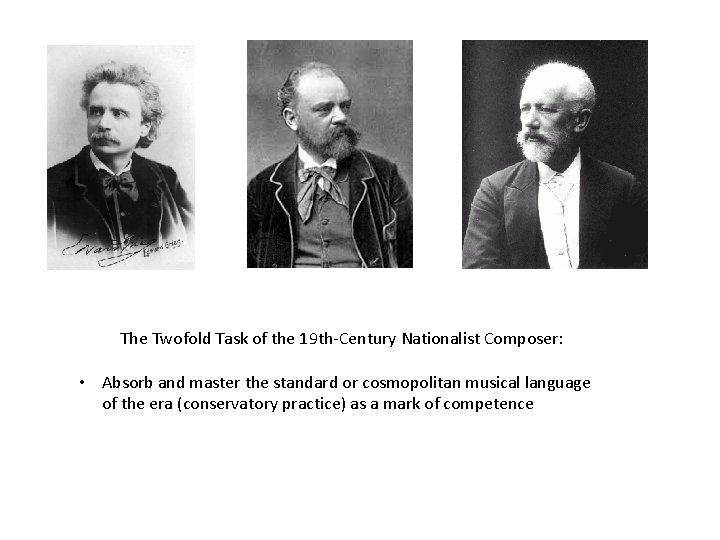
The Twofold Task of the 19 th-Century Nationalist Composer: • Absorb and master the standard or cosmopolitan musical language of the era (conservatory practice) as a mark of competence
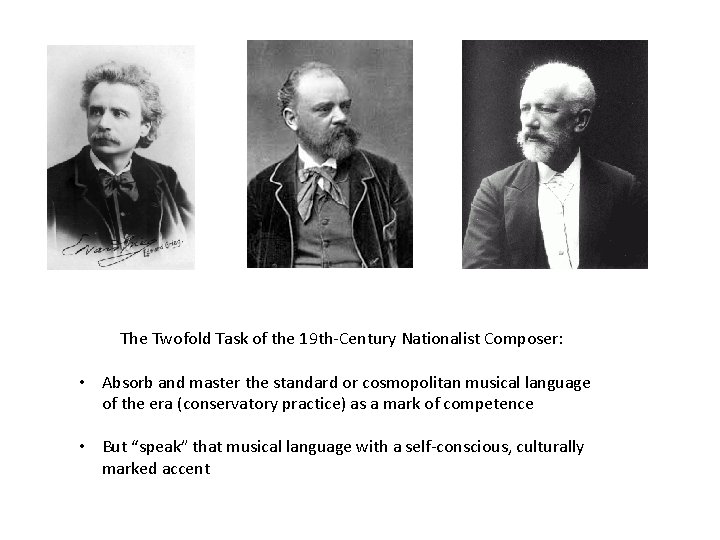
The Twofold Task of the 19 th-Century Nationalist Composer: • Absorb and master the standard or cosmopolitan musical language of the era (conservatory practice) as a mark of competence • But “speak” that musical language with a self-conscious, culturally marked accent
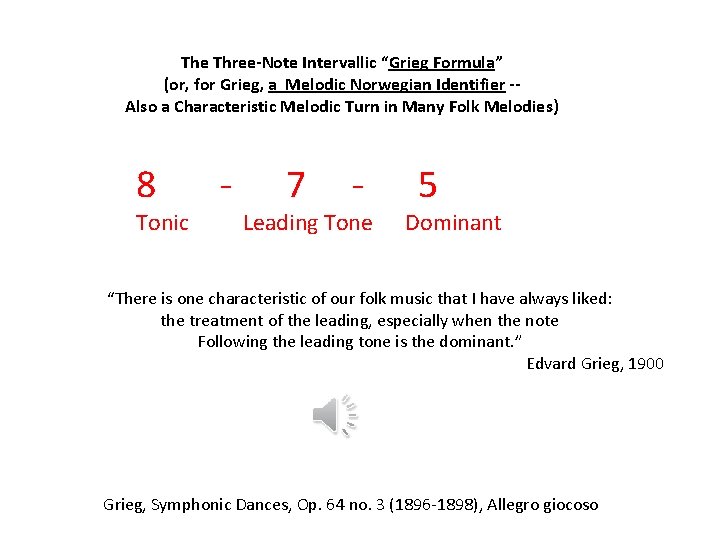
The Three-Note Intervallic “Grieg Formula” (or, for Grieg, a Melodic Norwegian Identifier -Also a Characteristic Melodic Turn in Many Folk Melodies) 8 Tonic - 7 - Leading Tone 5 Dominant “There is one characteristic of our folk music that I have always liked: the treatment of the leading, especially when the note Following the leading tone is the dominant. ” Edvard Grieg, 1900 Grieg, Symphonic Dances, Op. 64 no. 3 (1896 -1898), Allegro giocoso
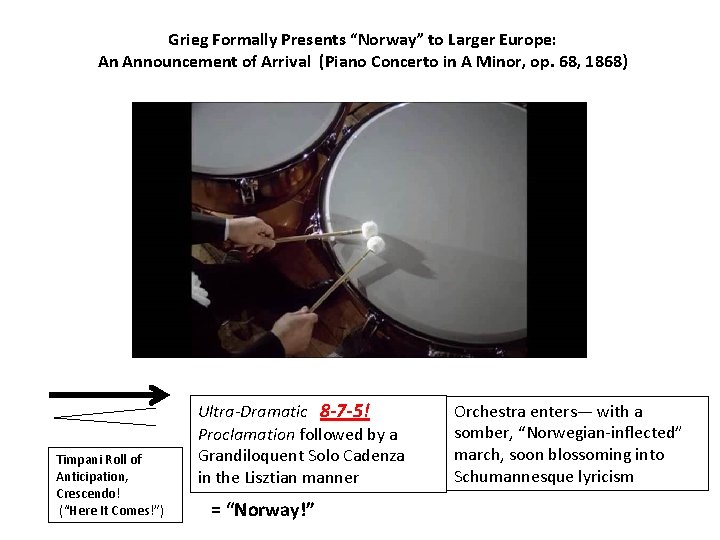
Grieg Formally Presents “Norway” to Larger Europe: An Announcement of Arrival (Piano Concerto in A Minor, op. 68, 1868) Timpani Roll of Anticipation, Crescendo! (“Here It Comes!”) Ultra-Dramatic 8 -7 -5! Proclamation followed by a Grandiloquent Solo Cadenza in the Lisztian manner = “Norway!” Orchestra enters— with a somber, “Norwegian-inflected” march, soon blossoming into Schumannesque lyricism
Grieg, Piano Concerto in A Minor (1968), finale Evoked: the Norwegian “halling” music/dance type: 2/4, “stomping, ” vigorous, athletic
Dvořák, Symphony No. 8 (1889), scherzo
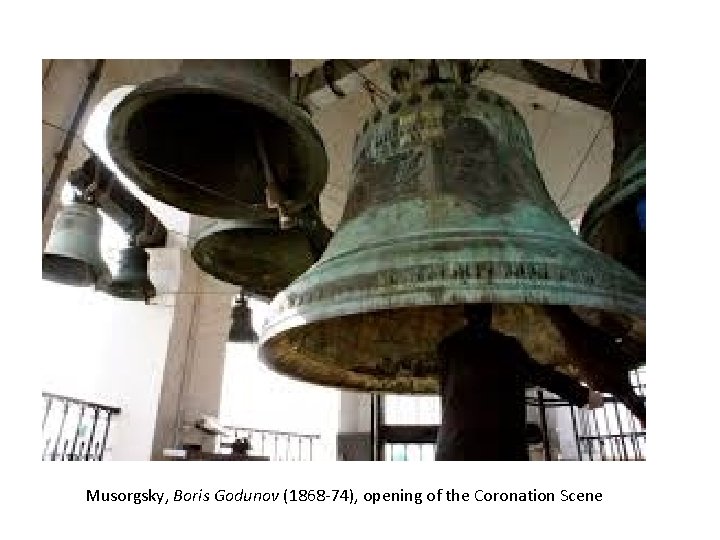
Musorgsky, Boris Godunov (1868 -74), opening of the Coronation Scene
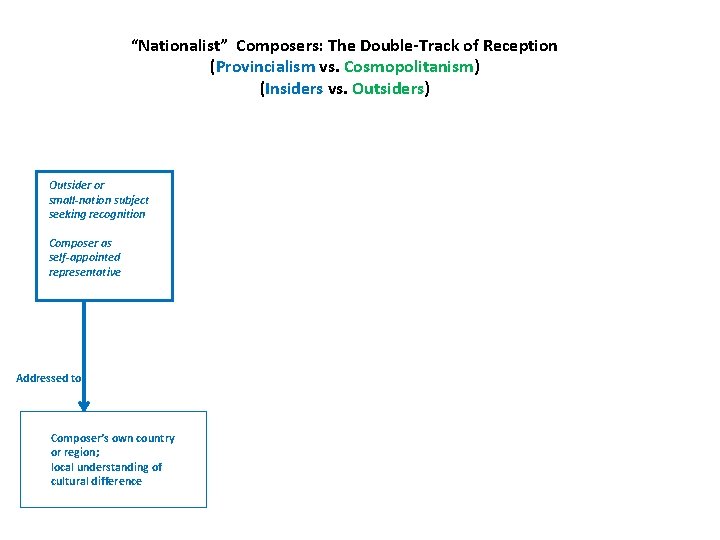
“Nationalist” Composers: The Double-Track of Reception (Provincialism vs. Cosmopolitanism) (Insiders vs. Outsiders) Outsider or small-nation subject seeking recognition Composer as self-appointed representative Addressed to: Composer’s own country or region; local understanding of cultural difference
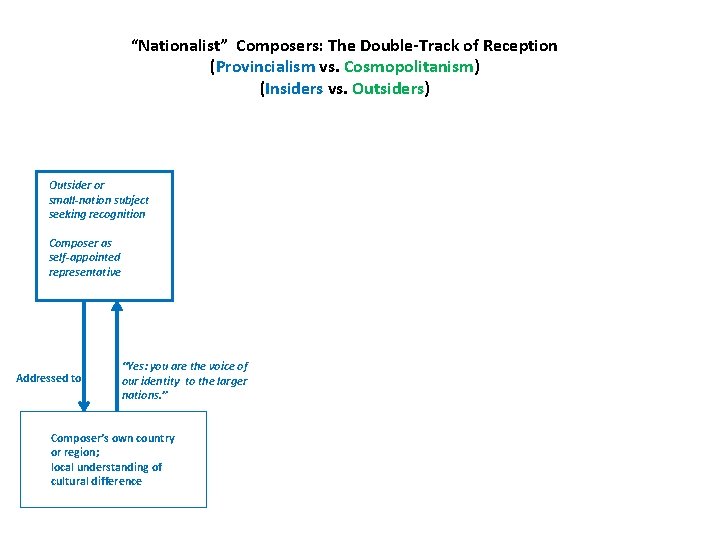
“Nationalist” Composers: The Double-Track of Reception (Provincialism vs. Cosmopolitanism) (Insiders vs. Outsiders) Outsider or small-nation subject seeking recognition Composer as self-appointed representative Addressed to: “Yes: you are the voice of our identity to the larger nations. ” Composer’s own country or region; local understanding of cultural difference
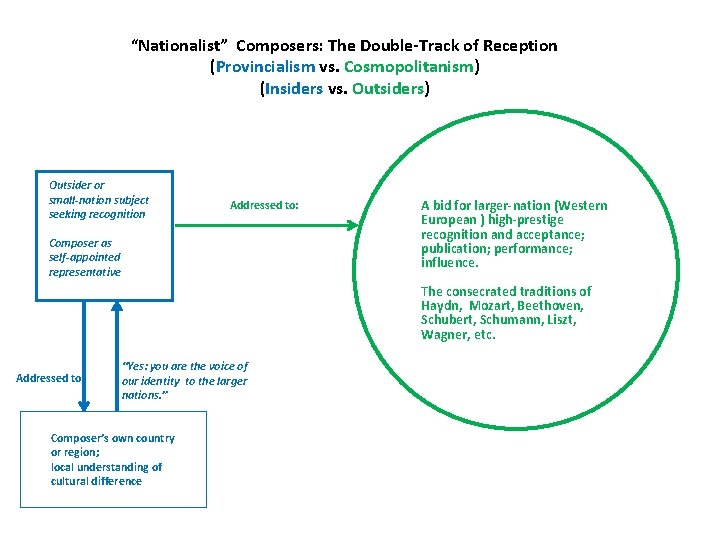
“Nationalist” Composers: The Double-Track of Reception (Provincialism vs. Cosmopolitanism) (Insiders vs. Outsiders) Outsider or small-nation subject seeking recognition Addressed to: Composer as self-appointed representative A bid for larger-nation (Western European ) high-prestige recognition and acceptance; publication; performance; influence. The consecrated traditions of Haydn, Mozart, Beethoven, Schubert, Schumann, Liszt, Wagner, etc. Addressed to: “Yes: you are the voice of our identity to the larger nations. ” Composer’s own country or region; local understanding of cultural difference
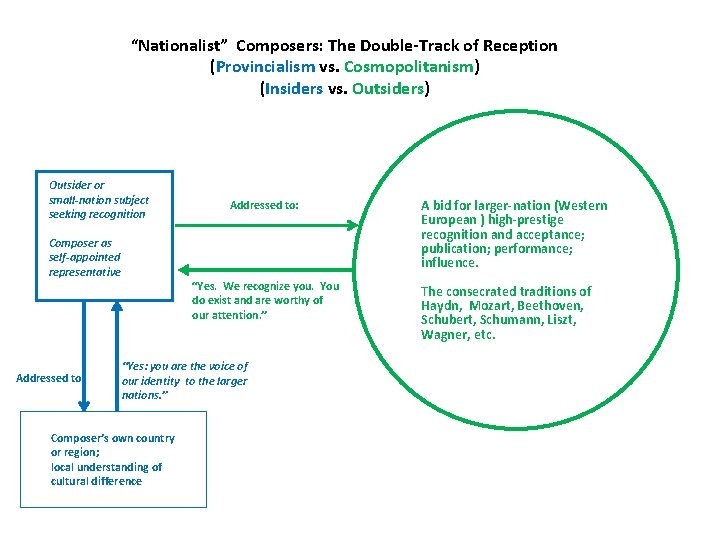
“Nationalist” Composers: The Double-Track of Reception (Provincialism vs. Cosmopolitanism) (Insiders vs. Outsiders) Outsider or small-nation subject seeking recognition Composer as self-appointed representative Addressed to: “Yes. We recognize you. You do exist and are worthy of our attention. ” “Yes: you are the voice of our identity to the larger nations. ” Composer’s own country or region; local understanding of cultural difference A bid for larger-nation (Western European ) high-prestige recognition and acceptance; publication; performance; influence. The consecrated traditions of Haydn, Mozart, Beethoven, Schubert, Schumann, Liszt, Wagner, etc.
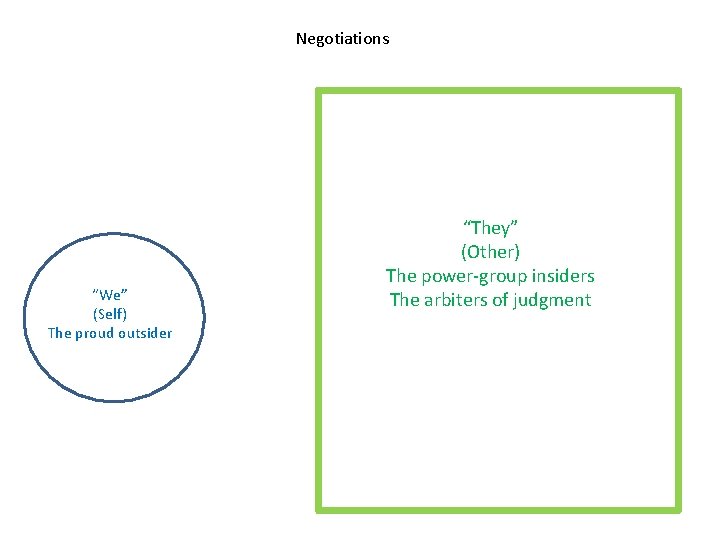
Negotiations “We” (Self) The proud outsider “They” (Other) The power-group insiders The arbiters of judgment
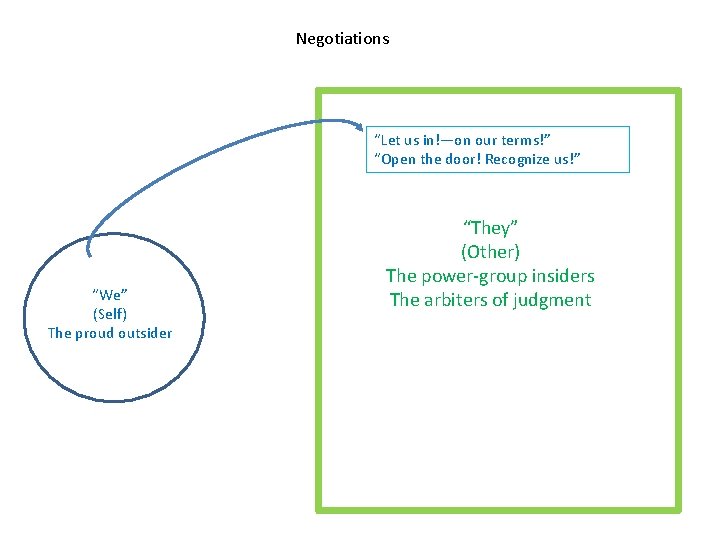
Negotiations “Let us in!—on our terms!” “Open the door! Recognize us!” “We” (Self) The proud outsider “They” (Other) The power-group insiders The arbiters of judgment
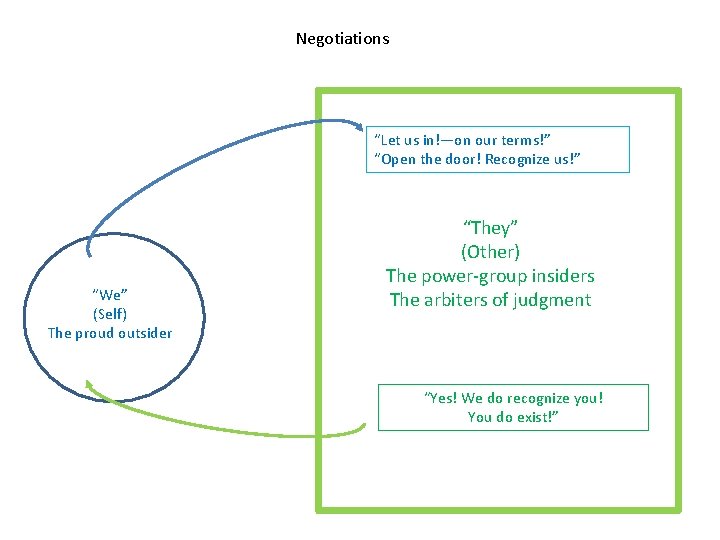
Negotiations “Let us in!—on our terms!” “Open the door! Recognize us!” “We” (Self) The proud outsider “They” (Other) The power-group insiders The arbiters of judgment “Yes! We do recognize you! You do exist!”
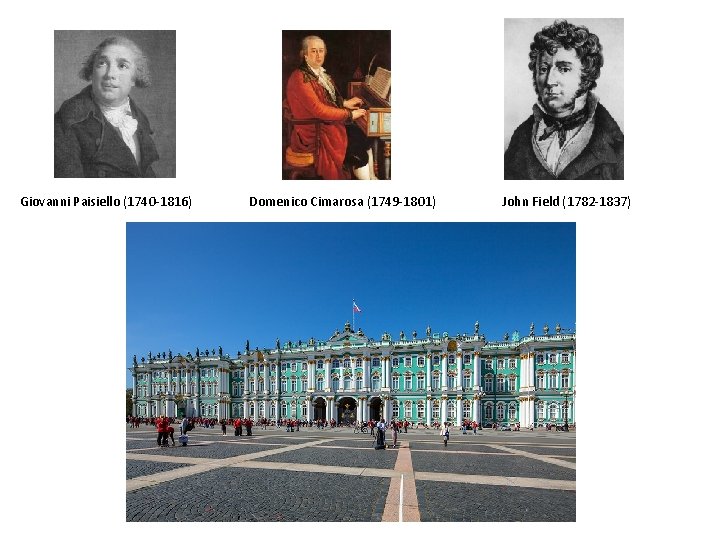
Giovanni Paisiello (1740 -1816) Domenico Cimarosa (1749 -1801) John Field (1782 -1837)
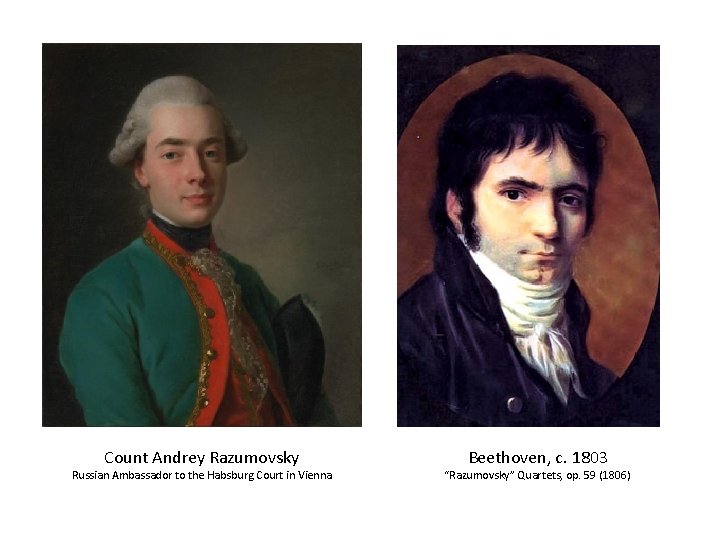
Count Andrey Razumovsky Russian Ambassador to the Habsburg Court in Vienna Beethoven, c. 1803 “Razumovsky” Quartets, op. 59 (1806)
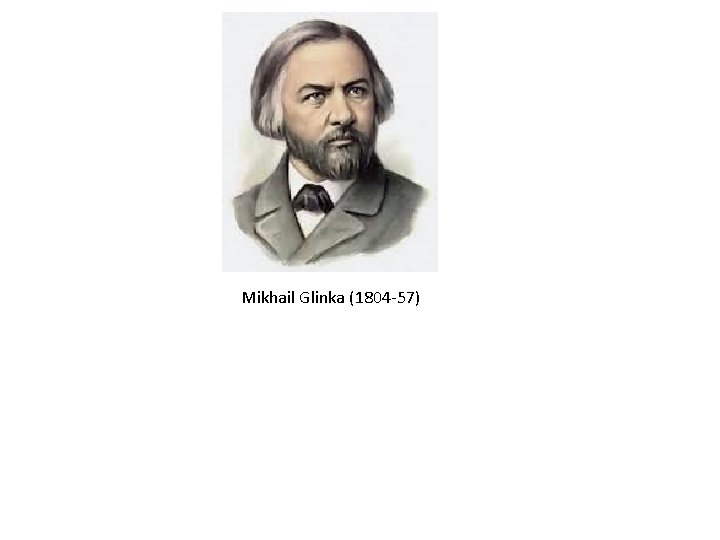
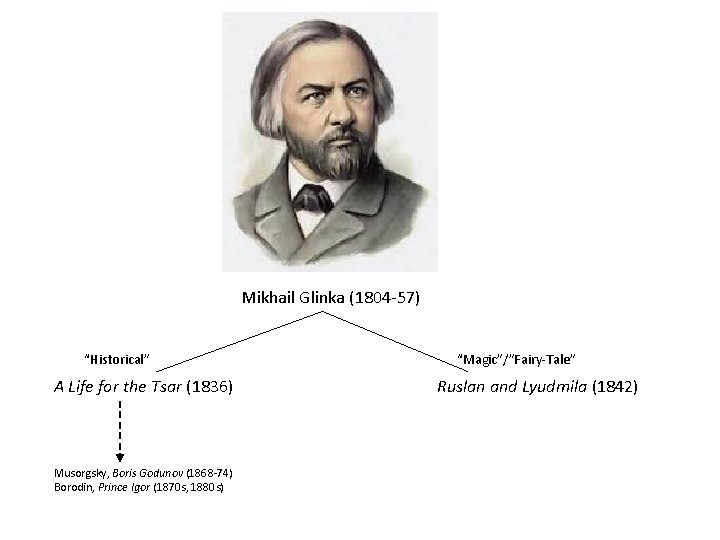
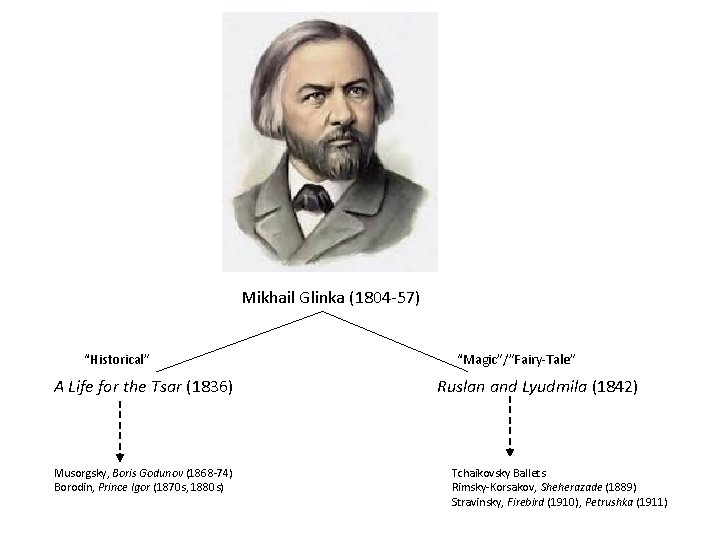
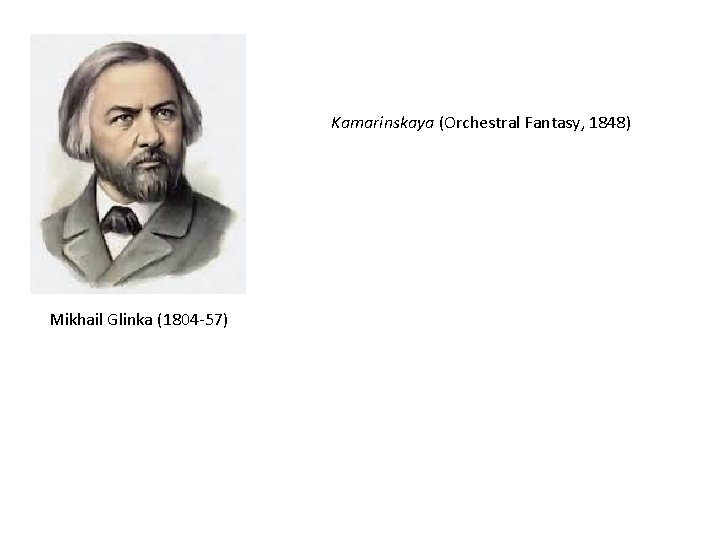
Mikhail Glinka (1804 -57)
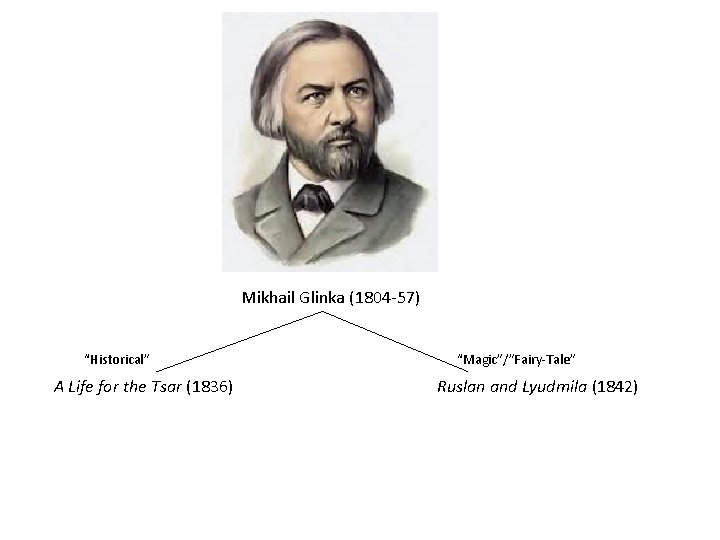
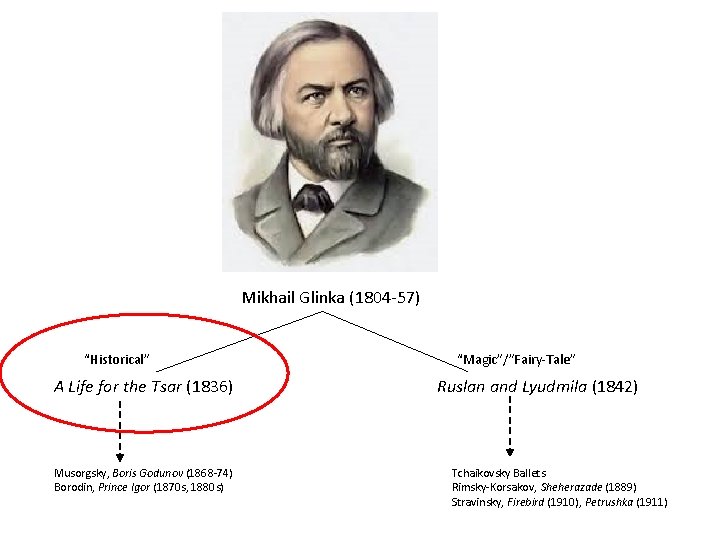
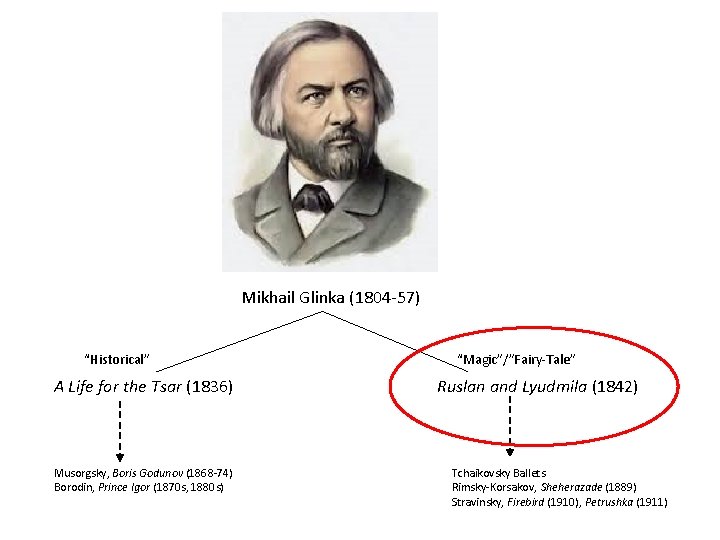
Mikhail Glinka (1804 -57) “Historical” A Life for the Tsar (1836) “Magic”/”Fairy-Tale” Ruslan and Lyudmila (1842)
Mikhail Glinka (1804 -57) “Historical” A Life for the Tsar (1836) Musorgsky, Boris Godunov (1868 -74) Borodin, Prince Igor (1870 s, 1880 s) “Magic”/”Fairy-Tale” Ruslan and Lyudmila (1842)
Mikhail Glinka (1804 -57) “Historical” A Life for the Tsar (1836) Musorgsky, Boris Godunov (1868 -74) Borodin, Prince Igor (1870 s, 1880 s) “Magic”/”Fairy-Tale” Ruslan and Lyudmila (1842) Tchaikovsky Ballets Rimsky-Korsakov, Sheherazade (1889) Stravinsky, Firebird (1910), Petrushka (1911)
Mikhail Glinka (1804 -57) “Historical” A Life for the Tsar (1836) Musorgsky, Boris Godunov (1868 -74) Borodin, Prince Igor (1870 s, 1880 s) “Magic”/”Fairy-Tale” Ruslan and Lyudmila (1842) Tchaikovsky Ballets Rimsky-Korsakov, Sheherazade (1889) Stravinsky, Firebird (1910), Petrushka (1911)
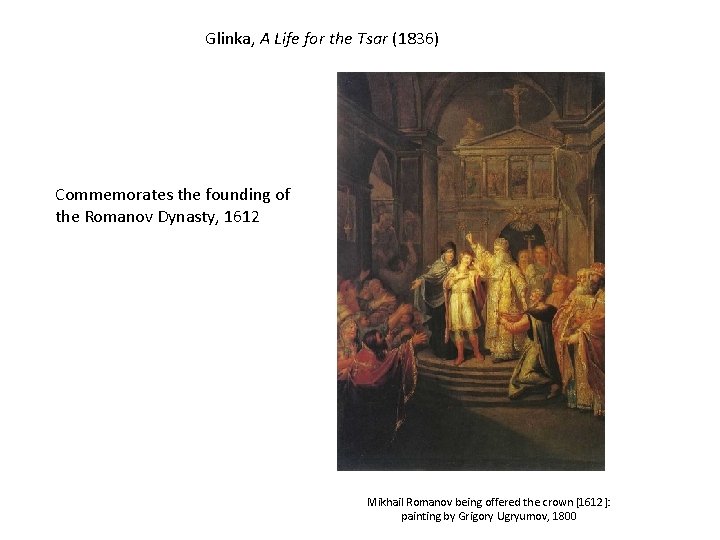
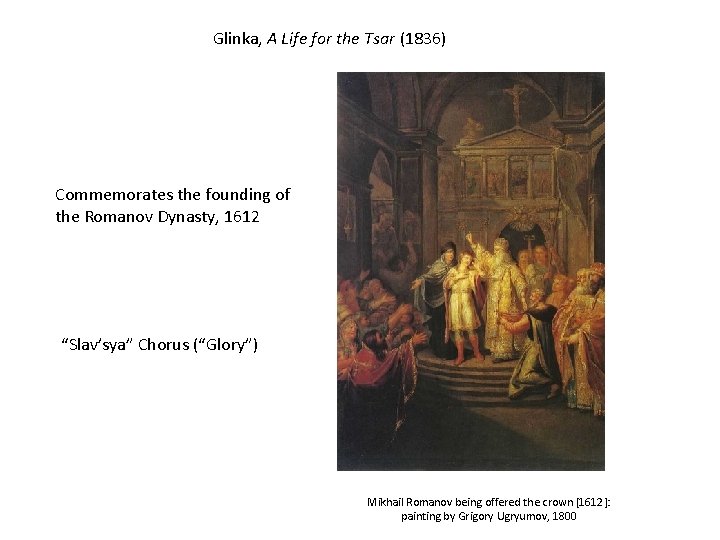
Glinka, A Life for the Tsar (1836) Commemorates the founding of the Romanov Dynasty, 1612 Mikhail Romanov being offered the crown [1612]: painting by Grigory Ugryumov, 1800
Glinka, A Life for the Tsar (1836) Commemorates the founding of the Romanov Dynasty, 1612 “Slav’sya” Chorus (“Glory”) Mikhail Romanov being offered the crown [1612]: painting by Grigory Ugryumov, 1800
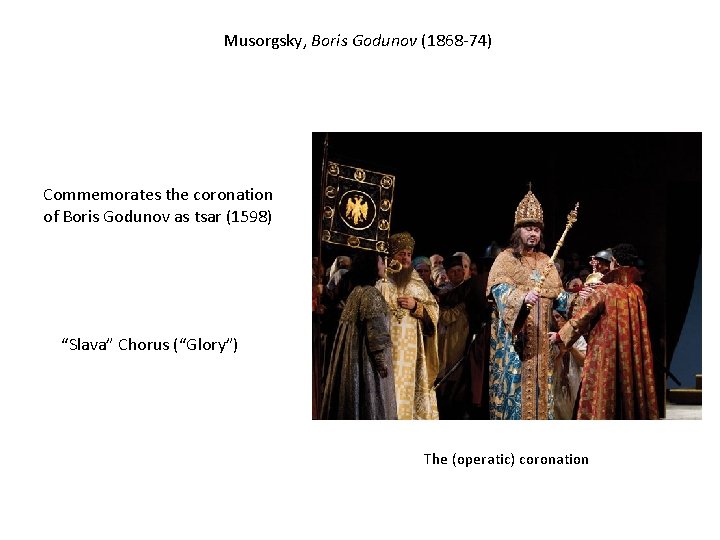
Musorgsky, Boris Godunov (1868 -74) Commemorates the coronation of Boris Godunov as tsar (1598) “Slava” Chorus (“Glory”) The (operatic) coronation
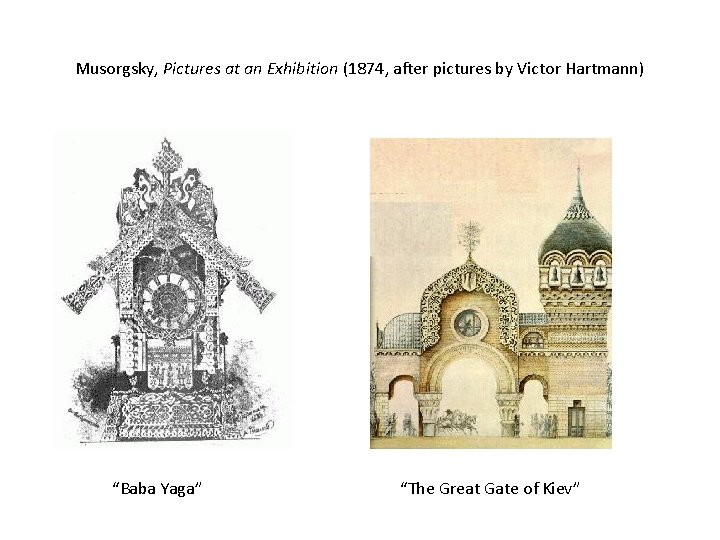
Musorgsky, Pictures at an Exhibition (1874, after pictures by Victor Hartmann) “Baba Yaga” “The Great Gate of Kiev”
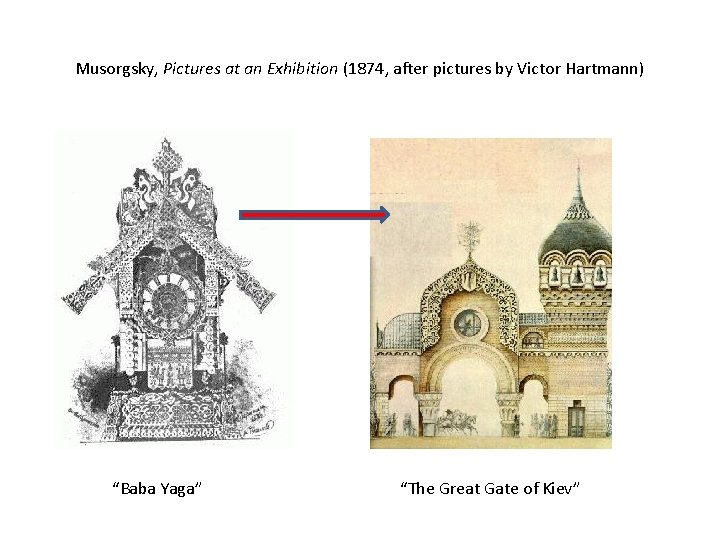
Musorgsky, Pictures at an Exhibition (1874, after pictures by Victor Hartmann) “Baba Yaga” “The Great Gate of Kiev”
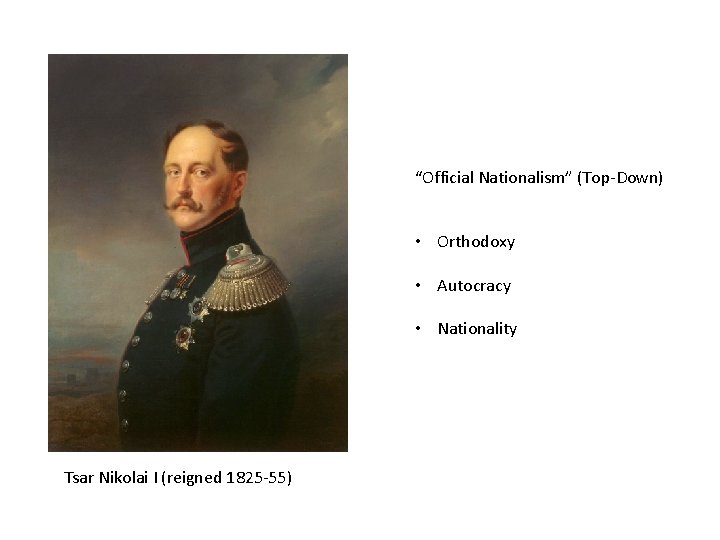
“Official Nationalism” (Top-Down) • Orthodoxy • Autocracy • Nationality Tsar Nikolai I (reigned 1825 -55)
Mikhail Glinka (1804 -57) “Historical” A Life for the Tsar (1836) Musorgsky, Boris Godunov (1868 -74) Borodin, Prince Igor (1870 s, 1880 s) “Magic”/”Fairy-Tale” Ruslan and Lyudmila (1842) Tchaikovsky Ballets Rimsky-Korsakov, Sheherazade (1889) Stravinsky, Firebird (1910), Petrushka (1911)
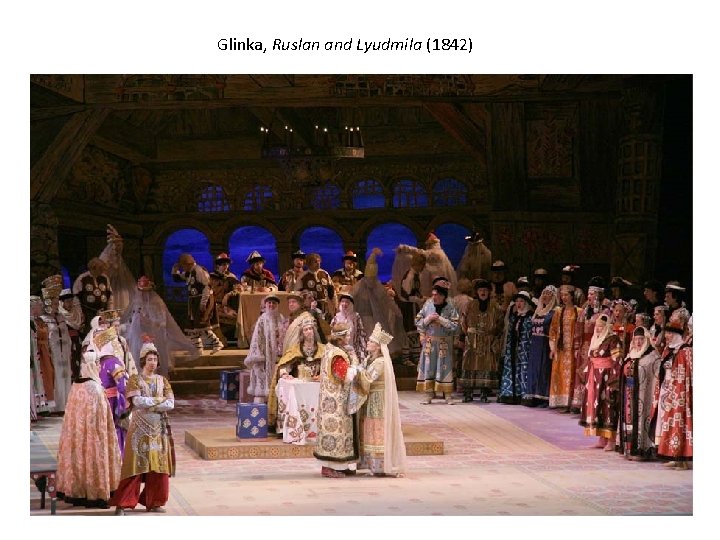
Glinka, Ruslan and Lyudmila (1842)
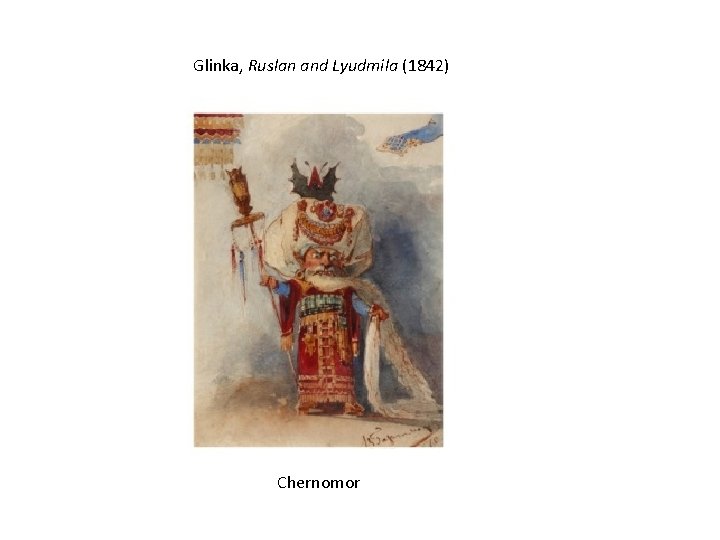
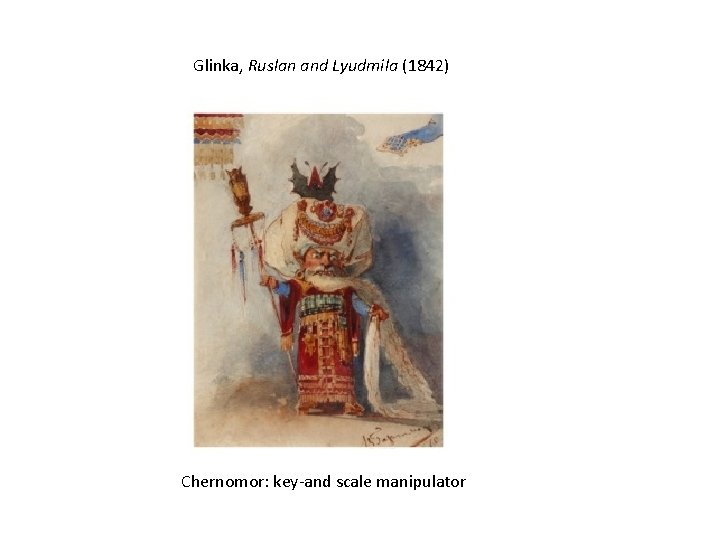
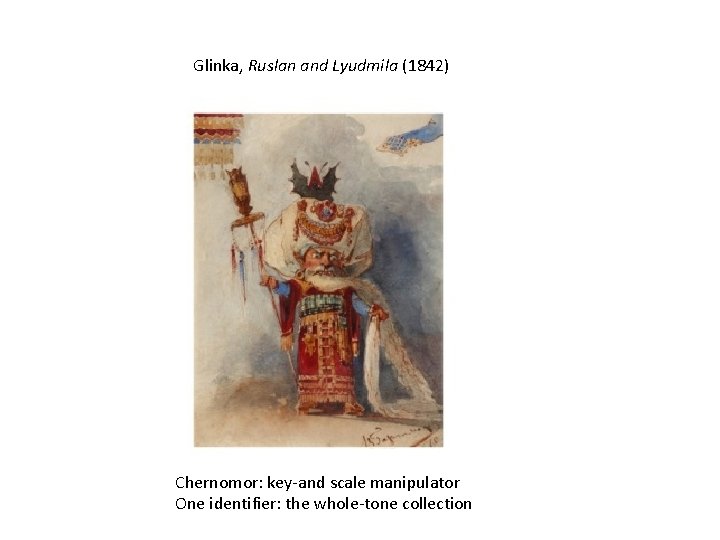
Glinka, Ruslan and Lyudmila (1842) Chernomor
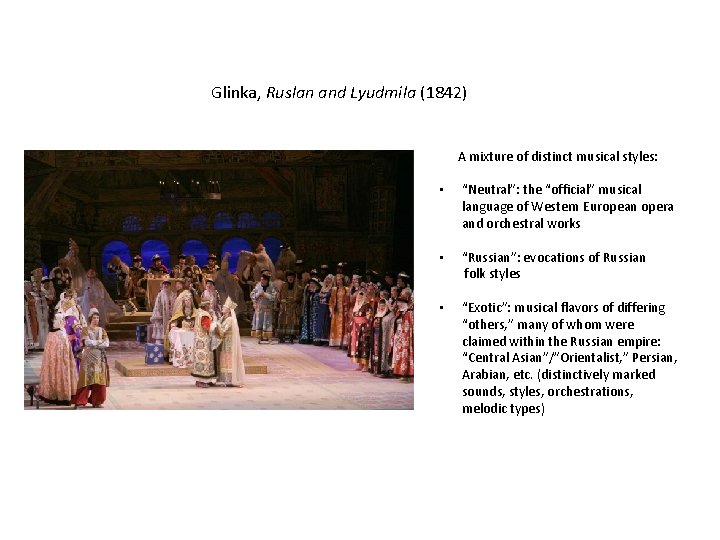
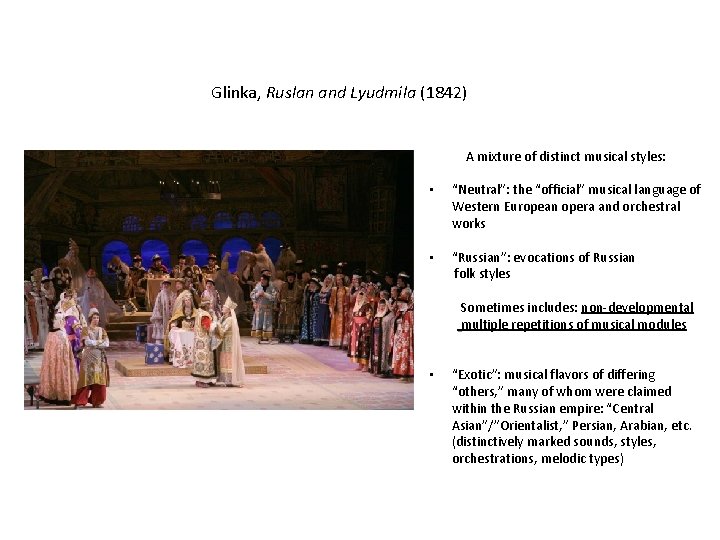
Glinka, Ruslan and Lyudmila (1842) A mixture of distinct musical styles: • “Neutral”: the “official” musical language of Western European opera and orchestral works • “Russian”: evocations of Russian folk styles • “Exotic”: musical flavors of differing “others, ” many of whom were claimed within the Russian empire: “Central Asian”/”Orientalist, ” Persian, Arabian, etc. (distinctively marked sounds, styles, orchestrations, melodic types)
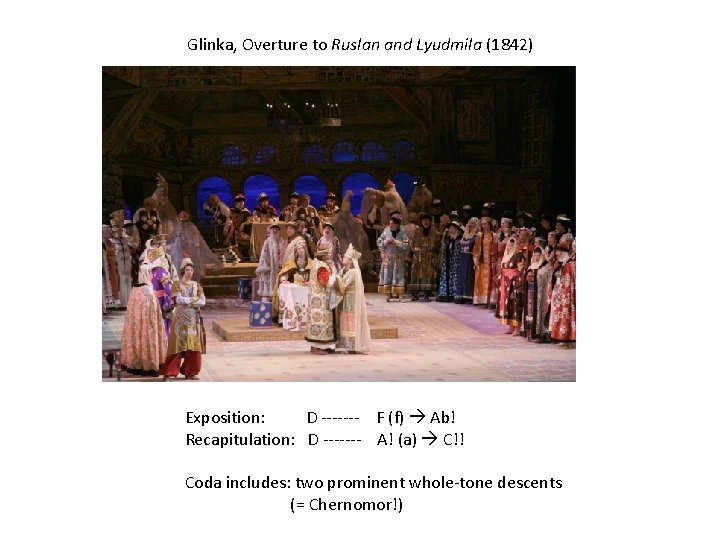
Glinka, Overture to Ruslan and Lyudmila (1842)
Glinka, Overture to Ruslan and Lyudmila (1842) Exposition: D ------- F (f) Ab!
Glinka, Overture to Ruslan and Lyudmila (1842) Exposition: D ------- F (f) Ab! Recapitulation: D ------- A! (a) C!!
Glinka, Overture to Ruslan and Lyudmila (1842) Exposition: D ------- F (f) Ab! Recapitulation: D ------- A! (a) C!! Coda includes: two prominent whole-tone descents (= Chernomor!)
Glinka, Ruslan and Lyudmila (1842) Chernomor: key-and scale manipulator
Glinka, Ruslan and Lyudmila (1842) Chernomor: key-and scale manipulator One identifier: the whole-tone collection
Glinka, Ruslan and Lyudmila (1842) A mixture of distinct musical styles: • “Neutral”: the “official” musical language of Western European opera and orchestral works • “Russian”: evocations of Russian folk styles Sometimes includes: non-developmental multiple repetitions of musical modules • “Exotic”: musical flavors of differing “others, ” many of whom were claimed within the Russian empire: “Central Asian”/”Orientalist, ” Persian, Arabian, etc. (distinctively marked sounds, styles, orchestrations, melodic types)
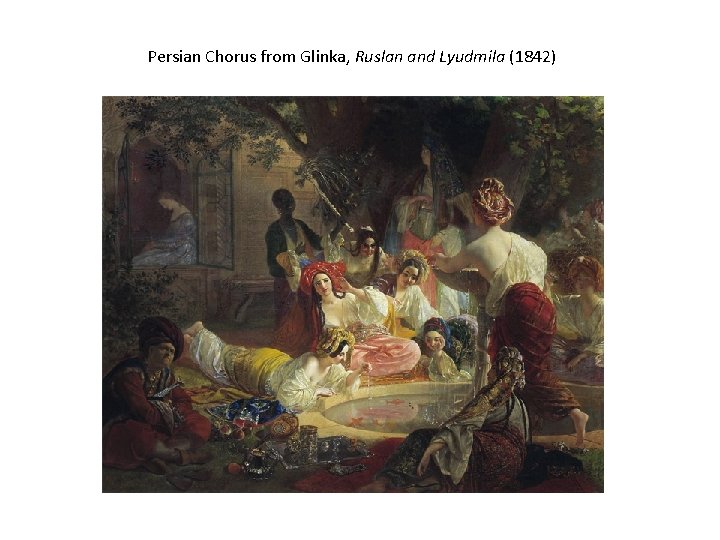
Persian Chorus from Glinka, Ruslan and Lyudmila (1842)
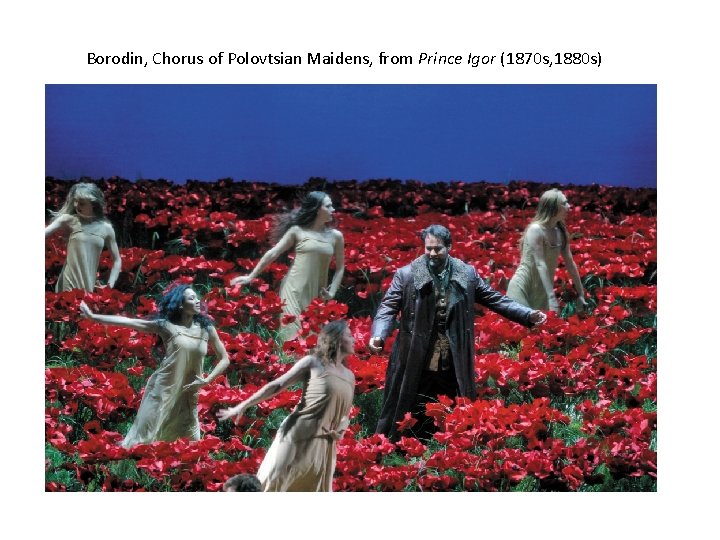
Borodin, Chorus of Polovtsian Maidens, from Prince Igor (1870 s, 1880 s)
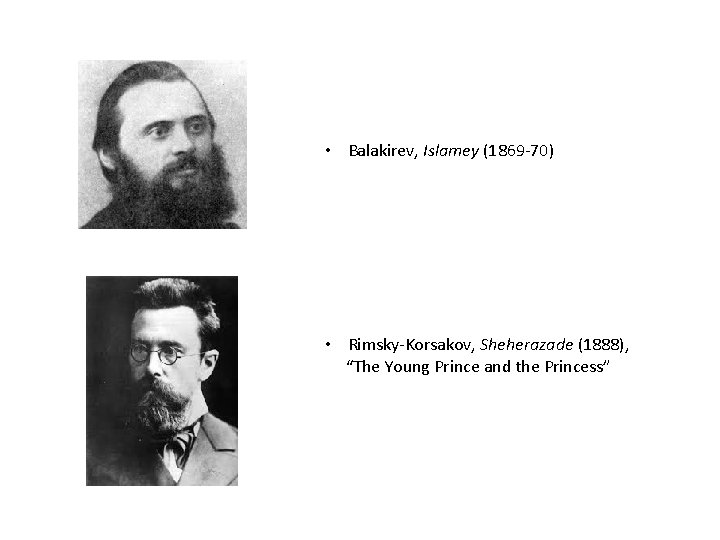
• Balakirev, Islamey (1869 -70) • Rimsky-Korsakov, Sheherazade (1888), “The Young Prince and the Princess”
Kamarinskaya (Orchestral Fantasy, 1848) Mikhail Glinka (1804 -57)
Kamarinskaya (Orchestral Fantasy, 1848) “Changing background technique” = modular, nondevelopmental repetition Mikhail Glinka (1804 -57)
Kamarinskaya (Orchestral Fantasy, 1848) “Changing background technique” = modular, nondevelopmental repetition Mikhail Glinka (1804 -57) • Tchaikovsky, Symphony No. 2, finale
Kamarinskaya (Orchestral Fantasy, 1848) “Changing background technique” = modular, nondevelopmental repetition Mikhail Glinka (1804 -57) • Tchaikovsky, Symphony No. 2, finale • Tchaikovsky, Violin Concerto, finale
Kamarinskaya (Orchestral Fantasy, 1848) “Changing background technique” = modular, nondevelopmental repetition Mikhail Glinka (1804 -57) • Tchaikovsky, Symphony No. 2, finale • Tchaikovsky, Violin Concerto, finale • Stravinsky, The Firebird, finale
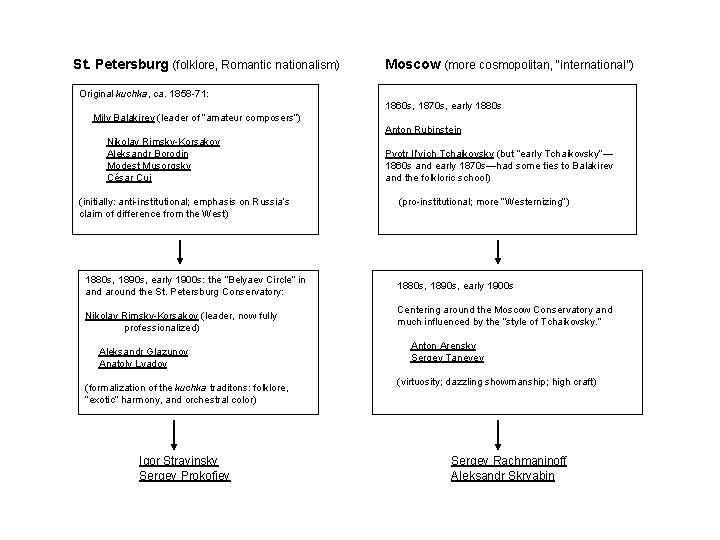
St. Petersburg (folklore, Romantic nationalism) Moscow (more cosmopolitan, “international”) Original kuchka, ca. 1858 -71: 1860 s, 1870 s, early 1880 s Mily Balakirev (leader of “amateur composers”) Anton Rubinstein Nikolay Rimsky-Korsakov Aleksandr Borodin Modest Musorgsky César Cui (initially: anti-institutional; emphasis on Russia’s claim of difference from the West) 1880 s, 1890 s, early 1900 s: the “Belyaev Circle” in and around the St. Petersburg Conservatory: Nikolay Rimsky-Korsakov (leader, now fully professionalized) Aleksandr Glazunov Anatoly Lyadov (formalization of the kuchka traditons: folklore, “exotic” harmony, and orchestral color) Igor Stravinsky Sergey Prokofiev Pyotr Il’yich Tchaikovsky (but “early Tchaikovsky”— 1860 s and early 1870 s—had some ties to Balakirev and the folkloric school) (pro-institutional; more “Westernizing”) 1880 s, 1890 s, early 1900 s Centering around the Moscow Conservatory and much influenced by the “style of Tchaikovsky. ” Anton Arensky Sergey Taneyev (virtuosity; dazzling showmanship; high craft) Sergey Rachmaninoff Aleksandr Skryabin