
Nimbus Dr Matthew Goodman DSO Program Manager Briefing
Nimbus Dr. Matthew Goodman, DSO Program Manager Briefing prepared for GLM Annual Science Meeting National Space and Technology Center – September 19, 2011 Huntsville, AL Approved for Public Release, Distribution Unlimited

The Agency 2
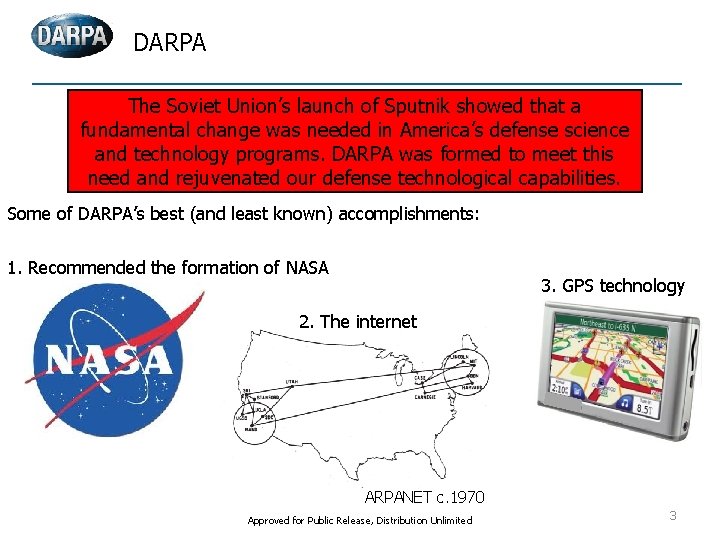
DARPA The Soviet Union’s launch of Sputnik showed that a fundamental change was needed in America’s defense science and technology programs. DARPA was formed to meet this need and rejuvenated our defense technological capabilities. Some of DARPA’s best (and least known) accomplishments: 1. Recommended the formation of NASA 3. GPS technology 2. The internet ARPANET c. 1970 Approved for Public Release, Distribution Unlimited 3

Nimbus Background 4

Summary Nimbus is a fundamental science program focused on obtaining a comprehensive understanding of the lightning process, its associated emissions and its ionospheric components. Why: Lightning is unpredictable and poses a significant danger to personnel, aircraft, electronic equipment, military assets and ordnance. Outdoor operations may be limited and more complicated when lightning is present within a predetermined radius. How: Seven unique performer teams are measuring, observing and recording all parameters and physical processes associated with both natural and triggered lightning across the United States, from ground to space, DC to daylight, using a comprehensive suite of state-of-the-art instrumentation, equipment and facilities. Approved for Public Release, Distribution Unlimited 5
Scientific Goals Broad Goals: 1. Develop scientific foundations for understanding the lightning discharge. 2. Develop experimentally validated, statistical models of the triggering of lightning. 3. Quantify the impact of triggered lightning on properties of natural lightning (including the emission of gamma rays, x-rays, UV, VNIR/SWIR, RF, VLF/ULF) and on the properties of ionospheric phenomena (elves, sprites, whistlers, etc. ). Specific Phase I Goals: 1. Operate at least 2 triggering facilities to obtain data about different types of thunderstorms in various geographical regions. 2. Measure and characterize critical parameters for lightning initiation, propagation and attachment. 3. Model, measure and characterize associated lightning phenomena (e. g. , terrestrial gamma ray flashes, compact intracloud discharges, etc. ). 4. Model, measure and characterize upward-going lightning (cloud to ionosphere). 5. Model, measure and characterize ionospheric phenomena (sprites, elves, whistlers, etc. ) using ground observations. 6. Model, measure and characterize tropospheric lightning over large distances under different environmental conditions. Approved for Public Release, Distribution Unlimited 6
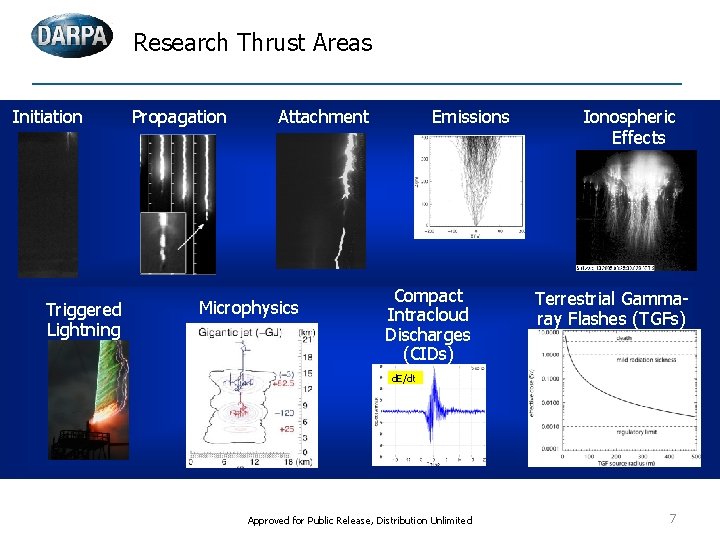
Research Thrust Areas Initiation Triggered Lightning Propagation Attachment Microphysics Emissions Compact Intracloud Discharges (CIDs) Ionospheric Effects Terrestrial Gammaray Flashes (TGFs) d. E/dt Approved for Public Release, Distribution Unlimited 7
Significant Research Questions Abound Initiation: What high energy processes (runaway electrons, x-rays, gamma rays) are involved in lightning initiation and how? Propagation: Why and how do lightning leaders step? Attachment: How do objects on the ground respond to the downward propagating stepped-leader, and what properties can enhance the probability of producing a successful upward streamer that will connect to the stepped-leader? Emissions: By what physical mechanisms do lightning leaders emit x-rays and do the x-rays affect propagation? TGFs: By what physical mechanisms are TGFs produced and are they hazardous to aircraft and humans in the aircraft? CIDs: How are CIDS related to other phenomena (gigantic blue jets, TGFs, etc. )? Ionospheric Effects: Do transient luminous events play a significant role in mesospheric physics, or in coupling the troposphere to the ionosphere? Triggered Lightning: How exactly does rocket-and-wire (classical and altitude) triggering of lightning work? Microphysics: What controls when a cloud ceases production of lightning flashes? Approved for Public Release, Distribution Unlimited 8

New Insights 9
Initiation Video: Natural Lightning Strike New theory suggests that when runaway electron avalanches exceed the relativistic threshold, the in-cloud electric field is forced to discharge. Approved for Public Release, Distribution Unlimited
Propagation Video: Natural Lightning Strike Experimental evidence has shown there at least three classifications of negative leaders: stepped leaders, dart-stepped leaders, and "chaotic" dart leaders. Approved for Public Release, Distribution Unlimited
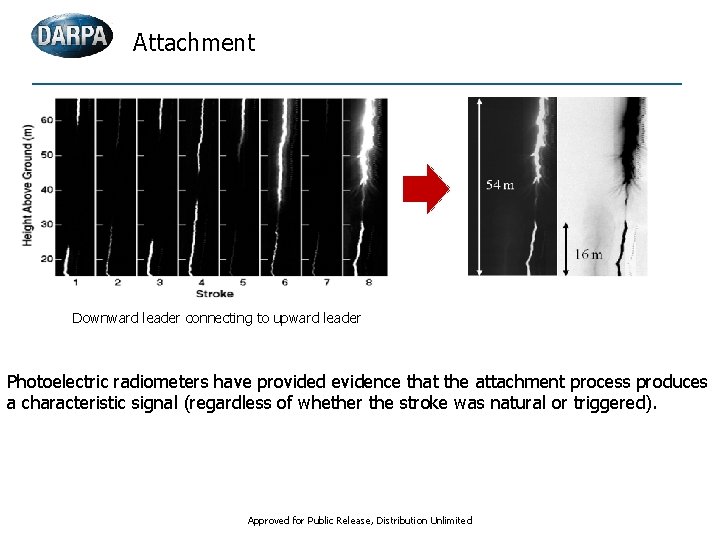
Attachment Downward leader connecting to upward leader Photoelectric radiometers have provided evidence that the attachment process produces a characteristic signal (regardless of whether the stroke was natural or triggered). Approved for Public Release, Distribution Unlimited
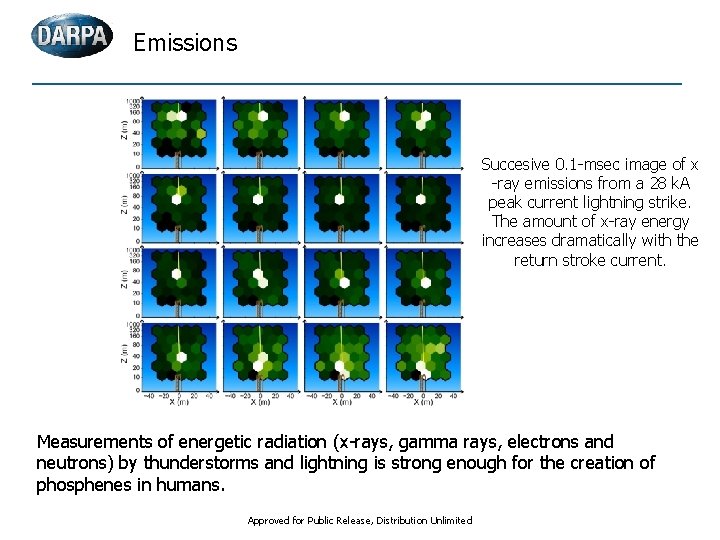
Emissions Succesive 0. 1 -msec image of x -ray emissions from a 28 k. A peak current lightning strike. The amount of x-ray energy increases dramatically with the return stroke current. Measurements of energetic radiation (x-rays, gamma rays, electrons and neutrons) by thunderstorms and lightning is strong enough for the creation of phosphenes in humans. Approved for Public Release, Distribution Unlimited
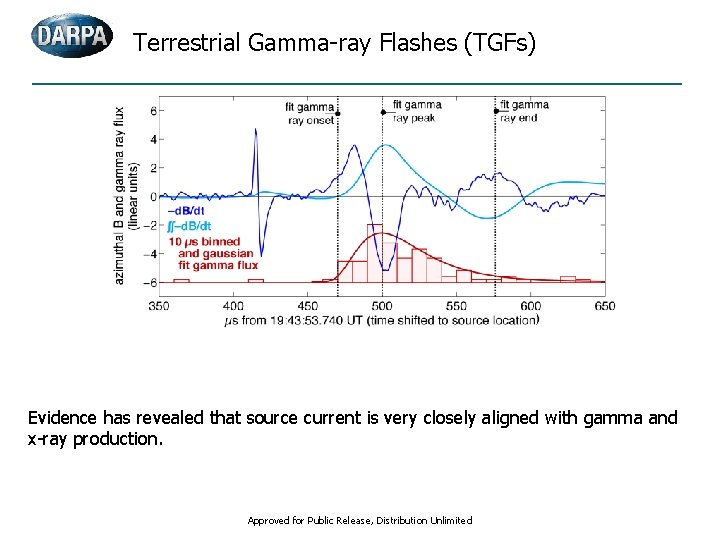
Terrestrial Gamma-ray Flashes (TGFs) Evidence has revealed that source current is very closely aligned with gamma and x-ray production. Approved for Public Release, Distribution Unlimited
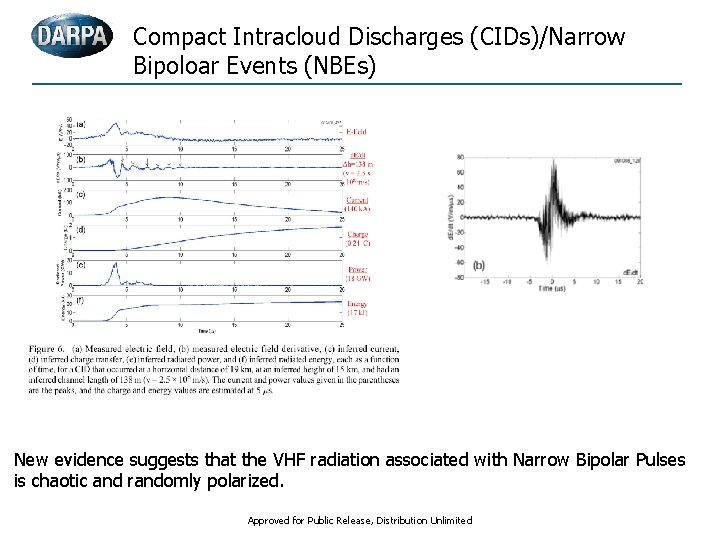
Compact Intracloud Discharges (CIDs)/Narrow Bipoloar Events (NBEs) New evidence suggests that the VHF radiation associated with Narrow Bipolar Pulses is chaotic and randomly polarized. Approved for Public Release, Distribution Unlimited
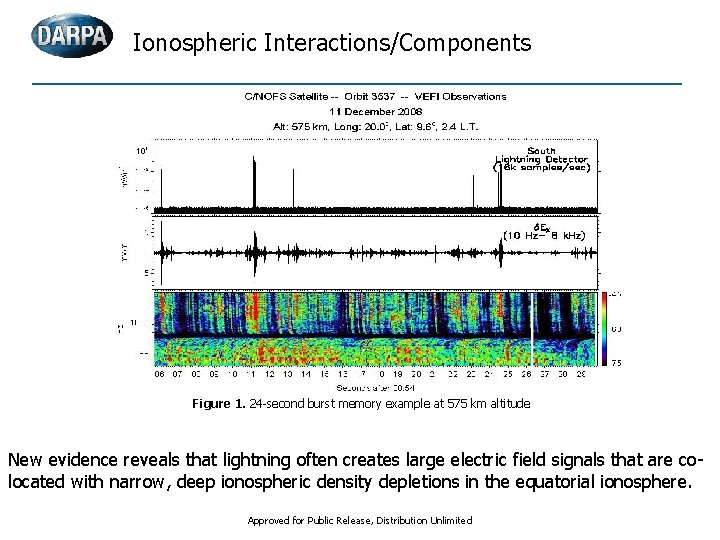
Ionospheric Interactions/Components Figure 1. 24 -second burst memory example at 575 km altitude New evidence reveals that lightning often creates large electric field signals that are colocated with narrow, deep ionospheric density depletions in the equatorial ionosphere. Approved for Public Release, Distribution Unlimited
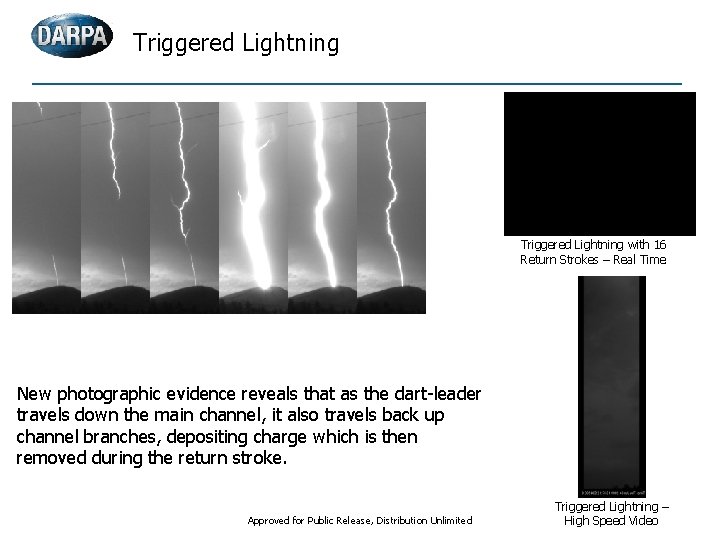
Triggered Lightning with 16 Return Strokes – Real Time New photographic evidence reveals that as the dart-leader travels down the main channel, it also travels back up channel branches, depositing charge which is then removed during the return stroke. Approved for Public Release, Distribution Unlimited Triggered Lightning – High Speed Video
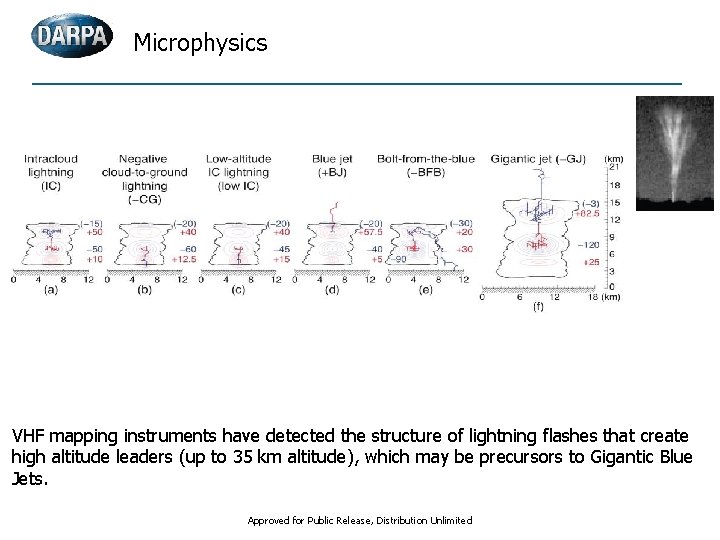
Microphysics VHF mapping instruments have detected the structure of lightning flashes that create high altitude leaders (up to 35 km altitude), which may be precursors to Gigantic Blue Jets. Approved for Public Release, Distribution Unlimited
In Conclusion 19
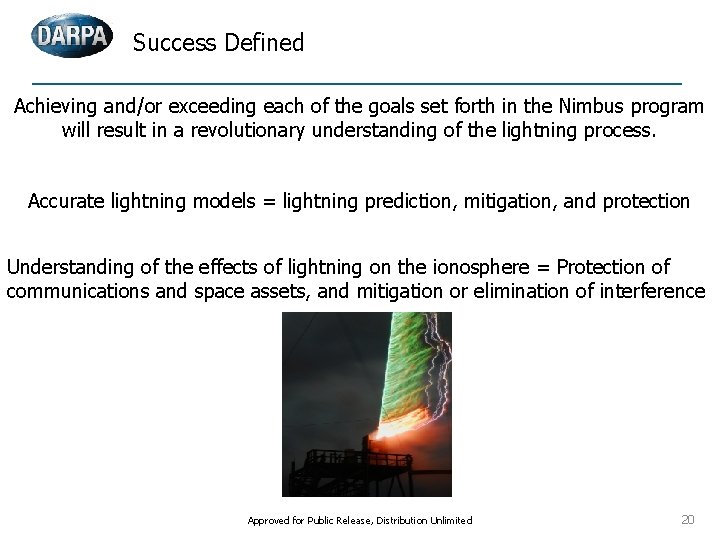
Success Defined Achieving and/or exceeding each of the goals set forth in the Nimbus program will result in a revolutionary understanding of the lightning process. Accurate lightning models = lightning prediction, mitigation, and protection Understanding of the effects of lightning on the ionosphere = Protection of communications and space assets, and mitigation or elimination of interference Approved for Public Release, Distribution Unlimited 20

www. darpa. mil Approved for Public Release, Distribution Unlimited 21
- Slides: 21