
Nile Civilizations Section 1 History is more or
- Slides: 104
Nile Civilizations Section 1 “History is more or less bunk. ” - Henry Ford Rats multiply so quickly that in 18 months, two rats could have over one million descendants.
Nile Civilizations Section 1
Nile Civilizations Section 1
Nile Civilizations Section 1
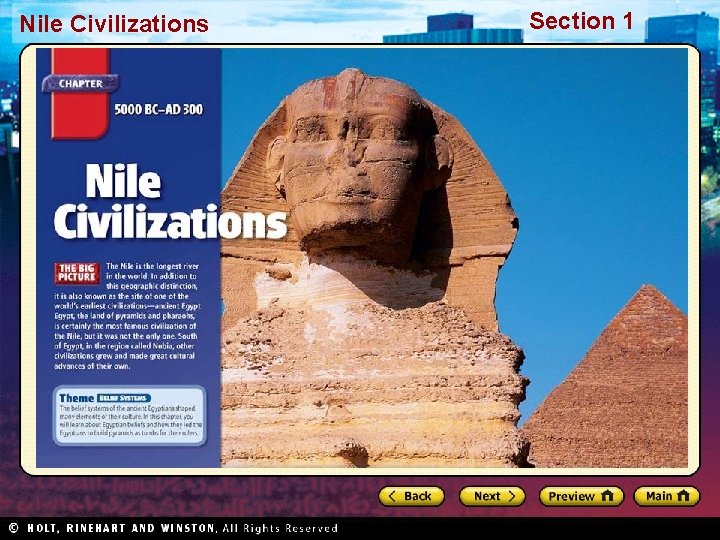
Section 1 Nile Civilizations The Kingdom of Egypt Main Idea Egypt was one of the most stable and longlasting civilizations of the ancient world.
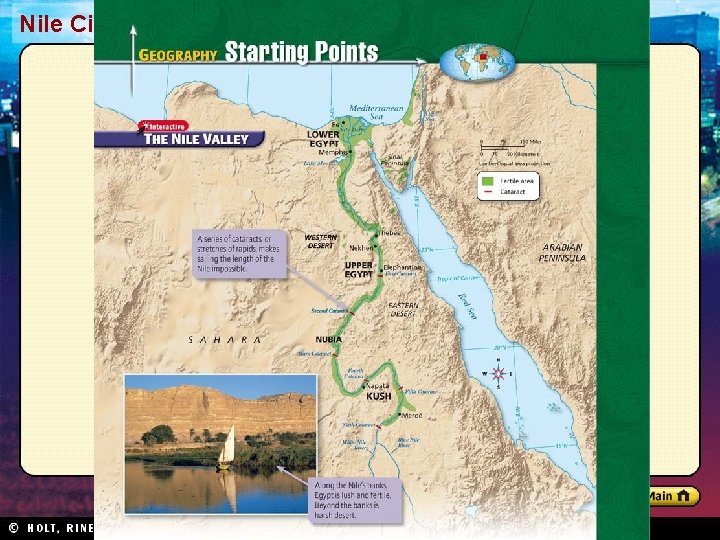
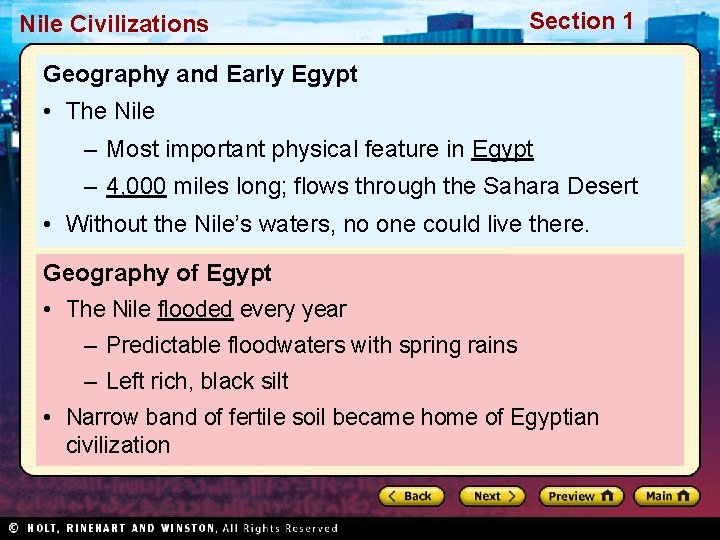
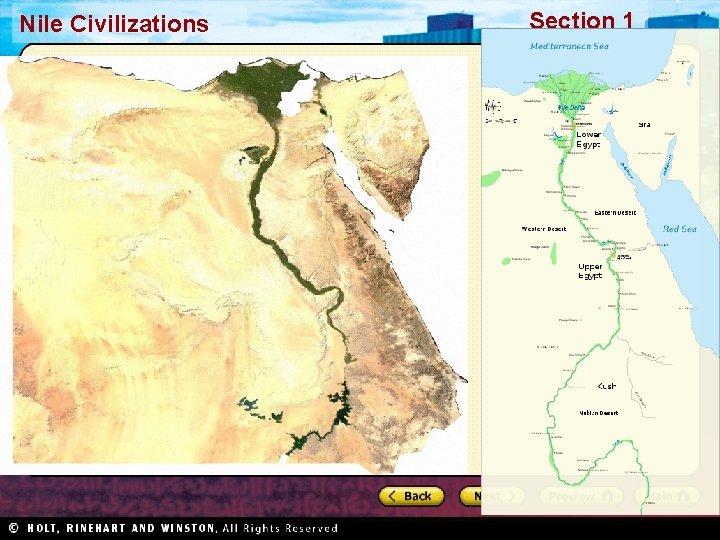
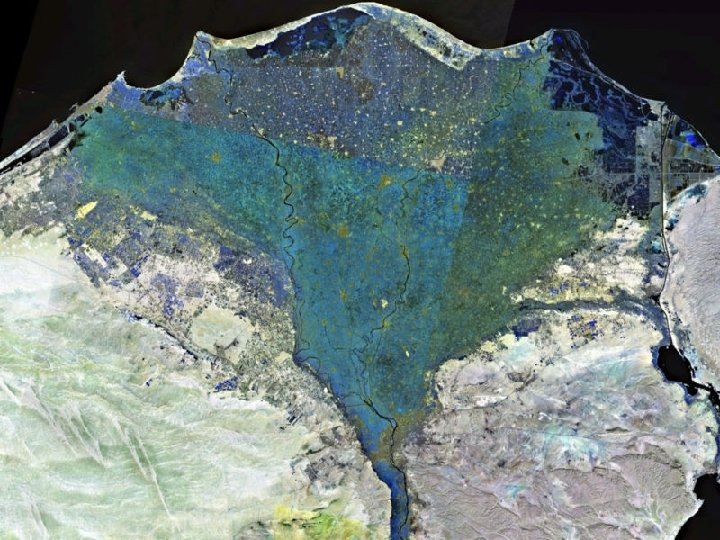
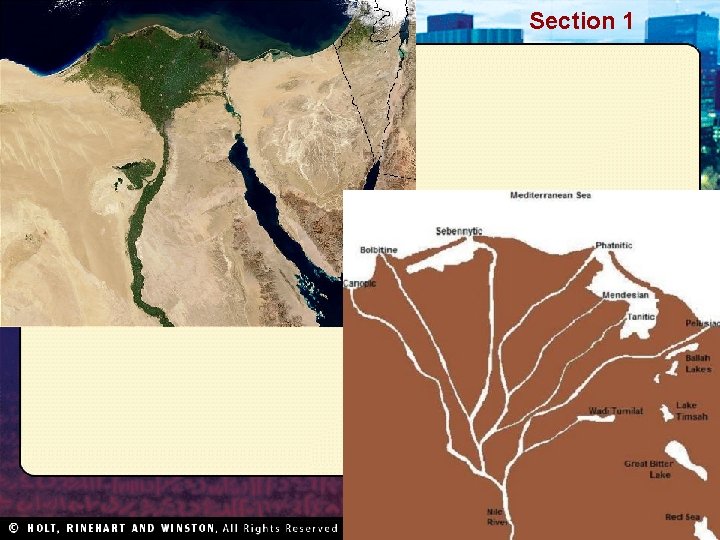
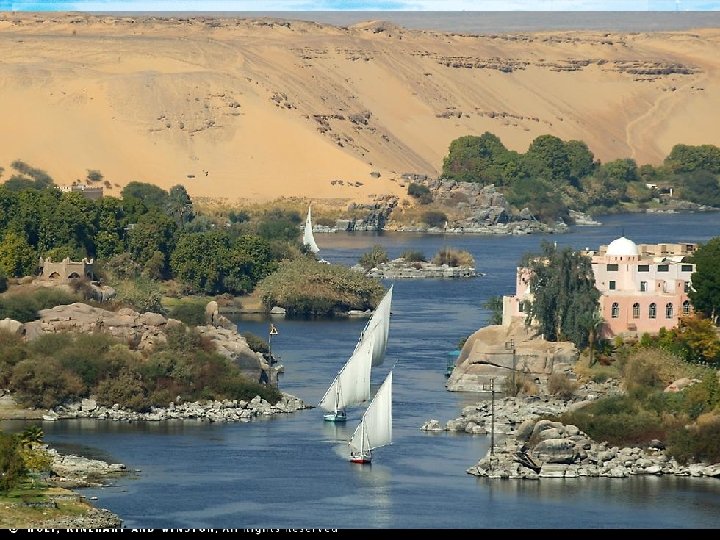
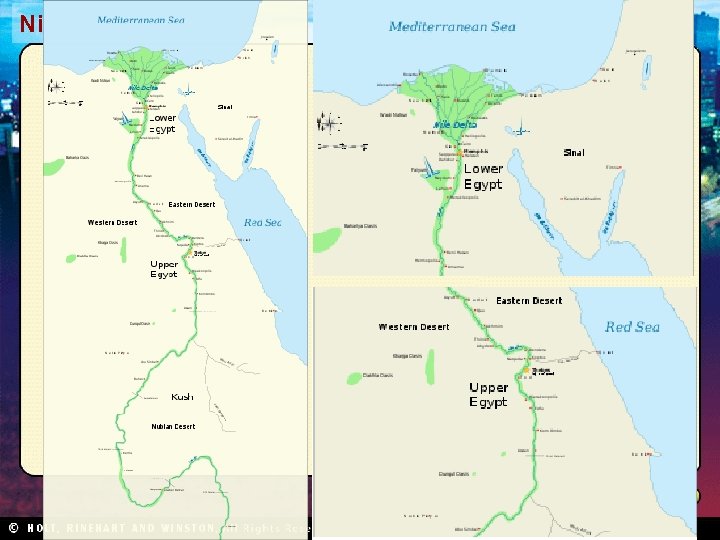
Nile Civilizations Section 1 Geography and Early Egypt • The Nile – Most important physical feature in Egypt – 4, 000 miles long; flows through the Sahara Desert • Without the Nile’s waters, no one could live there. Geography of Egypt • The Nile flooded every year – Predictable floodwaters with spring rains – Left rich, black silt • Narrow band of fertile soil became home of Egyptian civilization
Nile Civilizations Section 1
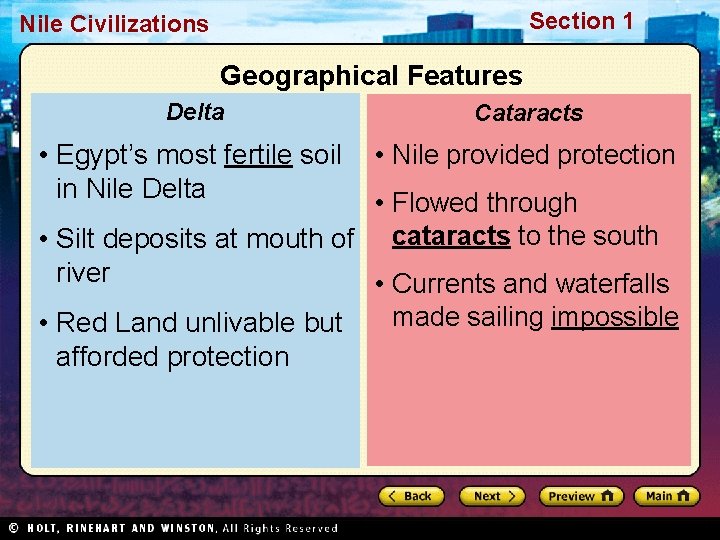
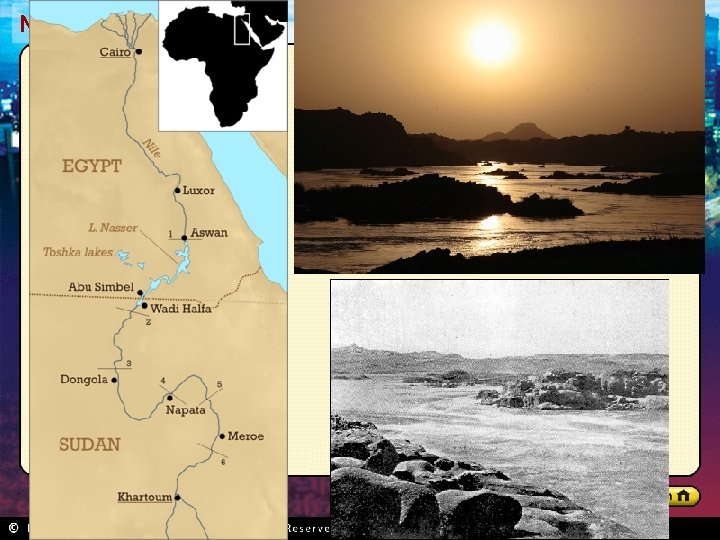
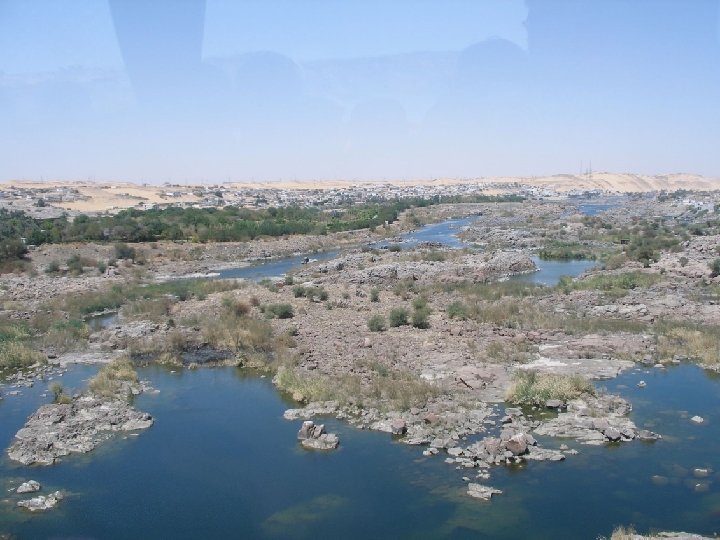
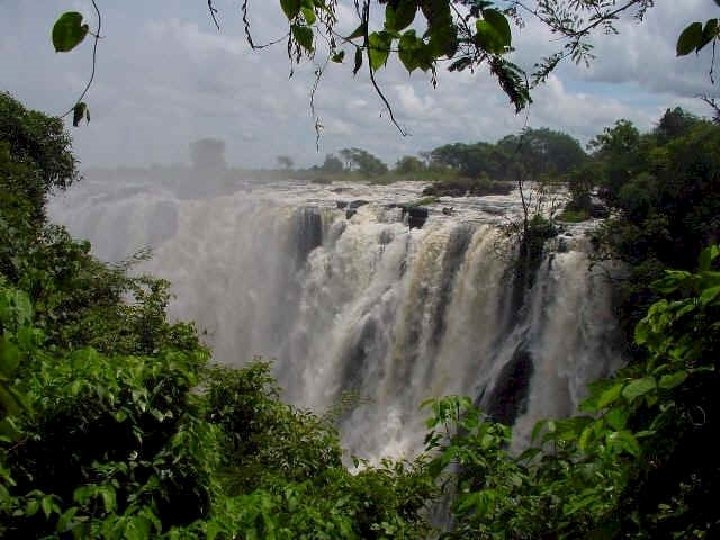
Section 1 Nile Civilizations Geographical Features Delta Cataracts • Egypt’s most fertile soil in Nile Delta • Nile provided protection • Red Land unlivable but afforded protection made sailing impossible • Flowed through • Silt deposits at mouth of cataracts to the south river • Currents and waterfalls
Nile Civilizations Section 1
Nile Civilizations Section 1
Nile Civilizations Section 1
Nile Civilizations Section 1
Nile Civilizations Section 1
Nile Civilizations Section 1
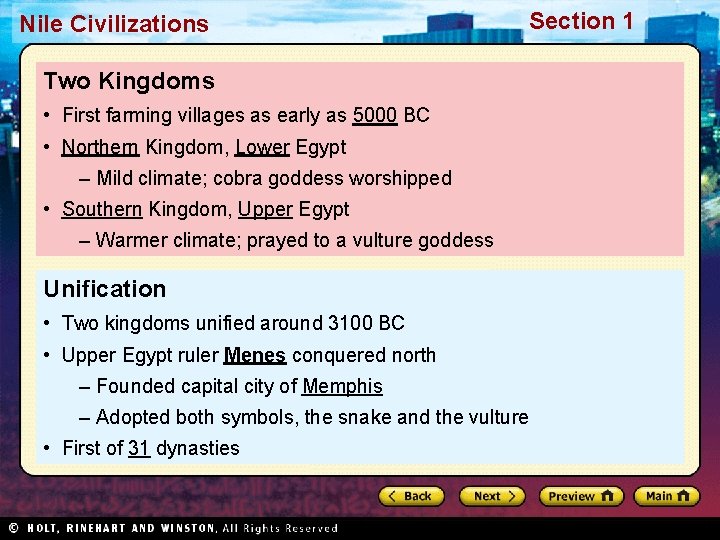
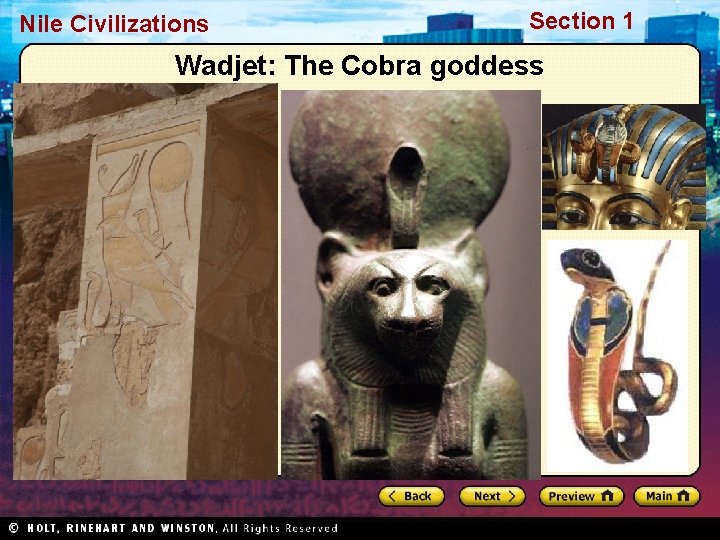
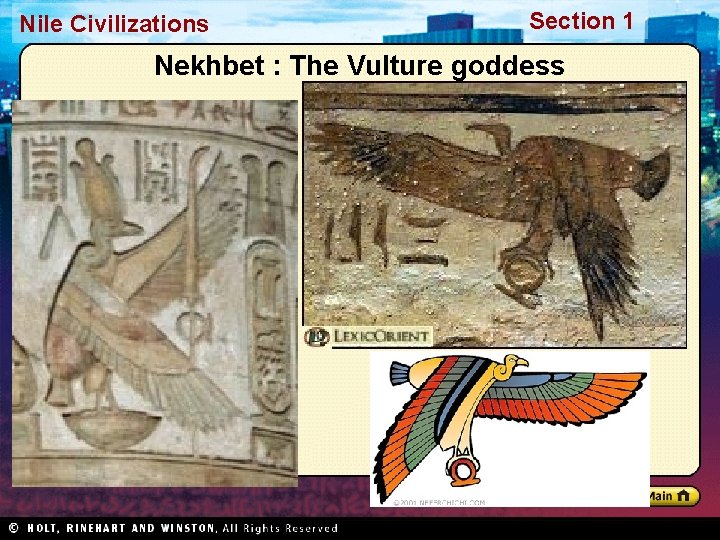
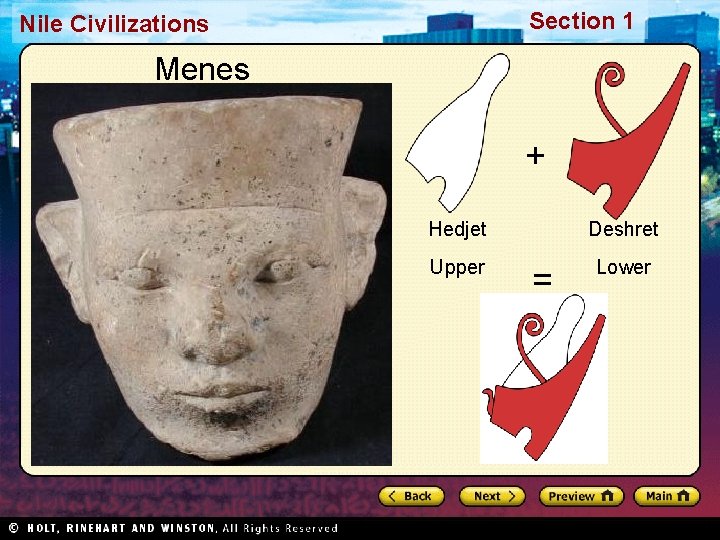
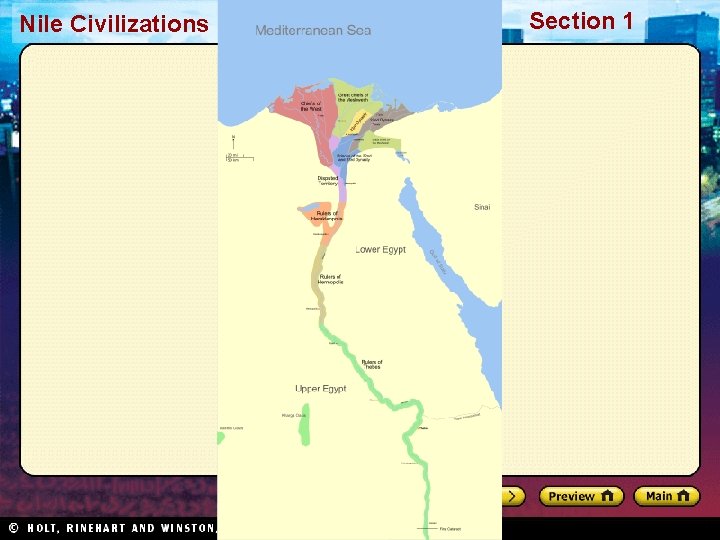
Nile Civilizations Section 1 Two Kingdoms • First farming villages as early as 5000 BC • Northern Kingdom, Lower Egypt – Mild climate; cobra goddess worshipped • Southern Kingdom, Upper Egypt – Warmer climate; prayed to a vulture goddess Unification • Two kingdoms unified around 3100 BC • Upper Egypt ruler Menes conquered north – Founded capital city of Memphis – Adopted both symbols, the snake and the vulture • First of 31 dynasties
Nile Civilizations Section 1
Nile Civilizations Section 1
Nile Civilizations Section 1 Wadjet: The Cobra goddess
Nile Civilizations Section 1 Nekhbet : The Vulture goddess
Section 1 Nile Civilizations Menes + Hedjet Deshret Upper Lower =
Nile Civilizations Section 1
Section 1 Nile Civilizations Question: How did geography affect where the early Egyptians lived? Answer(s): They lived in a narrow strip of fertile land where they could raise crops. It was surrounded by inhospitable desert, which would not easily support life.
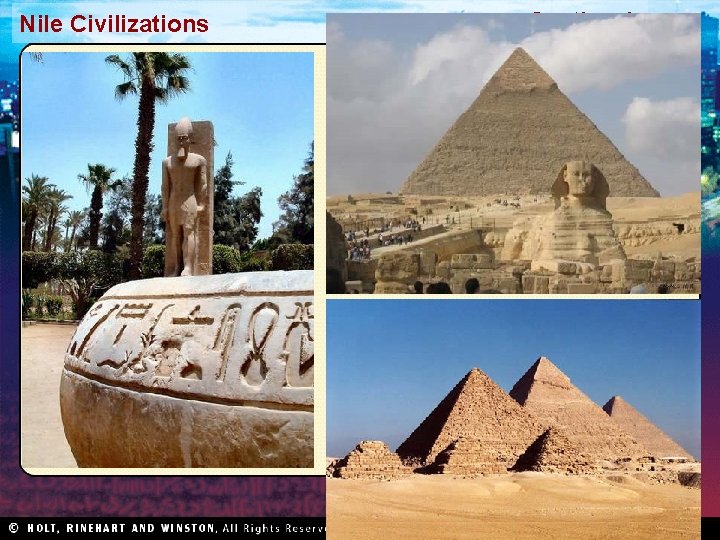
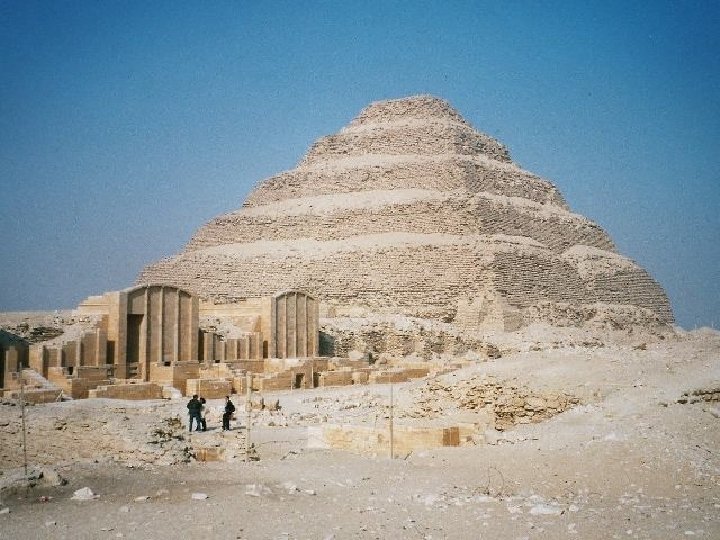
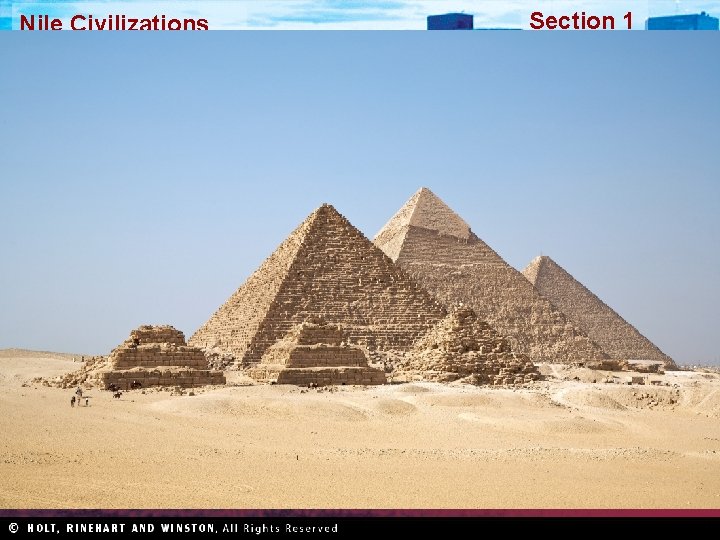
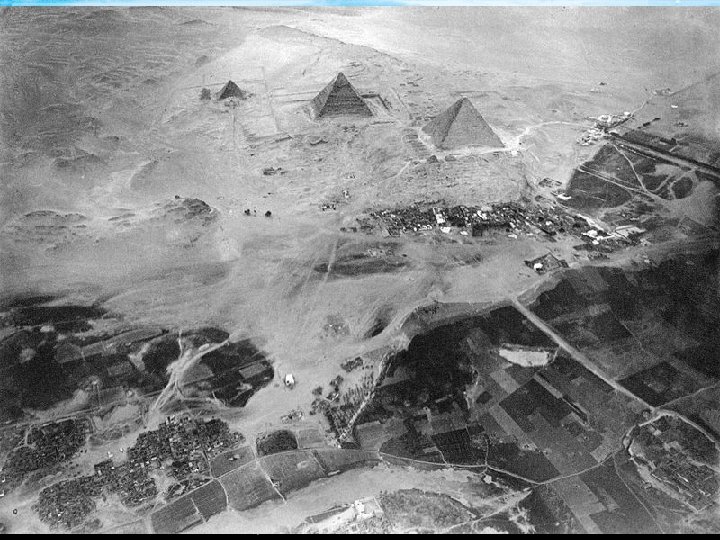
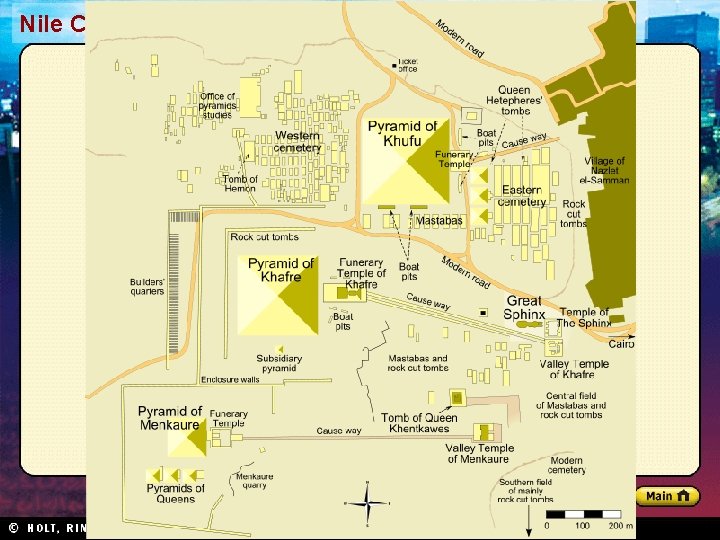
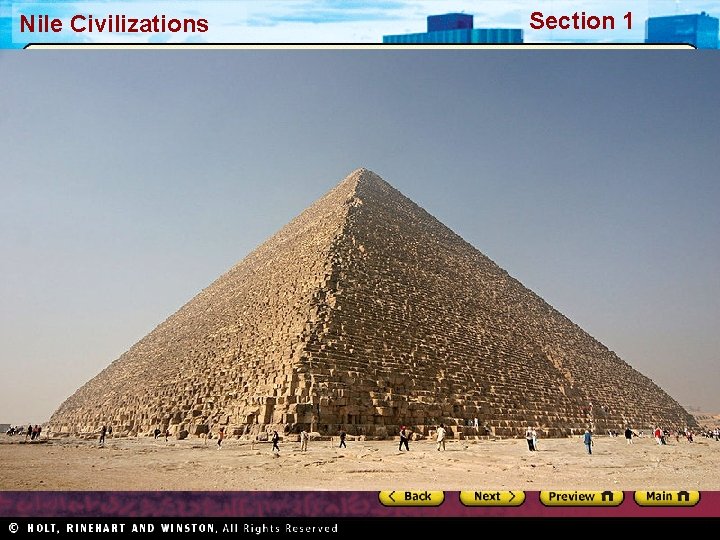
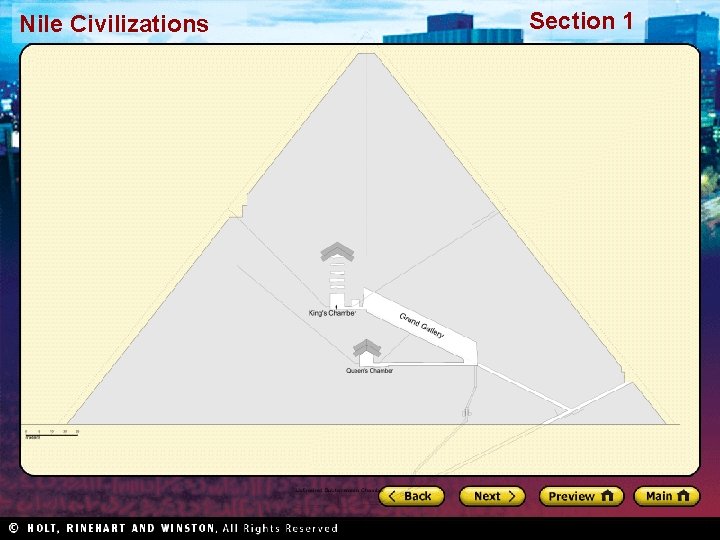
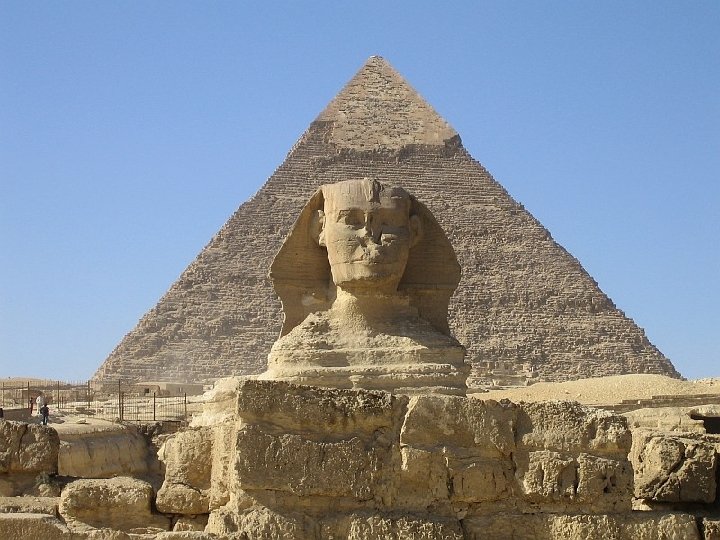
Section 1 Nile Civilizations The Old Kingdom Many of the institutions for which the Egyptian civilization is known were created during the period which began around 2650 BC. The Pyramids Building Pyramids • Took great planning and skill • Largest located near Giza • Built as tombs for rulers – Hollow chamber for burial – Treasures buried with them – Deadly traps within • Design changed to smoothsided over time • Ordered when kings took the throne • Built from the inside out • Not built by slaves – Peasants required to work one month per year – Professional craftspeople like architects, artists
Nile Civilizations Section 1
Nile Civilizations Section 1
Nile Civilizations Section 1
Nile Civilizations Section 1
Nile Civilizations Section 1
Nile Civilizations Section 1
Nile Civilizations Section 1
Nile Civilizations Section 1 The Pharaohs • The head of the government was the king • Became known as pharaoh (“great house”) • Had great power because he was believed to be a god • Egypt a theocracy, a state ruled by religious figures Egyptian Bureaucracy • Pharaoh could not rule Egypt alone • Aided by bureaucracy, many of whom were pharaoh’s relatives • Most powerful official was the vizier • Hundreds of lesser officials kept Egypt running smoothly
Section 1 Nile Civilizations Question: What Egyptian institutions were developed during the Old Kingdom? Answer(s): a government headed by the pharaoh, highly structured bureaucracy
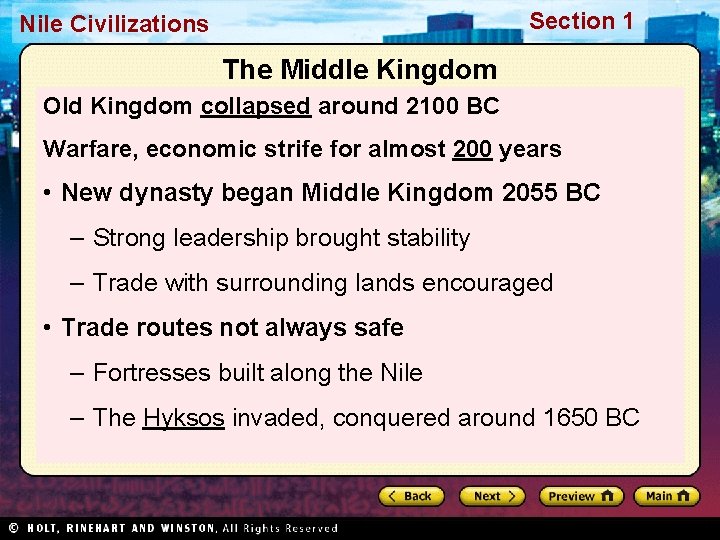
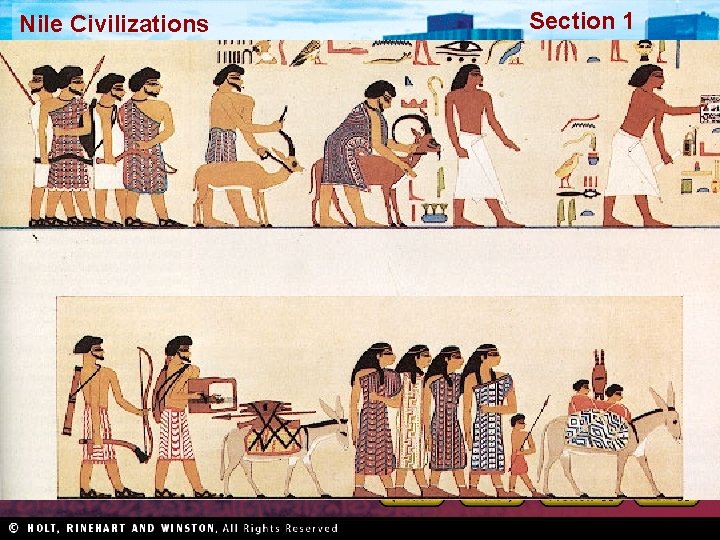
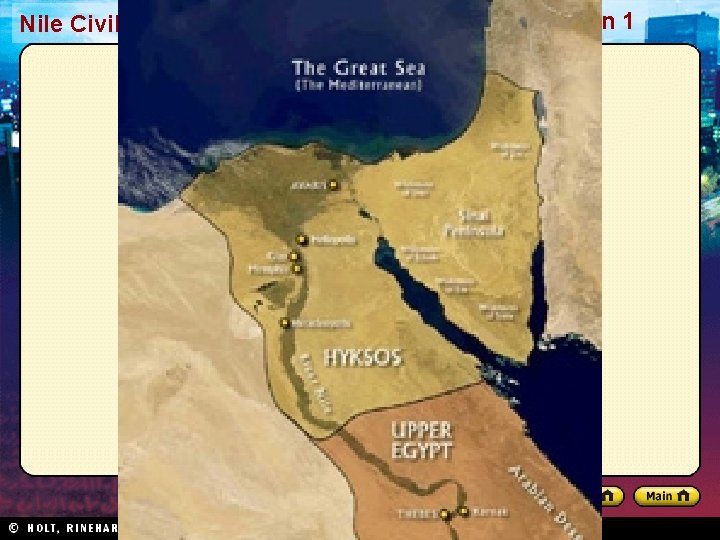
Section 1 Nile Civilizations The Middle Kingdom Old Kingdom collapsed around 2100 BC Warfare, economic strife for almost 200 years • New dynasty began Middle Kingdom 2055 BC – Strong leadership brought stability – Trade with surrounding lands encouraged • Trade routes not always safe – Fortresses built along the Nile – The Hyksos invaded, conquered around 1650 BC
Section 1 Nile Civilizations Question: How did the Middle Kingdom rise and fall? Answer(s): new dynasty came to power after almost 200 years of chaos; brought stability and economic prosperity; Middle Kingdom fell when Egypt was invaded by the Hyksos, who conquered Lower Egypt
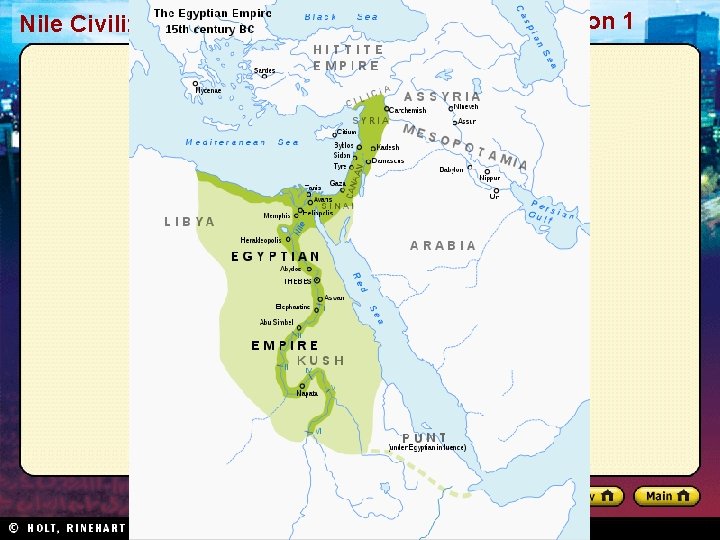
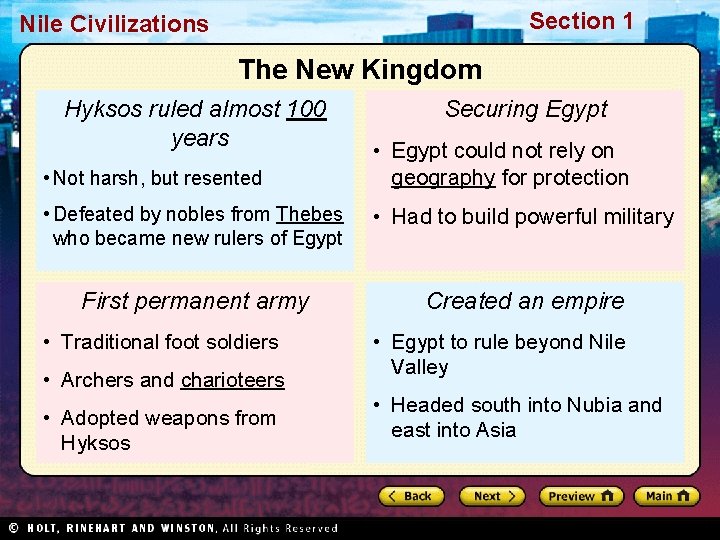
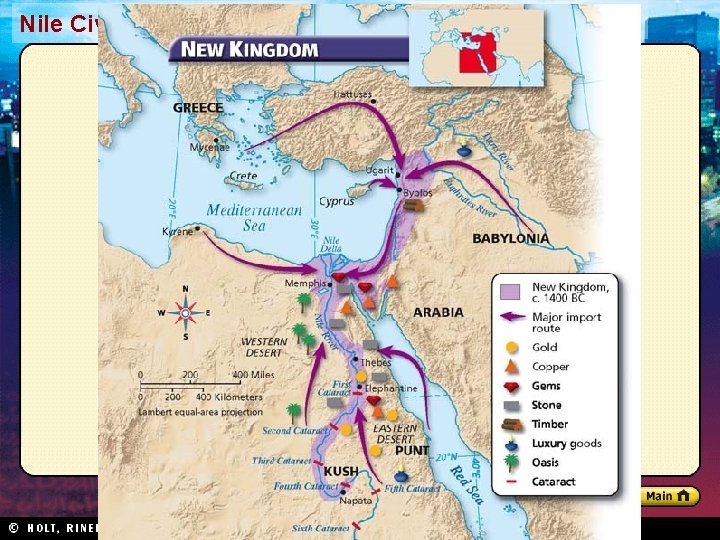
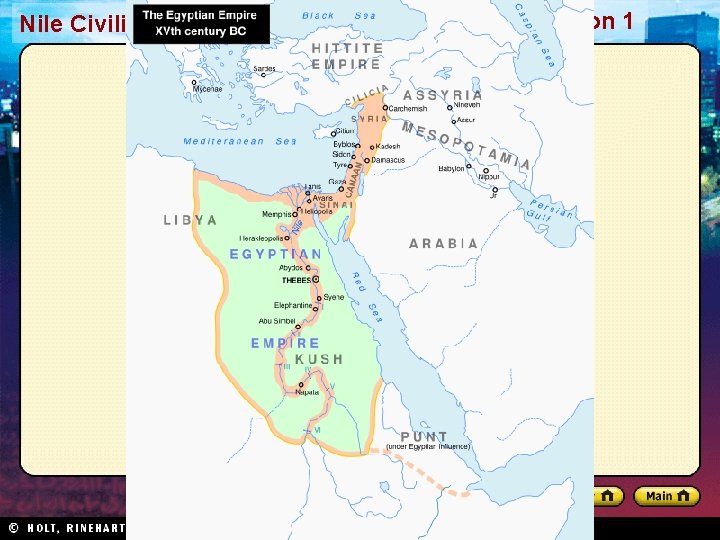
Section 1 Nile Civilizations The New Kingdom Hyksos ruled almost 100 years • Not harsh, but resented Securing Egypt • Egypt could not rely on geography for protection • Defeated by nobles from Thebes who became new rulers of Egypt • Had to build powerful military First permanent army Created an empire • Traditional foot soldiers • Archers and charioteers • Adopted weapons from Hyksos • Egypt to rule beyond Nile Valley • Headed south into Nubia and east into Asia
Nile Civilizations Section 1
Nile Civilizations Section 1
Nile Civilizations Section 1
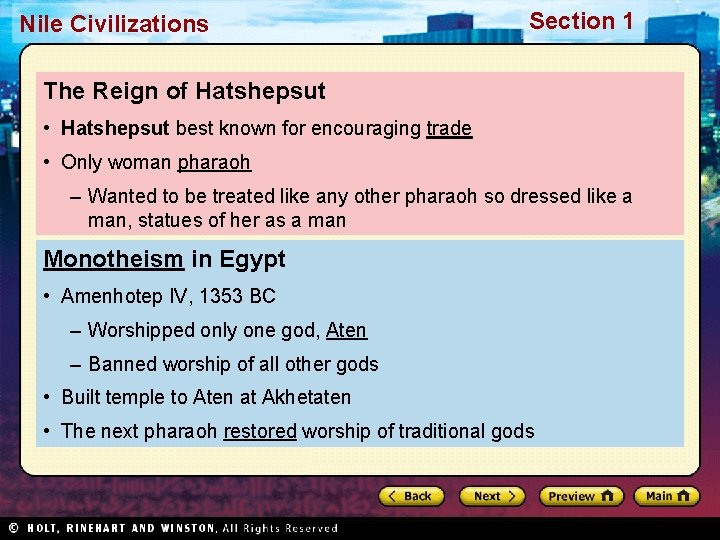
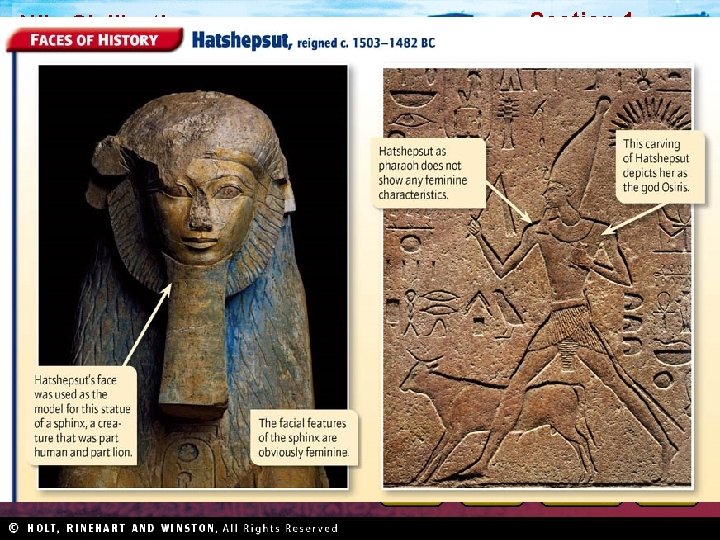
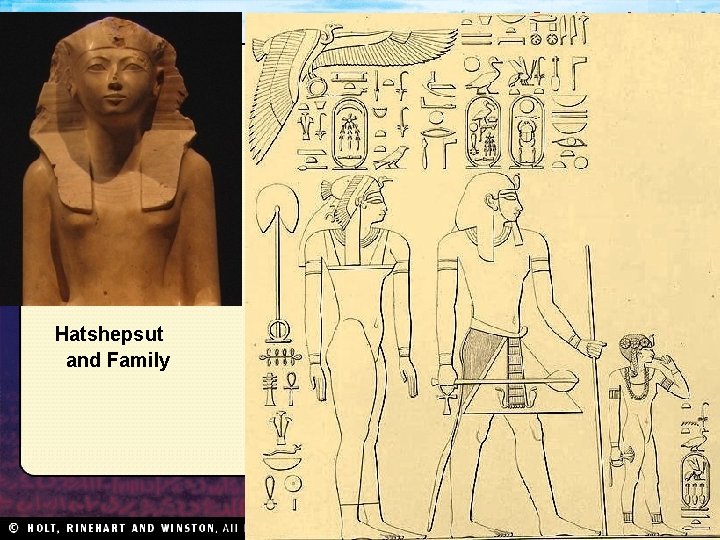
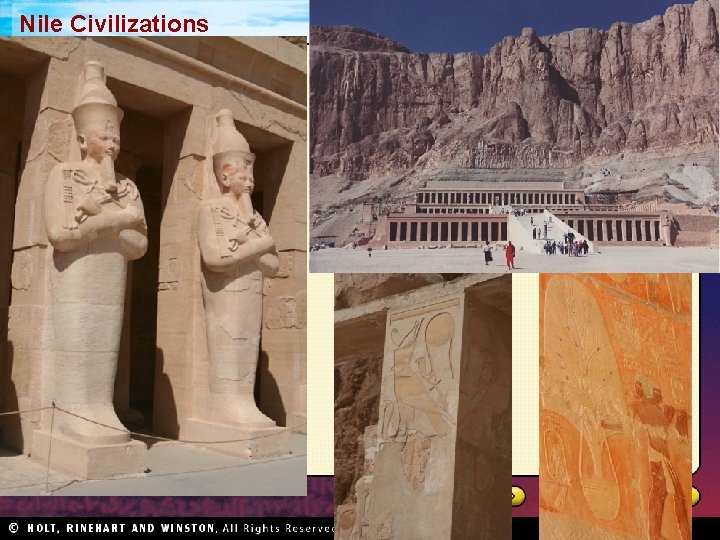
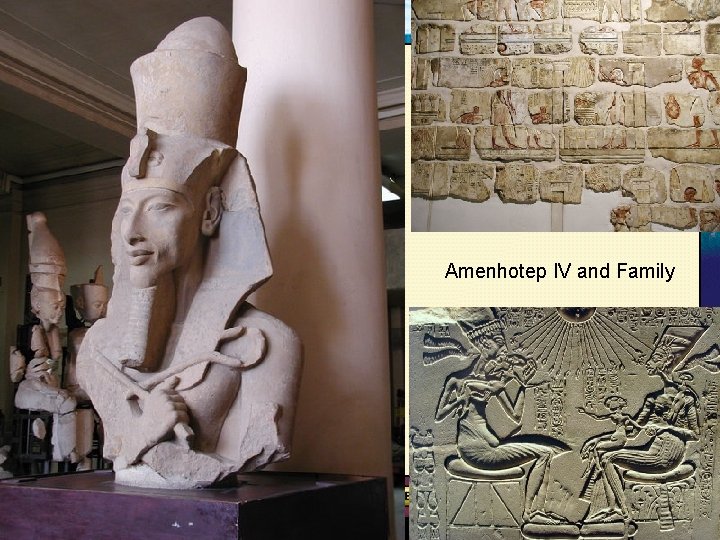
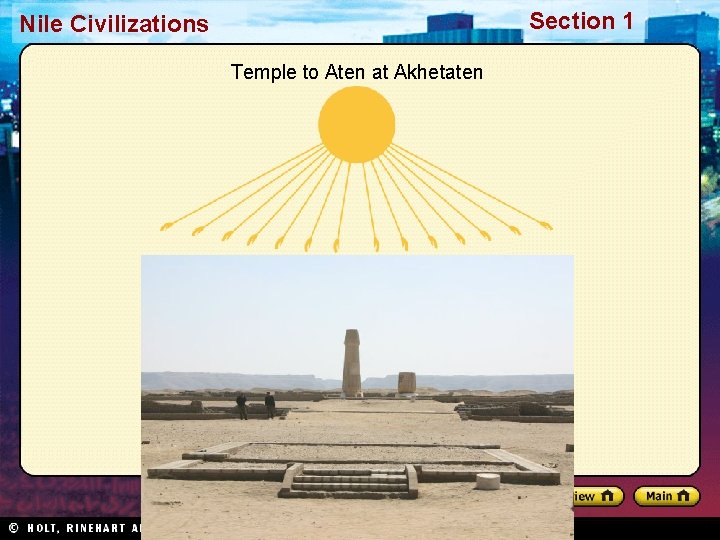
Nile Civilizations Section 1 The Reign of Hatshepsut • Hatshepsut best known for encouraging trade • Only woman pharaoh – Wanted to be treated like any other pharaoh so dressed like a man, statues of her as a man Monotheism in Egypt • Amenhotep IV, 1353 BC – Worshipped only one god, Aten – Banned worship of all other gods • Built temple to Aten at Akhetaten • The next pharaoh restored worship of traditional gods
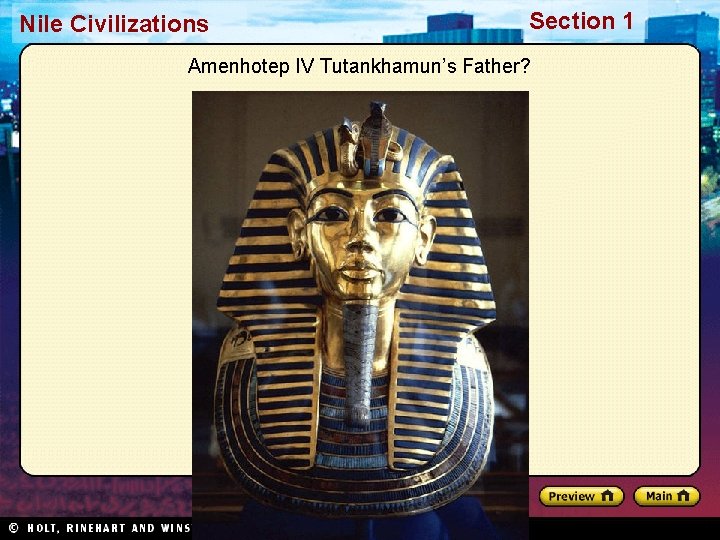
Nile Civilizations Section 1 Amenhotep IV Tutankhamun’s Father?
Nile Civilizations Section 1
Nile Civilizations Section 1
Nile Civilizations Hatshepsut and Family Section 1
Nile Civilizations Section 1
Nile Civilizations Section 1 Amenhotep IV and Family
Section 1 Nile Civilizations Temple to Aten at Akhetaten
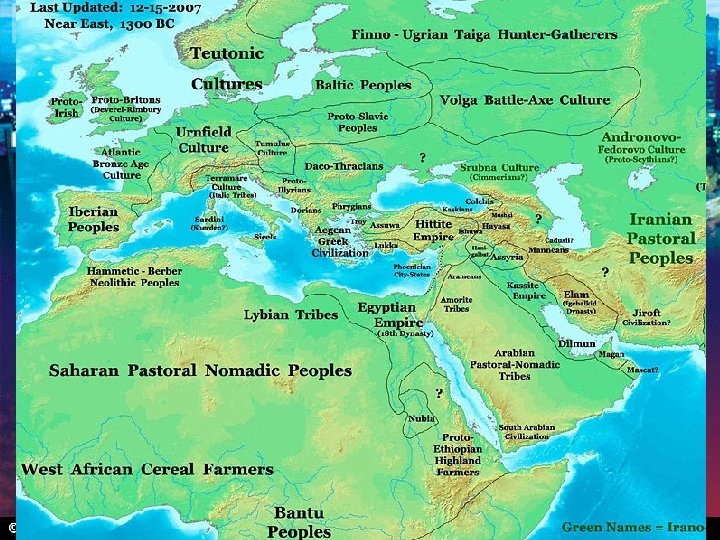
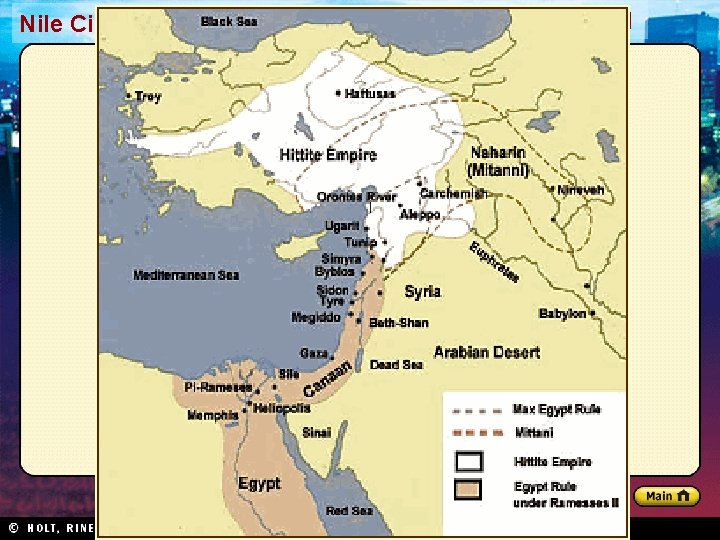
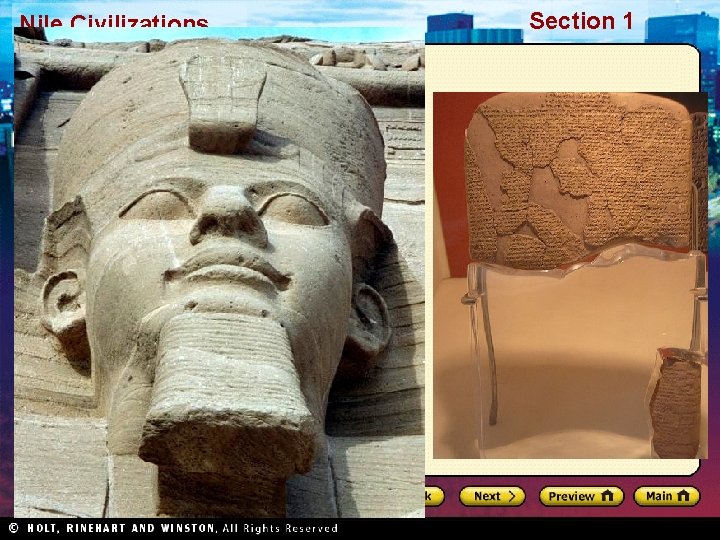
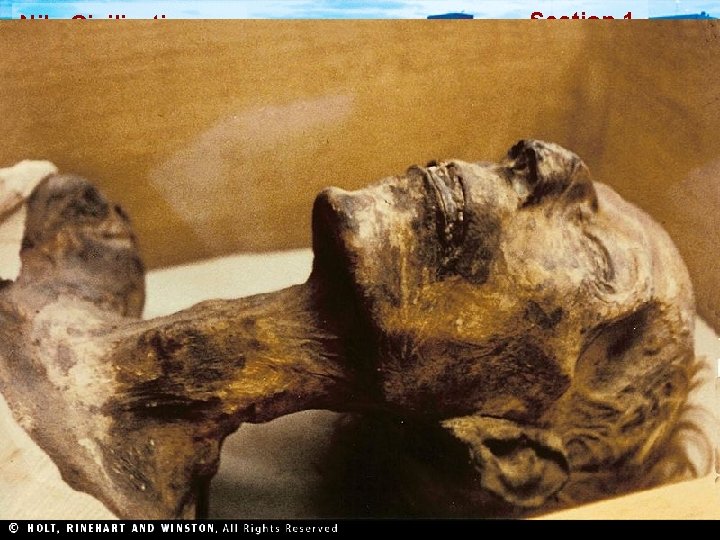
Section 1 Nile Civilizations Ramses the Great Egypt expanded empire • Fought campaigns in Nubia and Syria • A new foe around 1250 BC: Hittites invaded from Mesopotamia Confrontation with Hittites • Ramses the Great vs. Hittites = truce signed • Ramses married Hittite princess and conflict ended Ramses’ rule • Reign marked with extravagant splendor • Built more temples and monuments than other pharaohs; political/artistic achievements
Nile Civilizations Section 1
Nile Civilizations Section 1
Nile Civilizations Section 1
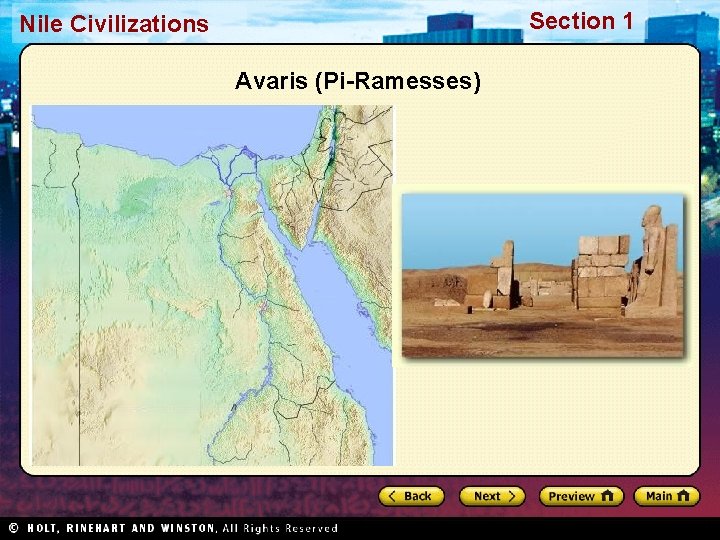
Section 1 Nile Civilizations Avaris (Pi-Ramesses)
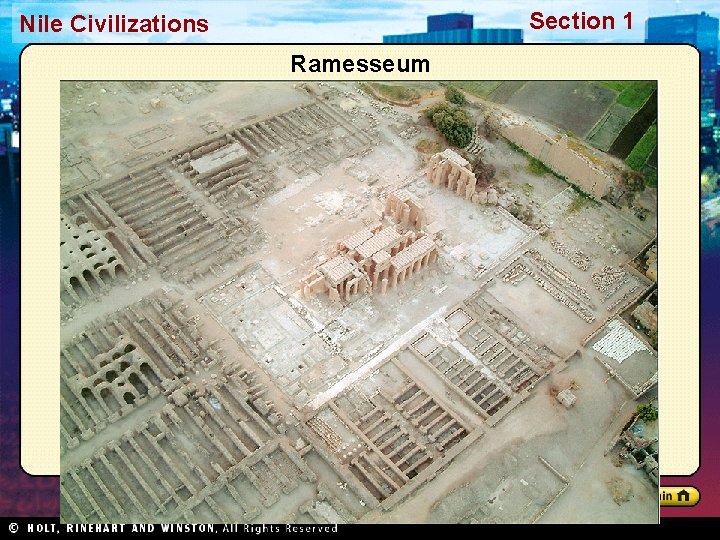
Section 1 Nile Civilizations Ramesseum
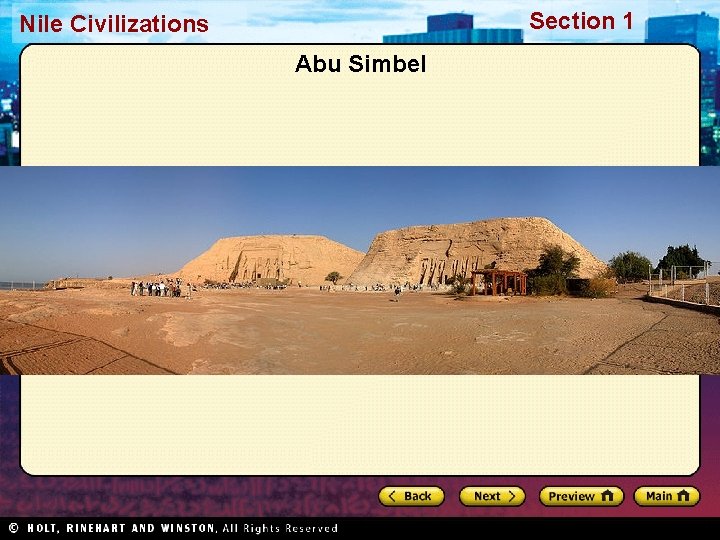
Section 1 Nile Civilizations Abu Simbel
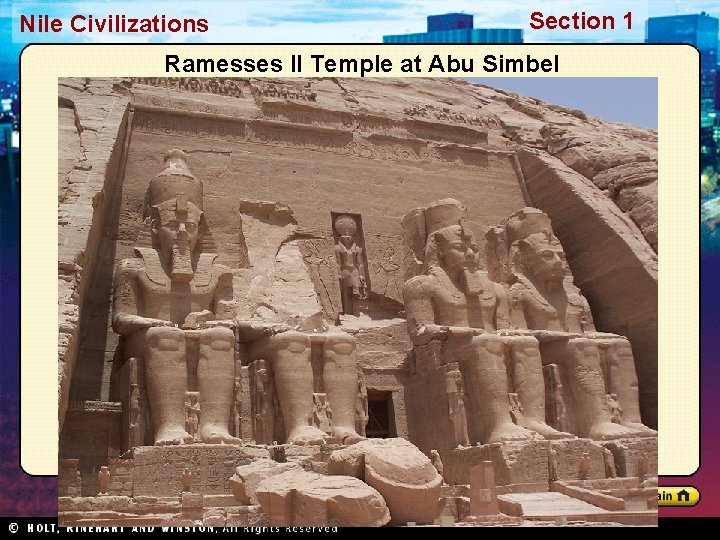
Nile Civilizations Section 1 Ramesses II Temple at Abu Simbel
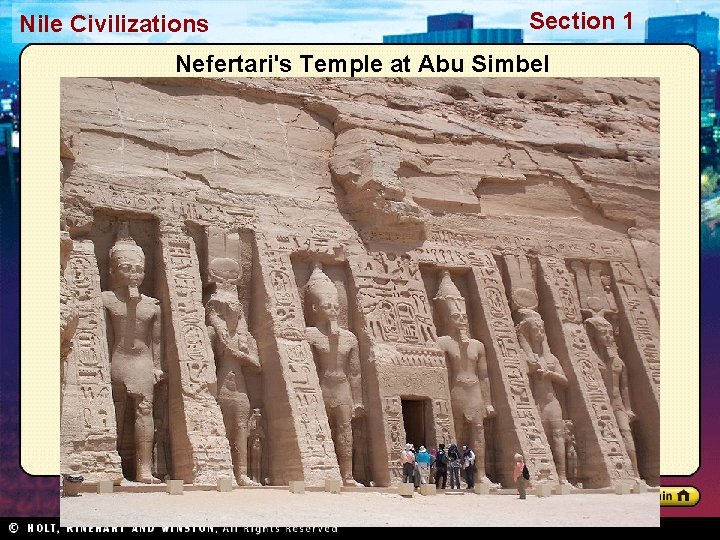
Nile Civilizations Section 1 Nefertari's Temple at Abu Simbel
Nile Civilizations Section 1
Nile Civilizations Section 1
Section 1 Nile Civilizations Egypt’s Decline • Ramses’ successors faced challenges to authority • Major invasions of Egypt – Sea Peoples devastated empires – Ended Hittite Empire, weakened Egypt’s control of Syria • Egypt broke into small states – Foreign rulers over next 700 years – Kushites, Libyans, Assyrians, Persians, Greeks, and Rome
Section 1 Nile Civilizations Question: How did Egypt grow and change during the New Kingdom? Answer(s): built strong military, created own empire, increased trade
Nile Civilizations Section 1
Nile Civilizations Section 1 “History, n. An account mostly false, of events mostly unimportant, which are brought about by rulers mostly knaves, and soldiers mostly fools. ” - Ambrose Bierce Wearing headphones for just an hour will increase bacteria in you ear by 700 x.
Section 1 Nile Civilizations Egyptian Culture Main Idea The ancient Egyptians are famous for their religion, their burial practices, and their advances in art, writing and science.
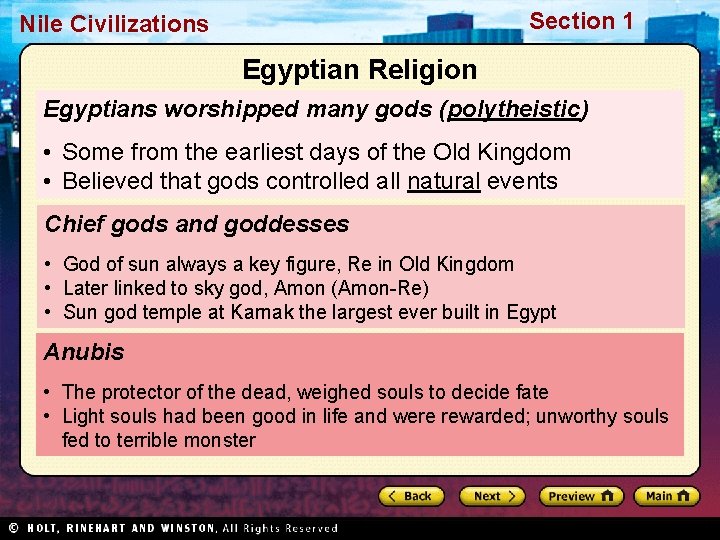
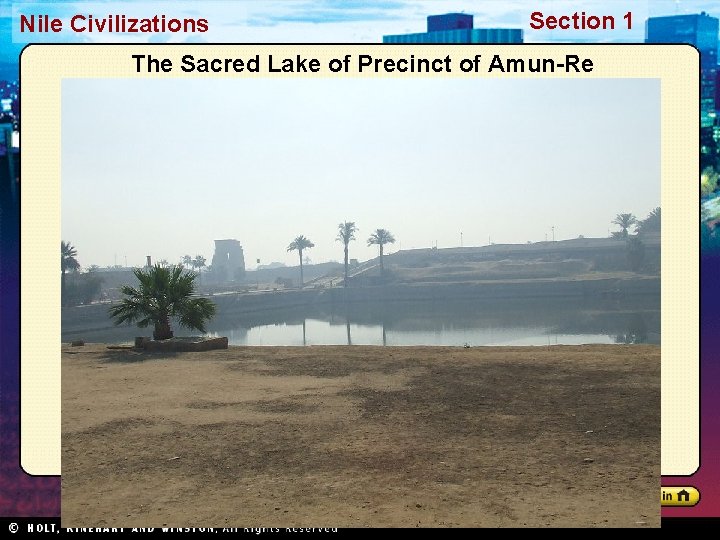
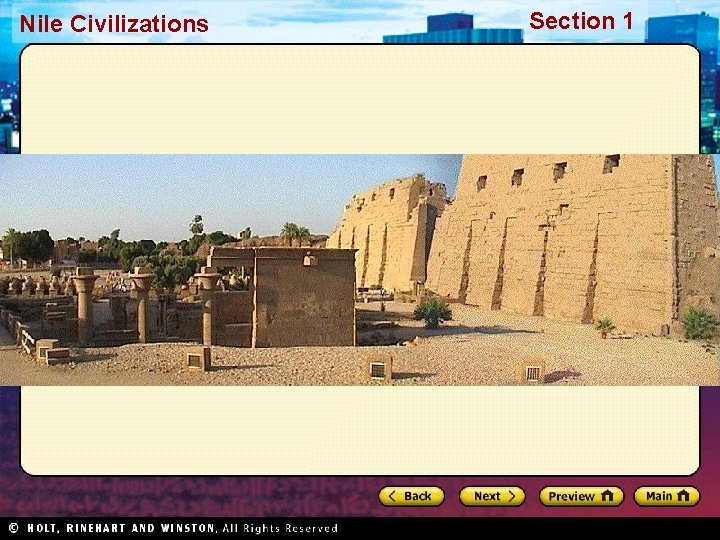
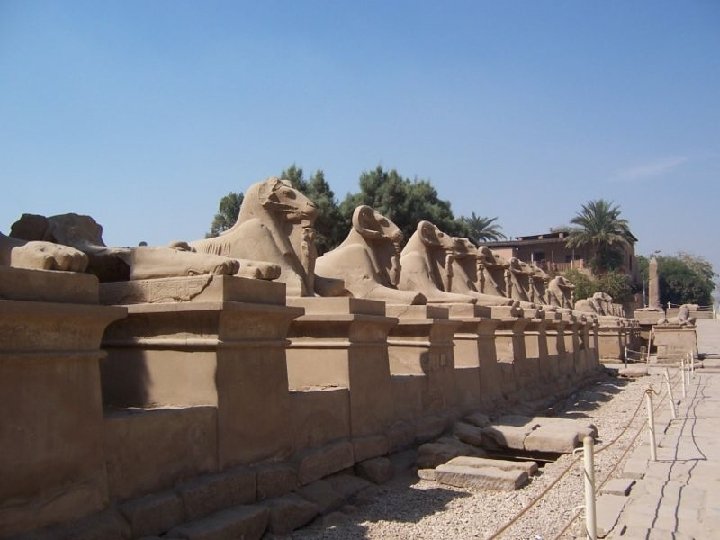
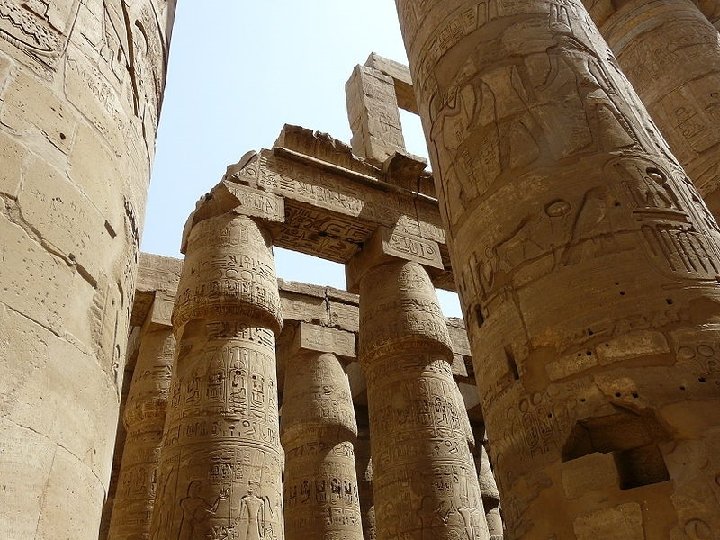
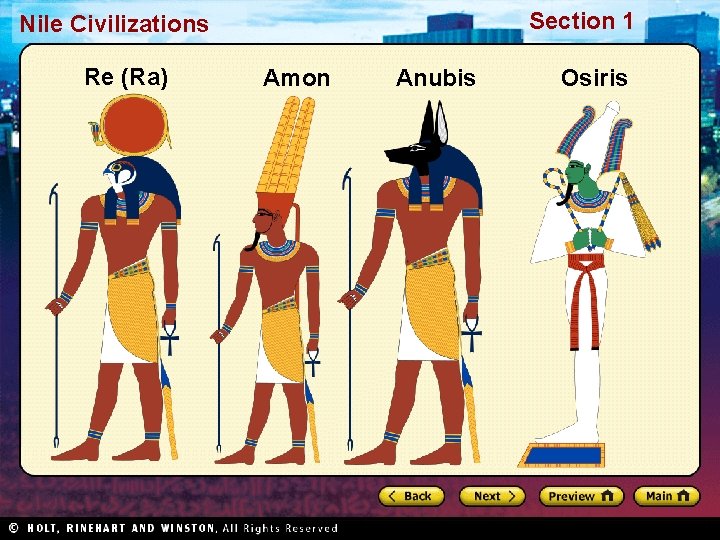
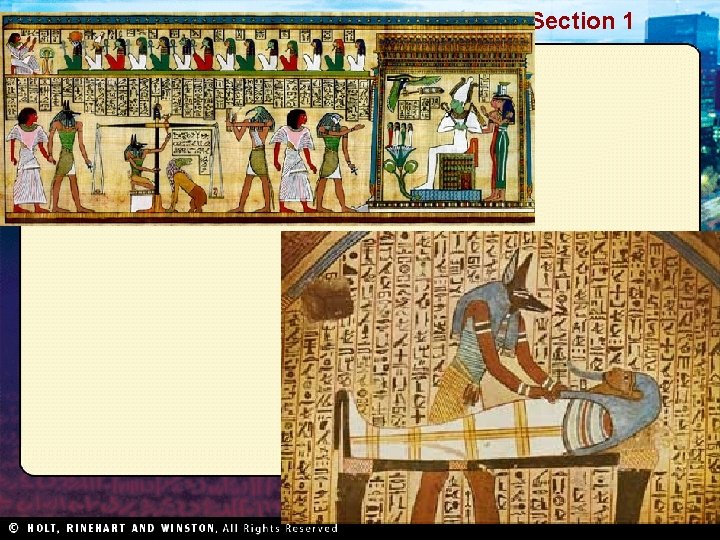
Section 1 Nile Civilizations Egyptian Religion Egyptians worshipped many gods (polytheistic) • Some from the earliest days of the Old Kingdom • Believed that gods controlled all natural events Chief gods and goddesses • God of sun always a key figure, Re in Old Kingdom • Later linked to sky god, Amon (Amon-Re) • Sun god temple at Karnak the largest ever built in Egypt Anubis • The protector of the dead, weighed souls to decide fate • Light souls had been good in life and were rewarded; unworthy souls fed to terrible monster
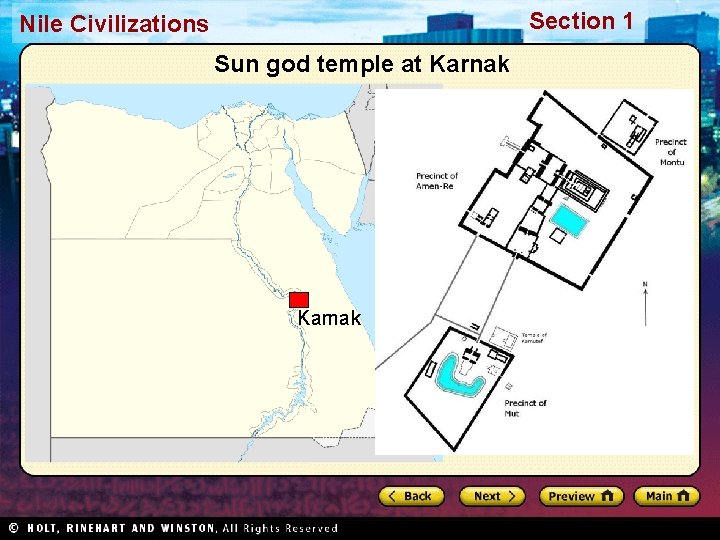
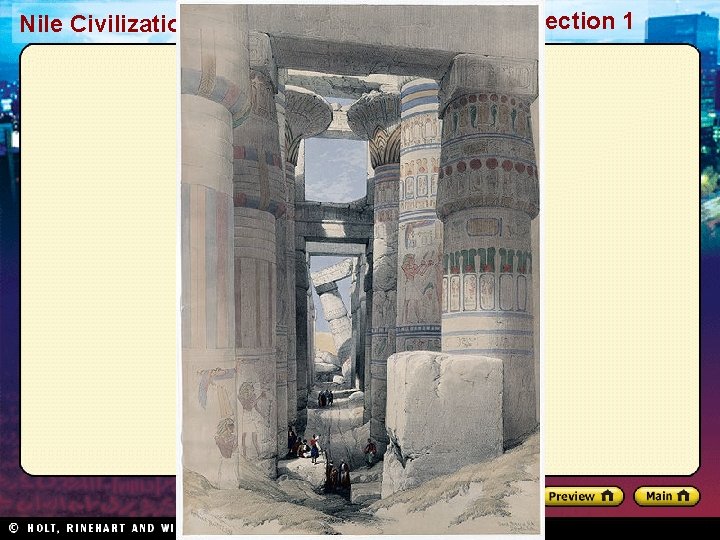
Section 1 Nile Civilizations Sun god temple at Karnak
Nile Civilizations Section 1 The Sacred Lake of Precinct of Amun-Re
Nile Civilizations Section 1
Nile Civilizations Section 1
Nile Civilizations Section 1
Nile Civilizations Section 1
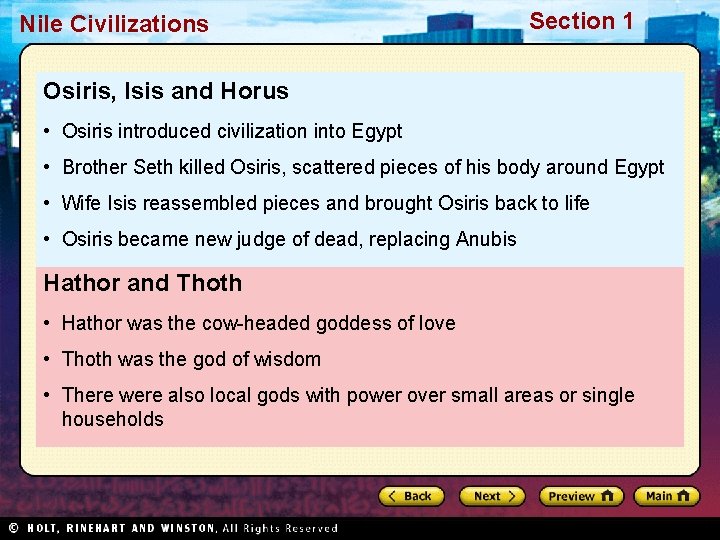
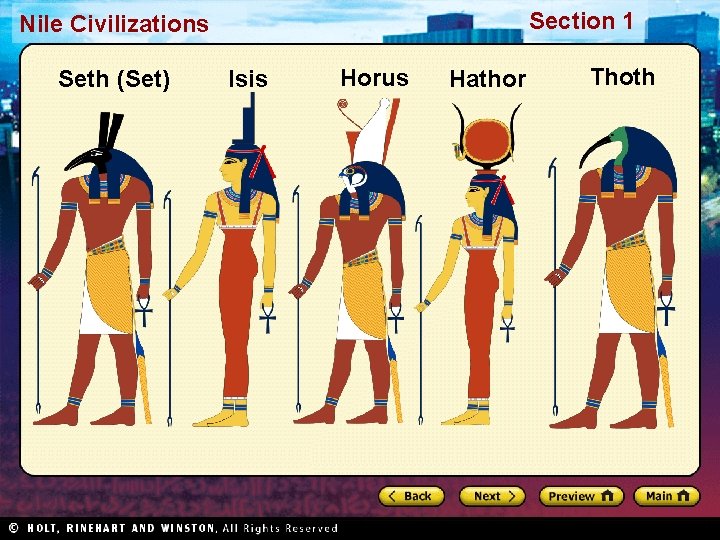
Nile Civilizations Section 1 Osiris, Isis and Horus • Osiris introduced civilization into Egypt • Brother Seth killed Osiris, scattered pieces of his body around Egypt • Wife Isis reassembled pieces and brought Osiris back to life • Osiris became new judge of dead, replacing Anubis Hathor and Thoth • Hathor was the cow-headed goddess of love • Thoth was the god of wisdom • There were also local gods with power over small areas or single households
Section 1 Nile Civilizations Re (Ra) Amon Anubis Osiris
Section 1 Nile Civilizations Seth (Set) Isis Horus Hathor Thoth
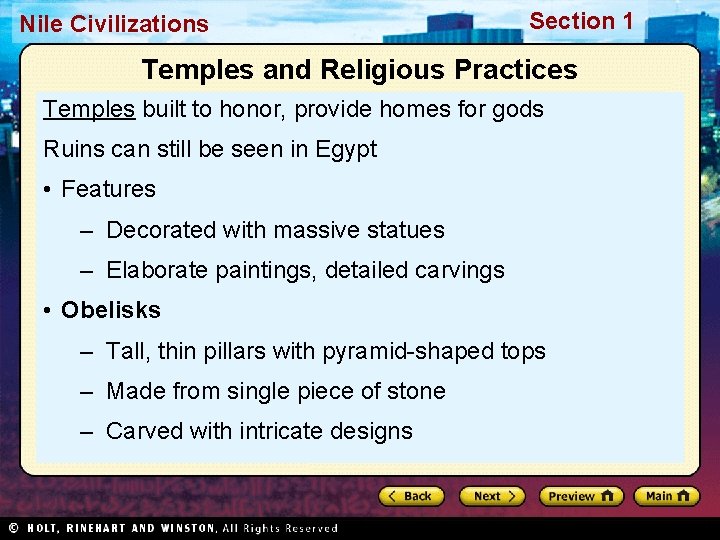
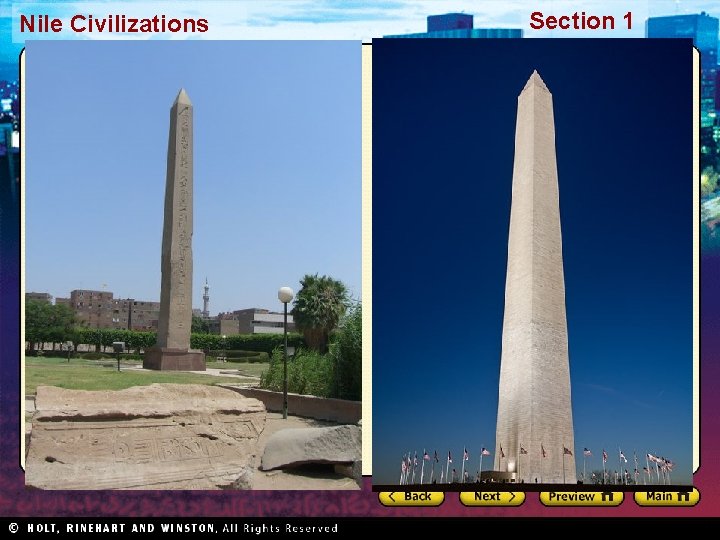
Nile Civilizations Section 1 Temples and Religious Practices Temples built to honor, provide homes for gods Ruins can still be seen in Egypt • Features – Decorated with massive statues – Elaborate paintings, detailed carvings • Obelisks – Tall, thin pillars with pyramid-shaped tops – Made from single piece of stone – Carved with intricate designs
Nile Civilizations Section 1
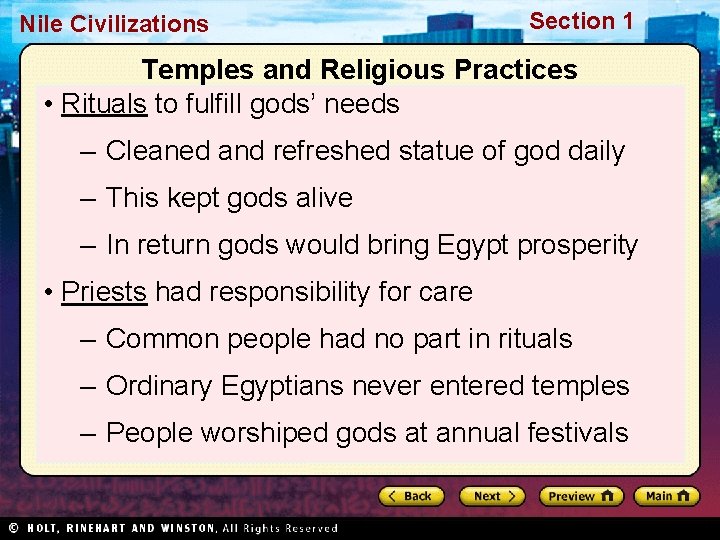
Nile Civilizations Section 1 Temples and Religious Practices • Rituals to fulfill gods’ needs – Cleaned and refreshed statue of god daily – This kept gods alive – In return gods would bring Egypt prosperity • Priests had responsibility for care – Common people had no part in rituals – Ordinary Egyptians never entered temples – People worshiped gods at annual festivals
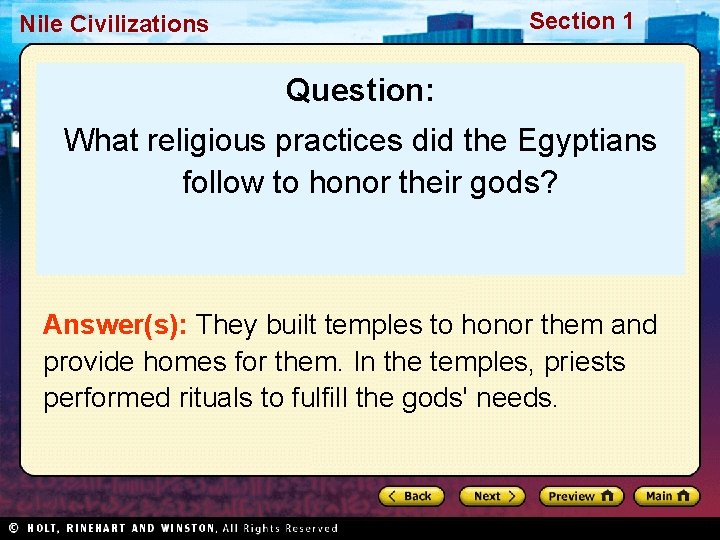
Section 1 Nile Civilizations Question: What religious practices did the Egyptians follow to honor their gods? Answer(s): They built temples to honor them and provide homes for them. In the temples, priests performed rituals to fulfill the gods' needs.
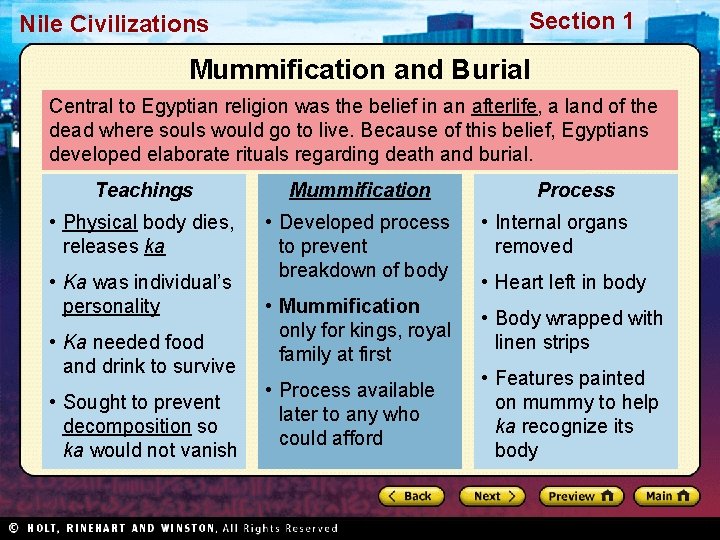
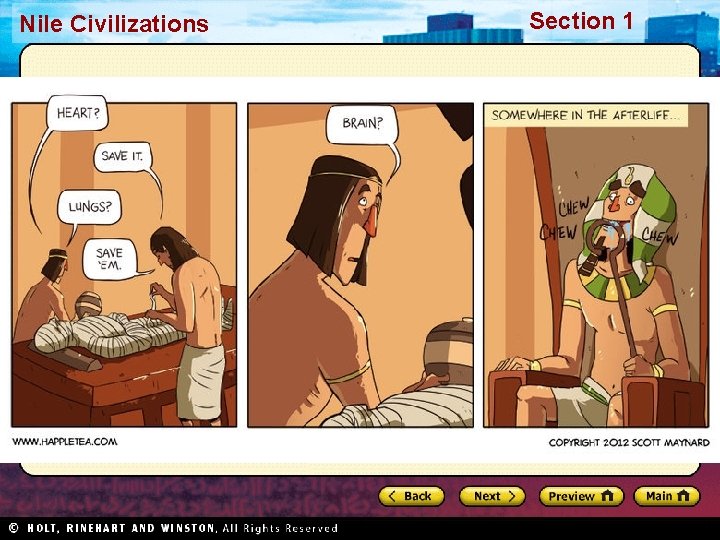
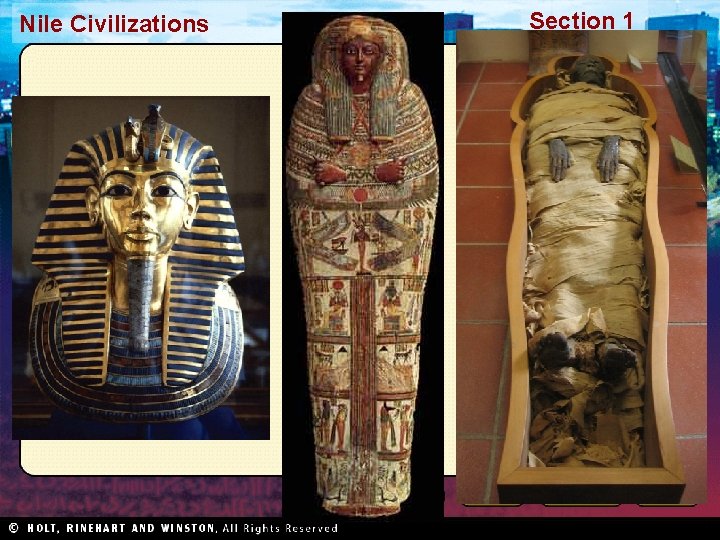
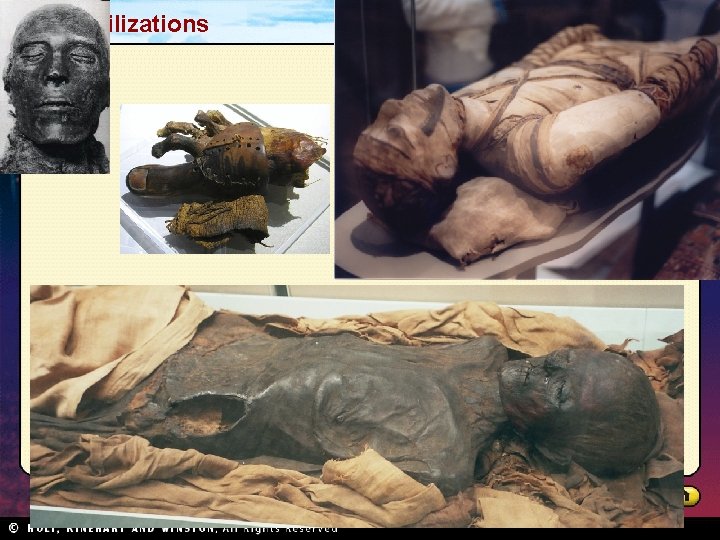
Section 1 Nile Civilizations Mummification and Burial Central to Egyptian religion was the belief in an afterlife, a land of the dead where souls would go to live. Because of this belief, Egyptians developed elaborate rituals regarding death and burial. Teachings Mummification • Physical body dies, releases ka • Developed process to prevent breakdown of body • Ka was individual’s personality • Ka needed food and drink to survive • Sought to prevent decomposition so ka would not vanish Process • Internal organs removed • Heart left in body • Mummification only for kings, royal family at first • Body wrapped with linen strips • Process available later to any who could afford • Features painted on mummy to help ka recognize its body
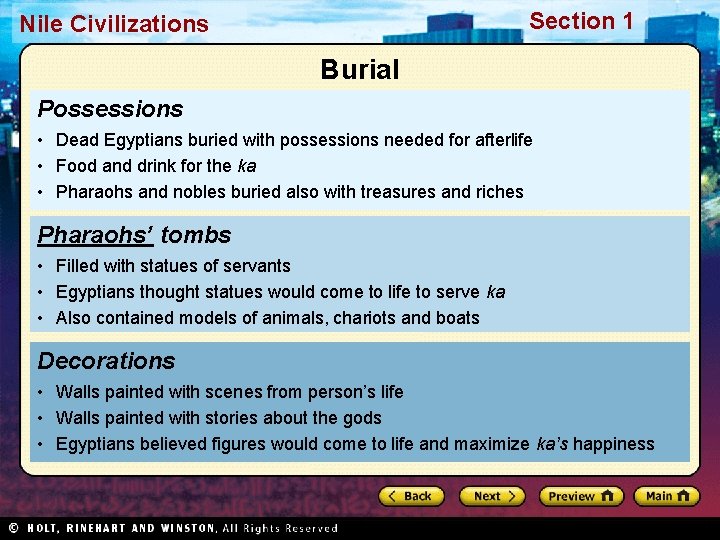
Section 1 Nile Civilizations Burial Possessions • Dead Egyptians buried with possessions needed for afterlife • Food and drink for the ka • Pharaohs and nobles buried also with treasures and riches Pharaohs’ tombs • Filled with statues of servants • Egyptians thought statues would come to life to serve ka • Also contained models of animals, chariots and boats Decorations • Walls painted with scenes from person’s life • Walls painted with stories about the gods • Egyptians believed figures would come to life and maximize ka’s happiness
Nile Civilizations Section 1
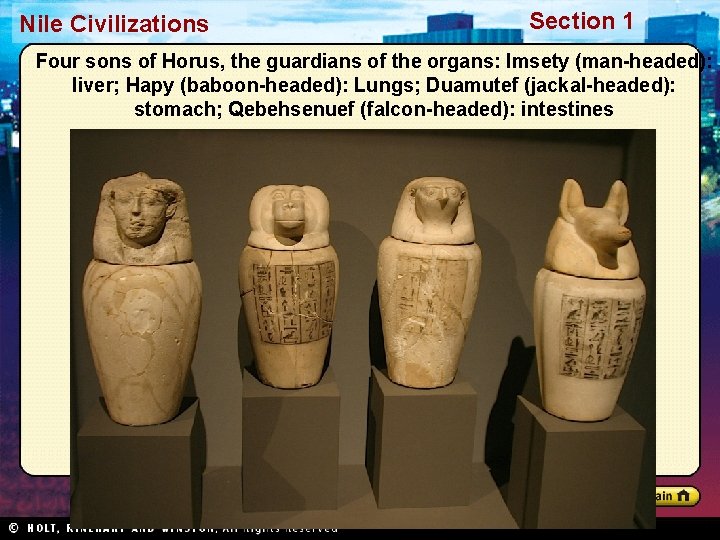
Nile Civilizations Section 1 Four sons of Horus, the guardians of the organs: Imsety (man-headed): liver; Hapy (baboon-headed): Lungs; Duamutef (jackal-headed): stomach; Qebehsenuef (falcon-headed): intestines
Nile Civilizations Section 1
Nile Civilizations Section 1
Nile Civilizations Section 1
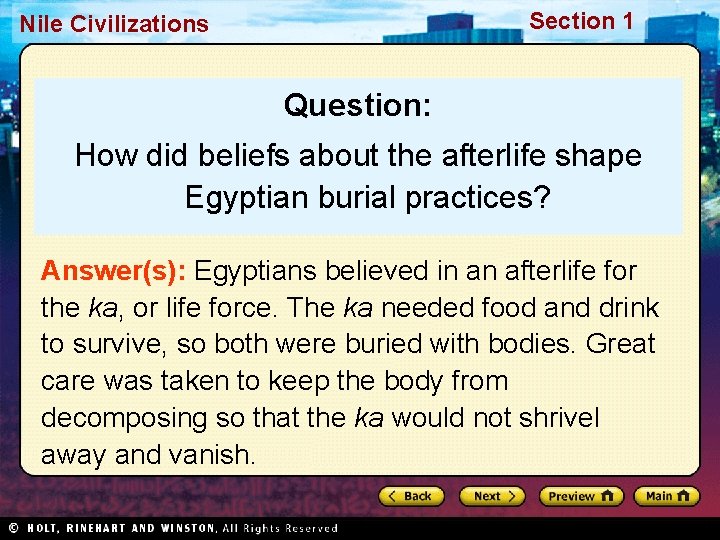
Section 1 Nile Civilizations Question: How did beliefs about the afterlife shape Egyptian burial practices? Answer(s): Egyptians believed in an afterlife for the ka, or life force. The ka needed food and drink to survive, so both were buried with bodies. Great care was taken to keep the body from decomposing so that the ka would not shrivel away and vanish.
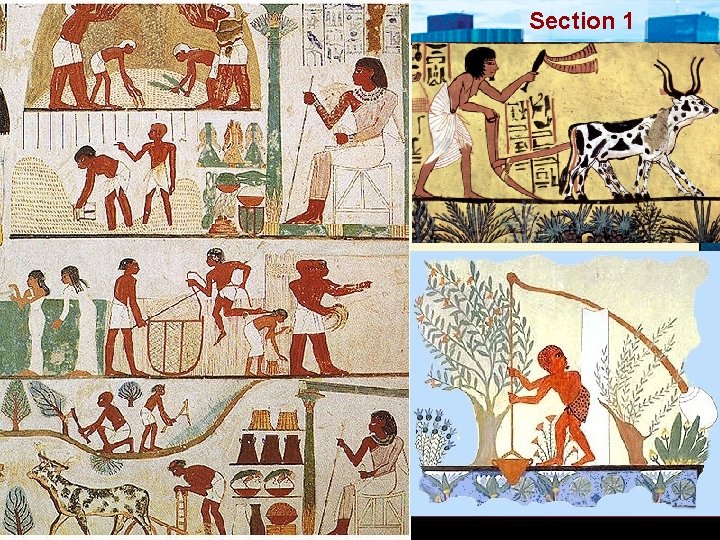
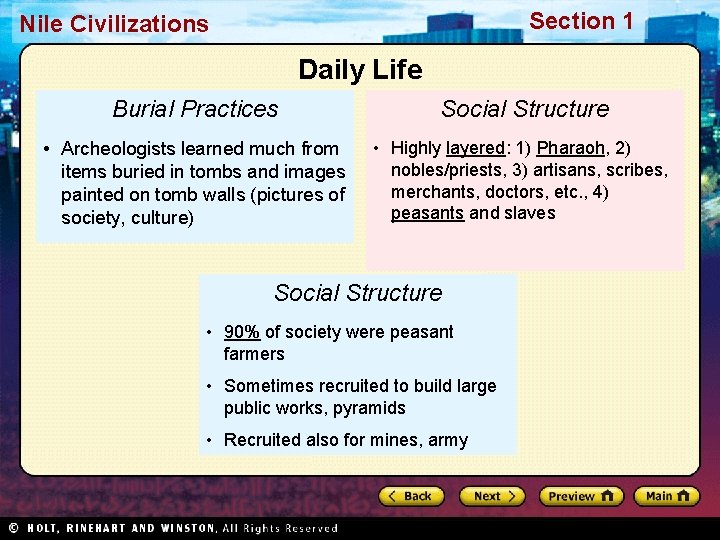
Section 1 Nile Civilizations Daily Life Burial Practices Social Structure • Archeologists learned much from items buried in tombs and images painted on tomb walls (pictures of society, culture) • Highly layered: 1) Pharaoh, 2) nobles/priests, 3) artisans, scribes, merchants, doctors, etc. , 4) peasants and slaves Social Structure • 90% of society were peasant farmers • Sometimes recruited to build large public works, pyramids • Recruited also for mines, army
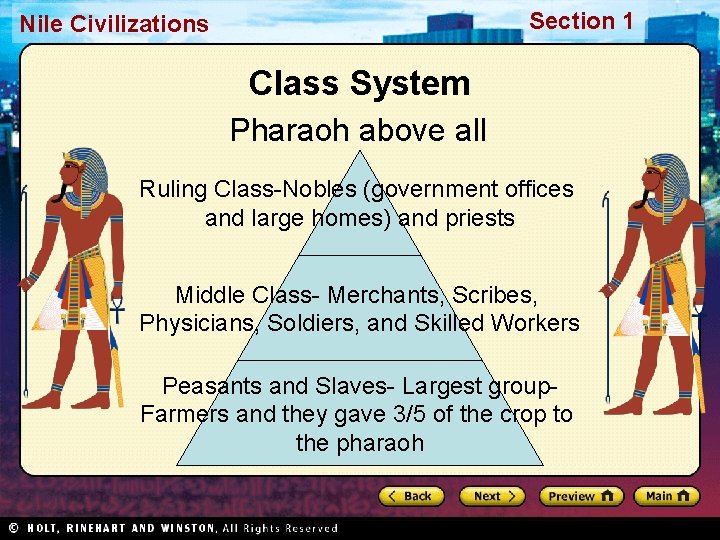
Section 1 Nile Civilizations Class System Pharaoh above all Ruling Class-Nobles (government offices and large homes) and priests Middle Class- Merchants, Scribes, Physicians, Soldiers, and Skilled Workers Peasants and Slaves- Largest group. Farmers and they gave 3/5 of the crop to the pharaoh
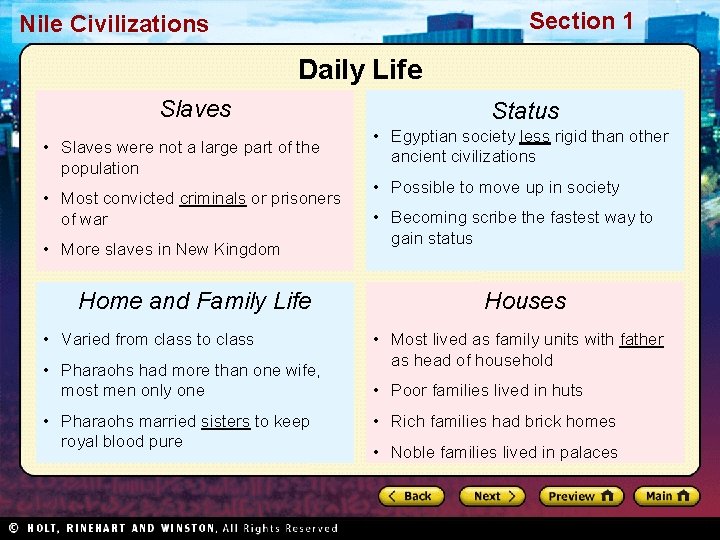
Section 1 Nile Civilizations Daily Life Slaves • Slaves were not a large part of the population • Most convicted criminals or prisoners of war • More slaves in New Kingdom Home and Family Life • Varied from class to class • Pharaohs had more than one wife, most men only one • Pharaohs married sisters to keep royal blood pure Status • Egyptian society less rigid than other ancient civilizations • Possible to move up in society • Becoming scribe the fastest way to gain status Houses • Most lived as family units with father as head of household • Poor families lived in huts • Rich families had brick homes • Noble families lived in palaces
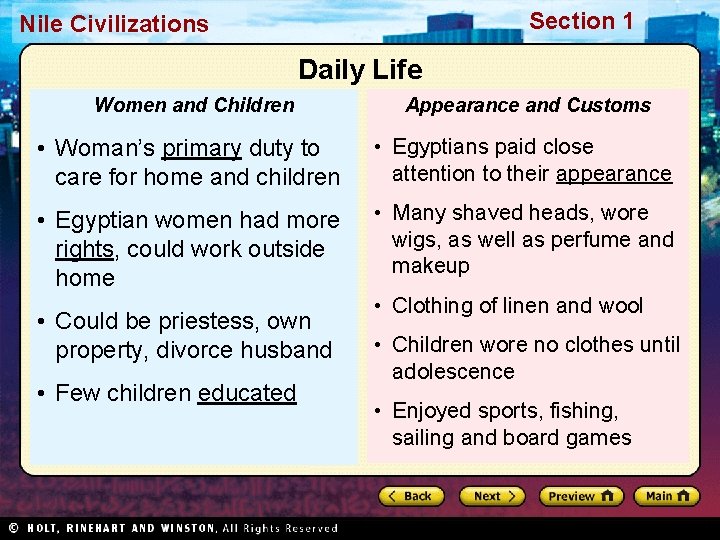
Section 1 Nile Civilizations Daily Life Women and Children Appearance and Customs • Woman’s primary duty to care for home and children • Egyptians paid close attention to their appearance • Egyptian women had more rights, could work outside home • Many shaved heads, wore wigs, as well as perfume and makeup • Could be priestess, own property, divorce husband • Few children educated • Clothing of linen and wool • Children wore no clothes until adolescence • Enjoyed sports, fishing, sailing and board games
Section 1 Nile Civilizations Question: How did life differ for rich and poor Egyptians? Answer(s): Rich had large homes, poor might live in tiny huts; wealthy men wore longer skirts or robes than peasants; wealthy men and women often wore gold jewelry.
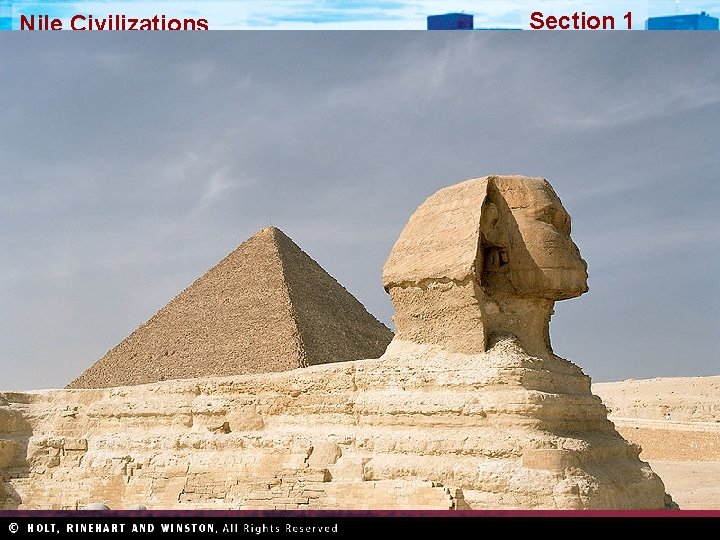
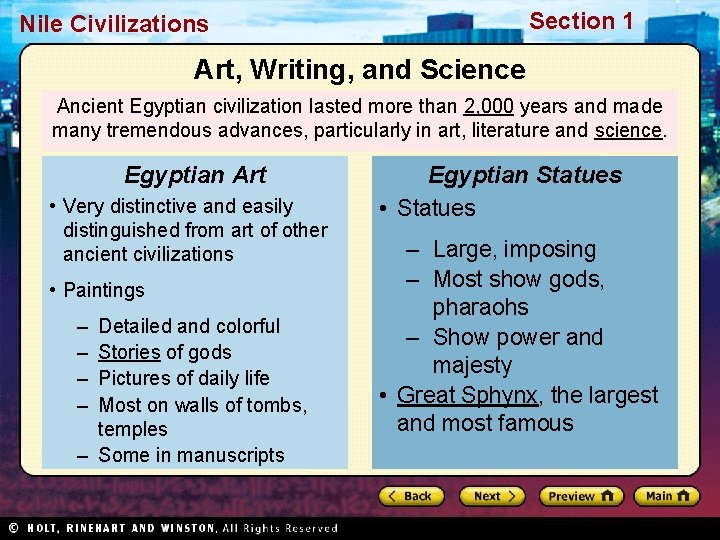
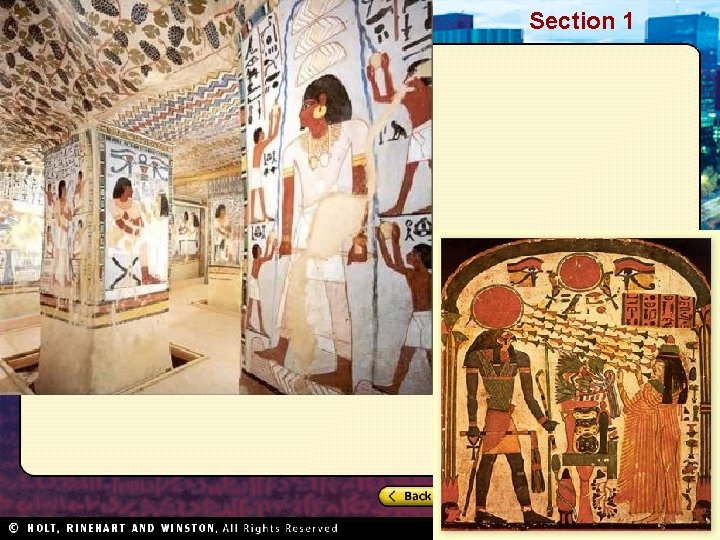
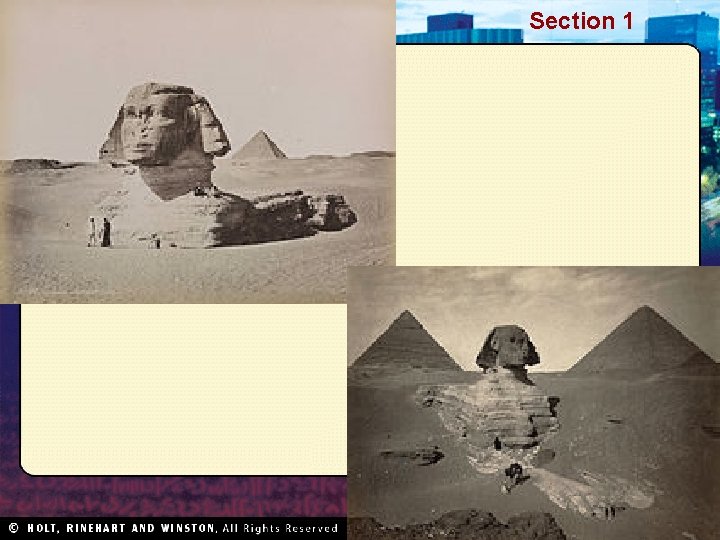
Section 1 Nile Civilizations Art, Writing, and Science Ancient Egyptian civilization lasted more than 2, 000 years and made many tremendous advances, particularly in art, literature and science. Egyptian Art • Very distinctive and easily distinguished from art of other ancient civilizations • Paintings – – Detailed and colorful Stories of gods Pictures of daily life Most on walls of tombs, temples – Some in manuscripts Egyptian Statues • Statues – Large, imposing – Most show gods, pharaohs – Show power and majesty • Great Sphynx, the largest and most famous
Nile Civilizations Section 1
Nile Civilizations Section 1
Nile Civilizations Section 1
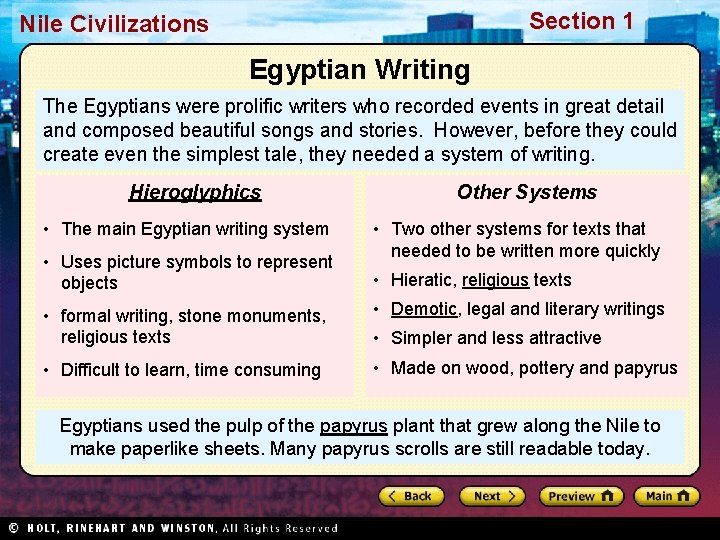
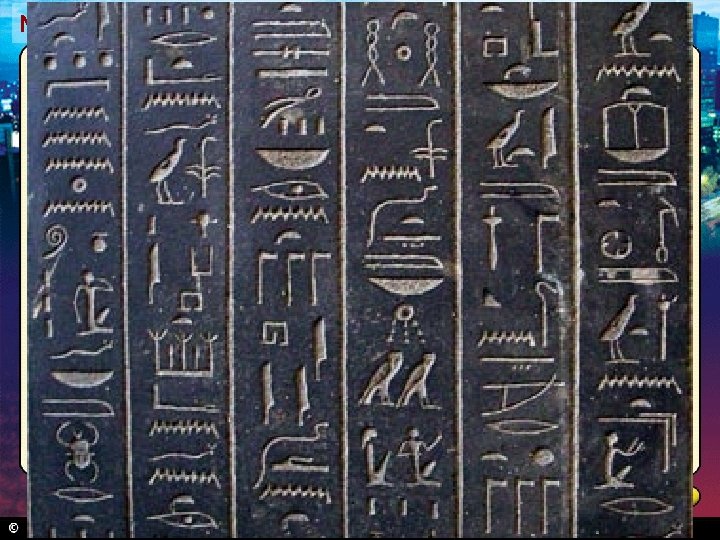
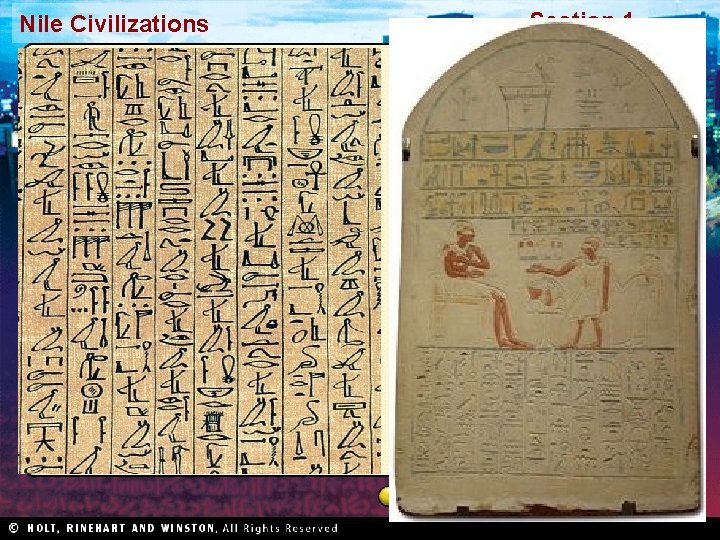
Section 1 Nile Civilizations Egyptian Writing The Egyptians were prolific writers who recorded events in great detail and composed beautiful songs and stories. However, before they could create even the simplest tale, they needed a system of writing. Hieroglyphics • The main Egyptian writing system • Uses picture symbols to represent objects Other Systems • Two other systems for texts that needed to be written more quickly • Hieratic, religious texts • formal writing, stone monuments, religious texts • Demotic, legal and literary writings • Difficult to learn, time consuming • Made on wood, pottery and papyrus • Simpler and less attractive Egyptians used the pulp of the papyrus plant that grew along the Nile to make paperlike sheets. Many papyrus scrolls are still readable today.
Nile Civilizations Section 1
Nile Civilizations Section 1
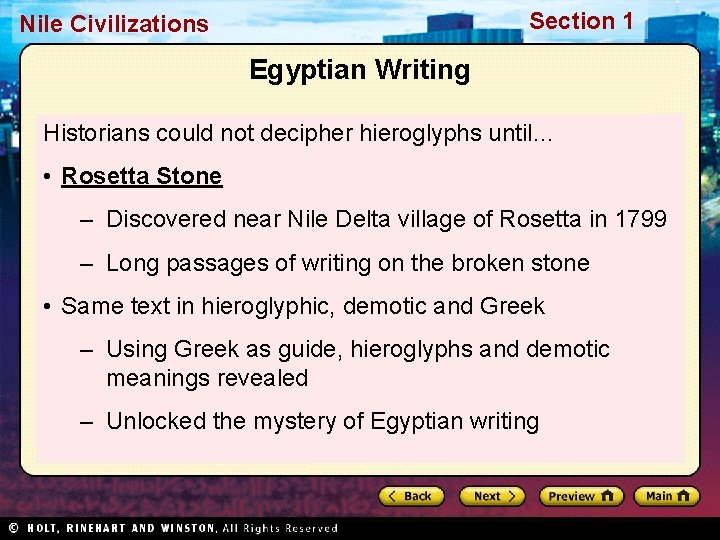
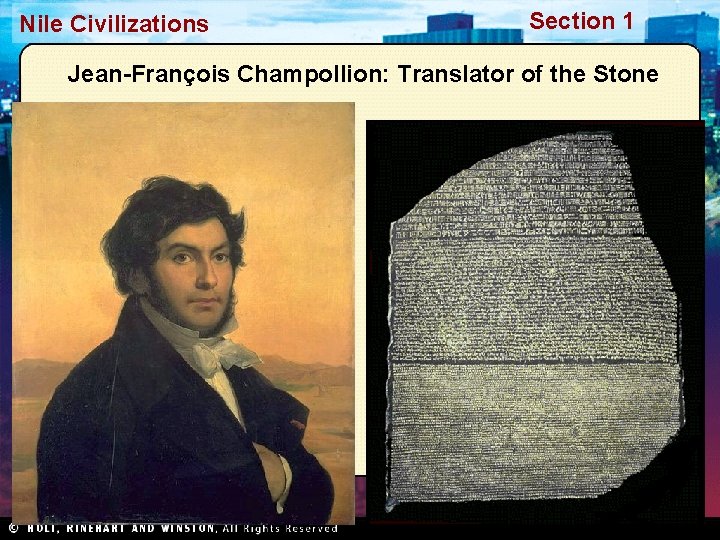
Section 1 Nile Civilizations Egyptian Writing Historians could not decipher hieroglyphs until… • Rosetta Stone – Discovered near Nile Delta village of Rosetta in 1799 – Long passages of writing on the broken stone • Same text in hieroglyphic, demotic and Greek – Using Greek as guide, hieroglyphs and demotic meanings revealed – Unlocked the mystery of Egyptian writing
Nile Civilizations Section 1 Jean-François Champollion: Translator of the Stone
Nile Civilizations Section 1
Nile Civilizations Section 1
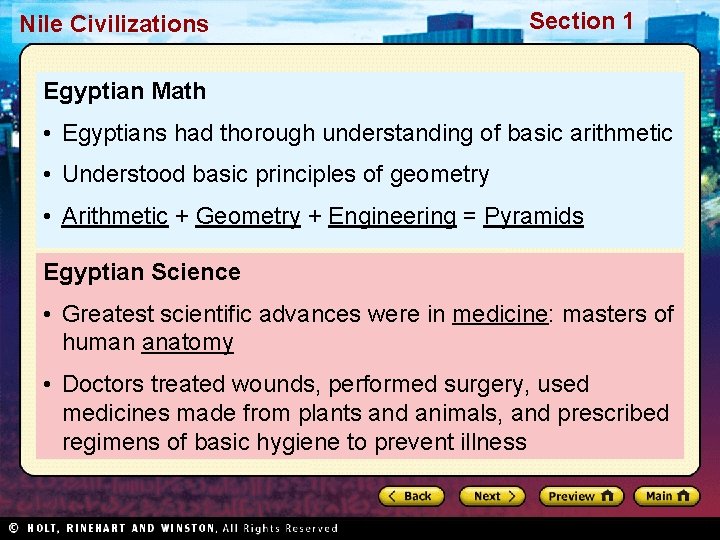
Nile Civilizations Section 1 Egyptian Math • Egyptians had thorough understanding of basic arithmetic • Understood basic principles of geometry • Arithmetic + Geometry + Engineering = Pyramids Egyptian Science • Greatest scientific advances were in medicine: masters of human anatomy • Doctors treated wounds, performed surgery, used medicines made from plants and animals, and prescribed regimens of basic hygiene to prevent illness
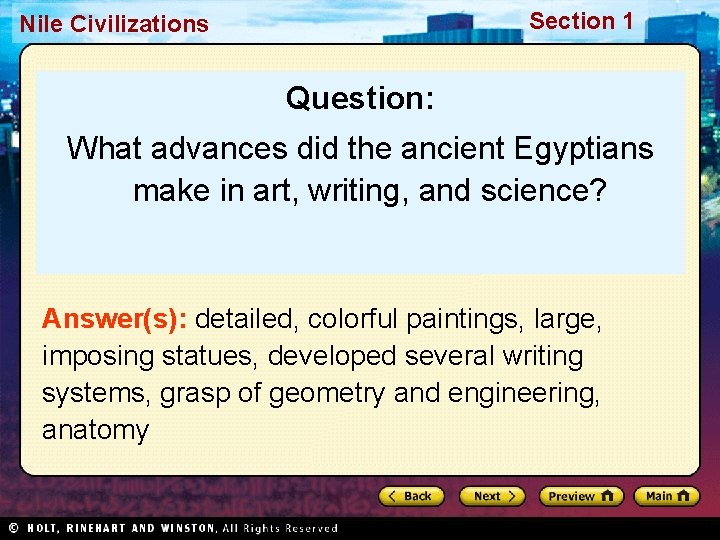
Section 1 Nile Civilizations Question: What advances did the ancient Egyptians make in art, writing, and science? Answer(s): detailed, colorful paintings, large, imposing statues, developed several writing systems, grasp of geometry and engineering, anatomy
Nile Civilizations Section 1
Nile Civilizations Section 1