
NIH PI Management Leadership Course Sharon L Milgram

- Slides: 98
NIH PI Management & Leadership Course Sharon L. Milgram, Director NIH OITE milgrams@od. nih. gov
Group Work – the Story of PM and YC After receiving good, but pretty critical, reviews to a paper we submitted to JCB, PM, a grad student in my lab, did not start working on the revisions quickly enough. I called PM in and made it clear that if we missed the 90 day deadline the editor would reject the paper outright. I said we would be embarrassed at the next thesis committee meeting and in front of the whole department. I was forceful in my assessment of the situation, and pretty negative about the potential outcomes. This approach worked well; PM started experiments immediately, worked really hard and finished the revisions in record time. Although PM seemed irritated at first, it didn’t last and the paper got accepted, making everyone happy. Another grad student YC had similar motivation problems but related to scheduling a required thesis proposal meeting and department seminar. I used the same approach of pointing out how embarrassed we would be. Although the approach worked well with PM, YC responded by disappearing, calling in sick, and avoiding me. We had some really awkward interactions until we finally talked about it; then I learned about many other issues in our relationship that I was completely unaware of. Unfortunately, it was too late to salvage things and YC moved to another lab, leaving me short staffed at a critical time.
Issues and Variables n Individuals: ¨ ¨ ¨ n n n have different responses to feedback are motivated in different ways respond in different ways to stress and setback Students may be at different stages and need different amounts of hands-on guidance Cultural and/or gender differences, biases and/or assumptions could be at play One student may have personal issues that the PI is unaware of and these issues impacted the response
What does it take to be a good leader?
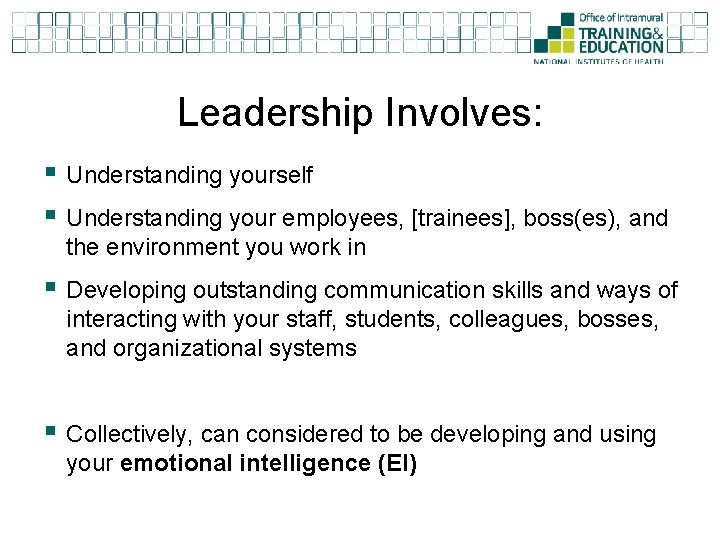
Leadership Involves: § Understanding yourself § Understanding your employees, [trainees], boss(es), and the environment you work in § Developing outstanding communication skills and ways of interacting with your staff, students, colleagues, bosses, and organizational systems § Collectively, can considered to be developing and using your emotional intelligence (EI)
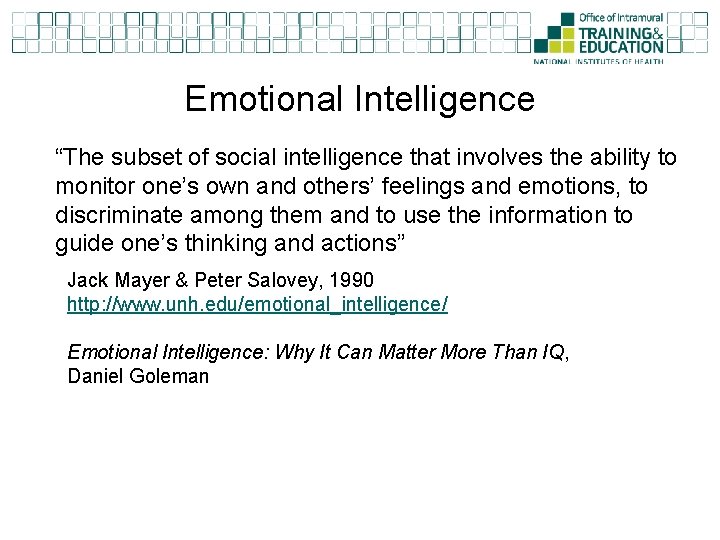
Emotional Intelligence “The subset of social intelligence that involves the ability to monitor one’s own and others’ feelings and emotions, to discriminate among them and to use the information to guide one’s thinking and actions” Jack Mayer & Peter Salovey, 1990 http: //www. unh. edu/emotional_intelligence/ Emotional Intelligence: Why It Can Matter More Than IQ, Daniel Goleman
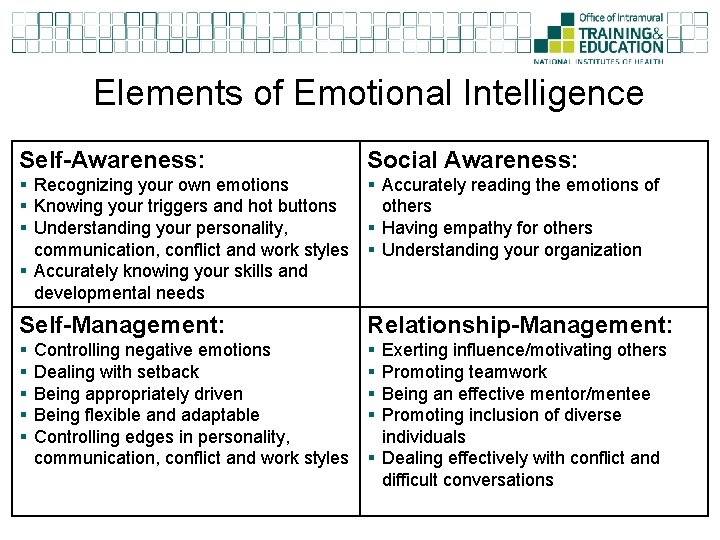
Elements of Emotional Intelligence Self-Awareness: Social Awareness: § Recognizing your own emotions § Accurately reading the emotions of § Knowing your triggers and hot buttons others § Understanding your personality, § Having empathy for others communication, conflict and work styles § Understanding your organization § Accurately knowing your skills and developmental needs Self-Management: Relationship-Management: § § § § § Controlling negative emotions Dealing with setback Being appropriately driven Being flexible and adaptable Controlling edges in personality, communication, conflict and work styles Exerting influence/motivating others Promoting teamwork Being an effective mentor/mentee Promoting inclusion of diverse individuals § Dealing effectively with conflict and difficult conversations
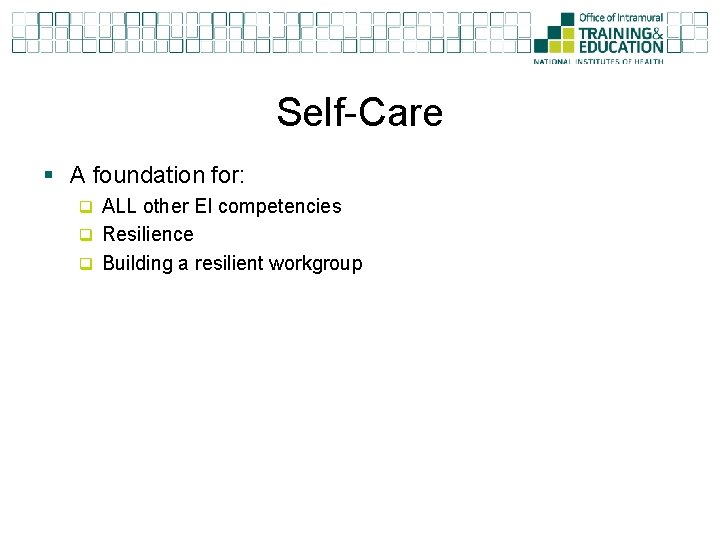
Self-Care § A foundation for: q ALL other EI competencies q Resilience q Building a resilient workgroup
What is Self-Care? n n n All the things we do (and don’t do) to maintain our physical, mental, emotional and spiritual health There are common themes, but we all have unique ways of “tuning-in and taking care” Data shows that management must model and encourage wellness behaviors for their trainees and staff
In Making the Transition to PI…. § § Explore elements of emotional intelligence and resilience Wrap your head around… q what it means to be “in charge” and not necessarily the one doing the work q What it means to have people working for you who may not care about the work as much as you do § Find mentorship now; consult early and often q Scientific and managementoring are not the same § § Learn about institutional resources and use them Remember to put your O 2 mask on first
Important Questions § What is it we are trying to accomplish? § What is our approach to scientific integrity and ethics? How will we maintain the highest possible standard at all times? § What is our shared vision for how we should work together? § How will we work together to build and maintain team morale? § How will we work cooperatively to resolve conflicts and deal with issues that come up?
PI Leadership & Management Course Dr. Sharon L. Milgram Director, NIH OITE
What Pushes Your Buttons?
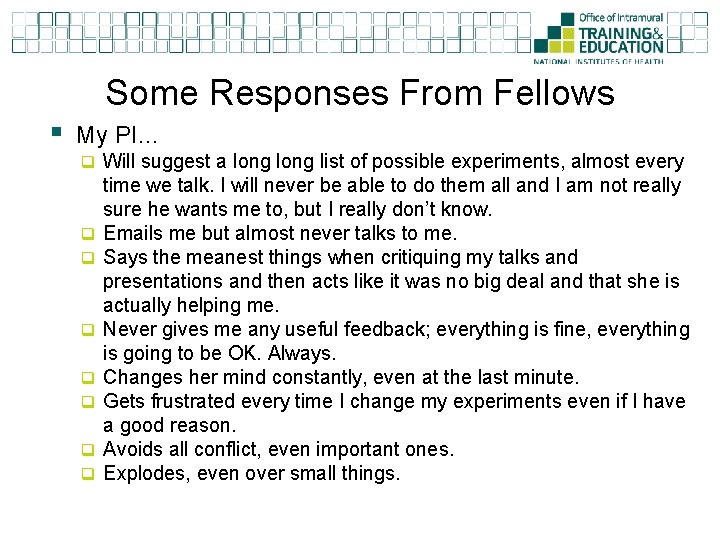
Some Responses From Fellows § My PI… q Will suggest a long list of possible experiments, almost every q q q q time we talk. I will never be able to do them all and I am not really sure he wants me to, but I really don’t know. Emails me but almost never talks to me. Says the meanest things when critiquing my talks and presentations and then acts like it was no big deal and that she is actually helping me. Never gives me any useful feedback; everything is fine, everything is going to be OK. Always. Changes her mind constantly, even at the last minute. Gets frustrated every time I change my experiments even if I have a good reason. Avoids all conflict, even important ones. Explodes, even over small things.
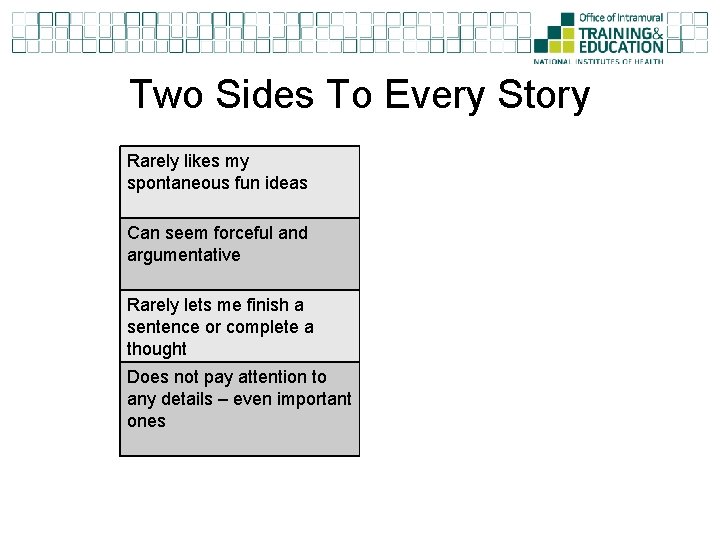
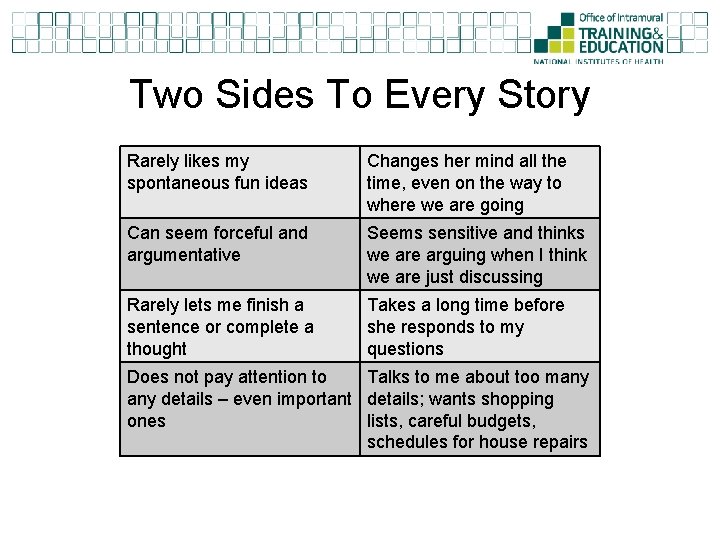
Two Sides To Every Story Rarely likes my spontaneous fun ideas Changes her mind all the time, even on the way to where we are going Can seem forceful and argumentative Seems sensitive and thinks we arguing when I think we are just discussing Rarely lets me finish a sentence or complete a thought Takes a long time before she responds to my questions. Does not pay attention to Talks to me about too many details – even important details; wants shopping ones lists, careful budgets, schedules for house repairs
Two Sides To Every Story Rarely likes my spontaneous fun ideas Changes her mind all the time, even on the way to where we are going Can seem forceful and argumentative Seems sensitive and thinks we arguing when I think we are just discussing Rarely lets me finish a sentence or complete a thought Takes a long time before she responds to my questions Does not pay attention to Talks to me about too many details – even important details; wants shopping ones lists, careful budgets, schedules for house repairs
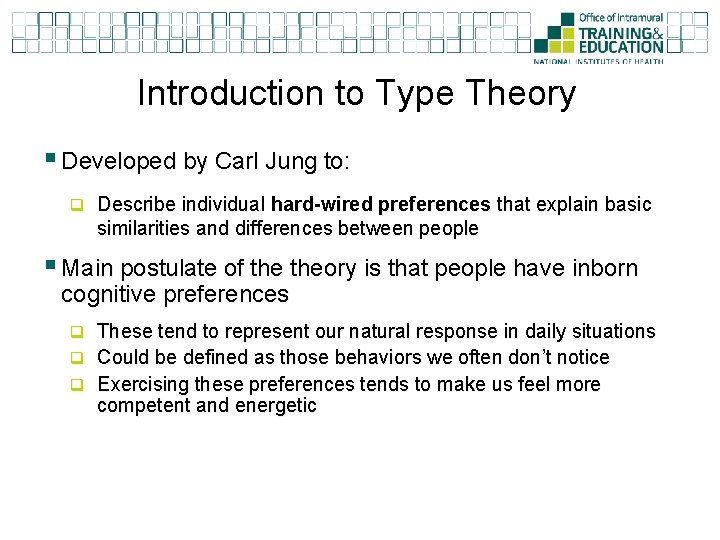
Introduction to Type Theory § Developed by Carl Jung to: q Describe individual hard-wired preferences that explain basic similarities and differences between people § Main postulate of theory is that people have inborn cognitive preferences q These tend to represent our natural response in daily situations q Could be defined as those behaviors we often don’t notice q Exercising these preferences tends to make us feel more competent and energetic
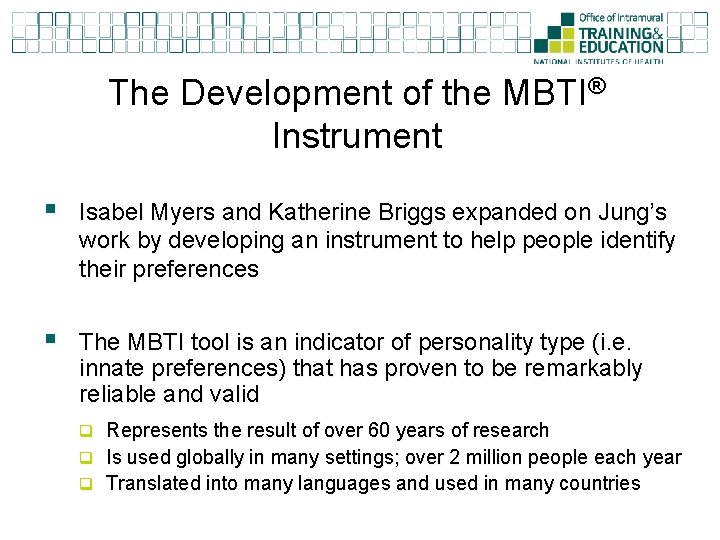
The Development of the MBTI® Instrument § Isabel Myers and Katherine Briggs expanded on Jung’s work by developing an instrument to help people identify their preferences § The MBTI tool is an indicator of personality type (i. e. innate preferences) that has proven to be remarkably reliable and valid q Represents the result of over 60 years of research q Is used globally in many settings; over 2 million people each year q Translated into many languages and used in many countries
What is a Preference?
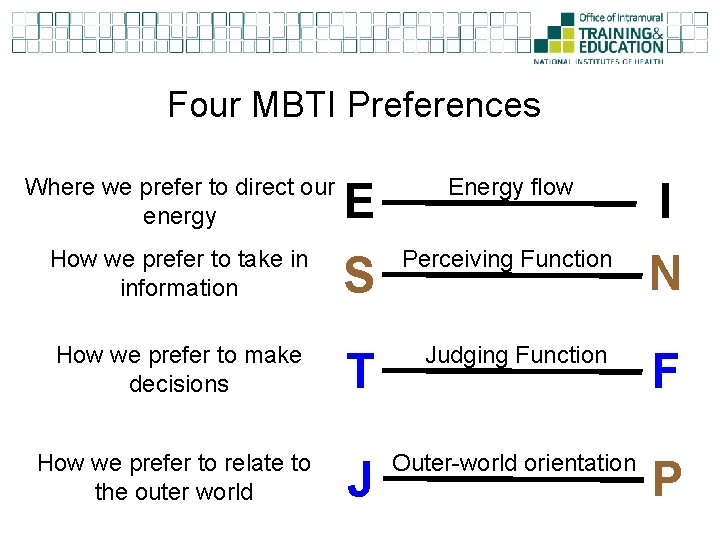
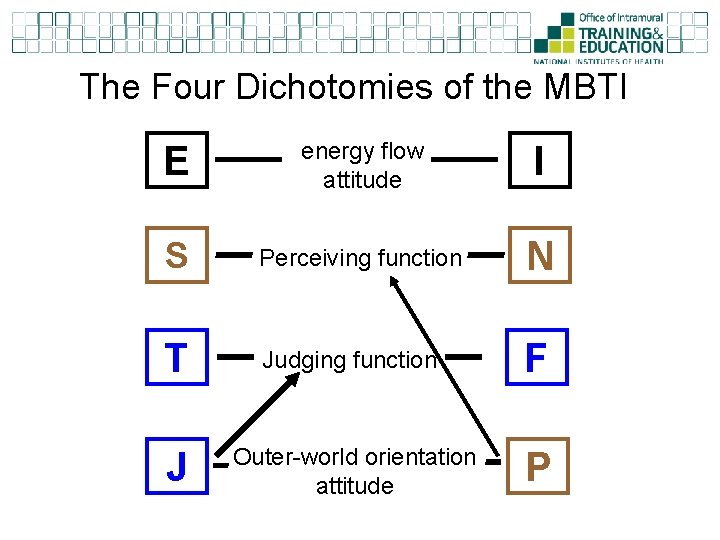
Four MBTI Preferences Where we prefer to direct our energy How we prefer to take in information How we prefer to make decisions How we prefer to relate to the outer world E Energy flow S Perceiving Function T Judging Function F J Outer-world orientation P I N
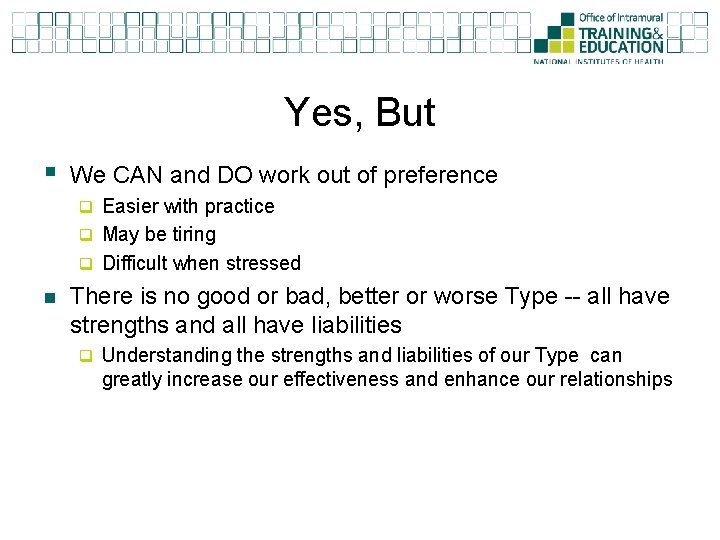
Yes, But § We CAN and DO work out of preference q Easier with practice q May be tiring q Difficult when stressed n There is no good or bad, better or worse Type -- all have strengths and all have liabilities q Understanding the strengths and liabilities of our Type can greatly increase our effectiveness and enhance our relationships
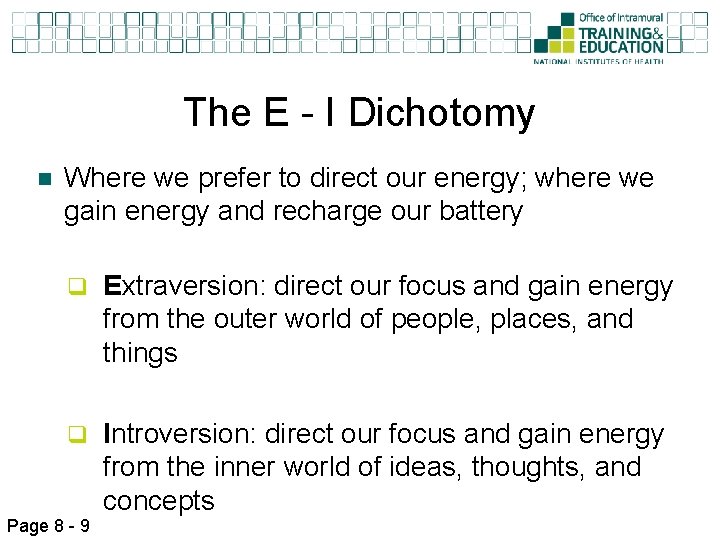
The E - I Dichotomy n Where we prefer to direct our energy; where we gain energy and recharge our battery q Extraversion: direct our focus and gain energy from the outer world of people, places, and things q Introversion: direct our focus and gain energy from the inner world of ideas, thoughts, and concepts Page 8 - 9
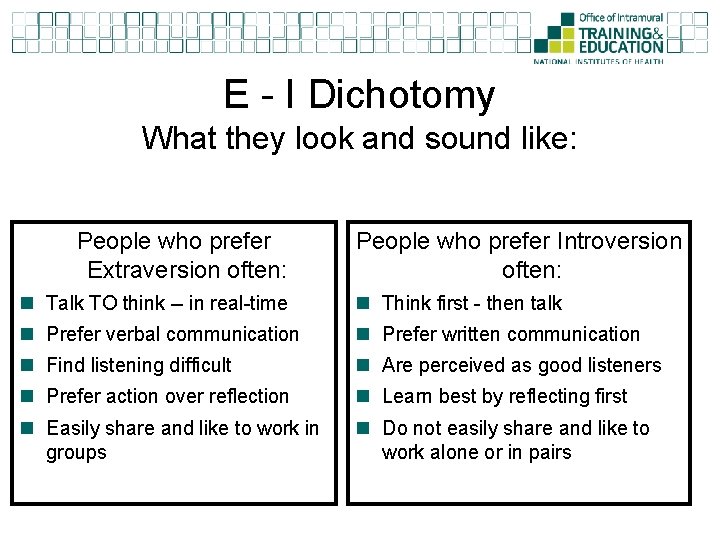
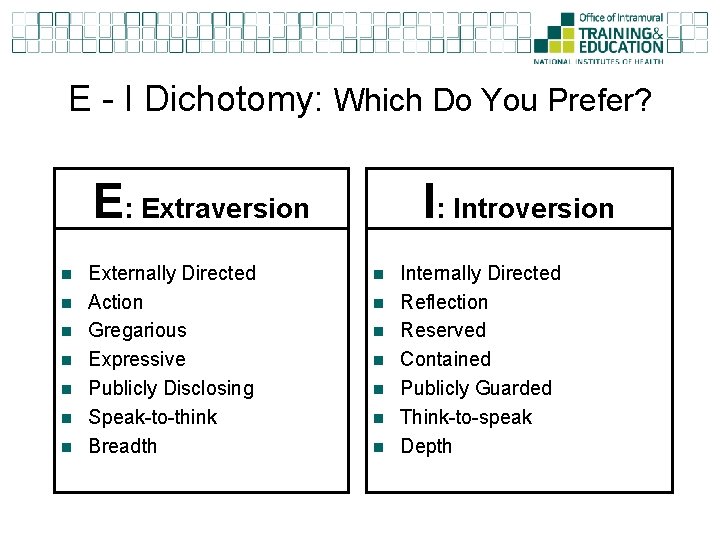
E - I Dichotomy What they look and sound like: People who prefer Extraversion often: People who prefer Introversion often: n Talk TO think -- in real-time n Think first - then talk n Prefer verbal communication n Prefer written communication n Find listening difficult n Are perceived as good listeners n Prefer action over reflection n Learn best by reflecting first n Easily share and like to work in groups n Do not easily share and like to work alone or in pairs
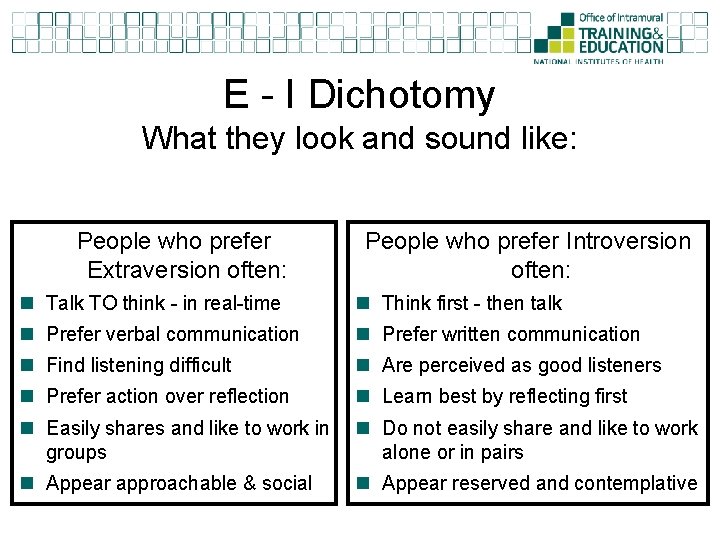
E - I Dichotomy What they look and sound like: People who prefer Extraversion often: People who prefer Introversion often: n Talk TO think - in real-time n Think first - then talk n Prefer verbal communication n Prefer written communication n Find listening difficult n Are perceived as good listeners n Prefer action over reflection n Learn best by reflecting first n Easily shares and like to work in n Do not easily share and like to work groups alone or in pairs n Appear approachable & social n Appear reserved and contemplative
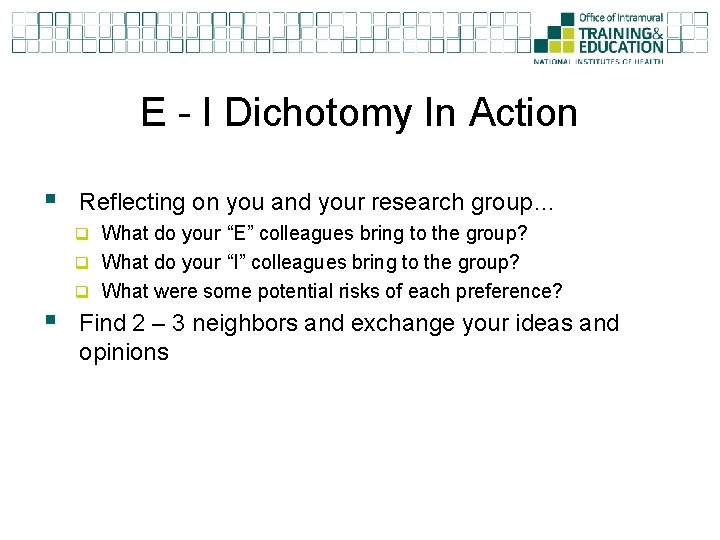
E - I Dichotomy In Action § Reflecting on you and your research group… q What do your “E” colleagues bring to the group? q What do your “I” colleagues bring to the group? q What were some potential risks of each preference? § Find 2 – 3 neighbors and exchange your ideas and opinions
E - I Dichotomy: Which Do You Prefer? E: Extraversion n n n Externally Directed Action Gregarious Expressive Publicly Disclosing Speak-to-think Breadth I: Introversion n n n Internally Directed Reflection Reserved Contained Publicly Guarded Think-to-speak Depth
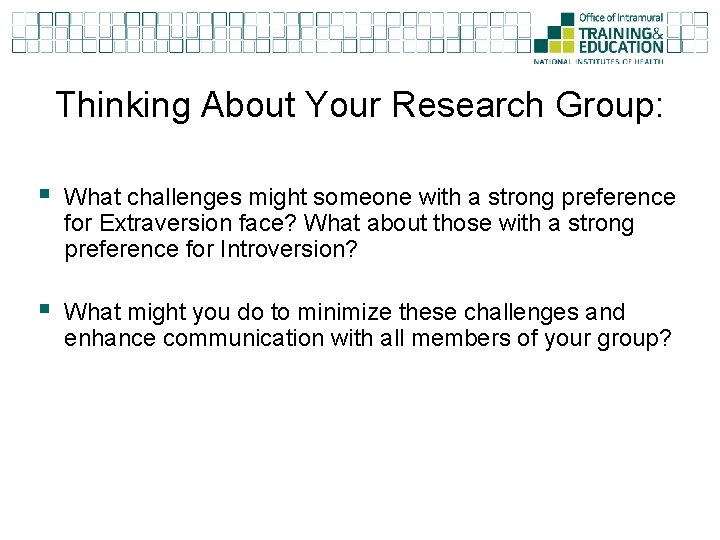
Thinking About Your Research Group: § What challenges might someone with a strong preference for Extraversion face? What about those with a strong preference for Introversion? § What might you do to minimize these challenges and enhance communication with all members of your group?
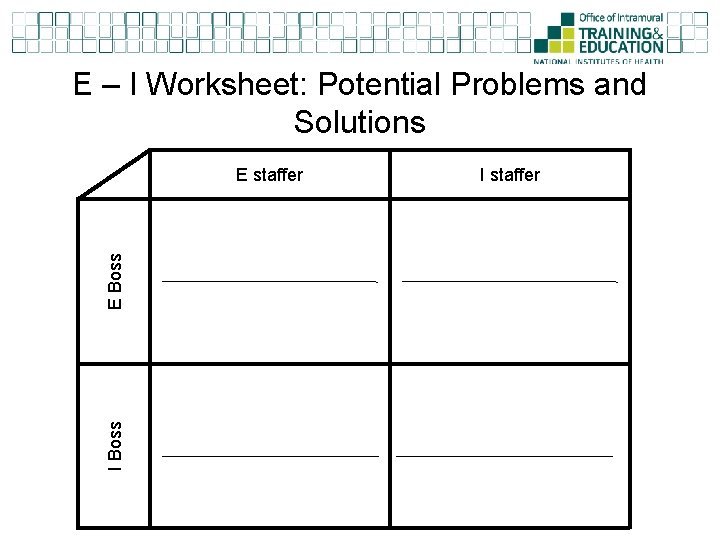
E – I Worksheet: Potential Problems and Solutions I Boss E staffer I staffer
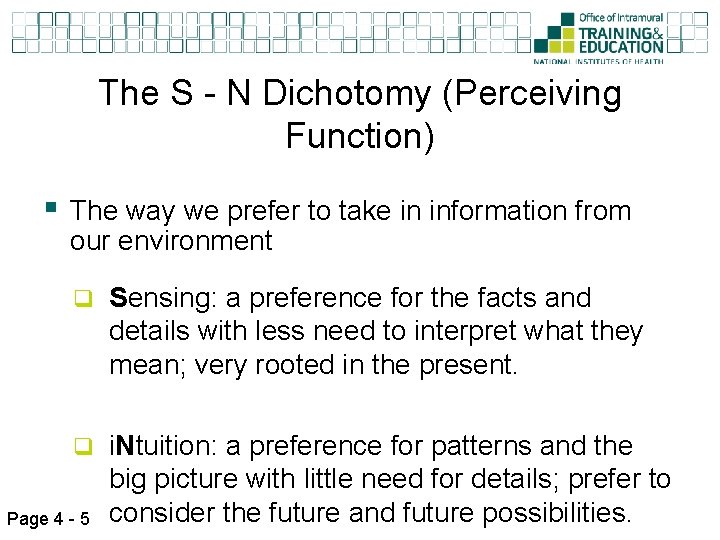
The S - N Dichotomy (Perceiving Function) § The way we prefer to take in information from our environment q Sensing: a preference for the facts and details with less need to interpret what they mean; very rooted in the present. q i. Ntuition: a preference for patterns and the Page 4 - 5 big picture with little need for details; prefer to consider the future and future possibilities.
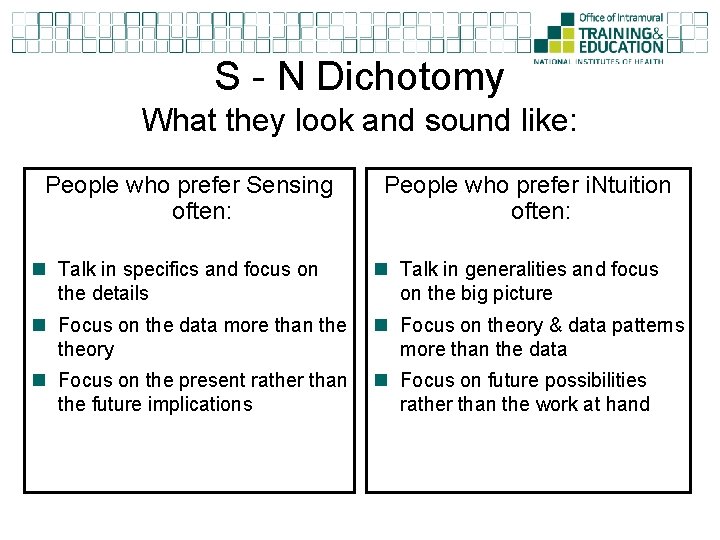
S - N Dichotomy What they look and sound like: People who prefer Sensing often: People who prefer i. Ntuition often: n Talk in specifics and focus on the details n Talk in generalities and focus on the big picture n Focus on the data more than theory n Focus on theory & data patterns more than the data n Focus on the present rather than n Focus on future possibilities the future implications rather than the work at hand
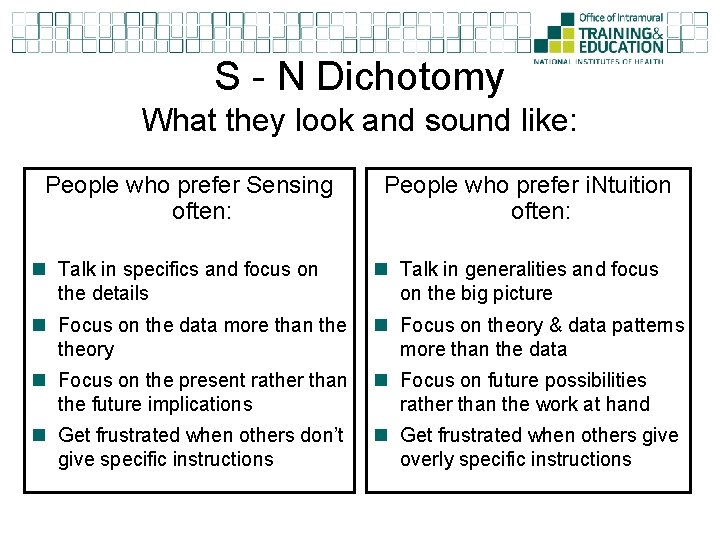
S - N Dichotomy What they look and sound like: People who prefer Sensing often: People who prefer i. Ntuition often: n Talk in specifics and focus on the details n Talk in generalities and focus on the big picture n Focus on the data more than theory n Focus on theory & data patterns more than the data n Focus on the present rather than n Focus on future possibilities the future implications rather than the work at hand n Get frustrated when others don’t give specific instructions n Get frustrated when others give overly specific instructions
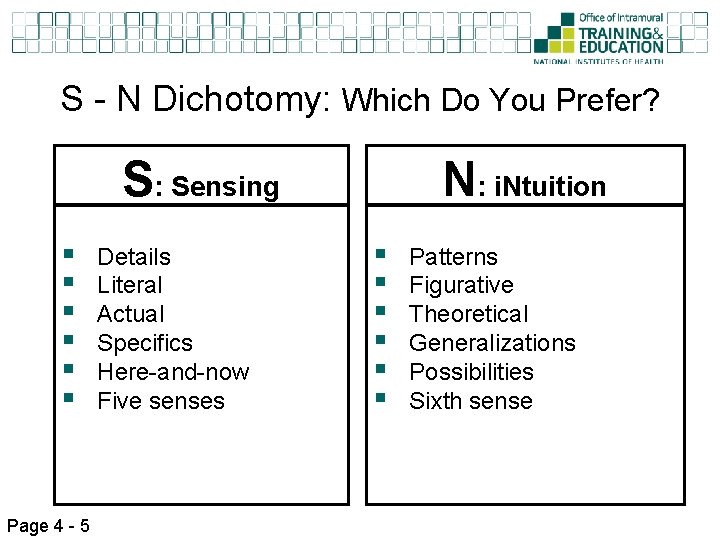
S - N Dichotomy: Which Do You Prefer? S: Sensing § § § Page 4 - 5 Details Literal Actual Specifics Here-and-now Five senses N: i. Ntuition § § § Patterns Figurative Theoretical Generalizations Possibilities Sixth sense
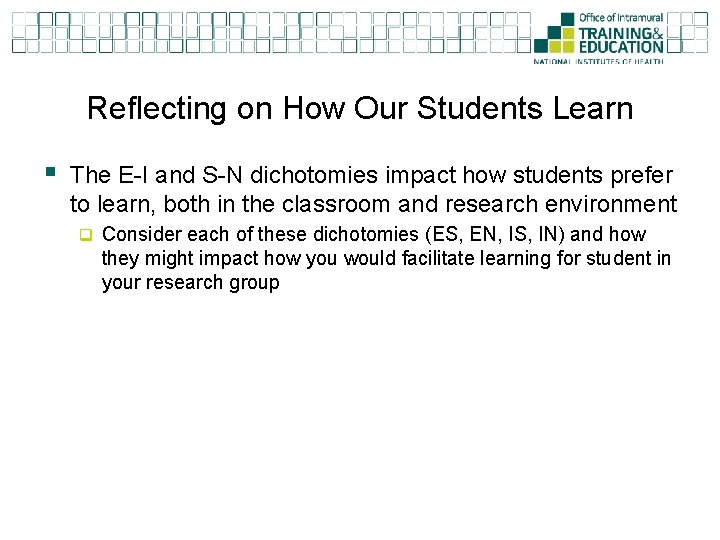
Reflecting on How Our Students Learn § The E-I and S-N dichotomies impact how students prefer to learn, both in the classroom and research environment q Consider each of these dichotomies (ES, EN, IS, IN) and how they might impact how you would facilitate learning for student in your research group
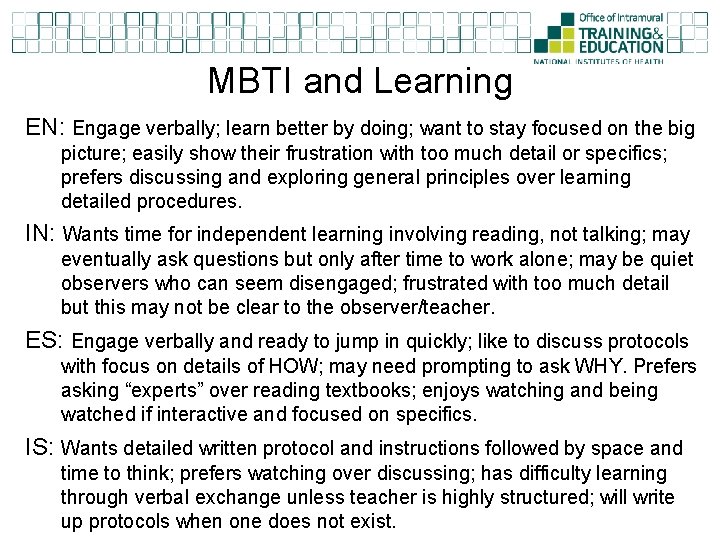
MBTI and Learning EN: Engage verbally; learn better by doing; want to stay focused on the big picture; easily show their frustration with too much detail or specifics; prefers discussing and exploring general principles over learning detailed procedures. IN: Wants time for independent learning involving reading, not talking; may eventually ask questions but only after time to work alone; may be quiet observers who can seem disengaged; frustrated with too much detail but this may not be clear to the observer/teacher. ES: Engage verbally and ready to jump in quickly; like to discuss protocols with focus on details of HOW; may need prompting to ask WHY. Prefers asking “experts” over reading textbooks; enjoys watching and being watched if interactive and focused on specifics. IS: Wants detailed written protocol and instructions followed by space and time to think; prefers watching over discussing; has difficulty learning through verbal exchange unless teacher is highly structured; will write up protocols when one does not exist.
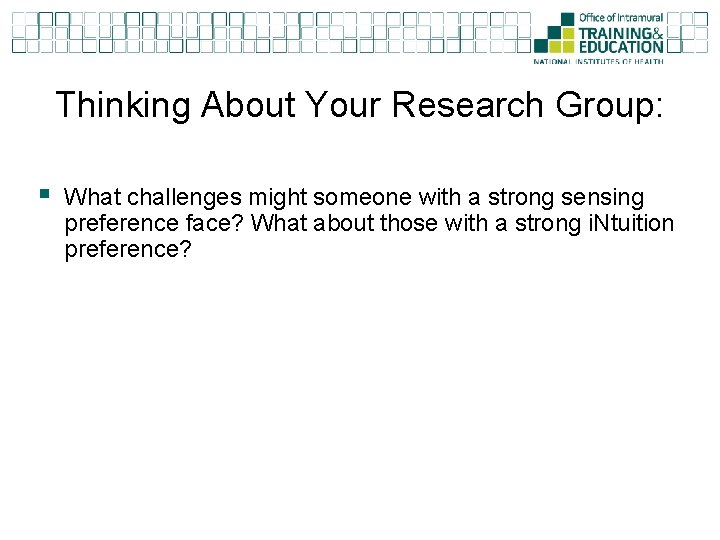
Thinking About Your Research Group: § What challenges might someone with a strong sensing preference face? What about those with a strong i. Ntuition preference?
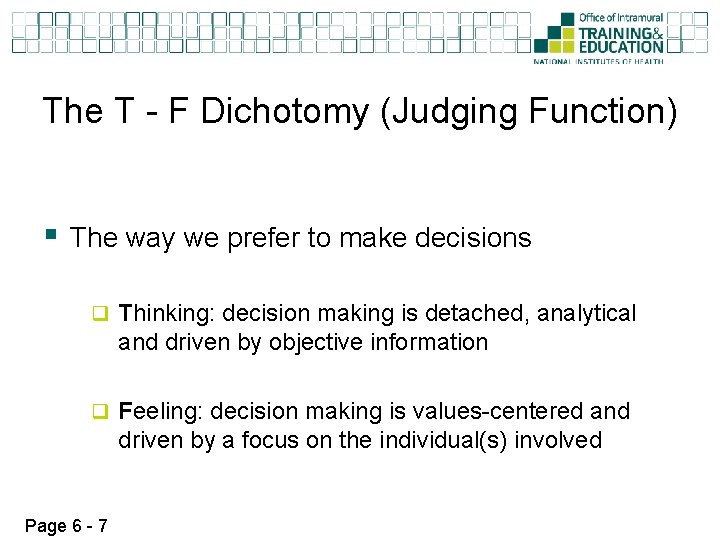
The T - F Dichotomy (Judging Function) § The way we prefer to make decisions q Thinking: decision making is detached, analytical and driven by objective information q Feeling: decision making is values-centered and driven by a focus on the individual(s) involved Page 6 - 7
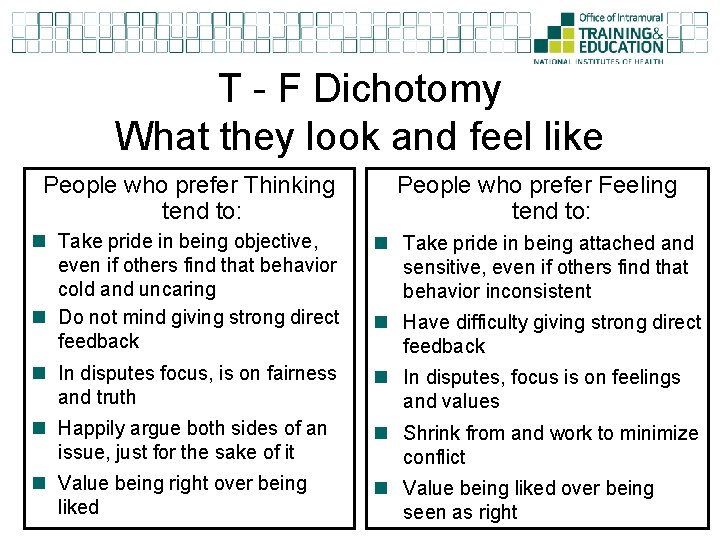
T - F Dichotomy What they look and feel like People who prefer Thinking tend to: People who prefer Feeling tend to: n Take pride in being objective, even if others find that behavior cold and uncaring n Do not mind giving strong direct feedback n Take pride in being attached and sensitive, even if others find that behavior inconsistent n In disputes focus, is on fairness and truth n In disputes, focus is on feelings and values n Happily argue both sides of an issue, just for the sake of it n Shrink from and work to minimize conflict n Value being right over being liked n Value being liked over being seen as right n Have difficulty giving strong direct feedback
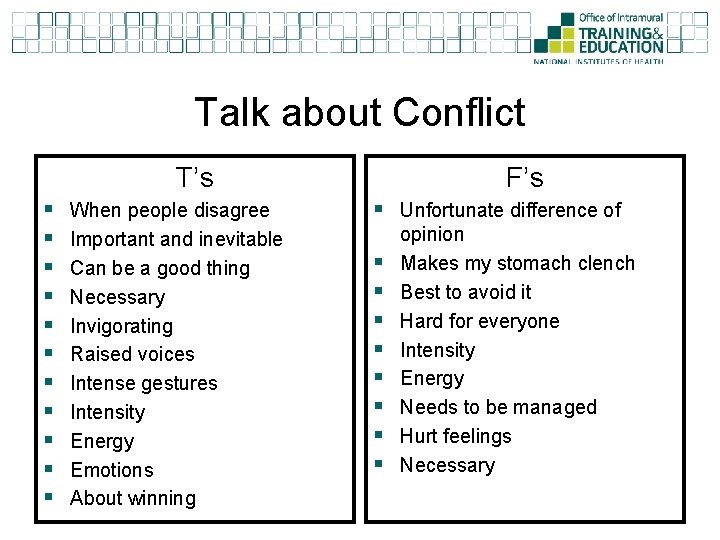
Talk about Conflict T’s § § § When people disagree Important and inevitable Can be a good thing Necessary Invigorating Raised voices Intense gestures Intensity Energy Emotions About winning F’s § § § § § Unfortunate difference of opinion Makes my stomach clench Best to avoid it Hard for everyone Intensity Energy Needs to be managed Hurt feelings Necessary
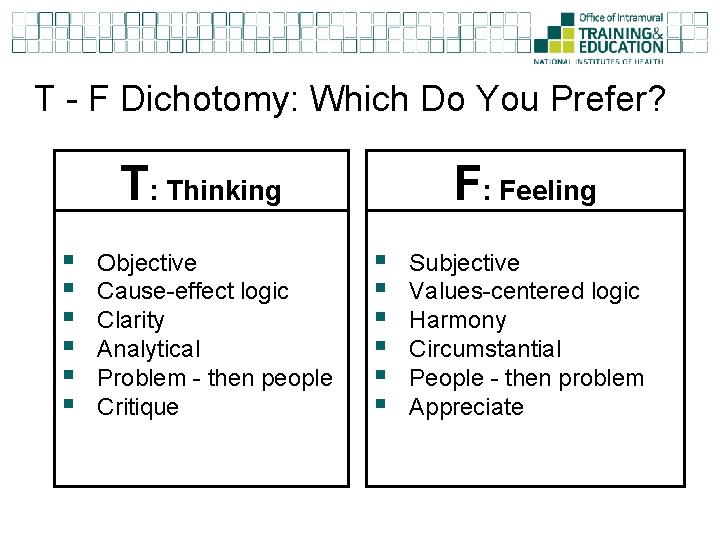
T - F Dichotomy: Which Do You Prefer? T: Thinking § § § Objective Cause-effect logic Clarity Analytical Problem - then people Critique F: Feeling § § § Subjective Values-centered logic Harmony Circumstantial People - then problem Appreciate
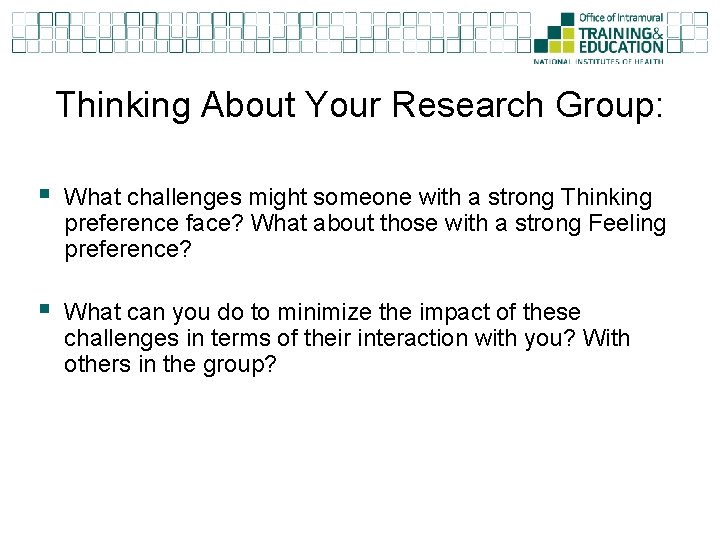
Thinking About Your Research Group: § What challenges might someone with a strong Thinking preference face? What about those with a strong Feeling preference? § What can you do to minimize the impact of these challenges in terms of their interaction with you? With others in the group?
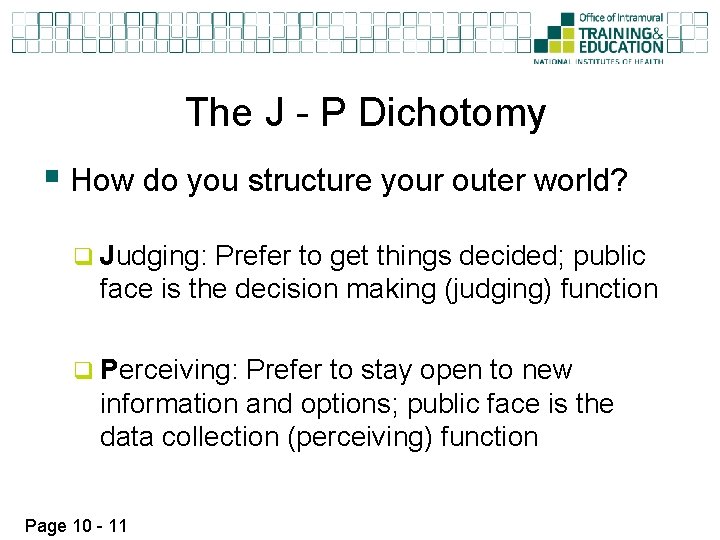
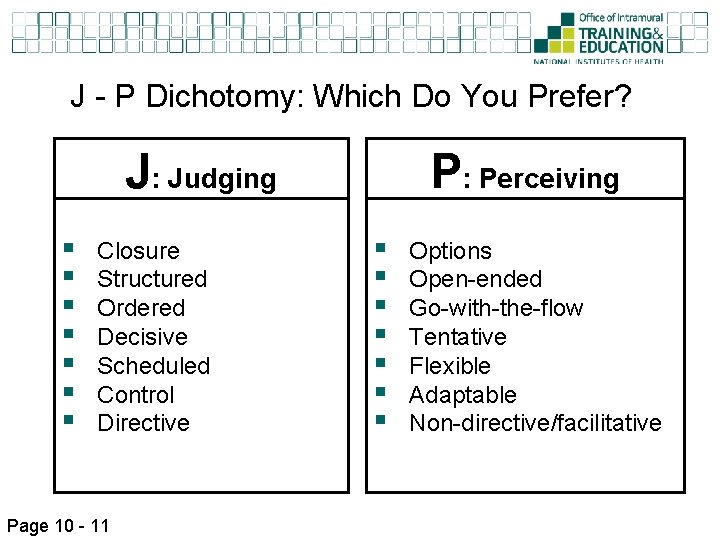
The J - P Dichotomy § How do you structure your outer world? q Judging: Prefer to get things decided; public face is the decision making (judging) function q Perceiving: Prefer to stay open to new information and options; public face is the data collection (perceiving) function Page 10 - 11
The Four Dichotomies of the MBTI E energy flow attitude I S Perceiving function N T Judging function F J Outer-world orientation attitude P
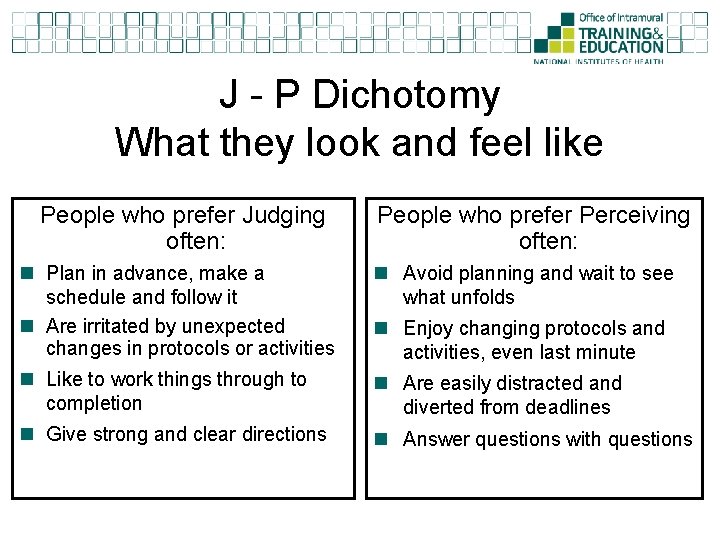
J - P Dichotomy What they look and feel like People who prefer Judging often: People who prefer Perceiving often: n Plan in advance, make a schedule and follow it n Are irritated by unexpected changes in protocols or activities n Like to work things through to completion n Avoid planning and wait to see what unfolds n Give strong and clear directions n Answer questions with questions n Enjoy changing protocols and activities, even last minute n Are easily distracted and diverted from deadlines
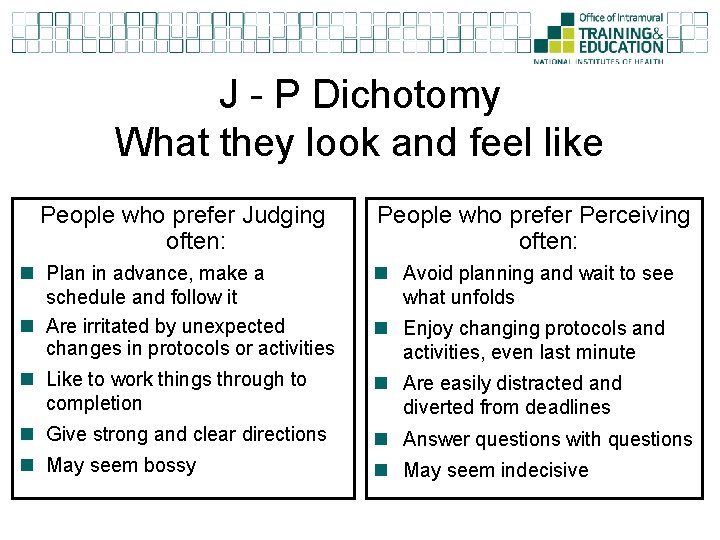
J - P Dichotomy What they look and feel like People who prefer Judging often: People who prefer Perceiving often: n Plan in advance, make a schedule and follow it n Are irritated by unexpected changes in protocols or activities n Like to work things through to completion n Avoid planning and wait to see what unfolds n Give strong and clear directions n Answer questions with questions n May seem bossy n May seem indecisive n Enjoy changing protocols and activities, even last minute n Are easily distracted and diverted from deadlines
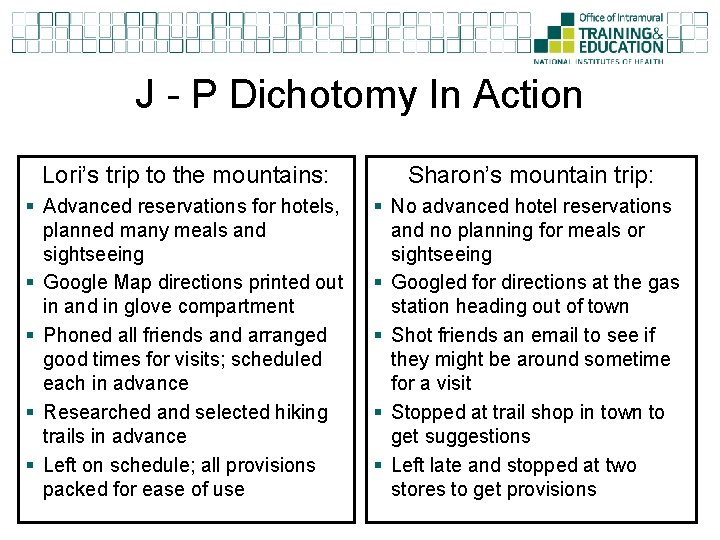
J - P Dichotomy In Action Lori’s trip to the mountains: Sharon’s mountain trip: § Advanced reservations for hotels, planned many meals and sightseeing § Google Map directions printed out in and in glove compartment § Phoned all friends and arranged good times for visits; scheduled each in advance § Researched and selected hiking trails in advance § Left on schedule; all provisions packed for ease of use § No advanced hotel reservations and no planning for meals or sightseeing § Googled for directions at the gas station heading out of town § Shot friends an email to see if they might be around sometime for a visit § Stopped at trail shop in town to get suggestions § Left late and stopped at two stores to get provisions
J - P Dichotomy: Which Do You Prefer? J: Judging § § § § Closure Structured Ordered Decisive Scheduled Control Directive Page 10 - 11 P: Perceiving § § § § Options Open-ended Go-with-the-flow Tentative Flexible Adaptable Non-directive/facilitative
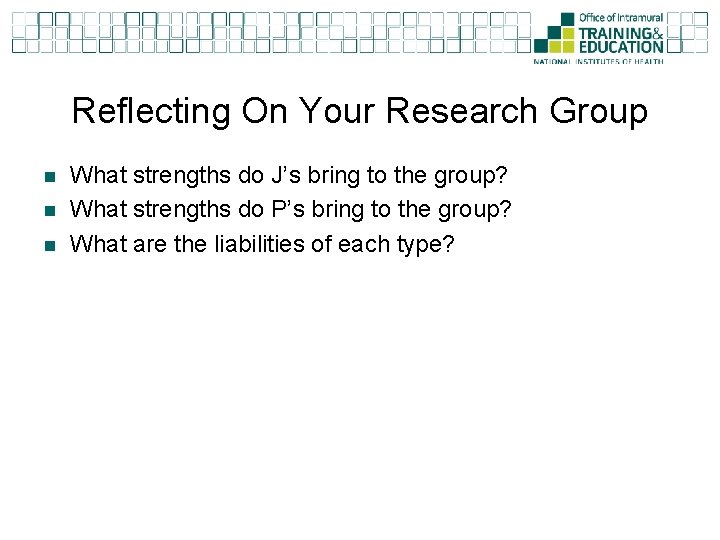
Reflecting On Your Research Group n n n What strengths do J’s bring to the group? What strengths do P’s bring to the group? What are the liabilities of each type?
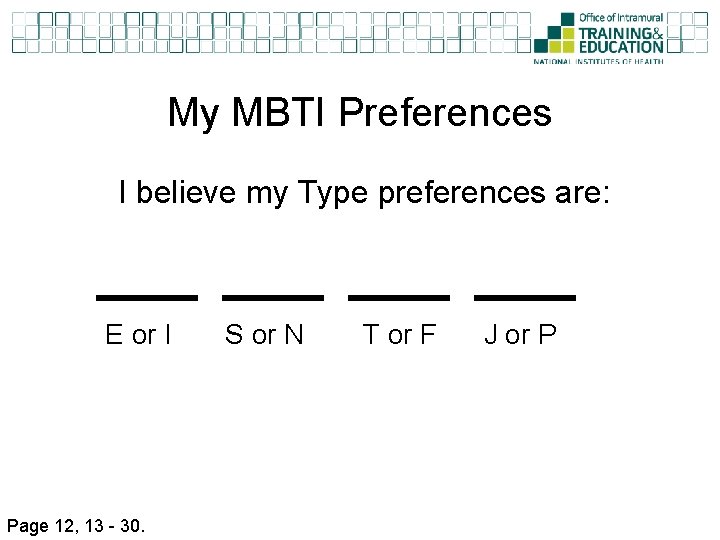
My MBTI Preferences I believe my Type preferences are: E or I Page 12, 13 - 30. S or N T or F J or P
Self-assessment vs. Survey n n You have the final word Reasons for differences between survey and self -assessment: q Torn between demands of work and self preferences q Answered in terms of what you thought was expected q Terms used were misunderstood q Currently in a growth period developing new processes § q Suffering illness or sleep deprivation Reading, thinking, and talking with OITE career counselor may help you reconcile
There is More Than the MBTI n n Family Culture Confidence level Comfort level
Reflecting On Your Research Group: How does your MBTI preferences impact how you interact with and give feedback to members of your group? Does it impact the way some members of your group interact with you (and with others) or how they receive feedback? Does it impact the way people in your group solve problems and interact amongst themselves?
Improving Mentoring Relationships
Some Facts n “The proportion of Ph. Ds that move into tenured or tenure-track faculty positions has declined from ~34% in 1993 to ~25% now. ” n “The percentages of biomedical Ph. Ds in industry and government have remained relatively constant. The categories that have seen growth are science-related occupations that do not involve the conduct of research …. “ n “Despite these changes, graduate training continues to be aimed almost exclusively at preparing people for academic research positions. ” Full report at http: //acd. od. nih. gov/bwf. htm
There is Angst on Both Sides n n The tenure process is inherently stressful More rules, stresses, distractions, and paperwork Some trainees may lack the background, experience, passion and/or work ethic needed to make immediate research contributions Some PIs may lack enthusiasm to mentor, especially towards non-research oriented careers (or lack knowledge even if there is enthusiasm)
Acknowledging these stresses on the system, how do we do good science while mentoring effectively and preparing students/postdocs for the breadth of careers they will end up pursuing?
Kram’s Mentor Role Theory CAREER FUNCTIONS PSYCHOSOCIAL FUNCTIONS Goal to help mentees learn the to enhance the mentees ropes and advance in the sense of competence, selforganization/field efficacy, personal and professional development Major focus The organization and the mentee’s career The mentee on a personal level http: //www. bu. edu/sph/files/2012/01/Ragins_Mentorfunctions-and-outcomes. pdf
Mentor Role Functions § Career Development Functions q Coaching on specific skills q Protecting from adverse actions q Providing challenging work assignments q Increasing exposure and visibility q Sponsoring for assignments, promotions, advantageous lateral moves § Psychosocial Functions q Helping in the development of a sense of professional self q Guiding in problem-solving and being a sounding board q Giving respect and support q Role modeling
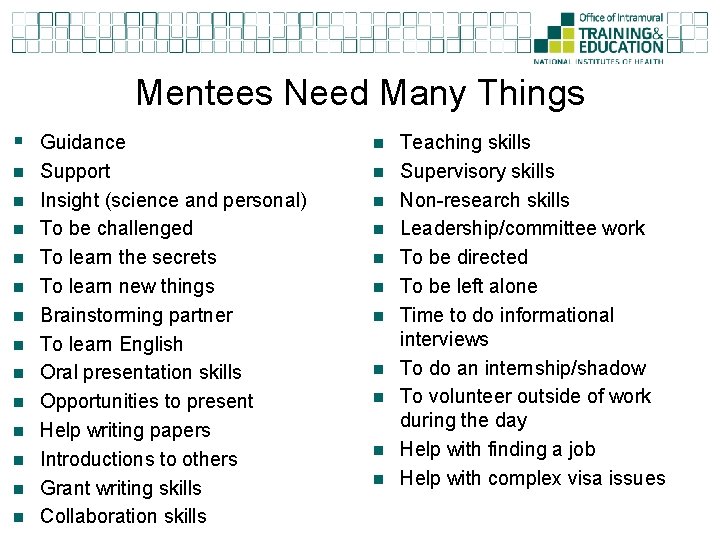
Mentees Need Many Things § n n n n Guidance Support Insight (science and personal) To be challenged To learn the secrets To learn new things Brainstorming partner To learn English Oral presentation skills Opportunities to present Help writing papers Introductions to others Grant writing skills Collaboration skills n n n Teaching skills Supervisory skills Non-research skills Leadership/committee work To be directed To be left alone Time to do informational interviews To do an internship/shadow To volunteer outside of work during the day Help with finding a job Help with complex visa issues
In research environments, one’s supervisor typically also serves as a mentor/sponsor/coach as well. What are the benefits of this approach; what are the risks?
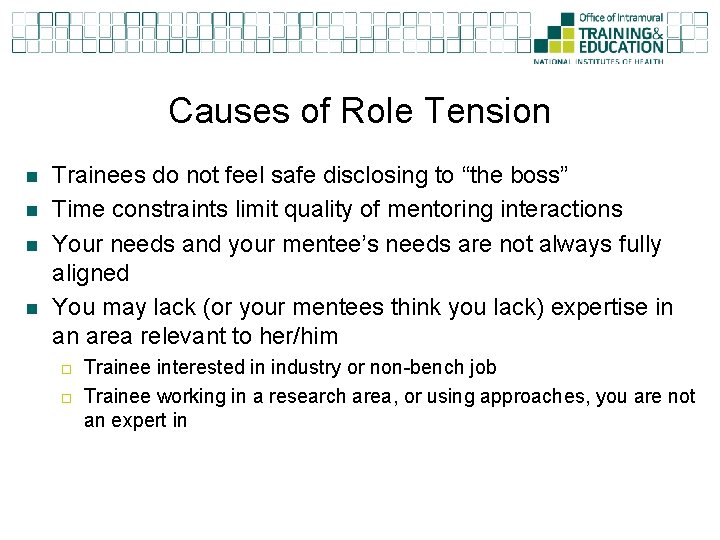
Causes of Role Tension n n Trainees do not feel safe disclosing to “the boss” Time constraints limit quality of mentoring interactions Your needs and your mentee’s needs are not always fully aligned You may lack (or your mentees think you lack) expertise in an area relevant to her/him ¨ ¨ Trainee interested in industry or non-bench job Trainee working in a research area, or using approaches, you are not an expert in
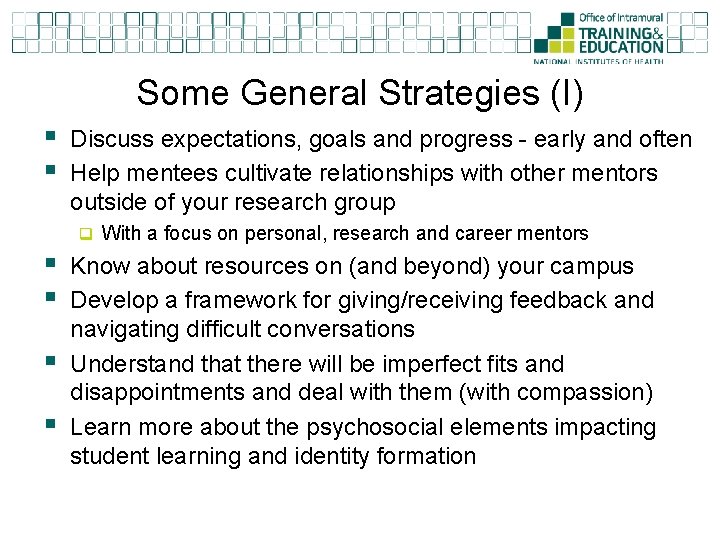
Some General Strategies (I) § § Discuss expectations, goals and progress - early and often Help mentees cultivate relationships with other mentors outside of your research group q With a focus on personal, research and career mentors § § Know about resources on (and beyond) your campus Develop a framework for giving/receiving feedback and navigating difficult conversations Understand that there will be imperfect fits and disappointments and deal with them (with compassion) Learn more about the psychosocial elements impacting student learning and identity formation
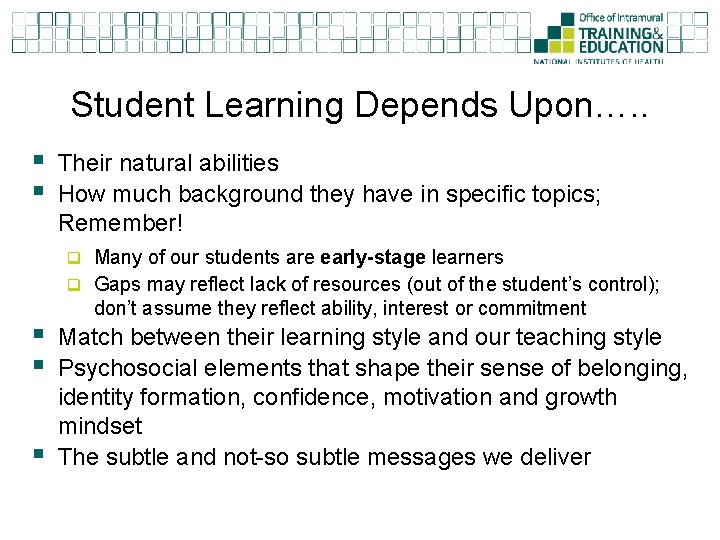
Student Learning Depends Upon…. . § § Their natural abilities How much background they have in specific topics; Remember! q Many of our students are early-stage learners q Gaps may reflect lack of resources (out of the student’s control); § § § don’t assume they reflect ability, interest or commitment Match between their learning style and our teaching style Psychosocial elements that shape their sense of belonging, identity formation, confidence, motivation and growth mindset The subtle and not-so subtle messages we deliver
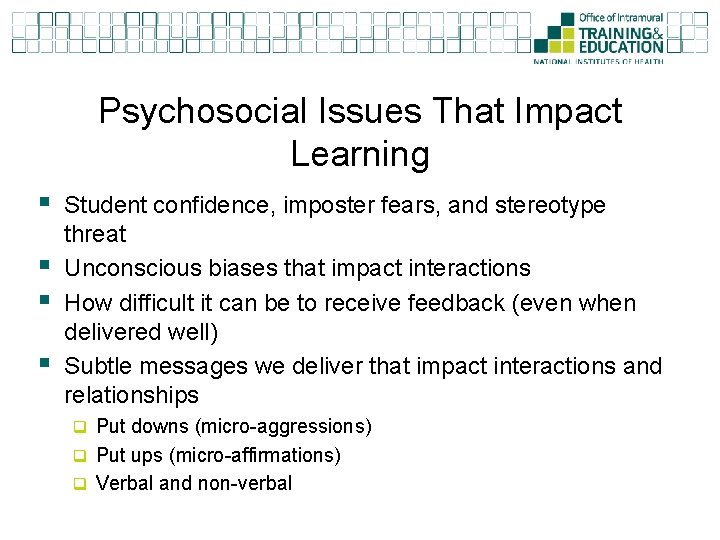
Psychosocial Issues That Impact Learning § § Student confidence, imposter fears, and stereotype threat Unconscious biases that impact interactions How difficult it can be to receive feedback (even when delivered well) Subtle messages we deliver that impact interactions and relationships q Put downs (micro-aggressions) q Put ups (micro-affirmations) q Verbal and non-verbal
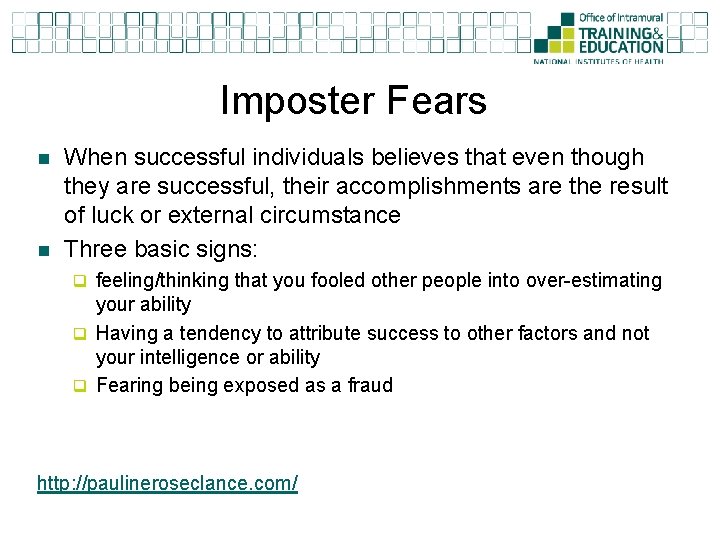
Imposter Fears n n When successful individuals believes that even though they are successful, their accomplishments are the result of luck or external circumstance Three basic signs: q feeling/thinking that you fooled other people into over-estimating your ability q Having a tendency to attribute success to other factors and not your intelligence or ability q Fearing being exposed as a fraud http: //paulineroseclance. com/
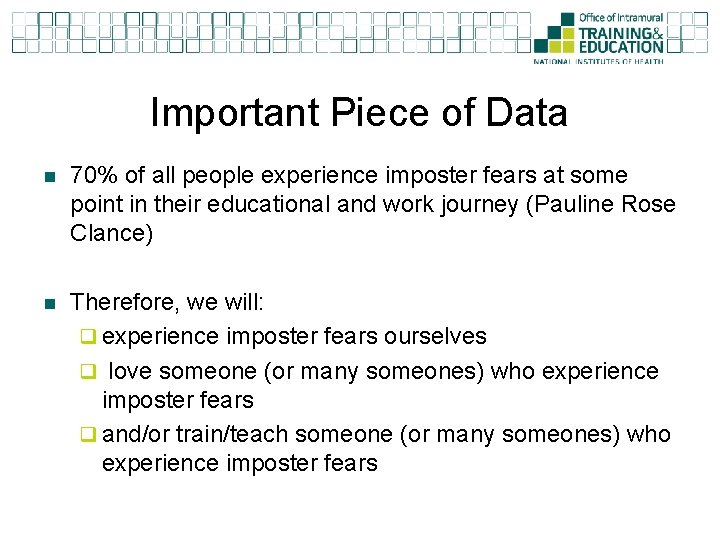
Important Piece of Data n 70% of all people experience imposter fears at some point in their educational and work journey (Pauline Rose Clance) n Therefore, we will: q experience imposter fears ourselves q love someone (or many someones) who experience imposter fears q and/or train/teach someone (or many someones) who experience imposter fears
Causes of Imposter Fears n n n Being a student Organizational culture and messaging Being in an environment that feels foreign Stress of ‘representing’ your entire social group (stereotype threat) Messages from family and childhood
Impacts of Imposter Fears n n n Decreased confidence and increased stress Second guessing yourself Unwillingness to ask for help “Holding back” – maintaining a low profile in a group; not volunteering for assignments or applying for competitive fellowships/awards/positions Engaging in self-sabotaging behavior Sensitivity to developmental feedback
Group Work n n Have imposter fears impacted you at some point in your career? Have you seen the impact of imposter fears in others? What are some ways a mentor can minimize the impact of imposter fears in a new learner?
Minimizing Imposter Fears n n n Validate their place in your group – verbally and through your behavior Normalize the “new learner” experience Use micro-affirmations to promote learning (See more at: http: //dus. psu. edu/mentor/2013/10/839/#sthash. Bglf 6 TBn. dpuf) n n n Approach learning through skills-based approach and a growth mindset (Carol Dweck) Avoid making mountains out of molehills Don’t make them the “standard bearer” Avoid comparisons to other students Encourage them to participate in trainee activities Encourage them to talk with a counselor
We Need to Evolve n From a single, long-term hierarchical relationship n To models of mentorship that include multiple, short and long-term relationships, that comprise a developmental network n Focused on science functions, career functions, and psychosocial functions n And remembering our own growth so we can help others grow
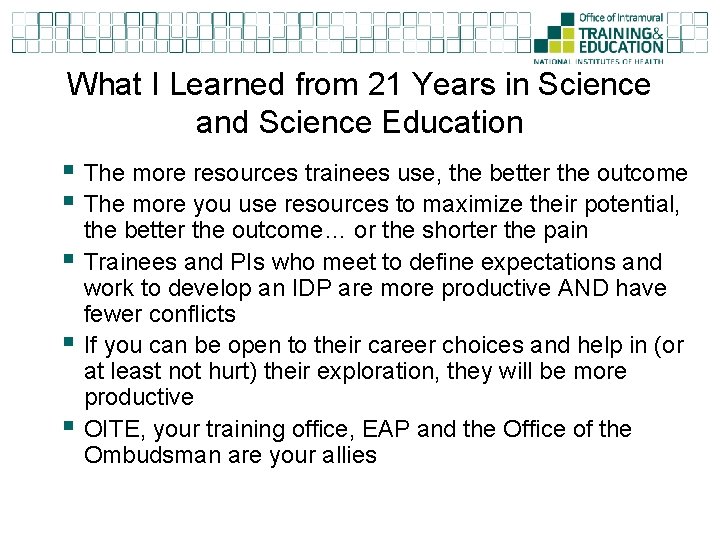
What I Learned from 21 Years in Science and Science Education § The more resources trainees use, the better the outcome; § § trainees use services when their PIs encourage their use The more you use University resources to maximize their potential, the better the outcome… or the shorter the pain Trainees and PIs who meet to define expectations and work to develop an IDP are more productive AND have fewer conflicts PIs who work to be open to the breadth of trainee career choices and help trainees explore careers, get more and better work from ALL of their trainees Ignoring difference does not make it go away; it just makes it harder to build an effective team
Core Competencies for OITE Training n n n Communication Grantsmanship Teaching and mentoring Leadership and management Career Readiness
Other Things to Know About § § § We have an open door policy for trainees and for PIs We offer career counseling and graduate/professional school advising free-of-charge Some other resources: q OITE orientations q Academic coaching q OITE Moving Guide q Trainee handbooks § § § Trainee affinity groups – SACNAS, LGBT-FF, NAAF, Mom&Dad Docs, Military Spouses Funding for NIH Academy postbacs (now) Funding for summer interns (via OITE Mentoring Awards)
What I Learned from 21 Years in Science and Science Education § The more resources trainees use, the better the outcome § The more you use resources to maximize their potential, § § § the better the outcome… or the shorter the pain Trainees and PIs who meet to define expectations and work to develop an IDP are more productive AND have fewer conflicts If you can be open to their career choices and help in (or at least not hurt) their exploration, they will be more productive OITE, your training office, EAP and the Office of the Ombudsman are your allies
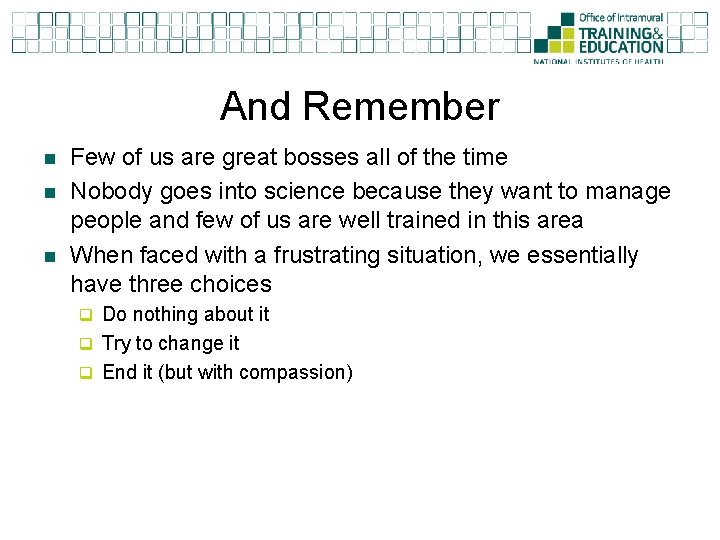
And Remember n n n Few of us are great bosses all of the time Nobody goes into science because they want to manage people and few of us are well trained in this area When faced with a frustrating situation, we essentially have three choices q Do nothing about it q Try to change it q End it (but with compassion)
OITE Resources for You and Your Mentees n n www. training. nih. gov for career videos, our Career Blog, Linked-In group, You Tube channel and other helpful resources Email me at milgrams@od. nih. gov
Giving Feedback So It Can Be Heard Sharon L. Milgram, Director NIH OITE milgrams@od. nih. gov
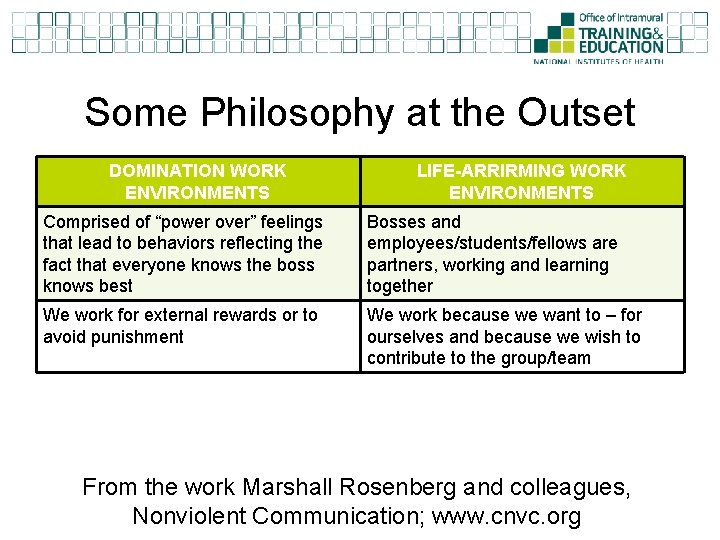
Some Philosophy at the Outset DOMINATION WORK ENVIRONMENTS LIFE-ARRIRMING WORK ENVIRONMENTS Comprised of “power over” feelings that lead to behaviors reflecting the fact that everyone knows the boss knows best Bosses and employees/students/fellows are partners, working and learning together We work for external rewards or to avoid punishment We work because we want to – for ourselves and because we wish to contribute to the group/team From the work Marshall Rosenberg and colleagues, Nonviolent Communication; www. cnvc. org
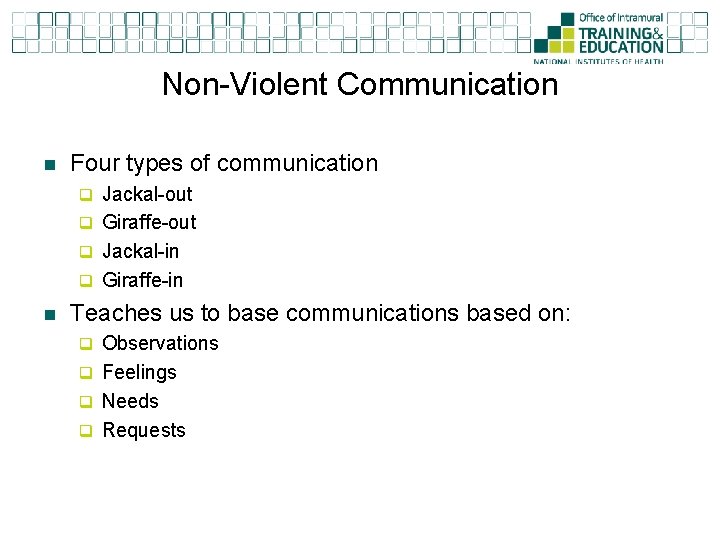
Non-Violent Communication n Four types of communication q Jackal-out q Giraffe-out q Jackal-in q Giraffe-in n Teaches us to base communications based on: q Observations q Feelings q Needs q Requests
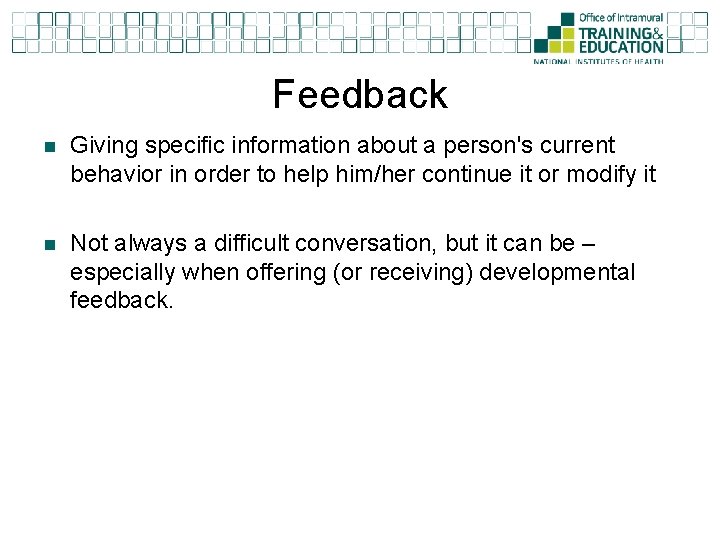
Feedback n Giving specific information about a person's current behavior in order to help him/her continue it or modify it n Not always a difficult conversation, but it can be – especially when offering (or receiving) developmental feedback.
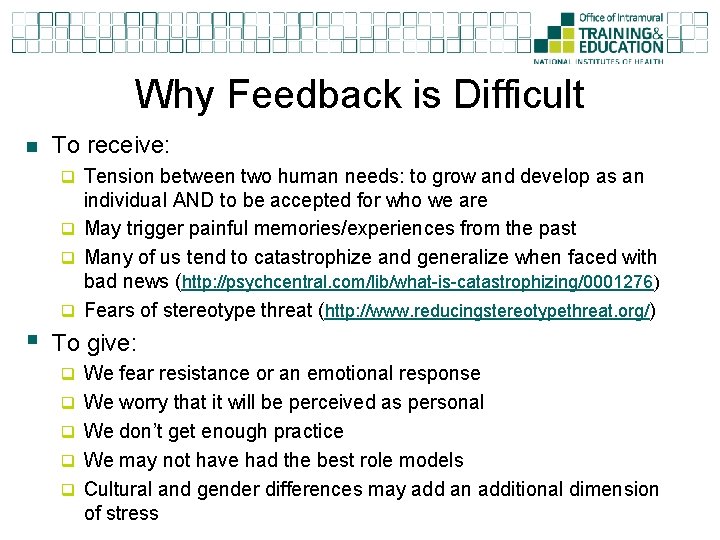
Why Feedback is Difficult n To receive: q Tension between two human needs: to grow and develop as an individual AND to be accepted for who we are q May trigger painful memories/experiences from the past q Many of us tend to catastrophize and generalize when faced with bad news (http: //psychcentral. com/lib/what-is-catastrophizing/0001276) q Fears of stereotype threat (http: //www. reducingstereotypethreat. org/) § To give: q We fear resistance or an emotional response q We worry that it will be perceived as personal q We don’t get enough practice q We may not have had the best role models q Cultural and gender differences may add an additional dimension of stress
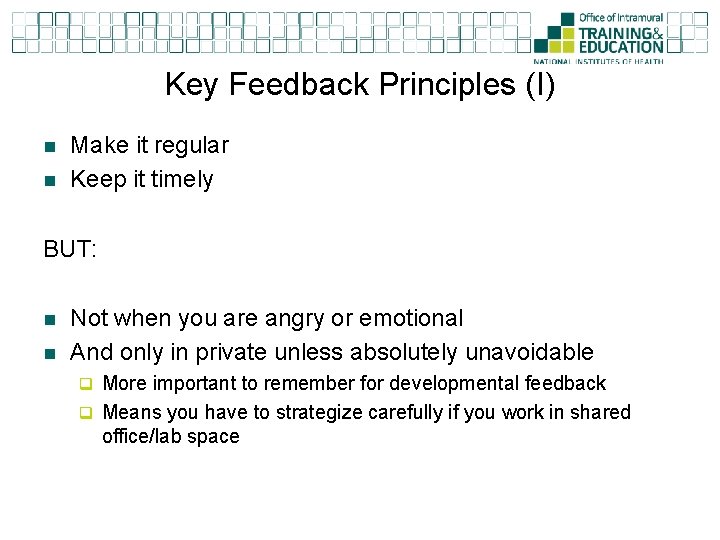
Key Feedback Principles (I) n n Make it regular Keep it timely BUT: n n Not when you are angry or emotional And only in private unless absolutely unavoidable q More important to remember for developmental feedback q Means you have to strategize carefully if you work in shared office/lab space
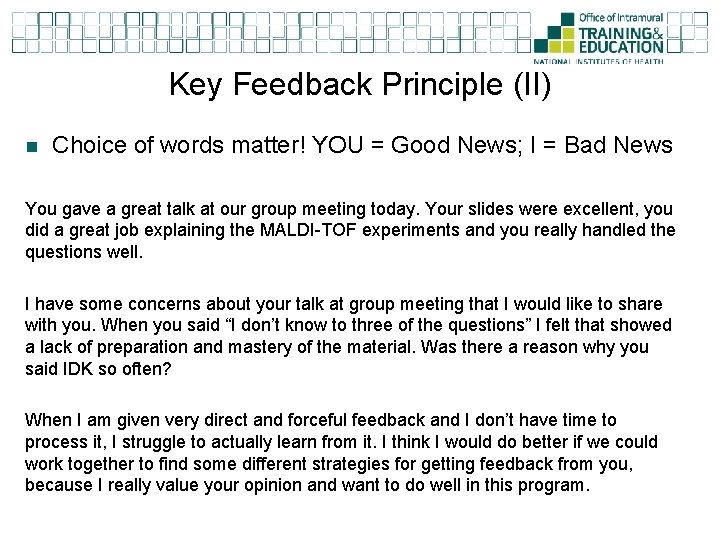
Key Feedback Principle (II) n Choice of words matter! YOU = Good News; I = Bad News You gave a great talk at our group meeting today. Your slides were excellent, you did a great job explaining the MALDI-TOF experiments and you really handled the questions well. I have some concerns about your talk at group meeting that I would like to share with you. When you said “I don’t know to three of the questions” I felt that showed a lack of preparation and mastery of the material. Was there a reason why you said IDK so often? When I am given very direct and forceful feedback and I don’t have time to process it, I struggle to actually learn from it. I think I would do better if we could work together to find some different strategies for getting feedback from you, because I really value your opinion and want to do well in this program.
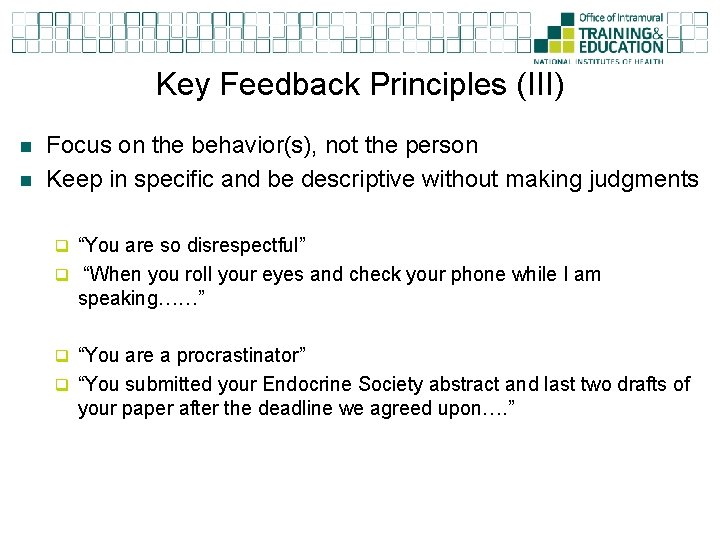
Key Feedback Principles (III) n n Focus on the behavior(s), not the person Keep in specific and be descriptive without making judgments q “You are so disrespectful” q “When you roll your eyes and check your phone while I am speaking……” q “You are a procrastinator” q “You submitted your Endocrine Society abstract and last two drafts of your paper after the deadline we agreed upon…. ”
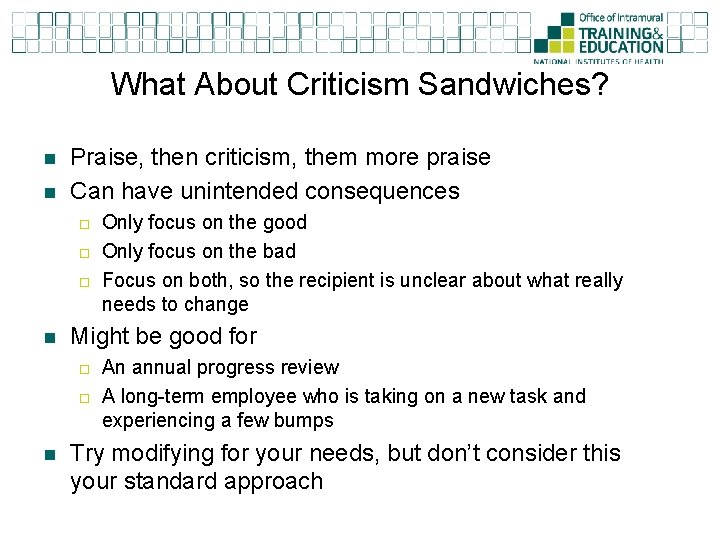
What About Criticism Sandwiches? n n Praise, then criticism, them more praise Can have unintended consequences ¨ ¨ ¨ n Might be good for ¨ ¨ n Only focus on the good Only focus on the bad Focus on both, so the recipient is unclear about what really needs to change An annual progress review A long-term employee who is taking on a new task and experiencing a few bumps Try modifying for your needs, but don’t consider this your standard approach
Threats and Implied Threats n n n It is a threat if the recipient views it as a threat We are hard-wired to respond to threats by shutting down cognitive processes and seeking safety Not likely to elicit the improvement you are seeking q Do you want a good letter of recommendation? q If you don’t improve I won’t be able to renew you q You have to contribute more to be on the paper q You know, if I am not satisfied with your work you could have visa problems
Ten Common Mistakes n n n n n Judges the individual and not the action Too vague to be helpful Speaks for others Negative feedback gets sandwiched between positive messages Exaggerated with generalities Psychoanalyzes the motive behind the behavior Goes on too long Contains an implied threat Uses inappropriate humor Is formed as a question, not a statement
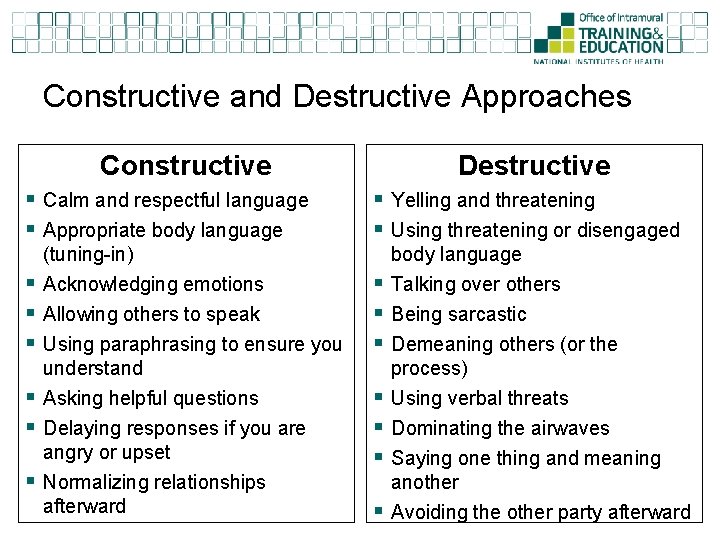
Constructive and Destructive Approaches Constructive § Calm and respectful language § Appropriate body language § § § (tuning-in) Acknowledging emotions Allowing others to speak Using paraphrasing to ensure you understand § Asking helpful questions § Delaying responses if you are § angry or upset Normalizing relationships afterward Destructive § Yelling and threatening § Using threatening or disengaged § § § body language Talking over others Being sarcastic Demeaning others (or the process) § Using verbal threats § Dominating the airwaves § Saying one thing and meaning § another Avoiding the other party afterward
Have you been putting off any difficult conversations with a student, staff, collaborator? Why? What do you need to do to move forward with having the conversation and attempting to resolve the situation?
Group Discussion n n How do you think Type, might impact someone’s approach toward, and behaviors during, conflict/difficult conversations and feedback; consider each dichotomy of the MBTI: E-I, S-N, T-F, J-P What about other topics discussed during the workshop today?
n Pick something that resonated with you today; that you want to do more of, want to do less of, or want to learn more about and share with your neighbor.
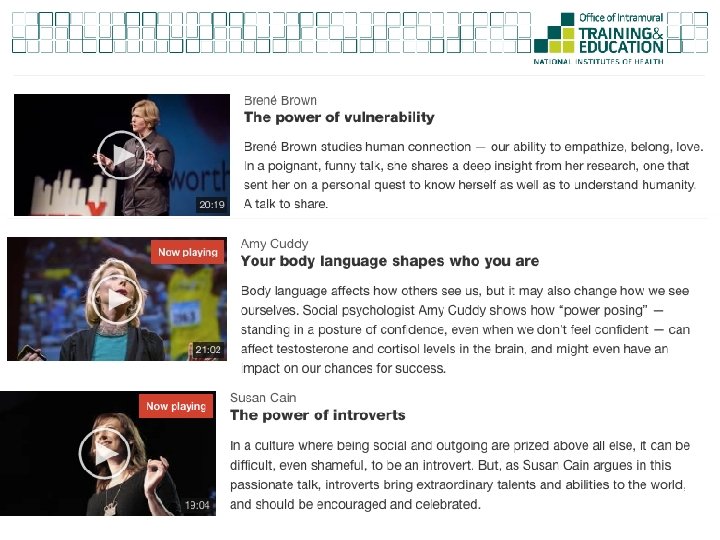
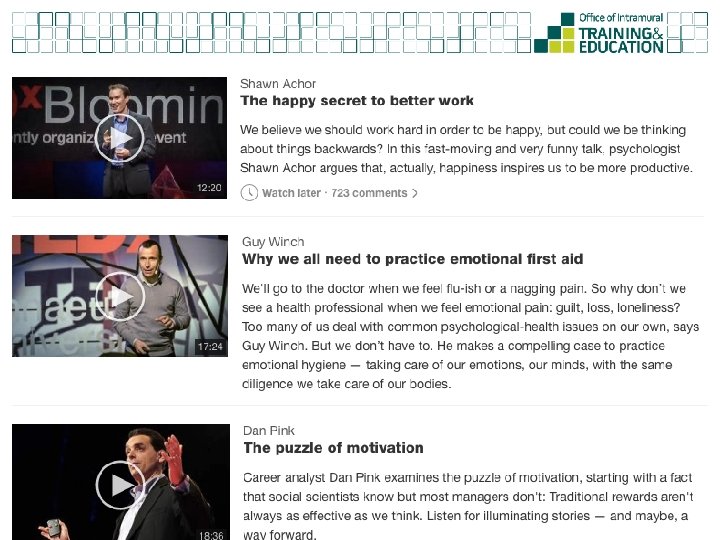
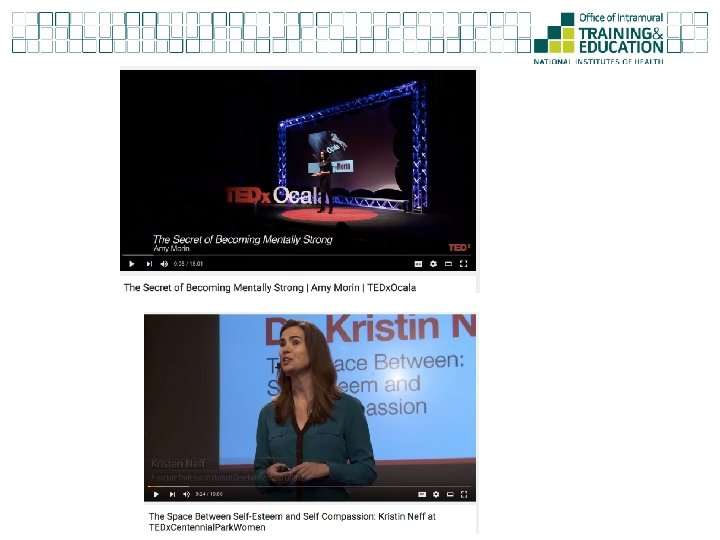
Some Books/TED Talks I Like n n n n n Type. Talk at Work: How the 16 Personality Types Determine Your Success on the Job; Otto Kroeger, Janet Thuesen, and Hile Rutledge Networking for People Who Hate Networking: A Guide for Introverts, the Overwhelmed and Underconnected; Devorah Zack Emotional Intelligence: Why It Can Matter More Than IQ; Dan Goleman Primal Leadership: Learning to Lead with Emotional Intelligence, Daniel Goleman, Richard Boyatzis, and Annie Mc. Kee Learned Optimism: How to Change Your Mind and Your Life ; Martin Seligman Self-Compassion: The Proven Power of Being Kind to Yourself; Kristin Neff Taking the Leap: Freeing Ourselves from Old Habits and Fears; Pema Chodron Everyday Bias: Identifying and Navigating Unconscious Judgments in Our Daily Lives, Howard Ross Thirteen Things Mentally Strong People Don’t Do; Amy Morin Becoming a Conflict Competent Leader, Craig Runde and Tim Flanagan
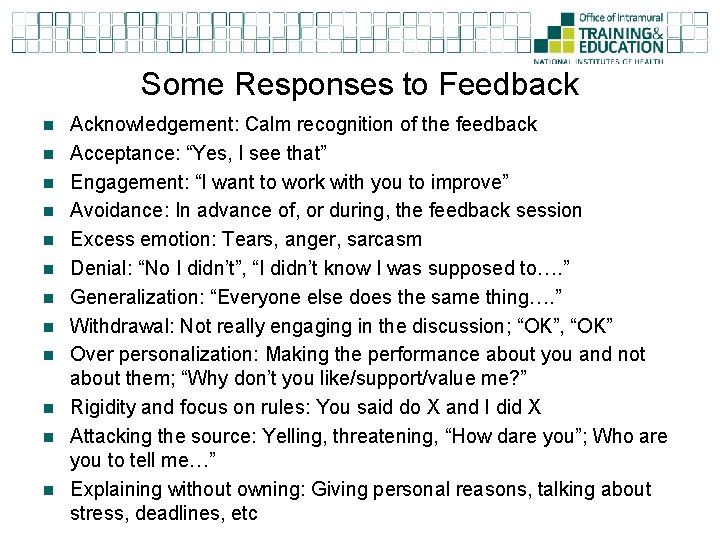
Some Responses to Feedback n n n Acknowledgement: Calm recognition of the feedback Acceptance: “Yes, I see that” Engagement: “I want to work with you to improve” Avoidance: In advance of, or during, the feedback session Excess emotion: Tears, anger, sarcasm Denial: “No I didn’t”, “I didn’t know I was supposed to…. ” Generalization: “Everyone else does the same thing…. ” Withdrawal: Not really engaging in the discussion; “OK”, “OK” Over personalization: Making the performance about you and not about them; “Why don’t you like/support/value me? ” Rigidity and focus on rules: You said do X and I did X Attacking the source: Yelling, threatening, “How dare you”; Who are you to tell me…” Explaining without owning: Giving personal reasons, talking about stress, deadlines, etc
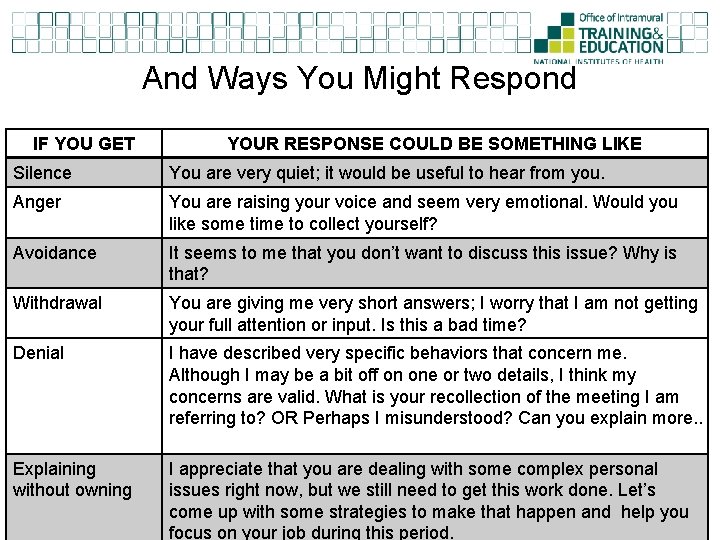
And Ways You Might Respond IF YOU GET YOUR RESPONSE COULD BE SOMETHING LIKE Silence You are very quiet; it would be useful to hear from you. Anger You are raising your voice and seem very emotional. Would you like some time to collect yourself? Avoidance It seems to me that you don’t want to discuss this issue? Why is that? Withdrawal You are giving me very short answers; I worry that I am not getting your full attention or input. Is this a bad time? Denial I have described very specific behaviors that concern me. Although I may be a bit off on one or two details, I think my concerns are valid. What is your recollection of the meeting I am referring to? OR Perhaps I misunderstood? Can you explain more. . Explaining without owning I appreciate that you are dealing with some complex personal issues right now, but we still need to get this work done. Let’s come up with some strategies to make that happen and help you focus on your job during this period.
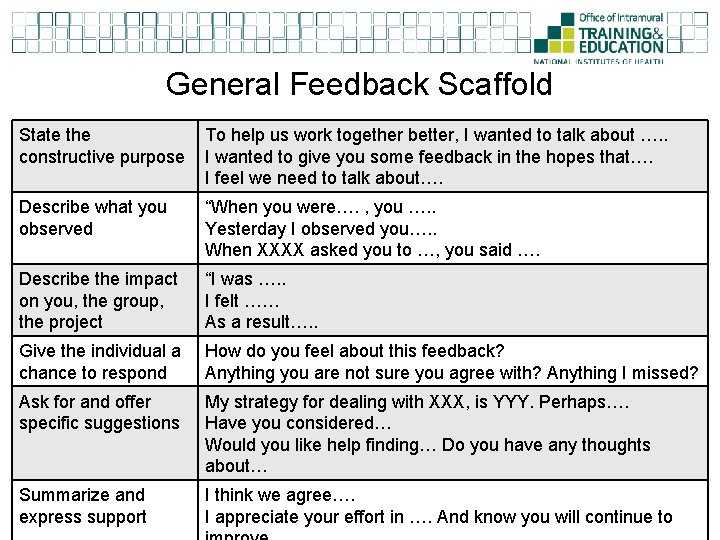
General Feedback Scaffold State the constructive purpose To help us work together better, I wanted to talk about …. . I wanted to give you some feedback in the hopes that…. I feel we need to talk about…. Describe what you observed “When you were…. , you …. . Yesterday I observed you…. . When XXXX asked you to …, you said …. Describe the impact on you, the group, the project “I was …. . I felt …… As a result…. . Give the individual a chance to respond How do you feel about this feedback? Anything you are not sure you agree with? Anything I missed? Ask for and offer specific suggestions My strategy for dealing with XXX, is YYY. Perhaps…. Have you considered… Would you like help finding… Do you have any thoughts about… Summarize and express support I think we agree…. I appreciate your effort in …. And know you will continue to