
NIH Guidelines Section III Levels of Review Level
- Slides: 25
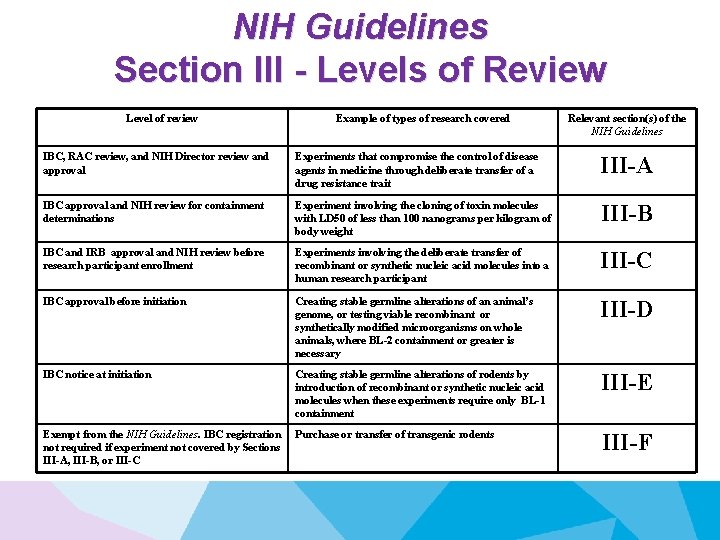
NIH Guidelines Section III - Levels of Review Level of review Example of types of research covered Relevant section(s) of the NIH Guidelines IBC, RAC review, and NIH Director review and approval Experiments that compromise the control of disease agents in medicine through deliberate transfer of a drug resistance trait III-A IBC approval and NIH review for containment determinations Experiment involving the cloning of toxin molecules with LD 50 of less than 100 nanograms per kilogram of body weight III-B IBC and IRB approval and NIH review before research participant enrollment Experiments involving the deliberate transfer of recombinant or synthetic nucleic acid molecules into a human research participant III-C IBC approval before initiation Creating stable germline alterations of an animal’s genome, or testing viable recombinant or synthetically modified microorganisms on whole animals, where BL-2 containment or greater is necessary III-D IBC notice at initiation Creating stable germline alterations of rodents by introduction of recombinant or synthetic nucleic acid molecules when these experiments require only BL-1 containment III-E Exempt from the NIH Guidelines. IBC registration not required if experiment not covered by Sections III-A, III-B, or III-C Purchase or transfer of transgenic rodents III-F
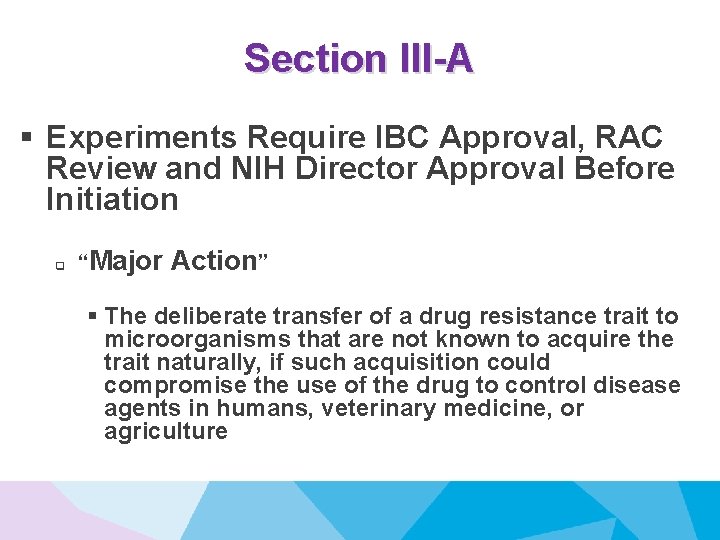
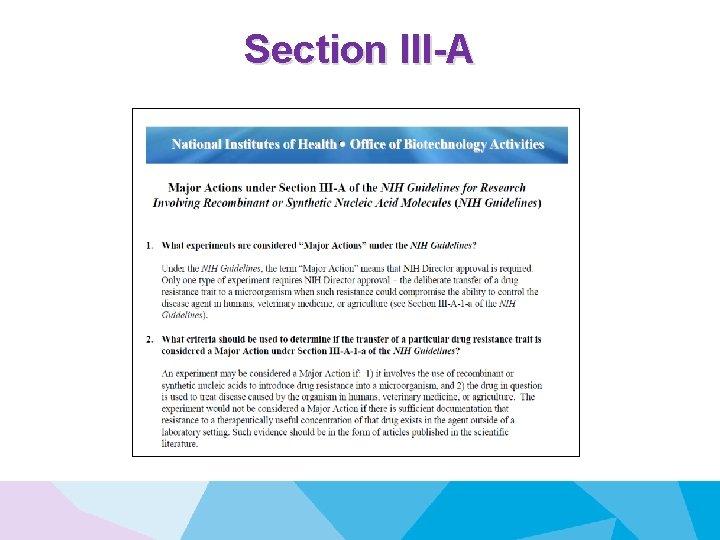
Section III-A § Experiments Require IBC Approval, RAC Review and NIH Director Approval Before Initiation q “Major Action” § The deliberate transfer of a drug resistance trait to microorganisms that are not known to acquire the trait naturally, if such acquisition could compromise the use of the drug to control disease agents in humans, veterinary medicine, or agriculture
Section III-A
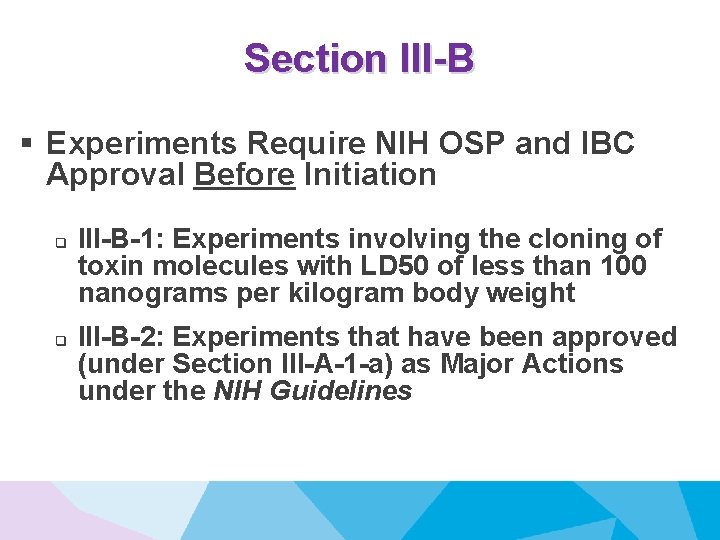
Section III-B § Experiments Require NIH OSP and IBC Approval Before Initiation q q III-B-1: Experiments involving the cloning of toxin molecules with LD 50 of less than 100 nanograms per kilogram body weight III-B-2: Experiments that have been approved (under Section III-A-1 -a) as Major Actions under the NIH Guidelines
Section III-C § Experiments Require IBC Approval and IRB Approval (and RAC Review as applicable) Before Initiation § Human gene transfer - deliberate transfer into human research participants of either: q q Recombinant nucleic acid molecules, or DNA or RNA derived from recombinant nucleic acid molecules, or Synthetic nucleic acid molecules, or DNA or RNA derived from synthetic nucleic acid molecules, that meet any one of the following criteria:
Section III-C § Contain more than 100 nucleotides; or § Possess biological properties that enable integration into the genome (e. g. , cis elements involved in integration); or § Have the potential to replicate in a cell; or § Can be translated or transcribed.
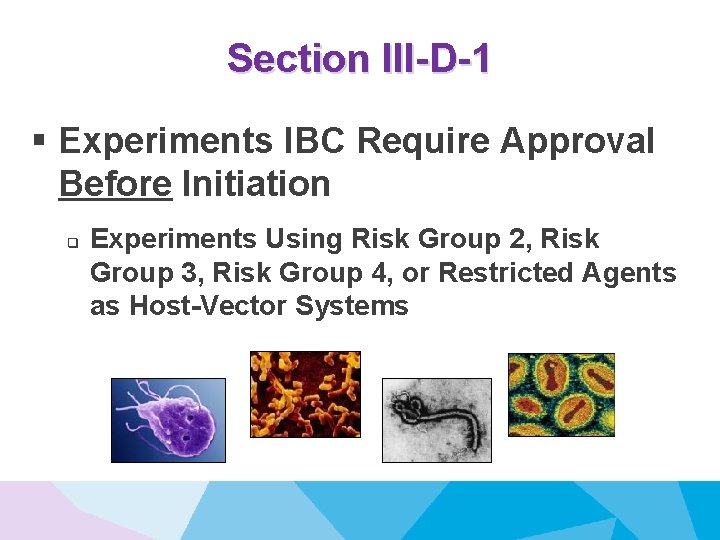
Section III-D-1 § Experiments IBC Require Approval Before Initiation q Experiments Using Risk Group 2, Risk Group 3, Risk Group 4, or Restricted Agents as Host-Vector Systems
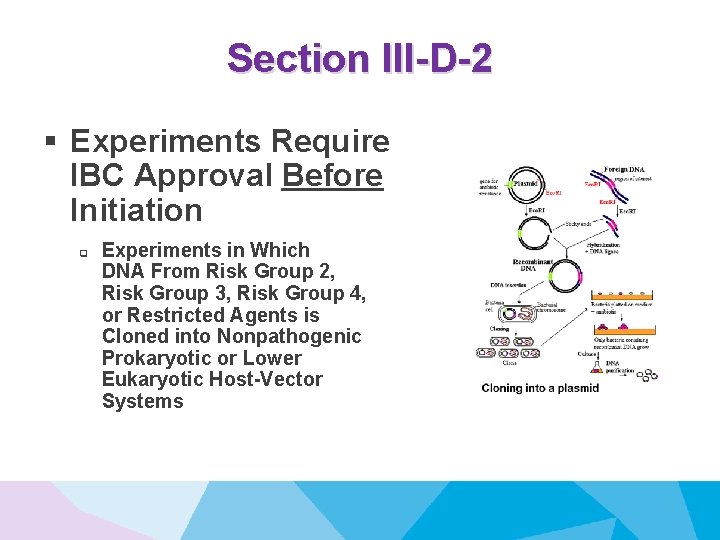
Section III-D-2 § Experiments Require IBC Approval Before Initiation q Experiments in Which DNA From Risk Group 2, Risk Group 3, Risk Group 4, or Restricted Agents is Cloned into Nonpathogenic Prokaryotic or Lower Eukaryotic Host-Vector Systems
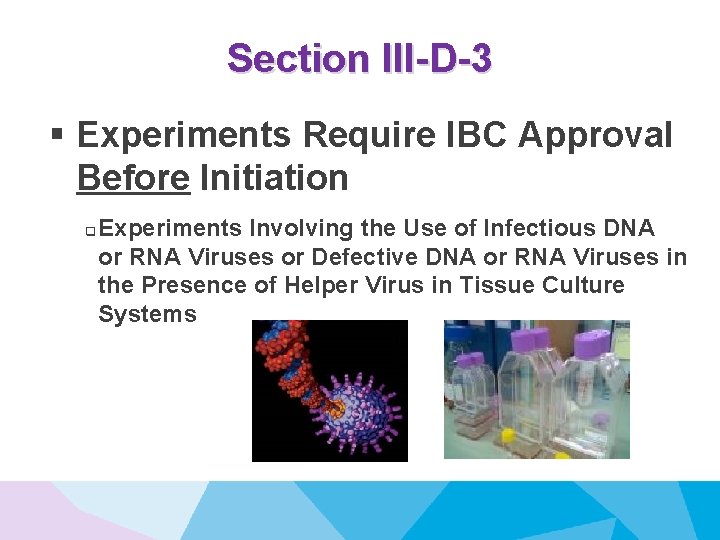
Section III-D-3 § Experiments Require IBC Approval Before Initiation q Experiments Involving the Use of Infectious DNA or RNA Viruses or Defective DNA or RNA Viruses in the Presence of Helper Virus in Tissue Culture Systems
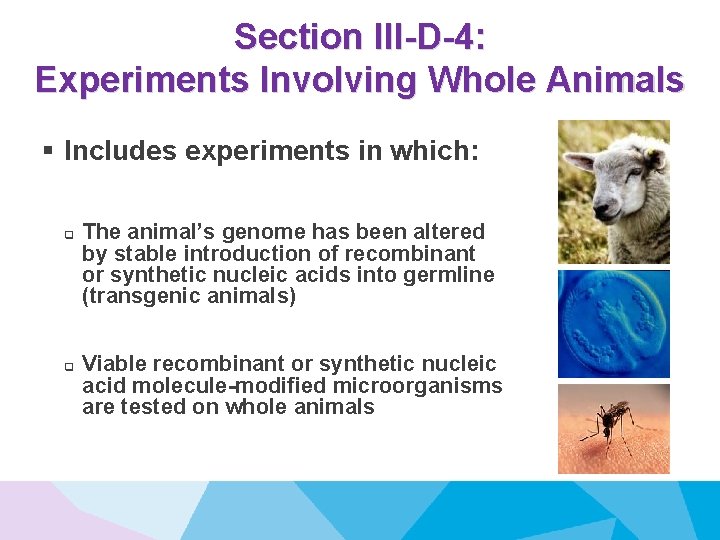
Section III-D-4: Experiments Involving Whole Animals § Includes experiments in which: q q The animal’s genome has been altered by stable introduction of recombinant or synthetic nucleic acids into germline (transgenic animals) Viable recombinant or synthetic nucleic acid molecule-modified microorganisms are tested on whole animals
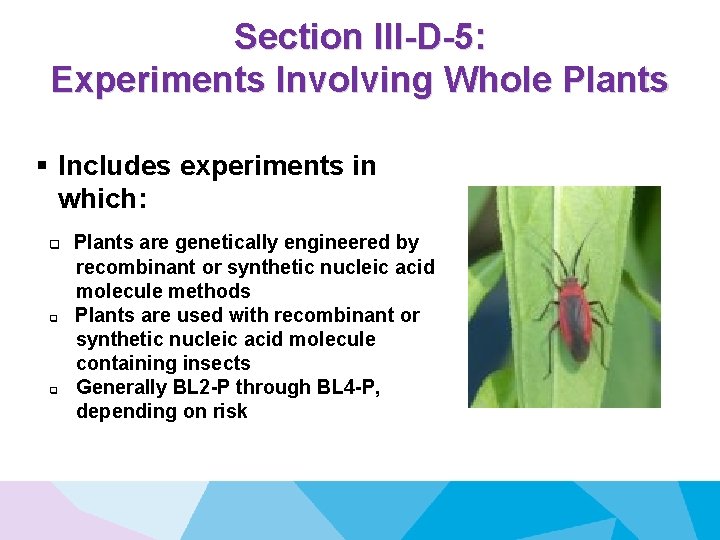
Section III-D-5: Experiments Involving Whole Plants § Includes experiments in which: q q q Plants are genetically engineered by recombinant or synthetic nucleic acid molecule methods Plants are used with recombinant or synthetic nucleic acid molecule containing insects Generally BL 2 -P through BL 4 -P, depending on risk
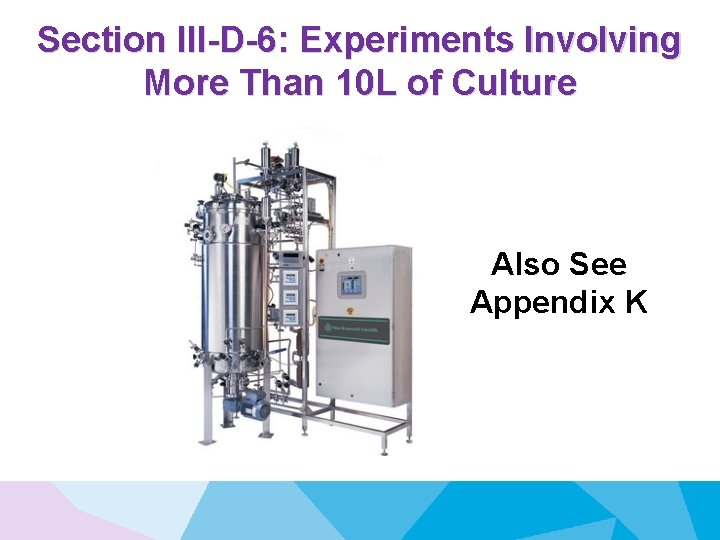
Section III-D-6: Experiments Involving More Than 10 L of Culture Also See Appendix K
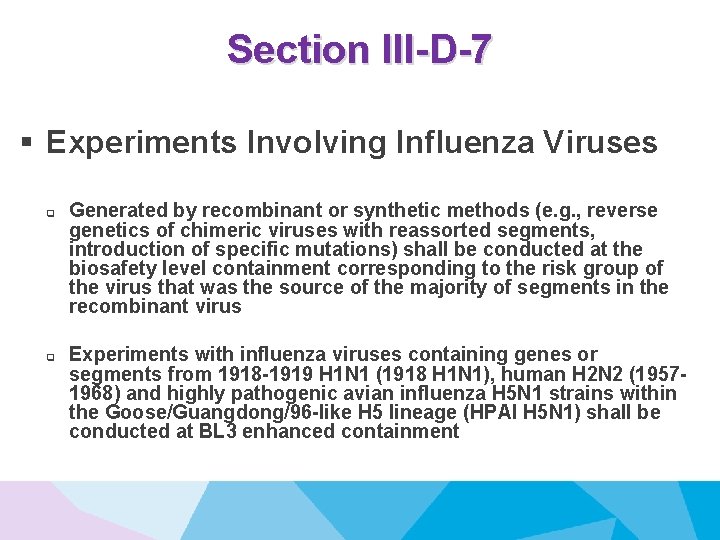
Section III-D-7 § Experiments Involving Influenza Viruses q q Generated by recombinant or synthetic methods (e. g. , reverse genetics of chimeric viruses with reassorted segments, introduction of specific mutations) shall be conducted at the biosafety level containment corresponding to the risk group of the virus that was the source of the majority of segments in the recombinant virus Experiments with influenza viruses containing genes or segments from 1918 -1919 H 1 N 1 (1918 H 1 N 1), human H 2 N 2 (19571968) and highly pathogenic avian influenza H 5 N 1 strains within the Goose/Guangdong/96 -like H 5 lineage (HPAI H 5 N 1) shall be conducted at BL 3 enhanced containment
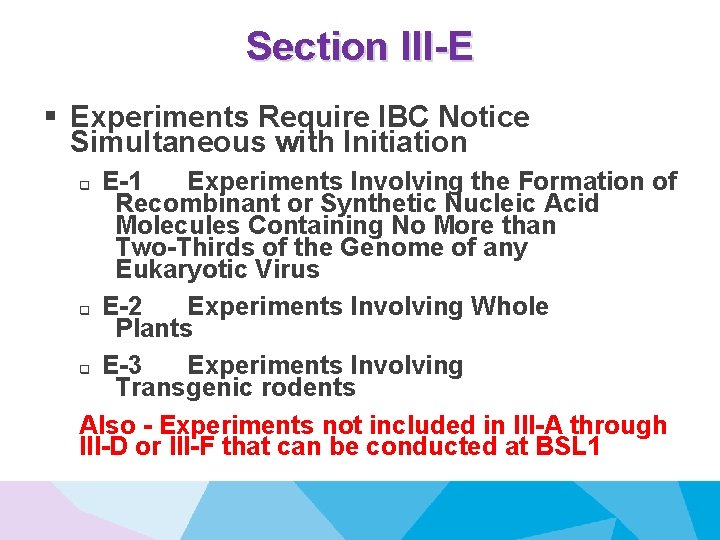
Section III-E § Experiments Require IBC Notice Simultaneous with Initiation E-1 Experiments Involving the Formation of Recombinant or Synthetic Nucleic Acid Molecules Containing No More than Two-Thirds of the Genome of any Eukaryotic Virus q E-2 Experiments Involving Whole Plants q E-3 Experiments Involving Transgenic rodents Also - Experiments not included in III-A through III-D or III-F that can be conducted at BSL 1 q
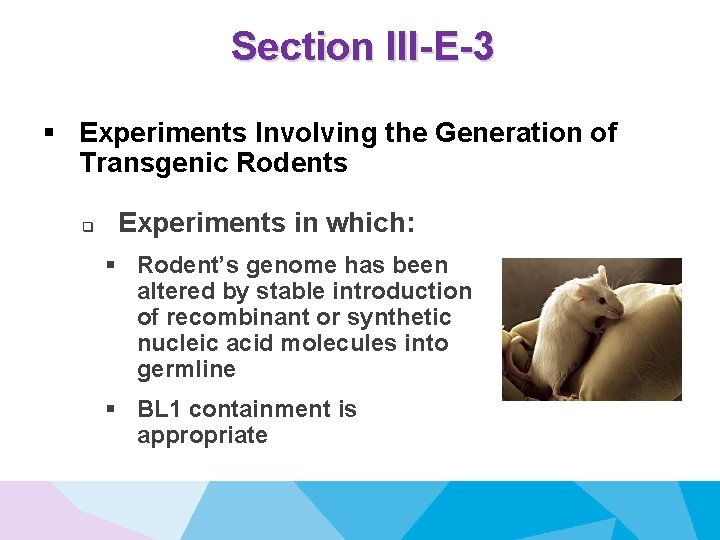
Section III-E-3 § Experiments Involving the Generation of Transgenic Rodents q Experiments in which: § Rodent’s genome has been altered by stable introduction of recombinant or synthetic nucleic acid molecules into germline § BL 1 containment is appropriate
Section III-F: Exempt Experiments Registration with the Institutional Biosafety Committee is not required (although many institutions may require this by policy)
Section III-F-1: Exempt Experiments § Synthetic nucleic acids that: (1) (2) (3) can neither replicate nor generate nucleic acids that can replicate in any living cell (e. g. , oligonucleotides or other synthetic nucleic acids that do not contain an origin of replication or contain elements known to interact with either DNA or RNA polymerase), and are not designed to integrate into DNA, and do not produce a toxin that is lethal for vertebrates at an LD 50 of less than 100 nanograms per kilogram body weight.
Section III-F-1: Exempt Experiments Note: If a synthetic nucleic acid is deliberately transferred into one or more human research participants and meets the amended criteria of Section III-C, it is not exempt under the NIH Guidelines.
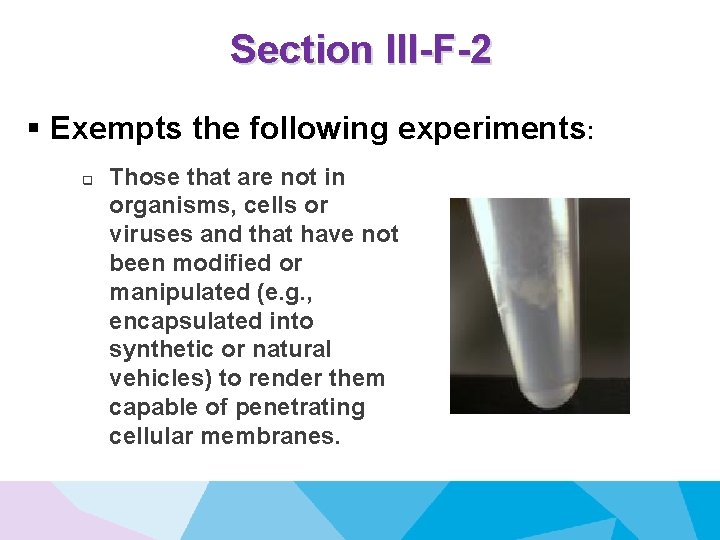
Section III-F-2 § Exempts the following experiments: q Those that are not in organisms, cells or viruses and that have not been modified or manipulated (e. g. , encapsulated into synthetic or natural vehicles) to render them capable of penetrating cellular membranes.
Section III-F-3 § Those that consist entirely of recombinant or synthetic nucleic acid sequence from a single source that exists contemporaneously in nature
Section III-F-4 § Those that consist entirely of nucleic acids from a prokaryotic host including its indigenous plasmids or viruses when propagated only in that host (or a closely related strain of the same species), or when transferred to another host by well established physiological means.
Section III-F-5 § Those that consist entirely of nucleic acids from an eukaryotic host including its chloroplasts, mitochondria, or plasmids (but excluding viruses) when propagated only in that host (or a closely related strain of the same species).
Section III-F-6 § Those that consist entirely of DNA segments from different species that exchange DNA by known physiological processes, though one or more of the segments may be a synthetic equivalent. Meaning recombinant DNA molecules that are: 1) composed entirely of DNA segments from one or more of the organisms within a sublist, and 2) to be propagated in any of the organisms within the same sublist
Section III-F-7 § Those genomic DNA molecules that have acquired a transposable element provided the transposable element does not contain any recombinant and/or synthetic DNA
Section III-F-8 § Those that do not present a significant risk to health or the environment as determined by the NIH Director, with the advice of the RAC, and following appropriate notice and opportunity for public comment. See Appendix C, Exemptions under Section III-F-8