
NIH Funding Opportunities for Early career Scientists Aleksandra
- Slides: 14
NIH Funding Opportunities for Early -career Scientists Aleksandra Vicentic, Ph. D. Nancy Desmond, Ph. D. Andrew Rossi, Ph. D. Division of Neuroscience and Basic Behavioral Science, NIMH June 2016
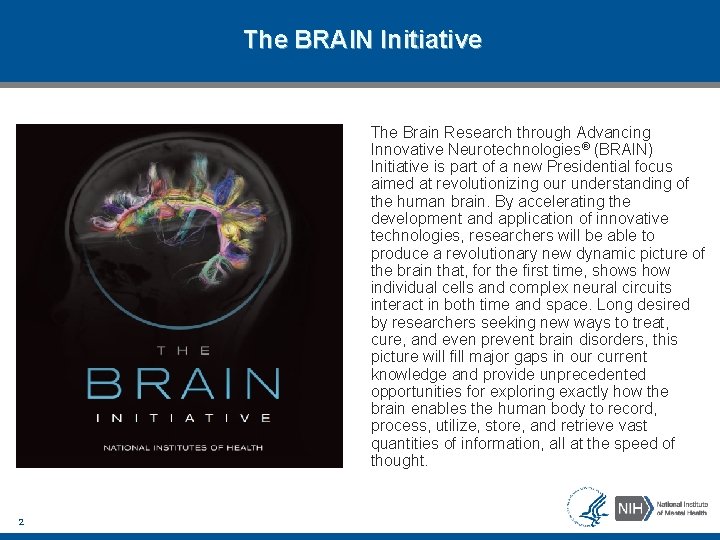
The BRAIN Initiative The Brain Research through Advancing Innovative Neurotechnologies® (BRAIN) Initiative is part of a new Presidential focus aimed at revolutionizing our understanding of the human brain. By accelerating the development and application of innovative technologies, researchers will be able to produce a revolutionary new dynamic picture of the brain that, for the first time, shows how individual cells and complex neural circuits interact in both time and space. Long desired by researchers seeking new ways to treat, cure, and even prevent brain disorders, this picture will fill major gaps in our current knowledge and provide unprecedented opportunities for exploring exactly how the brain enables the human body to record, process, utilize, store, and retrieve vast quantities of information, all at the speed of thought. 2
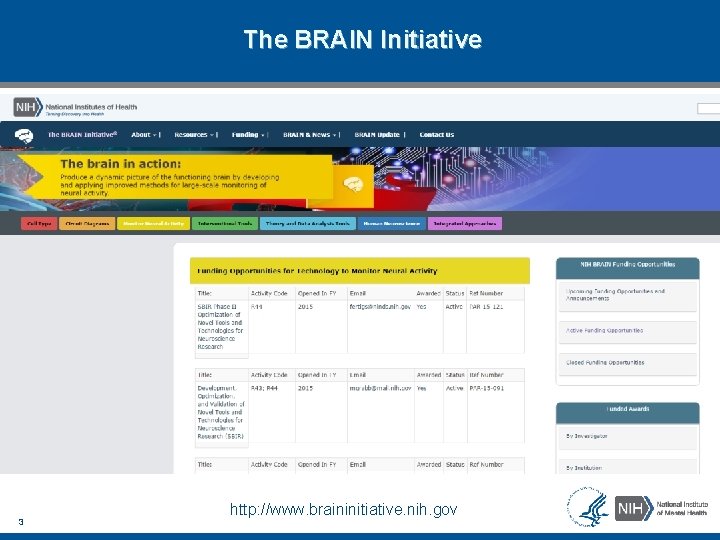
The BRAIN Initiative 3 http: //www. braininitiative. nih. gov
The BRAIN Initiative RFA-EB-15 -006 BRAIN Initiative: Theories, Models and Methods for Analysis of Complex Data from the Brain (R 01) § § § 4 Understand brain function from complex neuroscience data Theories to organize/unify data and infer general principles Mathematical/statistical models to drive testable hypothesis Methods for complex data analysis and feature detection Tools that can be used by the larger neuroscience community http: //braininitiative. nih. gov/funding_active. htm
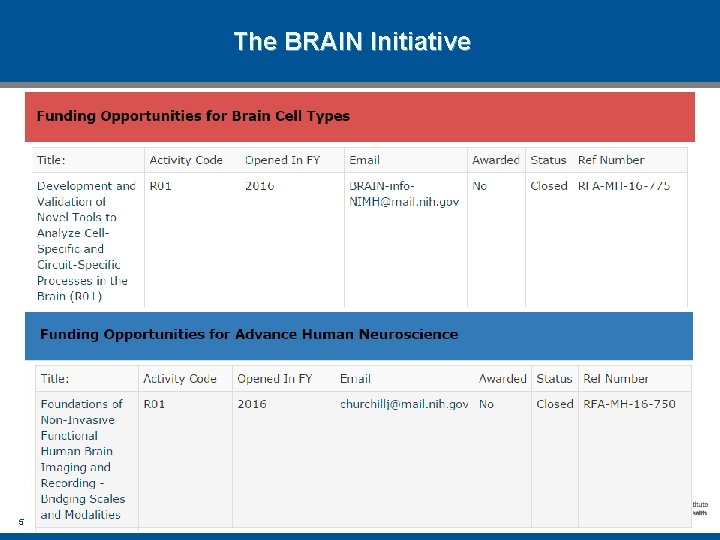
The BRAIN Initiative 5
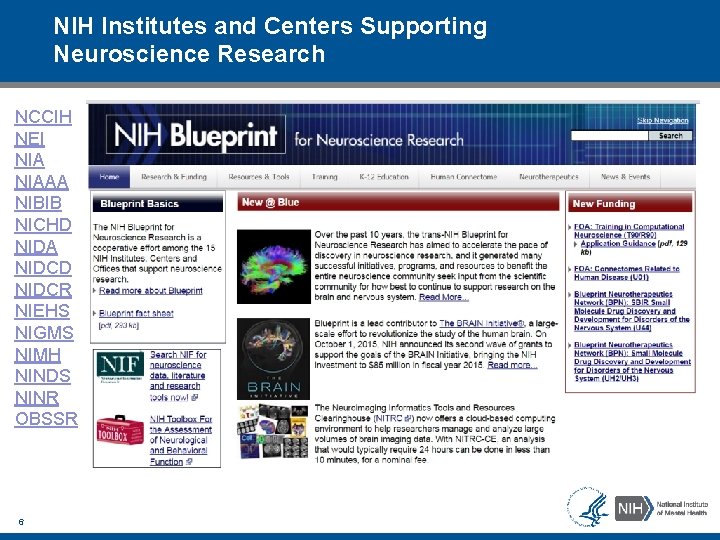
NIH Institutes and Centers Supporting Neuroscience Research NCCIH NEI NIAAA NIBIB NICHD NIDA NIDCD NIDCR NIEHS NIGMS NIMH NINDS NINR OBSSR 6
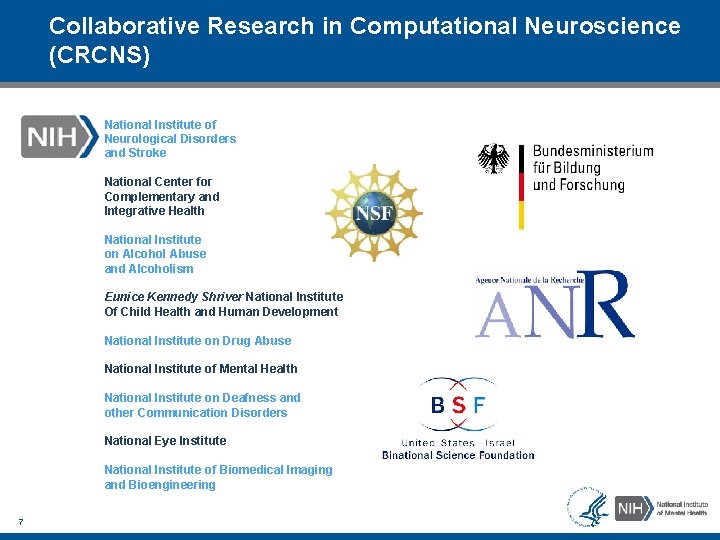
Collaborative Research in Computational Neuroscience (CRCNS) National Institute of Neurological Disorders and Stroke National Center for Complementary and Integrative Health National Institute on Alcohol Abuse and Alcoholism Eunice Kennedy Shriver National Institute Of Child Health and Human Development National Institute on Drug Abuse National Institute of Mental Health National Institute on Deafness and other Communication Disorders National Eye Institute National Institute of Biomedical Imaging and Bioengineering 7
8 NIH Isn’t the Only Option… § Other federal agencies (e. g. NSF, DOE, AHRQ, DOD) § Private foundations (e. g. American Heart Association, Autism Speaks, Simons Foundation, Keck) § Don’t ignore small grant opportunities!
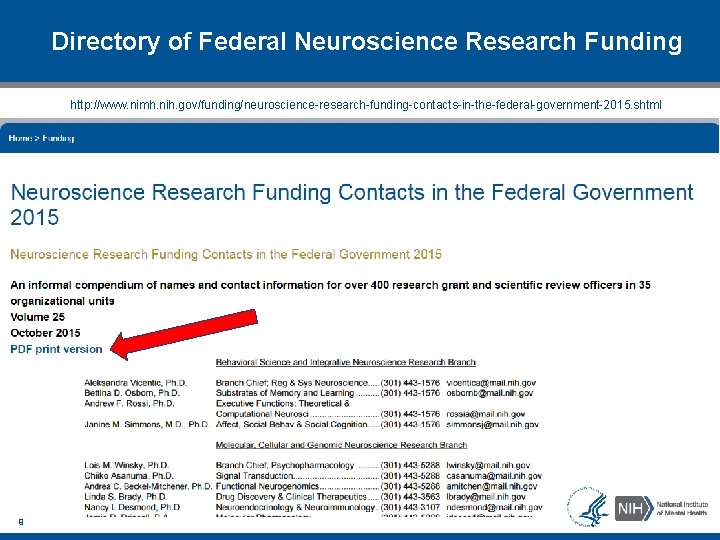
Directory of Federal Neuroscience Research Funding http: //www. nimh. nih. gov/funding/neuroscience-research-funding-contacts-in-the-federal-government-2015. shtml 9
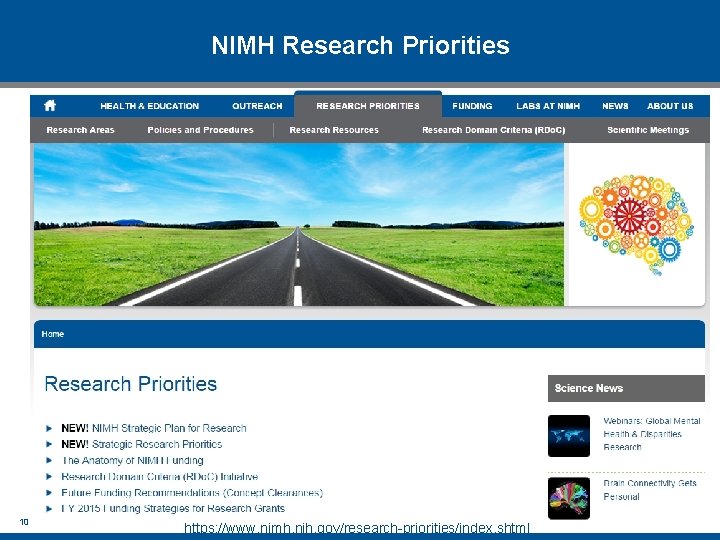
NIMH Research Priorities 10 https: //www. nimh. nih. gov/research-priorities/index. shtml
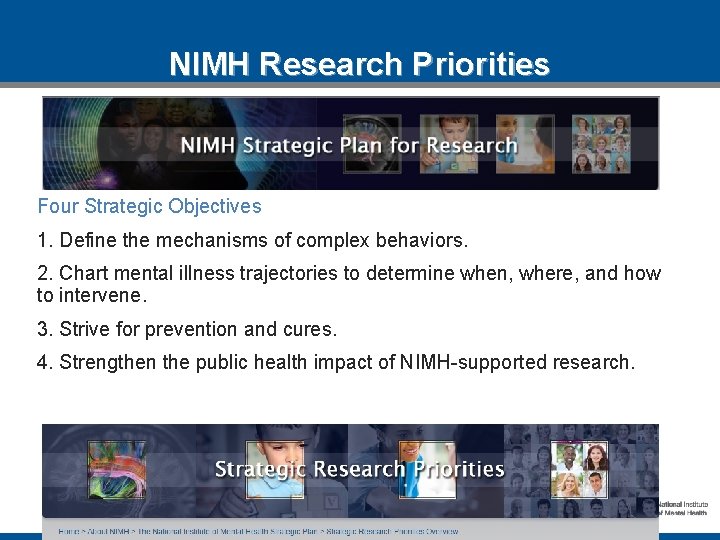
NIMH Research Priorities Four Strategic Objectives 1. Define the mechanisms of complex behaviors. 2. Chart mental illness trajectories to determine when, where, and how to intervene. 3. Strive for prevention and cures. 4. Strengthen the public health impact of NIMH-supported research.
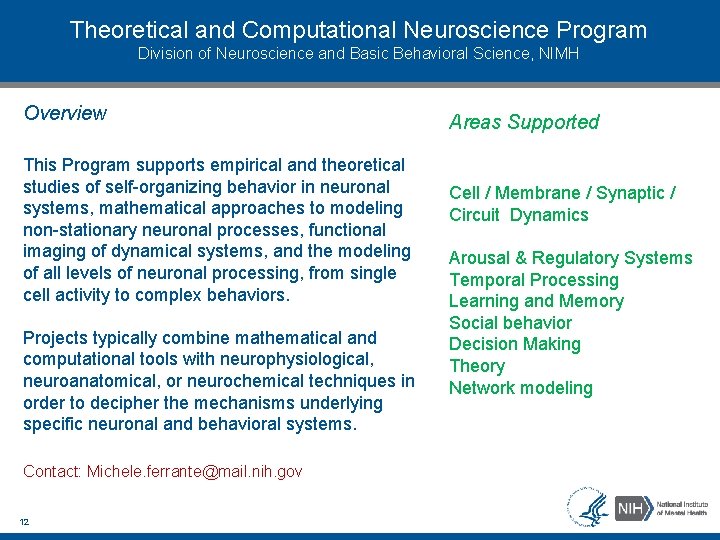
Theoretical and Computational Neuroscience Program Division of Neuroscience and Basic Behavioral Science, NIMH Overview This Program supports empirical and theoretical studies of self-organizing behavior in neuronal systems, mathematical approaches to modeling non-stationary neuronal processes, functional imaging of dynamical systems, and the modeling of all levels of neuronal processing, from single cell activity to complex behaviors. Projects typically combine mathematical and computational tools with neurophysiological, neuroanatomical, or neurochemical techniques in order to decipher the mechanisms underlying specific neuronal and behavioral systems. Contact: Michele. ferrante@mail. nih. gov 12 Areas Supported Cell / Membrane / Synaptic / Circuit Dynamics Arousal & Regulatory Systems Temporal Processing Learning and Memory Social behavior Decision Making Theory Network modeling
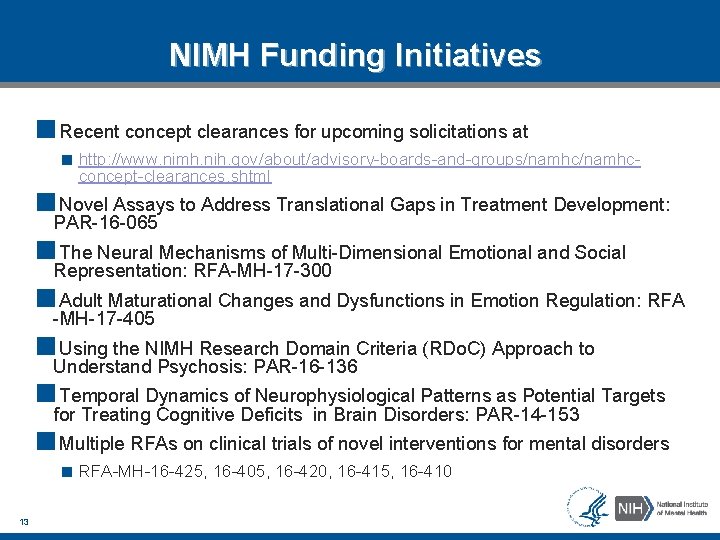
NIMH Funding Initiatives ■Recent concept clearances for upcoming solicitations at ■ http: //www. nimh. nih. gov/about/advisory-boards-and-groups/namhcconcept-clearances. shtml ■Novel Assays to Address Translational Gaps in Treatment Development: PAR-16 -065 ■The Neural Mechanisms of Multi-Dimensional Emotional and Social Representation: RFA-MH-17 -300 ■Adult Maturational Changes and Dysfunctions in Emotion Regulation: RFA -MH-17 -405 ■Using the NIMH Research Domain Criteria (RDo. C) Approach to Understand Psychosis: PAR-16 -136 ■Temporal Dynamics of Neurophysiological Patterns as Potential Targets for Treating Cognitive Deficits in Brain Disorders: PAR-14 -153 ■Multiple RFAs on clinical trials of novel interventions for mental disorders ■ 13 RFA-MH-16 -425, 16 -405, 16 -420, 16 -415, 16 -410
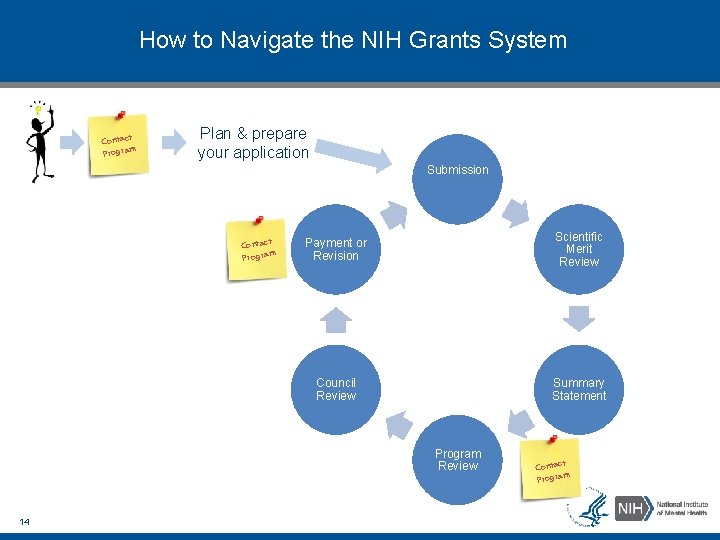
How to Navigate the NIH Grants System t Contac Program Plan & prepare your application Submission t Contac m a r g o Pr Payment or Revision Scientific Merit Review Council Review Summary Statement Program Review 14 tt CCoonnttaacc m a a r r PPrroogg m