
NIGHT VISION TECHNOLOGY 15 BY DEEPIKA G D
NIGHT VISION TECHNOLOGY 15 BY DEEPIKA. G. D 1 DB 05 IS 0 DBIT
NIGHT VISION TECHNOLOGY ü Introduction ü Types of NVT ü Thermal Imaging ü Image Enhancement ü Performance Attributes ü Technical characteristics ü Equipments ü Applications ü Conclusion ü References
Introduction ü NVT allows us to see in the dark ü Originally developed for military use ü Now used for site security, surveillance as well as search and rescue ü Evolved from bulky optical instruments in lightweight goggles through the advancement of image intensification technology.
Types of night vision ü Categorized by generations ü Each substantial change NVT establishes a new generation ü Categorized into: Generation-0 Generation-1 Generation-2 Generation-3 Generation-4
Generation-0 ü Created by US Army ü Uses active infrared ü A projection unit called IR illuminator is attached ü Full moon operation ü Use anode in conjunction with cathode to accelerate the electrons ü Problems –acceleration causes distortion of image as well as reduction of life of the tube ü Also, it was quickly duplicated by the hostile nations
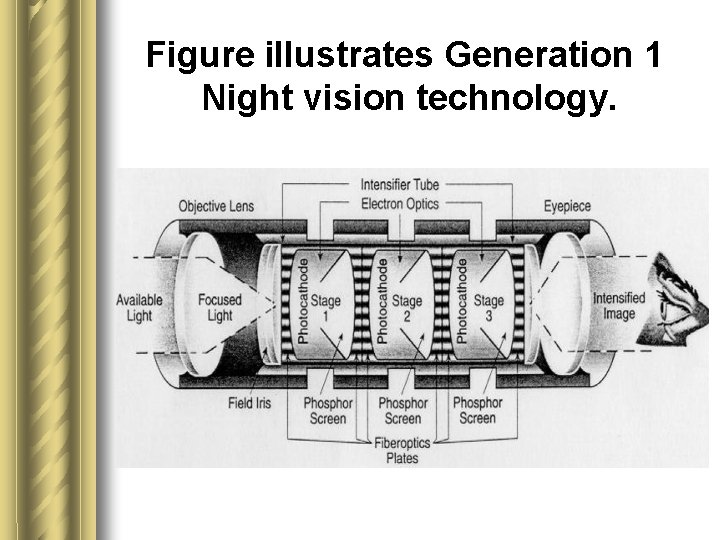
Figure illustrates Generation 1 Night vision technology.
Generation-1 (1960’s) ü Uses passive infrared ü Uses ambient light provided by the moon and the stars ü Don’t require a source of projected infrared light ü Don’t work well on cloudy or moonless nights ü One quarter moon operation ü Uses same image-intensifier tube technology as Generation-0 ü Same problems as faced by the Generation-0
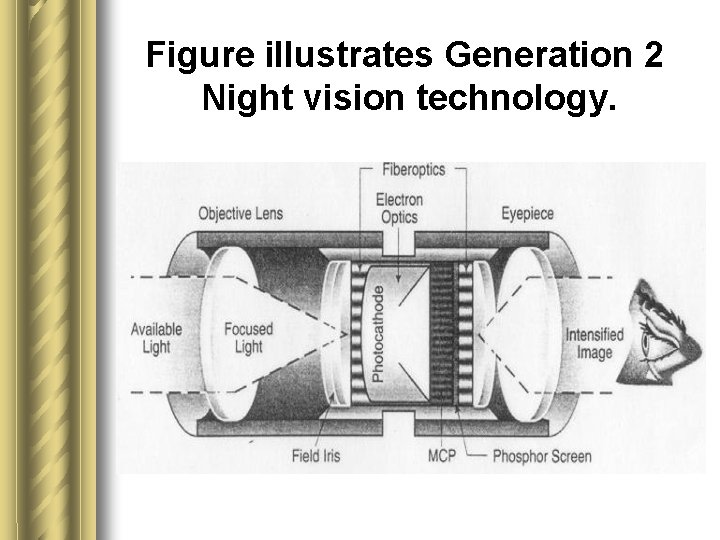
Figure illustrates Generation 2 Night vision technology.
Generation-2 (1970’s) ü Offer improved resolution and performance over Generation-1 devices ü Considerably more reliable ü Able to see in extreme low light conditions due to the addition of microchannel plate(MCP) to the imageintensifier tube ü The images are less distorted and brighter
Generation-3 (1990’s) ü Currently used by the US Army ü Better resolution and sensitivity ü Photocathode is made up of Gallium Arsenide ü MCP is coated with an ion barrier ü Tube life is increased
Generation-4 (2000’s) ü Known as “filmless and gated” technology ü Shows significant improvement in both high- and low-level light environments ü No ion barrier in MCP ü Responds quickly to different lightning conditions ü Reduced background noise ü Enhances signal to noise ratio ü Images are less distorted and brighter
Thermal imaging ü This technology operates by capturing upper portion of the infrared light spectrum, which is emitted as heat ü Hotter objects emit more of this light than the cooler objects ü These elements then create a thermogram ü Thermogram electric pulses display data
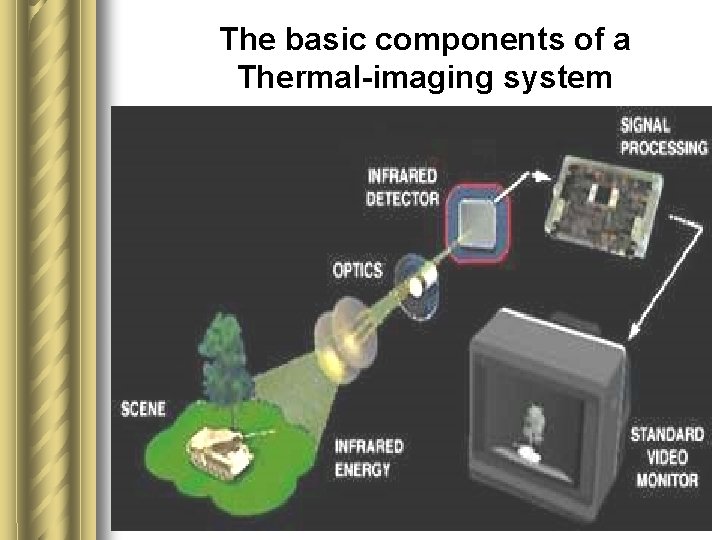
The basic components of a Thermal-imaging system
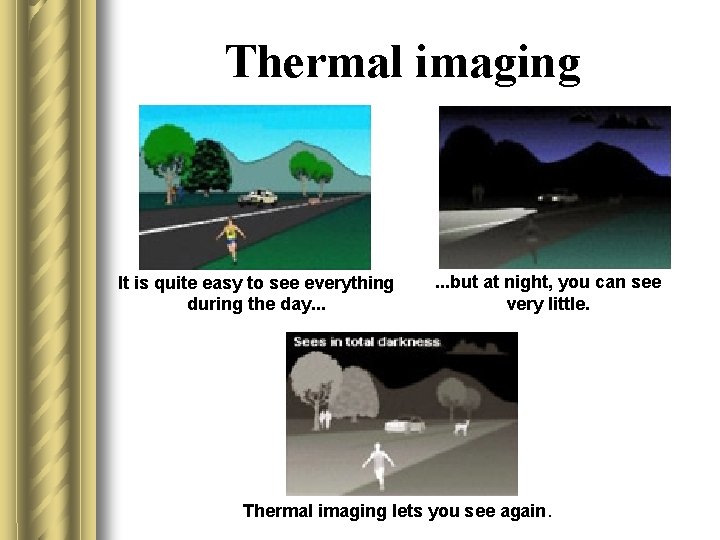
Thermal imaging It is quite easy to see everything during the day. . . but at night, you can see very little. Thermal imaging lets you see again.
Thermal imaging devices üTwo types: 1. Uncooled. 2. Cryogenically cooled. üGreat for detecting people or working in near-absolute darkness
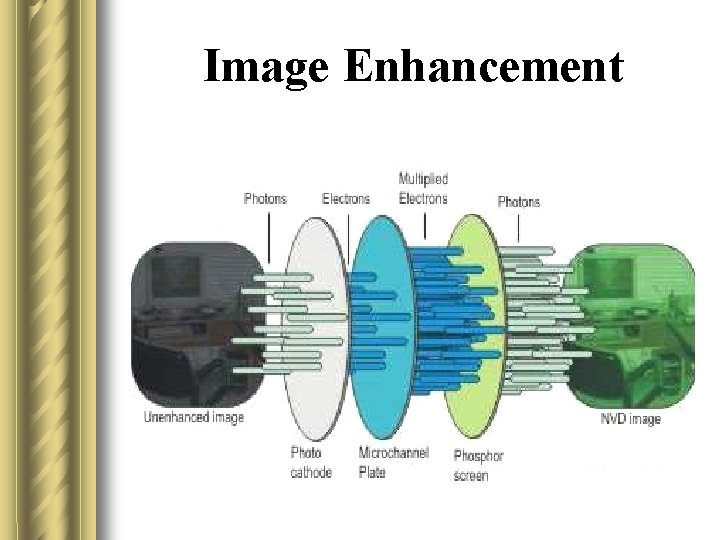
Image Enhancement
Image Enhancement ü It is also known as Image intensification ü Relies on image intensifier tube to collect an amplify infrared and visible light ü Lens captures the light which is then sent to image intensifier tube ü It has photocathode that converts photons into electrons ü When electrons pass through MCP , more electrons are presented ü This causes chain reaction where atoms are released ü Electrons reach phosphor screen and photons are released ü Those phosphor create green image
Performance Attributes ü Sensitivity (photo response)- tube’s ability to detect the available light ü Signal- plays a key role in night vision’s performance ü Resolution- ability to dissolve detail in the image
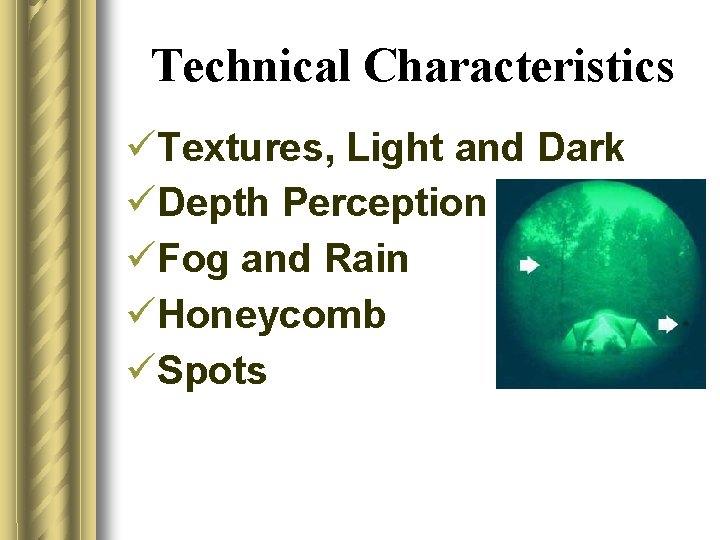
Technical Characteristics üTextures, Light and Dark üDepth Perception üFog and Rain üHoneycomb üSpots
Equipments Three categories ü Scopes ü Goggles ü Cameras
Equipments ü Scopes- monocular, handheld, better look at a specific object and then return to normal viewing conditions. ü Goggles- binocular, handheld or worn, excellent for constant viewing ü Cameras- send the image to a monitor for display or to a VCR for recording.
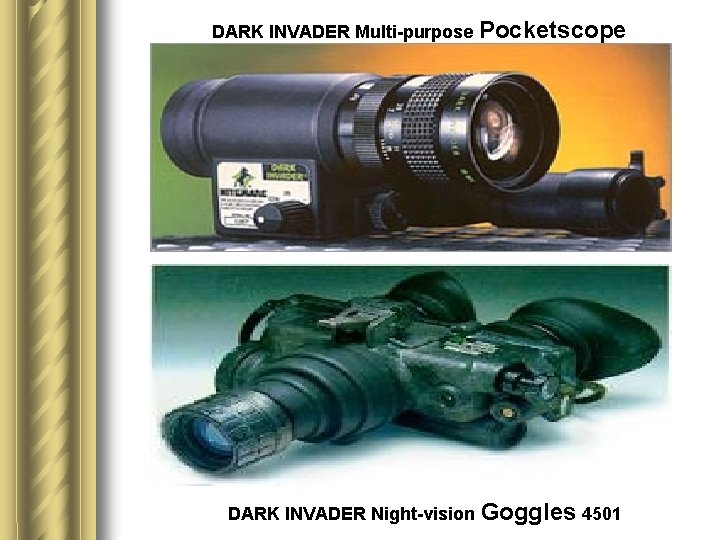
DARK INVADER Multi-purpose Pocketscope DARK INVADER Night-vision Goggles 4501
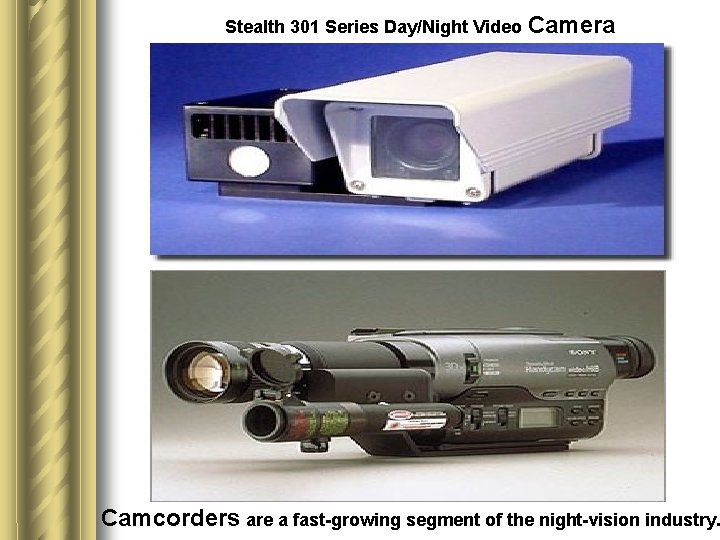
Stealth 301 Series Day/Night Video Camera Camcorders are a fast-growing segment of the night-vision industry.
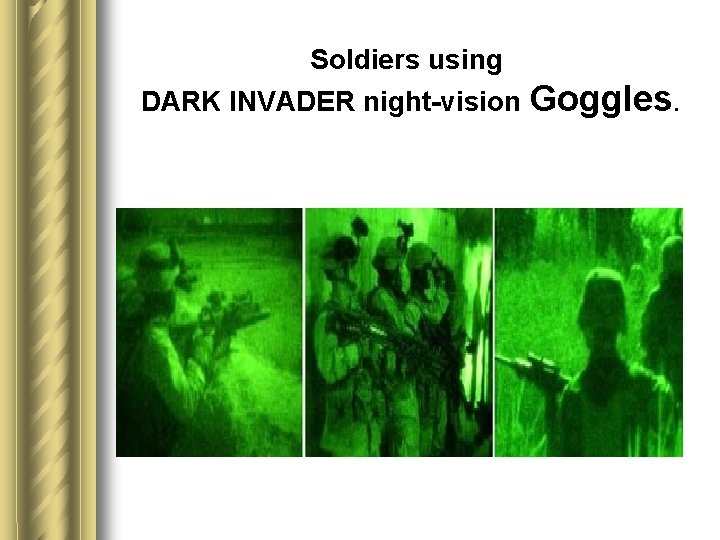
Soldiers using DARK INVADER night-vision Goggles.
Applications ü Military ü Law enforcement ü Hunting ü Wild life observation ü Surveillance ü Security ü Navigation ü Hidden-object detection ü Entertainment
Conclusions ü Although the term ``night vision'' currently encompasses three distinct technologies, it is the evolution of image intensification technology that first made devices practical and widely used. ü Their success was the result of advancements in light amplification and resolution techniques.
References Ø http: //electronics. howstuffworks. com/nightvision 3. html Ø http: //www. nightvision. com/militaryhome. html Ø http: //www. physics. ohiostate. edu/~wilkins/writing/Samples/shortmed/johnmediu m/index. html Ø http: //www. atncorp. com/How. Night. Vision. Works Ø http: //www. morovision. com/hownightvisionworks. htm Ø http: //www. alanaecology. com/acatalog/Introduction_to_ Nightvision. html


- Slides: 29