
Night Study Guide Simple Sentence A sentence that
- Slides: 18
Night Study Guide
Simple Sentence • A sentence that has a main subject and verb and expresses one complete idea. • Students may fail the test. • The hot summer sun pelted hot rays of heat on the girls laying by the pool.
Compound Sentence • Two independent clauses joined by a coordinating conjunction (fanboys) • Independent clause = complete sentence • Some experts says a small piece of chocolate should be part of a healthy diet, but others say that chocolate is unhealthy junk food.
Complex Sentence • ICDC or DC, IC • (IC) Independent clause = complete sentence • (DC) Dependent clause = fragment DC IC • When students finish their work, they give it to the teacher.
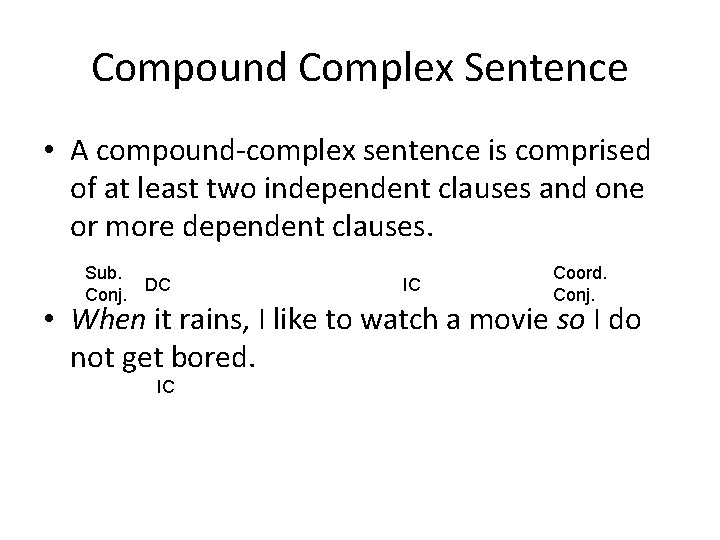
Compound Complex Sentence • A compound-complex sentence is comprised of at least two independent clauses and one or more dependent clauses. Sub. Conj. DC IC Coord. Conj. • When it rains, I like to watch a movie so I do not get bored. IC
Periodic Sentence • A periodic sentence is a sentence that has its main idea (independent clause) at the end. • As everyone knows except those who happen to be afflicted with it, love is blind.
Cumulative Sentence • begin with the independent clause and then finish with a flurry of modifying constructions • If you put your main point at the beginning of a long sentence, you are writing a loose sentence: IC • I am willing to pay slightly higher taxes for the privilege of living in Canada, considering the free health care, the cheap tuition fees, the low crime rate, the comprehensive social programs, and the wonderful winters.
Motif • recurring structures, contrasts, or literary devices that can help to develop and inform the piece’s major themes • motif can be an idea, an object, a place or a statement.
Foreshadowing • The use of hints or clues to suggest what will happen later in the story. • Not all foreshadowing is obvious. Frequently, future events are merely hinted at through dialogue, description, or the attitudes and reactions of the characters. • Foreshadowing frequently serves two purposes. It builds suspense by raising questions that encourage the reader to go on and find out more about the event that is being foreshadowed. Foreshadowing is also a means of making a narrative more believable by partially preparing the reader for events which are to follow. “I had seen the time when an old hound had given his life so that I might live” (2). Where the Red Fern Grows Foreshadows Old Dan’s death.
Absolute phrase • is a modifier generally made from a noun or noun phrase and a participle. It can modify a noun or pronoun or the whole of the base sentence to which it is attached. • can put an absolute phrase at the beginning of a sentence, in the middle or at the end, setting it off with a comma. • His head aching, his throat sore, he forgot to light the cigarette. (Sinclair Lewis, Cass Timberlane)
Appositive • a noun or noun phrase that renames another noun right beside it. • The appositive can be a short or long combination of words. • English, the class with the meanest teacher and the most homework, is my best subject.
Gerunds • Always end in -ing • They are used in the sentence as nouns and in every way that any other noun can be used: – Swimming is a good exercise. (subject) – Jane does not enjoy cooking. (direct object) – After eating, relax for a while. (object of preposition)
Participial Phrase • always act as adjectives • short phrases that appear at the beginning of a sentence or the end of the sentence • should always be set off from the main clause with a comma • The action that is occurring in these participial phrases should relate back to the subject • Example: Sitting in English, I tried to stay awake as Mrs. Boehme droned on and on.
Prepositional Phrases • will begin with a preposition and end with a noun, pronoun, gerund, or clause, the "object" of the preposition. • will function as an adjective or adverb • will never contain the subject of a sentence • In, under, around, at, on, through • The plane flew _____ the clouds.
Anaphora • A rhetorical device created by repeating the same word or group of words at the beginning of successive clauses, sentences, or lines. • “Never shall I forget that night, the night in camp, that turned my life into on long night seven times sealed. • Never shall I forget that smoke. • Never shall I forget the small faces of the children whose bodies I saw transformed into smoke under a silent sky.
Apostrophe • An apostrophe is a literary device in which someone directly addresses an inanimate object or someone who is either dead or simply not there. Apostrophes can be used to heighten one's understanding of a character's emotions, whether positive or negative. • Ex. Wiesel speaking to God as if He is present.
Hyperbole • A figure of speech that is often confused with a simile or a metaphor because it often compares two objects. The difference is a hyperbole is an exaggeration. • Are used to sound impressive or to emphasize something, such as a feeling, effort, or reaction. • I felt as though I had been running for years. • With lightning speed, he pulled it out and put it to his mouth.
Juxtaposition • Juxtaposition is the idea of putting two contrasting ideas side by side. • For example, Michael Moore uses juxtaposition in Fahrenheit 911, when he plays the song "What a Wonderful World" while playing scenes of war and violence.