
Night of the Scorpion Nissim Ezekiel The poem
- Slides: 9
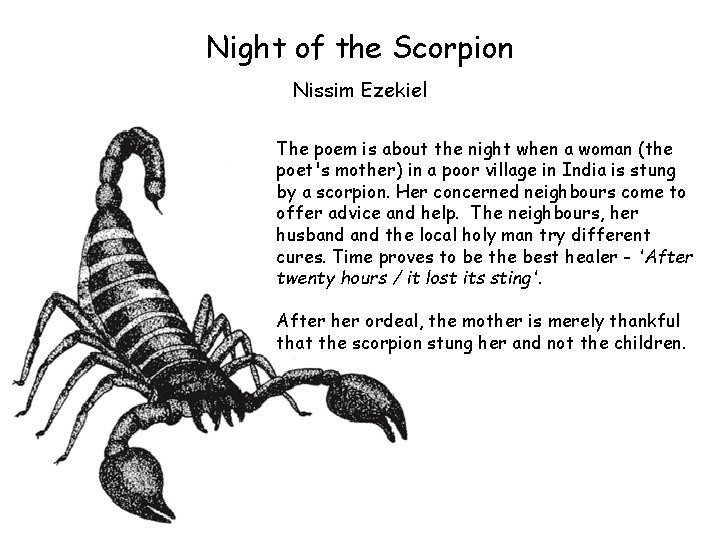
Night of the Scorpion Nissim Ezekiel The poem is about the night when a woman (the poet's mother) in a poor village in India is stung by a scorpion. Her concerned neighbours come to offer advice and help. The neighbours, her husband the local holy man try different cures. Time proves to be the best healer - 'After twenty hours / it lost its sting'. After her ordeal, the mother is merely thankful that the scorpion stung her and not the children.
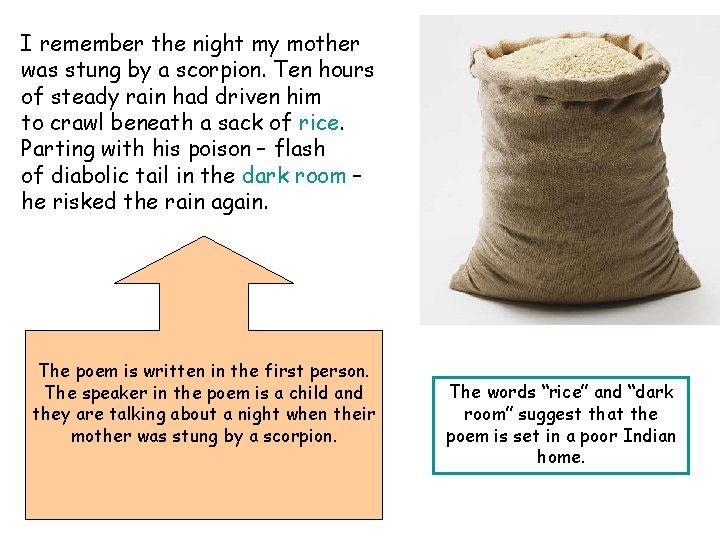
I remember the night my mother was stung by a scorpion. Ten hours of steady rain had driven him to crawl beneath a sack of rice. Parting with his poison – flash of diabolic tail in the dark room – he risked the rain again. The poem is written in the first person. The speaker in the poem is a child and they are talking about a night when their mother was stung by a scorpion. The words “rice” and “dark room” suggest that the poem is set in a poor Indian home.
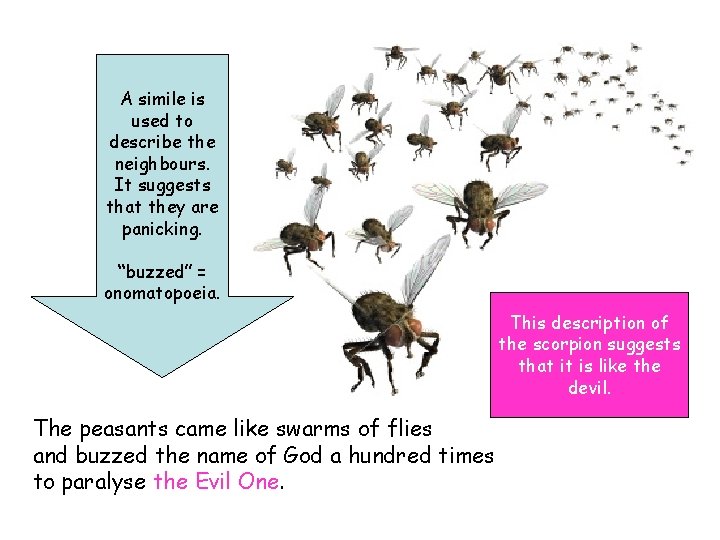
A simile is used to describe the neighbours. It suggests that they are panicking. “buzzed” = onomatopoeia. This description of the scorpion suggests that it is like the devil. The peasants came like swarms of flies and buzzed the name of God a hundred times to paralyse the Evil One.
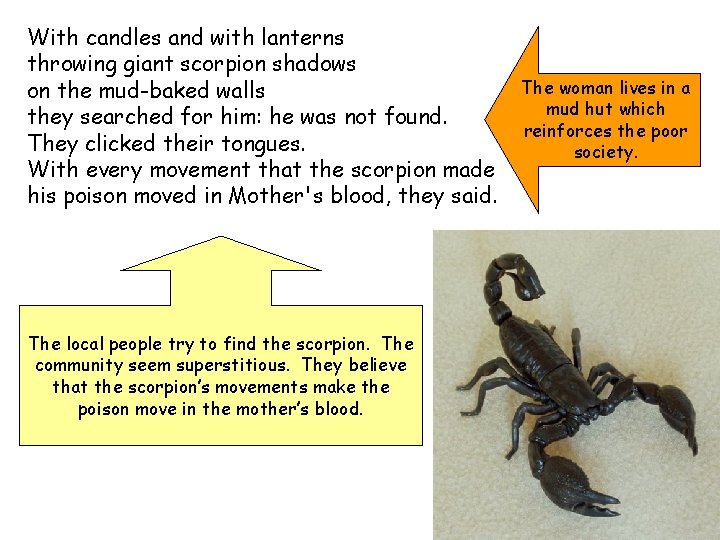
With candles and with lanterns throwing giant scorpion shadows on the mud-baked walls they searched for him: he was not found. They clicked their tongues. With every movement that the scorpion made his poison moved in Mother's blood, they said. The local people try to find the scorpion. The community seem superstitious. They believe that the scorpion’s movements make the poison move in the mother’s blood. The woman lives in a mud hut which reinforces the poor society.
“pr bir evi re th” ous b be inca refe irth lie rna r to ” an ve t i us she on. the d “ne T th w ey will d he v oma xt T are ie. illa n’s ma he re It ger ke rep lig st e iou show s t he iti s. s po on o e pr m s f “m ay er ound ay”. lik ea May he sit still, they said. May the sins of your previous birth be burned away tonight, they said. May your suffering decrease the misfortunes of your next birth, they said. May the sum of all evil balanced in this unreal world
The pain is seen as a way of cleansing the soul before the next life. This shows that the people in the poem are religious. against the sum of good become diminished by your pain. May the poison purify your flesh of desire, and your spirit of ambition, they said, and they sat around on the floor with my mother in the centre, the peace of understanding on each face. This seems ironic as the villagers have not been understanding or peaceful. They have shown panic.
More candles, more lanterns, more neighbours, more insects, and the endless rain. The mother is in lots of My mother twisted through and through, pain. The child groaning on a mat. remembers this event in My father, sceptic, rationalist, lots of detail. trying every curse and blessing, powder, mixture, herb and hybrid. He even poured a little paraffin upon the bitten toe and put a match to it. The child’s father is not normally superstitious. He is rational or realistic. However, he tries all sorts of remedies to cure the woman. This shows he feels desperate. He even tries putting paraffin on the sting and setting it alight.
Incantation = religious chanting or a spell. I watched the flame feeding on my mother. I watched the holy man perform his rites to tame the poison with an incantation. The people do not call a doctor for the woman. They call a “holy man”. This again shows that the society is religious and superstitious. They believe the holy man cure her.
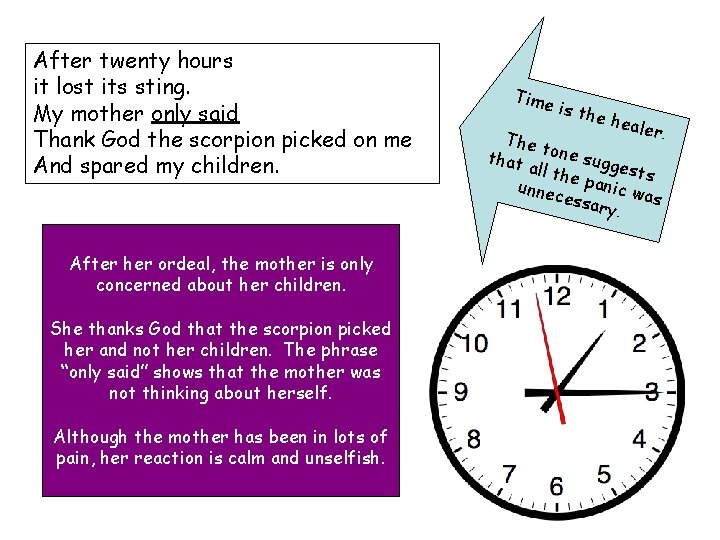
After twenty hours it lost its sting. My mother only said Thank God the scorpion picked on me And spared my children. After her ordeal, the mother is only concerned about her children. She thanks God that the scorpion picked her and not her children. The phrase “only said” shows that the mother was not thinking about herself. Although the mother has been in lots of pain, her reaction is calm and unselfish. Time is th e hea ler. The that tone sugg all th e e pan sts unne cessa ic was ry.