
Nigeria and Economic Recession Reappraising the Neoliberalism Option
Nigeria and Economic Recession: Reappraising the Neoliberalism Option Uzochukwu Amakom, Ph. D. Institute for Development Studies, University of Nigeria, Enugu Campus Enugu, Nigeria Presented at Centre for Popular Education (CEPED) Symposium sponsored by ASUU, Owerri Zone @ Nnamdi Azikiwe University Auditorium - May 11, 2017
Outline • What is Neoliberalism? • What was the Economic ideology of Nigeria pre and post independence? • Is Nigeria in Recession and if so why? • What has Neoliberalism got to do with the current recession? • What next?
What is Neoliberalism? • According to Mc. Lean and Mc. Millan (2009), it refers to a set of market-liberal economic policies that emerged in opposition to the developmental strategies based on import-substitution industrialization which had dominated the period 1945 to the early 1980 s. • It is often linked to the Washington Consensus with its principal tools as privatization and deregulation, trade and financial liberalization; shrinking the role of the state; as well as encouraging Foreign Direct Investment (FDI). • It began to be experienced in Nigeria as from the late 1970 s marked by the expansion of Nigeria’s external borrowing to include also the Euro-Dollar Capital Market as from 1978.
THE NEOLIBERAL THEORY • In recent years, neoliberal theory of economic development (advocated by Milton Friedman) has become influential in highest policy circles ØCentral tenet suggests that only in societies where markets are free of state interference can competitive entrepreneurs maximize economic growth for benefit of themselves and the rest of society ðNeoliberal ideology favours private rather than state solutions • Contrasted with Keynesian approach (popular until 1970 s) that advocated state intervention in the market*

THE NEOLIBERAL THEORY • Neoliberal theory of economic development is worth analyzing because the most important institutions affecting development policies in the global south adopted it and still apply it today. • Lets recall that A “hands off” approach by governments contributed to the severity of the Great Depression of the 1930 s, when the North American unemployment rate reached 30 percent. Thereafter, desperation brought a strong desire for a new approach to economic thinking. • In the United States, the Democratic Party under Franklin Delano Roosevelt, inspired by the economic thinking of the British economist John Maynard Keynes, took the view that government should intervene in the market. • Its policies, and those of likeminded governments in Canada, Britain, and elsewhere, favoured massive government spending to stimulate the economy and the establishment of public enterprises where the market had failed to provide viable alternatives.
Six Theories of Neoliberalism • All purpose denunciatory category • The way things are • an Anglo-American form of National Capitalism • Dominant ideology of global capitalism • A new form of governmentality and hegemony • Historical variant of liberal thought
The Neoliberalism Joke Marxist: "The workers have nothing to sell but their labour power“ Neoliberal: "I offer courses on How to Sell Your Labour Power Like A Shark"
Nigeria and Planning before Neoliberalism • Pre-Independence Plan (1945 -1956) • National Development Plan: 1962 -1968 • The Second National Plan (1970 -1974) • The Third National Development Plan (1975: 1980) • Fourth National Development Plan (1981 -1985) • The Berg Report of 1981 had requested for more fundamental liberalization of the Nigerian political economy • The Fifth National Development Plan replaced with the Structural Adjustment Programme (SAP) • The Structural Adjustment Programme (SAP) of 1986 thus marked the most forceful beginning of neoliberal economic regime in Nigeria.
Nigeria and Neoliberalism • As Umezurike (2013) suggests, the role of the global neoliberal conjuncture in the entrenchment of deregulation in Nigeria becomes even clearer when an elected civilian government of President Shehu Shagari (1979) was toppled by a military government in 1983 with the latter strengthening a liberal economic policy of Austerity Measures. This orthodox-liberal economic policy was implemented between 1982 to 1984 and came with the proclamation of Economic Stabilization (Temporary Provision) Act of 1981 which targeted the manifest excesses in government spending. • The fiscal cutback consisted of a freeze on capital expenditure, the curtailment of low-priority public investment projects, an increase in petroleum product prices and utility tariffs, a freeze on wages and salaries in the public sector.
Planning Post Neoliberalism in Nigeria • The Perspective Plan and Rolling Plans (1990 -1998) • The Abacha Vision 2010 • The Obasanjo Economic Direction (1999 -2003) • National Economic Empowerment and Development Strategy (NEEDS) (2003 -2007) • Yar’ Adua’s Seven Point Agenda • Nigeria’s Vision 20: 2020 • Transformational Agenda (2011 -2015) • Strategic Implementation Plan (June –December 2016) • Economic Recovery and Growth Plan (ERGP) 2017 -2020
Why do we blame Neoliberalism for Nigeria’s economic woes? • Neoliberalism has since become the bane for major macroeconomic projections and forecasting since adoption including: • Gross Domestic Product (GDP) • Price-level stability, • Inflation policy, • Exchange rate policy • Monetary policy, including interest rates • Employment policy • Most macroeconomic policies are usually FG responsibility • State Governments (SGs) have little leverage for setting macroeconomic policy • Best practice has been for SGs to closely align with FG economic policy to avoid destabilisation of the macro economy • With Neoliberalism this alignment will unleash more woes than better outcomes • These variables are somehow connected to not just economic but political outcomes

Where are we Today
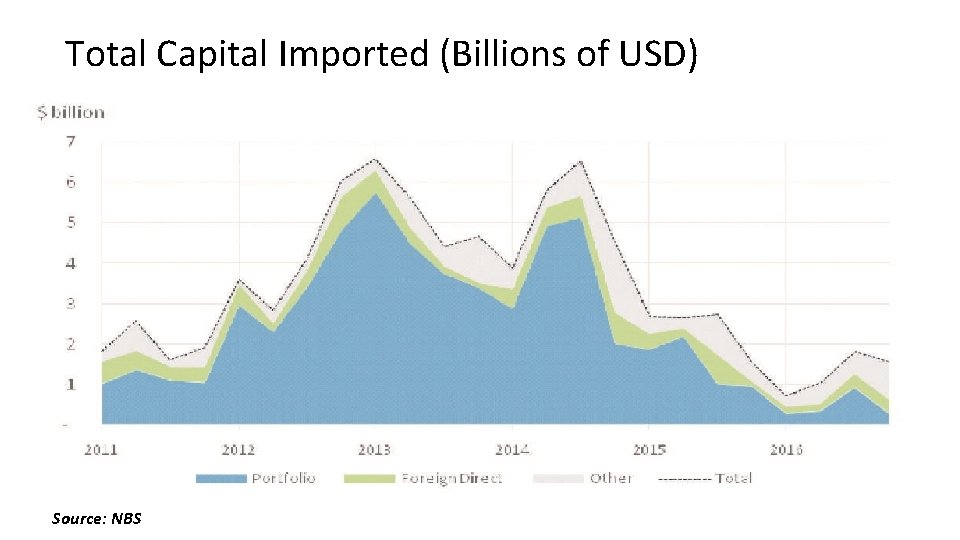
Total Capital Imported (Billions of USD) Source: NBS
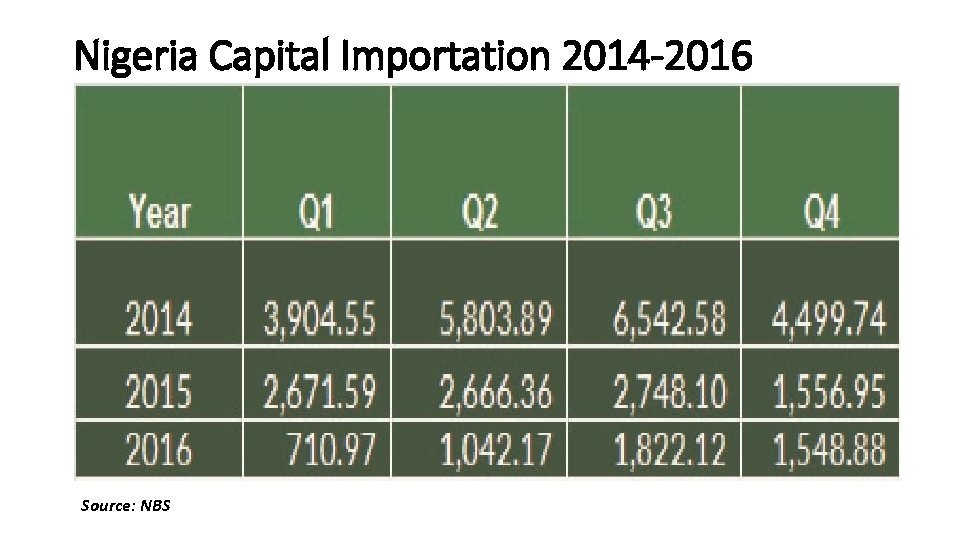
Nigeria Capital Importation 2014 -2016 Source: NBS
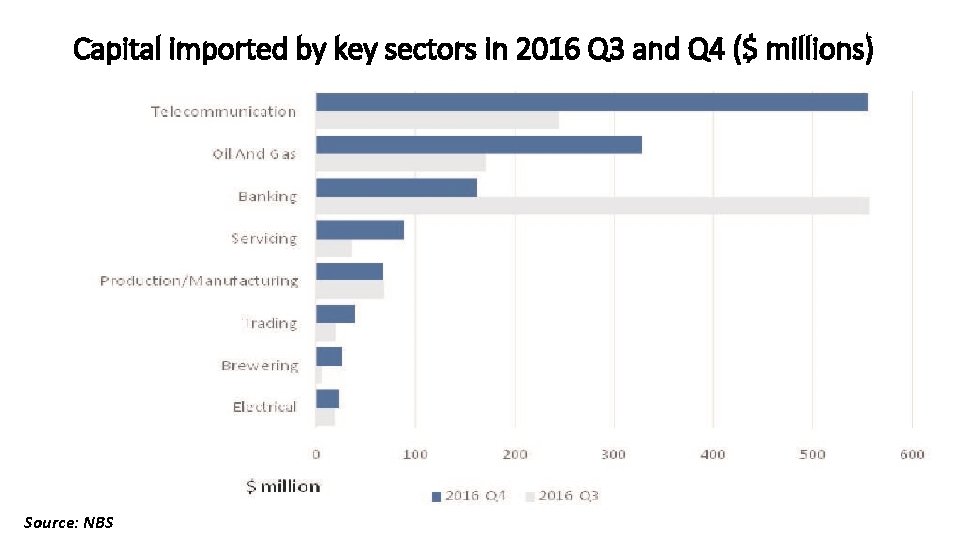
Capital imported by key sectors in 2016 Q 3 and Q 4 ($ millions) Source: NBS
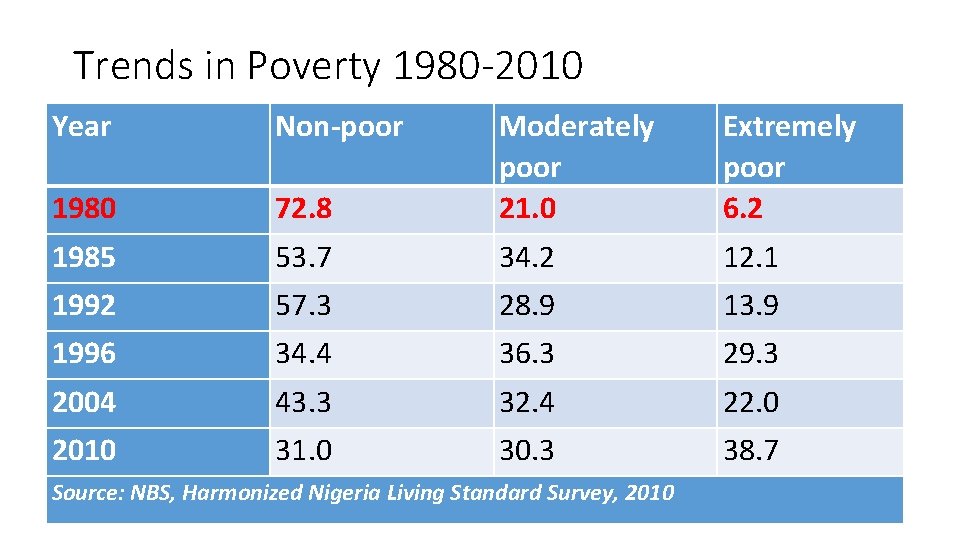
Trends in Poverty 1980 -2010 Year Non-poor 72. 8 Moderately poor 21. 0 Extremely poor 6. 2 1980 1985 53. 7 34. 2 12. 1 1992 57. 3 28. 9 13. 9 1996 34. 4 36. 3 29. 3 2004 43. 3 32. 4 22. 0 2010 31. 0 30. 3 38. 7 Source: NBS, Harmonized Nigeria Living Standard Survey, 2010
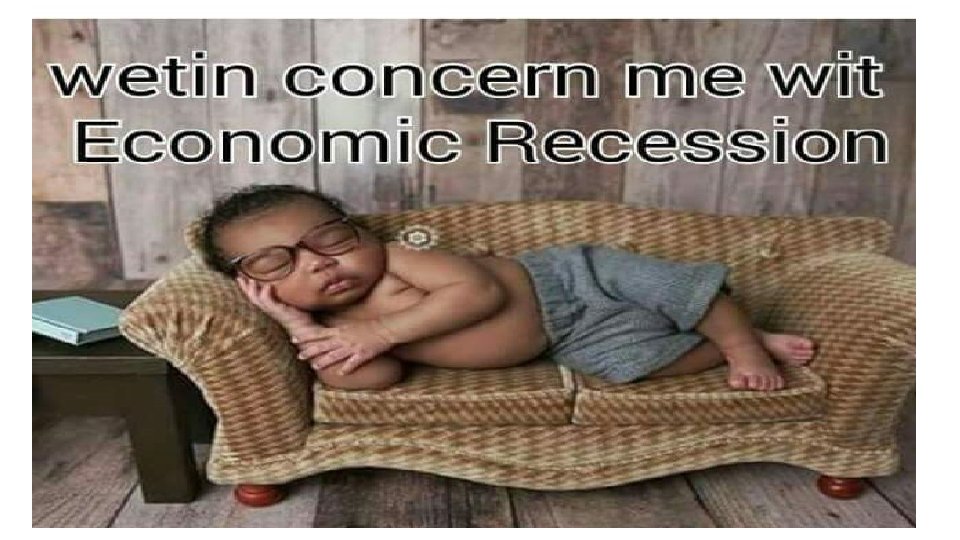
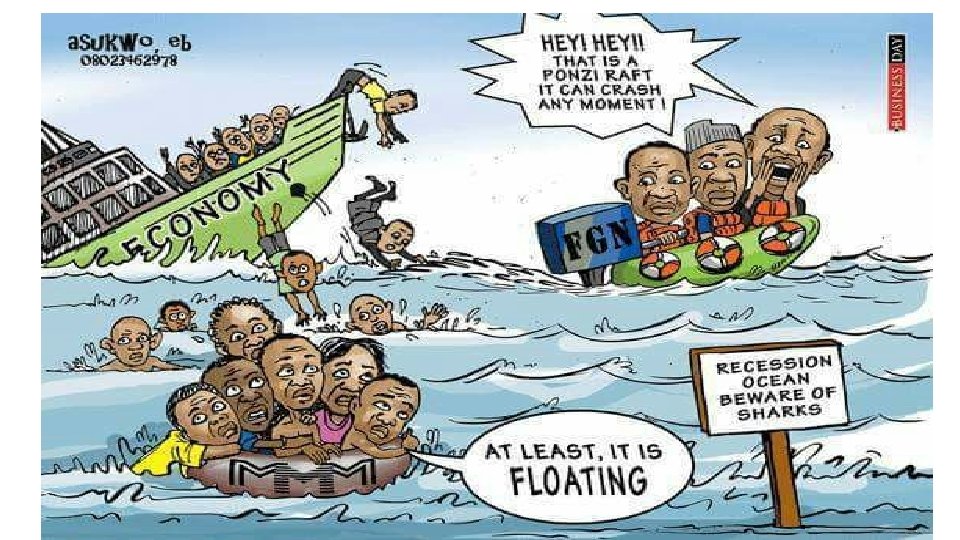
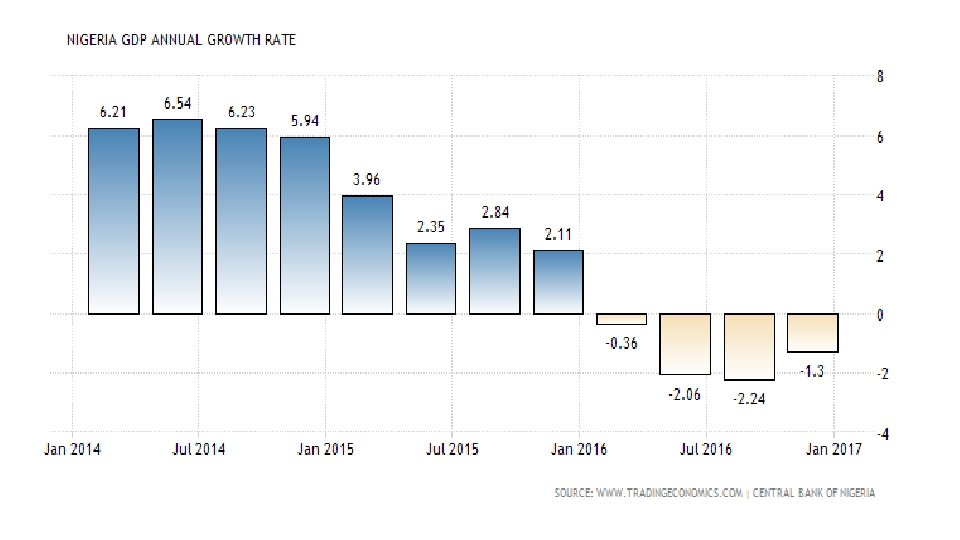
Results and some causes • The National Bureau of Statistics (NBS) confirmed that Nigeria is in its worst economic recession in 29 years • DOMESTIC FACTORS (The Nigerian Monitor) • Inability of the previous administration to save. • Nigeria’s over-dependence on foreign products. • Economic policies of the present administration • The delay and controversies of the 2016 and 2017 budgets • The activities of militants and pipeline vandals • The existence of wasteful and abuse-prone subsidies • The different actions (or inactions) of the Central Bank of Nigeria (CBN) in forestalling recession. • EXTERNAL FACTORS
Outlook for the Economic Recovery and Growth Plan (ERGP) – By 2020 • Stable Macroeconomic Environment • Restoration of Growth • Agricultural transformation and food security • Power and petroleum products sufficiency • Industrialized Economy • Job Creation and youth empowerment • Improved Foreign Exchange Inflows • The dance tune is yet to change. What next?
Policy Recommendations: Where Budgets Come in • Budget is foundational; financial statement of the policy direction • Balancing expenditure on social and real sectors • Social sector does not bring the resources; Real sector does! • But social sector is often the most visible ‘democracy dividends’ • So the need to balance that visibility with silent but sustainable transformative plan for real sector • Setting standards in each of health and education; even if government wants to be a partial player which should not be the case.
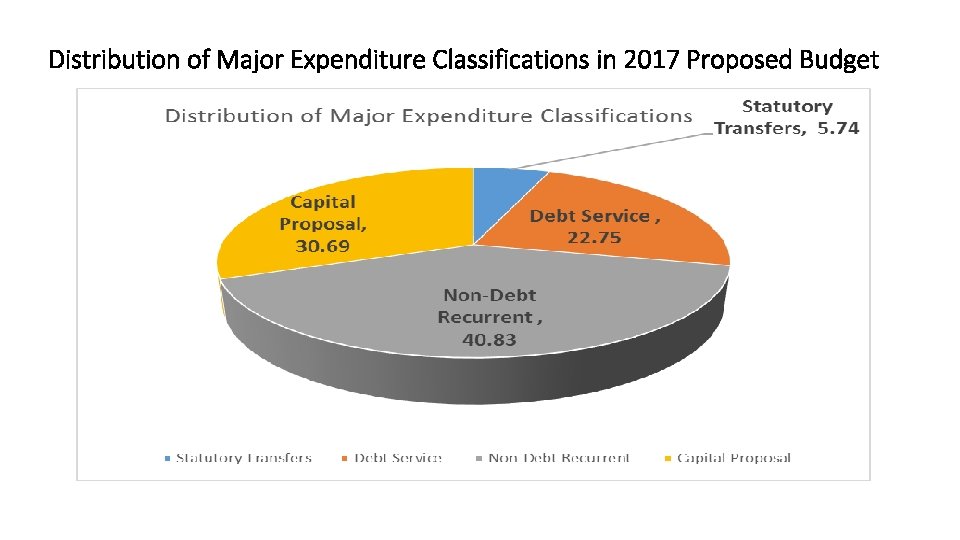
Distribution of Major Expenditure Classifications in 2017 Proposed Budget
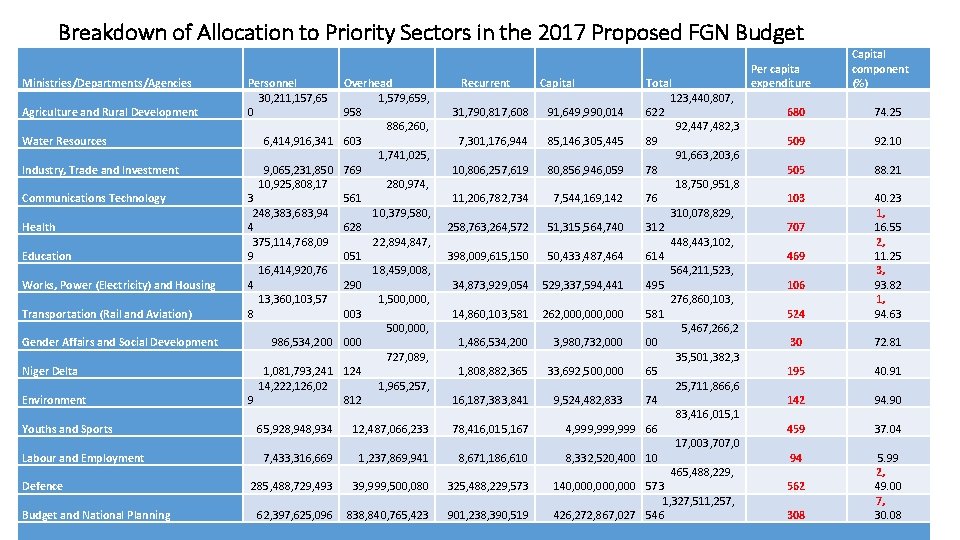
Breakdown of Allocation to Priority Sectors in the 2017 Proposed FGN Budget Ministries/Departments/Agencies Agriculture and Rural Development Personnel 30, 211, 157, 65 0 Water Resources 6, 414, 916, 341 Industry, Trade and Investment Communications Technology Health Education Works, Power (Electricity) and Housing Transportation (Rail and Aviation) 9, 065, 231, 850 10, 925, 808, 17 3 248, 383, 683, 94 4 375, 114, 768, 09 9 16, 414, 920, 76 4 13, 360, 103, 57 8 Gender Affairs and Social Development 986, 534, 200 Niger Delta Environment Youths and Sports Labour and Employment Defence Budget and National Planning 9 1, 081, 793, 241 14, 222, 126, 02 Overhead 1, 579, 659, 958 886, 260, 603 1, 741, 025, 769 280, 974, 561 10, 379, 580, 628 22, 894, 847, 051 18, 459, 008, 290 1, 500, 003 500, 000 727, 089, 124 1, 965, 257, 812 Recurrent Capital 31, 790, 817, 608 91, 649, 990, 014 7, 301, 176, 944 85, 146, 305, 445 10, 806, 257, 619 80, 856, 946, 059 11, 206, 782, 734 7, 544, 169, 142 258, 763, 264, 572 51, 315, 564, 740 398, 009, 615, 150 50, 433, 487, 464 34, 873, 929, 054 529, 337, 594, 441 14, 860, 103, 581 262, 000, 000 1, 486, 534, 200 3, 980, 732, 000 1, 808, 882, 365 33, 692, 500, 000 16, 187, 383, 841 9, 524, 482, 833 65, 928, 948, 934 12, 487, 066, 233 78, 416, 015, 167 4, 999, 999 7, 433, 316, 669 1, 237, 869, 941 8, 671, 186, 610 8, 332, 520, 400 285, 488, 729, 493 39, 999, 500, 080 325, 488, 229, 573 140, 000, 000 62, 397, 625, 096 838, 840, 765, 423 901, 238, 390, 519 426, 272, 867, 027 Per capita Total expenditure 123, 440, 807, 622 680 92, 447, 482, 3 89 509 91, 663, 203, 6 78 505 18, 750, 951, 8 76 103 310, 078, 829, 312 707 448, 443, 102, 614 469 564, 211, 523, 495 106 276, 860, 103, 581 524 5, 467, 266, 2 00 30 35, 501, 382, 3 65 195 25, 711, 866, 6 74 142 83, 416, 015, 1 66 459 17, 003, 707, 0 10 94 465, 488, 229, 573 562 1, 327, 511, 257, 546 308 Capital component (%) 74. 25 92. 10 88. 21 40. 23 1, 16. 55 2, 11. 25 3, 93. 82 1, 94. 63 72. 81 40. 91 94. 90 37. 04 5. 99 2, 49. 00 7, 30. 08
Expectations!!! • Think through this porous and baseless plan (ERGP) • Spend less on consumables and recurrent (almost 70% in 2017 FGN proposed budget) • Underlying philosophy – Government at all levels does not give jobs; it creates jobs – The SA, SSA, PA, SPA are hurting the masses • Average Nigerian especially from the South East are enterprising enough – Let’s tap from this entrepreneurship

Comments; Questions and Clarifications…
- Slides: 27