
Nicotine Chapter 7 History of Tobacco Nicotine Smoking
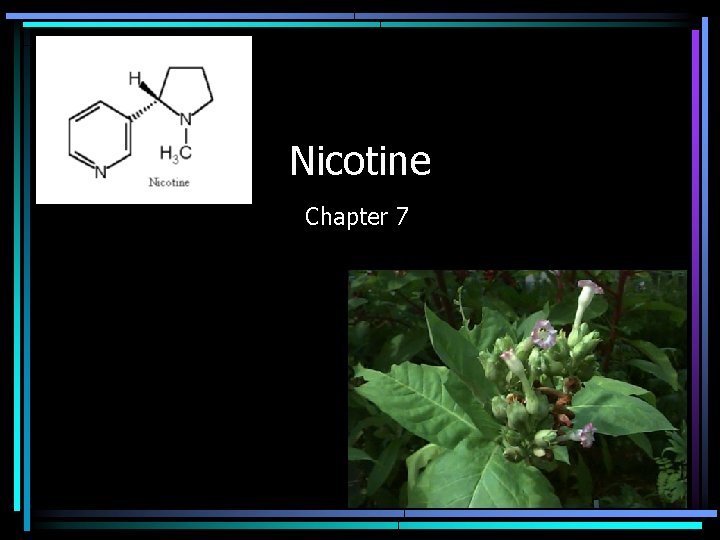
Nicotine Chapter 7
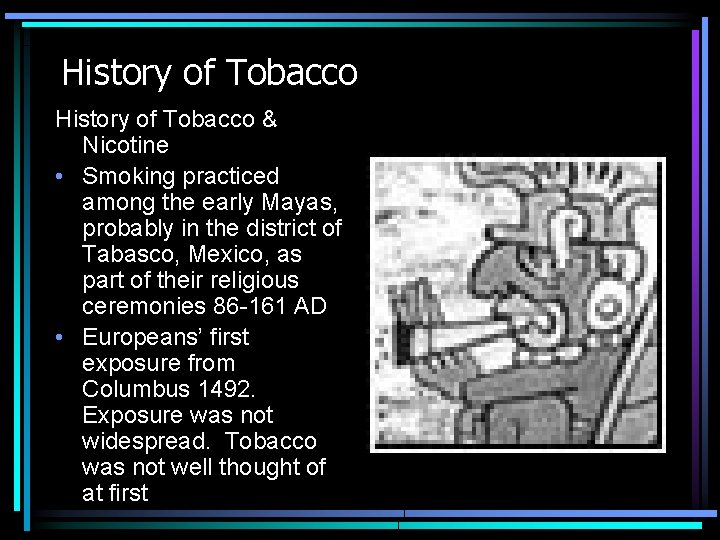
History of Tobacco & Nicotine • Smoking practiced among the early Mayas, probably in the district of Tabasco, Mexico, as part of their religious ceremonies 86 -161 AD • Europeans’ first exposure from Columbus 1492. Exposure was not widespread. Tobacco was not well thought of at first
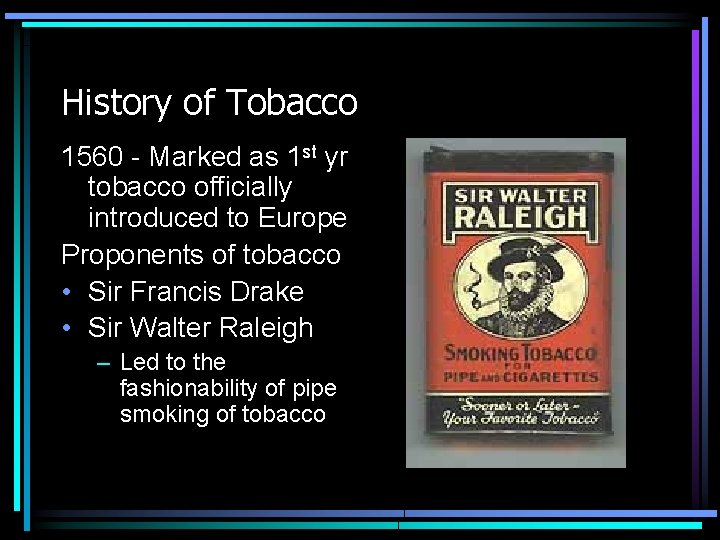
History of Tobacco 1560 - Marked as 1 st yr tobacco officially introduced to Europe Proponents of tobacco • Sir Francis Drake • Sir Walter Raleigh – Led to the fashionability of pipe smoking of tobacco
History of Tobacco King James I of England • 1604 - Pamphlet condemning tobacco – “bewitching of tobacco” Early 1700 s Russia – “Westernization” of people – penalties for smoking (torture, Siberian exile, death)
History of Tobacco By 17 th century • Tobacco here to stay – In Western Europe, used as treatment for migraines – Japan & China stop enforcing prohibition of use – Russia opens door to West – Sultan of Turkey begins to smoke

History of Tobacco • 1828 - Nicotine was isolated • Cigarettes first appeared in 1850 s, but chewing still more popular
Tobacco & Nicotine In US • In U. S. , tobacco became major commodity in early 1600 s, used as currency • Financed Revolutionary War – Ben Franklin promised Virginia's tobacco to France – Had it not been for tobacco, no French assistance & no USA
Tobacco Use in 20 th Century Future favored cigarettes over other usage • New emphasis on social manners • Public health issues of infectious disease – decrease in chewing except in small rural towns of U. S. • Women began smoking – But, 1904 NYC woman arrested for smoking in public • 1920 s - “reach for a Lucky instead of a sweet” – Promoted weight loss effects • Also cigarettes in WWI
Tobacco & Nicotine In US • 1890 s - no medicinal value for nicotine – dropped from U. S. pharmacopia • 1925 - 14 states banned smoking • 1938 - study linking cigarettes & lung cancer • 1954 - more stats relating smoking to lung cancer & cardiovascular disease • 1964 - first Surgeon General's report – advised smoking shortens life expectancy • 1986 - Surgeon General's report on passive smoking • Use continued to decline over past twenty years • 2000 – Worldwide consumption still on increase

Nicotine Forms • Tobacco – Smokeable • Cigarette • Pipe • Cigar – Leaf (Chewing) – Leaf (Dip) – Snuff (powdered) • Transdermal Patch
Snuff • Grind tobacco into fine powder • Pinch into nose & exhale with sneeze (cleared head of “superfluous humours”) • 1700 s – snuff overtook smoking as method of choice – Started in France & spread through rest of Europe
Chewing In U. S. , snuffing replaced by chewing • Freed hands for working • Low cost - democratic custom all could have • “spitting” seen as nasty habit, also health issue – Major cause of spread of infectious disease (TB)
Cigar Smoking • Tight rolls of tobacco leaves • Flue-curing - process of heating tobacco leaves – to cure them, makes milder smoke • Also new type of leaf – North Carolina #1 tobacco-growing center • Mixed effects of chewing with ingestion of smoke
Cigarettes • Rolls of shredded tobacco wrapped in paper • 1614 – Invented by beggars in Seville, Spain from scrap of cigars • 1856 - Became popular with English soldiers in Crimean War - Spread throughout Europe U. S, not inclined to use it – Public image – Rumors of opium, arsenic laced paper, & camel dung, – Also image: cigarette - dainty & “sissy” vs. cigars - fat, long & dark
Cigarettes 1881 - James Bonsack patented cigarettemaking machine • Made cigarettes even more low-cost • Revolutionized tobacco industry - From 300 cigarettes per hour by hand to 3 machines producing 200 cigarettes per minute
Cigarette Smoking Nicotine in a cigarette – 8 to 10 mg Smoking – delivers about 1 -3 mg to the smoker Technique of smoker can increase nicotine (time smoke is in lungs, rapid puffing)
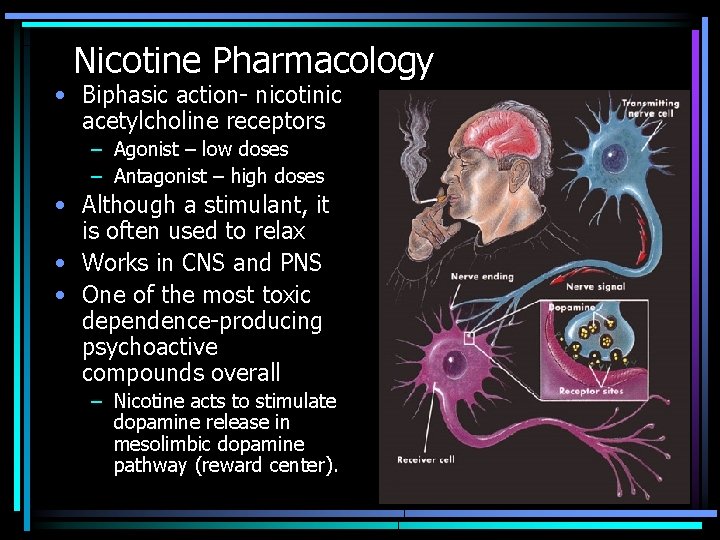
Nicotine Pharmacology • Biphasic action- nicotinic acetylcholine receptors – Agonist – low doses – Antagonist – high doses • Although a stimulant, it is often used to relax • Works in CNS and PNS • One of the most toxic dependence-producing psychoactive compounds overall – Nicotine acts to stimulate dopamine release in mesolimbic dopamine pathway (reward center).
Nicotine Pharmacology • One of most powerful poisons ingested by Americans – LD 50 60 mg • • Can't happen via inhalation Orally, two protections against death 1. quick first pass metabolism through liver 2. activation of vomiting center
Peripheral Effects • A sympathomimetic – Increases heart rate, blood pressure, respiration • A parasympathomimetic – Increases smooth muscle (GI tract) activity – Increases HCL production in stomach
Central Effects • Arousal • Improves vigilance & rapid information processing • Improves mental performance & memory • Stimulates adrenalin and ADH release • Nicotine may reverse some deficits caused by alcohol
Biotransformation/Excretion • Broken down by lung and liver – >90% in liver • Metabolization of nicotine and other toxins in cigarette smoking lowers blood levels of many important drugs. • Excreted through kidneys (urine) • Lungs do some excretion
Tolerance • Develops rapidly – Within the first exposure for some effects • Area Postrema – Can build up and dissipate over the course of a day – Chronic tolerance happens as well • Dispositional Tolerance – Some smokers clear nicotine faster
Dependence • One of the most dependence-producing drugs – Pharmacology – Stimulates reward center influences ANS – Function – Weight control, coping with negative affect/stress, cognitive enhancement – Social Factors – Friends, habit, context
Withdrawal Symptoms of Nicotine • • • Lethargy, decreased arousal Constipation Headaches Disrupted sleep cycles Irritability/anxiety Excessive hunger (blood sugar drop)
Compounds in Tobacco • Tar - sticky substance – Amount varies from 12 - 16 mg to 6 mg – Last 3 rd of cigarette contains 50% of tar (final puffs more hazardous) – Prevents cilia from working, decreases cilia escalator – Increases carcinogens compounds to settle on tissue rather than being expelled
Compounds in Tobacco Carbon Monoxide • Odorless & tasteless, but extremely toxic • Attaches to hemoglobin – Hemoglobin has greater affinity for CO than oxygen • Accumulation of CO occurs • Leads to asphyxiation of body
Health Effects of Nicotine Addiction • Cardiovascular Disease – Most likely killer • Cancer – Approx 90% of all lung cancer • Chronic Obstructive Pulmonary Disease – All long-term smokers get some level of COPD – Emphysema most serious
Approaches to Treatment • Self-help • Behavioral intervention • Pharmacotherapy • Combined strategies
Nicotine Replacement • Nicotine gum • Transdermal nicotine • Nicotine aerosols
Pharmacotherapy • Clonidine • SSRIs • Zyban
Quitting Overall • Combination of strategies works best • Behavioral + replacement + pharmacotherapy • Quitting reduces risk of all-cause mortality among other diseases • Risk of lung cancer remains elevated but drops significantly
- Slides: 31