
Nicolas Guy Brenet Sleeping Endymion 1756 Endymion Selene
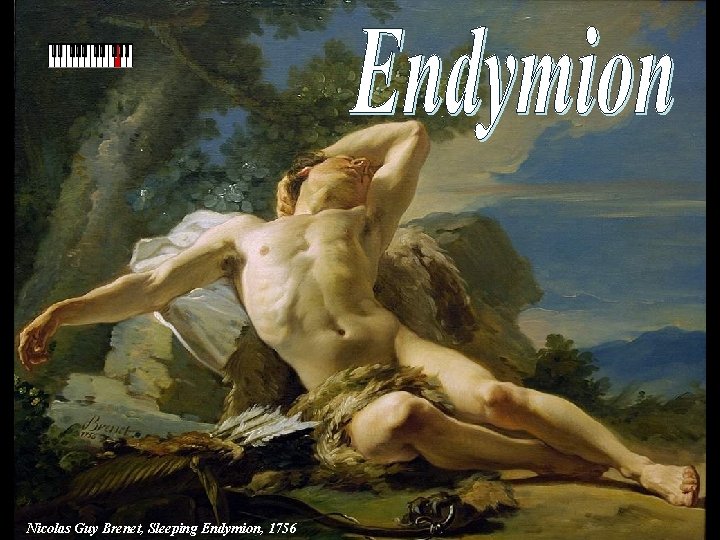
Nicolas Guy Brenet, Sleeping Endymion, 1756
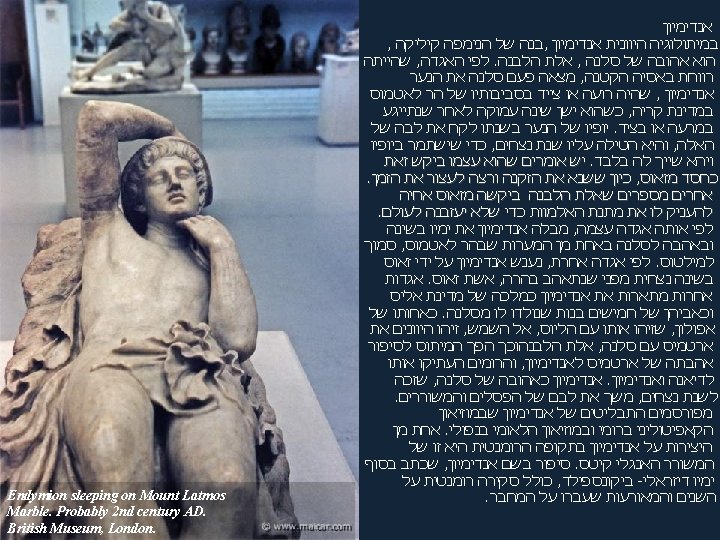
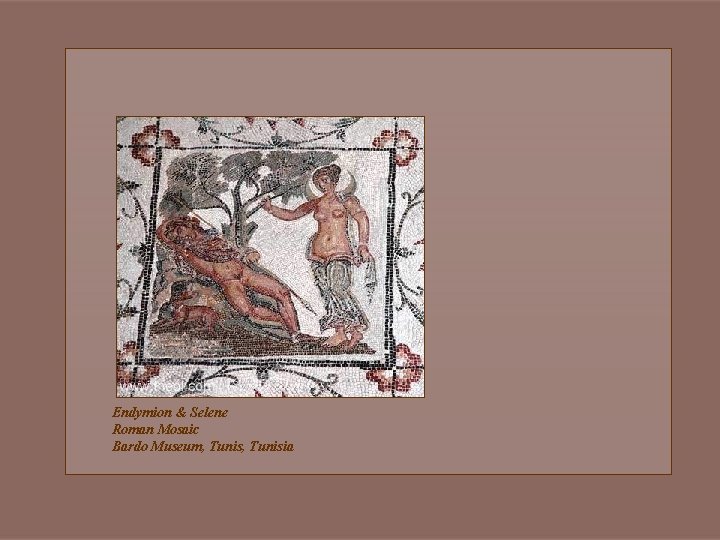
Endymion & Selene Roman Mosaic Bardo Museum, Tunisia
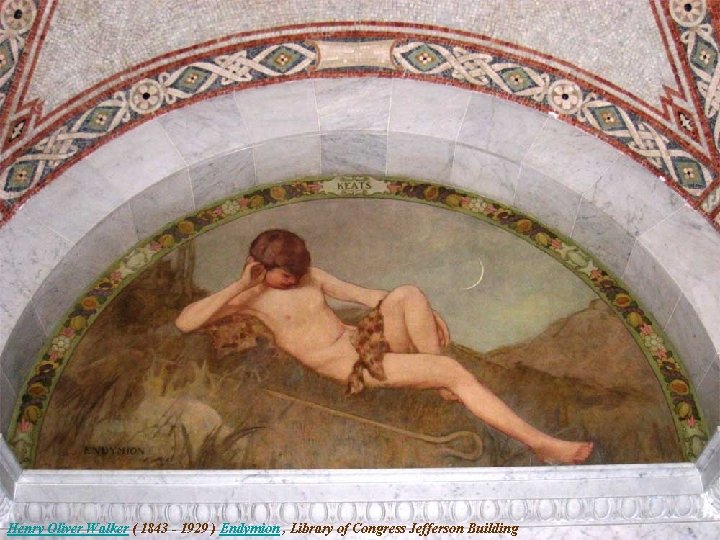
Henry Oliver Walker ( 1843 - 1929 ) Endymion , Library of Congress Jefferson Building
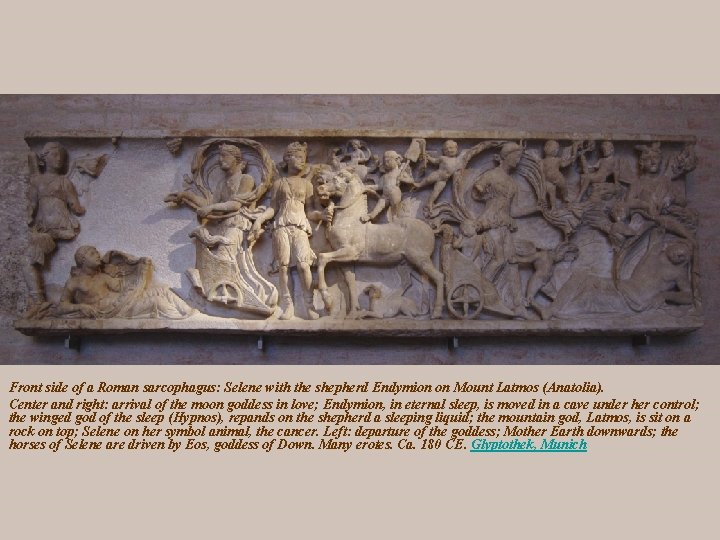
Front side of a Roman sarcophagus: Selene with the shepherd Endymion on Mount Latmos (Anatolia). Center and right: arrival of the moon goddess in love; Endymion, in eternal sleep, is moved in a cave under her control; the winged god of the sleep (Hypnos), repands on the shepherd a sleeping liquid; the mountain god, Latmos, is sit on a rock on top; Selene on her symbol animal, the cancer. Left: departure of the goddess; Mother Earth downwards; the horses of Selene are driven by Eos, goddess of Down. Many erotes. Ca. 180 CE. Glyptothek, Munich
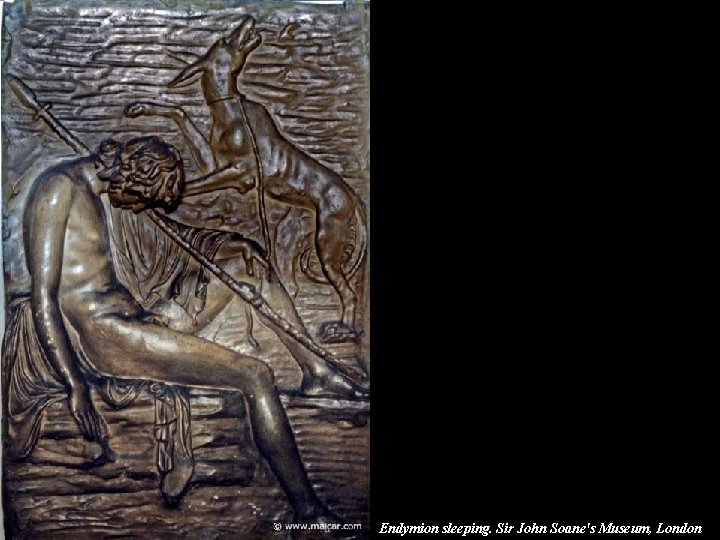
Endymion sleeping. Sir John Soane's Museum, London
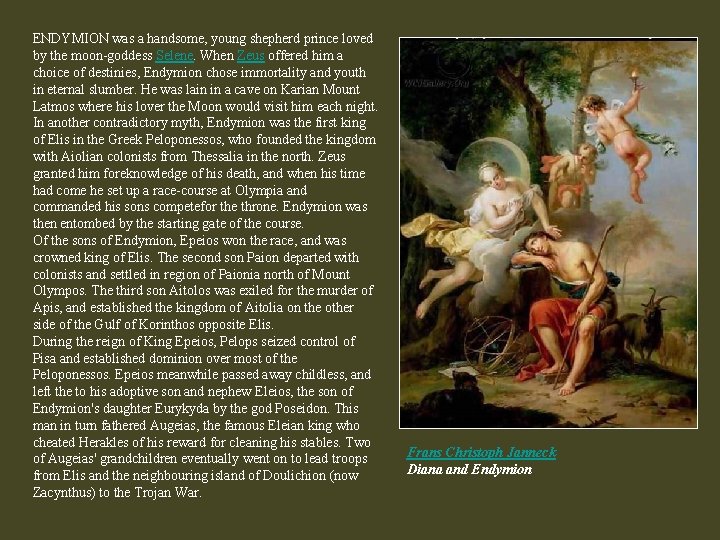
ENDYMION was a handsome, young shepherd prince loved by the moon-goddess Selene. When Zeus offered him a choice of destinies, Endymion chose immortality and youth in eternal slumber. He was lain in a cave on Karian Mount Latmos where his lover the Moon would visit him each night. In another contradictory myth, Endymion was the first king of Elis in the Greek Peloponessos, who founded the kingdom with Aiolian colonists from Thessalia in the north. Zeus granted him foreknowledge of his death, and when his time had come he set up a race-course at Olympia and commanded his sons competefor the throne. Endymion was then entombed by the starting gate of the course. Of the sons of Endymion, Epeios won the race, and was crowned king of Elis. The second son Paion departed with colonists and settled in region of Paionia north of Mount Olympos. The third son Aitolos was exiled for the murder of Apis, and established the kingdom of Aitolia on the other side of the Gulf of Korinthos opposite Elis. During the reign of King Epeios, Pelops seized control of Pisa and established dominion over most of the Peloponessos. Epeios meanwhile passed away childless, and left the to his adoptive son and nephew Eleios, the son of Endymion's daughter Eurykyda by the god Poseidon. This man in turn fathered Augeias, the famous Eleian king who cheated Herakles of his reward for cleaning his stables. Two of Augeias' grandchildren eventually went on to lead troops from Elis and the neighbouring island of Doulichion (now Zacynthus) to the Trojan War. Frans Christoph Janneck Diana and Endymion
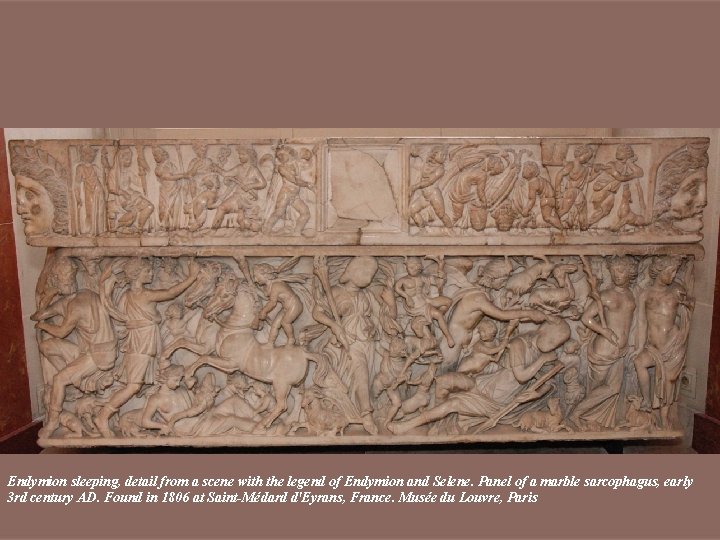
Endymion sleeping, detail from a scene with the legend of Endymion and Selene. Panel of a marble sarcophagus, early 3 rd century AD. Found in 1806 at Saint-Médard d'Eyrans, France. Musée du Louvre, Paris
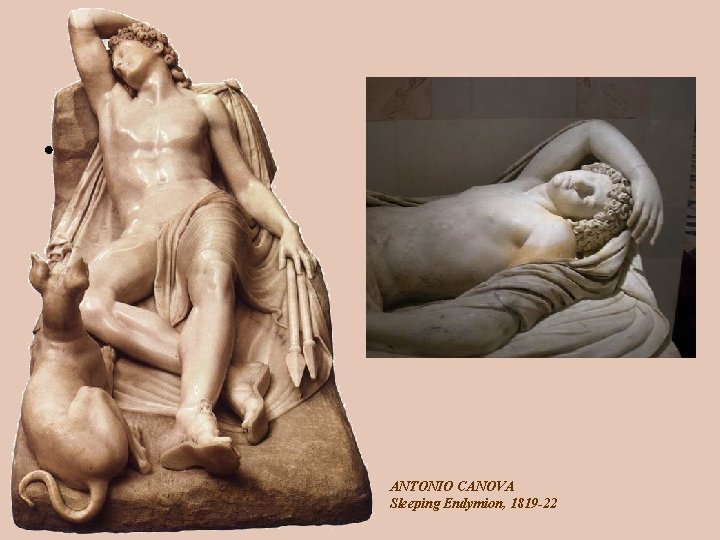
• ANTONIO CANOVA Sleeping Endymion, 1819 -22
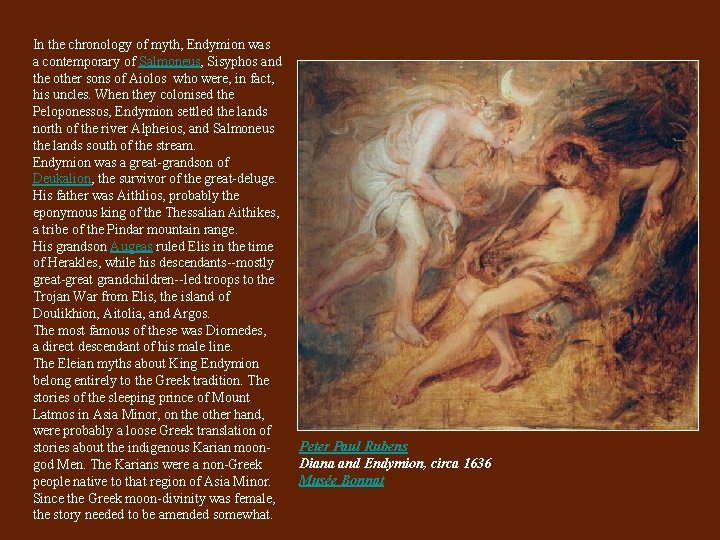
In the chronology of myth, Endymion was a contemporary of Salmoneus, Sisyphos and the other sons of Aiolos who were, in fact, his uncles. When they colonised the Peloponessos, Endymion settled the lands north of the river Alpheios, and Salmoneus the lands south of the stream. Endymion was a great-grandson of Deukalion, the survivor of the great-deluge. His father was Aithlios, probably the eponymous king of the Thessalian Aithikes, a tribe of the Pindar mountain range. His grandson Augeas ruled Elis in the time of Herakles, while his descendants--mostly great-great grandchildren--led troops to the Trojan War from Elis, the island of Doulikhion, Aitolia, and Argos. The most famous of these was Diomedes, a direct descendant of his male line. The Eleian myths about King Endymion belong entirely to the Greek tradition. The stories of the sleeping prince of Mount Latmos in Asia Minor, on the other hand, were probably a loose Greek translation of stories about the indigenous Karian moongod Men. The Karians were a non-Greek people native to that region of Asia Minor. Since the Greek moon-divinity was female, the story needed to be amended somewhat. Peter Paul Rubens Diana and Endymion, circa 1636 Musée Bonnat
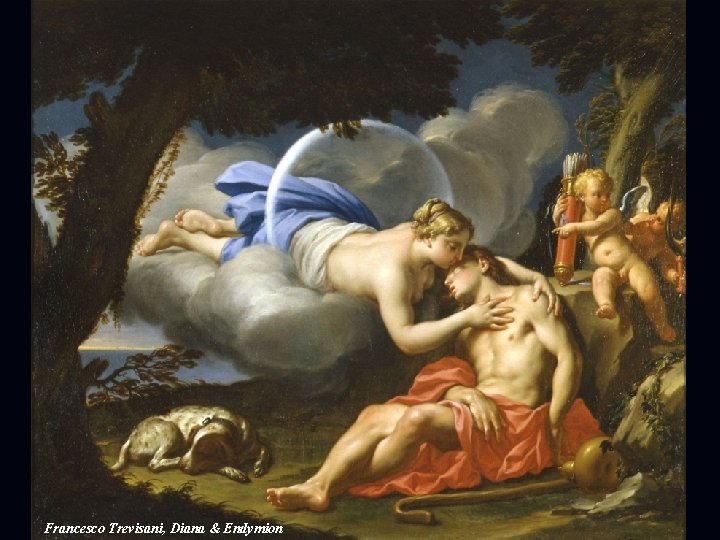
Francesco Trevisani, Diana & Endymion
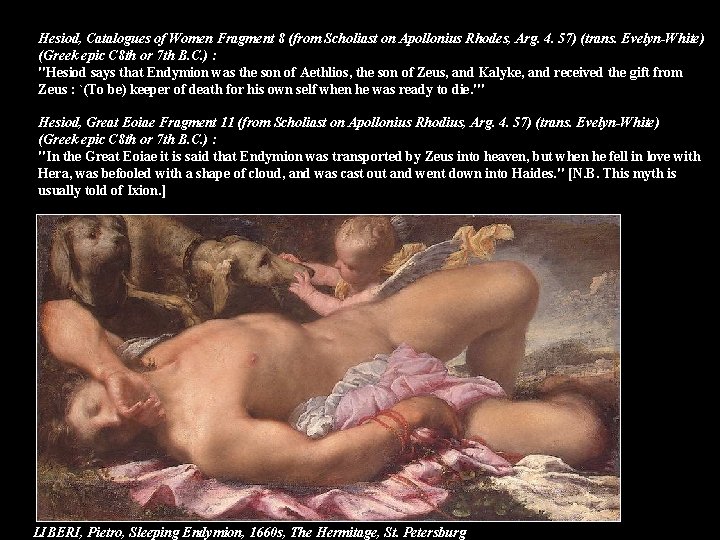
Hesiod, Catalogues of Women Fragment 8 (from Scholiast on Apollonius Rhodes, Arg. 4. 57) (trans. Evelyn-White) (Greek epic C 8 th or 7 th B. C. ) : "Hesiod says that Endymion was the son of Aethlios, the son of Zeus, and Kalyke, and received the gift from Zeus : `(To be) keeper of death for his own self when he was ready to die. '" Hesiod, Great Eoiae Fragment 11 (from Scholiast on Apollonius Rhodius, Arg. 4. 57) (trans. Evelyn-White) (Greek epic C 8 th or 7 th B. C. ) : "In the Great Eoiae it is said that Endymion was transported by Zeus into heaven, but when he fell in love with Hera, was befooled with a shape of cloud, and was cast out and went down into Haides. " [N. B. This myth is usually told of Ixion. ] LIBERI, Pietro, Sleeping Endymion, 1660 s, The Hermitage, St. Petersburg

Paolo Andrea Triscorni, Selene and Endymion , The Hermitage, St. Petersburg
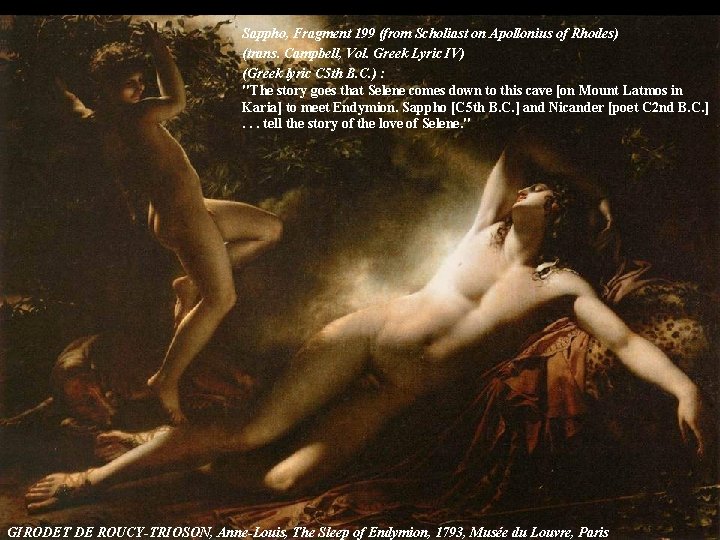
Sappho, Fragment 199 (from Scholiast on Apollonius of Rhodes) (trans. Campbell, Vol. Greek Lyric IV) (Greek lyric C 5 th B. C. ) : "The story goes that Selene comes down to this cave [on Mount Latmos in Karia] to meet Endymion. Sappho [C 5 th B. C. ] and Nicander [poet C 2 nd B. C. ]. . . tell the story of the love of Selene. " GIRODET DE ROUCY-TRIOSON, Anne-Louis, The Sleep of Endymion, 1793, Musée du Louvre, Paris
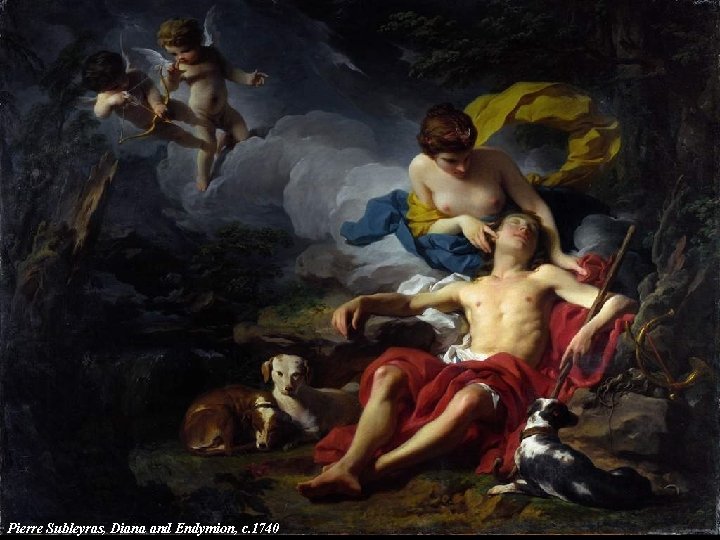
Pierre Subleyras, Diana and Endymion, c. 1740
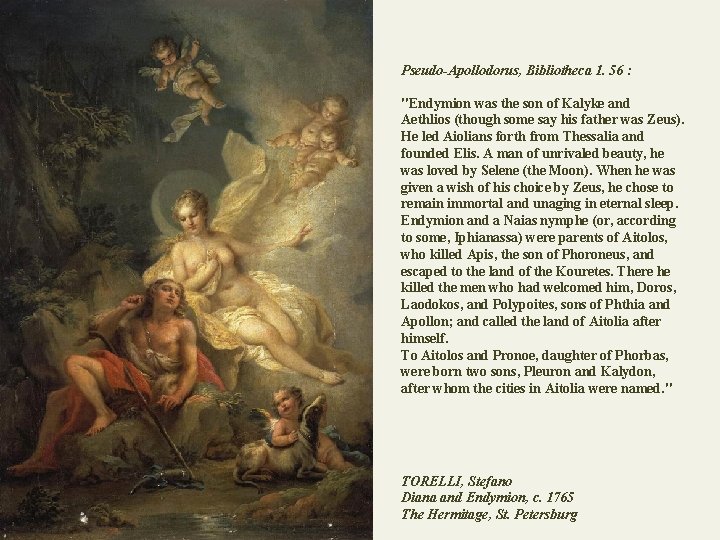
Pseudo-Apollodorus, Bibliotheca 1. 56 : "Endymion was the son of Kalyke and Aethlios (though some say his father was Zeus). He led Aiolians forth from Thessalia and founded Elis. A man of unrivaled beauty, he was loved by Selene (the Moon). When he was given a wish of his choice by Zeus, he chose to remain immortal and unaging in eternal sleep. Endymion and a Naias nymphe (or, according to some, Iphianassa) were parents of Aitolos, who killed Apis, the son of Phoroneus, and escaped to the land of the Kouretes. There he killed the men who had welcomed him, Doros, Laodokos, and Polypoites, sons of Phthia and Apollon; and called the land of Aitolia after himself. To Aitolos and Pronoe, daughter of Phorbas, were born two sons, Pleuron and Kalydon, after whom the cities in Aitolia were named. " TORELLI, Stefano Diana and Endymion, c. 1765 The Hermitage, St. Petersburg
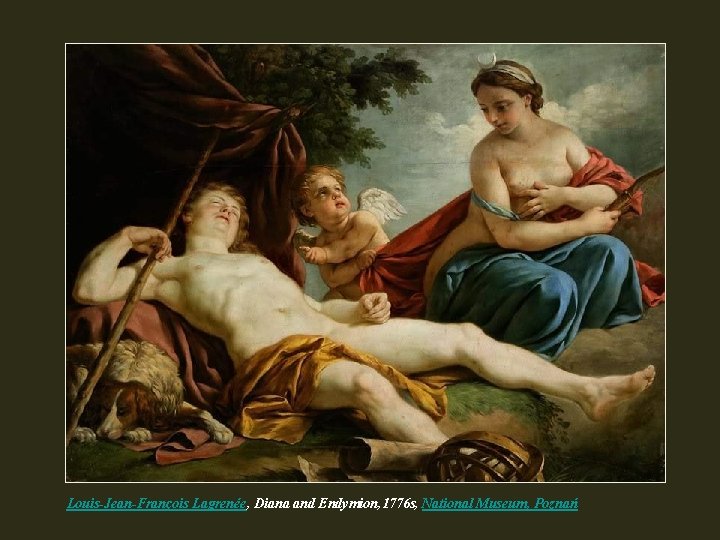
Louis-Jean-François Lagrenée, Diana and Endymion, 1776 s, National Museum, Poznań
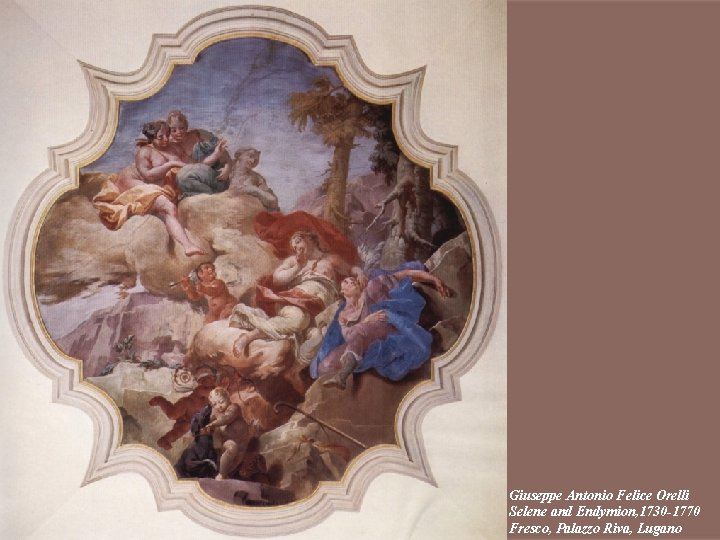
Giuseppe Antonio Felice Orelli Selene and Endymion, 1730 -1770 Fresco, Palazzo Riva, Lugano
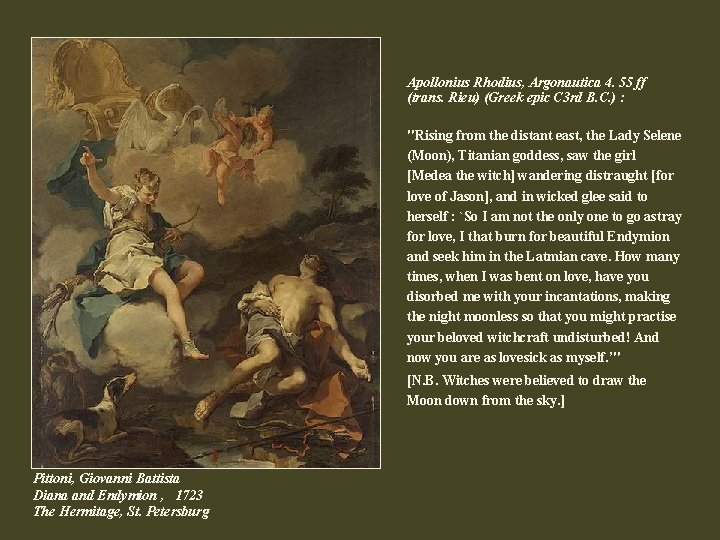
Apollonius Rhodius, Argonautica 4. 55 ff (trans. Rieu) (Greek epic C 3 rd B. C. ) : "Rising from the distant east, the Lady Selene (Moon), Titanian goddess, saw the girl [Medea the witch] wandering distraught [for love of Jason], and in wicked glee said to herself : `So I am not the only one to go astray for love, I that burn for beautiful Endymion and seek him in the Latmian cave. How many times, when I was bent on love, have you disorbed me with your incantations, making the night moonless so that you might practise your beloved witchcraft undisturbed! And now you are as lovesick as myself. ’" [N. B. Witches were believed to draw the Moon down from the sky. ] Pittoni, Giovanni Battista Diana and Endymion , 1723 The Hermitage, St. Petersburg

Walter Crane, Diana and Endymion, 1883
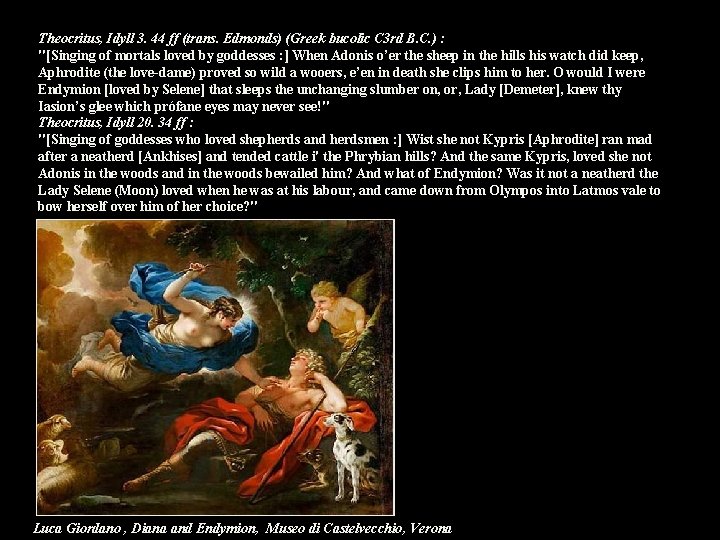
Theocritus, Idyll 3. 44 ff (trans. Edmonds) (Greek bucolic C 3 rd B. C. ) : "[Singing of mortals loved by goddesses : ] When Adonis o’er the sheep in the hills his watch did keep, Aphrodite (the love-dame) proved so wild a wooers, e’en in death she clips him to her. O would I were Endymion [loved by Selene] that sleeps the unchanging slumber on, or, Lady [Demeter], knew thy Iasion’s glee which prófane eyes may never see!" Theocritus, Idyll 20. 34 ff : "[Singing of goddesses who loved shepherds and herdsmen : ] Wist she not Kypris [Aphrodite] ran mad after a neatherd [Ankhises] and tended cattle i' the Phrybian hills? And the same Kypris, loved she not Adonis in the woods and in the woods bewailed him? And what of Endymion? Was it not a neatherd the Lady Selene (Moon) loved when he was at his labour, and came down from Olympos into Latmos vale to bow herself over him of her choice? " Luca Giordano , Diana and Endymion, Museo di Castelvecchio, Verona
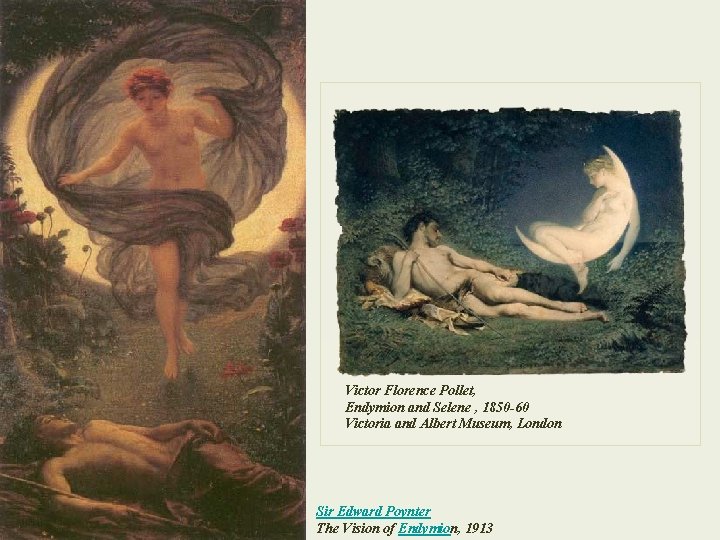
Victor Florence Pollet, Endymion and Selene , 1850 -60 Victoria and Albert Museum, London Sir Edward Poynter The Vision of Endymion, 1913
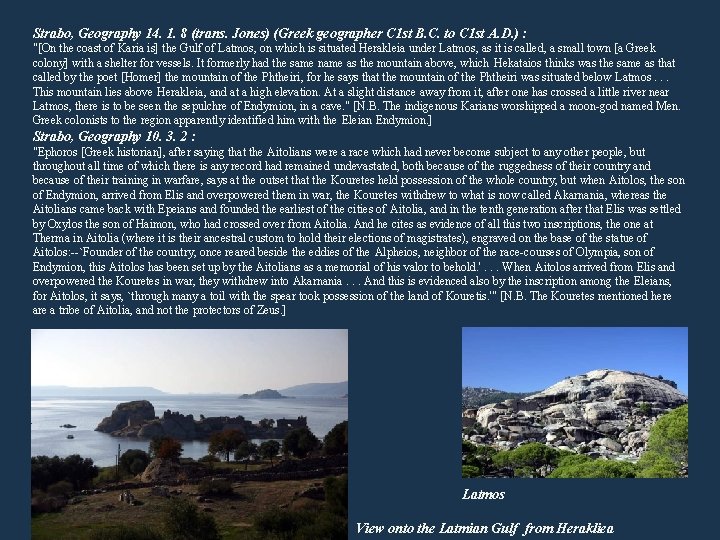
Strabo, Geography 14. 1. 8 (trans. Jones) (Greek geographer C 1 st B. C. to C 1 st A. D. ) : "[On the coast of Karia is] the Gulf of Latmos, on which is situated Herakleia under Latmos, as it is called, a small town [a Greek colony] with a shelter for vessels. It formerly had the same name as the mountain above, which Hekataios thinks was the same as that called by the poet [Homer] the mountain of the Phtheiri, for he says that the mountain of the Phtheiri was situated below Latmos. . . This mountain lies above Herakleia, and at a high elevation. At a slight distance away from it, after one has crossed a little river near Latmos, there is to be seen the sepulchre of Endymion, in a cave. " [N. B. The indigenous Karians worshipped a moon-god named Men. Greek colonists to the region apparently identified him with the Eleian Endymion. ] Strabo, Geography 10. 3. 2 : "Ephoros [Greek historian], after saying that the Aitolians were a race which had never become subject to any other people, but throughout all time of which there is any record had remained undevastated, both because of the ruggedness of their country and because of their training in warfare, says at the outset that the Kouretes held possession of the whole country, but when Aitolos, the son of Endymion, arrived from Elis and overpowered them in war, the Kouretes withdrew to what is now called Akarnania, whereas the Aitolians came back with Epeians and founded the earliest of the cities of Aitolia, and in the tenth generation after that Elis was settled by Oxylos the son of Haimon, who had crossed over from Aitolia. And he cites as evidence of all this two inscriptions, the one at Therma in Aitolia (where it is their ancestral custom to hold their elections of magistrates), engraved on the base of the statue of Aitolos: --`Founder of the country, once reared beside the eddies of the Alpheios, neighbor of the race-courses of Olympia, son of Endymion, this Aitolos has been set up by the Aitolians as a memorial of his valor to behold. '. . . When Aitolos arrived from Elis and overpowered the Kouretes in war, they withdrew into Akarnania. . . And this is evidenced also by the inscription among the Eleians, for Aitolos, it says, `through many a toil with the spear took possession of the land of Kouretis. '" [N. B. The Kouretes mentioned here a tribe of Aitolia, and not the protectors of Zeus. ] Latmos View onto the Latmian Gulf from Herakliea
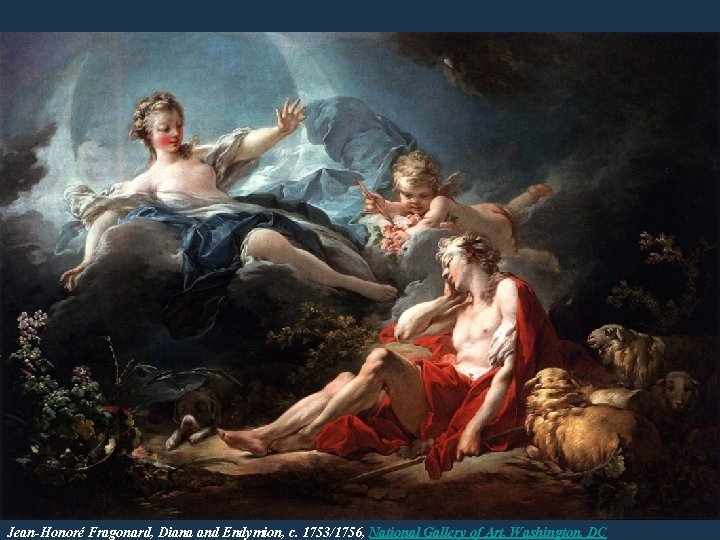
Jean-Honoré Fragonard, Diana and Endymion, c. 1753/1756, National Gallery of Art, Washington, DC
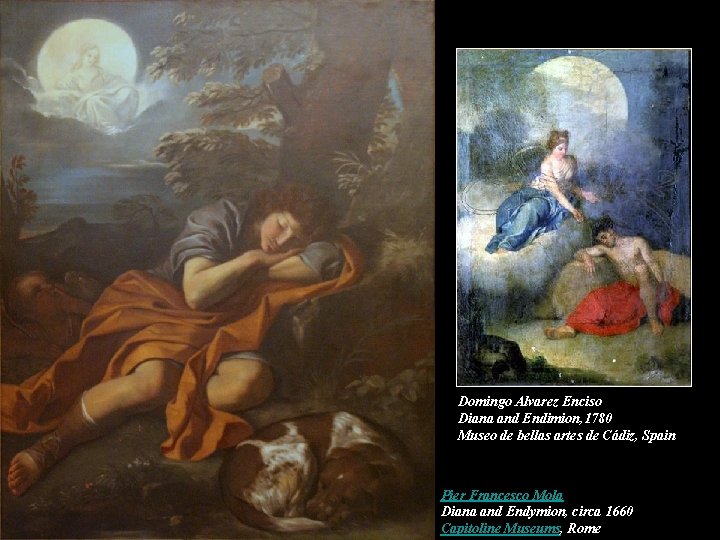
Domingo Alvarez Enciso Diana and Endimion, 1780 Museo de bellas artes de Cádiz, Spain Pier Francesco Mola Diana and Endymion, circa 1660 Capitoline Museums, Rome
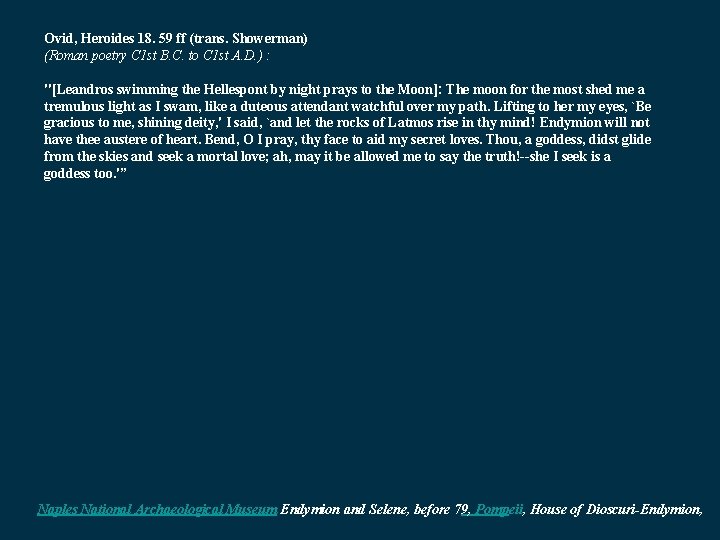
Ovid, Heroides 18. 59 ff (trans. Showerman) (Roman poetry C 1 st B. C. to C 1 st A. D. ) : "[Leandros swimming the Hellespont by night prays to the Moon]: The moon for the most shed me a tremulous light as I swam, like a duteous attendant watchful over my path. Lifting to her my eyes, `Be gracious to me, shining deity, ' I said, `and let the rocks of Latmos rise in thy mind! Endymion will not have thee austere of heart. Bend, O I pray, thy face to aid my secret loves. Thou, a goddess, didst glide from the skies and seek a mortal love; ah, may it be allowed me to say the truth!--she I seek is a goddess too. '” Naples National Archaeological Museum Endymion and Selene, before 79, Pompeii, House of Dioscuri-Endymion,
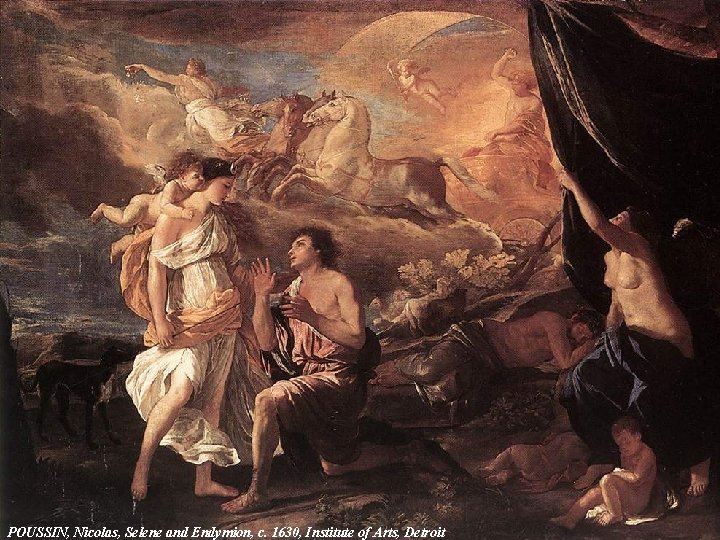
POUSSIN, Nicolas, Selene and Endymion, c. 1630, Institute of Arts, Detroit
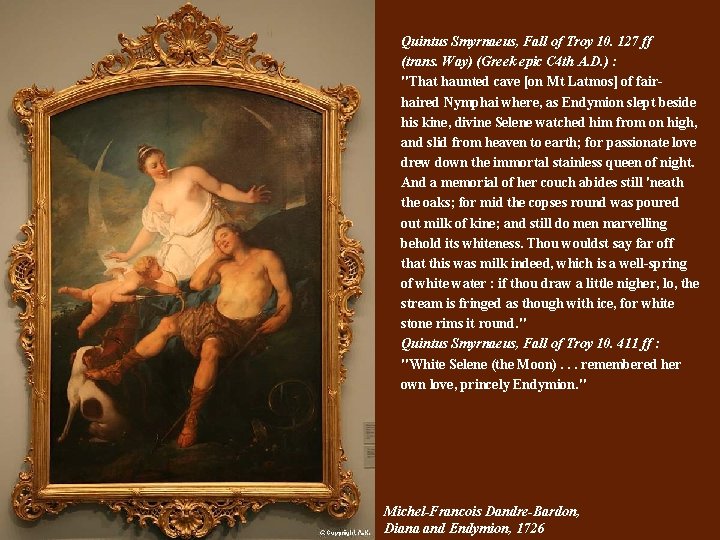
Quintus Smyrnaeus, Fall of Troy 10. 127 ff (trans. Way) (Greek epic C 4 th A. D. ) : "That haunted cave [on Mt Latmos] of fairhaired Nymphai where, as Endymion slept beside his kine, divine Selene watched him from on high, and slid from heaven to earth; for passionate love drew down the immortal stainless queen of night. And a memorial of her couch abides still 'neath the oaks; for mid the copses round was poured out milk of kine; and still do men marvelling behold its whiteness. Thou wouldst say far off that this was milk indeed, which is a well-spring of white water : if thou draw a little nigher, lo, the stream is fringed as though with ice, for white stone rims it round. " Quintus Smyrnaeus, Fall of Troy 10. 411 ff : "White Selene (the Moon). . . remembered her own love, princely Endymion. " Michel-Francois Dandre-Bardon, Diana and Endymion, 1726
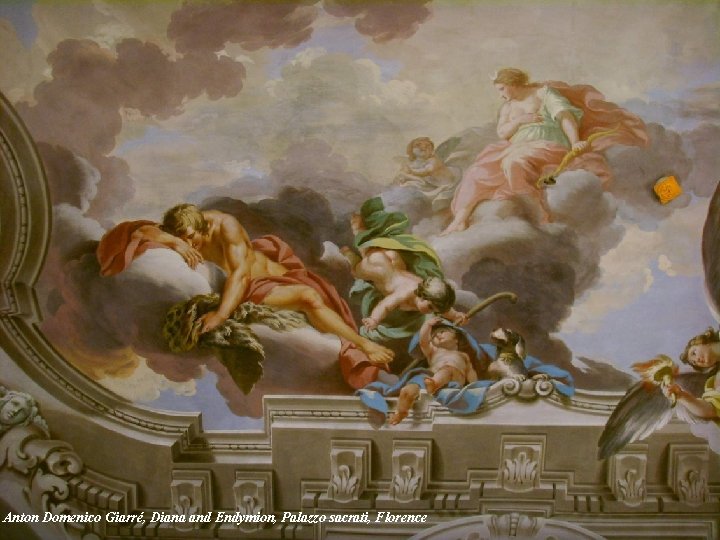
Anton Domenico Giarré, Diana and Endymion, Palazzo sacrati, Florence
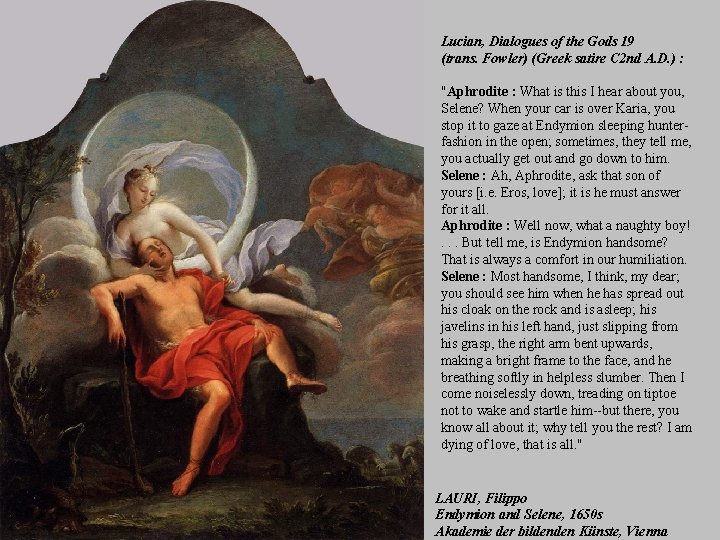
Lucian, Dialogues of the Gods 19 (trans. Fowler) (Greek satire C 2 nd A. D. ) : "Aphrodite : What is this I hear about you, Selene? When your car is over Karia, you stop it to gaze at Endymion sleeping hunterfashion in the open; sometimes, they tell me, you actually get out and go down to him. Selene : Ah, Aphrodite, ask that son of yours [i. e. Eros, love]; it is he must answer for it all. Aphrodite : Well now, what a naughty boy!. . . But tell me, is Endymion handsome? That is always a comfort in our humiliation. Selene : Most handsome, I think, my dear; you should see him when he has spread out his cloak on the rock and is asleep; his javelins in his left hand, just slipping from his grasp, the right arm bent upwards, making a bright frame to the face, and he breathing softly in helpless slumber. Then I come noiselessly down, treading on tiptoe not to wake and startle him--but there, you know all about it; why tell you the rest? I am dying of love, that is all. " LAURI, Filippo Endymion and Selene, 1650 s Akademie der bildenden Künste, Vienna
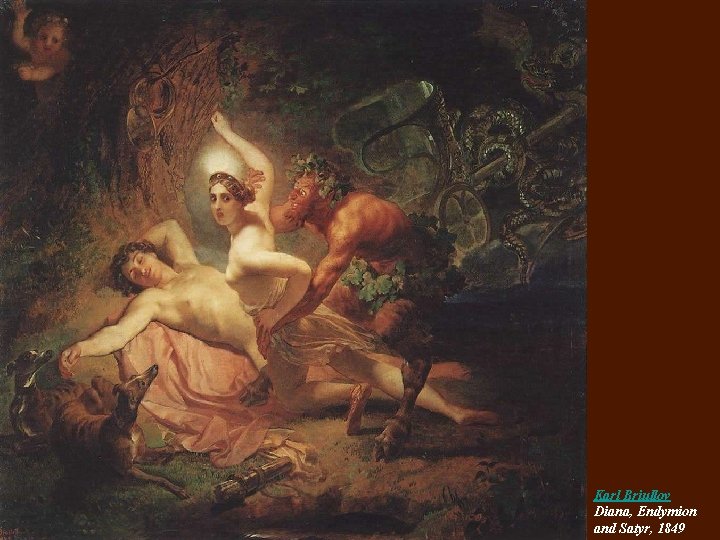
Karl Briullov Diana, Endymion and Satyr, 1849
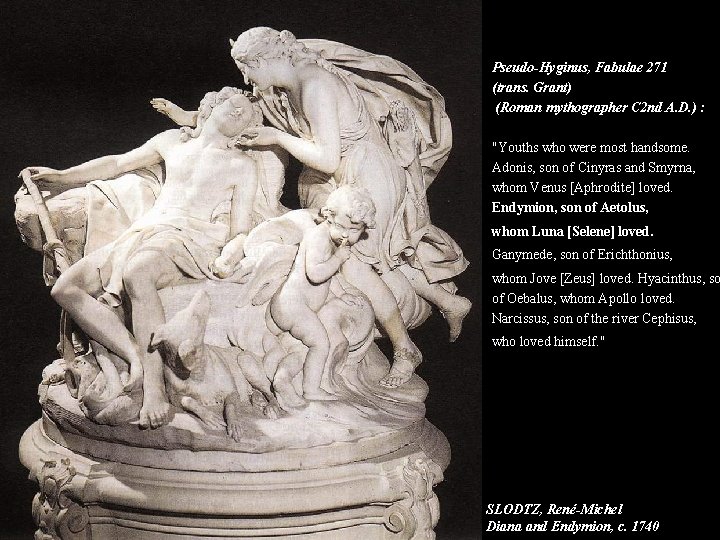
Pseudo-Hyginus, Fabulae 271 (trans. Grant) (Roman mythographer C 2 nd A. D. ) : "Youths who were most handsome. Adonis, son of Cinyras and Smyrna, whom Venus [Aphrodite] loved. Endymion, son of Aetolus, whom Luna [Selene] loved. Ganymede, son of Erichthonius, whom Jove [Zeus] loved. Hyacinthus, so of Oebalus, whom Apollo loved. Narcissus, son of the river Cephisus, who loved himself. " SLODTZ, René-Michel Diana and Endymion, c. 1740
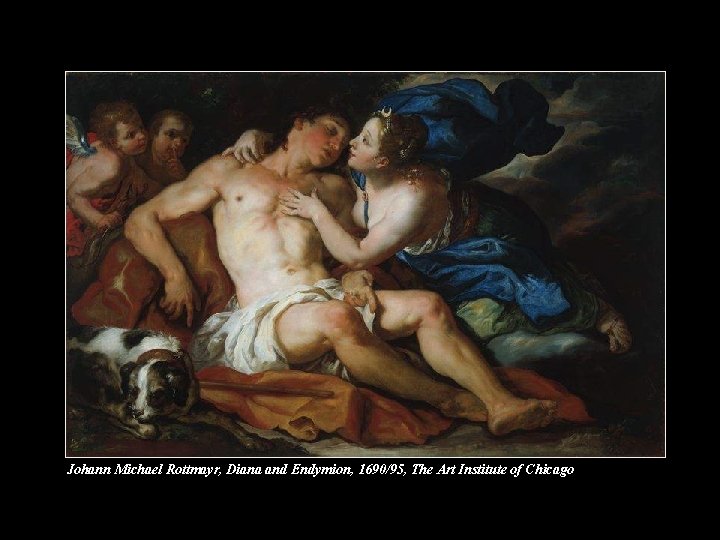
Johann Michael Rottmayr, Diana and Endymion, 1690/95, The Art Institute of Chicago
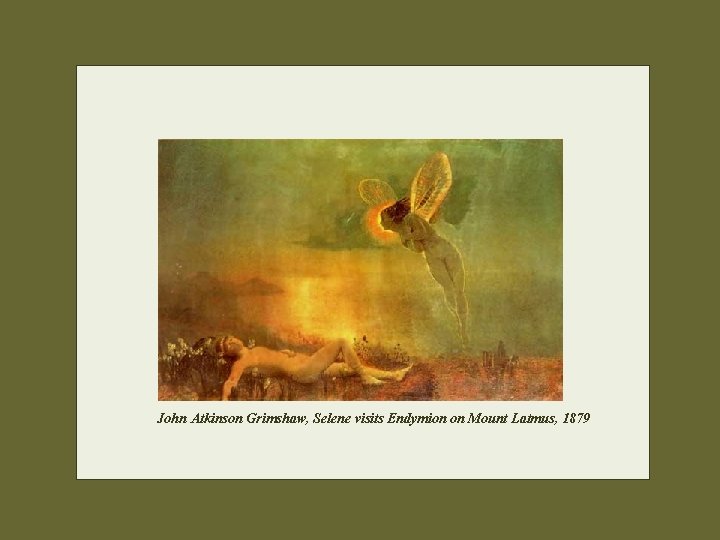
John Atkinson Grimshaw, Selene visits Endymion on Mount Latmus, 1879

Propertius, Elegies 2. 15 (trans. Goold) (Roman elegy C 1 st B. C. ): "It was naked that Endymion enraptured Phoebus’s sister [Selene] and naked, they say, lay with the goddess. " Attributed to Johann Carl Loth Selene and Endymion or The Death of Orion, 1660 -1680 Rijksmuseum Amsterdam
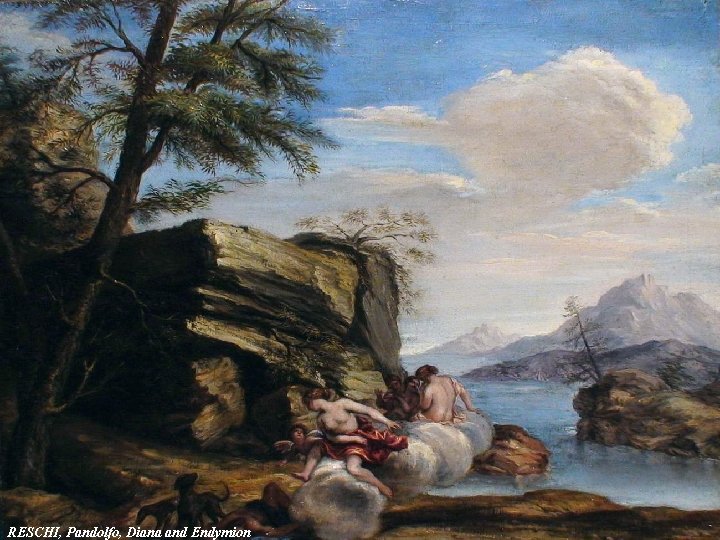
RESCHI, Pandolfo, Diana and Endymion
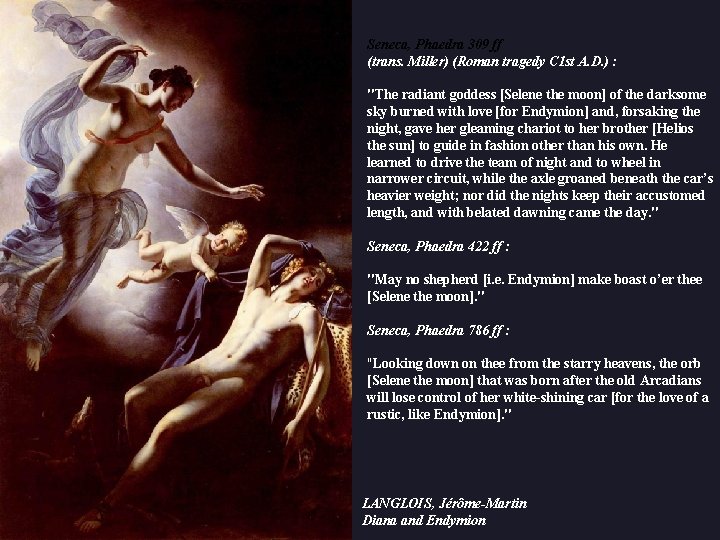
Seneca, Phaedra 309 ff (trans. Miller) (Roman tragedy C 1 st A. D. ) : "The radiant goddess [Selene the moon] of the darksome sky burned with love [for Endymion] and, forsaking the night, gave her gleaming chariot to her brother [Helios the sun] to guide in fashion other than his own. He learned to drive the team of night and to wheel in narrower circuit, while the axle groaned beneath the car’s heavier weight; nor did the nights keep their accustomed length, and with belated dawning came the day. " Seneca, Phaedra 422 ff : "May no shepherd [i. e. Endymion] make boast o’er thee [Selene the moon]. " Seneca, Phaedra 786 ff : "Looking down on thee from the starry heavens, the orb [Selene the moon] that was born after the old Arcadians will lose control of her white-shining car [for the love of a rustic, like Endymion]. " LANGLOIS, Jérôme-Martin Diana and Endymion

Annibale Carracci, Diana and Endymion , 1597, Farnese Gallery, Rome
Valerius Flaccus, Argonautica 8. 28 ff (trans. Mozley) (Roman epic C 1 st A. D. ) : "The Latmian hunter [Endymion], while his comrades are yet scattered in troops about the glens, rests in the summer shade, fit lover for a goddess, and soon Luna [Selene the moon] comes with veiled horns. " Sebastiano Ricci Selene and Endymion, c. 1713 Chiswick House, London
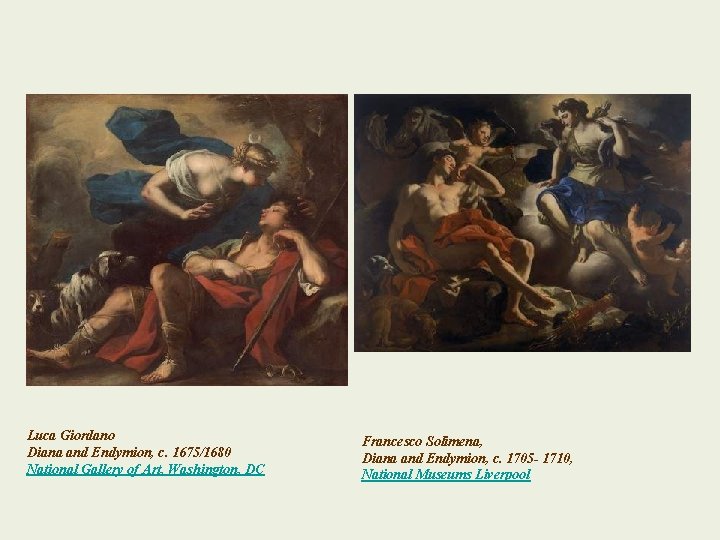
Luca Giordano Diana and Endymion, c. 1675/1680 National Gallery of Art, Washington, DC Francesco Solimena, Diana and Endymion, c. 1705 - 1710, National Museums Liverpool
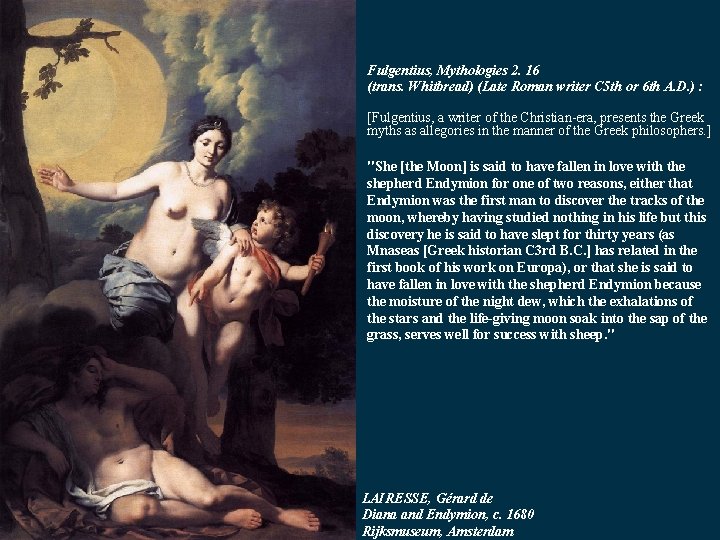
Fulgentius, Mythologies 2. 16 (trans. Whitbread) (Late Roman writer C 5 th or 6 th A. D. ) : [Fulgentius, a writer of the Christian-era, presents the Greek myths as allegories in the manner of the Greek philosophers. ] "She [the Moon] is said to have fallen in love with the shepherd Endymion for one of two reasons, either that Endymion was the first man to discover the tracks of the moon, whereby having studied nothing in his life but this discovery he is said to have slept for thirty years (as Mnaseas [Greek historian C 3 rd B. C. ] has related in the first book of his work on Europa), or that she is said to have fallen in love with the shepherd Endymion because the moisture of the night dew, which the exhalations of the stars and the life-giving moon soak into the sap of the grass, serves well for success with sheep. " LAIRESSE, Gérard de Diana and Endymion, c. 1680 Rijksmuseum, Amsterdam
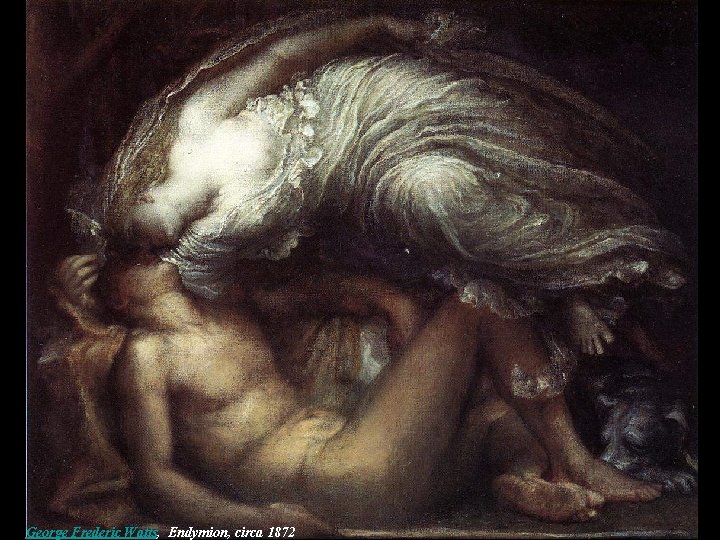
George Frederic Watts, Endymion, circa 1872
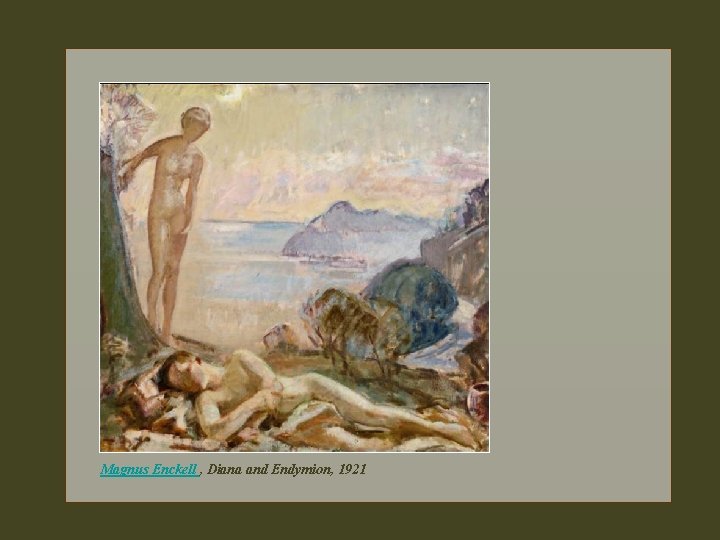
Magnus Enckell , Diana and Endymion, 1921
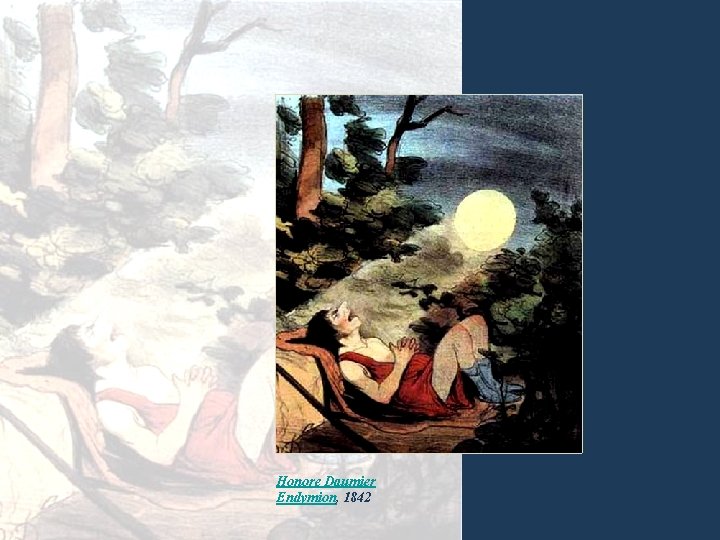
Honore Daumier Endymion, 1842
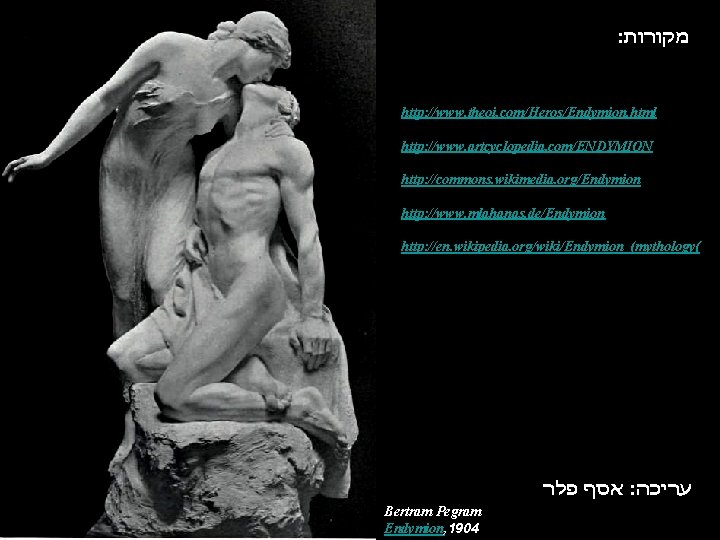
: מקורות http: //www. theoi. com/Heros/Endymion. html http: //www. artcyclopedia. com/ENDYMION http: //commons. wikimedia. org/Endymion http: //www. mlahanas. de/Endymion http: //en. wikipedia. org/wiki/Endymion_(mythology( אסף פלר : עריכה Bertram Pegram Endymion, 1904

, שלום לך אני מזמין אותך לבקר באתר המצגות שלי ולהנות ממצגות נוספות אסף פלר , להתראות http: //assaffeller. com Vik Muniz Pictures of Junk Series Diana and Endymion )Detail , ( after Francesco Mola, 2007
- Slides: 46