
NickelGallium Layered Double Hydroxides Synthesis and Characterization Lorenzo
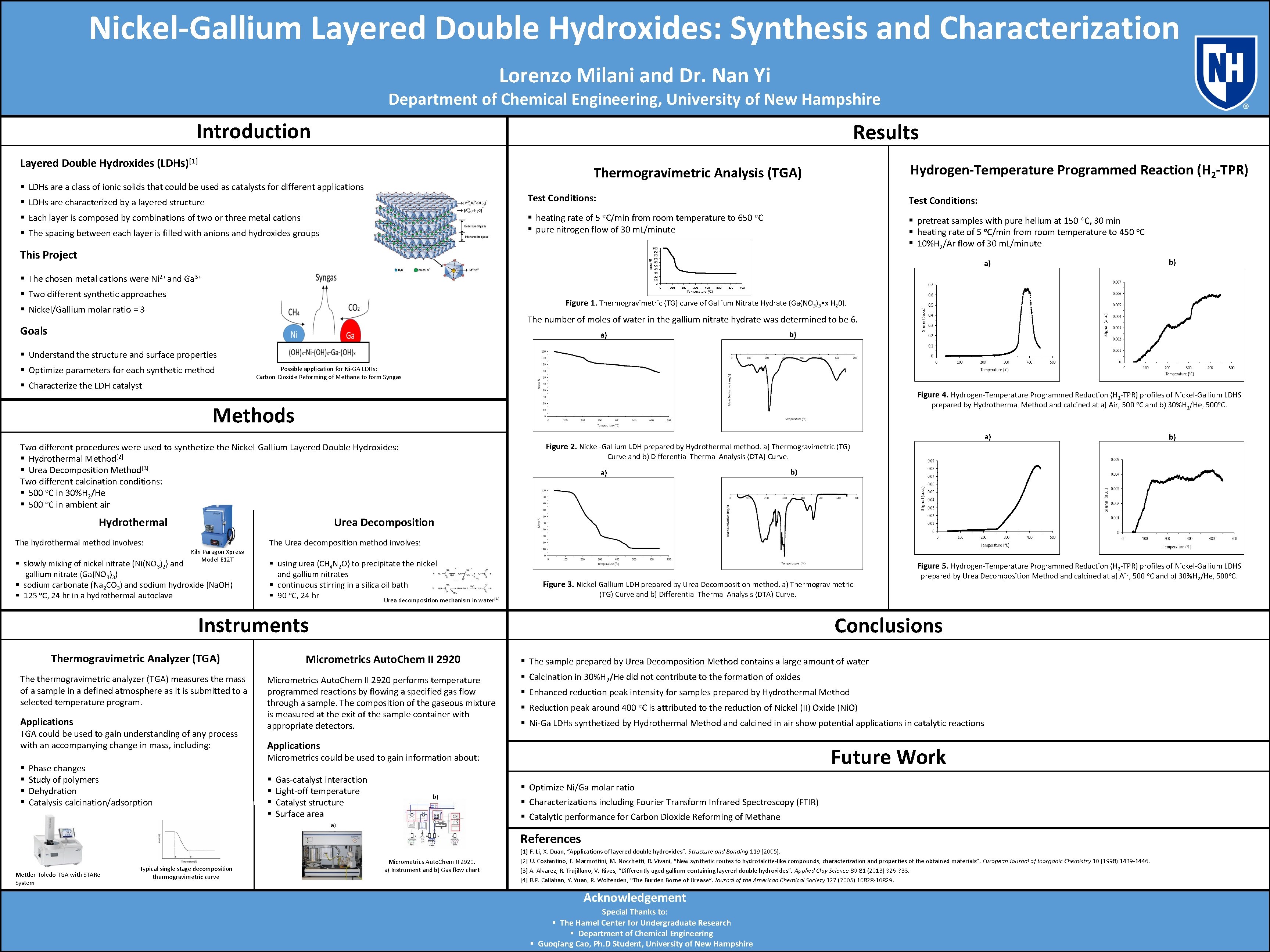
Nickel-Gallium Layered Double Hydroxides: Synthesis and Characterization Lorenzo Milani and Dr. Nan Yi Department of Chemical Engineering, University of New Hampshire Introduction Results Layered Double Hydroxides (LDHs)[1] Hydrogen-Temperature Programmed Reaction (H 2 -TPR) Thermogravimetric Analysis (TGA) § LDHs are a class of ionic solids that could be used as catalysts for different applications § LDHs are characterized by a layered structure Test Conditions: § Each layer is composed by combinations of two or three metal cations § heating rate of 5 ᵒC/min from room temperature to 650 ᵒC § pure nitrogen flow of 30 m. L/minute § pretreat samples with pure helium at 150 °C, 30 min § heating rate of 5 ᵒC/min from room temperature to 450 ᵒC § 10%H 2/Ar flow of 30 m. L/minute § The spacing between each layer is filled with anions and hydroxides groups 100 90 80 70 60 50 40 30 20 10 0 a) Mass % This Project § The chosen metal cations were Ni 2+ and Ga 3+ § Two different synthetic approaches 0 100 200 300 400 Temperature (ᵒC) 500 600 b) 700 Figure 1. Thermogravimetric (TG) curve of Gallium Nitrate Hydrate (Ga(NO 3)3 • x H 20). § Nickel/Gallium molar ratio = 3 The number of moles of water in the gallium nitrate hydrate was determined to be 6. Goals b) a) § Understand the structure and surface properties § Optimize parameters for each synthetic method § Characterize the LDH catalyst Possible application for Ni-GA LDHs: Carbon Dioxide Reforming of Methane to form Syngas Figure 4. Hydrogen-Temperature Programmed Reduction (H 2 -TPR) profiles of Nickel-Gallium LDHS prepared by Hydrothermal Method and calcined at a) Air, 500 ᵒC and b) 30%H 2/He, 500ᵒC. Methods Figure 2. Nickel-Gallium LDH prepared by Hydrothermal method. a) Thermogravimetric (TG) Two different procedures were used to synthetize the Nickel-Gallium Layered Double Hydroxides: § Hydrothermal Method[2] § Urea Decomposition Method[3] Two different calcination conditions: § 500 ᵒC in 30%H 2/He § 500 ᵒC in ambient air Hydrothermal The hydrothermal method involves: Curve and b) Differential Thermal Analysis (DTA) Curve. a) b) Kiln Paragon Xpress Model E 12 T The Urea decomposition method involves: § using urea (CH 4 N 2 O) to precipitate the nickel and gallium nitrates § continuous stirring in a silica oil bath § 90 ᵒC, 24 hr Urea decomposition mechanism in water[4] Figure 5. Hydrogen-Temperature Programmed Reduction (H 2 -TPR) profiles of Nickel-Gallium LDHS Figure 3. Nickel-Gallium LDH prepared by Urea Decomposition method. a) Thermogravimetric Conclusions Thermogravimetric Analyzer (TGA) Micrometrics Auto. Chem II 2920 The thermogravimetric analyzer (TGA) measures the mass of a sample in a defined atmosphere as it is submitted to a selected temperature program. Micrometrics Auto. Chem II 2920 performs temperature programmed reactions by flowing a specified gas flow through a sample. The composition of the gaseous mixture is measured at the exit of the sample container with appropriate detectors. Applications TGA could be used to gain understanding of any process with an accompanying change in mass, including: Phase changes Study of polymers Dehydration Catalysis-calcination/adsorption § The sample prepared by Urea Decomposition Method contains a large amount of water § Calcination in 30%H 2/He did not contribute to the formation of oxides § Enhanced reduction peak intensity for samples prepared by Hydrothermal Method § Reduction peak around 400 ᵒC is attributed to the reduction of Nickel (II) Oxide (Ni. O) § Ni-Ga LDHs synthetized by Hydrothermal Method and calcined in air show potential applications in catalytic reactions Applications Future Work Micrometrics could be used to gain information about: § § prepared by Urea Decomposition Method and calcined at a) Air, 500 ᵒC and b) 30%H 2/He, 500ᵒC. (TG) Curve and b) Differential Thermal Analysis (DTA) Curve. Instruments Gas-catalyst interaction Light-off temperature Catalyst structure Surface area b) § Optimize Ni/Ga molar ratio § Characterizations including Fourier Transform Infrared Spectroscopy (FTIR) § Catalytic performance for Carbon Dioxide Reforming of Methane a) References Mettler Toledo TGA with STARe System b) Urea Decomposition § slowly mixing of nickel nitrate (Ni(NO 3)2) and gallium nitrate (Ga(NO 3)3) § sodium carbonate (Na 2 CO 3) and sodium hydroxide (Na. OH) § 125 ᵒC, 24 hr in a hydrothermal autoclave § § a) Typical single stage decomposition thermogravimetric curve Micrometrics Auto. Chem II 2920. a) Instrument and b) Gas flow chart [1] F. Li, X. Duan, “Applications of layered double hydroxides”. Structure and Bonding 119 (2005). [2] U. Costantino, F. Marmottini, M. Nocchetti, R. Vivani, “New synthetic routes to hydrotalcite-like compounds, characterization and properties of the obtained materials”. European Journal of Inorganic Chemistry 10 (1998) 1439 -1446. [3] A. Alvarez, R. Trujillano, V. Rives, “Differently aged gallium-containing layered double hydroxides”. Applied Clay Science 80 -81 (2013) 326 -333. [4] B. P. Callahan, Y. Yuan, R. Wolfenden, "The Burden Borne of Urease“. Journal of the American Chemical Society 127 (2005) 10828 -10829. Acknowledgement Special Thanks to: § The Hamel Center for Undergraduate Research § Department of Chemical Engineering § Guoqiang Cao, Ph. D Student, University of New Hampshire
- Slides: 1