
NICE guidance Supporting Social Care Jade Fortune Implementation

![Additional resources relevant medication • Decision-making and mental capacity [NG 108] • Controlled drugs:](https://slidetodoc.com/presentation_image_h2/2fcde261912f7cb574609e0eb5150ecf/image-17.jpg "Additional resources relevant medication • Decision-making and mental capacity [NG 108] • Controlled drugs:")


- Slides: 39
NICE guidance: Supporting Social Care Jade Fortune– Implementation Facilitator, NICE © NICE 2020. All rights reserved. Subject to notice of rights.
Overview • About NICE – who we are and what we do • How NICE fits in the regulatory framework • NICE guidance – supporting care homes • How to find what you need HISTORY & BACKGROUND 2
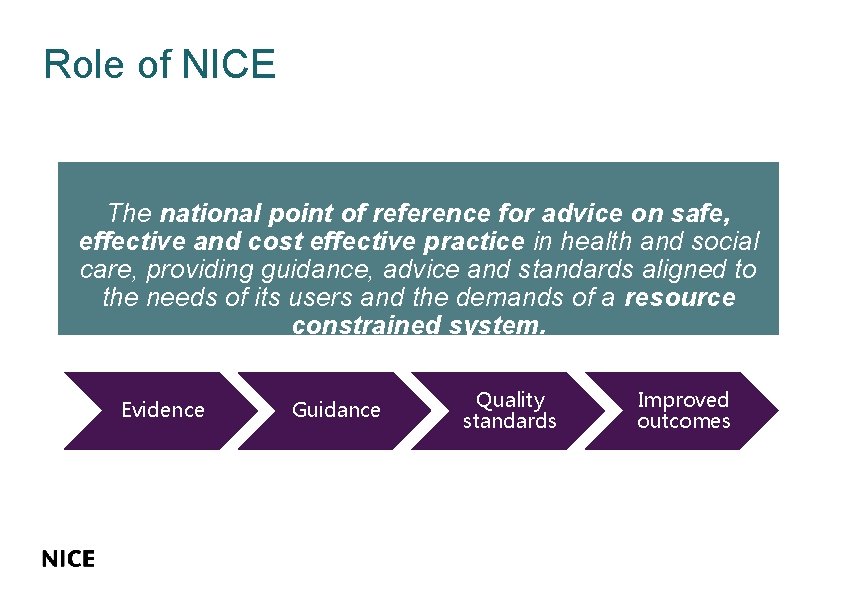
Role of NICE The national point of reference for advice on safe, effective and cost effective practice in health and social care, providing guidance, advice and standards aligned to the needs of its users and the demands of a resource constrained system. Evidence Guidance Quality standards Improved outcomes HISTORY & BACKGROUND
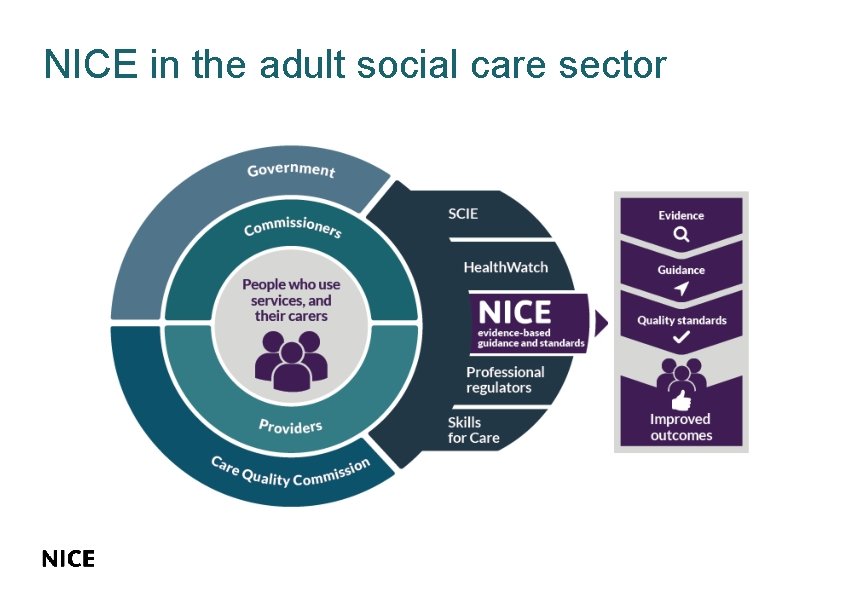
NICE in the adult social care sector HISTORY & BACKGROUND
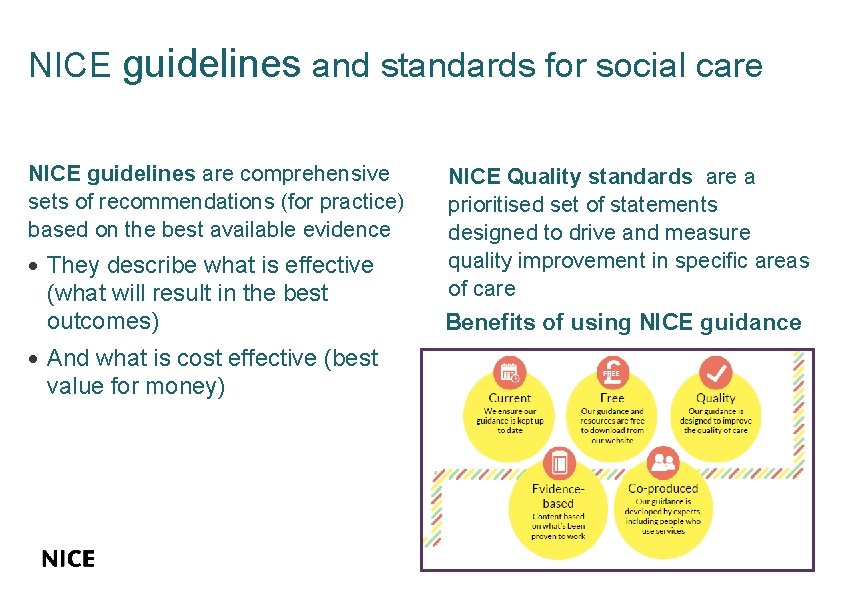
NICE guidelines and standards for social care NICE guidelines are comprehensive sets of recommendations (for practice) based on the best available evidence They describe what is effective (what will result in the best outcomes) NICE Quality standards are a prioritised set of statements designed to drive and measure quality improvement in specific areas of care Benefits of using NICE guidance And what is cost effective (best value for money) HISTORY & BACKGROUND
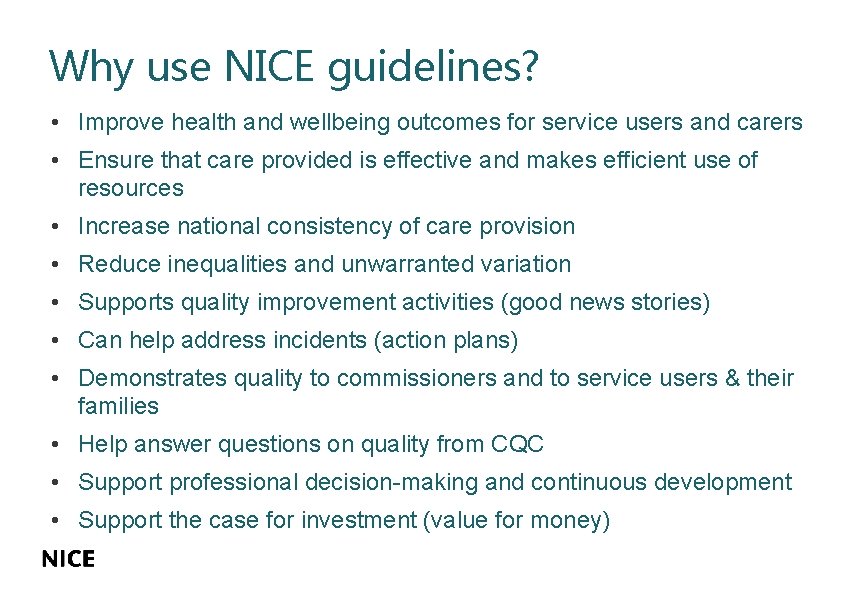
Why use NICE guidelines? • Improve health and wellbeing outcomes for service users and carers • Ensure that care provided is effective and makes efficient use of resources • Increase national consistency of care provision • Reduce inequalities and unwarranted variation • Supports quality improvement activities (good news stories) • Can help address incidents (action plans) • Demonstrates quality to commissioners and to service users & their families • Help answer questions on quality from CQC • Support professional decision-making and continuous development • Support the case for investment (value for money) HISTORY & BACKGROUND
Medication HISTORY & BACKGROUND
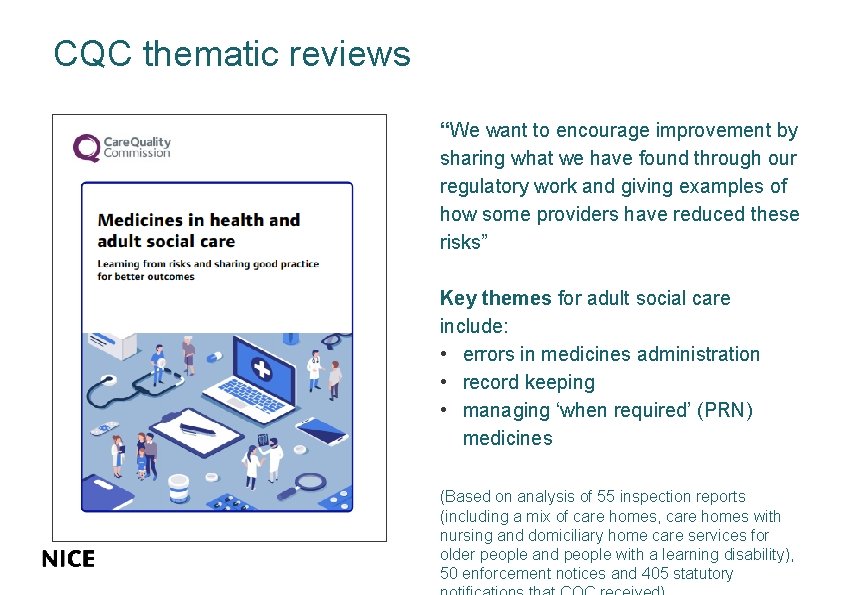
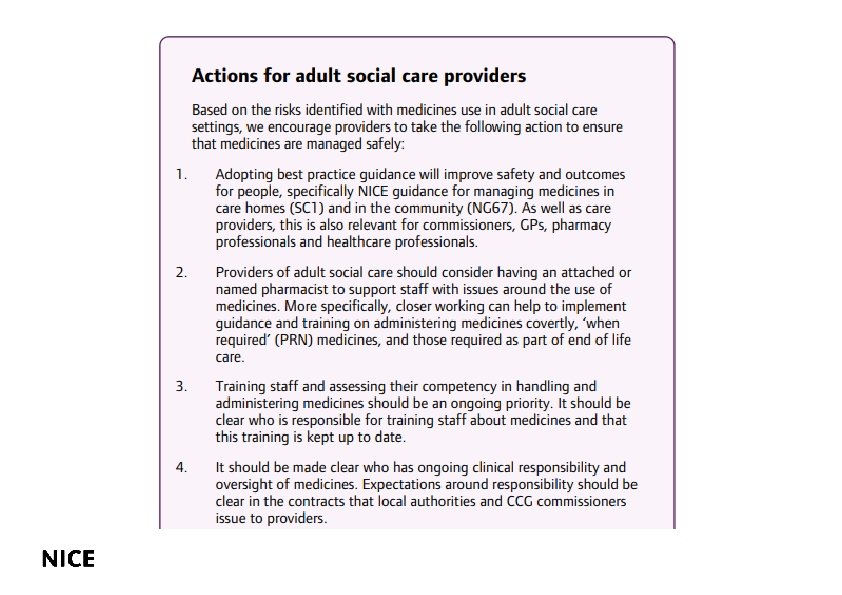
CQC thematic reviews “We want to encourage improvement by sharing what we have found through our regulatory work and giving examples of how some providers have reduced these risks” Key themes for adult social care include: • errors in medicines administration • record keeping • managing ‘when required’ (PRN) medicines (Based on analysis of 55 inspection reports (including a mix of care homes, care homes with nursing and domiciliary home care services for older people and people with a learning disability), 8 HISTORY & BACKGROUND 50 enforcement notices and 405 statutory
HISTORY & BACKGROUND 9
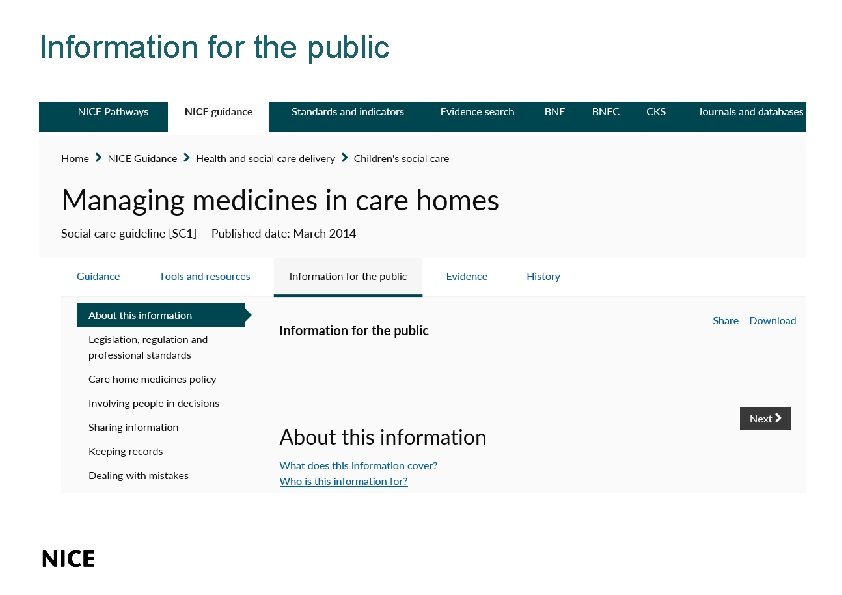
Information for the public
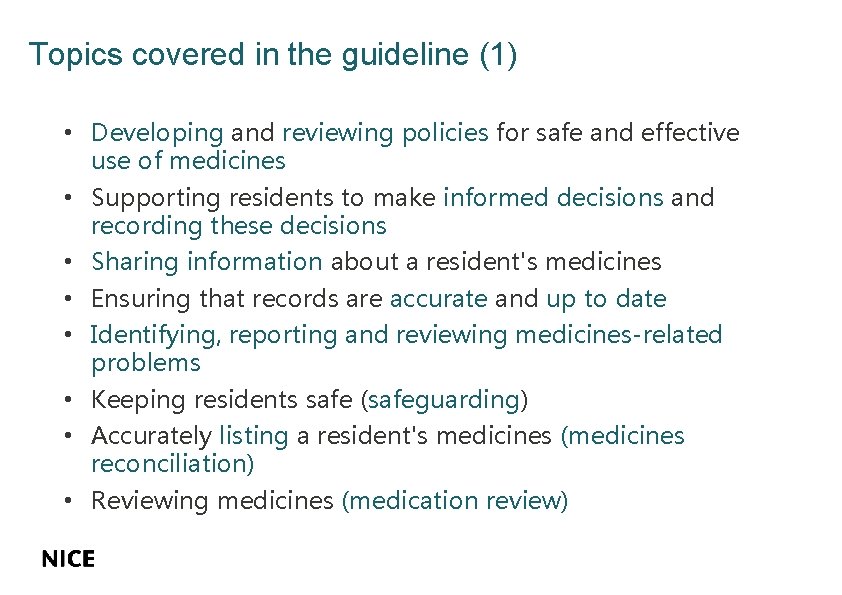
Topics covered in the guideline (1) • Developing and reviewing policies for safe and effective use of medicines • Supporting residents to make informed decisions and recording these decisions • Sharing information about a resident's medicines • Ensuring that records are accurate and up to date • Identifying, reporting and reviewing medicines-related problems • Keeping residents safe (safeguarding) • Accurately listing a resident's medicines (medicines reconciliation) • Reviewing medicines (medication review)
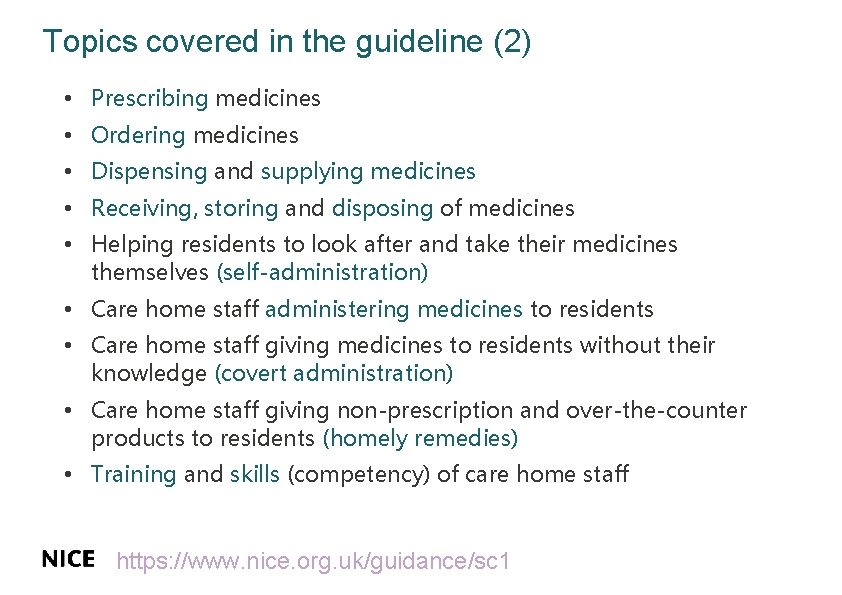
Topics covered in the guideline (2) • Prescribing medicines • Ordering medicines • Dispensing and supplying medicines • Receiving, storing and disposing of medicines • Helping residents to look after and take their medicines themselves (self-administration) • Care home staff administering medicines to residents • Care home staff giving medicines to residents without their knowledge (covert administration) • Care home staff giving non-prescription and over-the-counter products to residents (homely remedies) • Training and skills (competency) of care home staff https: //www. nice. org. uk/guidance/sc 1
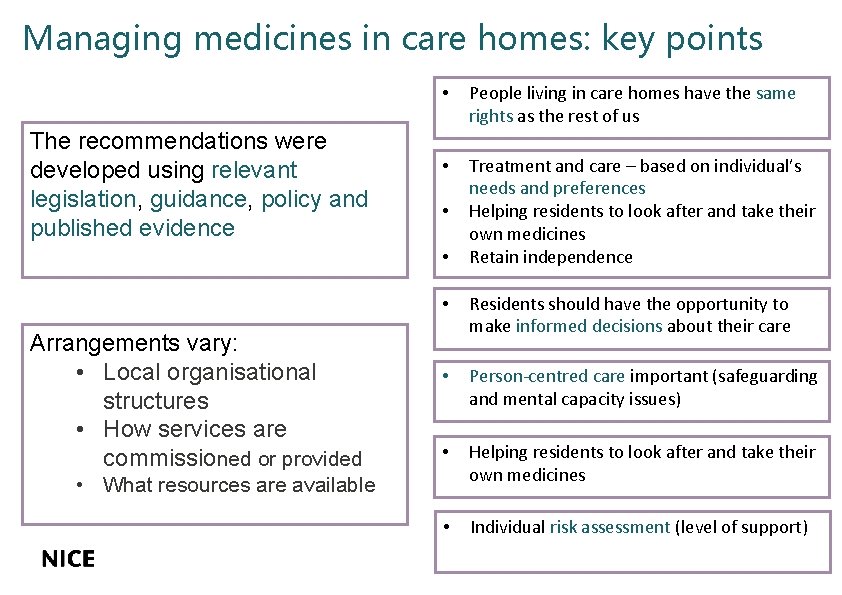
Managing medicines in care homes: key points The recommendations were developed using relevant legislation, guidance, policy and published evidence • People living in care homes have the same rights as the rest of us • Treatment and care – based on individual’s needs and preferences Helping residents to look after and take their own medicines Retain independence • • Arrangements vary: • Local organisational structures • How services are commissioned or provided • Residents should have the opportunity to make informed decisions about their care • Person-centred care important (safeguarding and mental capacity issues) • Helping residents to look after and take their own medicines • Individual risk assessment (level of support) • What resources are available
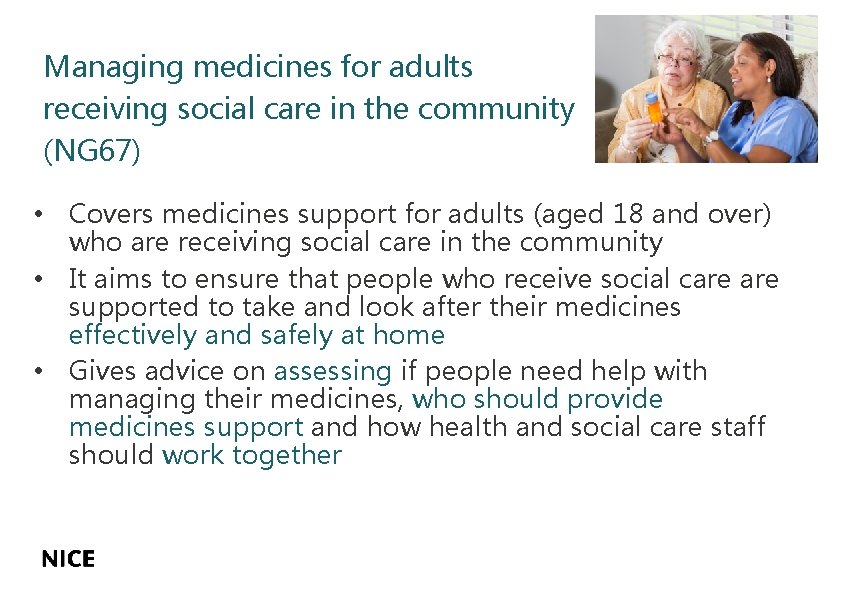
Managing medicines for adults receiving social care in the community (NG 67) • Covers medicines support for adults (aged 18 and over) who are receiving social care in the community • It aims to ensure that people who receive social care supported to take and look after their medicines effectively and safely at home • Gives advice on assessing if people need help with managing their medicines, who should provide medicines support and how health and social care staff should work together
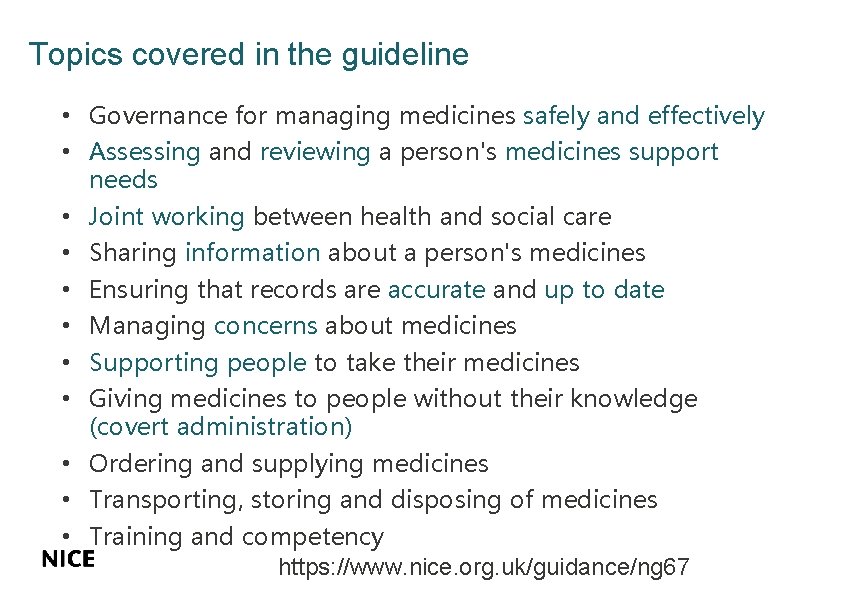
Topics covered in the guideline • Governance for managing medicines safely and effectively • Assessing and reviewing a person's medicines support needs • Joint working between health and social care • Sharing information about a person's medicines • Ensuring that records are accurate and up to date • Managing concerns about medicines • Supporting people to take their medicines • Giving medicines to people without their knowledge (covert administration) • Ordering and supplying medicines • Transporting, storing and disposing of medicines • Training and competency https: //www. nice. org. uk/guidance/ng 67
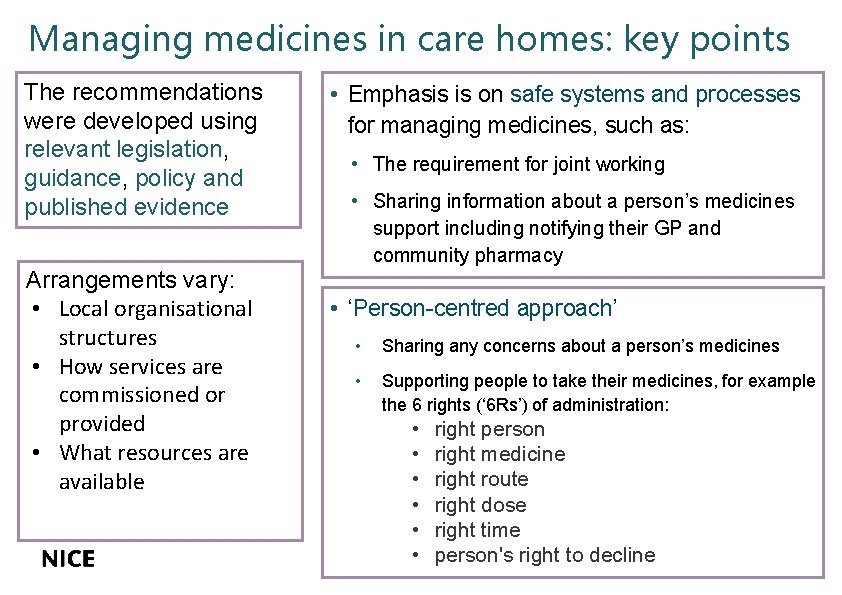
Managing medicines in care homes: key points The recommendations were developed using relevant legislation, guidance, policy and published evidence Arrangements vary: • Local organisational structures • How services are commissioned or provided • What resources are available • Emphasis is on safe systems and processes for managing medicines, such as: • The requirement for joint working • Sharing information about a person’s medicines support including notifying their GP and community pharmacy • ‘Person-centred approach’ • Sharing any concerns about a person’s medicines • Supporting people to take their medicines, for example the 6 rights (‘ 6 Rs’) of administration: • • • right person right medicine right route right dose right time person's right to decline
Additional resources relevant medication • Decision-making and mental capacity [NG 108] • Controlled drugs: safe use and management [NG 46] • Transition between inpatient hospital settings and community or care home settings for adults with social care needs (NG 27) • Medicines management in care homes (QS 85) Quick Guides • Giving medicines covertly • What to expect during assessment and care planning • Effective record keeping and ordering of medicines • Discussing and planning medicines support
Oral Health HISTORY & BACKGROUND
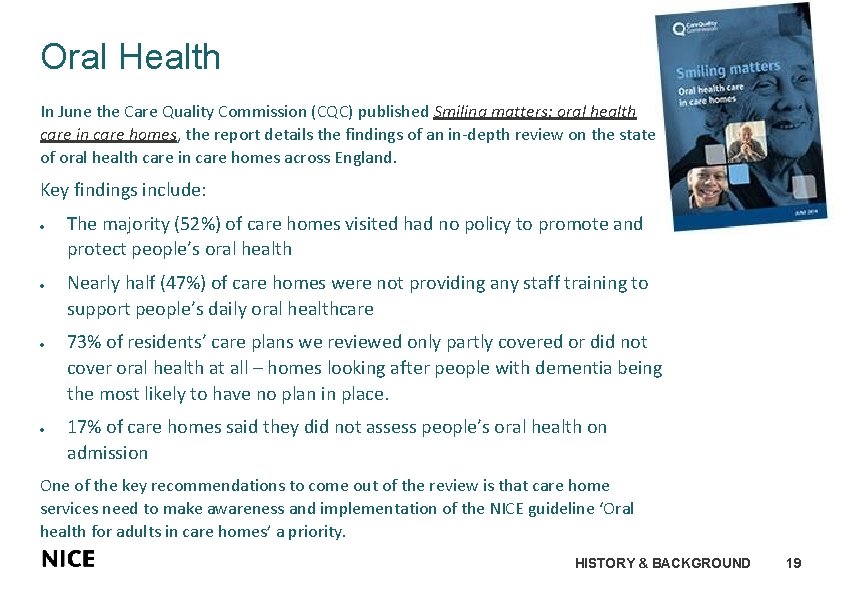
Oral Health In June the Care Quality Commission (CQC) published Smiling matters: oral health care in care homes, the report details the findings of an in-depth review on the state of oral health care in care homes across England. Key findings include: The majority (52%) of care homes visited had no policy to promote and protect people’s oral health Nearly half (47%) of care homes were not providing any staff training to support people’s daily oral healthcare 73% of residents’ care plans we reviewed only partly covered or did not cover oral health at all – homes looking after people with dementia being the most likely to have no plan in place. 17% of care homes said they did not assess people’s oral health on admission One of the key recommendations to come out of the review is that care home services need to make awareness and implementation of the NICE guideline ‘Oral health for adults in care homes’ a priority. HISTORY & BACKGROUND 19
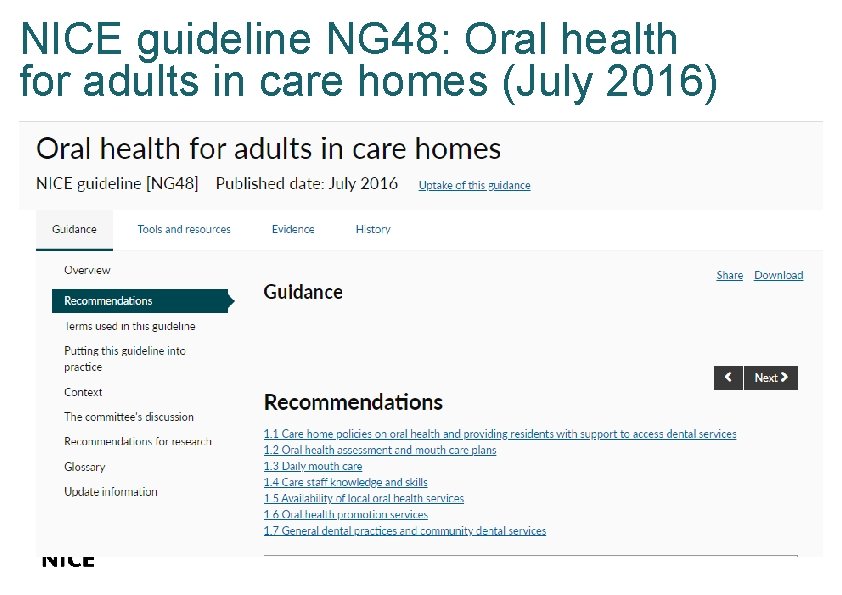
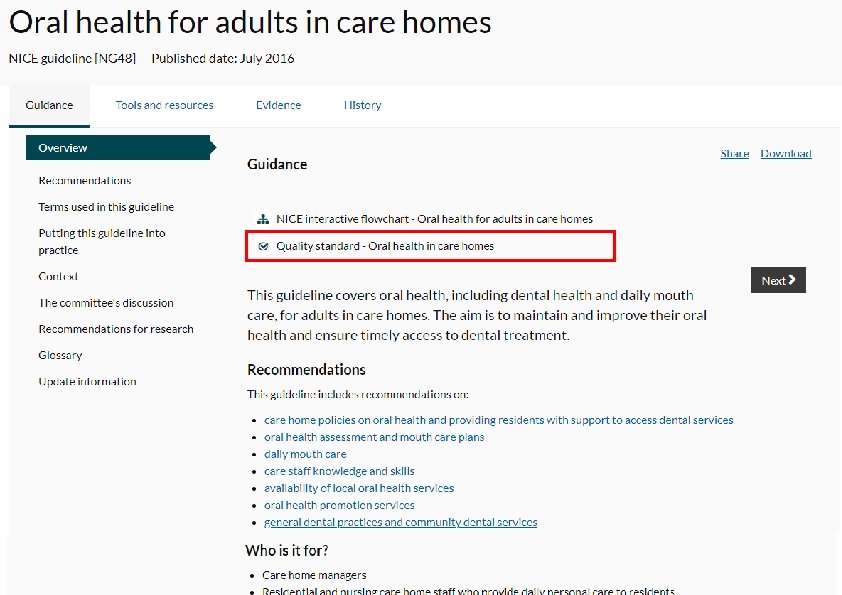
NICE guideline NG 48: Oral health for adults in care homes (July 2016) HISTORY & BACKGROUND
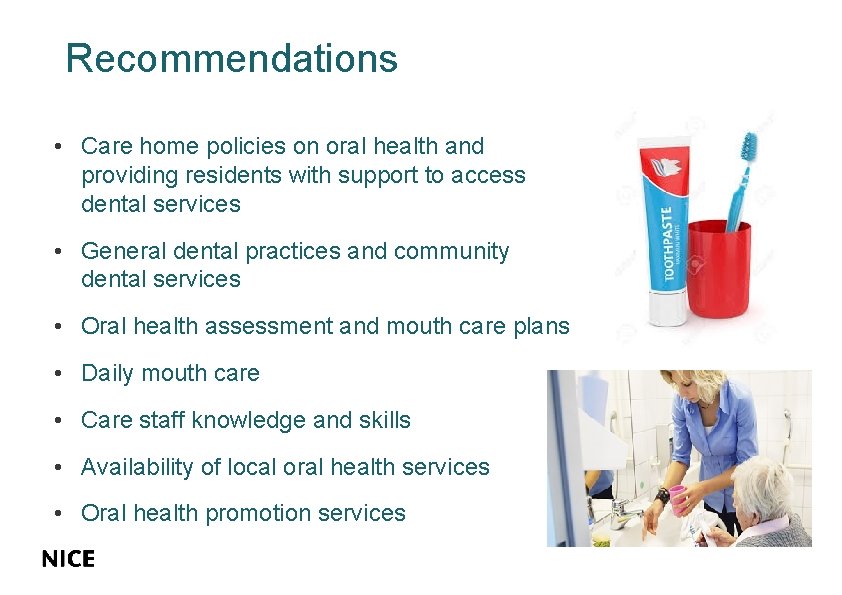
Recommendations • Care home policies on oral health and providing residents with support to access dental services • General dental practices and community dental services • Oral health assessment and mouth care plans • Daily mouth care • Care staff knowledge and skills • Availability of local oral health services • Oral health promotion services HISTORY & BACKGROUND
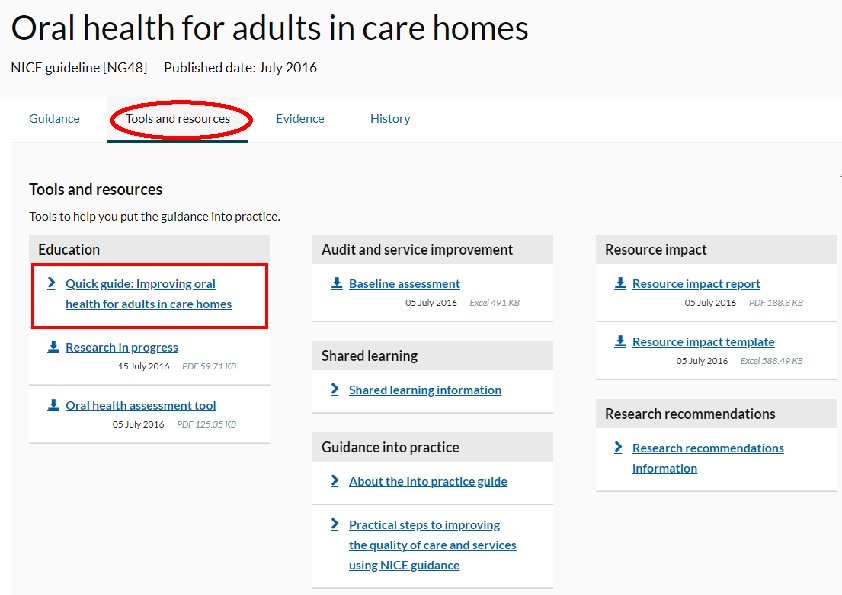
HISTORY & BACKGROUND 22
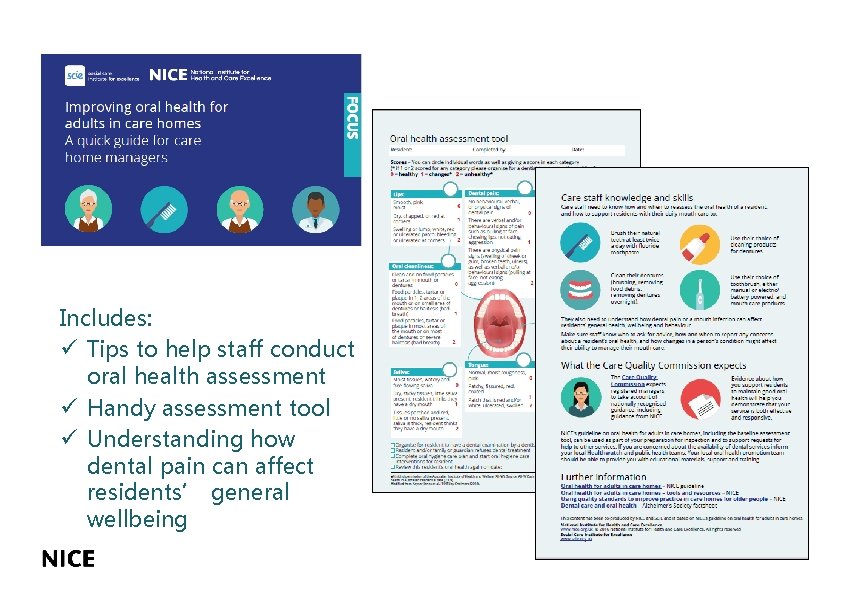
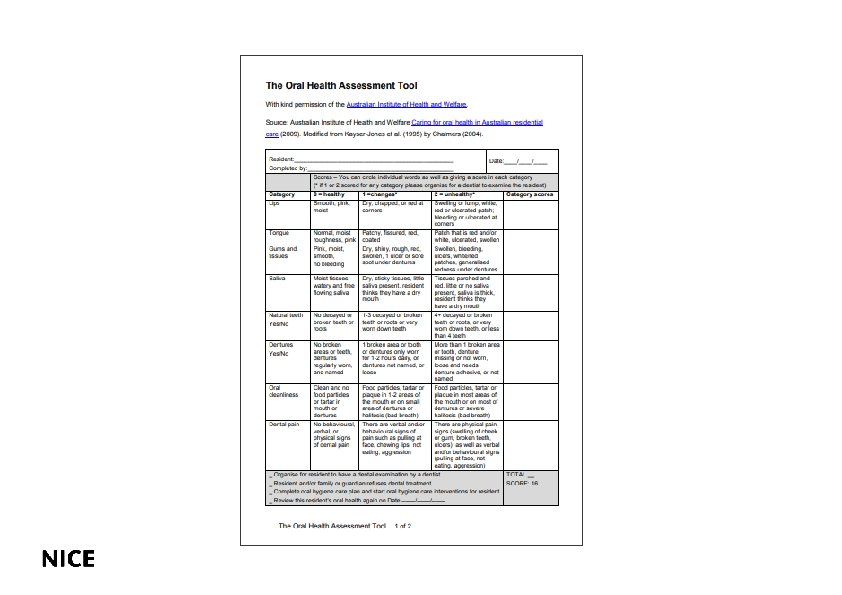
Includes: ü Tips to help staff conduct oral health assessment ü Handy assessment tool ü Understanding how dental pain can affect residents’ general wellbeing HISTORY & BACKGROUND
HISTORY & BACKGROUND 24
HISTORY & BACKGROUND 25
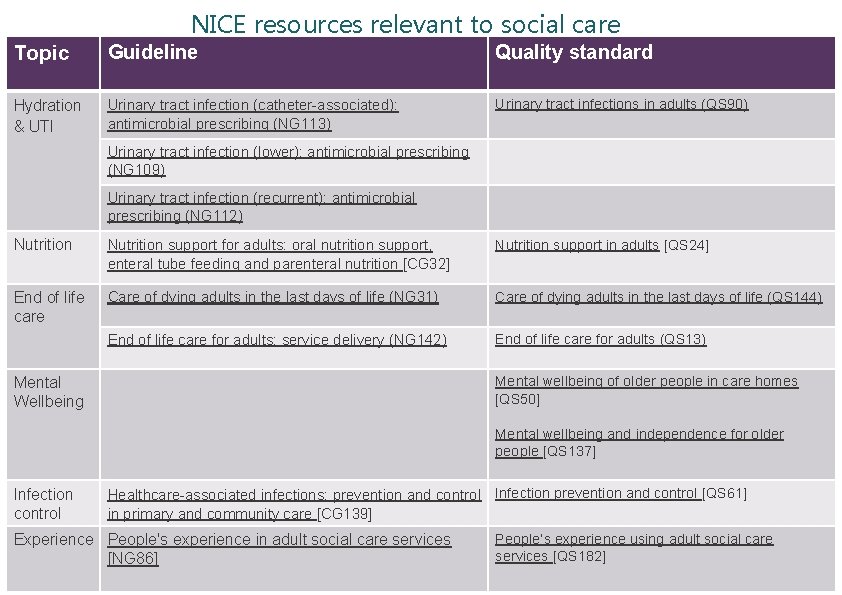
NICE resources relevant to social care Topic Guideline Quality standard Hydration & UTI Urinary tract infection (catheter-associated): antimicrobial prescribing (NG 113) Urinary tract infections in adults (QS 90) Urinary tract infection (lower): antimicrobial prescribing (NG 109) Urinary tract infection (recurrent): antimicrobial prescribing (NG 112) Nutrition support for adults: oral nutrition support, enteral tube feeding and parenteral nutrition [CG 32] Nutrition support in adults [QS 24] End of life care Care of dying adults in the last days of life (NG 31) Care of dying adults in the last days of life (QS 144) End of life care for adults: service delivery (NG 142) End of life care for adults (QS 13) Mental wellbeing of older people in care homes [QS 50] Mental Wellbeing Mental wellbeing and independence for older people [QS 137] Infection control Healthcare-associated infections: prevention and control Infection prevention and control [QS 61] in primary and community care [CG 139] Experience People's experience in adult social care services [NG 86] People’s experience using adult social care services [QS 182]
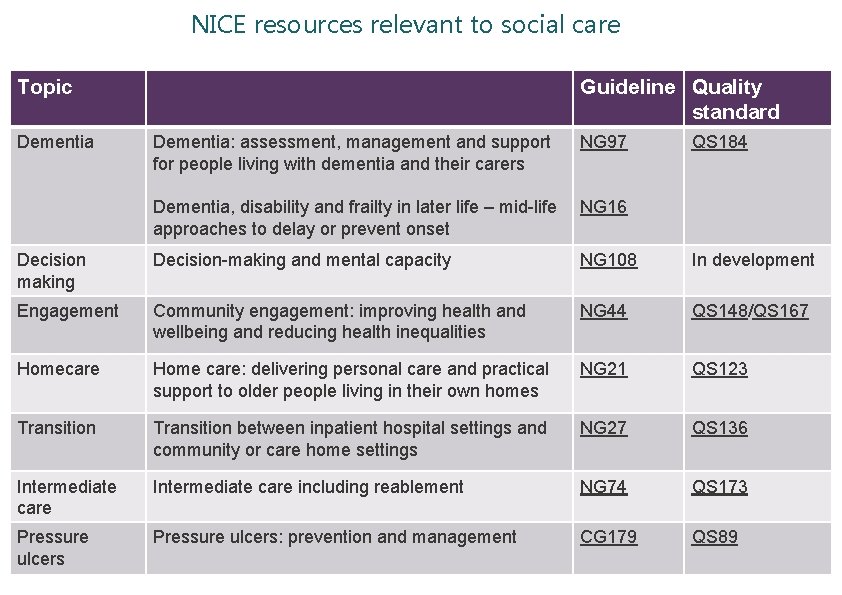
NICE resources relevant to social care Topic Dementia Guideline Quality standard Dementia: assessment, management and support for people living with dementia and their carers NG 97 QS 184 Dementia, disability and frailty in later life – mid-life approaches to delay or prevent onset NG 16 Decision making Decision-making and mental capacity NG 108 In development Engagement Community engagement: improving health and wellbeing and reducing health inequalities NG 44 QS 148/QS 167 Homecare Home care: delivering personal care and practical support to older people living in their own homes NG 21 QS 123 Transition between inpatient hospital settings and community or care home settings NG 27 QS 136 Intermediate care including reablement NG 74 QS 173 Pressure ulcers: prevention and management CG 179 QS 89
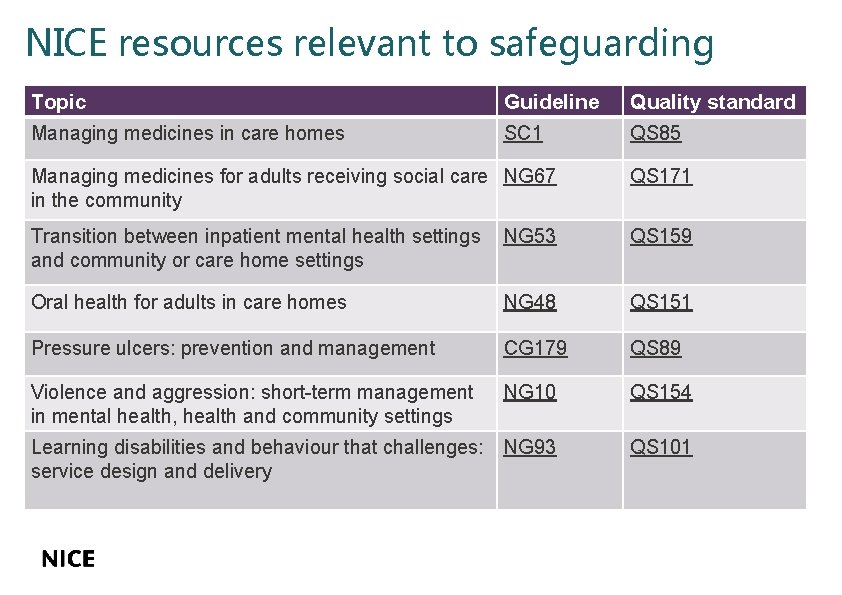
NICE resources relevant to safeguarding Topic Managing medicines in care homes Guideline SC 1 Quality standard QS 85 Managing medicines for adults receiving social care NG 67 in the community QS 171 Transition between inpatient mental health settings and community or care home settings NG 53 QS 159 Oral health for adults in care homes NG 48 QS 151 Pressure ulcers: prevention and management CG 179 QS 89 Violence and aggression: short-term management in mental health, health and community settings NG 10 QS 154 Learning disabilities and behaviour that challenges: NG 93 service design and delivery QS 101 28
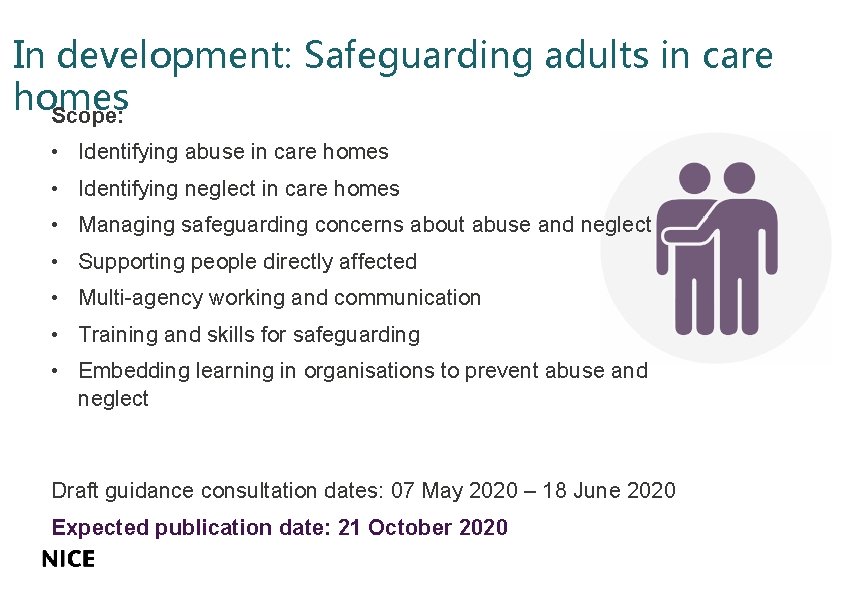
In development: Safeguarding adults in care homes Scope: • Identifying abuse in care homes • Identifying neglect in care homes • Managing safeguarding concerns about abuse and neglect • Supporting people directly affected • Multi-agency working and communication • Training and skills for safeguarding • Embedding learning in organisations to prevent abuse and neglect Draft guidance consultation dates: 07 May 2020 – 18 June 2020 Expected publication date: 21 October 2020 29
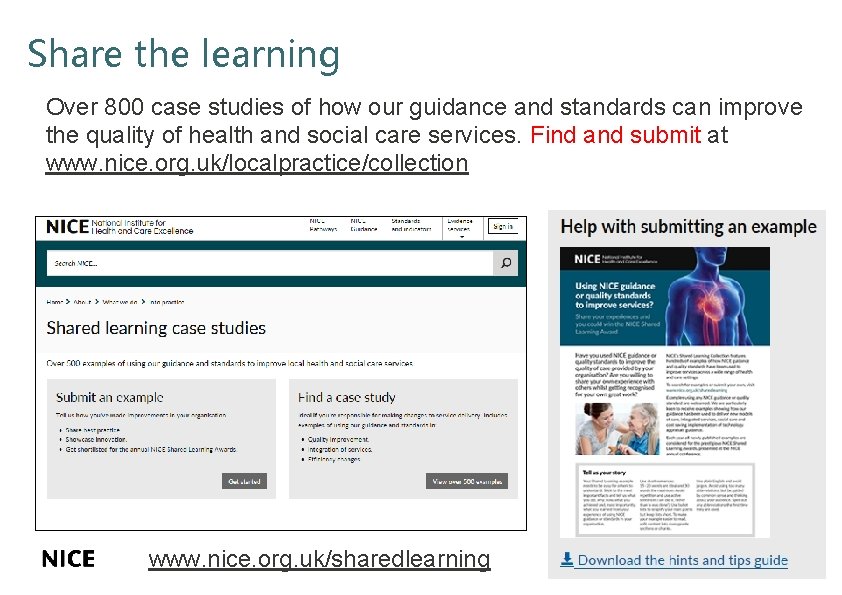
Share the learning Over 800 case studies of how our guidance and standards can improve the quality of health and social care services. Find and submit at www. nice. org. uk/localpractice/collection www. nice. org. uk/sharedlearning HISTORY & BACKGROUND
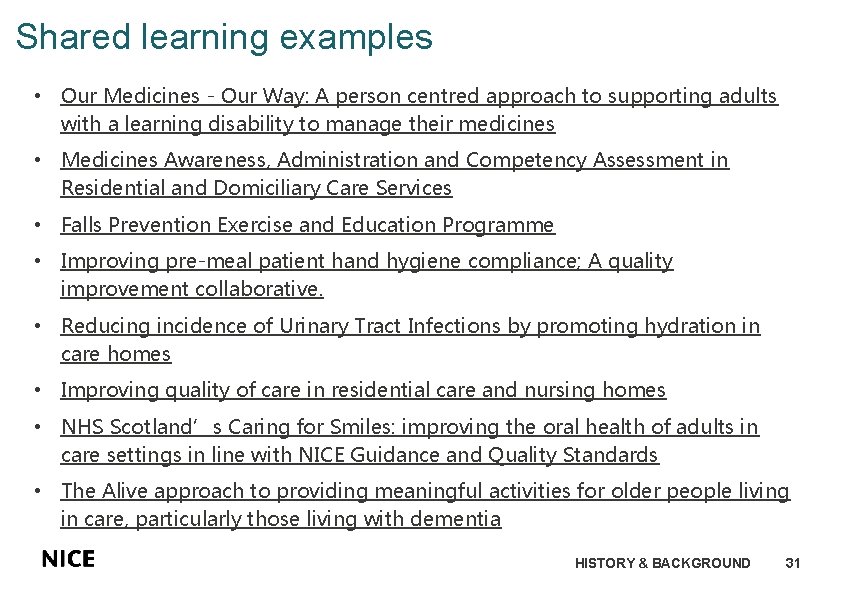
Shared learning examples • Our Medicines - Our Way: A person centred approach to supporting adults with a learning disability to manage their medicines • Medicines Awareness, Administration and Competency Assessment in Residential and Domiciliary Care Services • Falls Prevention Exercise and Education Programme • Improving pre-meal patient hand hygiene compliance; A quality improvement collaborative. • Reducing incidence of Urinary Tract Infections by promoting hydration in care homes • Improving quality of care in residential care and nursing homes • NHS Scotland’s Caring for Smiles: improving the oral health of adults in care settings in line with NICE Guidance and Quality Standards • The Alive approach to providing meaningful activities for older people living in care, particularly those living with dementia HISTORY & BACKGROUND 31
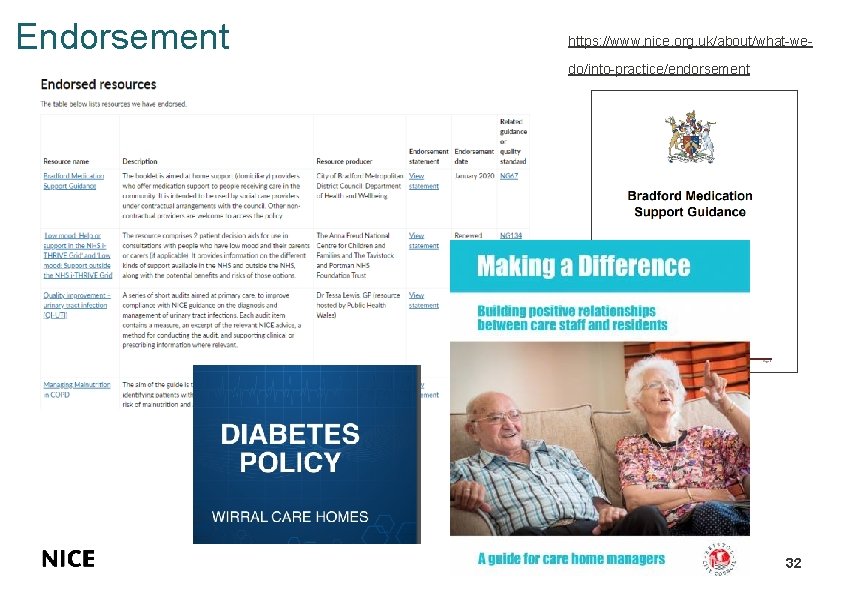
Endorsement https: //www. nice. org. uk/about/what-wedo/into-practice/endorsement HISTORY & BACKGROUND 32
Making it easier to find what you need HISTORY & BACKGROUND
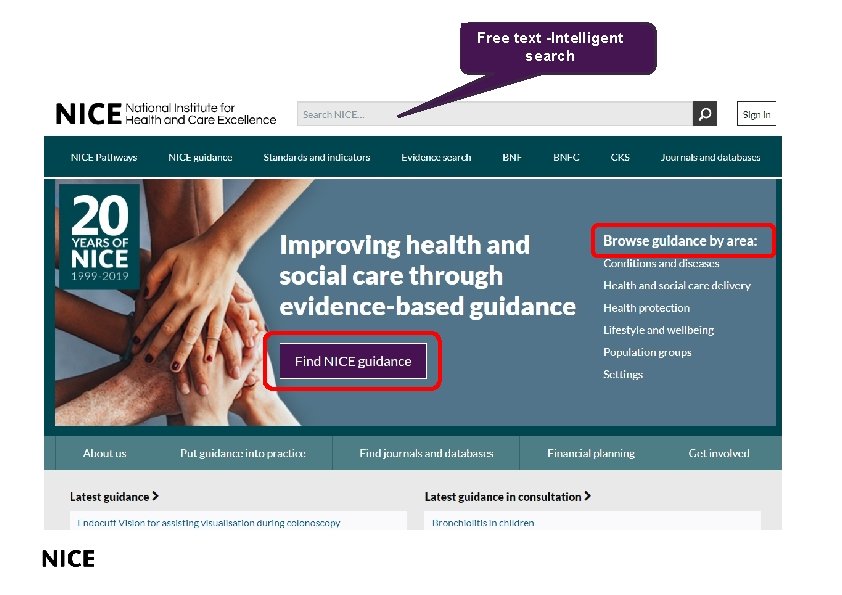
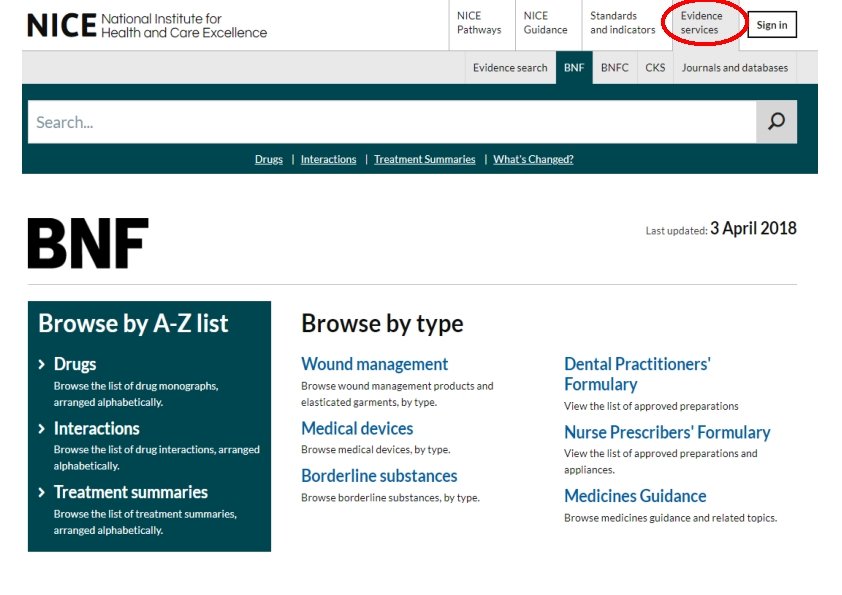
Intelligent browsing Free text -Intelligent search HISTORY & BACKGROUND
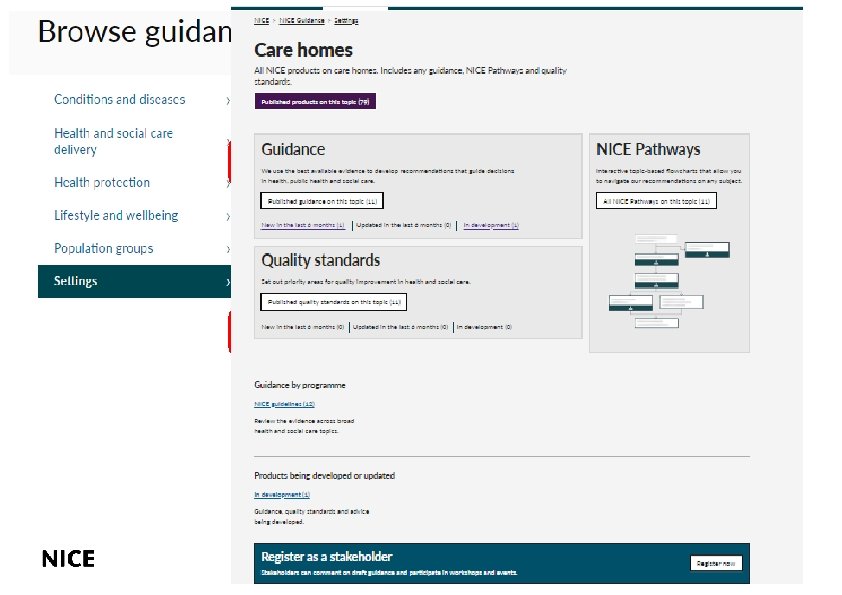
HISTORY & BACKGROUND 35
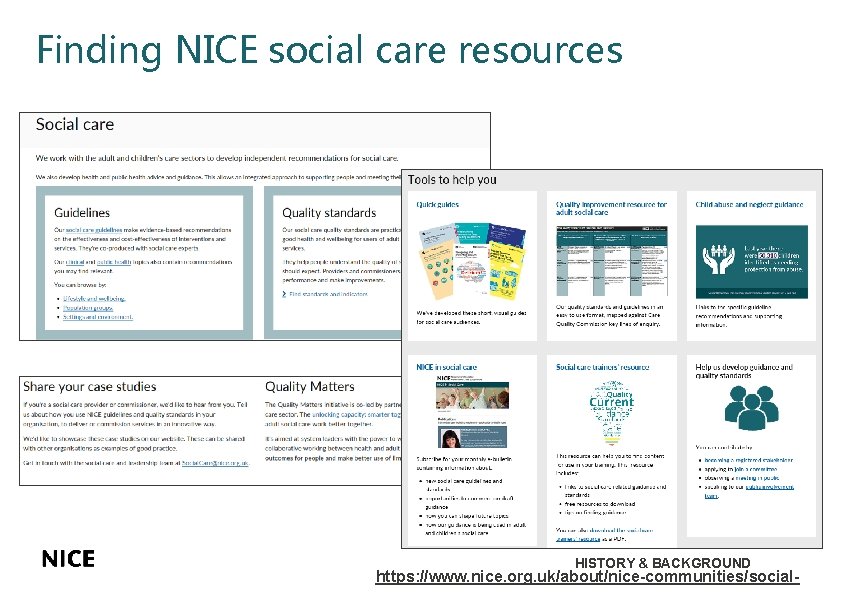
Finding NICE social care resources HISTORY & BACKGROUND https: //www. nice. org. uk/about/nice-communities/social-
HISTORY & BACKGROUND
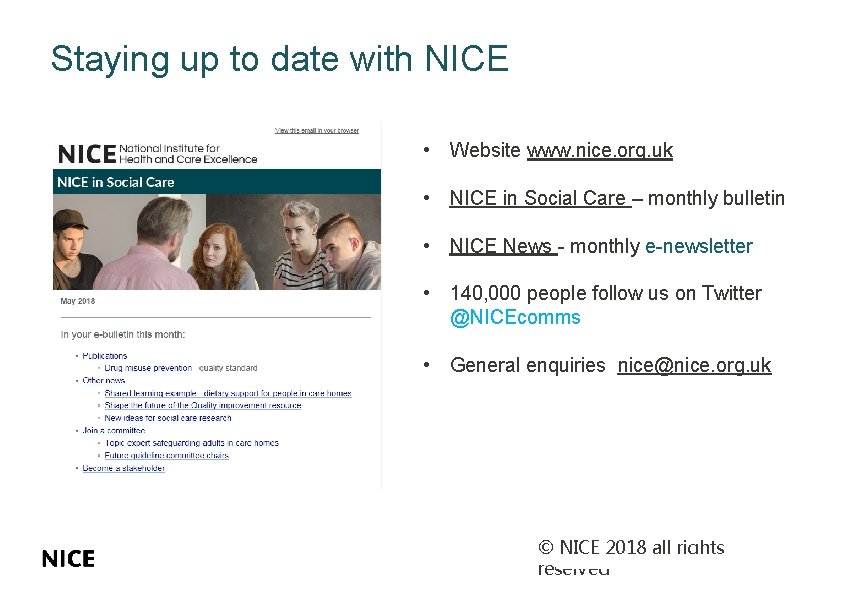
Staying up to date with NICE • Website www. nice. org. uk • NICE in Social Care – monthly bulletin • NICE News - monthly e-newsletter • 140, 000 people follow us on Twitter @NICEcomms • General enquiries nice@nice. org. uk © NICE 2018 all rights HISTORY & BACKGROUND reserved
Thank you Any questions? HISTORY & BACKGROUND 39