
NICA Project Management Information System Maksim Bashashin Dmitry
NICA Project Management Information System Maksim Bashashin, Dmitry Kekelidze, Vladimir Korenkov, Alexandr Philippov, Yuri Potrebenikov, Sergey Kuniaev, Grigory Trubnikov
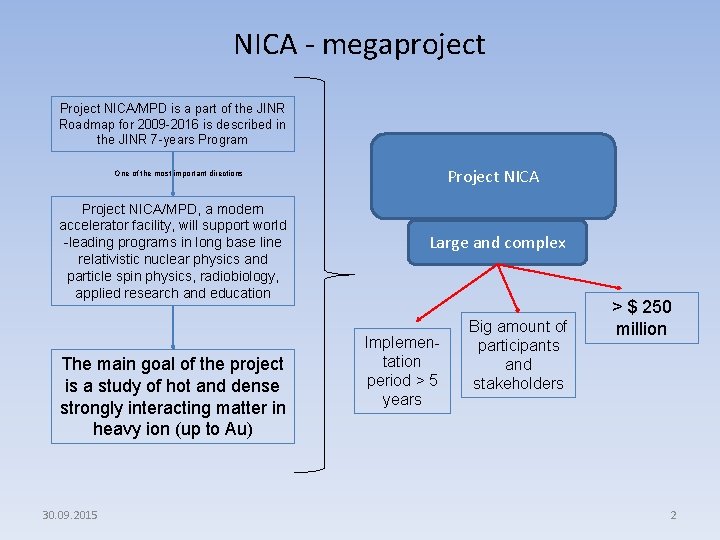
NICA - megaproject Project NICA/MPD is a part of the JINR Roadmap for 2009 -2016 is described in the JINR 7 -years Program Project NICA One of the most important directions Project NICA/MPD, a modern accelerator facility, will support world -leading programs in long base line relativistic nuclear physics and particle spin physics, radiobiology, applied research and education The main goal of the project is a study of hot and dense strongly interacting matter in heavy ion (up to Au) 30. 09. 2015 Large and complex Implementation period > 5 years Big amount of participants and stakeholders > $ 250 million 2
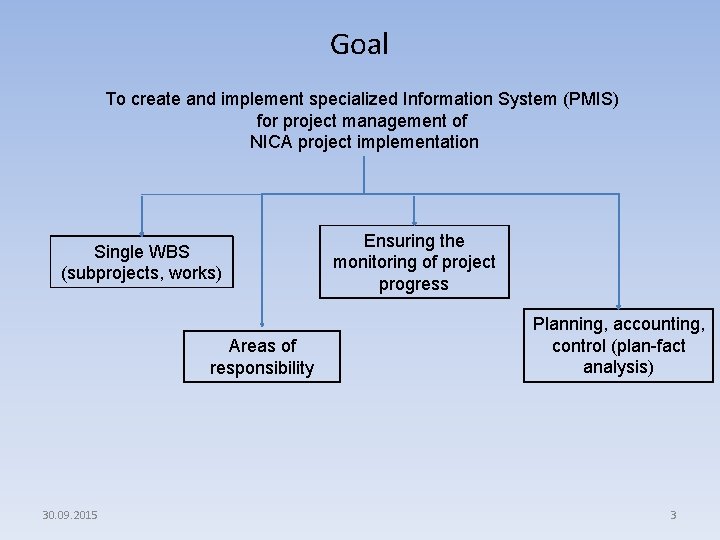
Goal To create and implement specialized Information System (PMIS) for project management of NICA project implementation Single WBS (subprojects, works) Areas of responsibility 30. 09. 2015 Ensuring the monitoring of project progress Planning, accounting, control (plan-fact analysis) 3
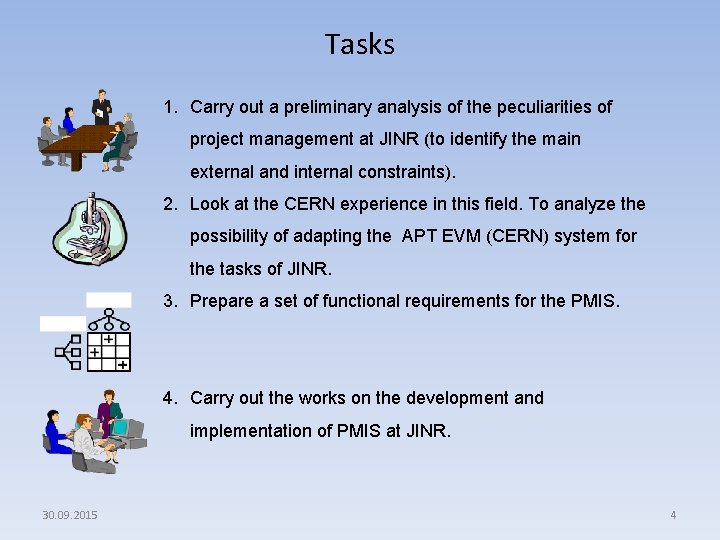
Tasks 1. Carry out a preliminary analysis of the peculiarities of project management at JINR (to identify the main external and internal constraints). 2. Look at the CERN experience in this field. To analyze the possibility of adapting the APT EVM (CERN) system for the tasks of JINR. 3. Prepare a set of functional requirements for the PMIS. 4. Carry out the works on the development and implementation of PMIS at JINR. 30. 09. 2015 4
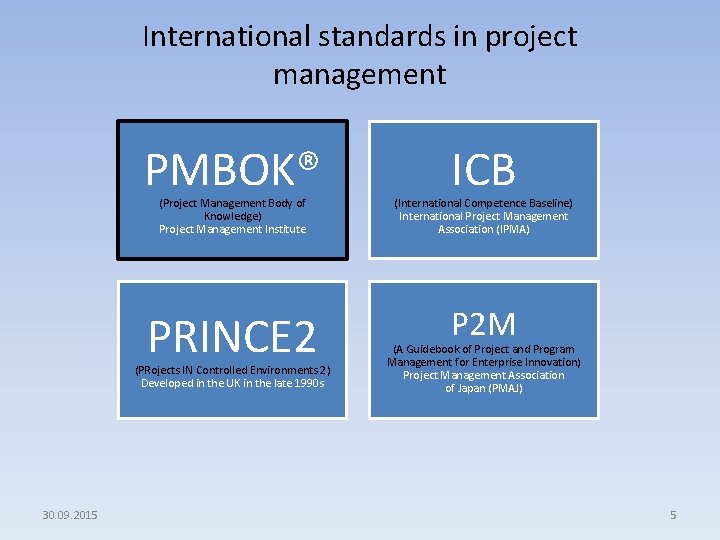
International standards in project management PMBOK® (Project Management Body of Knowledge) Project Management Institute (International Competence Baseline) International Project Management Association (IPMA) PRINCE 2 P 2 M (PRojects IN Controlled Environments 2) Developed in the UK in the late 1990 s 30. 09. 2015 ICB (A Guidebook of Project and Program Management for Enterprise Innovation) Project Management Association of Japan (PMAJ) 5
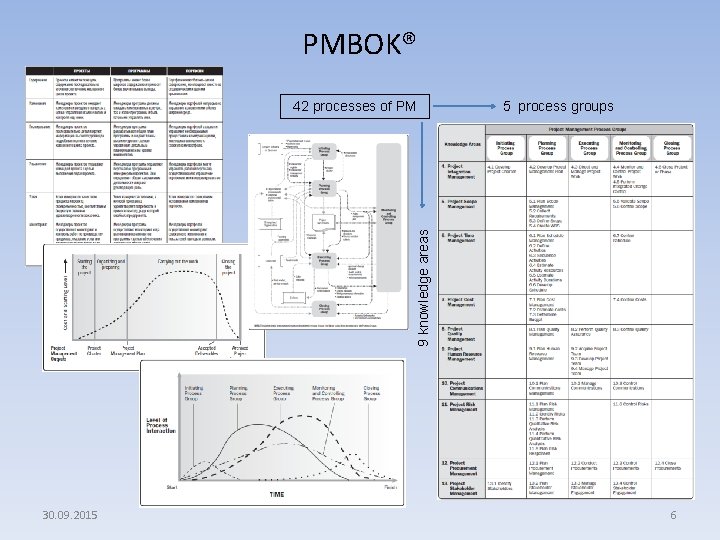
PMBOK® 5 process groups 9 knowledge areas 42 processes of PM 30. 09. 2015 6
What do we have to pay attention for during the PMIS creation? 1. Peculiarities of project life cycle model. 2. Triple constraint (resources – time – scope). 3. Factors within and out enterprise: a) Organizational culture, structures and processes; b) The internal fiscal rules and policies; c) Existing corporate information systems; d) The political climate and market situation; e) Organizational communications; f) Experience of using the project management information systems in the organization. 4. We need to choose and use only those processes which are appropriate for NICA project, to change (adopt) the processes for our project. 30. 09. 2015 7
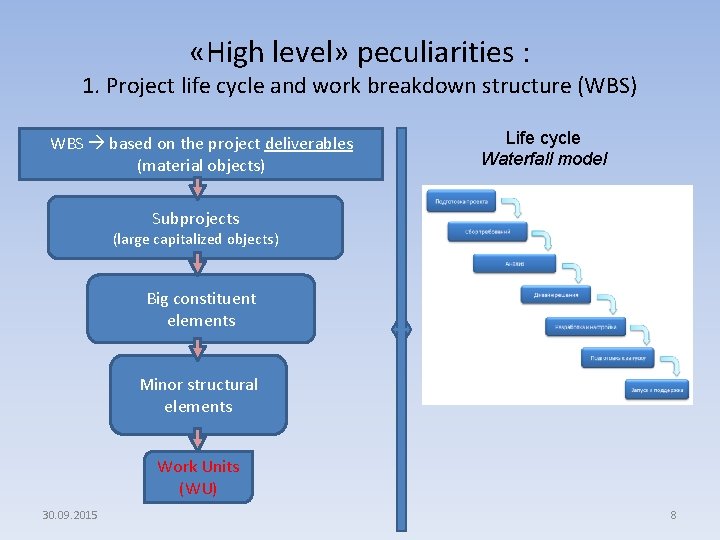
«High level» peculiarities : 1. Project life cycle and work breakdown structure (WBS) WBS based on the project deliverables (material objects) Life cycle Waterfall model Subprojects (large capitalized objects) Big constituent elements Minor structural elements Work Units (WU) 30. 09. 2015 8
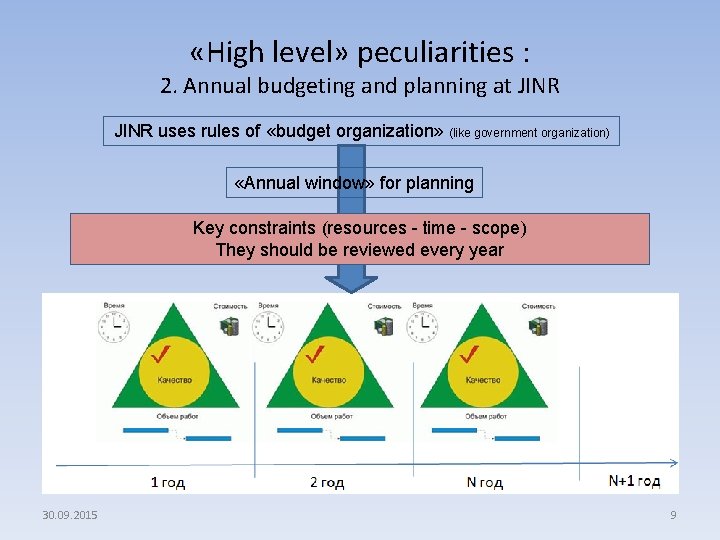
«High level» peculiarities : 2. Annual budgeting and planning at JINR uses rules of «budget organization» (like government organization) «Annual window» for planning Key constraints (resources - time - scope) They should be reviewed every year 30. 09. 2015 9
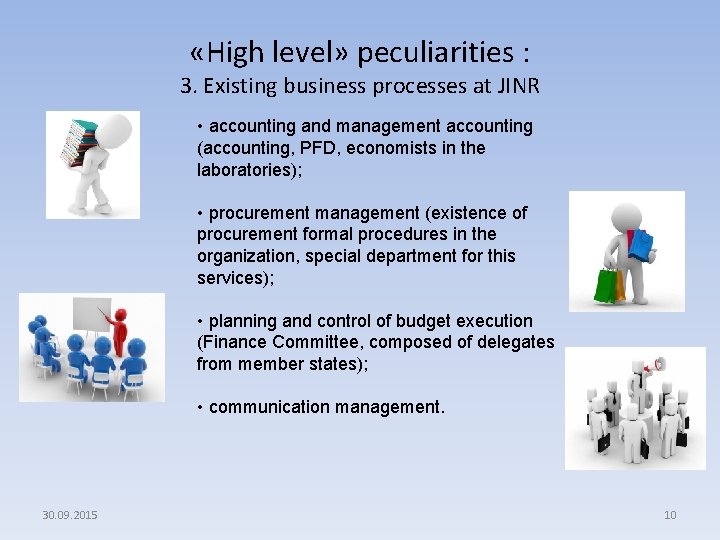
«High level» peculiarities : 3. Existing business processes at JINR • accounting and management accounting (accounting, PFD, economists in the laboratories); • procurement management (existence of procurement formal procedures in the organization, special department for this services); • planning and control of budget execution (Finance Committee, composed of delegates from member states); • communication management. 30. 09. 2015 10
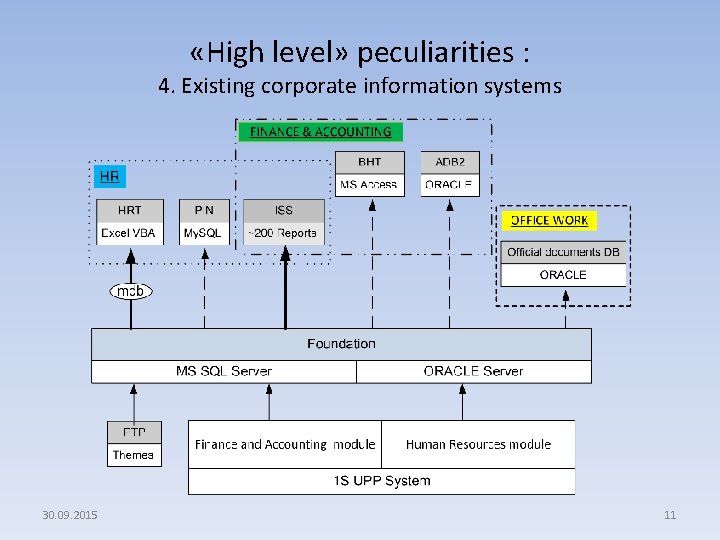
«High level» peculiarities : 4. Existing corporate information systems 30. 09. 2015 11
AIS in 2010 -2011 years The systems supported the following workflows : • accounting and management accounting (1 S UPP, ADB 2); • budget planning and control (BHT, ADB 2, PTP); • HR (HRT, ISS, 1 S UPP); • the activities of scientific personnel (PIN); • forming of analytical reports, analysis of financial and economic activity/results (ISS, ADB 2, 1 S UPP). 30. 09. 2015 12
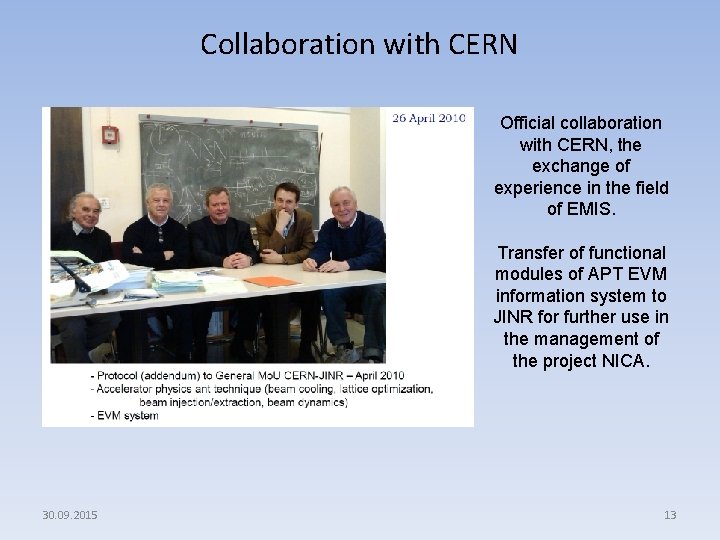
Collaboration with CERN Official collaboration with CERN, the exchange of experience in the field of EMIS. Transfer of functional modules of APT EVM information system to JINR for further use in the management of the project NICA. 30. 09. 2015 13
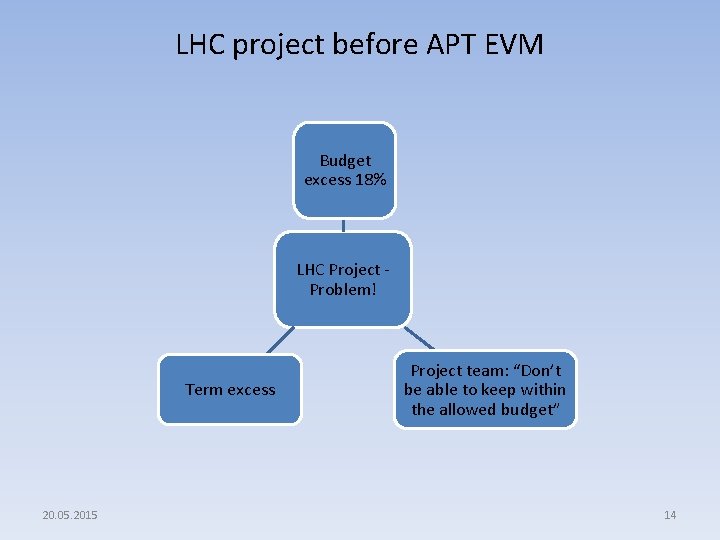
LHC project before APT EVM Budget excess 18% LHC Project Problem! Term excess 20. 05. 2015 Project team: “Don’t be able to keep within the allowed budget” 14
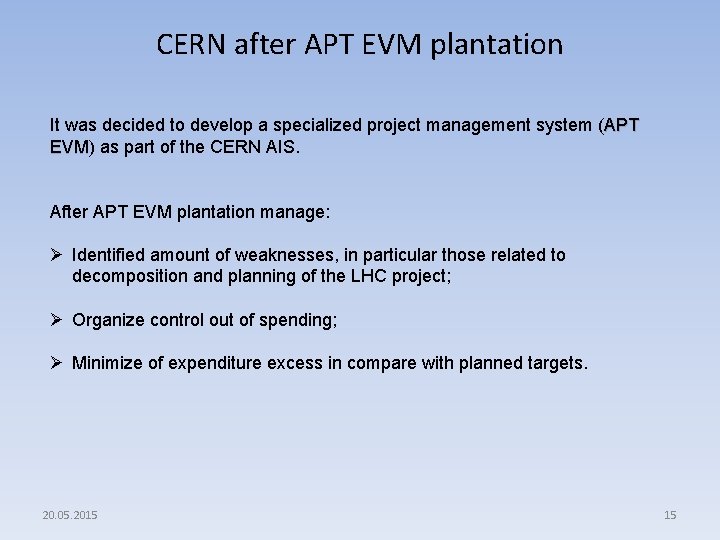
CERN after APT EVM plantation It was decided to develop a specialized project management system (APT EVM) EVM as part of the CERN AIS. After APT EVM plantation manage: Ø Identified amount of weaknesses, in particular those related to decomposition and planning of the LHC project; Ø Organize control out of spending; Ø Minimize of expenditure excess in compare with planned targets. 20. 05. 2015 15
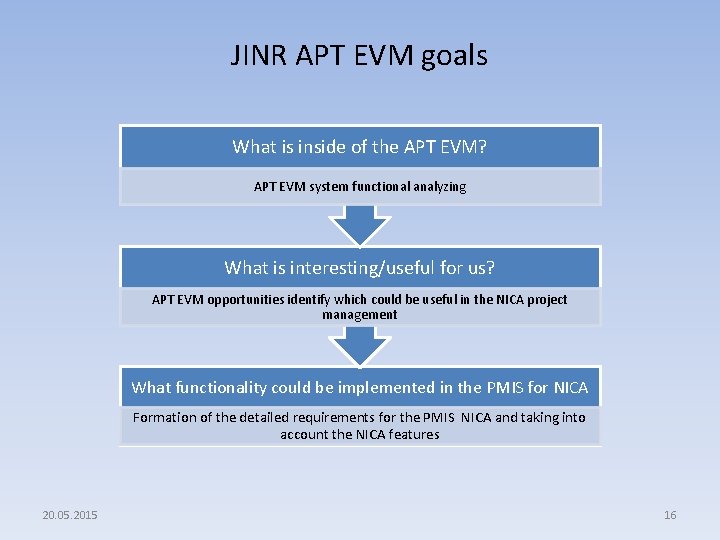
JINR APT EVM goals What is inside of the APT EVM? APT EVM system functional analyzing What is interesting/useful for us? APT EVM opportunities identify which could be useful in the NICA project management What functionality could be implemented in the PMIS for NICA Formation of the detailed requirements for the PMIS NICA and taking into account the NICA features 20. 05. 2015 16
The APT EVM startup required • bring the project structure for a single form and requirements, i. e. , determine the restrictions on the nesting level of WBS (not more than 4 levels deep), a minimum set of WU (works) characteristics; • prepare a description of the organizational structure (OBS); • budget code description (in CERN like terminology); • JINR user list (administrators, project managers, sub-managers and work packages); • produce functional revision JINR ADB 2 for cost unloading information (works payment) regarding the APT EVM elements; • make the changes to the APT EVM functionality, in order for system able to perceive the cost data from an external system. 20. 05. 2015 17
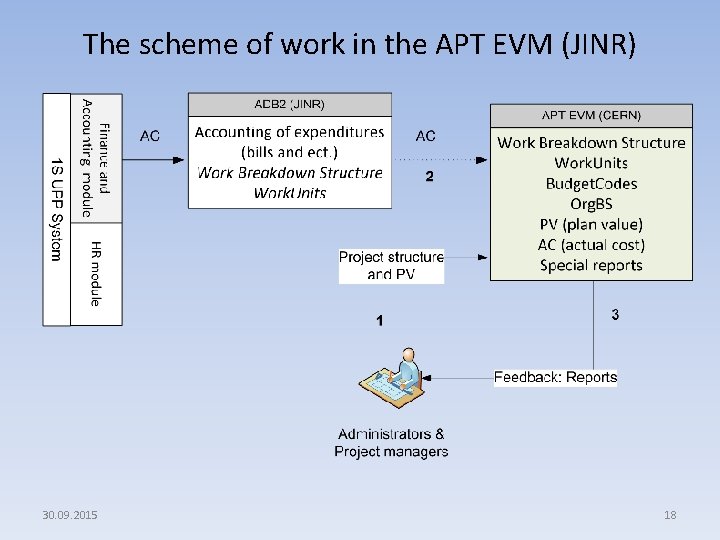
The scheme of work in the APT EVM (JINR) 30. 09. 2015 18
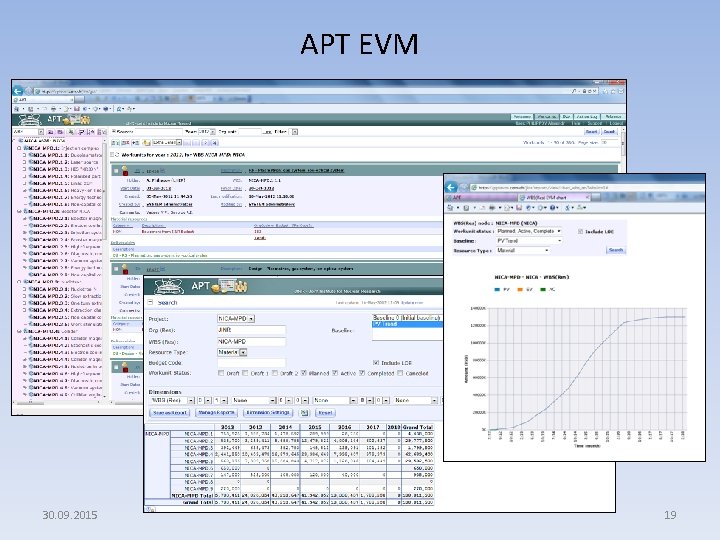
APT EVM 30. 09. 2015 19
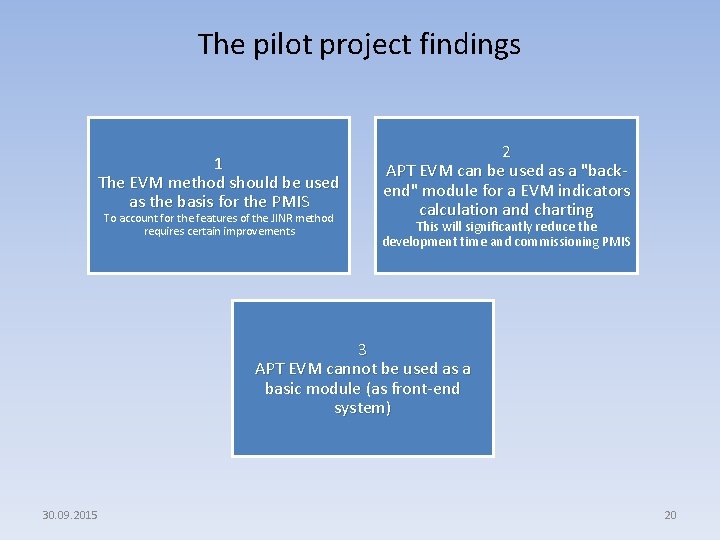
The pilot project findings 1 The EVM method should be used as the basis for the PMIS To account for the features of the JINR method requires certain improvements 2 APT EVM can be used as a "backend" module for a EVM indicators calculation and charting This will significantly reduce the development time and commissioning PMIS 3 APT EVM cannot be used as a basic module (as front-end system) 30. 09. 2015 20
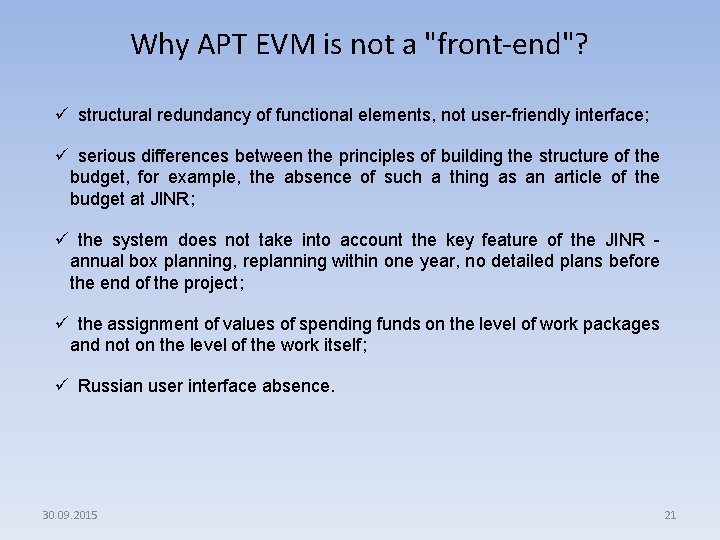
Why APT EVM is not a "front-end"? ü structural redundancy of functional elements, not user-friendly interface; ü serious differences between the principles of building the structure of the budget, for example, the absence of such a thing as an article of the budget at JINR; ü the system does not take into account the key feature of the JINR annual box planning, replanning within one year, no detailed plans before the end of the project; ü the assignment of values of spending funds on the level of work packages and not on the level of the work itself; ü Russian user interface absence. 30. 09. 2015 21
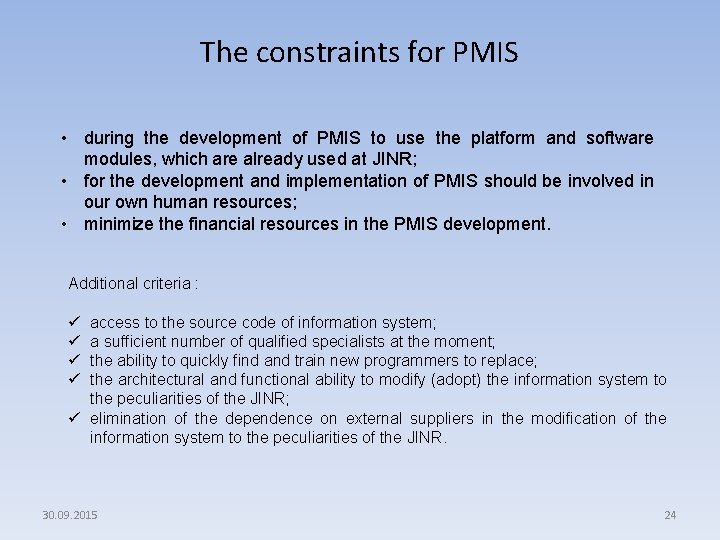
The constraints for PMIS • during the development of PMIS to use the platform and software modules, which are already used at JINR; • for the development and implementation of PMIS should be involved in our own human resources; • minimize the financial resources in the PMIS development. Additional criteria : ü ü access to the source code of information system; a sufficient number of qualified specialists at the moment; the ability to quickly find and train new programmers to replace; the architectural and functional ability to modify (adopt) the information system to the peculiarities of the JINR; ü elimination of the dependence on external suppliers in the modification of the information system to the peculiarities of the JINR. 30. 09. 2015 24
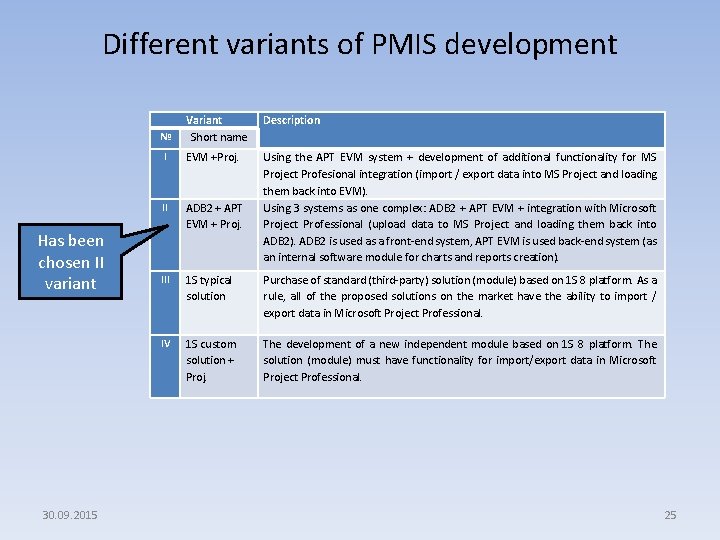
Different variants of PMIS development Variant Short name Description I EVM +Proj. II ADB 2 + APT EVM + Proj. Using the APT EVM system + development of additional functionality for MS Project Profesional integration (import / export data into MS Project and loading them back into EVM). Using 3 systems as one complex: ADB 2 + APT EVM + integration with Microsoft Project Professional (upload data to MS Project and loading them back into ADB 2). ADB 2 is used as a front-end system, APT EVM is used back-end system (as an internal software module for charts and reports creation). III 1 S typical solution Purchase of standard (third-party) solution (module) based on 1 S 8 platform. As a rule, all of the proposed solutions on the market have the ability to import / export data in Microsoft Project Professional. IV 1 S custom solution + Proj. The development of a new independent module based on 1 S 8 platform. The solution (module) must have functionality for import/export data in Microsoft Project Professional. № Has been chosen II variant 30. 09. 2015 25
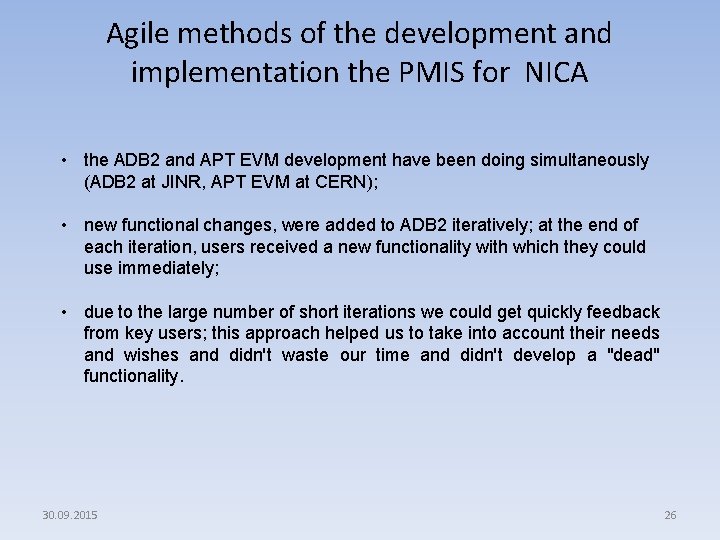
Agile methods of the development and implementation the PMIS for NICA • the ADB 2 and APT EVM development have been doing simultaneously (ADB 2 at JINR, APT EVM at CERN); • new functional changes, were added to ADB 2 iteratively; at the end of each iteration, users received a new functionality with which they could use immediately; • due to the large number of short iterations we could get quickly feedback from key users; this approach helped us to take into account their needs and wishes and didn't waste our time and didn't develop a "dead" functionality. 30. 09. 2015 26
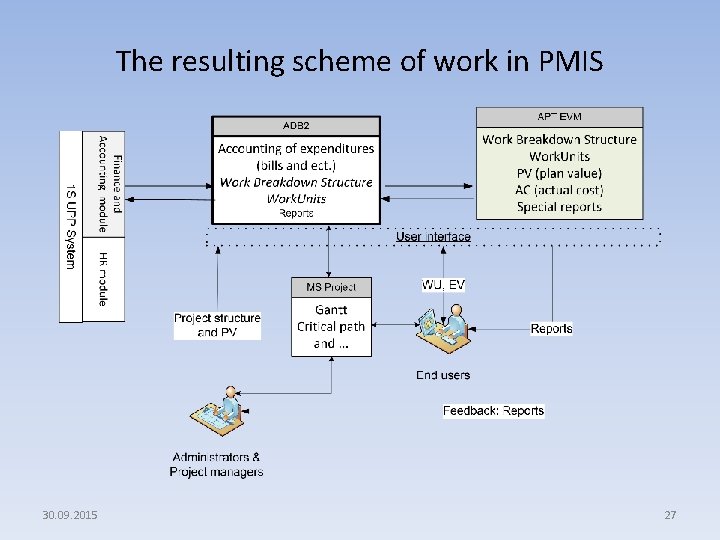
The resulting scheme of work in PMIS 30. 09. 2015 27
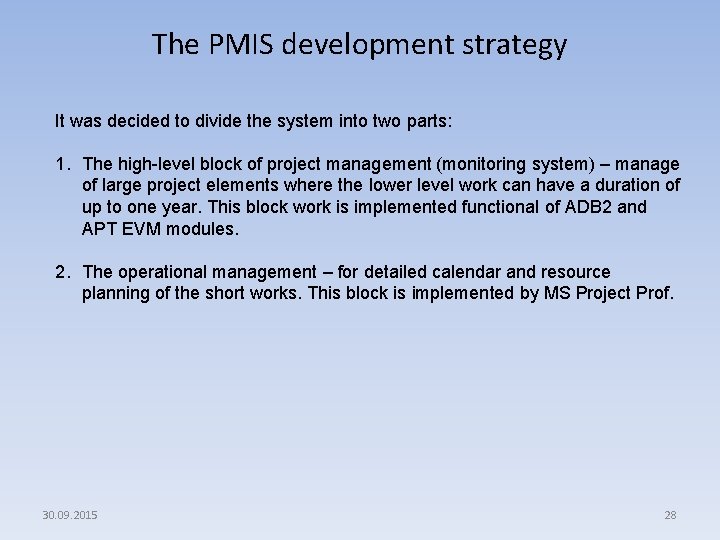
The PMIS development strategy It was decided to divide the system into two parts: 1. The high-level block of project management (monitoring system) – manage of large project elements where the lower level work can have a duration of up to one year. This block work is implemented functional of ADB 2 and APT EVM modules. 2. The operational management – for detailed calendar and resource planning of the short works. This block is implemented by MS Project Prof. 30. 09. 2015 28
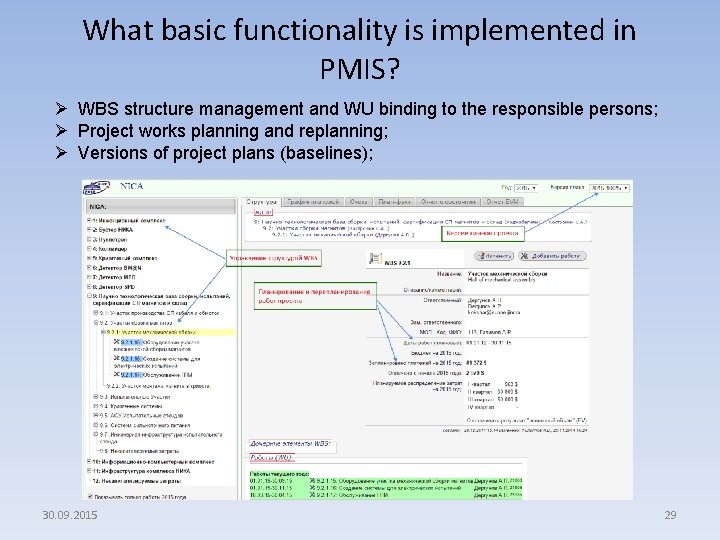
What basic functionality is implemented in PMIS? Ø WBS structure management and WU binding to the responsible persons; Ø Project works planning and replanning; Ø Versions of project plans (baselines); 30. 09. 2015 29
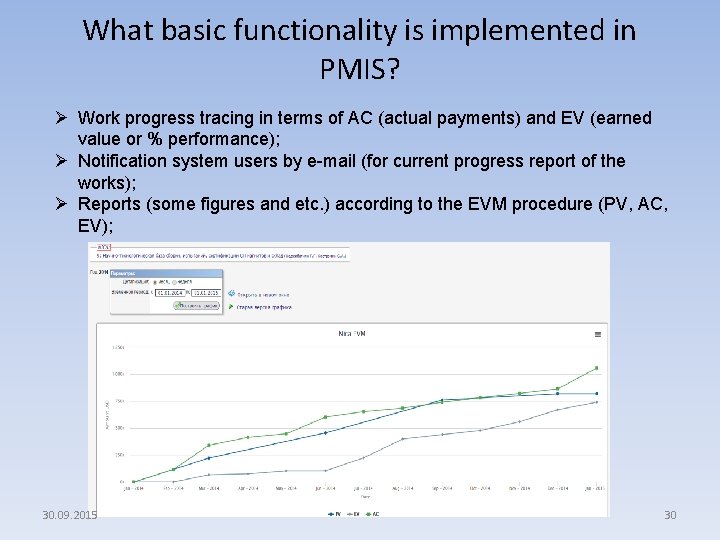
What basic functionality is implemented in PMIS? Ø Work progress tracing in terms of AC (actual payments) and EV (earned value or % performance); Ø Notification system users by e-mail (for current progress report of the works); Ø Reports (some figures and etc. ) according to the EVM procedure (PV, AC, EV); 30. 09. 2015 30
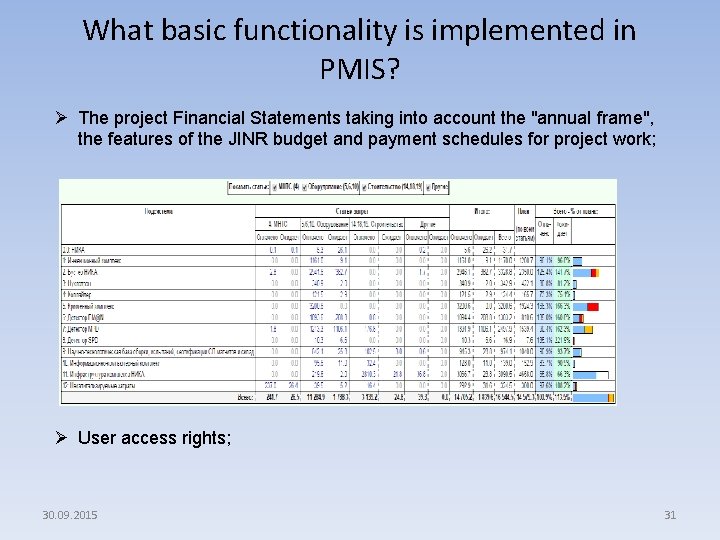
What basic functionality is implemented in PMIS? Ø The project Financial Statements taking into account the "annual frame", the features of the JINR budget and payment schedules for project work; Ø User access rights; 30. 09. 2015 31
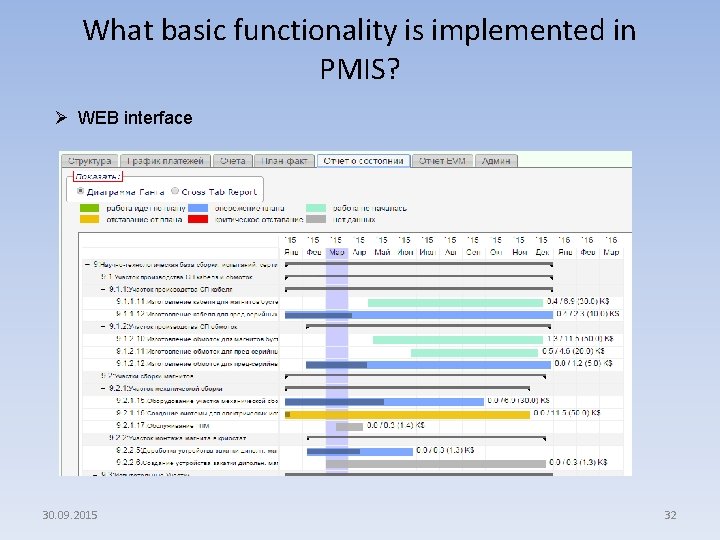
What basic functionality is implemented in PMIS? Ø WEB interface 30. 09. 2015 32
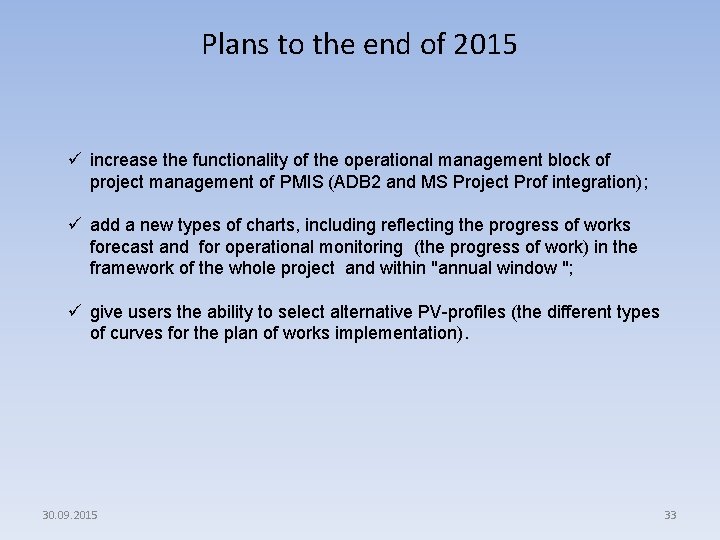
Plans to the end of 2015 ü increase the functionality of the operational management block of project management of PMIS (ADB 2 and MS Project Prof integration); ü add a new types of charts, including reflecting the progress of works forecast and for operational monitoring (the progress of work) in the framework of the whole project and within "annual window "; ü give users the ability to select alternative PV-profiles (the different types of curves for the plan of works implementation). 30. 09. 2015 33
Thank you! mbashashin@jinr. ru 30. 09. 2015 34
- Slides: 34