
NHS Test Trace A guide for local organisations
- Slides: 24
NHS Test & Trace A guide for local organisations The information in these slides was correct as of 18/06/20. COVID-19 contact tracing is a rapidly evolving area and guidance is subject to change Public Health June 2020
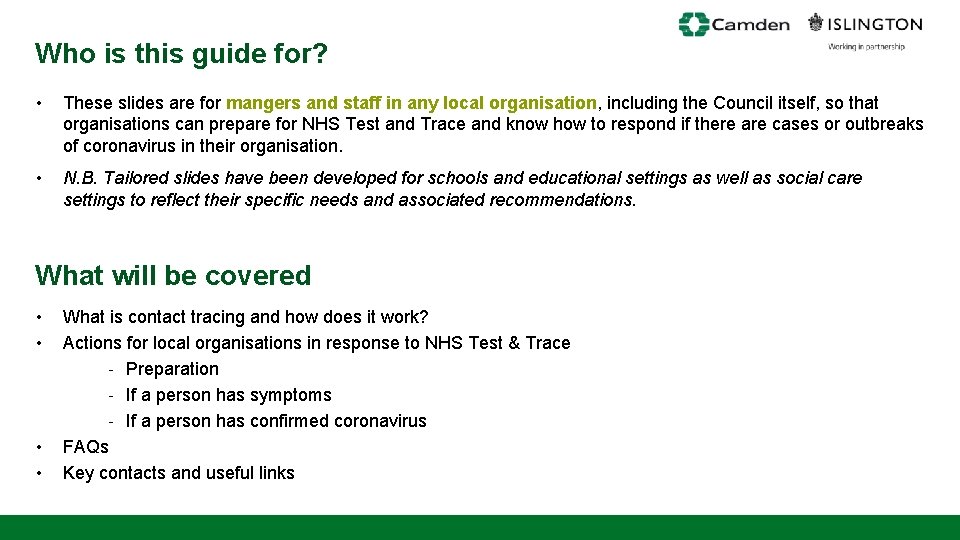
Who is this guide for? • These slides are for mangers and staff in any local organisation, including the Council itself, so that organisations can prepare for NHS Test and Trace and know how to respond if there are cases or outbreaks of coronavirus in their organisation. • N. B. Tailored slides have been developed for schools and educational settings as well as social care settings to reflect their specific needs and associated recommendations. What will be covered • • What is contact tracing and how does it work? Actions for local organisations in response to NHS Test & Trace - Preparation - If a person has symptoms - If a person has confirmed coronavirus FAQs Key contacts and useful links
What is contact tracing and how does it work?
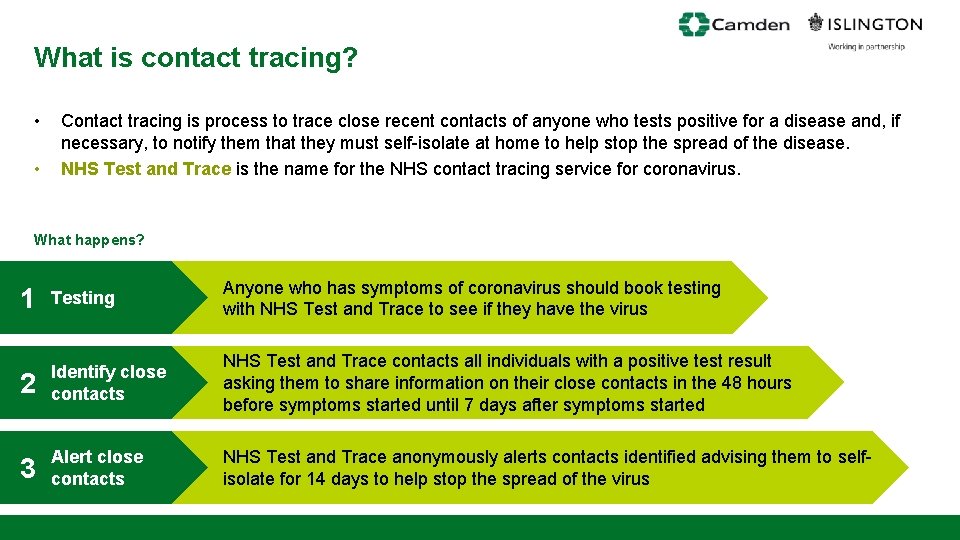
What is contact tracing? • • Contact tracing is process to trace close recent contacts of anyone who tests positive for a disease and, if necessary, to notify them that they must self-isolate at home to help stop the spread of the disease. NHS Test and Trace is the name for the NHS contact tracing service for coronavirus. What happens? 1 Testing Anyone who has symptoms of coronavirus should book testing with NHS Test and Trace to see if they have the virus 2 Identify close contacts NHS Test and Trace contacts all individuals with a positive test result asking them to share information on their close contacts in the 48 hours before symptoms started until 7 days after symptoms started 3 Alert close contacts NHS Test and Trace anonymously alerts contacts identified advising them to selfisolate for 14 days to help stop the spread of the virus
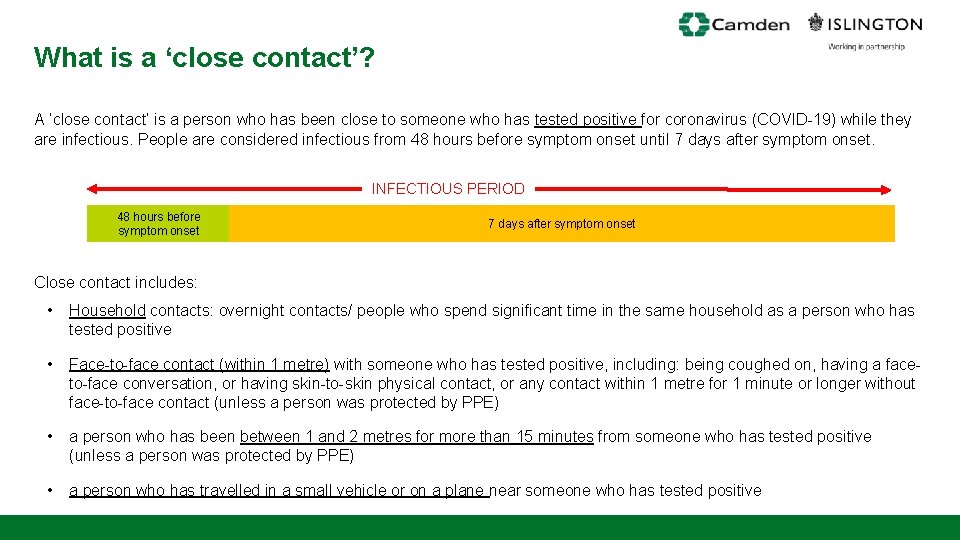
What is a ‘close contact’? A ‘close contact’ is a person who has been close to someone who has tested positive for coronavirus (COVID-19) while they are infectious. People are considered infectious from 48 hours before symptom onset until 7 days after symptom onset. INFECTIOUS PERIOD 48 hours before symptom onset 7 days after symptom onset Close contact includes: • Household contacts: overnight contacts/ people who spend significant time in the same household as a person who has tested positive • Face-to-face contact (within 1 metre) with someone who has tested positive, including: being coughed on, having a faceto-face conversation, or having skin-to-skin physical contact, or any contact within 1 metre for 1 minute or longer without face-to-face contact (unless a person was protected by PPE) • a person who has been between 1 and 2 metres for more than 15 minutes from someone who has tested positive (unless a person was protected by PPE) • a person who has travelled in a small vehicle or on a plane near someone who has tested positive
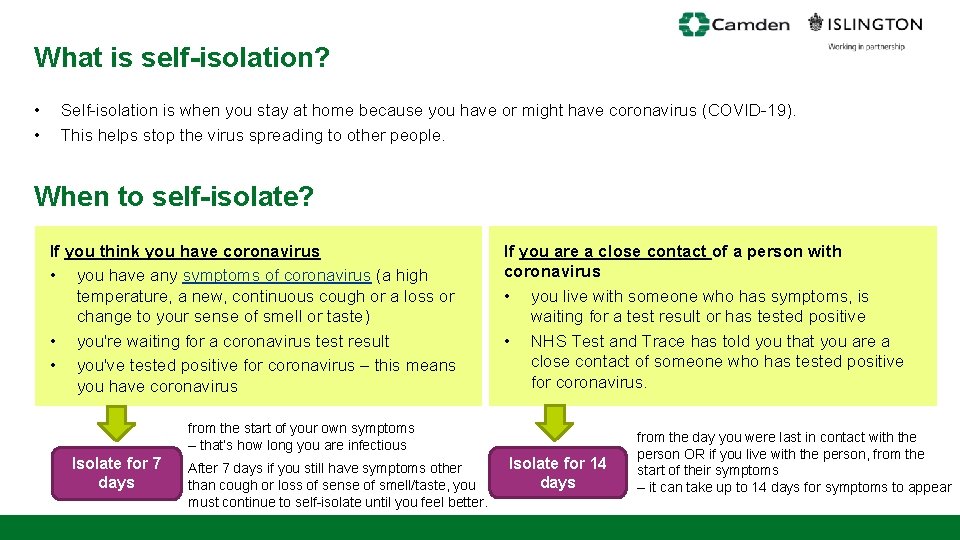
What is self-isolation? • • Self-isolation is when you stay at home because you have or might have coronavirus (COVID-19). This helps stop the virus spreading to other people. When to self-isolate? If you think you have coronavirus • you have any symptoms of coronavirus (a high temperature, a new, continuous cough or a loss or change to your sense of smell or taste) • you're waiting for a coronavirus test result • you've tested positive for coronavirus – this means you have coronavirus If you are a close contact of a person with coronavirus • you live with someone who has symptoms, is waiting for a test result or has tested positive • NHS Test and Trace has told you that you are a close contact of someone who has tested positive for coronavirus. from the start of your own symptoms – that’s how long you are infectious Isolate for 7 days After 7 days if you still have symptoms other than cough or loss of sense of smell/taste, you must continue to self-isolate until you feel better. Isolate for 14 days from the day you were last in contact with the person OR if you live with the person, from the start of their symptoms – it can take up to 14 days for symptoms to appear
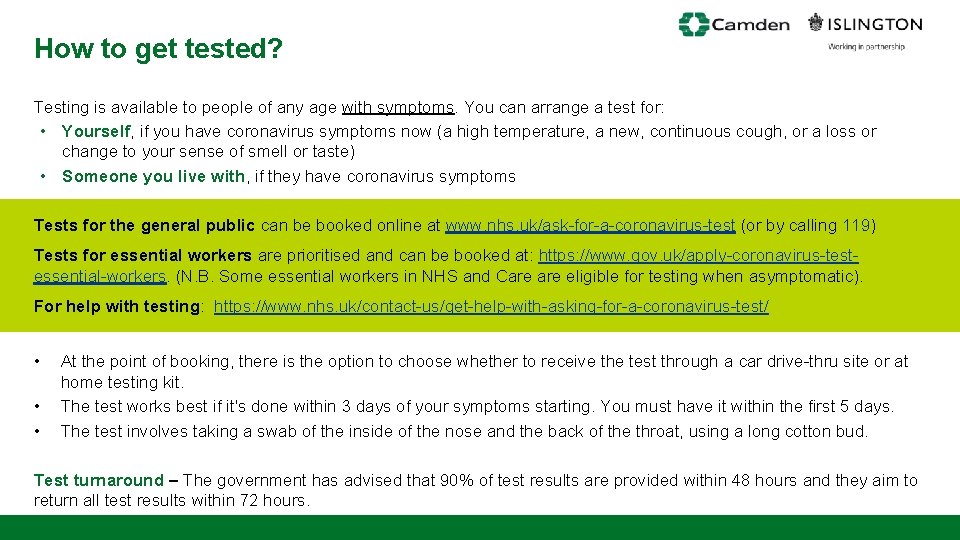
How to get tested? Testing is available to people of any age with symptoms. You can arrange a test for: • Yourself, if you have coronavirus symptoms now (a high temperature, a new, continuous cough, or a loss or change to your sense of smell or taste) • Someone you live with, if they have coronavirus symptoms Tests for the general public can be booked online at www. nhs. uk/ask-for-a-coronavirus-test (or by calling 119) Tests for essential workers are prioritised and can be booked at: https: //www. gov. uk/apply-coronavirus-testessential-workers. (N. B. Some essential workers in NHS and Care eligible for testing when asymptomatic). For help with testing: https: //www. nhs. uk/contact-us/get-help-with-asking-for-a-coronavirus-test/ • • • At the point of booking, there is the option to choose whether to receive the test through a car drive-thru site or at home testing kit. The test works best if it's done within 3 days of your symptoms starting. You must have it within the first 5 days. The test involves taking a swab of the inside of the nose and the back of the throat, using a long cotton bud. Test turnaround – The government has advised that 90% of test results are provided within 48 hours and they aim to return all test results within 72 hours.
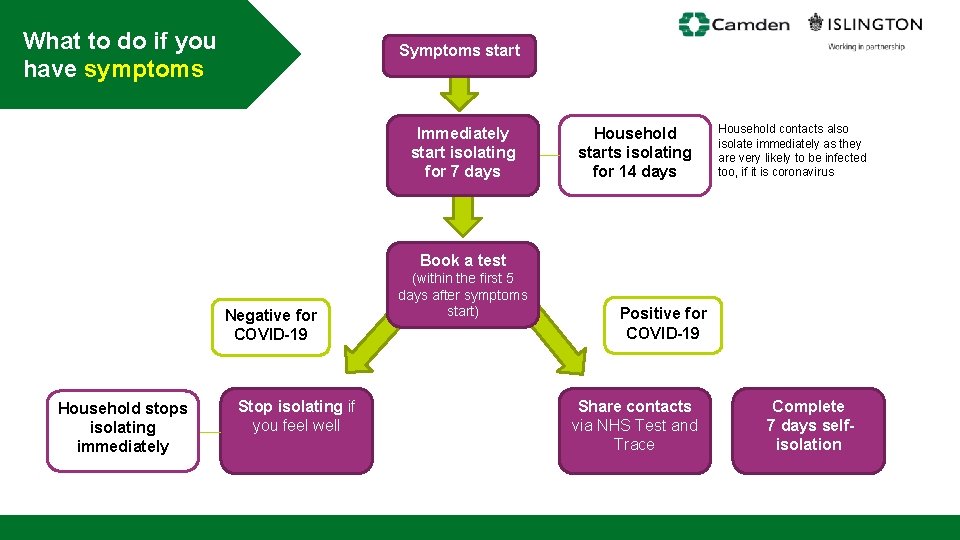
What to do if you have symptoms Symptoms start Immediately start isolating for 7 days Household starts isolating for 14 days Household contacts also isolate immediately as they are very likely to be infected too, if it is coronavirus Book a test Negative for COVID-19 Household stops isolating immediately Stop isolating if you feel well (within the first 5 days after symptoms start) Positive for COVID-19 Share contacts via NHS Test and Trace Complete 7 days selfisolation
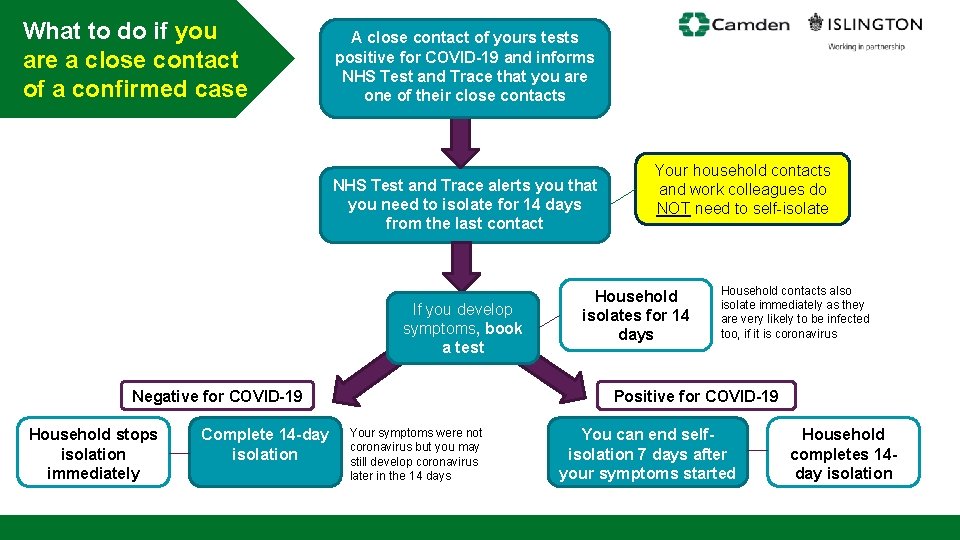
What to do if you are a close contact of a confirmed case A close contact of yours tests positive for COVID-19 and informs NHS Test and Trace that you are one of their close contacts NHS Test and Trace alerts you that you need to isolate for 14 days from the last contact If you develop symptoms, book a test Negative for COVID-19 Household stops isolation immediately Complete 14 -day isolation Your household contacts and work colleagues do NOT need to self-isolate Household isolates for 14 days Household contacts also isolate immediately as they are very likely to be infected too, if it is coronavirus Positive for COVID-19 Your symptoms were not coronavirus but you may still develop coronavirus later in the 14 days You can end selfisolation 7 days after your symptoms started Household completes 14 day isolation
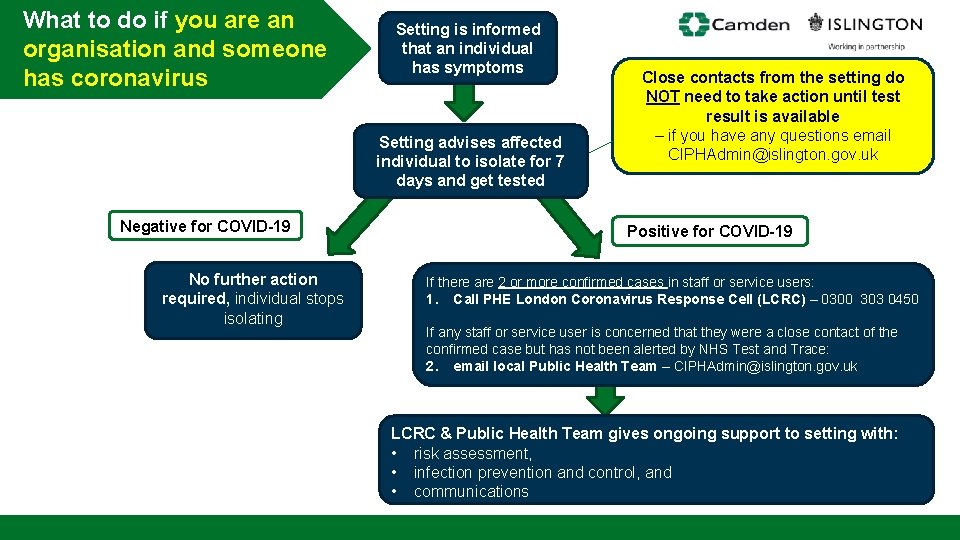
What to do if you are an organisation and someone has coronavirus Setting is informed that an individual has symptoms Setting advises affected individual to isolate for 7 days and get tested Negative for COVID-19 No further action required, individual stops isolating Close contacts from the setting do NOT need to take action until test result is available – if you have any questions email CIPHAdmin@islington. gov. uk Positive for COVID-19 If there are 2 or more confirmed cases in staff or service users: 1. Call PHE London Coronavirus Response Cell (LCRC) – 0300 303 0450 If any staff or service user is concerned that they were a close contact of the confirmed case but has not been alerted by NHS Test and Trace: 2. email local Public Health Team – CIPHAdmin@islington. gov. uk LCRC & Public Health Team gives ongoing support to setting with: • risk assessment, • infection prevention and control, and • communications
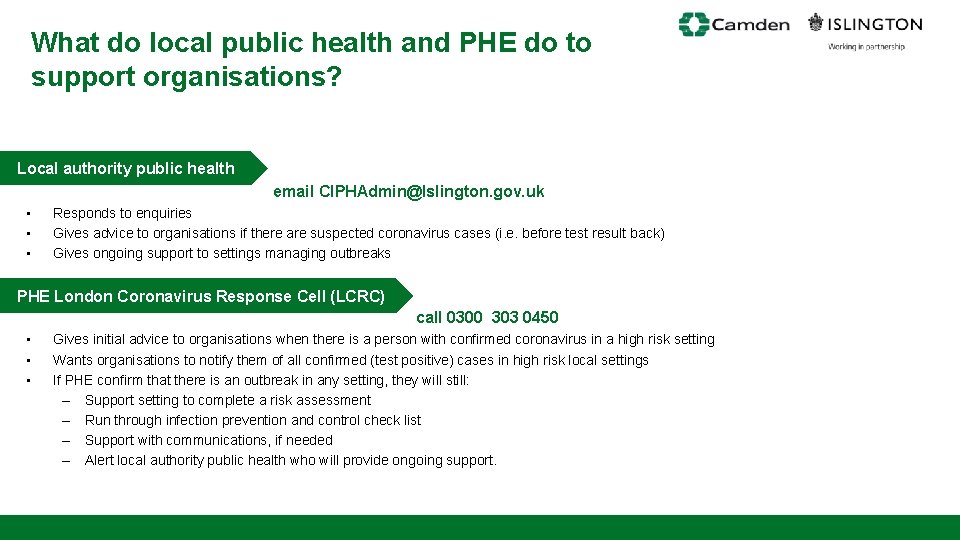
What do local public health and PHE do to support organisations? Local authority public health email CIPHAdmin@Islington. gov. uk • • • Responds to enquiries Gives advice to organisations if there are suspected coronavirus cases (i. e. before test result back) Gives ongoing support to settings managing outbreaks PHE London Coronavirus Response Cell (LCRC) call 0300 303 0450 • • • Gives initial advice to organisations when there is a person with confirmed coronavirus in a high risk setting Wants organisations to notify them of all confirmed (test positive) cases in high risk local settings If PHE confirm that there is an outbreak in any setting, they will still: – Support setting to complete a risk assessment – Run through infection prevention and control check list – Support with communications, if needed – Alert local authority public health who will provide ongoing support.
Actions for local organisations in response to NHS Test & Trace
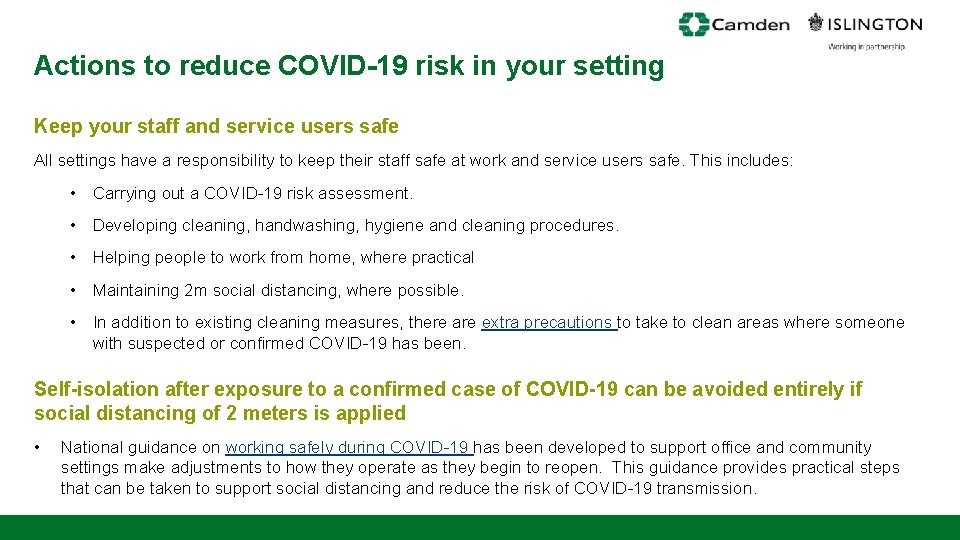
Actions to reduce COVID-19 risk in your setting Keep your staff and service users safe All settings have a responsibility to keep their staff safe at work and service users safe. This includes: • Carrying out a COVID-19 risk assessment. • Developing cleaning, handwashing, hygiene and cleaning procedures. • Helping people to work from home, where practical • Maintaining 2 m social distancing, where possible. • In addition to existing cleaning measures, there are extra precautions to take to clean areas where someone with suspected or confirmed COVID-19 has been. Self-isolation after exposure to a confirmed case of COVID-19 can be avoided entirely if social distancing of 2 meters is applied • National guidance on working safely during COVID-19 has been developed to support office and community settings make adjustments to how they operate as they begin to reopen. This guidance provides practical steps that can be taken to support social distancing and reduce the risk of COVID-19 transmission.
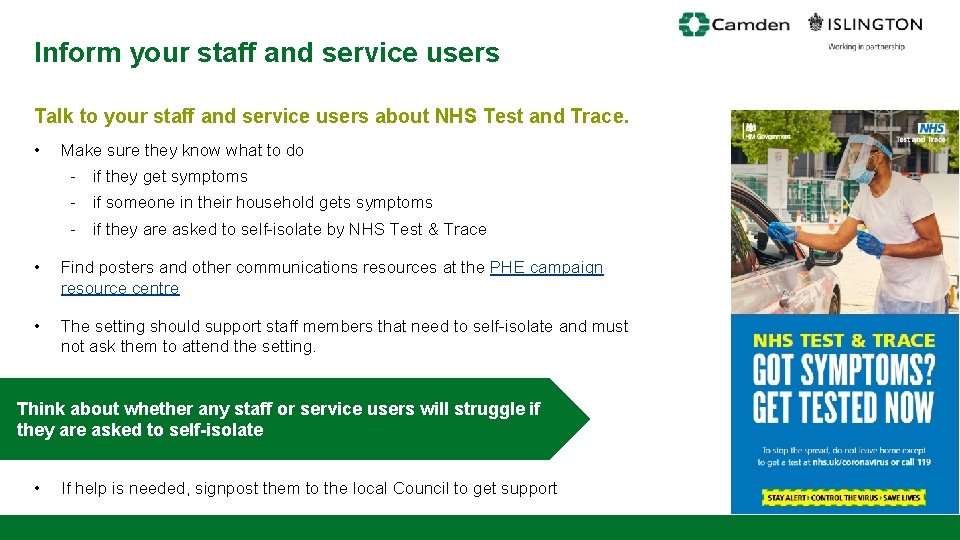
Inform your staff and service users Talk to your staff and service users about NHS Test and Trace. • Make sure they know what to do - if they get symptoms - if someone in their household gets symptoms - if they are asked to self-isolate by NHS Test & Trace • Find posters and other communications resources at the PHE campaign resource centre • The setting should support staff members that need to self-isolate and must not ask them to attend the setting. Think about whether any staff or service users will struggle if they are asked to self-isolate • If help is needed, signpost them to the local Council to get support
Think about potential impacts on staffing and capacity There may be times where several staff members are required to self-isolate at the same time as a result of being a close contact of a COVID-19 positive individual from either inside or outside the organisation. Organisations can prevent staff absence by facilitating social distancing • • • Communicate the importance of social distancing to staff Be aware of circumstances where staff may become relaxed around social distancing – e. g. during informal time such as tea breaks. Try to take action to reduce staff unnecessarily being in close contact with each other - e. g. staggered breaks, work stations being more than 2 m apart. Organisations should ensure their Business Continuity Plans are up to date • • Consider plans to support staff to work from home where practical, or rearrange staffing as needed. Consider how to manage if a large number of staff are required to self-isolate.
Advice for managers What to advise a staff member with symptoms When someone first develops symptoms they should be advised to self-isolate immediately and to arrange a test • If the test is positive, they should log onto the NHS Test and Trace system to identify their close contacts in the 48 hours before becoming • • unwell. If the test is negative, no action needs to be taken by others and the unwell member of staff can return to work when they feel well enough. While waiting for the test result, no one else in the organisation needs to self-isolate What to advise staff who think they may be a close contact of a person with symptoms Staff who believe that they may be close contacts of a person with symptoms do not need to self-isolate unless they are told to do so by the NHS Test and Trace system following a positive test result. • If there are concerns that the unwell person has not been tested and/or has not given information on their close contacts to NHS Test and • Trace, staff members should contact their managers. Managers should contact CIPHAdmin@islington. gov. uk for advice. Any staff member who believes themselves to have been exposed to possible COVID-19 but is waiting to hear whether the test result is positive can be advised to: - avoid individuals who are at high-risk of contracting COVID-19, for example, because they have pre-existing medical conditions, such as respiratory issues - take extra care in practicing social distancing and good hygiene and in watching out for symptoms. - be aware that they may receive a notification from the NHS test and trace service advising they need to self-isolate.
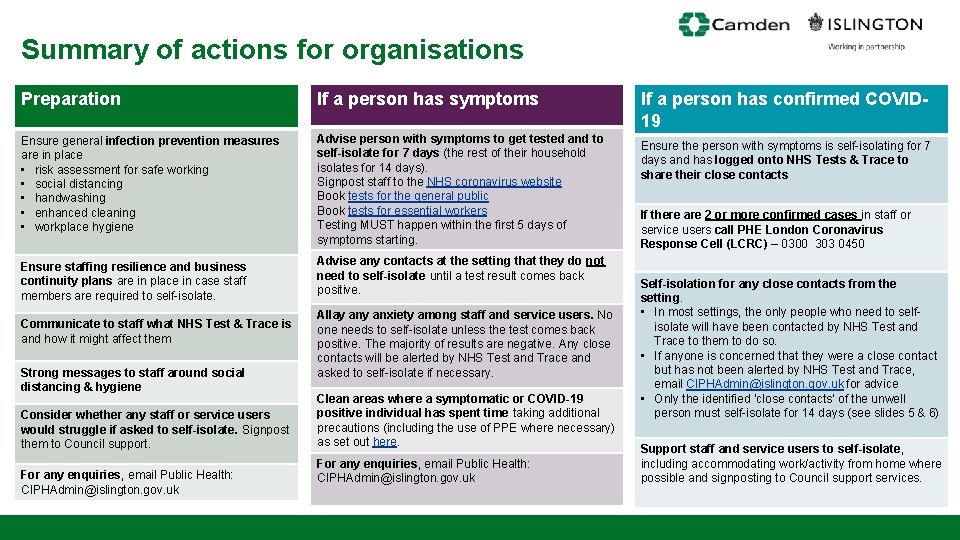
Summary of actions for organisations Preparation If a person has symptoms Ensure general infection prevention measures are in place • risk assessment for safe working • social distancing • handwashing • enhanced cleaning • workplace hygiene Advise person with symptoms to get tested and to self-isolate for 7 days (the rest of their household isolates for 14 days). Signpost staff to the NHS coronavirus website Book tests for the general public Book tests for essential workers Testing MUST happen within the first 5 days of symptoms starting. Ensure staffing resilience and business continuity plans are in place in case staff members are required to self-isolate. Advise any contacts at the setting that they do not need to self-isolate until a test result comes back positive. Communicate to staff what NHS Test & Trace is and how it might affect them Strong messages to staff around social distancing & hygiene Consider whether any staff or service users would struggle if asked to self-isolate. Signpost them to Council support. For any enquiries, email Public Health: CIPHAdmin@islington. gov. uk Allay anxiety among staff and service users. No one needs to self-isolate unless the test comes back positive. The majority of results are negative. Any close contacts will be alerted by NHS Test and Trace and asked to self-isolate if necessary. Clean areas where a symptomatic or COVID-19 positive individual has spent time taking additional precautions (including the use of PPE where necessary) as set out here. For any enquiries, email Public Health: CIPHAdmin@islington. gov. uk If a person has confirmed COVID 19 Ensure the person with symptoms is self-isolating for 7 days and has logged onto NHS Tests & Trace to share their close contacts If there are 2 or more confirmed cases in staff or service users call PHE London Coronavirus Response Cell (LCRC) – 0300 303 0450 Self-isolation for any close contacts from the setting. • In most settings, the only people who need to selfisolate will have been contacted by NHS Test and Trace to them to do so. • If anyone is concerned that they were a close contact but has not been alerted by NHS Test and Trace, email CIPHAdmin@islington. gov. uk for advice • Only the identified ‘close contacts’ of the unwell person must self-isolate for 14 days (see slides 5 & 6) Support staff and service users to self-isolate, including accommodating work/activity from home where possible and signposting to Council support services.
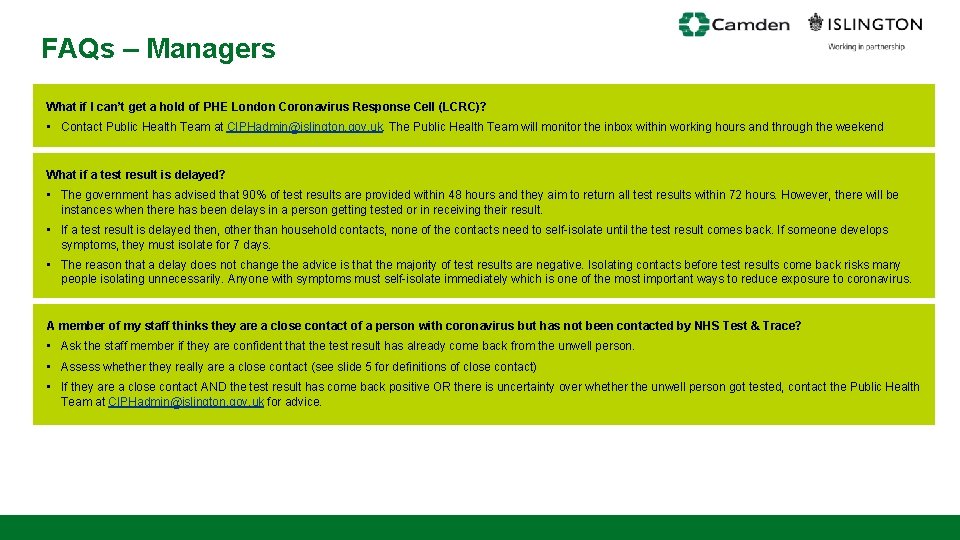
FAQs – Managers What if I can’t get a hold of PHE London Coronavirus Response Cell (LCRC)? • Contact Public Health Team at CIPHadmin@islington. gov. uk. The Public Health Team will monitor the inbox within working hours and through the weekend What if a test result is delayed? • The government has advised that 90% of test results are provided within 48 hours and they aim to return all test results within 72 hours. However, there will be instances when there has been delays in a person getting tested or in receiving their result. • If a test result is delayed then, other than household contacts, none of the contacts need to self-isolate until the test result comes back. If someone develops symptoms, they must isolate for 7 days. • The reason that a delay does not change the advice is that the majority of test results are negative. Isolating contacts before test results come back risks many people isolating unnecessarily. Anyone with symptoms must self-isolate immediately which is one of the most important ways to reduce exposure to coronavirus. A member of my staff thinks they are a close contact of a person with coronavirus but has not been contacted by NHS Test & Trace? • Ask the staff member if they are confident that the test result has already come back from the unwell person. • Assess whether they really are a close contact (see slide 5 for definitions of close contact) • If they are a close contact AND the test result has come back positive OR there is uncertainty over whether the unwell person got tested, contact the Public Health Team at CIPHadmin@islington. gov. uk for advice.
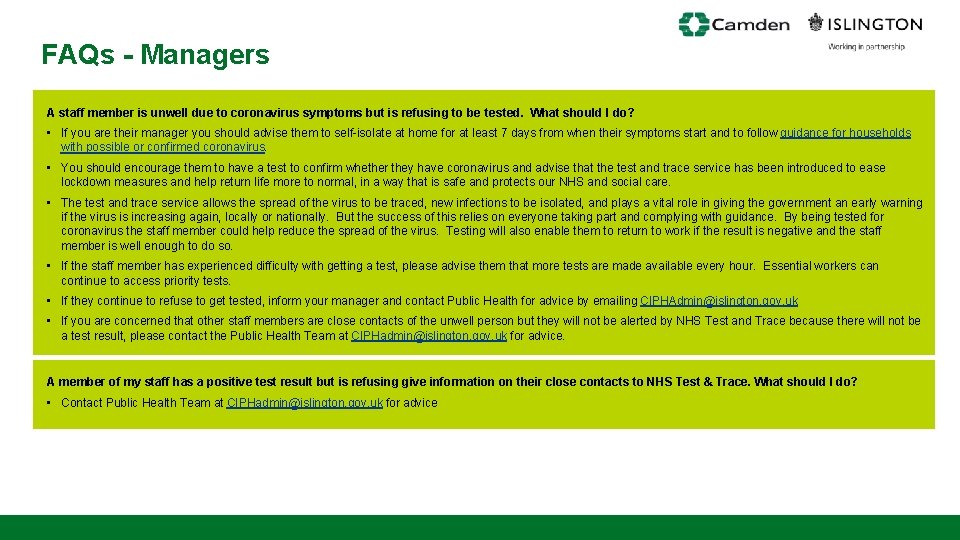
FAQs - Managers A staff member is unwell due to coronavirus symptoms but is refusing to be tested. What should I do? • If you are their manager you should advise them to self-isolate at home for at least 7 days from when their symptoms start and to follow guidance for households with possible or confirmed coronavirus. • You should encourage them to have a test to confirm whether they have coronavirus and advise that the test and trace service has been introduced to ease lockdown measures and help return life more to normal, in a way that is safe and protects our NHS and social care. • The test and trace service allows the spread of the virus to be traced, new infections to be isolated, and plays a vital role in giving the government an early warning if the virus is increasing again, locally or nationally. But the success of this relies on everyone taking part and complying with guidance. By being tested for coronavirus the staff member could help reduce the spread of the virus. Testing will also enable them to return to work if the result is negative and the staff member is well enough to do so. • If the staff member has experienced difficulty with getting a test, please advise them that more tests are made available every hour. Essential workers can continue to access priority tests. • If they continue to refuse to get tested, inform your manager and contact Public Health for advice by emailing CIPHAdmin@islington. gov. uk • If you are concerned that other staff members are close contacts of the unwell person but they will not be alerted by NHS Test and Trace because there will not be a test result, please contact the Public Health Team at CIPHadmin@islington. gov. uk for advice. A member of my staff has a positive test result but is refusing give information on their close contacts to NHS Test & Trace. What should I do? • Contact Public Health Team at CIPHadmin@islington. gov. uk for advice
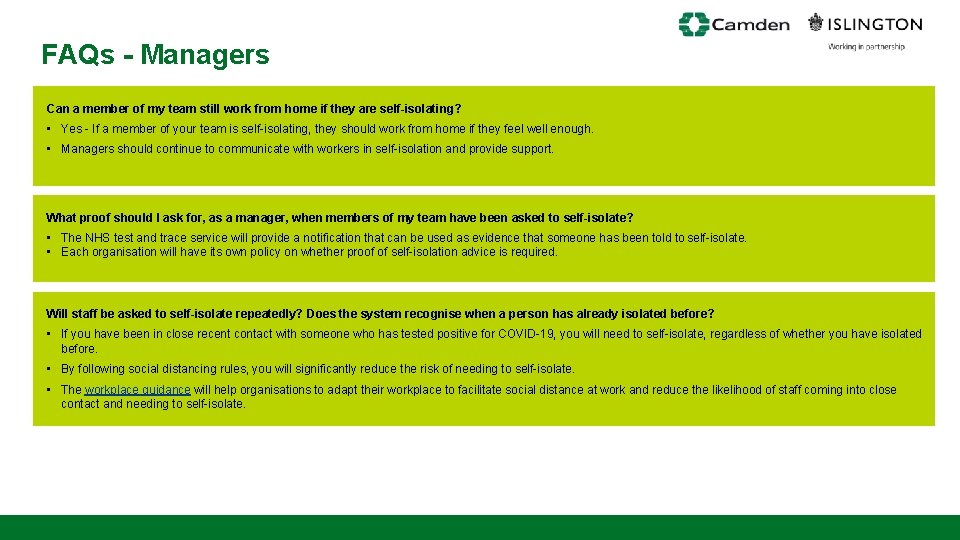
FAQs - Managers Can a member of my team still work from home if they are self-isolating? • Yes - If a member of your team is self-isolating, they should work from home if they feel well enough. • Managers should continue to communicate with workers in self-isolation and provide support. What proof should I ask for, as a manager, when members of my team have been asked to self-isolate? • The NHS test and trace service will provide a notification that can be used as evidence that someone has been told to self-isolate. • Each organisation will have its own policy on whether proof of self-isolation advice is required. Will staff be asked to self-isolate repeatedly? Does the system recognise when a person has already isolated before? • If you have been in close recent contact with someone who has tested positive for COVID-19, you will need to self-isolate, regardless of whether you have isolated before. • By following social distancing rules, you will significantly reduce the risk of needing to self-isolate. • The workplace guidance will help organisations to adapt their workplace to facilitate social distance at work and reduce the likelihood of staff coming into close contact and needing to self-isolate.
FAQs – General advice to the public How will I know if I need to self-isolate? • • • When a person who has symptoms receives a positive test result for COVID-19, the NHS test and trace service will ask them to share information about their close contacts just before and after they developed symptoms. Any non-household contacts who need to self-isolate will be contacted by the NHS test and trace service. They will receive a formal notification (either a phone call, letter, email or text message) setting out what to do. The period of self-isolation will be for 14 days from the point of most recent contact with the person who has tested positive for coronavirus. What does it mean to self-isolate? • • Do not leave your home for any reason – if you need food or medicine, order it online or by phone, or ask friends and family to drop it off at your home Unless it is possible for you to work from home, do not attend work. You will need to contact your employer to advise them that you have been told to self-isolate. Your employer may ask to see the formal notification. • Do not have visitors in your home, including friends and family – except for essential care • Try to avoid contact with anyone you live with as much as possible • If you live with someone at higher risk from coronavirus, try to arrange for them to stay with friends or family for 14 days. • People you live with do not need to self-isolate unless a person in that household has had symptoms but they must take extra care to follow the guidance on social distancing and handwashing and avoid contact with you at home. It’s really important to do this even if you don’t feel unwell because, if you have been infected, you could become infectious to others at any point up to 14 days after contact with a case.
FAQs – General advice to the public A person I have had close contact with in the last 2 days has told me they have coronavirus symptoms and they are being tested. What should I do? You do not need to self-isolate while the person with symptoms is awaiting their test result. But you should; • take extra care in practicing social distancing and good hygiene, like washing your hands regularly. • remain vigilant for your own symptoms • avoid individuals who are at high-risk of contracting COVID-19, for example, because they have pre-existing medical conditions, such as respiratory issues, or are over age 70. • be aware that you may receive a notification from the NHS test and trace service advising you need to self-isolate. What will happen if someone I don't know personally but come into contact with, such as on public transport, tests positive for COVID-19? • Everyone should continue to follow the social distancing guidelines by remaining 2 m apart from others and wearing a face covering on public transport or in settings where social distancing is not possible. • The NHS COVID-19 app, which is expected to be rolled out shortly, will enable the test and trace service to anonymously alert app users who have come into close contact with other app users who test positive for COVID-19. What does NHS Test & Trace do with my data and information? • When someone is contacted by the NHS test and trace service and told they have been in contact with someone with coronavirus, they will not be told who that person was, to protect anonymity. • The information they provide will be handled in strict confidence and will only be kept and used in line with data protection laws. It will help with contacting people who are at risk of having been exposed to coronavirus and explain what they must do to help prevent the further spread of the virus.
Key contacts and useful links Key contacts PHE London Coronavirus Response Cell (LCRC) – call 0300 303 0450 Local Public Health Team – email CIPHAdmin@islington. gov. uk Useful links PHE Campaign Resource Centre – for posters and other coronavirus media resources Book tests for the general public Book tests for essential workers NHS coronavirus homepage NHS website with easy to follow instructions/FAQs on NHS Test & Trace: how it works guidance Guidance on cleaning 3
Please email the Public Health Team on CIPHadmin@islington. gov. uk with any questions about these slides