
NHS Surrey Lipid Guidelines Dr Adam Jacques adamjacquesdoctors
- Slides: 36
NHS Surrey Lipid Guidelines Dr Adam Jacques adamjacques@doctors. org. uk Ashford & St Peter’s Hospital NHS Foundation Trust Prescribing Information is available at the end of this presentation
Prescribing Information is available at the end of this presentation
Prescribing Information is available at the end of this presentation
Prescribing Information is available at the end of this presentation
The Evidence for Intensive Statin Therapy
Myocardial Ischaemia Reduction with Aggressive Cholesterol Lowering (MIRACL) Schwartz GG et al. JAMA 2001; 285 (13): 1711 -1718 Prescribing Information is available at the end of this presentation
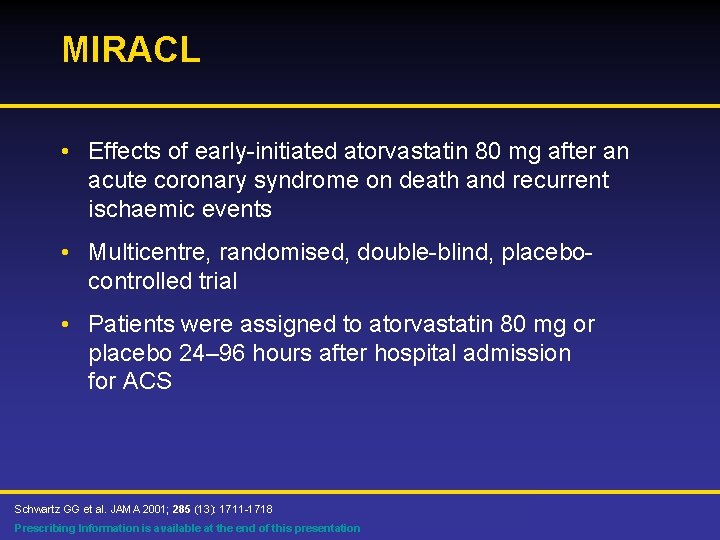
MIRACL • Effects of early-initiated atorvastatin 80 mg after an acute coronary syndrome on death and recurrent ischaemic events • Multicentre, randomised, double-blind, placebocontrolled trial • Patients were assigned to atorvastatin 80 mg or placebo 24– 96 hours after hospital admission for ACS Schwartz GG et al. JAMA 2001; 285 (13): 1711 -1718 Prescribing Information is available at the end of this presentation
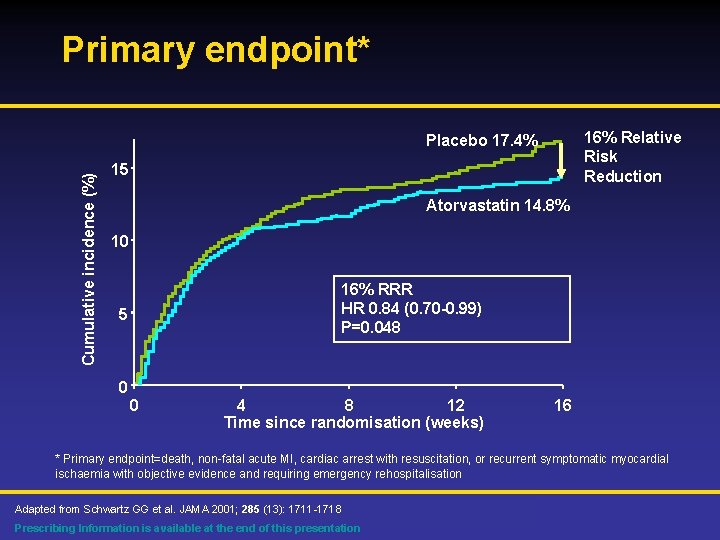
Primary endpoint* 16% Relative Risk Reduction Cumulative incidence (%) Placebo 17. 4% 15 Atorvastatin 14. 8% 10 16% RRR HR 0. 84 (0. 70 -0. 99) P=0. 048 5 0 0 4 8 12 Time since randomisation (weeks) 16 * Primary endpoint=death, non-fatal acute MI, cardiac arrest with resuscitation, or recurrent symptomatic myocardial ischaemia with objective evidence and requiring emergency rehospitalisation Adapted from Schwartz GG et al. JAMA 2001; 285 (13): 1711 -1718 Prescribing Information is available at the end of this presentation
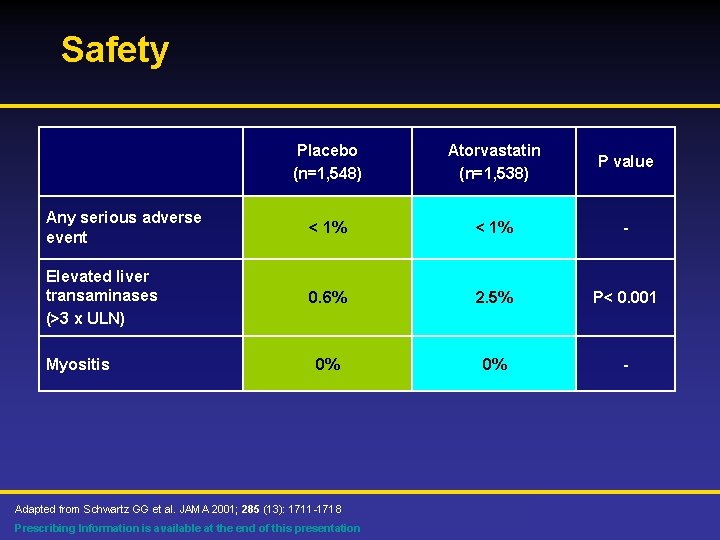
Safety Placebo (n=1, 548) Atorvastatin (n=1, 538) P value Any serious adverse event < 1% - Elevated liver transaminases (>3 x ULN) 0. 6% 2. 5% P< 0. 001 0% 0% - Myositis Adapted from Schwartz GG et al. JAMA 2001; 285 (13): 1711 -1718 Prescribing Information is available at the end of this presentation
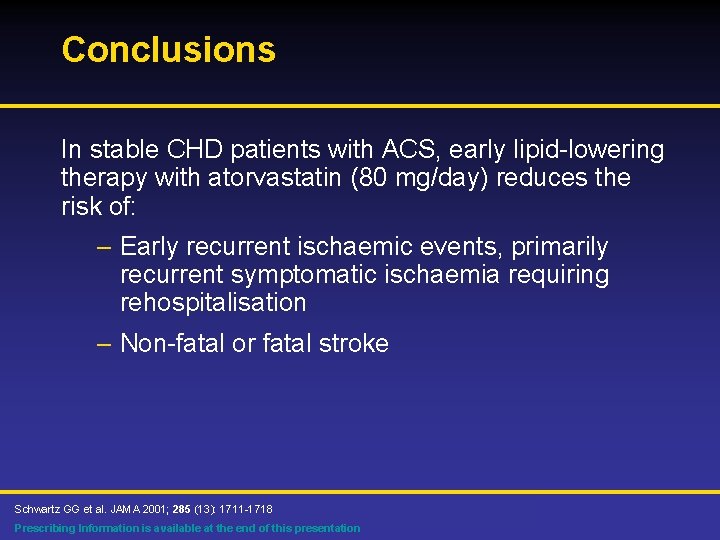
Conclusions In stable CHD patients with ACS, early lipid-lowering therapy with atorvastatin (80 mg/day) reduces the risk of: – Early recurrent ischaemic events, primarily recurrent symptomatic ischaemia requiring rehospitalisation – Non-fatal or fatal stroke Schwartz GG et al. JAMA 2001; 285 (13): 1711 -1718 Prescribing Information is available at the end of this presentation
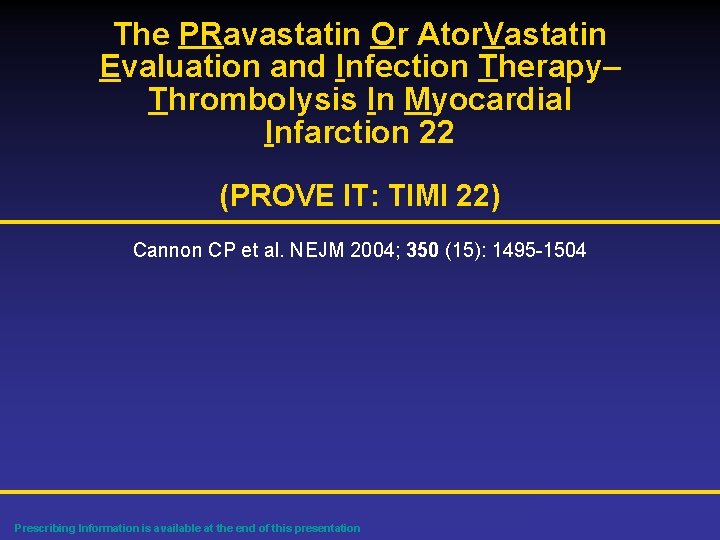
The PRavastatin Or Ator. Vastatin Evaluation and Infection Therapy– Thrombolysis In Myocardial Infarction 22 (PROVE IT: TIMI 22) Cannon CP et al. NEJM 2004; 350 (15): 1495 -1504 Prescribing Information is available at the end of this presentation
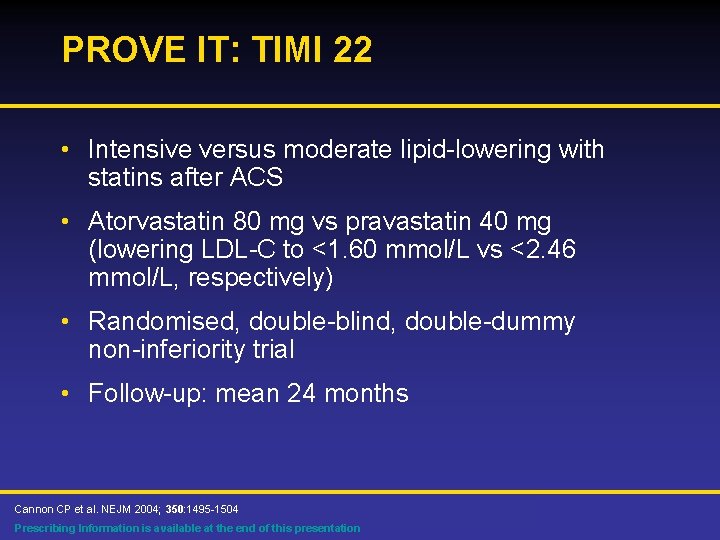
PROVE IT: TIMI 22 • Intensive versus moderate lipid-lowering with statins after ACS • Atorvastatin 80 mg vs pravastatin 40 mg (lowering LDL-C to <1. 60 mmol/L vs <2. 46 mmol/L, respectively) • Randomised, double-blind, double-dummy non-inferiority trial • Follow-up: mean 24 months Cannon CP et al. NEJM 2004; 350: 1495 -1504 Prescribing Information is available at the end of this presentation
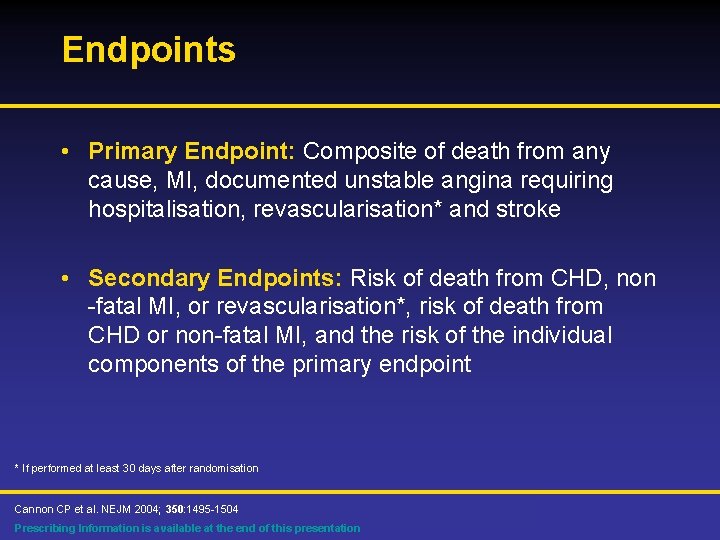
Endpoints • Primary Endpoint: Composite of death from any cause, MI, documented unstable angina requiring hospitalisation, revascularisation* and stroke • Secondary Endpoints: Risk of death from CHD, non -fatal MI, or revascularisation*, risk of death from CHD or non-fatal MI, and the risk of the individual components of the primary endpoint * If performed at least 30 days after randomisation Cannon CP et al. NEJM 2004; 350: 1495 -1504 Prescribing Information is available at the end of this presentation
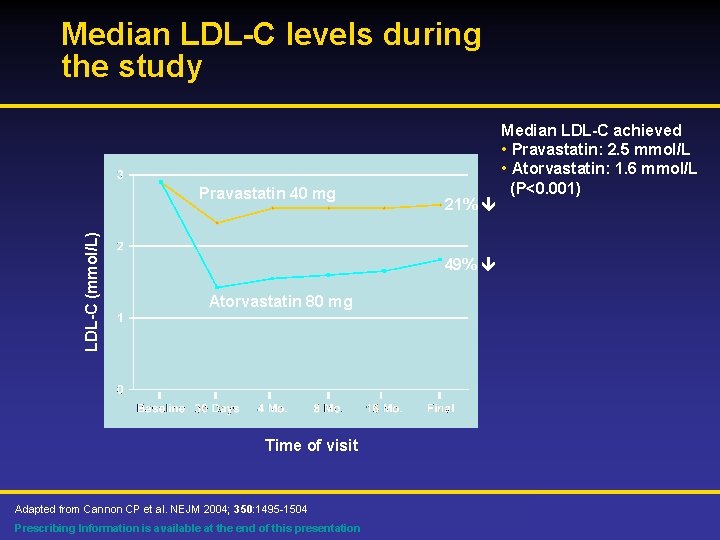
Median LDL-C levels during the study LDL-C (mmol/L) Pravastatin 40 mg 21% 49% Atorvastatin 80 mg Time of visit Adapted from Cannon CP et al. NEJM 2004; 350: 1495 -1504 Prescribing Information is available at the end of this presentation Median LDL-C achieved • Pravastatin: 2. 5 mmol/L • Atorvastatin: 1. 6 mmol/L (P<0. 001)
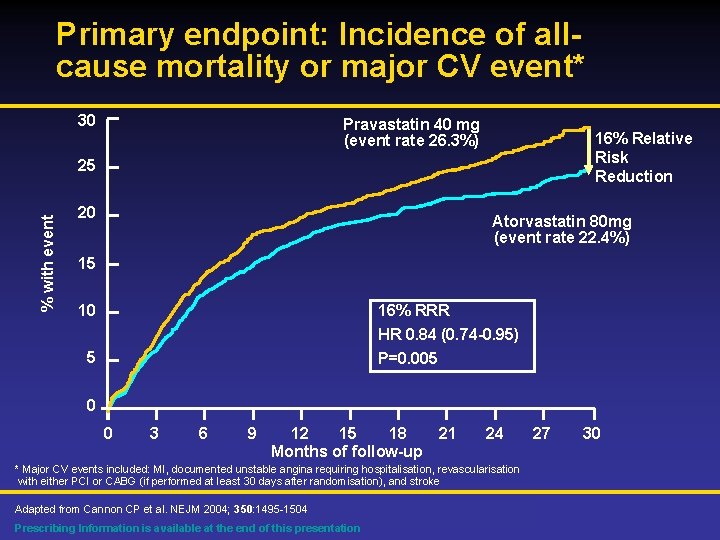
Primary endpoint: Incidence of allcause mortality or major CV event* 30 Pravastatin 40 mg (event rate 26. 3%) 16% Relative Risk Reduction % with event 25 20 Atorvastatin 80 mg (event rate 22. 4%) 15 10 16% RRR HR 0. 84 (0. 74 -0. 95) P=0. 005 5 0 0 3 6 9 12 15 18 Months of follow-up 21 24 * Major CV events included: MI, documented unstable angina requiring hospitalisation, revascularisation with either PCI or CABG (if performed at least 30 days after randomisation), and stroke Adapted from Cannon CP et al. NEJM 2004; 350: 1495 -1504 Prescribing Information is available at the end of this presentation 27 30
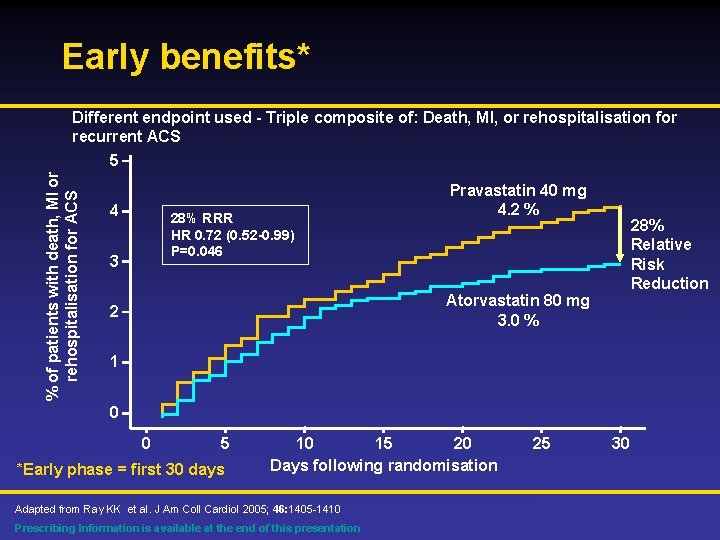
Early benefits* % of patients with death, MI or rehospitalisation for ACS Different endpoint used - Triple composite of: Death, MI, or rehospitalisation for recurrent ACS 5 4 28% RRR HR 0. 72 (0. 52 -0. 99) P=0. 046 3 Pravastatin 40 mg 4. 2 % 28% Relative Risk Reduction Atorvastatin 80 mg 3. 0 % 2 1 0 0 5 *Early phase = first 30 days 10 15 20 Days following randomisation Adapted from Ray KK et al. J Am Coll Cardiol 2005; 46: 1405 -1410 Prescribing Information is available at the end of this presentation 25 30
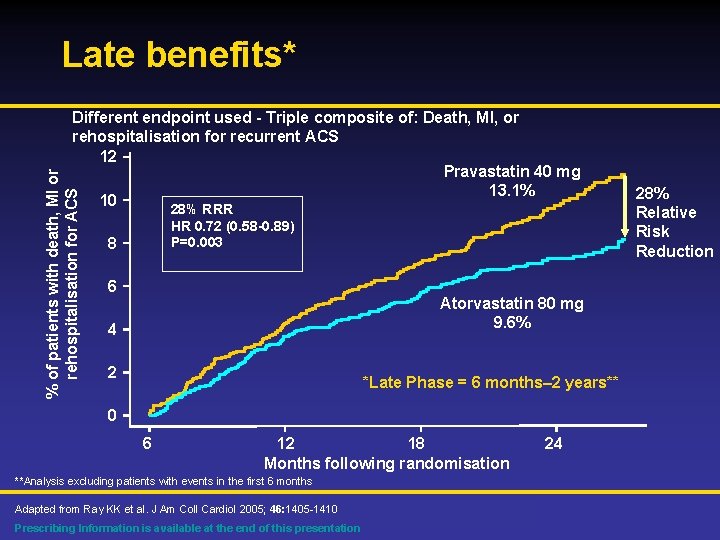
Late benefits* % of patients with death, MI or rehospitalisation for ACS Different endpoint used - Triple composite of: Death, MI, or rehospitalisation for recurrent ACS 12 Pravastatin 40 mg 13. 1% 10 28% RRR HR 0. 72 (0. 58 -0. 89) P=0. 003 8 6 Atorvastatin 80 mg 9. 6% 4 2 *Late Phase = 6 months– 2 years** 0 6 12 18 Months following randomisation **Analysis excluding patients with events in the first 6 months Adapted from Ray KK et al. J Am Coll Cardiol 2005; 46: 1405 -1410 Prescribing Information is available at the end of this presentation 24 28% Relative Risk Reduction
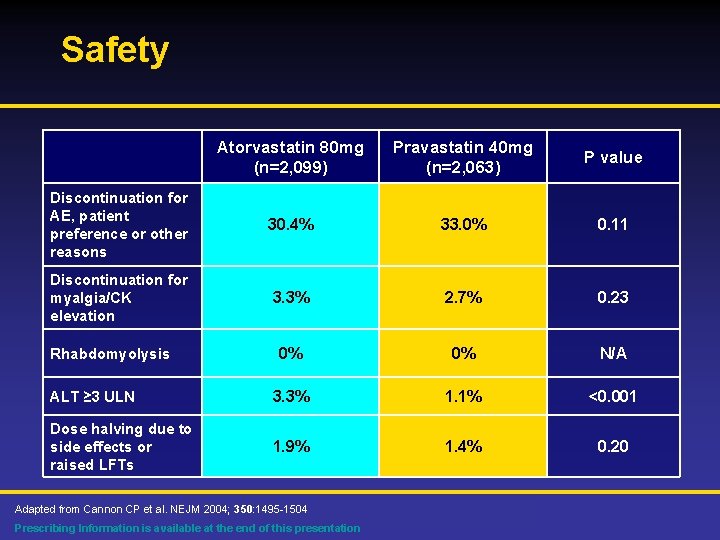
Safety Atorvastatin 80 mg (n=2, 099) Pravastatin 40 mg (n=2, 063) P value Discontinuation for AE, patient preference or other reasons 30. 4% 33. 0% 0. 11 Discontinuation for myalgia/CK elevation 3. 3% 2. 7% 0. 23 0% 0% N/A ALT ≥ 3 ULN 3. 3% 1. 1% <0. 001 Dose halving due to side effects or raised LFTs 1. 9% 1. 4% 0. 20 Rhabdomyolysis Adapted from Cannon CP et al. NEJM 2004; 350: 1495 -1504 Prescribing Information is available at the end of this presentation
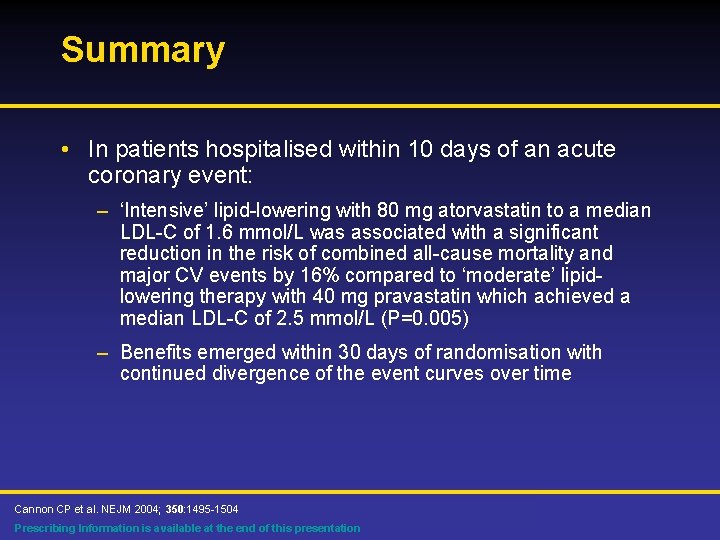
Summary • In patients hospitalised within 10 days of an acute coronary event: – ‘Intensive’ lipid-lowering with 80 mg atorvastatin to a median LDL-C of 1. 6 mmol/L was associated with a significant reduction in the risk of combined all-cause mortality and major CV events by 16% compared to ‘moderate’ lipidlowering therapy with 40 mg pravastatin which achieved a median LDL-C of 2. 5 mmol/L (P=0. 005) – Benefits emerged within 30 days of randomisation with continued divergence of the event curves over time Cannon CP et al. NEJM 2004; 350: 1495 -1504 Prescribing Information is available at the end of this presentation
The Treating to New Targets Study (TNT) La. Rosa JC et al. N Engl J Med 2005; 352 (14): 1425 -1435 Prescribing Information is available at the end of this presentation
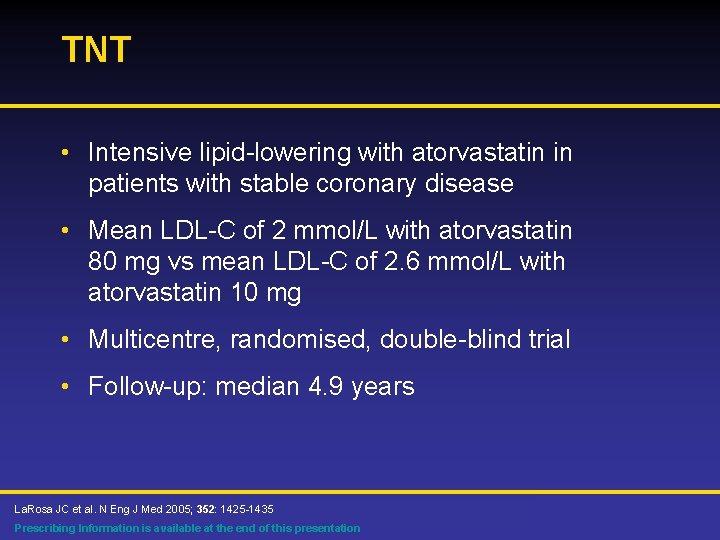
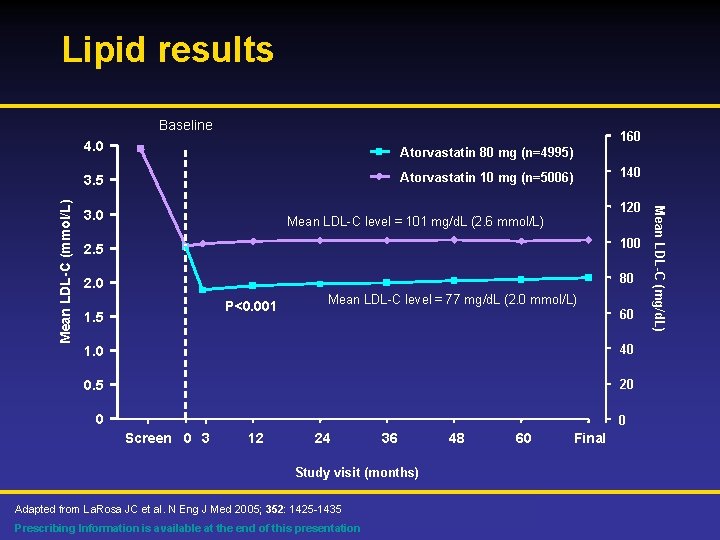
TNT • Intensive lipid-lowering with atorvastatin in patients with stable coronary disease • Mean LDL-C of 2 mmol/L with atorvastatin 80 mg vs mean LDL-C of 2. 6 mmol/L with atorvastatin 10 mg • Multicentre, randomised, double-blind trial • Follow-up: median 4. 9 years La. Rosa JC et al. N Eng J Med 2005; 352: 1425 -1435 Prescribing Information is available at the end of this presentation
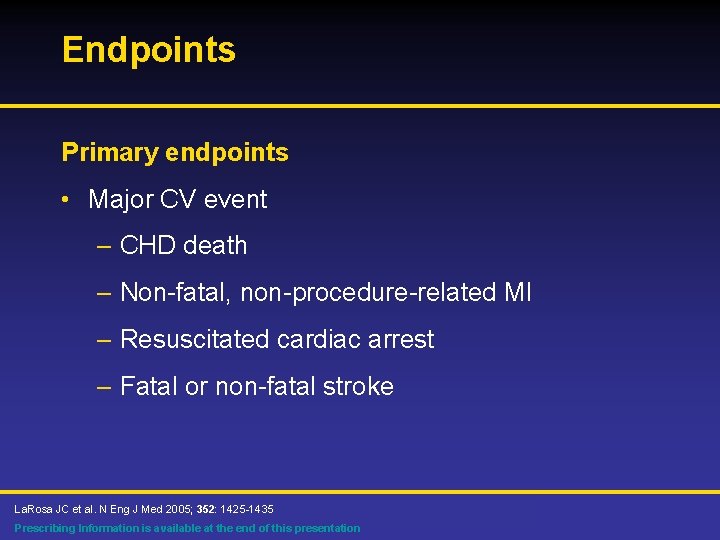
Endpoints Primary endpoints • Major CV event – CHD death – Non-fatal, non-procedure-related MI – Resuscitated cardiac arrest – Fatal or non-fatal stroke La. Rosa JC et al. N Eng J Med 2005; 352: 1425 -1435 Prescribing Information is available at the end of this presentation
Lipid results 160 4. 0 Atorvastatin 80 mg (n=4995) 3. 5 Atorvastatin 10 mg (n=5006) 3. 0 140 120 Mean LDL-C level = 101 mg/d. L (2. 6 mmol/L) 2. 5 100 2. 0 80 P<0. 001 1. 5 Mean LDL-C level = 77 mg/d. L (2. 0 mmol/L) 60 1. 0 40 0. 5 20 0 0 Screen 0 3 12 24 36 Study visit (months) Adapted from La. Rosa JC et al. N Eng J Med 2005; 352: 1425 -1435 Prescribing Information is available at the end of this presentation 48 60 Final Mean LDL-C (mg/d. L) Mean LDL-C (mmol/L) Baseline
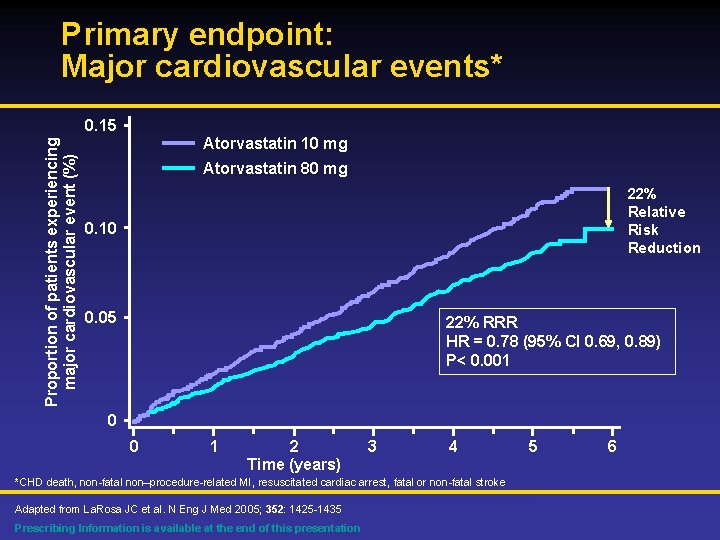
Primary endpoint: Major cardiovascular events* Proportion of patients experiencing major cardiovascular event (%) 0. 15 Atorvastatin 10 mg Atorvastatin 80 mg 22% Relative Risk Reduction 0. 10 0. 05 22% RRR HR = 0. 78 (95% CI 0. 69, 0. 89) P< 0. 001 0 0 1 2 Time (years) 3 4 *CHD death, non-fatal non–procedure-related MI, resuscitated cardiac arrest, fatal or non-fatal stroke Adapted from La. Rosa JC et al. N Eng J Med 2005; 352: 1425 -1435 Prescribing Information is available at the end of this presentation 5 6
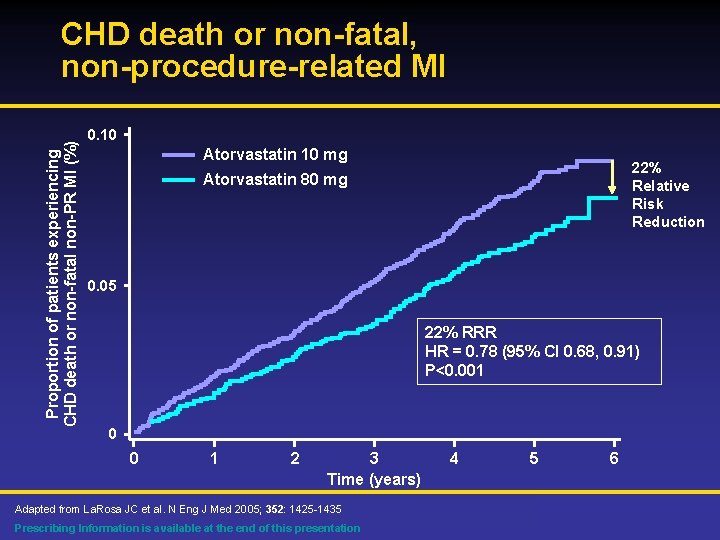
Proportion of patients experiencing CHD death or non-fatal non-PR MI (%) CHD death or non-fatal, non-procedure-related MI 0. 10 Atorvastatin 10 mg 22% Relative Risk Reduction Atorvastatin 80 mg 0. 05 22% RRR HR = 0. 78 (95% CI 0. 68, 0. 91) P<0. 001 0 0 1 2 3 Time (years) Adapted from La. Rosa JC et al. N Eng J Med 2005; 352: 1425 -1435 Prescribing Information is available at the end of this presentation 4 5 6
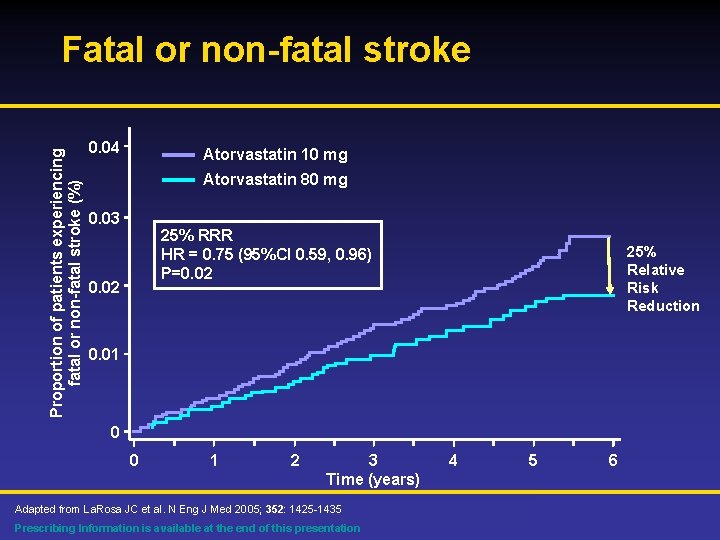
Proportion of patients experiencing fatal or non-fatal stroke (%) Fatal or non-fatal stroke 0. 04 Atorvastatin 10 mg Atorvastatin 80 mg 0. 03 25% RRR HR = 0. 75 (95%CI 0. 59, 0. 96) P=0. 02 25% Relative Risk Reduction 0. 01 0 0 1 2 3 Time (years) Adapted from La. Rosa JC et al. N Eng J Med 2005; 352: 1425 -1435 Prescribing Information is available at the end of this presentation 4 5 6
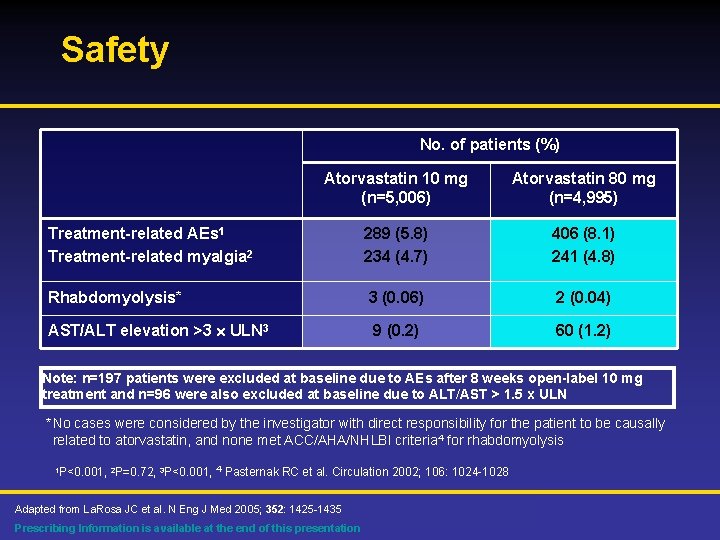
Safety No. of patients (%) Atorvastatin 10 mg (n=5, 006) Atorvastatin 80 mg (n=4, 995) Treatment-related AEs 1 Treatment-related myalgia 2 289 (5. 8) 234 (4. 7) 406 (8. 1) 241 (4. 8) Rhabdomyolysis* 3 (0. 06) 2 (0. 04) AST/ALT elevation >3 ULN 3 9 (0. 2) 60 (1. 2) Note: n=197 patients were excluded at baseline due to AEs after 8 weeks open-label 10 mg treatment and n=96 were also excluded at baseline due to ALT/AST > 1. 5 x ULN * No cases were considered by the investigator with direct responsibility for the patient to be causally related to atorvastatin, and none met ACC/AHA/NHLBI criteria 4 for rhabdomyolysis 1 P<0. 001, 2 P=0. 72, 3 P<0. 001, 4 Pasternak RC et al. Circulation 2002; 106: 1024 -1028 Adapted from La. Rosa JC et al. N Eng J Med 2005; 352: 1425 -1435 Prescribing Information is available at the end of this presentation
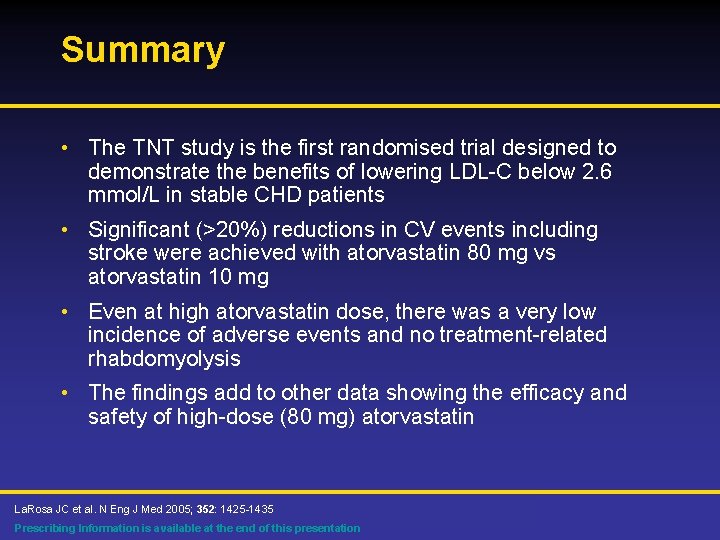
Summary • The TNT study is the first randomised trial designed to demonstrate the benefits of lowering LDL-C below 2. 6 mmol/L in stable CHD patients • Significant (>20%) reductions in CV events including stroke were achieved with atorvastatin 80 mg vs atorvastatin 10 mg • Even at high atorvastatin dose, there was a very low incidence of adverse events and no treatment-related rhabdomyolysis • The findings add to other data showing the efficacy and safety of high-dose (80 mg) atorvastatin La. Rosa JC et al. N Eng J Med 2005; 352: 1425 -1435 Prescribing Information is available at the end of this presentation
Effect of Statin Therapy on Lipid Lowering, Ischaemic Heart Disease & Stroke: Meta-Analyses Law MR et al. BMJ 2003; 326: 1423 -1429 Prescribing Information is available at the end of this presentation
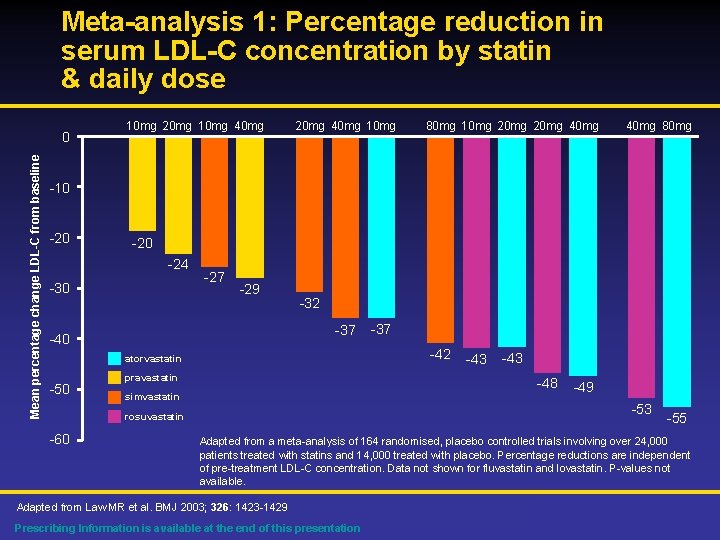
Meta-analysis 1: Percentage reduction in serum LDL-C concentration by statin & daily dose Mean percentage change LDL-C from baseline 0 10 mg 20 mg 10 mg 40 mg 20 mg 40 mg 10 mg 80 mg 10 mg 20 mg 40 mg 80 mg -10 -20 -24 -30 -27 -29 -32 -37 -40 -42 atorvastatin -50 pravastatin -43 -48 simvastatin -49 -53 rosuvastatin -60 -37 -55 Adapted from a meta-analysis of 164 randomised, placebo controlled trials involving over 24, 000 patients treated with statins and 14, 000 treated with placebo. Percentage reductions are independent of pre-treatment LDL-C concentration. Data not shown for fluvastatin and lovastatin. P-values not available. Adapted from Law MR et al. BMJ 2003; 326: 1423 -1429 Prescribing Information is available at the end of this presentation
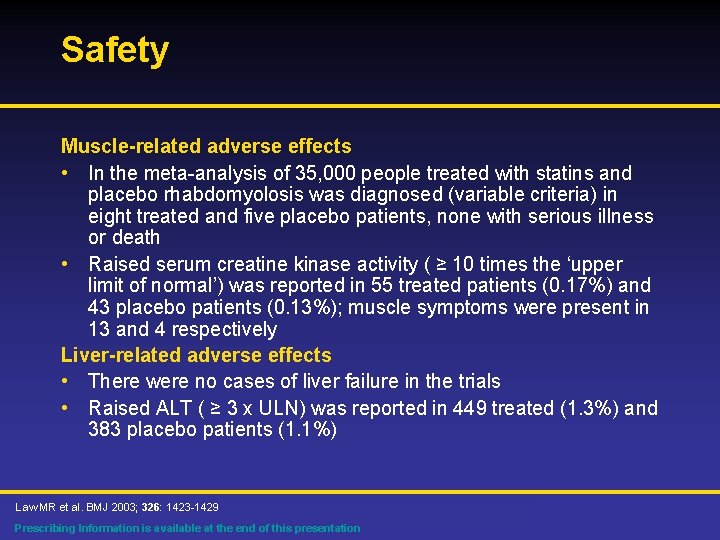
Safety Muscle-related adverse effects • In the meta-analysis of 35, 000 people treated with statins and placebo rhabdomyolosis was diagnosed (variable criteria) in eight treated and five placebo patients, none with serious illness or death • Raised serum creatine kinase activity ( ≥ 10 times the ‘upper limit of normal’) was reported in 55 treated patients (0. 17%) and 43 placebo patients (0. 13%); muscle symptoms were present in 13 and 4 respectively Liver-related adverse effects • There were no cases of liver failure in the trials • Raised ALT ( ≥ 3 x ULN) was reported in 449 treated (1. 3%) and 383 placebo patients (1. 1%) Law MR et al. BMJ 2003; 326: 1423 -1429 Prescribing Information is available at the end of this presentation
Prescribing Information is available at the end of this presentation
Prescribing Information is available at the end of this presentation
Prescribing Information is available at the end of this presentation
Prescribing Information is available at the end of this presentation
Prescribing Information is available at the end of this presentation