
NHS Pension Scheme The value of membership The

NHS Pension Scheme The value of membership

The full ten-point agenda 1. An overview 2. How much does the scheme cost 3. How your pension builds up 4. Keeping track of your pension 5. Protection benefits 6. Leaving the scheme 7. Retiring from the scheme 8. Saving enough to stop work 9. Ways to increase your benefits 10. Pensions tax

1. An overview
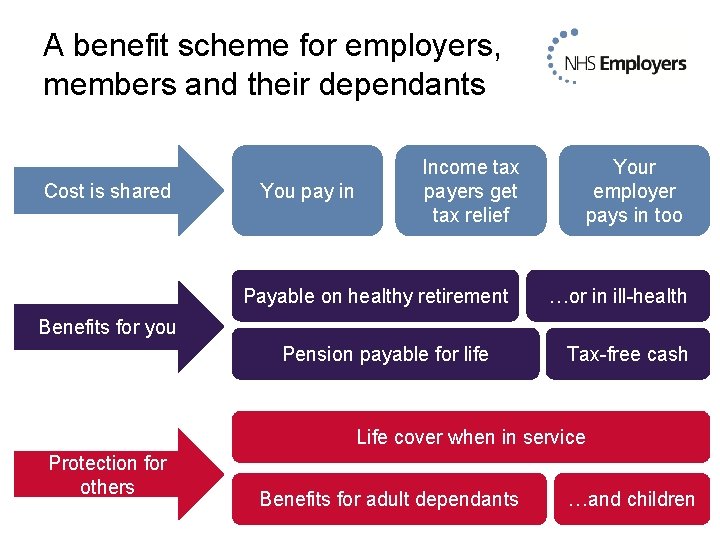
A benefit scheme for employers, members and their dependants Cost is shared You pay in Income tax payers get tax relief Payable on healthy retirement Your employer pays in too …or in ill-health Benefits for you Pension payable for life Tax-free cash Life cover when in service Protection for others Benefits for adult dependants …and children
2. How much does the scheme cost?
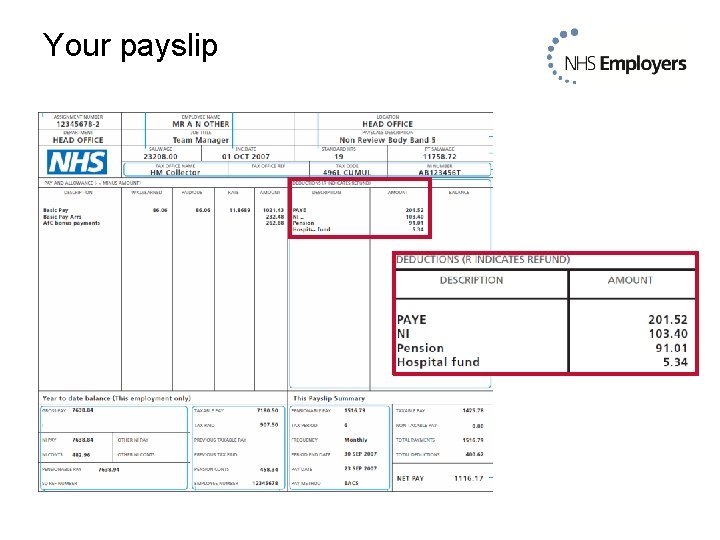
Your payslip
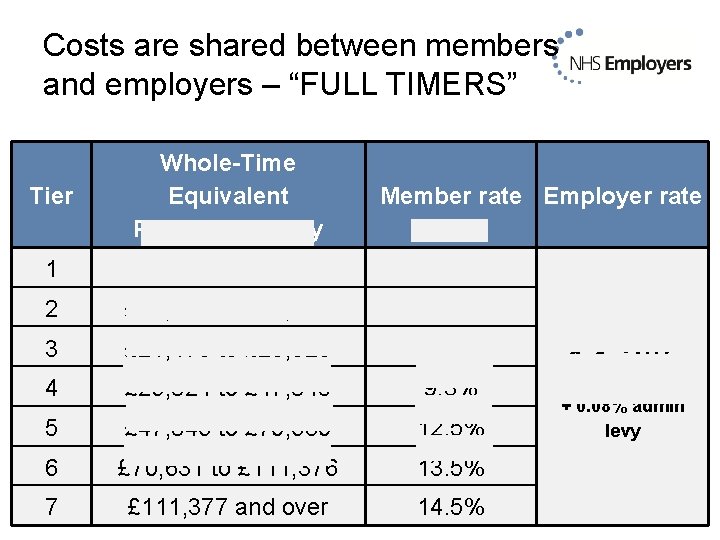
Costs are shared between members and employers – “FULL TIMERS” Tier Whole-Time Equivalent Pensionable Pay 1 £ 0 to £ 15, 431 5. 0% 2 £ 15, 432 to £ 21, 477 5. 6% 3 £ 21, 478 to £ 26, 823 7. 1% 4 £ 26, 824 to £ 47, 845 9. 3% 5 £ 47, 846 to £ 70, 630 12. 5% 6 £ 70, 631 to £ 111, 376 13. 5% 7 £ 111, 377 and over 14. 5% Member rate Employer rate 14. 3% + 0. 08% admin levy
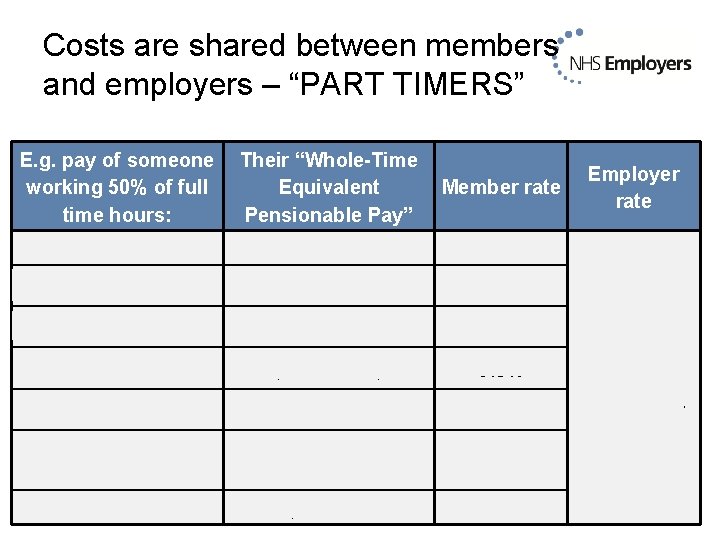
Costs are shared between members and employers – “PART TIMERS” E. g. pay of someone working 50% of full time hours: Their “Whole-Time Equivalent Pensionable Pay” Member rate £ 0 up to £ 7, 716 £ 0 to £ 15, 431 5. 0% £ 7, 716 up to £ 10, 739 £ 15, 432 to £ 21, 477 5. 6% £ 10, 739 up to £ 13412 £ 21, 478 to £ 26, 823 7. 1% £ 13, 412 up to £ 23923 £ 26, 824 to £ 47, 845 9. 3% £ 23, 923 up to £ 35, 315 £ 47, 846 to £ 70, 630 12. 5% £ 35, 316 up to £ 55, 688 £ 70, 631 to £ 111, 376 13. 5% £ 55, 689 and over £ 111, 377 and over 14. 5% Employer rate 14. 3% + 0. 08% admin levy
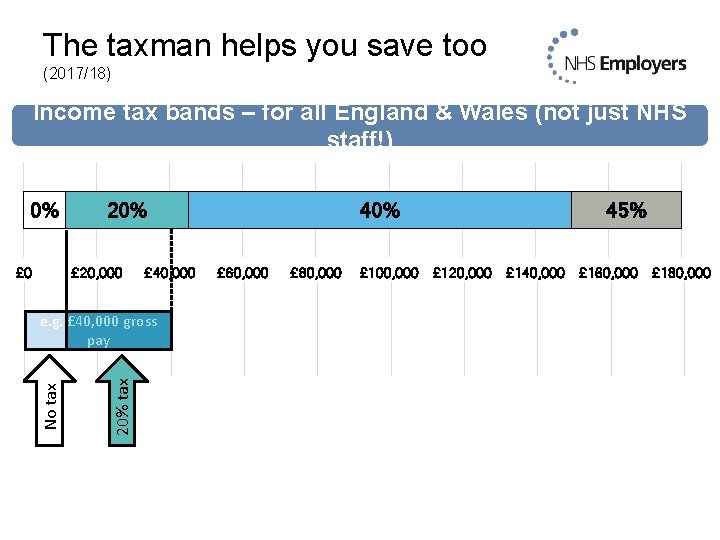
The taxman helps you save too (2017/18) Income tax bands – for all England & Wales (not just NHS staff!) 0% £ 0 20% £ 20, 000 £ 40, 000 20% tax No tax e. g. £ 40, 000 gross pay 40% £ 60, 000 £ 80, 000 £ 100, 000 45% £ 120, 000 £ 140, 000 £ 160, 000 £ 180, 000
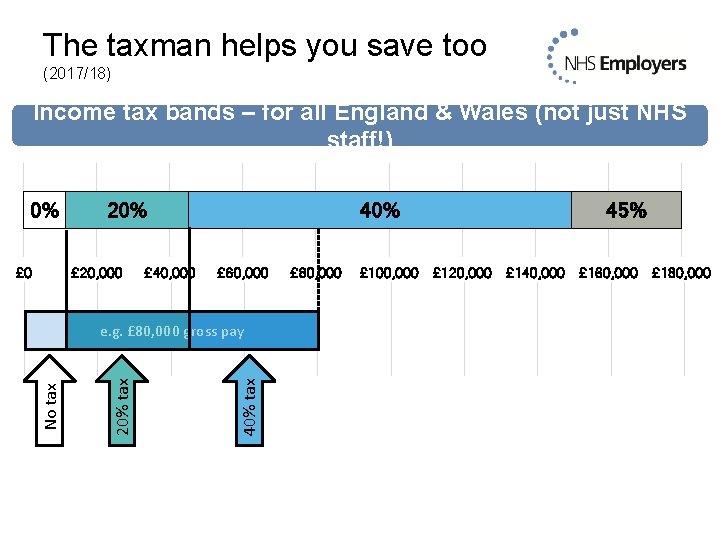
The taxman helps you save too (2017/18) Income tax bands – for all England & Wales (not just NHS staff!) 0% £ 0 20% £ 20, 000 £ 40, 000 40% £ 60, 000 40% tax 20% tax No tax e. g. £ 80, 000 gross pay £ 80, 000 £ 100, 000 45% £ 120, 000 £ 140, 000 £ 160, 000 £ 180, 000
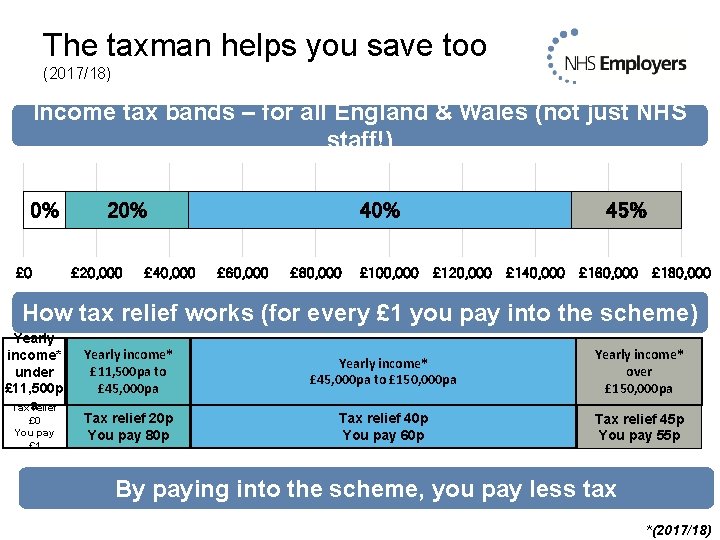
The taxman helps you save too (2017/18) Income tax bands – for all England & Wales (not just NHS staff!) 0% £ 0 20% £ 20, 000 £ 40, 000 40% £ 60, 000 £ 80, 000 £ 100, 000 45% £ 120, 000 £ 140, 000 £ 160, 000 £ 180, 000 How tax relief works (for every £ 1 you pay into the scheme) Yearly income* under £ 11, 500 p Tax a relief £ 0 You pay £ 1 Yearly income* £ 11, 500 pa to £ 45, 000 pa Yearly income* £ 45, 000 pa to £ 150, 000 pa Yearly income* over £ 150, 000 pa Tax relief 20 p You pay 80 p Tax relief 40 p You pay 60 p Tax relief 45 p You pay 55 p By paying into the scheme, you pay less tax *(2017/18)
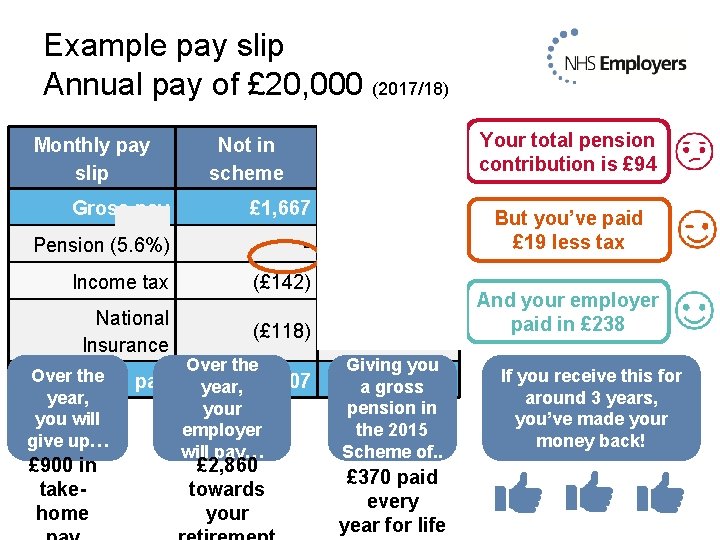
Example pay slip Annual pay of £ 20, 000 (2017/18) Monthly pay slip Not in scheme In the scheme Gross pay £ 1, 667 Pension (5. 6%) - (£ 94) Income tax (£ 142) (£ 123) National Insurance (£ 118) Over the Take-home pay year, £ 1, 407 year, your you will employer give up… will pay… Giving you £ 1, 332 a gross pension in the 2015 Scheme of. . £ 900 in takehome £ 2, 860 towards your £ 370 paid every year for life Your total pension contribution is £ 94 But you’ve paid £ 19 less tax And your employer paid in £ 238 If you receive this for around 3 years, you’ve made your money back!
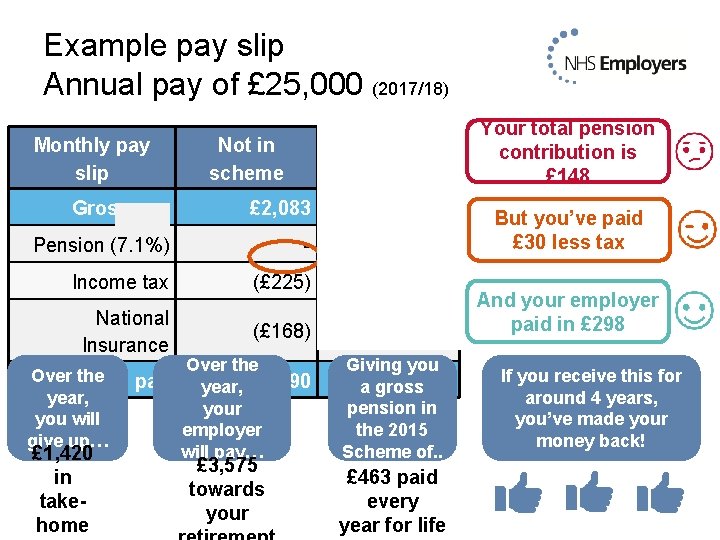
Example pay slip Annual pay of £ 25, 000 (2017/18) Monthly pay slip Not in scheme In the scheme Gross pay £ 2, 083 Pension (7. 1%) - (£ 148) Income tax (£ 225) (£ 195) National Insurance (£ 168) Over the Take-home pay year, £ 1, 690 year, your you will employer give up… will pay… £ 1, 420 Giving you £ 1, 572 a gross pension in the 2015 Scheme of. . in takehome £ 3, 575 towards your £ 463 paid every year for life Your total pension contribution is £ 148 But you’ve paid £ 30 less tax And your employer paid in £ 298 If you receive this for around 4 years, you’ve made your money back!
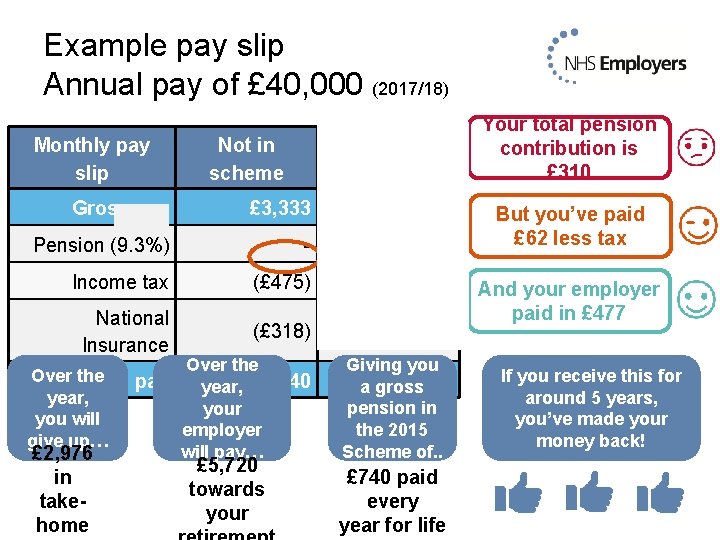
Example pay slip Annual pay of £ 40, 000 (2017/18) Monthly pay slip Not in scheme In the scheme Gross pay £ 3, 333 Pension (9. 3%) - (£ 310) Income tax (£ 475) (£ 413) National Insurance (£ 318) Over the Take-home pay year, £ 2, 540 year, your you will employer give up… will pay… £ 2, 976 Giving you £ 2, 292 a gross pension in the 2015 Scheme of. . in takehome £ 5, 720 towards your £ 740 paid every year for life Your total pension contribution is £ 310 But you’ve paid £ 62 less tax And your employer paid in £ 477 If you receive this for around 5 years, you’ve made your money back!

3. How your pension builds up
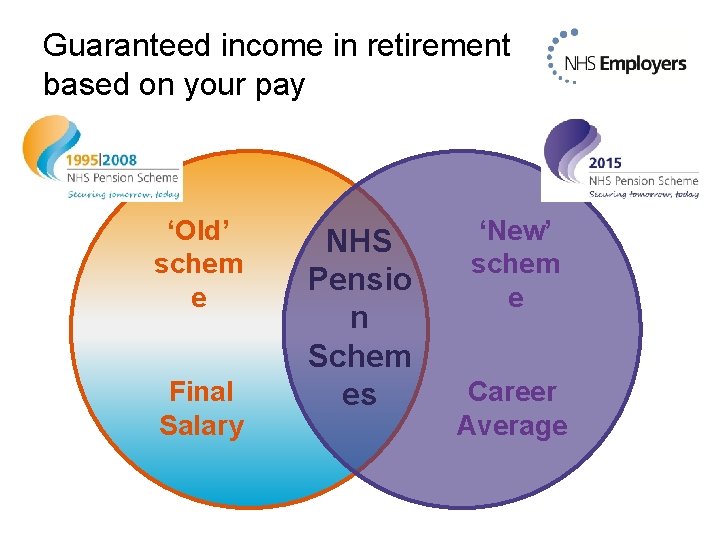
Guaranteed income in retirement based on your pay ‘Old’ schem e Final Salary NHS Pensio n Schem es ‘New’ schem e Career Average

Career Average pensions Your pension builds up in slices, using your pay in every year After year 1 After year 2 After year 3 Uses pay in year 1 Uses pay in year 2 Uses pay in year 3 Total pension at the end of your career Uses ‘average’ pay across whole career At retirement your pension is paid every year, for life Pension paid in year 1 Pension paid Pension paid in year 3 in year 4 in year 6 in year 7 & on… in year 2 in year 5

Final Salary pensions Your pension builds up in slices, using your pay near the end of each year After year 1 After year 2 Uses Final Salary at end of year 1 Uses Final Salary at end of year 2 After year 3 Uses Final Salary at end of year 3 Total pension at the end of your career Uses Final Salary at retirement (or earlier leaving) At retirement your pension is paid every year, for life Pension paid in year 1 Pension paid Pension paid in year 3 in year 4 in year 6 in year 7 & on… in year 2 in year 5
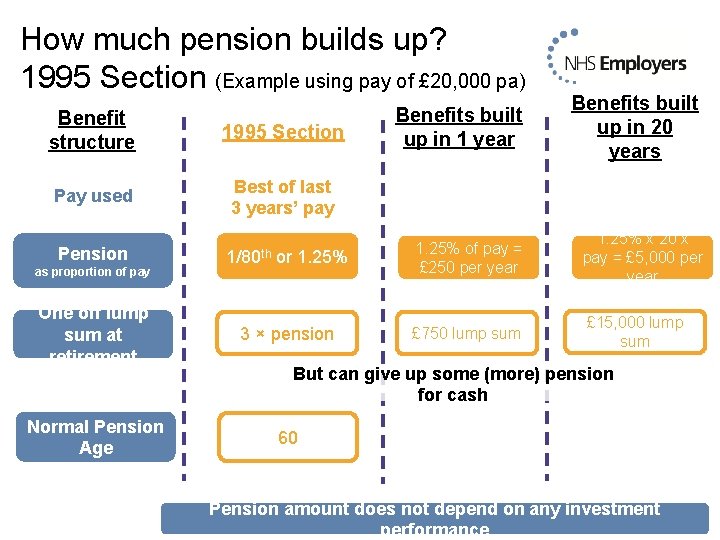
How much pension builds up? 1995 Section (Example using pay of £ 20, 000 pa) Benefit structure 1995 Section Pay used Best of last 3 years’ pay Pension 1/80 th as proportion of pay or 1. 25% One off lump sum at retirement 3 × pension Normal Pension Age 60 Benefits built up in 1 year Benefits built up in 20 years 1. 25% of pay = £ 250 per year 1. 25% x 20 x pay = £ 5, 000 per year £ 750 lump sum £ 15, 000 lump sum But can give up some (more) pension for cash Pension amount does not depend on any investment performance
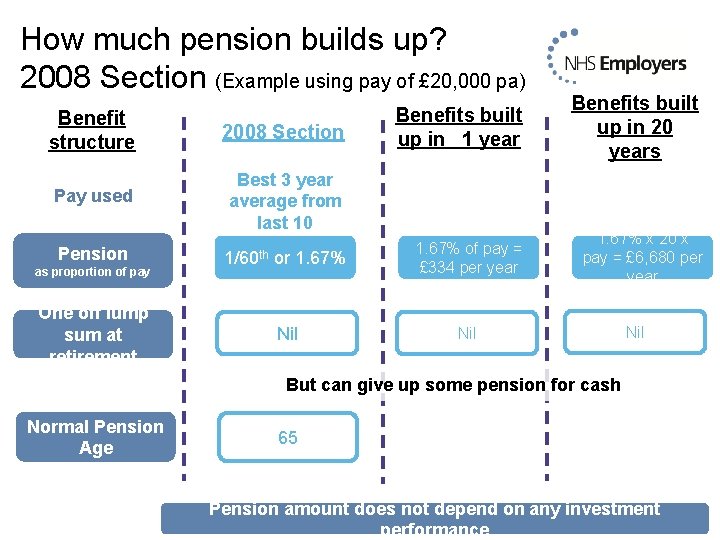
How much pension builds up? 2008 Section (Example using pay of £ 20, 000 pa) Benefit structure 2008 Section Pay used Best 3 year average from last 10 Pension 1/60 th as proportion of pay One off lump sum at retirement or 1. 67% Nil Benefits built up in 1 year Benefits built up in 20 years 1. 67% of pay = £ 334 per year 1. 67% x 20 x pay = £ 6, 680 per year Nil But can give up some pension for cash Normal Pension Age 65 Pension amount does not depend on any investment performance

How much pension builds up? 2015 Section (Example using pay of £ 20, 000 pa) Benefit structure 2015 Section Pay used Pensionable pay over career Pension as proportion of pay One off lump sum at retirement 1/54 th or 1. 85% Nil Benefits built up in 1 year Benefits built up in 20 years 1. 85% of pay = £ 370 per year 1. 85% x 20 x pay = £ 7, 400 per year Nil But can give up some pension for cash Normal Pension Age State Pension Age (65+) Pension amount does not depend on any investment performance
4. Keeping track of your pension
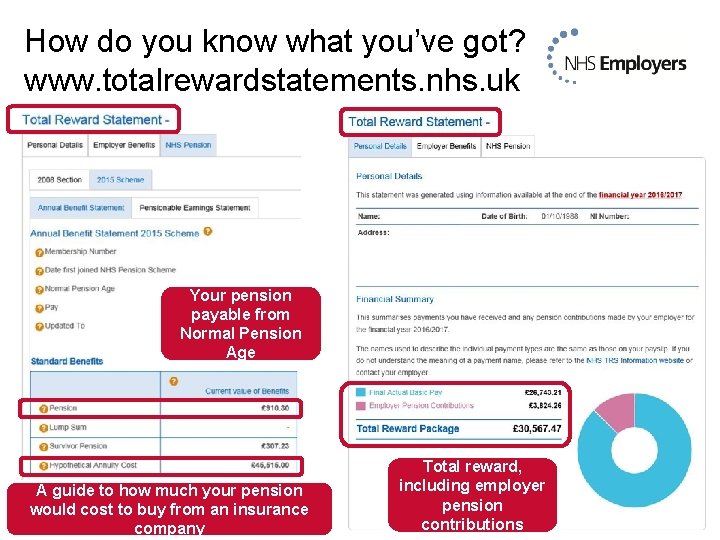
How do you know what you’ve got? www. totalrewardstatements. nhs. uk Your pension payable from Normal Pension Age A guide to how much your pension would cost to buy from an insurance company Total reward, including employer pension contributions
5. Family benefits
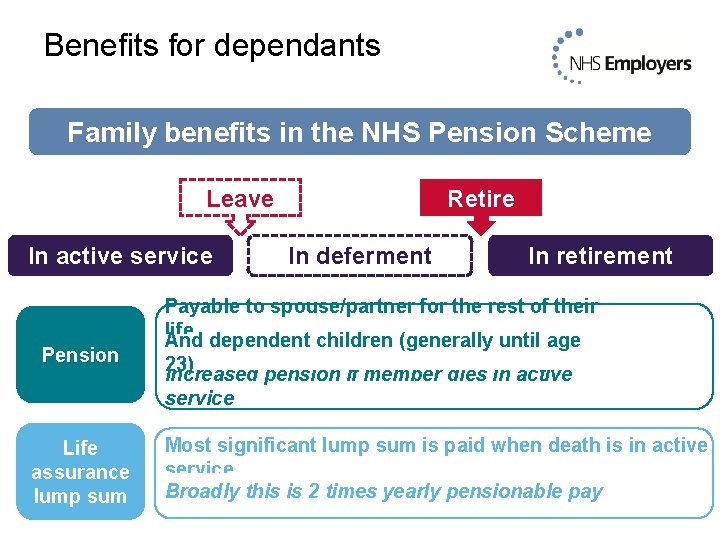
Benefits for dependants Family benefits in the NHS Pension Scheme Leave In active service Pension Retire In deferment In retirement Payable to spouse/partner for the rest of their life And dependent children (generally until age 23) Increased pension if member dies in active service Life assurance lump sum Most significant lump sum is paid when death is in active service Broadly this is 2 times yearly pensionable pay

6. Leaving the scheme
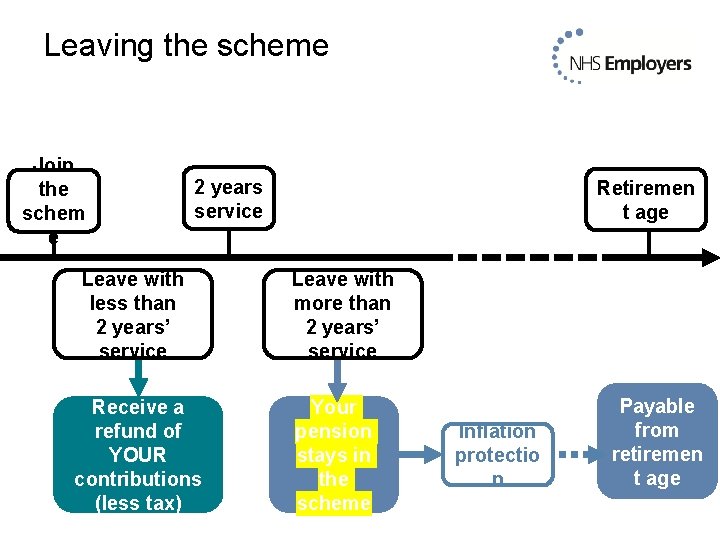
Leaving the scheme Join the schem e 2 years service Leave with less than 2 years’ service Receive a refund of YOUR contributions (less tax) Retiremen t age Leave with more than 2 years’ service Your pension stays in the scheme Inflation protectio n Payable from retiremen t age
7. Retiring from the scheme
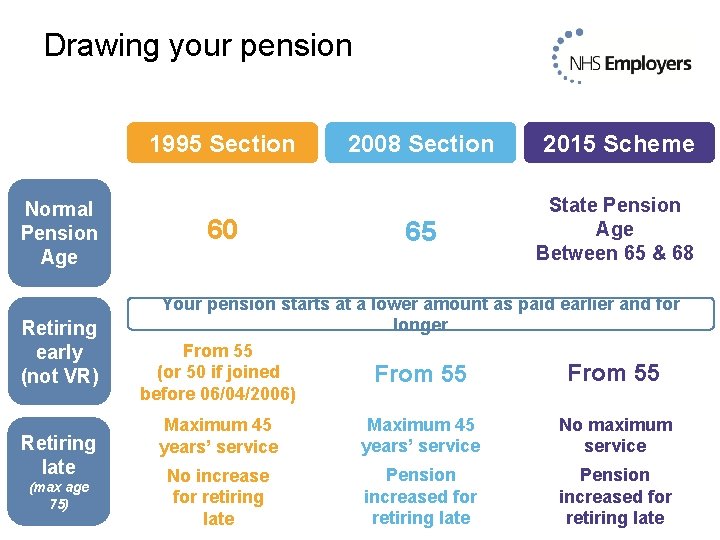
Drawing your pension 1995 Section Normal Pension Age Retiring early (not VR) Retiring late (max age 75) 60 2008 Section 2015 Scheme 65 State Pension Age Between 65 & 68 Your pension starts at a lower amount as paid earlier and for longer From 55 (or 50 if joined From 55 before 06/04/2006) Maximum 45 years’ service No maximum service No increase for retiring late Pension increased for retiring late
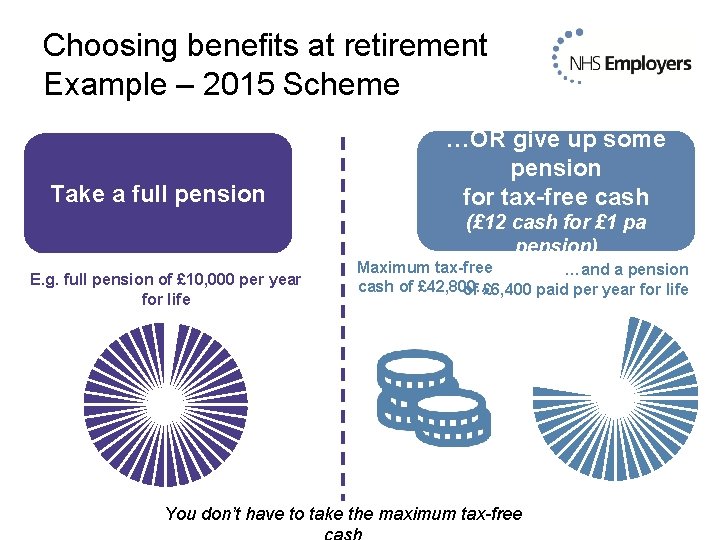
Choosing benefits at retirement Example – 2015 Scheme Take a full pension …OR give up some pension for tax-free cash (£ 12 cash for £ 1 pa pension) E. g. full pension of £ 10, 000 per year for life Maximum tax-free …and a pension cash of £ 42, 800… of £ 6, 400 paid per year for life You don’t have to take the maximum tax-free
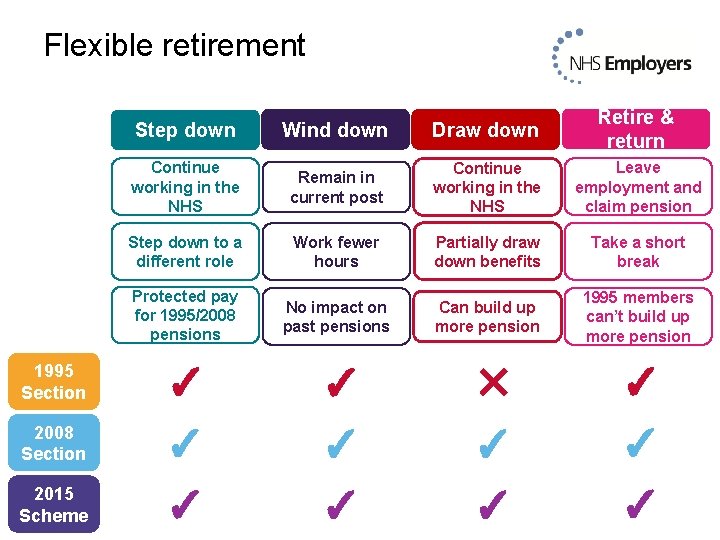
Flexible retirement Step down Wind down Draw down Retire & return Continue working in the NHS Remain in current post Continue working in the NHS Leave employment and claim pension Step down to a different role Work fewer hours Partially draw down benefits Take a short break Protected pay for 1995/2008 pensions No impact on past pensions Can build up more pension 1995 members can’t build up more pension 1995 Section ✓ ✓ ✕ ✓ 2008 Section ✓ ✓ 2015 Scheme ✓ ✓
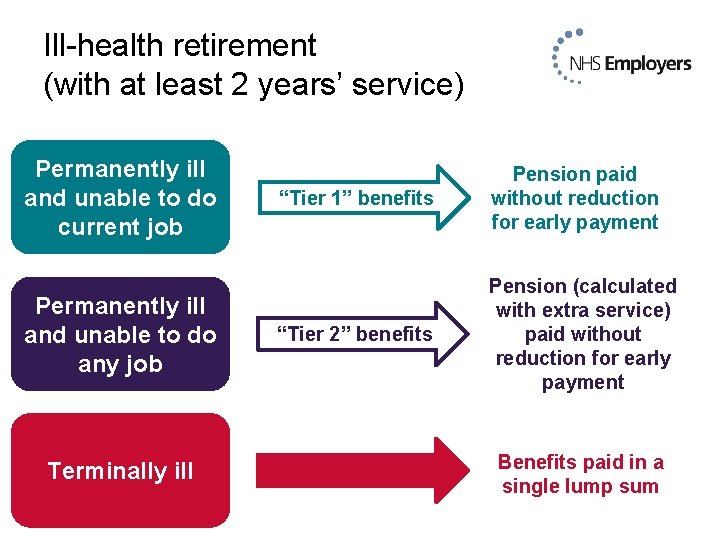
Ill-health retirement (with at least 2 years’ service) Permanently ill and unable to do current job Permanently ill and unable to do any job Terminally ill “Tier 1” benefits Pension paid without reduction for early payment “Tier 2” benefits Pension (calculated with extra service) paid without reduction for early payment Benefits paid in a single lump sum
8. Saving enough to stop work
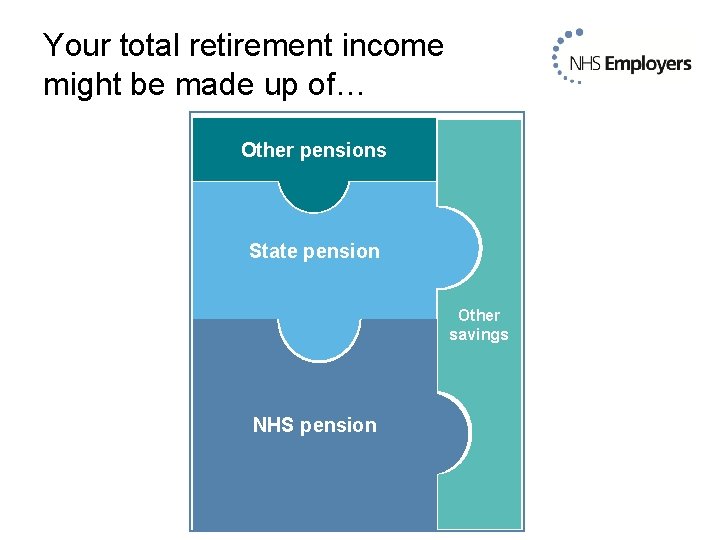
Your total retirement income might be made up of… Other pensions State pension Other savings NHS pension

How much is enough money to stop work? Lots of research 50% to 75% of pay? % income replacement = pension ÷ pay To pay for the basics… …the lower your pay, the higher the % needed But what is right for you? Think it through with your partner …the higher your pay, the lower the % needed
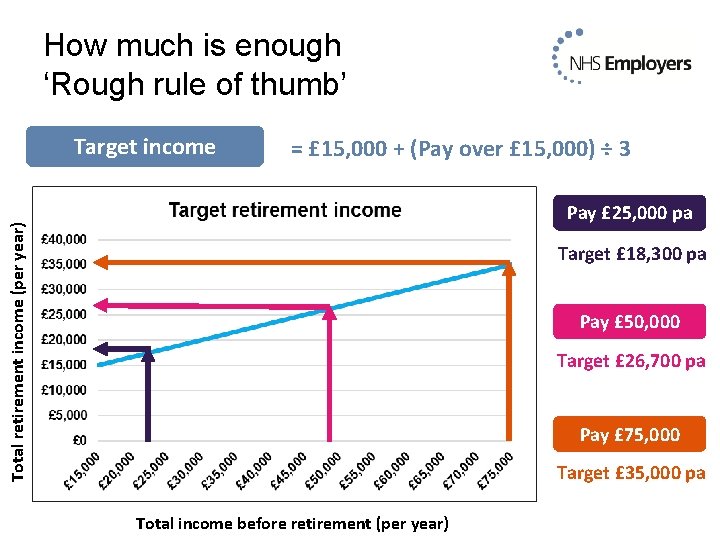
How much is enough ‘Rough rule of thumb’ Target income = £ 15, 000 + (Pay over £ 15, 000) ÷ 3 Total retirement income (per year) Pay £ 25, 000 pa Target £ 18, 300 pa Pay £ 50, 000 Target £ 26, 700 pa Pay £ 75, 000 Target £ 35, 000 pa Total income before retirement (per year)
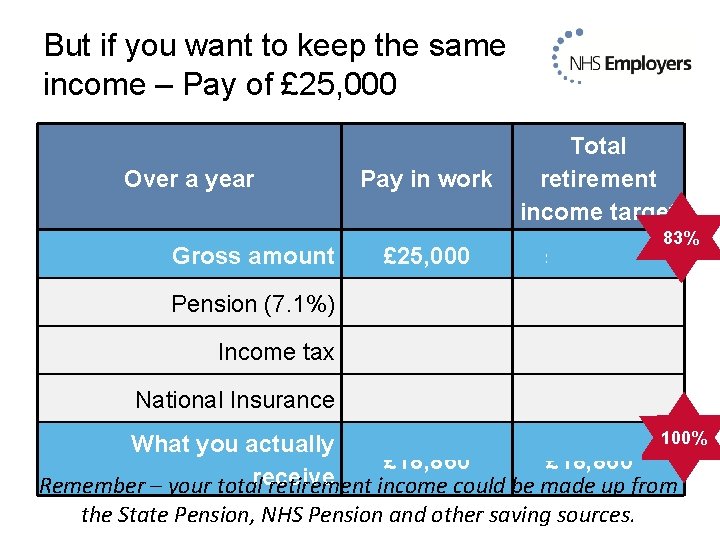
But if you want to keep the same income – Pay of £ 25, 000 Over a year Pay in work Total retirement income target Gross amount £ 25, 000 £ 20, 700 Pension (7. 1%) (£ 1, 775) Nil Income tax (£ 2, 345) (£ 1, 840) National Insurance (£ 2, 020) Nil 83% 100% What you actually £ 18, 860 Remember – your totalreceive retirement income could be made up from the State Pension, NHS Pension and other saving sources.
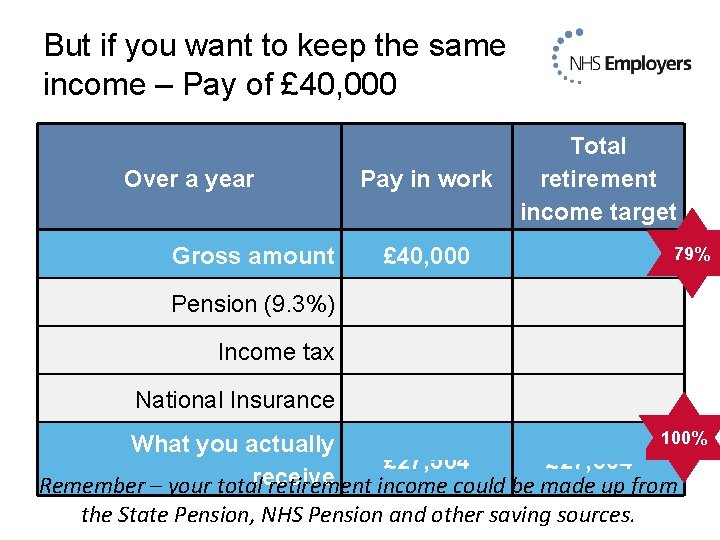
But if you want to keep the same income – Pay of £ 40, 000 Over a year Pay in work Total retirement income target Gross amount £ 40, 000 £ 31, 505 Pension (9. 3%) (£ 3, 720) Nil Income tax (£ 4, 956) (£ 4, 001) National Insurance (£ 3, 820) Nil 79% 100% What you actually £ 27, 504 Remember – your totalreceive retirement income could be made up from the State Pension, NHS Pension and other saving sources.
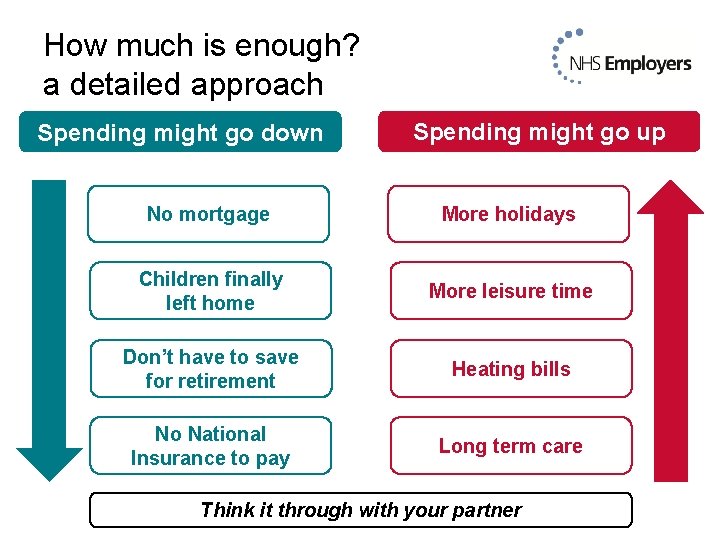
How much is enough? a detailed approach Spending might go down Spending might go up No mortgage More holidays Children finally left home More leisure time Don’t have to save for retirement Heating bills No National Insurance to pay Long term care Think it through with your partner
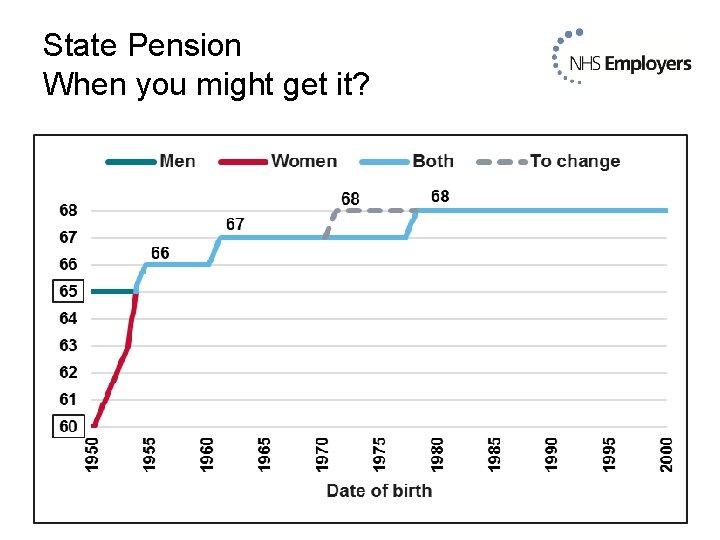
State Pension When you might get it?
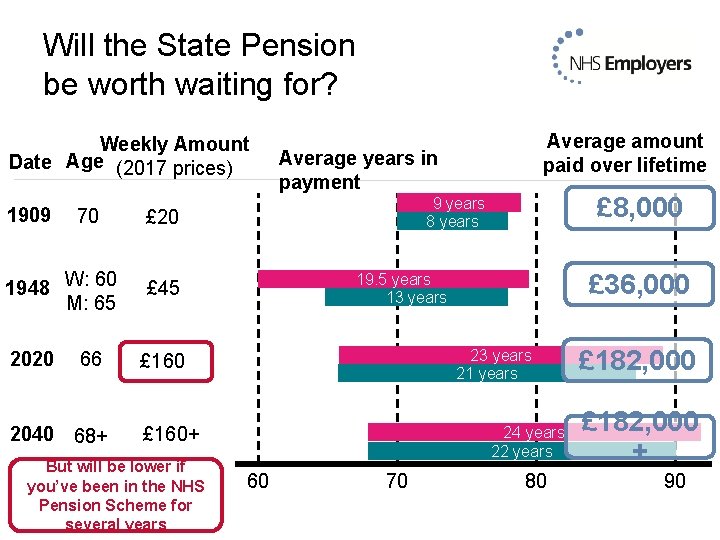
Will the State Pension be worth waiting for? Weekly Amount Date Age (2017 prices) 1909 70 1948 W: 60 M: 65 2020 66 2040 68+ Average years in payment £ 8, 000 9 years 8 years £ 20 £ 36, 000 19. 5 years 13 years £ 45 23 years 21 years £ 160+ But will be lower if you’ve been in the NHS Pension Scheme for several years Average amount paid over lifetime 24 years 22 years 60 70 80 £ 182, 000 + 90
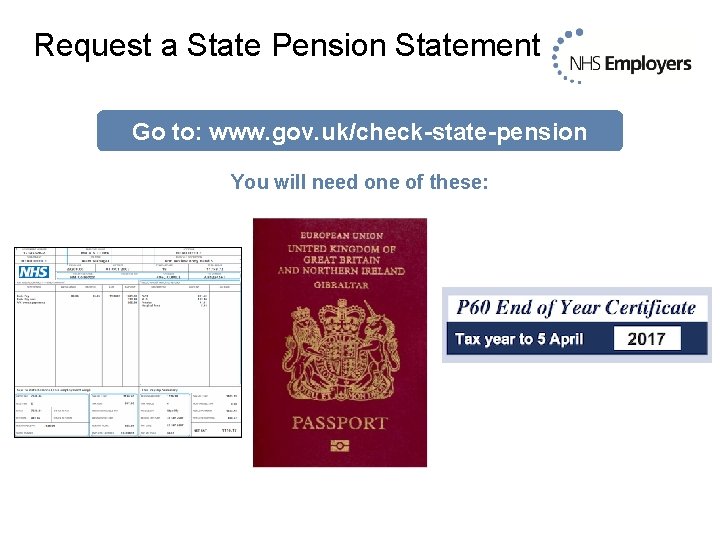
Request a State Pension Statement Go to: www. gov. uk/check-state-pension You will need one of these:
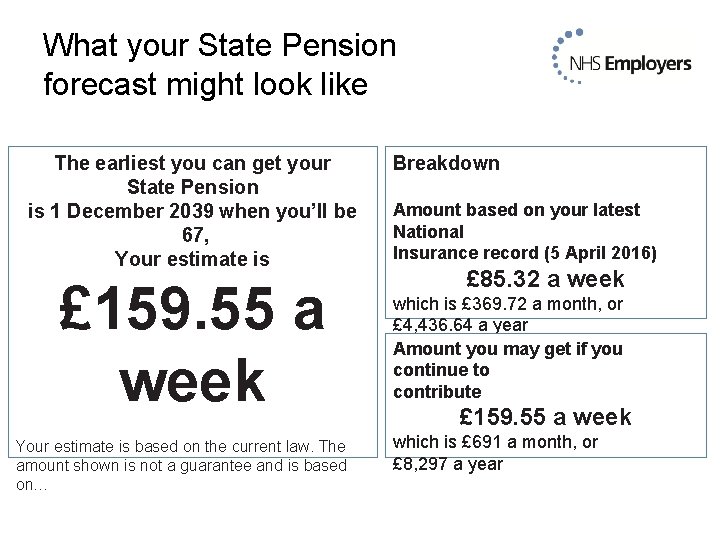
What your State Pension forecast might look like The earliest you can get your State Pension is 1 December 2039 when you’ll be 67, Your estimate is £ 159. 55 a week Your estimate is based on the current law. The amount shown is not a guarantee and is based on… Breakdown Amount based on your latest National Insurance record (5 April 2016) £ 85. 32 a week which is £ 369. 72 a month, or £ 4, 436. 64 a year Amount you may get if you continue to contribute £ 159. 55 a week which is £ 691 a month, or £ 8, 297 a year
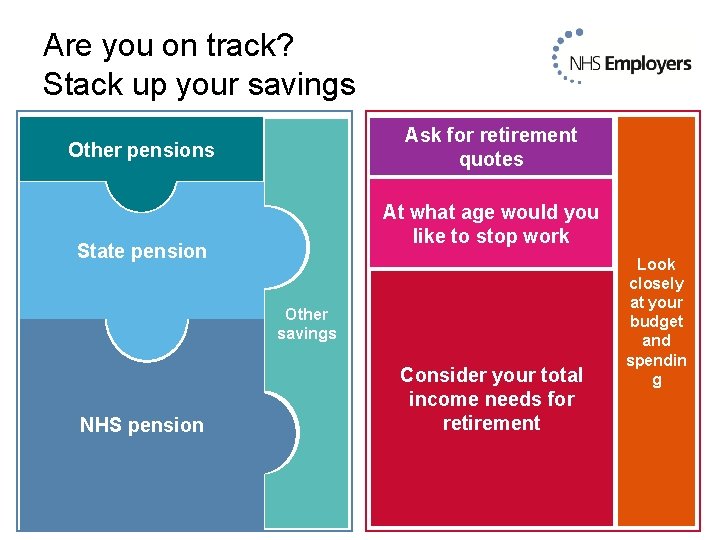
Are you on track? Stack up your savings Ask for retirement quotes Other pensions At what age would you like to stop work State pension Other savings NHS pension Consider your total income needs for retirement Look closely at your budget and spendin g

9. Ways to increase your benefits
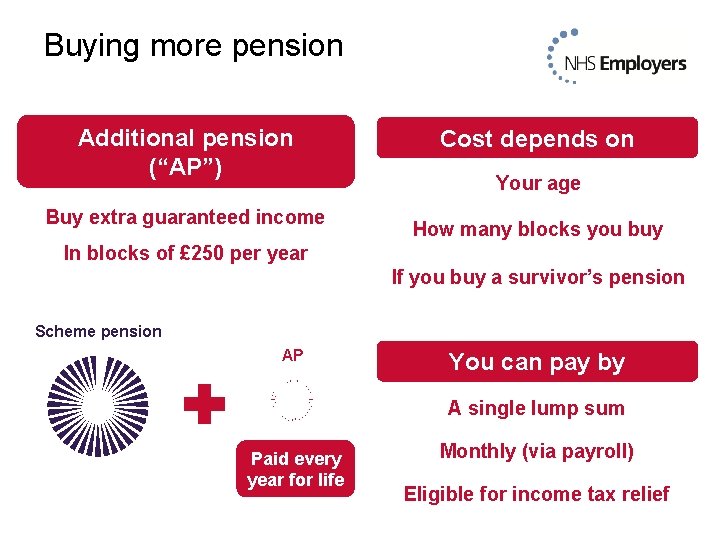
Buying more pension Additional pension (“AP”) Buy extra guaranteed income Cost depends on Your age How many blocks you buy In blocks of £ 250 per year If you buy a survivor’s pension Scheme pension AP You can pay by A single lump sum Paid every year for life Monthly (via payroll) Eligible for income tax relief
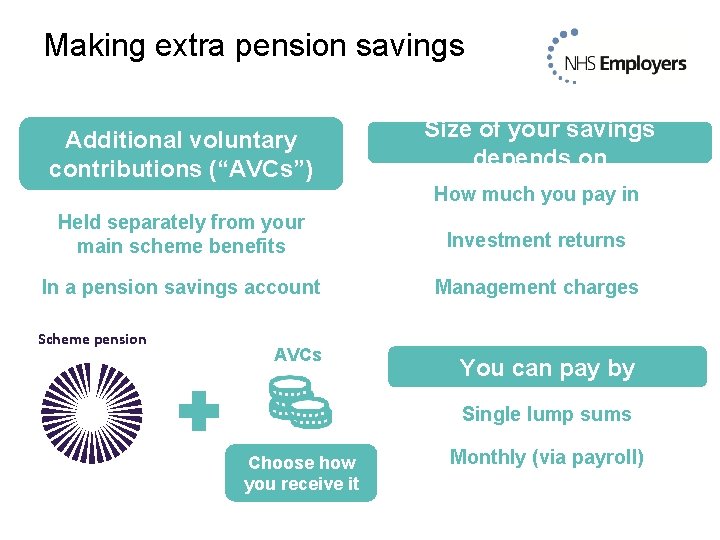
Making extra pension savings Additional voluntary contributions (“AVCs”) Size of your savings depends on How much you pay in Held separately from your main scheme benefits Investment returns In a pension savings account Management charges Scheme pension AVCs You can pay by Single lump sums Choose how you receive it Monthly (via payroll)
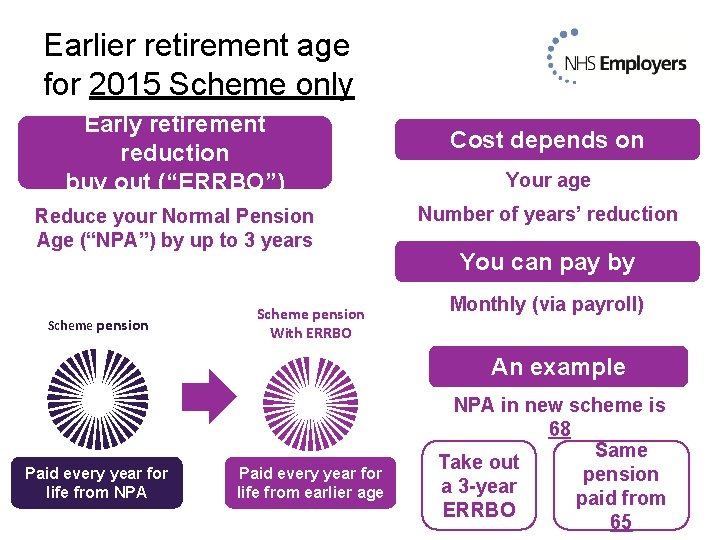
Earlier retirement age for 2015 Scheme only Early retirement reduction buy out (“ERRBO”) Reduce your Normal Pension Age (“NPA”) by up to 3 years Scheme pension With ERRBO Cost depends on Your age Number of years’ reduction You can pay by Monthly (via payroll) An example Paid every year for life from NPA Paid every year for life from earlier age NPA in new scheme is 68 Same Take out pension a 3 -year paid from ERRBO 65
10. Pensions tax
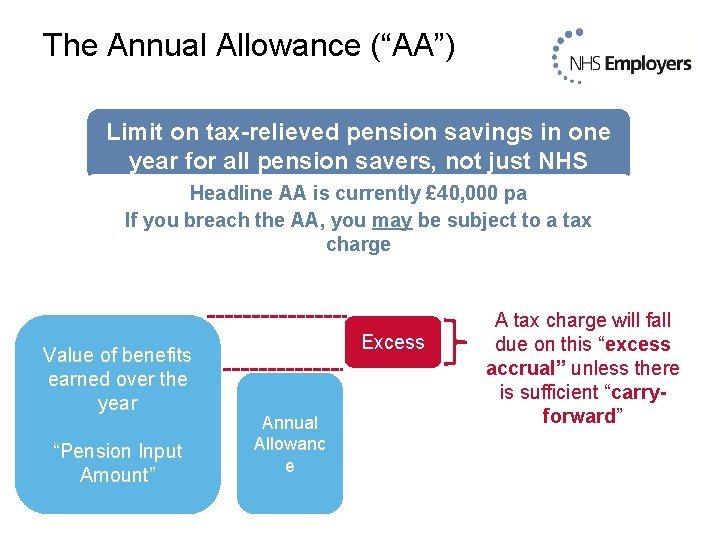
The Annual Allowance (“AA”) Limit on tax-relieved pension savings in one year for all pension savers, not just NHS Headline AA is currently £ 40, 000 pa If you breach the AA, you may be subject to a tax charge Value of benefits earned over the year “Pension Input Amount” Excess Annual Allowanc e A tax charge will fall due on this “excess accrual” unless there is sufficient “carryforward”
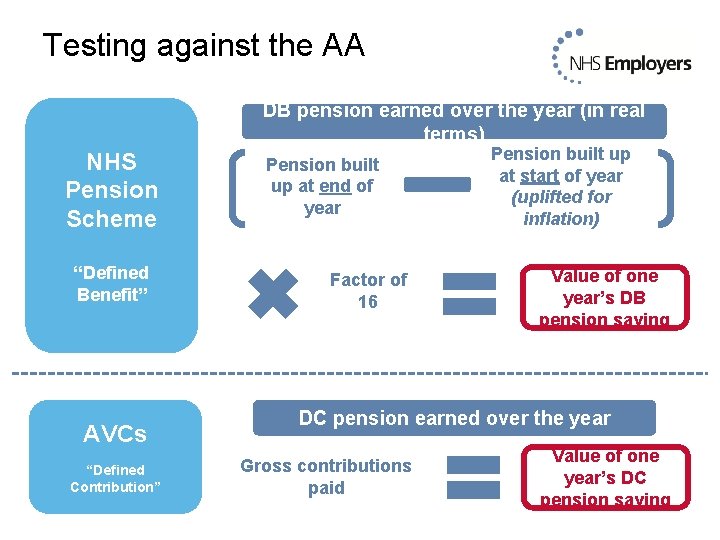
Testing against the AA DB pension earned over the year (in real terms) NHS Pension Scheme “Defined Benefit” AVCs “Defined Contribution” Pension built up at end of year Factor of 16 Pension built up at start of year (uplifted for inflation) Value of one year’s DB pension saving DC pension earned over the year Gross contributions paid Value of one year’s DC pension saving
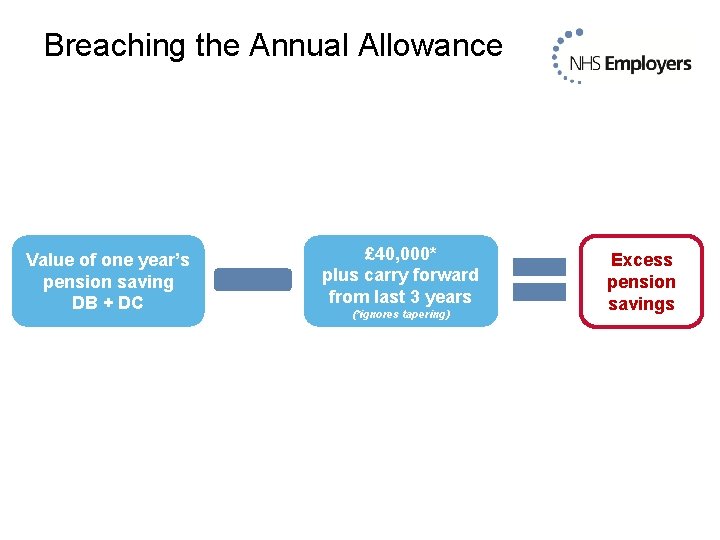
Breaching the Annual Allowance Value of one year’s pension saving DB + DC £ 40, 000* plus carry forward from last 3 years (*ignores tapering) Excess pension savings
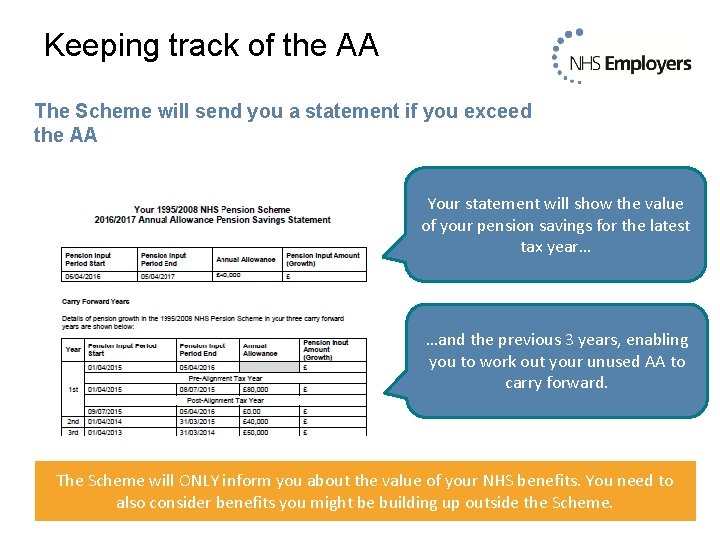
Keeping track of the AA The Scheme will send you a statement if you exceed the AA Your statement will show the value of your pension savings for the latest tax year… …and the previous 3 years, enabling you to work out your unused AA to carry forward. The Scheme will ONLY inform you about the value of your NHS benefits. You need to also consider benefits you might be building up outside the Scheme.
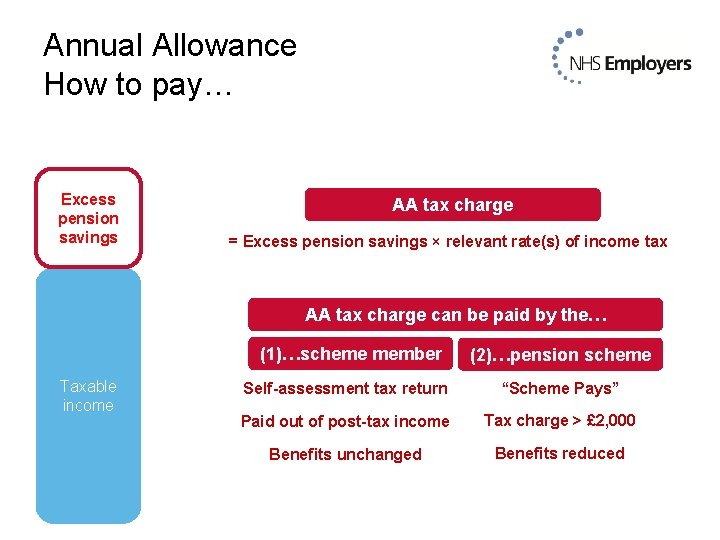
Annual Allowance How to pay… Excess pension savings AA tax charge = Excess pension savings × relevant rate(s) of income tax AA tax charge can be paid by the… (1)…scheme member Taxable income (2)…pension scheme Self-assessment tax return “Scheme Pays” Paid out of post-tax income Tax charge > £ 2, 000 Benefits unchanged Benefits reduced
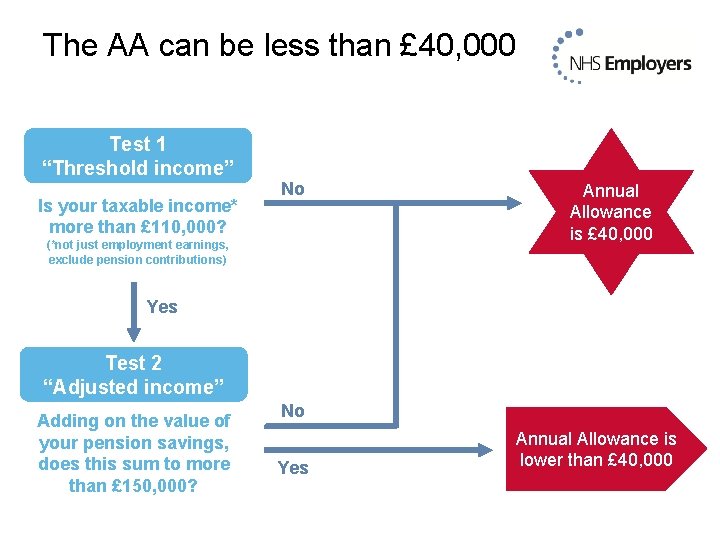
The AA can be less than £ 40, 000 Test 1 “Threshold income” Is your taxable income* more than £ 110, 000? No (*not just employment earnings, exclude pension contributions) Annual Allowance is £ 40, 000 Yes Test 2 “Adjusted income” Adding on the value of your pension savings, does this sum to more than £ 150, 000? No Yes Annual Allowance is lower than £ 40, 000
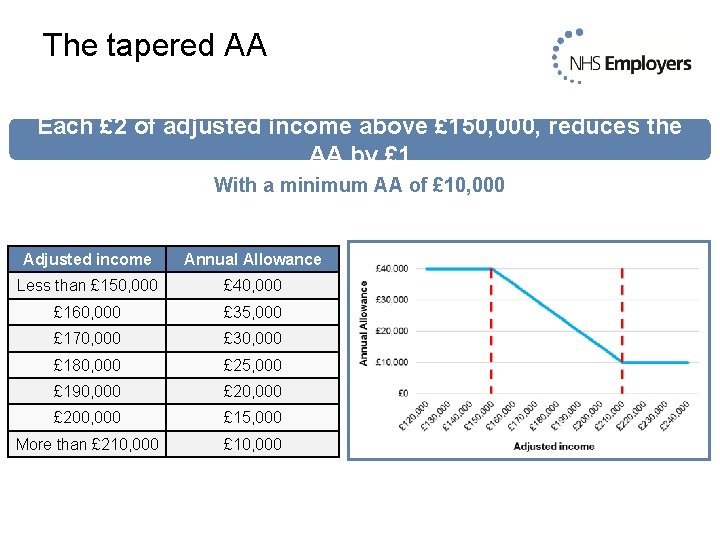
The tapered AA Each £ 2 of adjusted income above £ 150, 000, reduces the AA by £ 1 With a minimum AA of £ 10, 000 Adjusted income Annual Allowance Less than £ 150, 000 £ 40, 000 £ 160, 000 £ 35, 000 £ 170, 000 £ 30, 000 £ 180, 000 £ 25, 000 £ 190, 000 £ 200, 000 £ 15, 000 More than £ 210, 000 £ 10, 000

The Lifetime Allowance (“LTA”) Limit on tax-relieved pension savings over a lifetime for all pension savers – not just NHS LTA is currently £ 1, 030, 000 (2018/19) If you breach the LTA, you may be subject to a tax charge Excess Total value of benefits across all schemes Lifetime Allowanc e A tax charge will fall due on these “excess benefits”
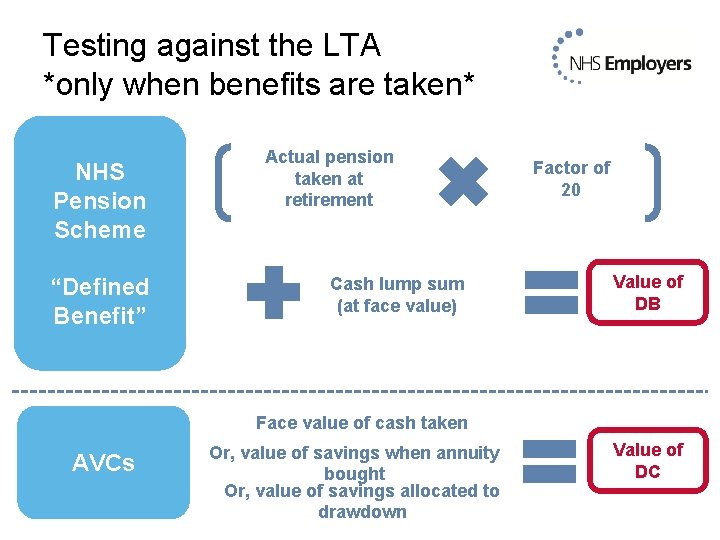
Testing against the LTA *only when benefits are taken* NHS Pension Scheme “Defined Benefit” Actual pension taken at retirement Cash lump sum (at face value) Factor of 20 Value of DB Face value of cash taken AVCs Or, value of savings when annuity bought Or, value of savings allocated to drawdown Value of DC
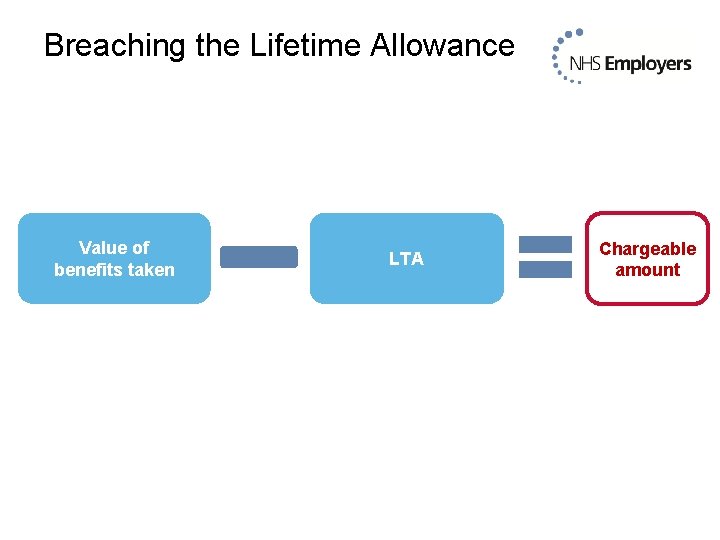
Breaching the Lifetime Allowance Value of benefits taken LTA Chargeable amount
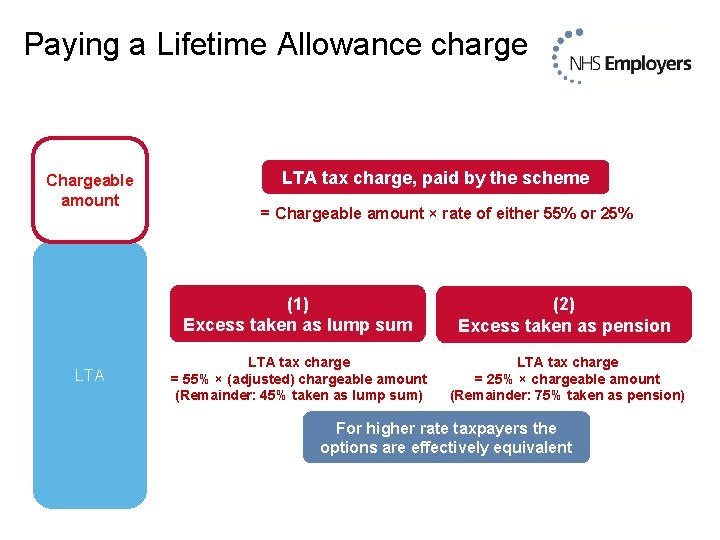
Paying a Lifetime Allowance charge Chargeable amount LTA tax charge, paid by the scheme = Chargeable amount × rate of either 55% or 25% (1) Excess taken as lump sum (2) Excess taken as pension LTA tax charge = 55% × (adjusted) chargeable amount (Remainder: 45% taken as lump sum) LTA tax charge = 25% × chargeable amount (Remainder: 75% taken as pension) For higher rate taxpayers the options are effectively equivalent
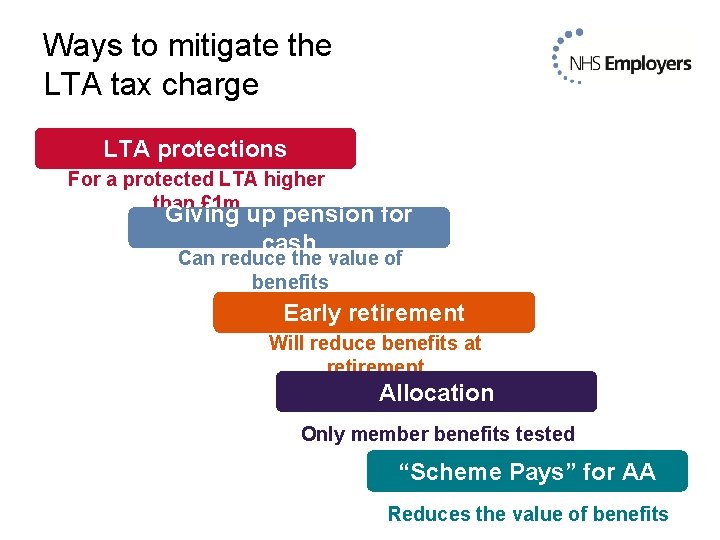
Ways to mitigate the LTA tax charge LTA protections For a protected LTA higher than £ 1 m Giving up pension for cash Can reduce the value of benefits Early retirement Will reduce benefits at retirement Allocation Only member benefits tested “Scheme Pays” for AA Reduces the value of benefits
Disclaimers and warnings • • • The content of this presentation is designed to assist NHS employers in providing their employees with helpful information regarding pension saving. None of the material provided is intended as financial advice or recommendation and NHS Employers accept no liability arising from any use of the presentation. If employees require specific advice or help regarding their financial planning, they should contact an Appropriately Qualified Financial Adviser. This presentation has been created using Power. Point 2016. Spacing and formatting may change if a different version is used. We recommend that users check the presentation before delivery to spot and correct any format changes. NHS Employers cannot take responsibility for any amendments, edits and additions made from this point forward by users. We have taken every care in the preparation of these materials, but it is not binding. If any error or omission should subsequently be discovered, the scheme regulations take precedence. We understand the information, illustrations and figures quoted to be accurate at the time of writing (26 January 2018). However, over time these will become out of date – for example as tax bands or contribution rates change over time, new legislation or tax treatments are introduced or altered, and new financial products and systems are introduced. We take no responsibility in ensuring the materials are kept up to date. Any figures set out in this presentation are intended as illustrations only. The benefits provided by the NHS Pension Scheme are governed by Regulations. More details of the benefits provided by the Scheme can be found on the Scheme website. Some of the information provided is “opinion based”, for example setting out “rules of thumb” or the “value of the State Pension”. The materials covering these sections are therefore not intended to be statements of fact. Very different viewpoints or opinions could reasonably be taken, and each individual will be different. Specifically these opinions are not intended to direct individuals to take a particular course of action, but are provided as generic ideas to be considered.
- Slides: 62