
NHS LONG TERM PLAN 1 Insert slide title

- Slides: 5
NHS LONG TERM PLAN 1 Insert slide title in master
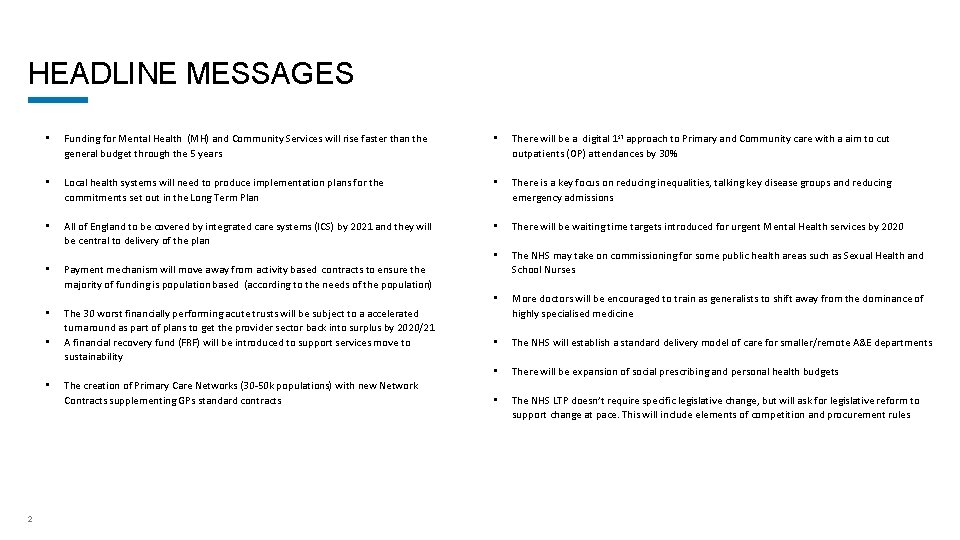
HEADLINE MESSAGES • Funding for Mental Health (MH) and Community Services will rise faster than the general budget through the 5 years • There will be a digital 1 st approach to Primary and Community care with a aim to cut outpatients (OP) attendances by 30% • Local health systems will need to produce implementation plans for the commitments set out in the Long Term Plan • There is a key focus on reducing inequalities, talking key disease groups and reducing emergency admissions • All of England to be covered by integrated care systems (ICS) by 2021 and they will be central to delivery of the plan • There will be waiting time targets introduced for urgent Mental Health services by 2020 • The NHS may take on commissioning for some public health areas such as Sexual Health and School Nurses • More doctors will be encouraged to train as generalists to shift away from the dominance of highly specialised medicine • The NHS will establish a standard delivery model of care for smaller/remote A&E departments • There will be expansion of social prescribing and personal health budgets • The NHS LTP doesn’t require specific legislative change, but will ask for legislative reform to support change at pace. This will include elements of competition and procurement rules • • 2 Payment mechanism will move away from activity based contracts to ensure the majority of funding is population based (according to the needs of the population) The 30 worst financially performing acute trusts will be subject to a accelerated turnaround as part of plans to get the provider sector back into surplus by 2020/21 A financial recovery fund (FRF) will be introduced to support services move to sustainability The creation of Primary Care Networks (30 -50 k populations) with new Network Contracts supplementing GPs standard contracts
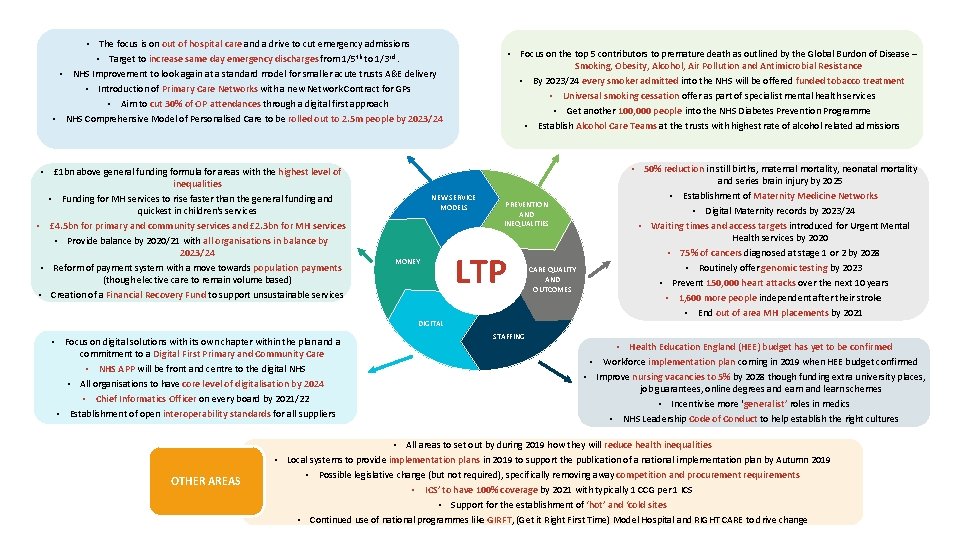
• The focus is on out of hospital care and a drive to cut emergency admissions • Target to increase same day emergency discharges from 1/5 th to 1/3 rd. • NHS Improvement to look again at a standard model for smaller acute trusts A&E delivery • Introduction of Primary Care Networks with a new Network Contract for GPs • Aim to cut 30% of OP attendances through a digital first approach • NHS Comprehensive Model of Personalised Care to be rolled out to 2. 5 m people by 2023/24 • £ 1 bn above general funding formula for areas with the highest level of inequalities • Funding for MH services to rise faster than the general funding and quickest in children's services • £ 4. 5 bn for primary and community services and £ 2. 3 bn for MH services • Provide balance by 2020/21 with all organisations in balance by 2023/24 • Reform of payment system with a move towards population payments (though elective care to remain volume based) • Creation of a Financial Recovery Fund to support unsustainable services • Focus on the top 5 contributors to premature death as outlined by the Global Burdon of Disease – Smoking, Obesity, Alcohol, Air Pollution and Antimicrobial Resistance • By 2023/24 every smoker admitted into the NHS will be offered funded tobacco treatment • Universal smoking cessation offer as part of specialist mental health services • Get another 100, 000 people into the NHS Diabetes Prevention Programme • Establish Alcohol Care Teams at the trusts with highest rate of alcohol related admissions NEW SERVICE MODELS MONEY PREVENTION AND INEQUALITIES LTP DIGITAL • Focus on digital solutions with its own chapter within the plan and a commitment to a Digital First Primary and Community Care • NHS APP will be front and centre to the digital NHS • All organisations to have core level of digitalisation by 2024 • Chief Informatics Officer on every board by 2021/22 • Establishment of open interoperability standards for all suppliers OTHER AREAS STAFFING CARE QUALITY AND OUTCOMES • 50% reduction in still births, maternal mortality, neonatal mortality and series brain injury by 2025 • Establishment of Maternity Medicine Networks • Digital Maternity records by 2023/24 • Waiting times and access targets introduced for Urgent Mental Health services by 2020 • 75% of cancers diagnosed at stage 1 or 2 by 2028 • Routinely offer genomic testing by 2023 • Prevent 150, 000 heart attacks over the next 10 years • 1, 600 more people independent after their stroke • End out of area MH placements by 2021 • Health Education England (HEE) budget has yet to be confirmed • Workforce implementation plan coming in 2019 when HEE budget confirmed • Improve nursing vacancies to 5% by 2028 though funding extra university places, job guarantees, online degrees and earn and learn schemes • Incentivise more ‘generalist’ roles in medics • NHS Leadership Code of Conduct to help establish the right cultures • All areas to set out by during 2019 how they will reduce health inequalities • Local systems to provide implementation plans in 2019 to support the publication of a national implementation plan by Autumn 2019 • Possible legislative change (but not required), specifically removing away competition and procurement requirements • ICS’ to have 100% coverage by 2021 with typically 1 CCG per 1 ICS • Support for the establishment of ‘hot’ and ‘cold sites • Continued use of national programmes like GIRFT, (Get it Right First Time) Model Hospital and RIGHT CARE to drive change
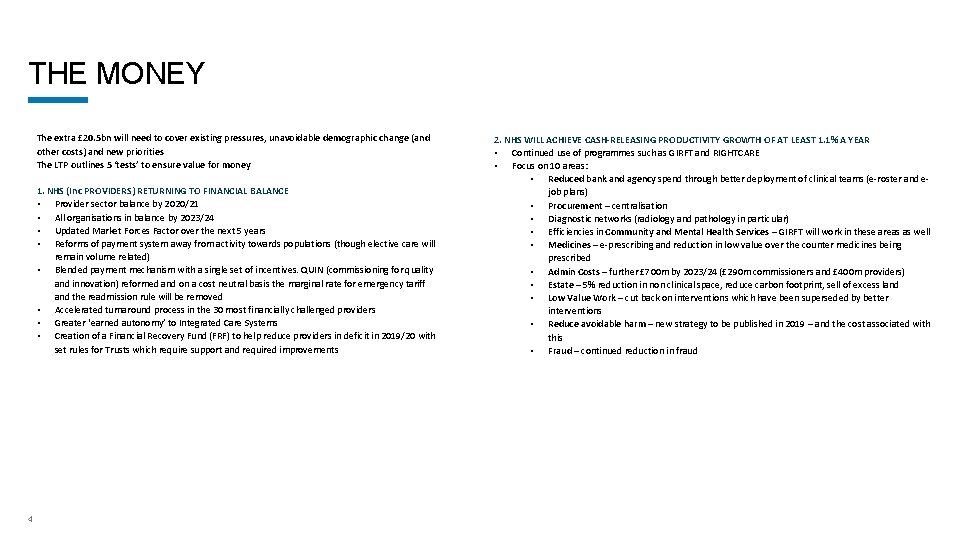
THE MONEY The extra £ 20. 5 bn will need to cover existing pressures, unavoidable demographic change (and other costs) and new priorities The LTP outlines 5 ‘tests’ to ensure value for money 1. NHS (Inc PROVIDERS) RETURNING TO FINANCIAL BALANCE • Provider sector balance by 2020/21 • All organisations in balance by 2023/24 • Updated Market Forces Factor over the next 5 years • Reforms of payment system away from activity towards populations (though elective care will remain volume related) • Blended payment mechanism with a single set of incentives. QUIN (commissioning for quality and innovation) reformed and on a cost neutral basis the marginal rate for emergency tariff and the readmission rule will be removed • Accelerated turnaround process in the 30 most financially challenged providers • Greater ‘earned autonomy’ to Integrated Care Systems • Creation of a Financial Recovery Fund (FRF) to help reduce providers in deficit in 2019/20 with set rules for Trusts which require support and required improvements 4 2. NHS WILL ACHIEVE CASH-RELEASING PRODUCTIVITY GROWTH OF AT LEAST 1. 1% A YEAR • Continued use of programmes such as GIRFT and RIGHTCARE • Focus on 10 areas: • Reduced bank and agency spend through better deployment of clinical teams (e-roster and ejob plans) • Procurement – centralisation • Diagnostic networks (radiology and pathology in particular) • Efficiencies in Community and Mental Health Services – GIRFT will work in these areas as well • Medicines – e-prescribing and reduction in low value over the counter medicines being prescribed • Admin Costs – further £ 700 m by 2023/24 (£ 290 m commissioners and £ 400 m providers) • Estate – 5% reduction in non clinical space, reduce carbon footprint, sell of excess land • Low Value Work – cut back on interventions which have been superseded by better interventions • Reduce avoidable harm – new strategy to be published in 2019 – and the cost associated with this • Fraud – continued reduction in fraud
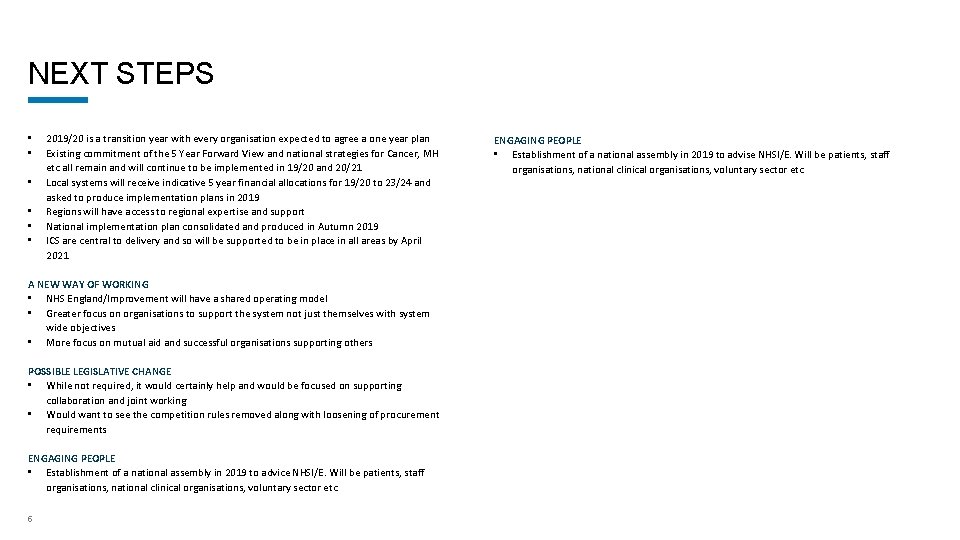
NEXT STEPS • • • 2019/20 is a transition year with every organisation expected to agree a one year plan Existing commitment of the 5 Year Forward View and national strategies for Cancer, MH etc all remain and will continue to be implemented in 19/20 and 20/21 Local systems will receive indicative 5 year financial allocations for 19/20 to 23/24 and asked to produce implementation plans in 2019 Regions will have access to regional expertise and support National implementation plan consolidated and produced in Autumn 2019 ICS are central to delivery and so will be supported to be in place in all areas by April 2021 A NEW WAY OF WORKING • NHS England/Improvement will have a shared operating model • Greater focus on organisations to support the system not just themselves with system wide objectives • More focus on mutual aid and successful organisations supporting others POSSIBLE LEGISLATIVE CHANGE • While not required, it would certainly help and would be focused on supporting collaboration and joint working • Would want to see the competition rules removed along with loosening of procurement requirements ENGAGING PEOPLE • Establishment of a national assembly in 2019 to advice NHSI/E. Will be patients, staff organisations, national clinical organisations, voluntary sector etc 5 ENGAGING PEOPLE • Establishment of a national assembly in 2019 to advise NHSI/E. Will be patients, staff organisations, national clinical organisations, voluntary sector etc