
NHS Knowledge and Library Services The Value Proposition

NHS Knowledge and Library Services The Value Proposition Dominic Gilroy Library and Knowledge Services Lead dominic. gilroy@hee. nhs. uk November 2020
This presentation will cover • • Economics by Design Our approach The need for evidence in healthcare Our key messages Current economic benefits of Knowledge and Library Services Potential to increase our economic benefit Essentials to optimise your economic benefit
Economics by Design

Methodology

NHS funded Library and Knowledge Services in England Value Proposition: The gift of time A report to Health Education England by Economics. By. Design November 2020 @NHS_Health. Ed. Eng
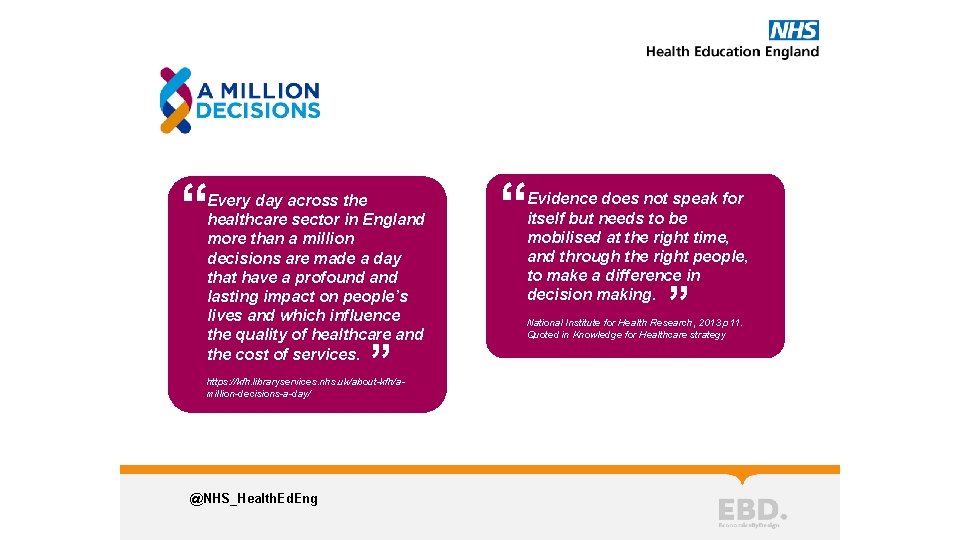
“ Every day across the healthcare sector in England more than a million decisions are made a day that have a profound and lasting impact on people’s lives and which influence the quality of healthcare and the cost of services. ” https: //kfh. libraryservices. nhs. uk/about-kfh/amillion-decisions-a-day/ @NHS_Health. Ed. Eng “ Evidence does not speak for itself but needs to be mobilised at the right time, and through the right people, to make a difference in decision making. ” National Institute for Health Research, 2013 p 11. Quoted in Knowledge for Healthcare strategy
Key Messages 1. The NHS Library and Knowledge Services operate across a diverse and complex customer base. 2. The services provided take the ‘heavy lifting’ out of getting evidence into practice and give the ‘gift of time’ to healthcare professionals. 3. Informed decisions improve outcomes, quality of care, patient experience, resource utilisation and operational efficiencies. This is best achieved when healthcare professionals are supported by the right knowledge services, with the right resources and with the right teams and roles. 4. When supported by high-performing Library and Knowledge Services, NHS provider organisations are able to demonstrate how they are meeting their statutory obligations to use evidence to inform practice and hence improve their CQC ratings. 5. The core value proposition is simple: The service provides healthcare professional staff with time-saving accelerated access to better quality evidence. This enables the NHS to meet its statutory obligations to utilise evidence from research. It enables healthcare professionals to use their time more effectively to drive improvements against the NHS quadruple aim *. *https: //www. ncbi. nlm. nih. gov/pmc/articles/PMC 4226781/ @NHS_Health. Ed. Eng
Key Messages 6. Case studies of high performing NHS Library and Knowledge Services demonstrate two key enablers for benefits realisation: that the service has a clear strategic leadership role in knowledge management and mobilisation, and is integrated with service delivery. 7. There is a growing and consistent body of robust international evidence to support this Value Proposition. 8. Recently published research from the NHS suggests similar benefits do exist for the NHS. 9. Assuming findings from the international literature applicable to the NHS, the service is potentially already generating an overall economic benefit of £ 132 m per annum for the NHS, delivering a net economic benefit of £ 77 m per annum. This could increase to £ 106 m per annum were target staff ratios for librarians achieved. * 10. Further high-quality NHS based research will help to quantify the ‘gift of time’ for healthcare professionals and the associated quality improvement benefits for patients, provided by NHS Library and Knowledge Services staff. Scope: This report draws on robust published research and selected case studies from the NHS to describe, and model the potential economic value of a well-run NHS Library and Knowledge Service to its users and funders. Valuation methods used for Key Finding 9, are consistent with the H. M. Treasury Green Book. This is not primary research. *this represents a financial value of economic benefits rather than NHS budgetary impact @NHS_Health. Ed. Eng
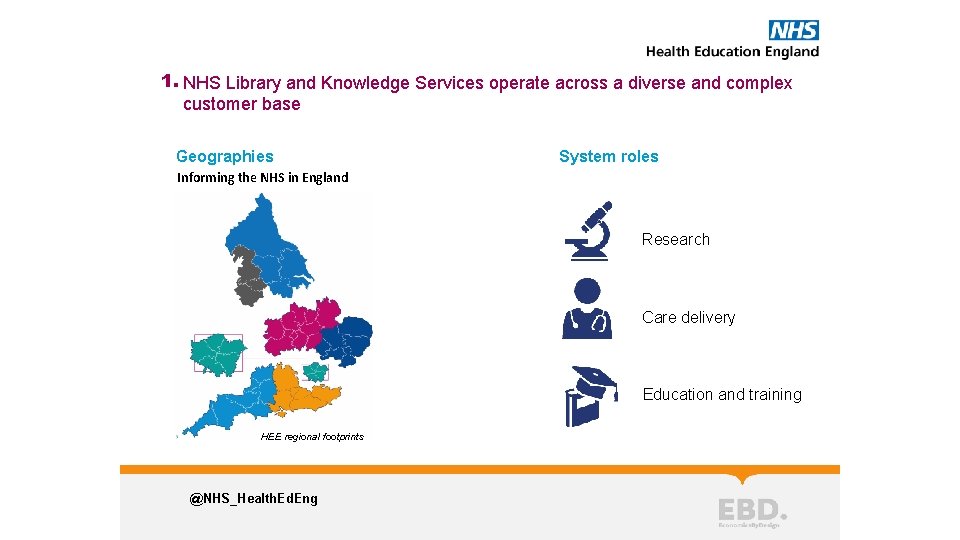
1. NHS Library and Knowledge Services operate across a diverse and complex customer base Geographies System roles Informing the NHS in England Research Care delivery Education and training HEE regional footprints @NHS_Health. Ed. Eng
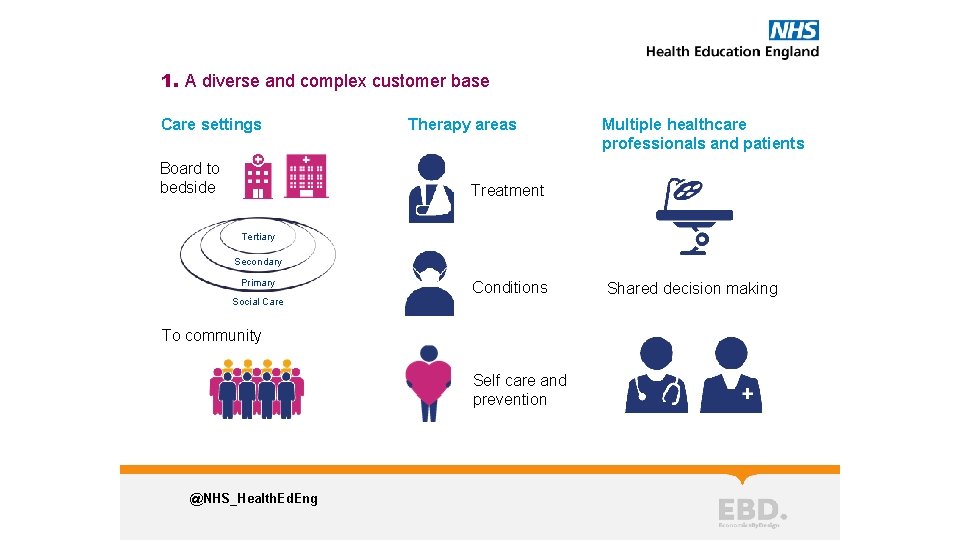
1. A diverse and complex customer base Care settings Board to bedside Therapy areas Multiple healthcare professionals and patients Treatment Tertiary Secondary Primary Social Care Conditions To community Self care and prevention @NHS_Health. Ed. Eng Shared decision making
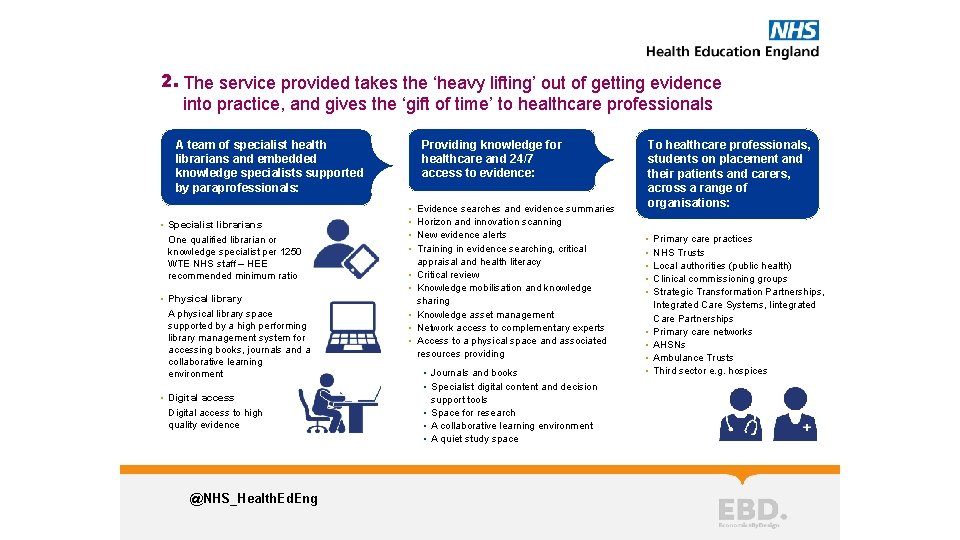
2. The service provided takes the ‘heavy lifting’ out of getting evidence into practice, and gives the ‘gift of time’ to healthcare professionals A team of specialist health librarians and embedded knowledge specialists supported by paraprofessionals: • Specialist librarians One qualified librarian or knowledge specialist per 1250 WTE NHS staff – HEE recommended minimum ratio • Physical library A physical library space supported by a high performing library management system for accessing books, journals and a collaborative learning environment • Digital access to high quality evidence @NHS_Health. Ed. Eng Providing knowledge for healthcare and 24/7 access to evidence: • • • Evidence searches and evidence summaries Horizon and innovation scanning New evidence alerts Training in evidence searching, critical appraisal and health literacy Critical review Knowledge mobilisation and knowledge sharing Knowledge asset management Network access to complementary experts Access to a physical space and associated resources providing • Journals and books • Specialist digital content and decision support tools • Space for research • A collaborative learning environment • A quiet study space To healthcare professionals, students on placement and their patients and carers, across a range of organisations: • • • Primary care practices NHS Trusts Local authorities (public health) Clinical commissioning groups Strategic Transformation Partnerships, Integrated Care Systems, Iintegrated Care Partnerships Primary care networks AHSNs Ambulance Trusts Third sector e. g. hospices
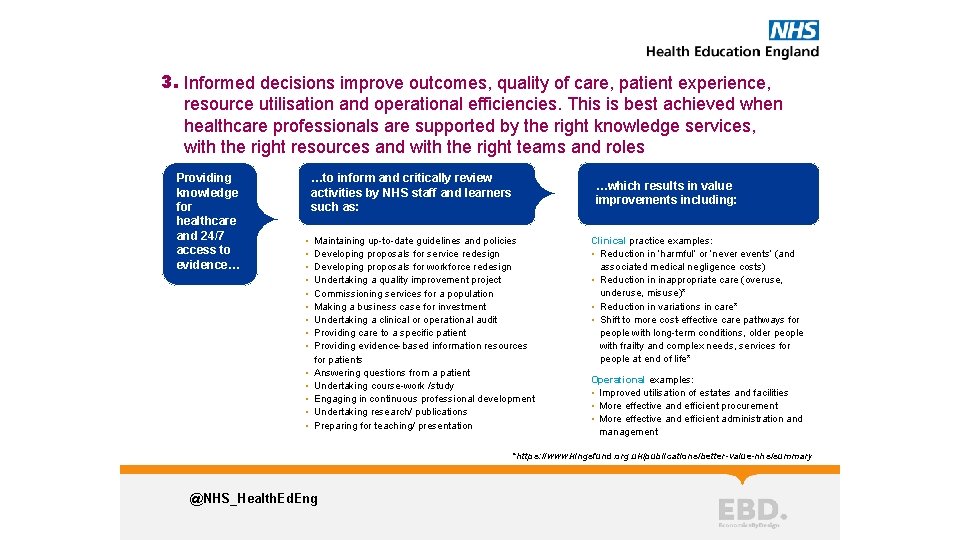
3. Informed decisions improve outcomes, quality of care, patient experience, resource utilisation and operational efficiencies. This is best achieved when healthcare professionals are supported by the right knowledge services, with the right resources and with the right teams and roles Providing knowledge for healthcare and 24/7 access to evidence… …to inform and critically review activities by NHS staff and learners such as: • • • • …which results in value improvements including: Maintaining up-to-date guidelines and policies Developing proposals for service redesign Developing proposals for workforce redesign Undertaking a quality improvement project Commissioning services for a population Making a business case for investment Undertaking a clinical or operational audit Providing care to a specific patient Providing evidence-based information resources for patients Answering questions from a patient Undertaking course-work /study Engaging in continuous professional development Undertaking research/ publications Preparing for teaching/ presentation Clinical practice examples: • Reduction in ‘harmful’ or ‘never events’ (and associated medical negligence costs) • Reduction in inappropriate care (overuse, underuse, misuse)* • Reduction in variations in care* • Shift to more cost-effective care pathways for people with long-term conditions, older people with frailty and complex needs, services for people at end of life* Operational examples: • Improved utilisation of estates and facilities • More effective and efficient procurement • More effective and efficient administration and management *https: //www. kingsfund. org. uk/publications/better-value-nhs/summary @NHS_Health. Ed. Eng
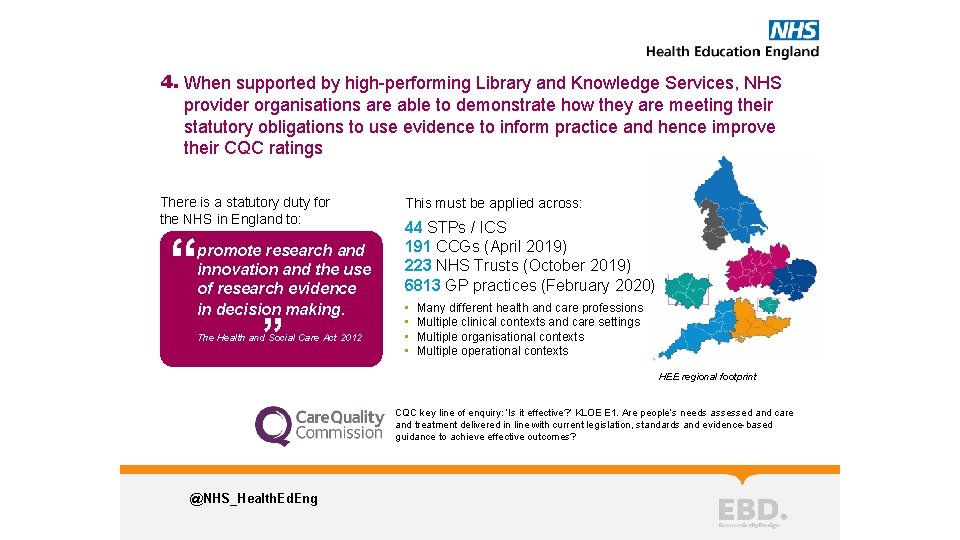
4. When supported by high-performing Library and Knowledge Services, NHS provider organisations are able to demonstrate how they are meeting their statutory obligations to use evidence to inform practice and hence improve their CQC ratings There is a statutory duty for the NHS in England to: “ promote research and innovation and the use of research evidence in decision making. ” The Health and Social Care Act 2012 This must be applied across: 44 STPs / ICS 191 CCGs (April 2019) 223 NHS Trusts (October 2019) 6813 GP practices (February 2020) • • Many different health and care professions Multiple clinical contexts and care settings Multiple organisational contexts Multiple operational contexts HEE regional footprint CQC key line of enquiry: ‘Is it effective? ’ KLOE E 1. Are people’s needs assessed and care and treatment delivered in line with current legislation, standards and evidence-based guidance to achieve effective outcomes? @NHS_Health. Ed. Eng
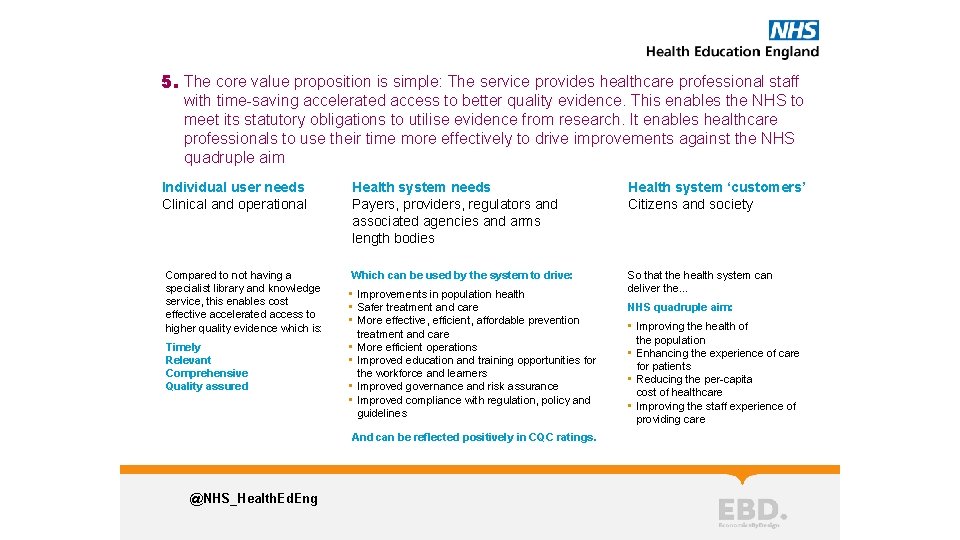
5. The core value proposition is simple: The service provides healthcare professional staff with time-saving accelerated access to better quality evidence. This enables the NHS to meet its statutory obligations to utilise evidence from research. It enables healthcare professionals to use their time more effectively to drive improvements against the NHS quadruple aim Individual user needs Clinical and operational Compared to not having a specialist library and knowledge service, this enables cost effective accelerated access to higher quality evidence which is: Timely Relevant Comprehensive Quality assured Health system needs Payers, providers, regulators and associated agencies and arms length bodies Health system ‘customers’ Citizens and society Which can be used by the system to drive: So that the health system can deliver the… • Improvements in population health • Safer treatment and care • More effective, efficient, affordable prevention treatment and care • More efficient operations • Improved education and training opportunities for the workforce and learners • Improved governance and risk assurance • Improved compliance with regulation, policy and guidelines And can be reflected positively in CQC ratings. @NHS_Health. Ed. Eng NHS quadruple aim: • Improving the health of the population • Enhancing the experience of care for patients • Reducing the per-capita cost of healthcare • Improving the staff experience of providing care
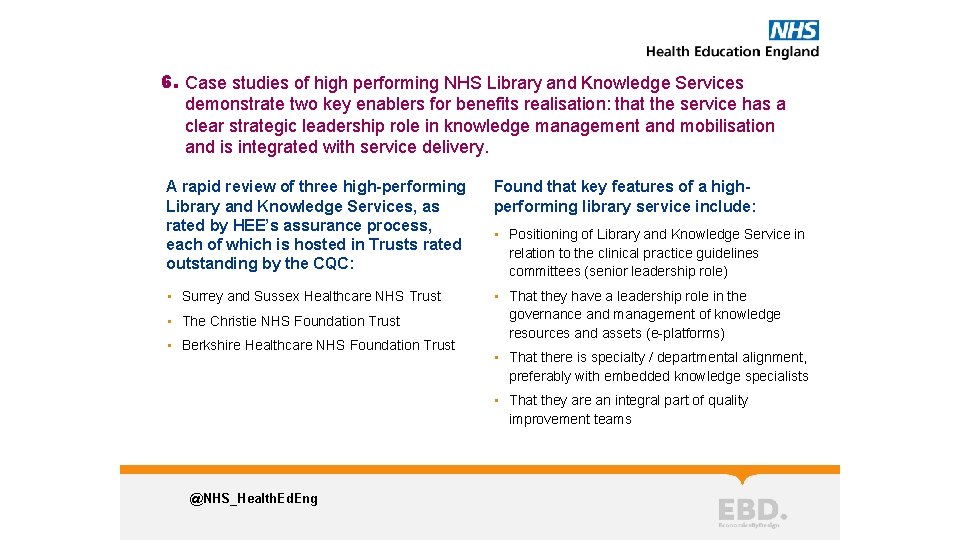
6. Case studies of high performing NHS Library and Knowledge Services demonstrate two key enablers for benefits realisation: that the service has a clear strategic leadership role in knowledge management and mobilisation and is integrated with service delivery. A rapid review of three high-performing Library and Knowledge Services, as rated by HEE’s assurance process, each of which is hosted in Trusts rated outstanding by the CQC: Found that key features of a highperforming library service include: • Surrey and Sussex Healthcare NHS Trust • That they have a leadership role in the • The Christie NHS Foundation Trust • Berkshire Healthcare NHS Foundation Trust • Positioning of Library and Knowledge Service in relation to the clinical practice guidelines committees (senior leadership role) governance and management of knowledge resources and assets (e-platforms) • That there is specialty / departmental alignment, preferably with embedded knowledge specialists • That they are an integral part of quality improvement teams @NHS_Health. Ed. Eng
- Slides: 15