
NHS Fetal Anomaly Screening Programme Marie Coughlin Screening
- Slides: 28
NHS Fetal Anomaly Screening Programme Marie Coughlin Screening Lead January 25 th 2010
Today’s Session l First of 6 Antenatal & Newborn sessions throughout 2010 l Same format will be used – feedback on this would be useful
Reasons for Today’s Session l As a result of Cha. MPs commissioned review of screening l A need to further engage public health in Antenatal & Newborn Screening Programmes l At the request of public health screening leads l Part of C&M Screening Action Plan l Thought it useful to invite commissioners also
Aim of the Session l To increase knowledge base within public health
Session Format l Overview of UK NSC/NWSHA structure l Overview of Fetal Anomaly Screening l Review of patient pathway l Data and QA l Future developments l Questions/comments
Overarching Structure l UK NSC oversees 6 Antenatal & Newborn Screening Programmes l SHA coordinators with regional and national role l NWSHA coordinator jobs out to advert l UK NSC has defined accountability & governance structure for SHA, PCT and provider
Purpose of Fetal Anomaly Screening l Aim to offer women 2 ultrasound tests at 10 -12 weeks and 18 -20 weeks of pregnancy l First scan for dating and pregnancy viability l Second scan screens for major structural anomalies l Down’s Syndrome Screening Programme now part of Fetal Anomaly Screening Programme l Screens for down’s syndrome between 10 -18 weeks depending on local screening strategies
Cont… l Aspires to give women an informed choice l Does not screen for all conditions l For down’s syndrome only gives an indication of risk, does not confirm l Unlike other screening programmes, emphasis not on high uptake rates
Cont. . . l Conditions screened for: — Alobar Holoprosencepathy (HPE) — Anencephaly — Bilateral Renal Agenesis — Cleft Lip/Palate — Congenital Diaphragmatic Hernia (CDH) — Congenital Heart Disease — Down’s Syndrome
Cont… l Conditions screened for: — Edward’s Syndrome (Trisomy 18) — Exomphalos (Omphalocele) — Gastroschisis — Lethal Skeletal Dysplasia — Spina Bifida — Trisomy 13 (Patau’s Syndrome)
Patient Pathway…
NHS Fetal Anomaly Screening Programme (FASP) Rebecca Till Screening Midwife Macclesfield District General Hospital 26 th January 2010
Aim l Programme breakdown l Strategies & Tests l Pathways
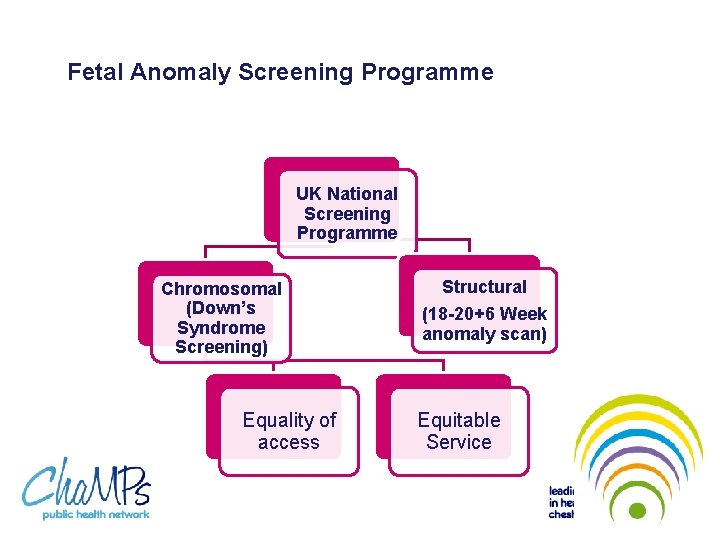
Fetal Anomaly Screening Programme UK National Screening Programme Chromosomal (Down’s Syndrome Screening) Equality of access Structural (18 -20+6 Week anomaly scan) Equitable Service
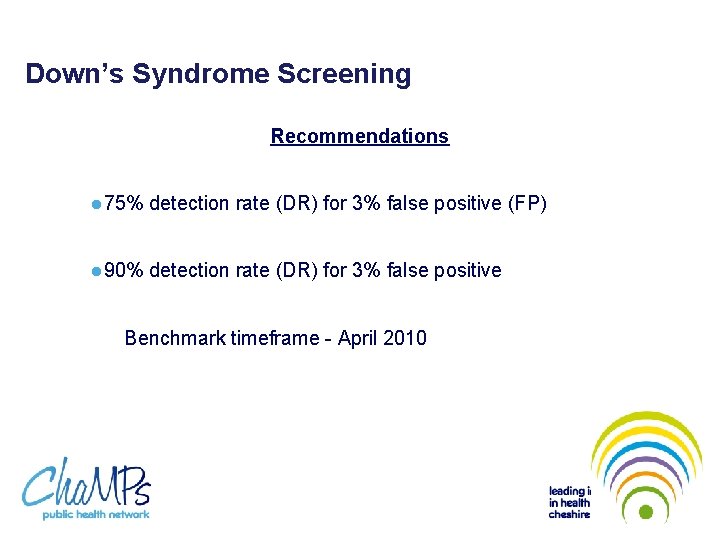
Down’s Syndrome Screening Recommendations l 75% detection rate (DR) for 3% false positive (FP) l 90% detection rate (DR) for 3% false positive Benchmark timeframe - April 2010
Screening Strategies l 1 st Trimester Combined l Quadruple Test
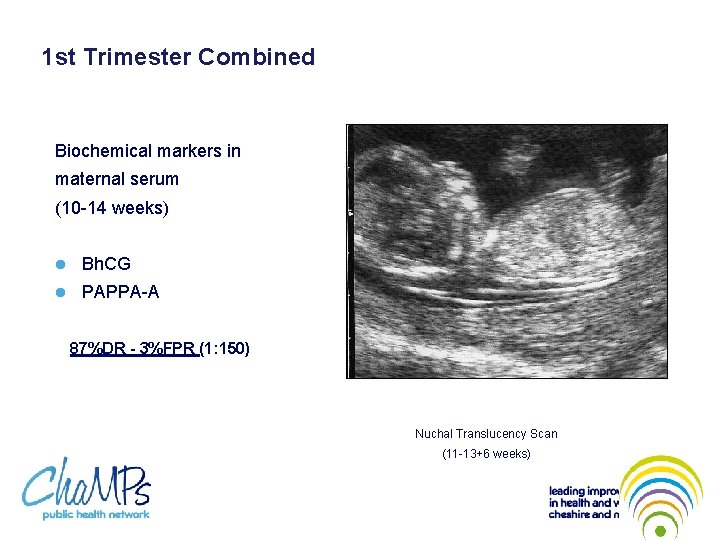
1 st Trimester Combined Biochemical markers in maternal serum (10 -14 weeks) l Bh. CG l PAPPA-A 87%DR - 3%FPR (1: 150) Nuchal Translucency Scan (11 -13+6 weeks)
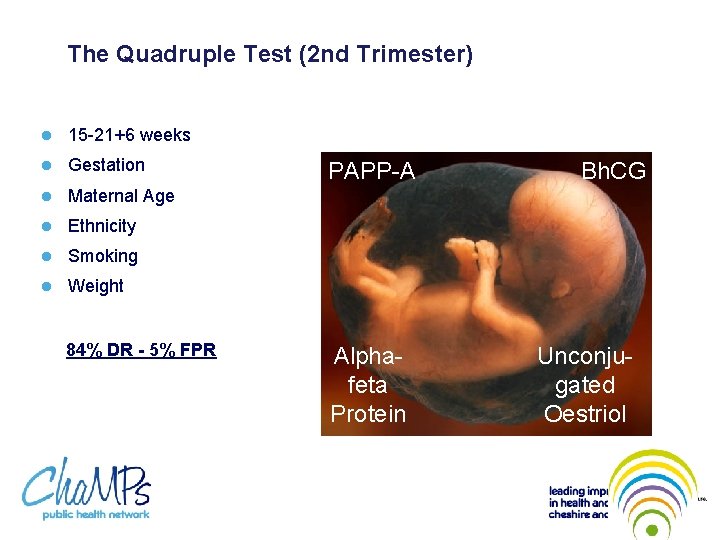
The Quadruple Test (2 nd Trimester) l 15 -21+6 weeks l Gestation l Maternal Age l Ethnicity l Smoking l Weight 84% DR - 5% FPR PAPP-A Alphafeta Alpha-feta Protein Bh. CG Unconjugated Oestriol
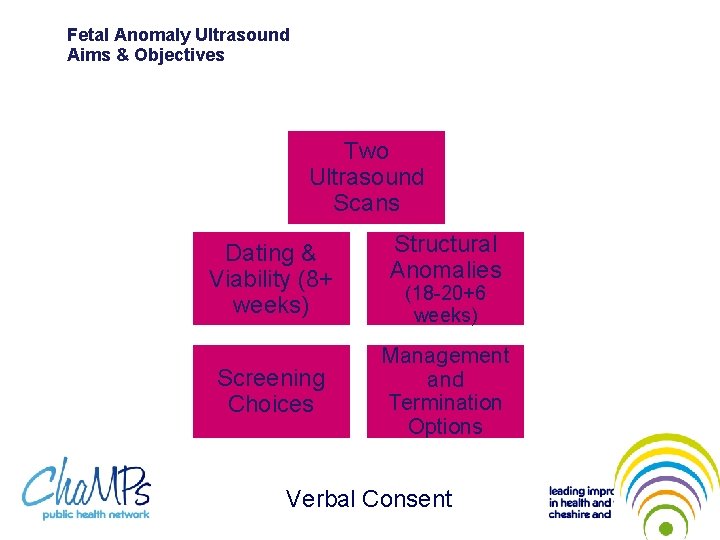
Fetal Anomaly Ultrasound Aims & Objectives Two Ultrasound Scans PAPP-A Structural Dating & Anomalies Viability (8+ (18 -20+6 weeks) Screening Choices Management and Termination Options Verbal Consent
Fetal Anomaly Ultrasound l Abnormalities l Development l Show fetus/heartbeat l Listed anatomy l Measurements l Discuss results l Printed handout
Patient Pathway and Timelines l Screening Timeline l Pathway for Trisomy 21 Screening l Pathway for raised NT > 3. 5 mm l Pathway for Fetal Anomaly Screening
Conclusions l Robust l Implications on Implementation l Resources
Data, Performance & QA l Very difficult to obtain data – not held centrally l Trusts required to produce annual report l QA for laboratories l Developing QA for the rest of the service – NW coordinator roles will aid this
Future Developments l 1 st trimester screening for Down’s Syndrome to be implemented by April 2010 — C&M PCTs not on target for this l QA function to be developed further l I. T. system to improve data collection to be developed
Questions/Comments l How/who monitors annual reports within PCT organisations? l How can we achieve 1 st trimester screening by April 2010? l With regard to QA, how do we assure our Boards that local programmes run satisfactorily?
My Questions l Did you find this session useful? l What will you do differently as a result of this session?
Thank You