
NHS 111 StarLine ReLaunch Access to Clinical Advice
- Slides: 28
NHS 111 Star*Line - Re-Launch Access to Clinical Advice for Care Home teams Winter Readiness Webinar 2 – 14 th October 2019 (Revised version) Supported by and delivering for: London’s NHS organisations include all of London’s CCGs, NHS England Health Education
A collective approach to planning for winter The London Enhanced Health in Care Homes (EHCH) programme team have working together with Sustainable Transformation Partnership (STP) teams, Clinical Commissioning Groups (CCGs) and Local Authorities (LA) to support local teams to have the information and resources to be able to facilitate their local approach to ensuring that social care providers are partners in winter planning and the collective system resilience for London. Following this session we will be sharing a summary pack which we encourage teams to use to compliment existing resources; extracting information you feel is most valuable for your care providers locally. To help raise awareness of the resources available we have planned 4 commissioner focused webinars and a single provider webinar – all these resources will be recorded and available to access via the EHCH website: https: //www. healthylondon. org/resource/accelerated-improvementresources/enhanced-health-in-care-homes/winter-readiness-2/ 2
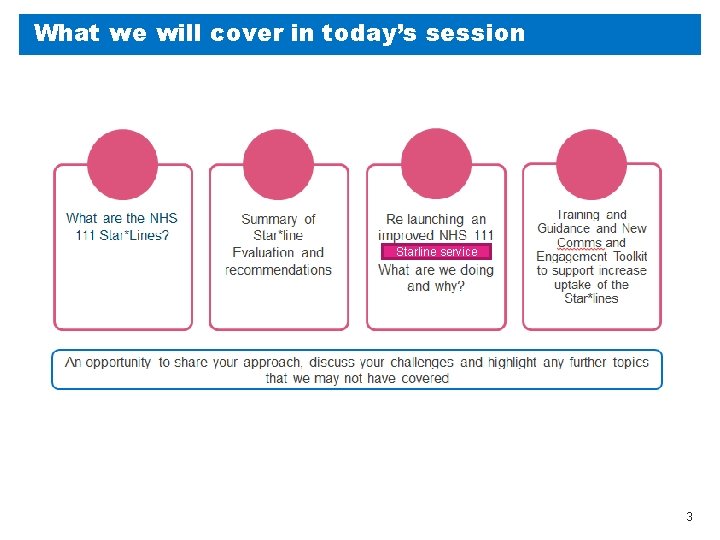
What we will cover in today’s session Starline service 3
01 NHS 111 Star*Line – an introduction Transforming London’s health and care together
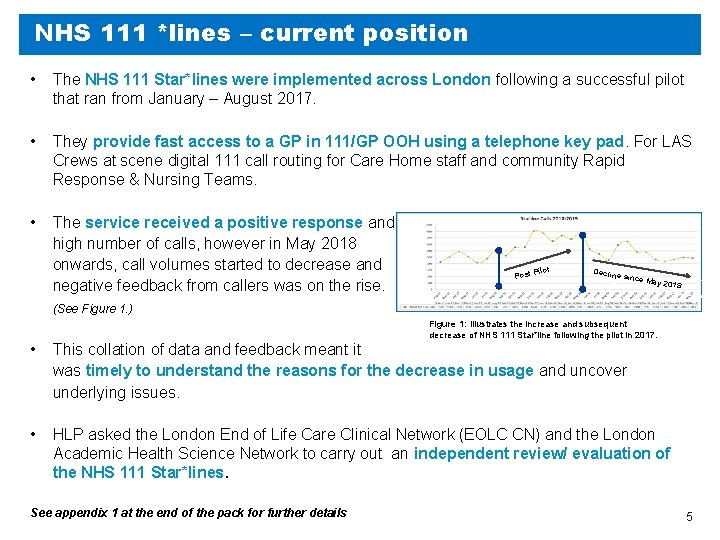
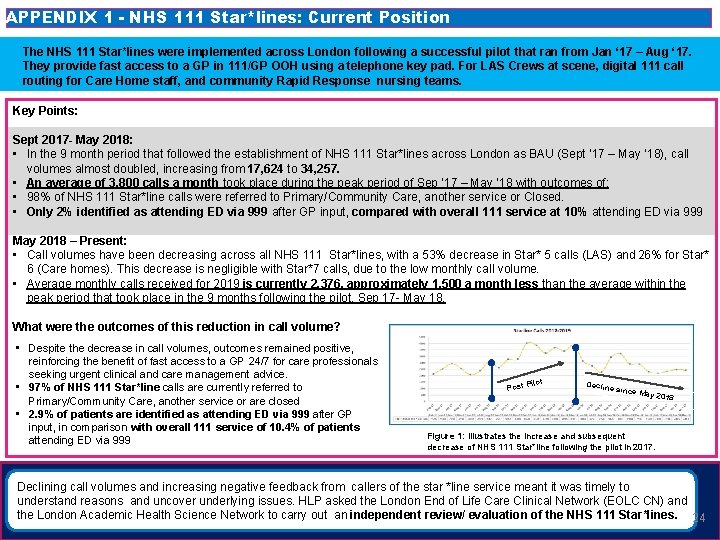
NHS 111 *lines – current position • The NHS 111 Star*lines were implemented across London following a successful pilot that ran from January – August 2017. • They provide fast access to a GP in 111/GP OOH using a telephone key pad. For LAS Crews at scene digital 111 call routing for Care Home staff and community Rapid Response & Nursing Teams. • The service received a positive response and high number of calls, however in May 2018 onwards, call volumes started to decrease and negative feedback from callers was on the rise. ilot Post P Decline since M ay 2018 (See Figure 1. ) Figure 1: Illustrates the increase and subsequent decrease of NHS 111 Star*line following the pilot in 2017. • This collation of data and feedback meant it was timely to understand the reasons for the decrease in usage and uncover underlying issues. • HLP asked the London End of Life Care Clinical Network (EOLC CN) and the London Academic Health Science Network to carry out an independent review/ evaluation of the NHS 111 Star*lines. See appendix 1 at the end of the pack for further details 5
02 Star*Line Evaluation and recommendations Transforming London’s health and care together 6
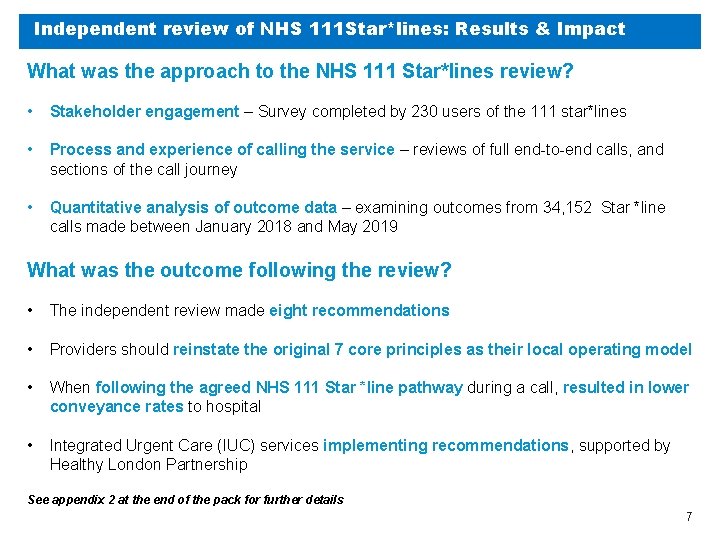
Independent review of NHS 111 Star*lines: Results & Impact What was the approach to the NHS 111 Star*lines review? • Stakeholder engagement – Survey completed by 230 users of the 111 star*lines • Process and experience of calling the service – reviews of full end-to-end calls, and sections of the call journey • Quantitative analysis of outcome data – examining outcomes from 34, 152 Star *line calls made between January 2018 and May 2019 What was the outcome following the review? • The independent review made eight recommendations • Providers should reinstate the original 7 core principles as their local operating model • When following the agreed NHS 111 Star *line pathway during a call, resulted in lower conveyance rates to hospital • Integrated Urgent Care (IUC) services implementing recommendations, supported by Healthy London Partnership See appendix 2 at the end of the pack for further details 7
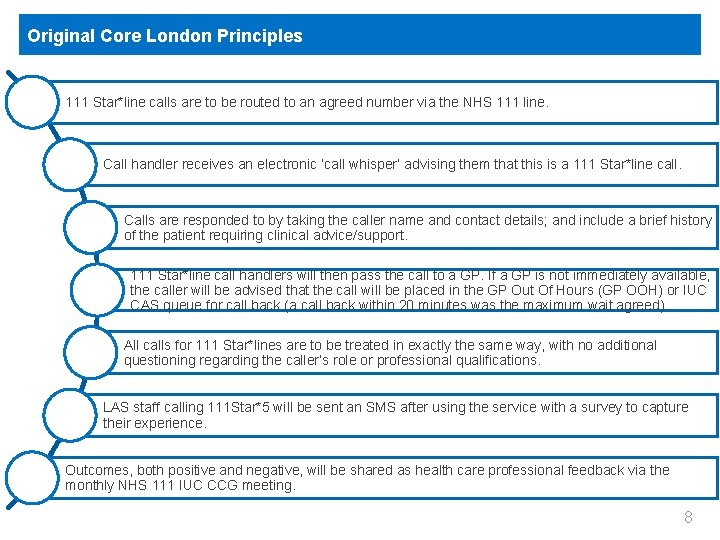
Original Core London Principles 111 Star*line calls are to be routed to an agreed number via the NHS 111 line. Call handler receives an electronic ‘call whisper’ advising them that this is a 111 Star*line call. Calls are responded to by taking the caller name and contact details; and include a brief history of the patient requiring clinical advice/support. 111 Star*line call handlers will then pass the call to a GP. If a GP is not immediately available, the caller will be advised that the call will be placed in the GP Out Of Hours (GP OOH) or IUC CAS queue for call back (a call back within 20 minutes was the maximum wait agreed). All calls for 111 Star*lines are to be treated in exactly the same way, with no additional questioning regarding the caller’s role or professional qualifications. LAS staff calling 111 Star*5 will be sent an SMS after using the service with a survey to capture their experience. Outcomes, both positive and negative, will be shared as health care professional feedback via the Recognising the importance for London Ambulance Service crews to be monthly NHS 111 IUC CCG meeting. able to access and speak to a GP promptly, a waiting time of no more than 20 mins was agreed in order to meet this requirement. 8
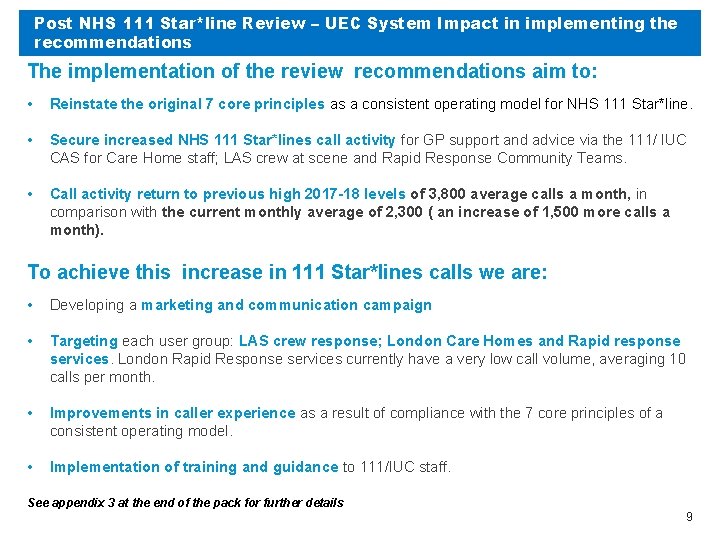
Post NHS 111 Star*line Review – UEC System Impact in implementing the recommendations The implementation of the review recommendations aim to: • Reinstate the original 7 core principles as a consistent operating model for NHS 111 Star*line. • Secure increased NHS 111 Star*lines call activity for GP support and advice via the 111/ IUC CAS for Care Home staff; LAS crew at scene and Rapid Response Community Teams. • Call activity return to previous high 2017 -18 levels of 3, 800 average calls a month, in comparison with the current monthly average of 2, 300 ( an increase of 1, 500 more calls a month). To achieve this increase in 111 Star*lines calls we are: • Developing a marketing and communication campaign • Targeting each user group: LAS crew response; London Care Homes and Rapid response services. London Rapid Response services currently have a very low call volume, averaging 10 calls per month. • Improvements in caller experience as a result of compliance with the 7 core principles of a consistent operating model. • Implementation of training and guidance to 111/IUC staff. See appendix 3 at the end of the pack for further details 9
03 Improved Access (telephony) Transforming London’s health and care together 10
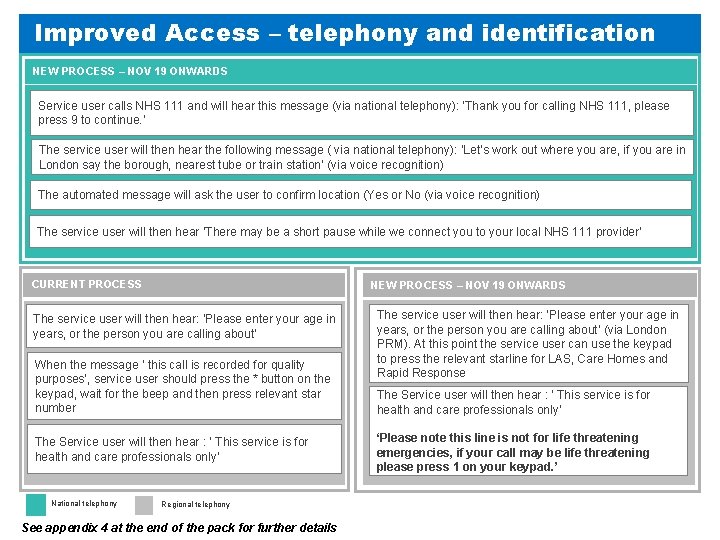
Improved Access – telephony and identification NEW PROCESS – NOV 19 ONWARDS Service user calls NHS 111 and will hear this message (via national telephony): ‘Thank you for calling NHS 111, please press 9 to continue. ’ The service user will then hear the following message ( via national telephony): ‘Let’s work out where you are, if you are in London say the borough, nearest tube or train station’ (via voice recognition) The automated message will ask the user to confirm location (Yes or No (via voice recognition) The service user will then hear ‘There may be a short pause while we connect you to your local NHS 111 provider’ CURRENT PROCESS NEW PROCESS – NOV 19 ONWARDS The service user will then hear: ‘Please enter your age in years, or the person you are calling about’ When the message ‘ this call is recorded for quality purposes’, service user should press the * button on the keypad, wait for the beep and then press relevant star number The Service user will then hear : ‘ This service is for health and care professionals only’ National telephony Regional telephony See appendix 4 at the end of the pack for further details The service user will then hear: ‘Please enter your age in years, or the person you are calling about’ (via London PRM). At this point the service user can use the keypad to press the relevant starline for LAS, Care Homes and Rapid Response The Service user will then hear : ‘ This service is for health and care professionals only’ ‘Please note this line is not for life threatening emergencies, if your call may be life threatening please press 1 on your keypad. ’
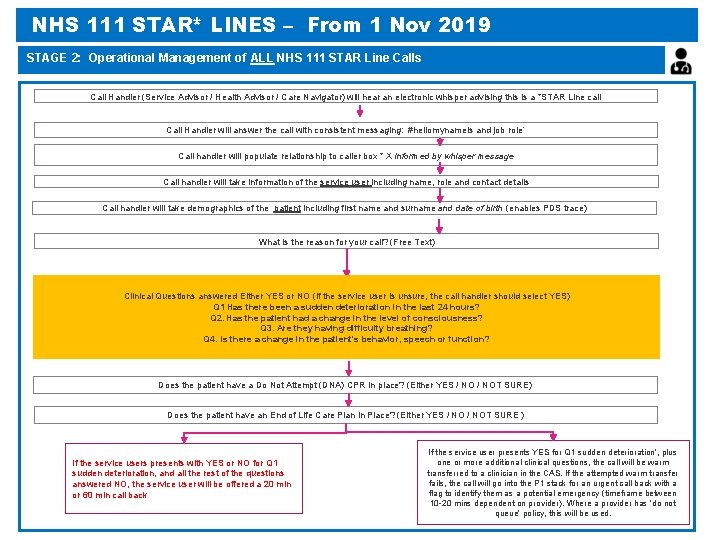
NHS 111 STAR* LINES – From 1 Nov 2019 STAGE 2: Operational Management of ALL NHS 111 STAR Line Calls Call Handler (Service Advisor / Health Advisor / Care Navigator) will hear an electronic whisper advising this is a *STAR Line call Call Handler will answer the call with consistent messaging: #hellomynameis and job role’ Call handler will populate relationship to caller box * X informed by whisper message Call handler will take information of the service user including name, role and contact details Call handler will take demographics of the patient including first name and surname and date of birth (enables PDS trace) What is the reason for your call? (Free Text) Clinical Questions answered Either YES or NO (if the service user is unsure, the call handler should select YES) Q 1 Has there been a sudden deterioration in the last 24 hours? Q 2. Has the patient had a change in the level of consciousness? Q 3. Are they having difficulty breathing? Q 4. Is there a change in the patient's behavior, speech or function? Does the patient have a Do Not Attempt (DNA) CPR in place? (Either YES / NOT SURE) Does the patient have an End of Life Care Plan in Place? (Either YES / NOT SURE ) If the service users presents with YES or NO for Q 1 sudden deterioration, and all the rest of the questions answered NO, the service user will be offered a 20 min or 60 min call back If the service user presents YES for Q 1 sudden deterioration’, plus one or more additional clinical questions, the call will be warm transferred to a clinician in the CAS. If the attempted warm transfer fails, the call will go into the P 1 stack for an urgent call back with a flag to identify them as a potential emergency (timeframe between 10 -20 mins dependent on provider). Where a provider has ‘do not queue’ policy, this will be used.
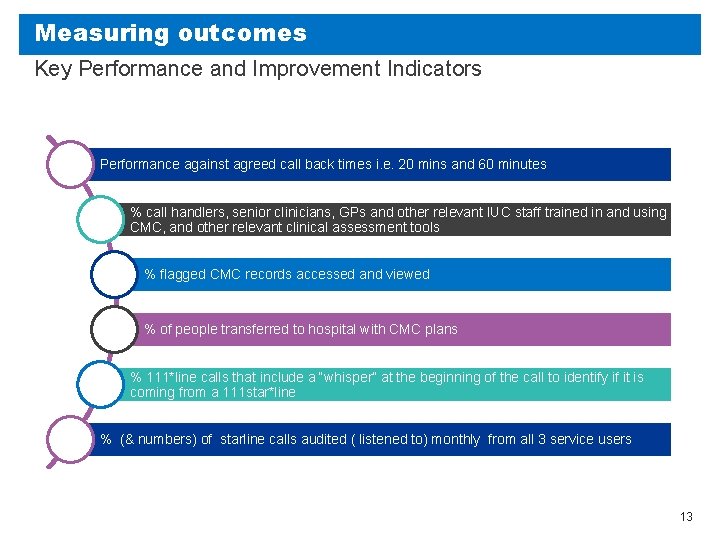
Measuring outcomes Key Performance and Improvement Indicators Performance against agreed call back times i. e. 20 mins and 60 minutes % call handlers, senior clinicians, GPs and other relevant IUC staff trained in and using CMC, and other relevant clinical assessment tools % flagged CMC records accessed and viewed % of people transferred to hospital with CMC plans % 111*line calls that include a “whisper” at the beginning of the call to identify if it is coming from a 111 star*line % (& numbers) of starline calls audited ( listened to) monthly from all 3 service users 13
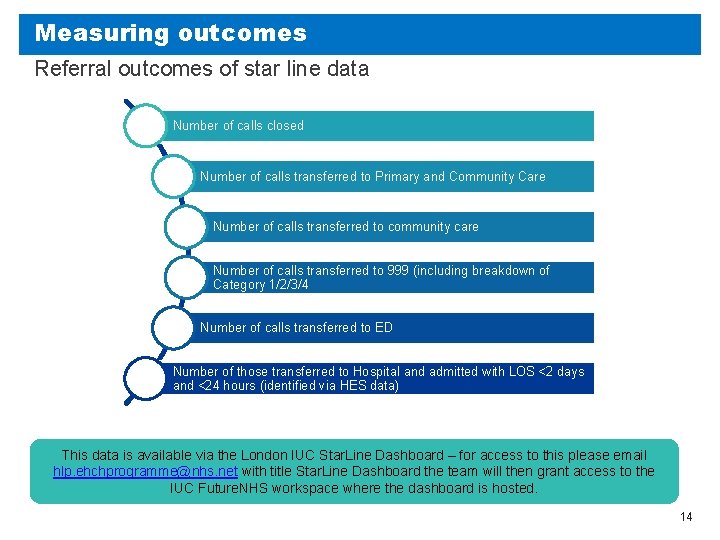
Measuring outcomes Referral outcomes of star line data Number of calls closed Number of calls transferred to Primary and Community Care Number of calls transferred to community care Number of calls transferred to 999 (including breakdown of Category 1/2/3/4 Number of calls transferred to ED Number of those transferred to Hospital and admitted with LOS <2 days and <24 hours (identified via HES data) This data is available via the London IUC Star. Line Dashboard – for access to this please email hlp. ehchprogramme@nhs. net with title Star. Line Dashboard the team will then grant access to the IUC Future. NHS workspace where the dashboard is hosted. 14
04 Creating a culture of compassion “Hello my name is……” Transforming London’s health and care together 15
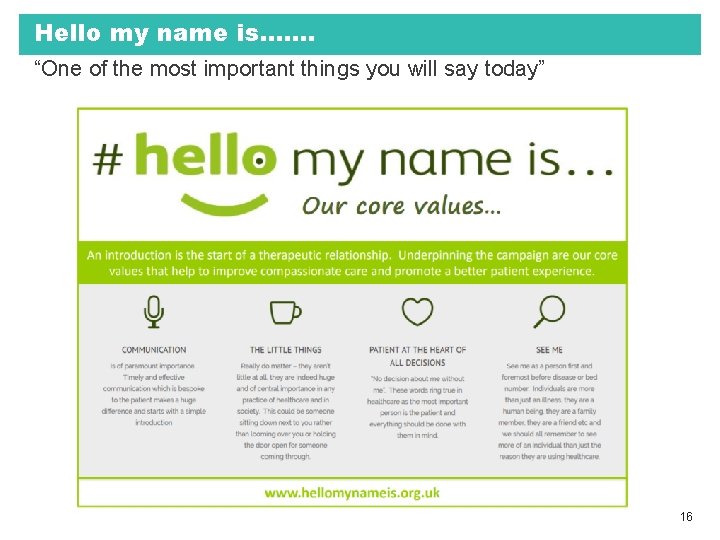
Hello my name is……. “One of the most important things you will say today” 16
05 Improving Handover across Health and Care colleagues using SBAR Transforming London’s health and care together 17
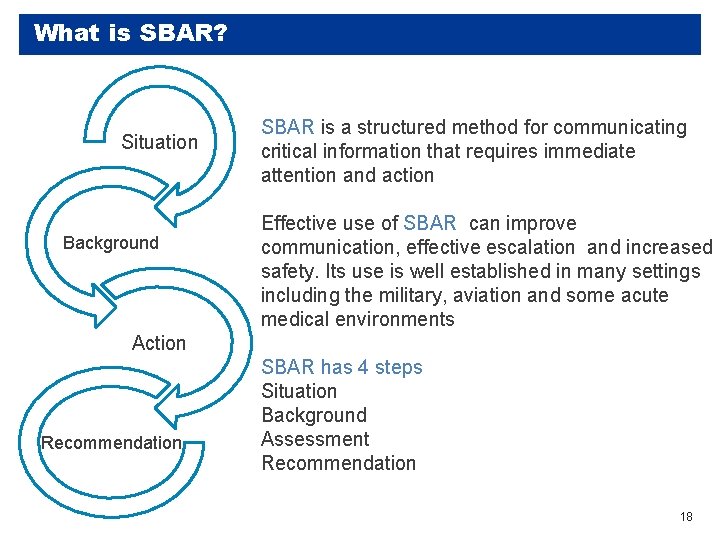
What is SBAR? Situation Background SBAR is a structured method for communicating critical information that requires immediate attention and action Effective use of SBAR can improve communication, effective escalation and increased safety. Its use is well established in many settings including the military, aviation and some acute medical environments Action Recommendation SBAR has 4 steps Situation Background Assessment Recommendation 18
Why are we using SBAR to support handover from care home teams to NHS 111 CAS? To reduce the barrier to effective communication across different disciplines and levels of staff using the NHS 111 Star*Line service. • SBAR creates a shared mental model around all patient handoffs and situations requiring escalation, or critical exchange of information (handovers) • SBAR is memory prompt; easy to remember and encourages prior preparation for communication • SBAR reduces the incidence of missed communications Click here to access the tool online 19
06 What support do you feel you would need to roll this out locally? Transforming London’s health and care together 20
07 Resources Transforming London’s health and care together 21
Resources Hello my name is…https: //www. hellomynameis. org. uk/ NHS Improvement SBAR resources https: //improvement. nhs. uk/documents/2162/sbar-communication-tool. pdf NELFT Significant 7 – for more details please email NWL RASD http: //anyflip. com/vxeq/qxfd E-Learning for Health SBAR e-learning module for care home teams – care home teams can access this free learning using their NHSmail account and ODS code https: //www. e-lfh. org. uk/programmes/sbar-communication-in-care-homes/ Further resources will be shared via the London EHCH Future. NHS pages https: //future. nhs. uk/connect. ti/carehomes/view? object. Id=12856304 please email hlp. ehchprogramme@nhs. net for access 22
08 Appendices Transforming London’s health and care together 23
APPENDIX 1 - NHS 111 Star*lines: Current Position The NHS 111 Star*lines were implemented across London following a successful pilot that ran from Jan ‘ 17 – Aug ‘ 17. They provide fast access to a GP in 111/GP OOH using a telephone key pad. For LAS Crews at scene, digital 111 call routing for Care Home staff, and community Rapid Response nursing teams. Key Points: Sept 2017 - May 2018: • In the 9 month period that followed the establishment of NHS 111 Star*lines across London as BAU (Sept ‘ 17 – May ‘ 18), call volumes almost doubled, increasing from 17, 624 to 34, 257. • An average of 3, 800 calls a month took place during the peak period of Sep ‘ 17 – May ‘ 18 with outcomes of: • 98% of NHS 111 Star*line calls were referred to Primary/Community Care, another service or Closed. • Only 2% identified as attending ED via 999 after GP input, compared with overall 111 service at 10% attending ED via 999 May 2018 – Present: • Call volumes have been decreasing across all NHS 111 Star*lines, with a 53% decrease in Star* 5 calls (LAS) and 26% for Star* 6 (Care homes). This decrease is negligible with Star*7 calls, due to the low monthly call volume. • Average monthly calls received for 2019 is currently 2, 376, approximately 1, 500 a month less than the average within the peak period that took place in the 9 months following the pilot, Sep 17 - May 18. What were the outcomes of this reduction in call volume? • Despite the decrease in call volumes, outcomes remained positive, reinforcing the benefit of fast access to a GP 24/7 for care professionals seeking urgent clinical and care management advice. • 97% of NHS 111 Star*line calls are currently referred to Primary/Community Care, another service or are closed • 2. 9% of patients are identified as attending ED via 999 after GP input, in comparison with overall 111 service of 10. 4% of patients attending ED via 999 Post P ilot Decline since M ay 2018 Figure 1: Illustrates the increase and subsequent decrease of NHS 111 Star*line following the pilot in 2017. Declining call volumes and increasing negative feedback from callers of the star *line service meant it was timely to understand reasons and uncover underlying issues. HLP asked the London End of Life Care Clinical Network (EOLC CN) and the London Academic Health Science Network to carry out an independent review/ evaluation of the NHS 111 Star*lines. 24
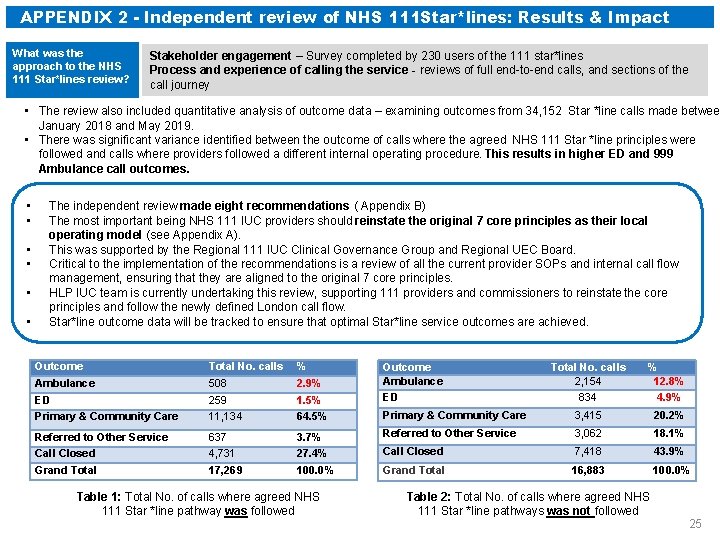
APPENDIX 2 - Independent review of NHS 111 Star*lines: Results & Impact What was the approach to the NHS 111 Star*lines review? Stakeholder engagement – Survey completed by 230 users of the 111 star*lines Process and experience of calling the service - reviews of full end-to-end calls, and sections of the call journey • The review also included quantitative analysis of outcome data – examining outcomes from 34, 152 Star *line calls made between January 2018 and May 2019. • There was significant variance identified between the outcome of calls where the agreed NHS 111 Star *line principles were followed and calls where providers followed a different internal operating procedure. This results in higher ED and 999 Ambulance call outcomes. • • • The independent review made eight recommendations ( Appendix B) The most important being NHS 111 IUC providers should reinstate the original 7 core principles as their local operating model (see Appendix A). This was supported by the Regional 111 IUC Clinical Governance Group and Regional UEC Board. Critical to the implementation of the recommendations is a review of all the current provider SOPs and internal call flow management, ensuring that they are aligned to the original 7 core principles. HLP IUC team is currently undertaking this review, supporting 111 providers and commissioners to reinstate the core principles and follow the newly defined London call flow. Star*line outcome data will be tracked to ensure that optimal Star*line service outcomes are achieved. Outcome Total No. calls % Ambulance 508 2. 9% ED 259 1. 5% Outcome Ambulance ED Primary & Community Care 11, 134 64. 5% Referred to Other Service 637 Call Closed Grand Total No. calls 2, 154 834 % 12. 8% 4. 9% Primary & Community Care 3, 415 20. 2% 3. 7% Referred to Other Service 3, 062 18. 1% 4, 731 27. 4% Call Closed 7, 418 43. 9% 17, 269 100. 0% Grand Total 16, 883 100. 0% Table 1: Total No. of calls where agreed NHS 111 Star *line pathway was followed Table 2: Total No. of calls where agreed NHS 111 Star *line pathways was not followed 25
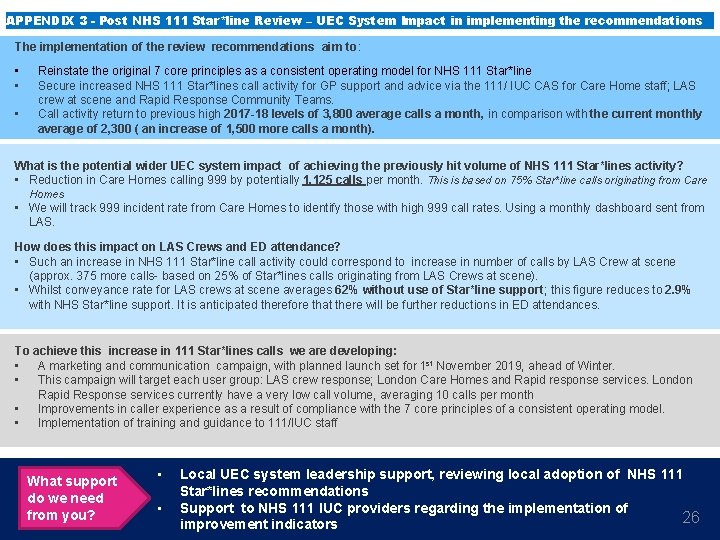
APPENDIX 3 - Post NHS 111 Star*line Review – UEC System Impact in implementing the recommendations The implementation of the review recommendations aim to: • • • Reinstate the original 7 core principles as a consistent operating model for NHS 111 Star*line Secure increased NHS 111 Star*lines call activity for GP support and advice via the 111/ IUC CAS for Care Home staff; LAS crew at scene and Rapid Response Community Teams. Call activity return to previous high 2017 -18 levels of 3, 800 average calls a month, in comparison with the current monthly average of 2, 300 ( an increase of 1, 500 more calls a month). What is the potential wider UEC system impact of achieving the previously hit volume of NHS 111 Star*lines activity? • Reduction in Care Homes calling 999 by potentially 1, 125 calls per month. This is based on 75% Star*line calls originating from Care Homes • We will track 999 incident rate from Care Homes to identify those with high 999 call rates. Using a monthly dashboard sent from LAS. How does this impact on LAS Crews and ED attendance? • Such an increase in NHS 111 Star*line call activity could correspond to increase in number of calls by LAS Crew at scene (approx. 375 more calls- based on 25% of Star*lines calls originating from LAS Crews at scene). • Whilst conveyance rate for LAS crews at scene averages 62% without use of Star*line support; this figure reduces to 2. 9% with NHS Star*line support. It is anticipated therefore that there will be further reductions in ED attendances. To achieve this increase in 111 Star*lines calls we are developing: • A marketing and communication campaign, with planned launch set for 1 st November 2019, ahead of Winter. • This campaign will target each user group: LAS crew response; London Care Homes and Rapid response services. London Rapid Response services currently have a very low call volume, averaging 10 calls per month • Improvements in caller experience as a result of compliance with the 7 core principles of a consistent operating model. • Implementation of training and guidance to 111/IUC staff What support do we need from you? • • Local UEC system leadership support, reviewing local adoption of NHS 111 Star*lines recommendations Support to NHS 111 IUC providers regarding the implementation of 26 improvement indicators
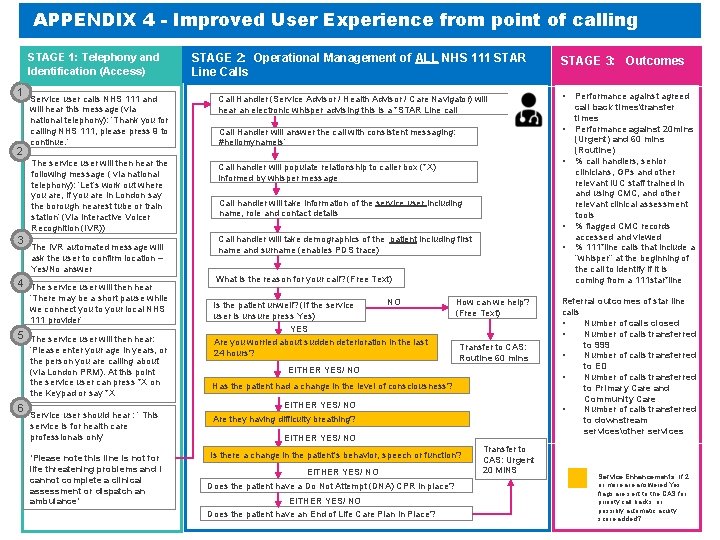
APPENDIX 4 - Improved User Experience from point of calling STAGE 1: Telephony and Identification (Access) 1 Service user calls NHS 111 and 2 will hear this message (via national telephony): ‘Thank you for calling NHS 111, please press 9 to continue. ’ The service user will then hear the following message ( via national telephony): ‘Let’s work out where you are, if you are in London say the borough nearest tube or train station’ (Via Interactive Voicer Recognition (IVR)) 3 The IVR automated message will ask the user to confirm location – Yes/No answer 4 The service user will then hear ‘There may be a short pause while we connect you to your local NHS 111 provider’ 5 The service user will then hear: ‘Please enter your age in years, or the person you are calling about’ (via London PRM). At this point the service user can press *X on the Keypad or say *X 6 STAGE 2: Operational Management of ALL NHS 111 STAR Line Calls STAGE 3: Outcomes Call Handler (Service Advisor / Health Advisor / Care Navigator) will hear an electronic whisper advising this is a *STAR Line call • Call Handler will answer the call with consistent messaging: #hellomynameis’ • • Call handler will populate relationship to caller box (*X) informed by whisper message Call handler will take information of the service user including name, role and contact details • Call handler will take demographics of the patient including first name and surname (enables PDS trace) • What is the reason for your call? (Free Text) NO Is the patient unwell? (If the service user is unsure press Yes) YES Are you worried about sudden deterioration in the last 24 hours? How can we help? (Free Text) Transfer to CAS: Routine 60 mins EITHER YES/ NO Has the patient had a change in the level of consciousness? EITHER YES/ NO Service user should hear : ‘ This service is for health care professionals only’ Are they having difficulty breathing? ‘Please note this line is not for life threatening problems and I cannot complete a clinical assessment or dispatch an ambulance’. Is there a change in the patient's behavior, speech or function? EITHER YES/ NO Does the patient have a Do Not Attempt (DNA) CPR in place? EITHER YES/ NO Does the patient have an End of Life Care Plan in Place? Transfer to CAS: Urgent 20 MINS Performance against agreed call back timestransfer times Performance against 20 mins (Urgent) and 60 mins (Routine) % call handlers, senior clinicians, GPs and other relevant IUC staff trained in and using CMC, and other relevant clinical assessment tools % flagged CMC records accessed and viewed % 111*line calls that include a “whisper” at the beginning of the call to identify if it is coming from a 111 star*line Referral outcomes of star line calls • Number of calls closed • Number of calls transferred to 999 • Number of calls transferred to ED • Number of calls transferred to Primary Care and Community Care • Number of calls transferred to downstream servicesother services Service Enhancements: If 2 or more answered Yes, flags are sent to the CAS for priority call backs, or possibly automatic acuity score added?
All the work we do with our partners moves us closer towards our goal to make London the healthiest global city. www. healthylondon. org england. healthylondon@nhs. net @healthy. LDN 28