
NHS 111 SERVICE How internal systems and processes
- Slides: 27
NHS 111 SERVICE How internal systems and processes drive continual quality improvement within our NHS 111 service © Harmoni 2013
BACKGROUND • The NHS 111 service is a singular point of access for the public to use when needing health care and advice • It is designed to facilitate calls which are less urgent than 999 (however still incorporates 999 process when required) • It is a national program designed to meet the local requirements of an area © Harmoni 2013 Page 2
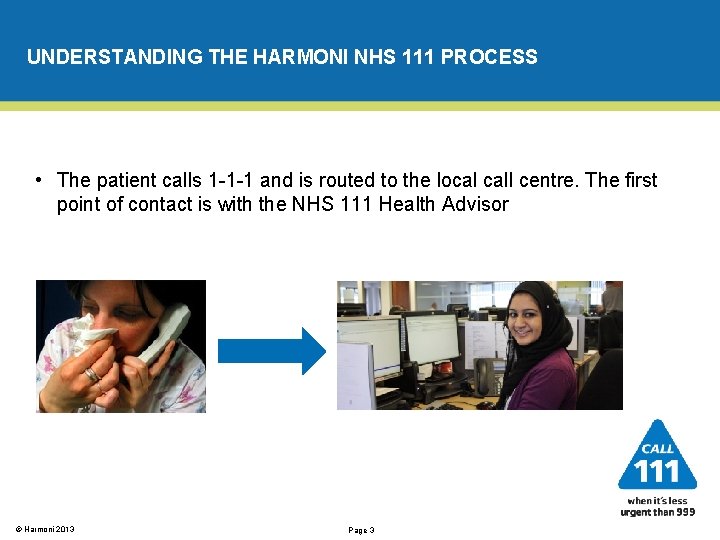
UNDERSTANDING THE HARMONI NHS 111 PROCESS • The patient calls 1 -1 -1 and is routed to the local call centre. The first point of contact is with the NHS 111 Health Advisor © Harmoni 2013 Page 3
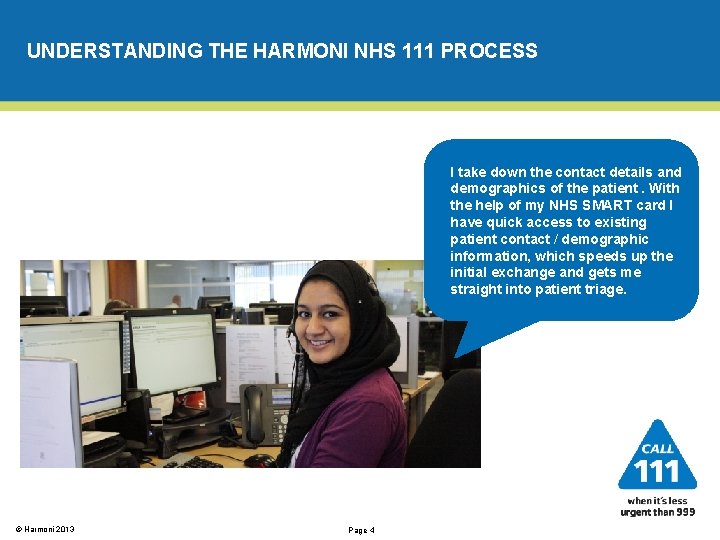
UNDERSTANDING THE HARMONI NHS 111 PROCESS I take down the contact details and demographics of the patient. With the help of my NHS SMART card I have quick access to existing patient contact / demographic information, which speeds up the initial exchange and gets me straight into patient triage. © Harmoni 2013 Page 4
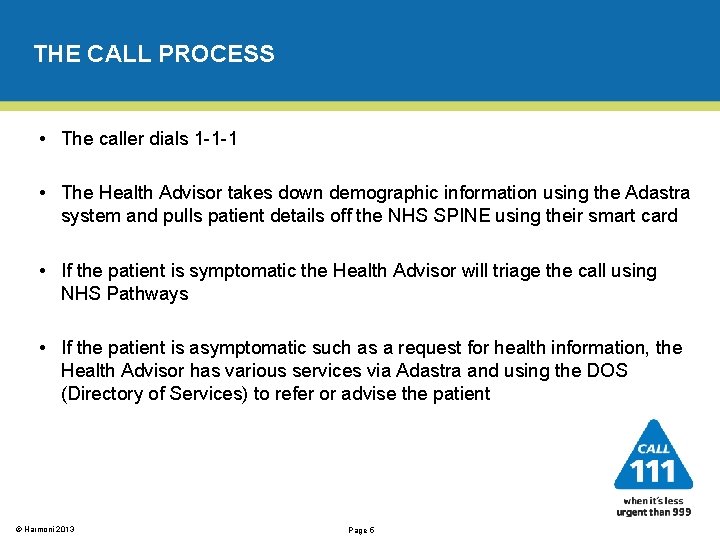
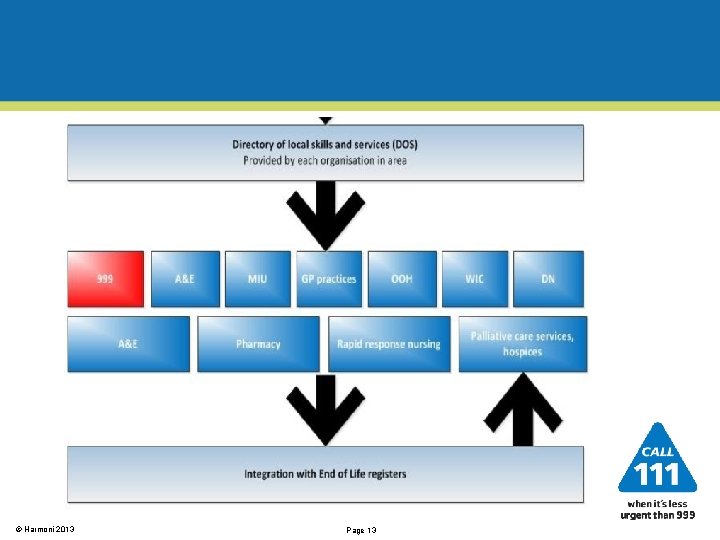
THE CALL PROCESS • The caller dials 1 -1 -1 • The Health Advisor takes down demographic information using the Adastra system and pulls patient details off the NHS SPINE using their smart card • If the patient is symptomatic the Health Advisor will triage the call using NHS Pathways • If the patient is asymptomatic such as a request for health information, the Health Advisor has various services via Adastra and using the DOS (Directory of Services) to refer or advise the patient © Harmoni 2013 Page 5
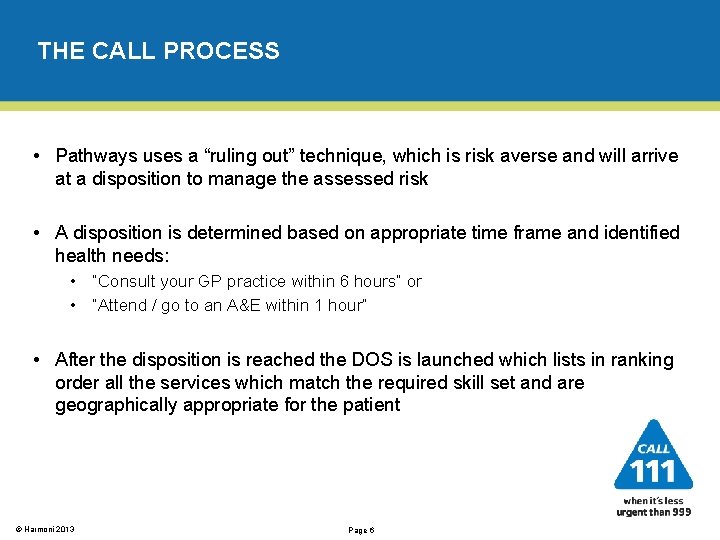
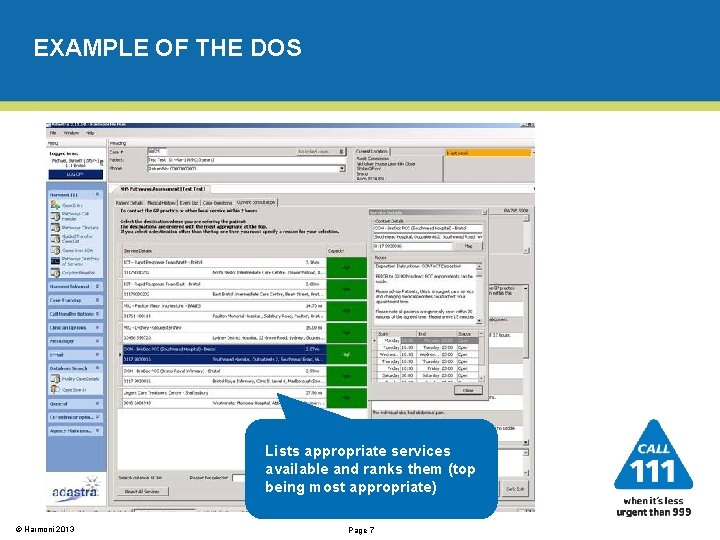
THE CALL PROCESS • Pathways uses a “ruling out” technique, which is risk averse and will arrive at a disposition to manage the assessed risk • A disposition is determined based on appropriate time frame and identified health needs: • “Consult your GP practice within 6 hours” or • “Attend / go to an A&E within 1 hour” • After the disposition is reached the DOS is launched which lists in ranking order all the services which match the required skill set and are geographically appropriate for the patient © Harmoni 2013 Page 6
EXAMPLE OF THE DOS Lists appropriate services available and ranks them (top being most appropriate) © Harmoni 2013 Page 7
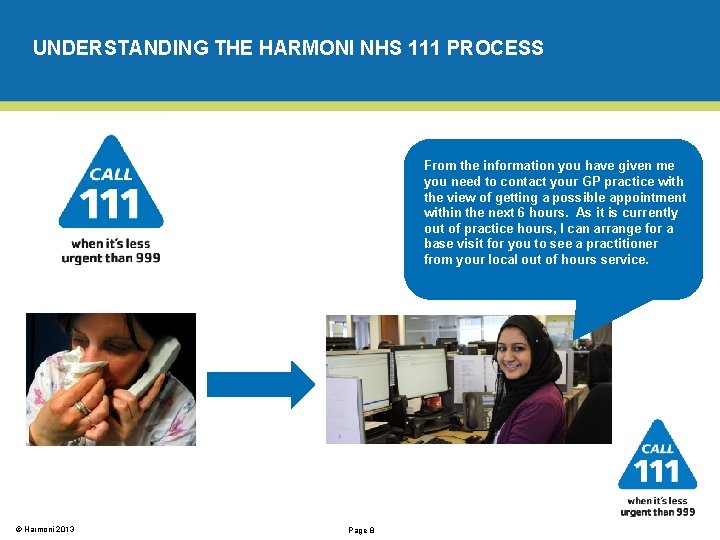
UNDERSTANDING THE HARMONI NHS 111 PROCESS From the information you have given me you need to contact your GP practice with the view of getting a possible appointment within the next 6 hours. As it is currently out of practice hours, I can arrange for a base visit for you to see a practitioner from your local out of hours service. © Harmoni 2013 Page 8
THE CALL PROCESS • Each NHS Pathways disposition is given a code which is linked to all the relevant services on the DOS • This allows for several appropriate services to be displayed on screen which the Health Advisor can use to direct the patient to • If the call is complex, beyond the scope of the Health Advisor or the patient refuses the NHS Pathways disposition instruction, the Health Advisor can warm transfer this call to an in-house clinician (Paramedic or Nurse) © Harmoni 2013 Page 9
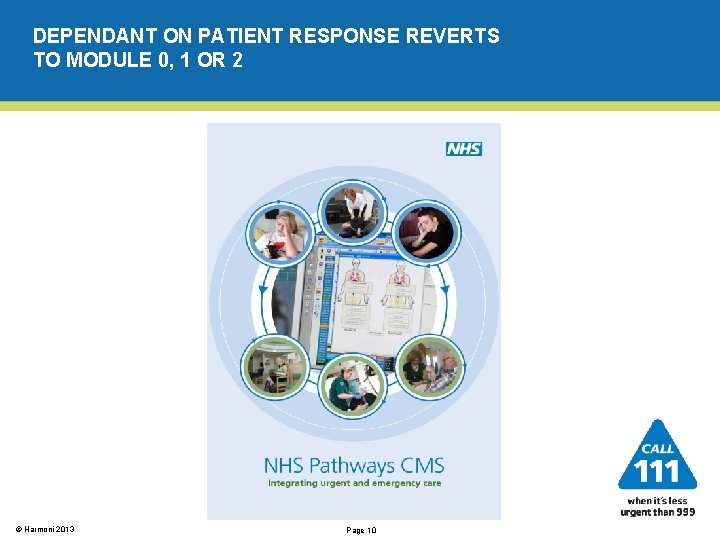
DEPENDANT ON PATIENT RESPONSE REVERTS TO MODULE 0, 1 OR 2 © Harmoni 2013 Page 10
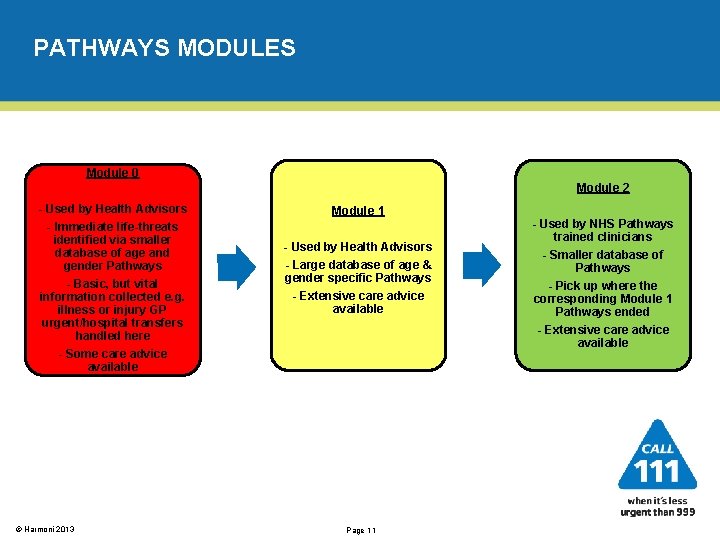
PATHWAYS MODULES Module 0 Module 2 - Used by Health Advisors - Immediate life-threats identified via smaller database of age and gender Pathways - Basic, but vital information collected e. g. illness or injury GP urgent/hospital transfers handled here - Some care advice available © Harmoni 2013 Module 1 - Used by Health Advisors - Large database of age & gender specific Pathways - Extensive care advice available Page 11 - Used by NHS Pathways trained clinicians - Smaller database of Pathways - Pick up where the corresponding Module 1 Pathways ended - Extensive care advice available
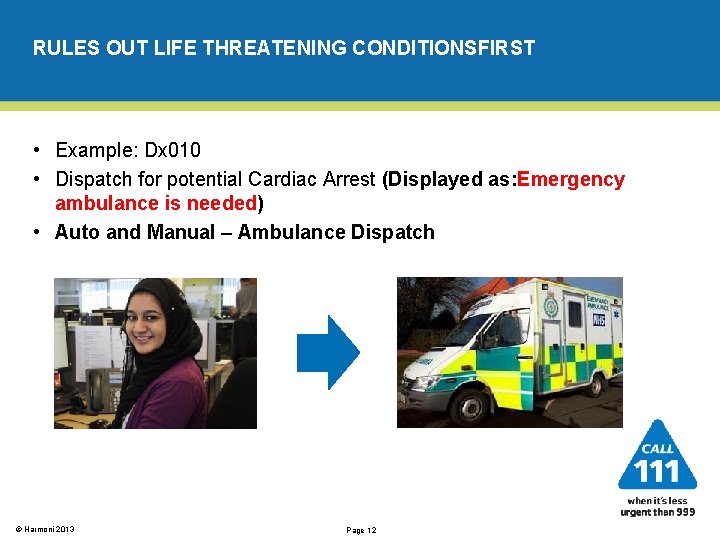
RULES OUT LIFE THREATENING CONDITIONSFIRST • Example: Dx 010 • Dispatch for potential Cardiac Arrest (Displayed as: Emergency ambulance is needed) • Auto and Manual – Ambulance Dispatch © Harmoni 2013 Page 12
© Harmoni 2013 Page 13
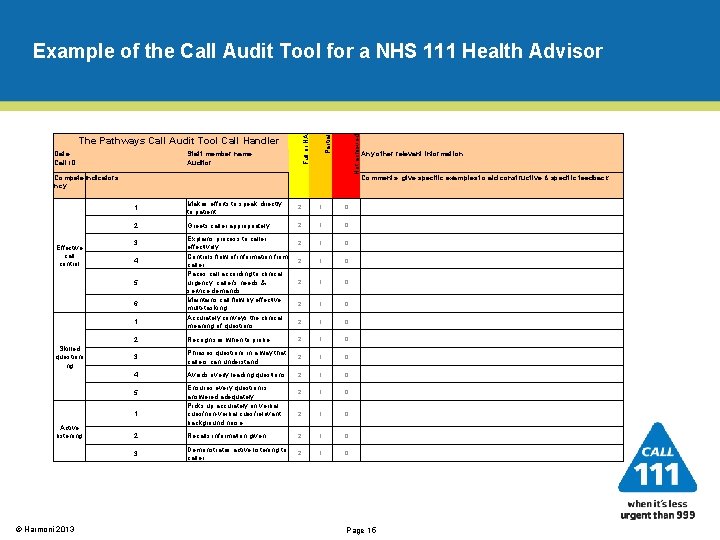
CQI AND CALL AUDITING • Health Advisor (HA) and Clinical Advisor (CA) Call Audits: • HA and CA are audited at least 4 times every three months throughout their NHS 111 service • The audit is a standardised audit tool which looks at 8 key competencies which are required for both a Health Advisor and a Clinical Advisor • These competencies include various technical, interpersonal and operational skills, including a heavily weighted scoring for Clinical Safety © Harmoni 2013 Page 14
Date: Call ID: Not achieved The Pathways Call Audit Tool Call Handler Partial Full or NA Example of the Call Audit Tool for a NHS 111 Health Advisor Staff member name: Any other relevant information: Auditor: Compete Indicators ncy Effective call control 1 Makes efforts to speak directly to patient 2 1 0 2 Greets caller appropriately 2 1 0 2 1 0 3 4 5 6 1 Skilled questioni ng 2 1 0 3 Phrases questions in a way that callers can understand 2 1 0 4 Avoids overly leading questions 2 1 0 Ensures every question is answered adequately Picks up accurately on verbal cues/non-verbal cues/relevant background noise Comments- give specific examples to aid constructive & specific feedback Recognises when to probe 1 © Harmoni 2013 Explains process to caller effectively Controls flow of information from caller Paces call according to clinical urgency, caller's needs & service demands Maintains call flow by effective multi-tasking Accurately conveys the clinical meaning of questions 2 5 Active listening 2 Recalls information given 2 1 0 3 Demonstrates active listening to caller 2 1 0 Page 15
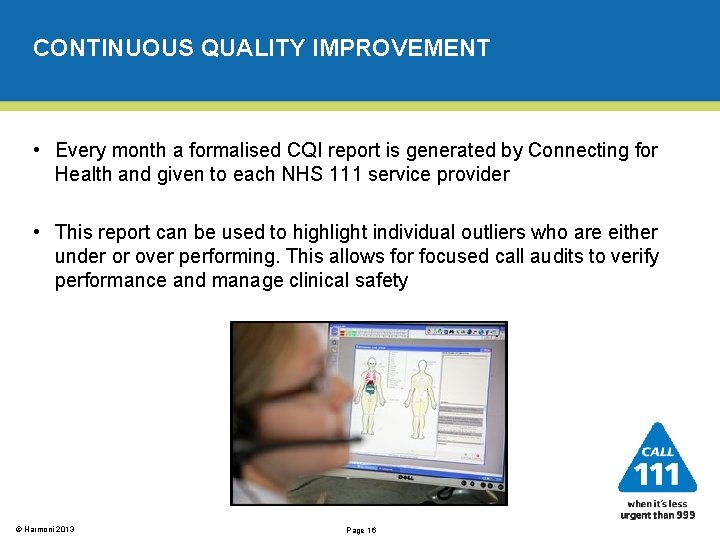
CONTINUOUS QUALITY IMPROVEMENT • Every month a formalised CQI report is generated by Connecting for Health and given to each NHS 111 service provider • This report can be used to highlight individual outliers who are either under or over performing. This allows for focused call audits to verify performance and manage clinical safety © Harmoni 2013 Page 16
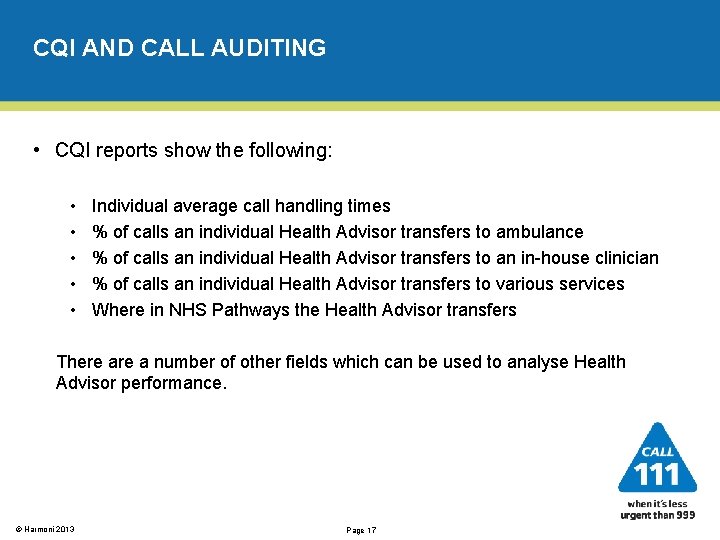
CQI AND CALL AUDITING • CQI reports show the following: • • • Individual average call handling times % of calls an individual Health Advisor transfers to ambulance % of calls an individual Health Advisor transfers to an in-house clinician % of calls an individual Health Advisor transfers to various services Where in NHS Pathways the Health Advisor transfers There a number of other fields which can be used to analyse Health Advisor performance. © Harmoni 2013 Page 17
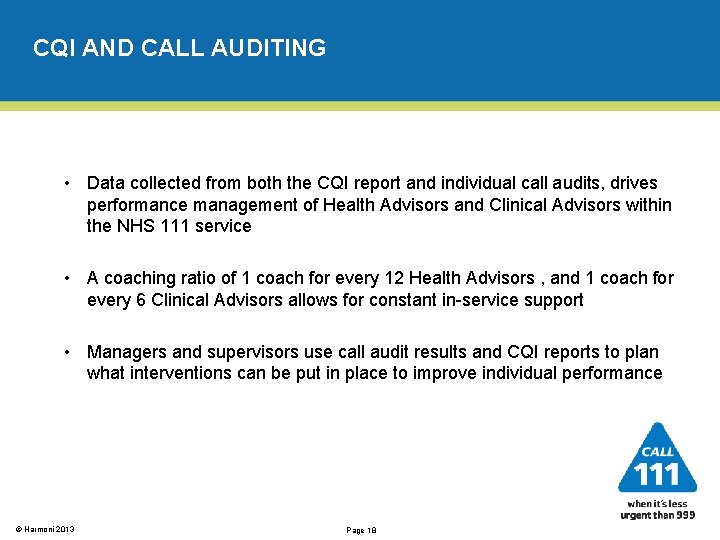
CQI AND CALL AUDITING • Data collected from both the CQI report and individual call audits, drives performance management of Health Advisors and Clinical Advisors within the NHS 111 service • A coaching ratio of 1 coach for every 12 Health Advisors , and 1 coach for every 6 Clinical Advisors allows for constant in-service support • Managers and supervisors use call audit results and CQI reports to plan what interventions can be put in place to improve individual performance © Harmoni 2013 Page 18
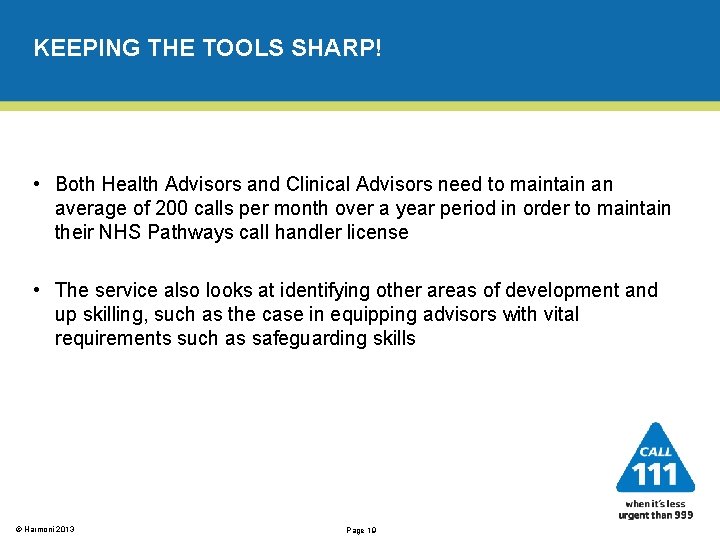
KEEPING THE TOOLS SHARP! • Both Health Advisors and Clinical Advisors need to maintain an average of 200 calls per month over a year period in order to maintain their NHS Pathways call handler license • The service also looks at identifying other areas of development and up skilling, such as the case in equipping advisors with vital requirements such as safeguarding skills © Harmoni 2013 Page 19
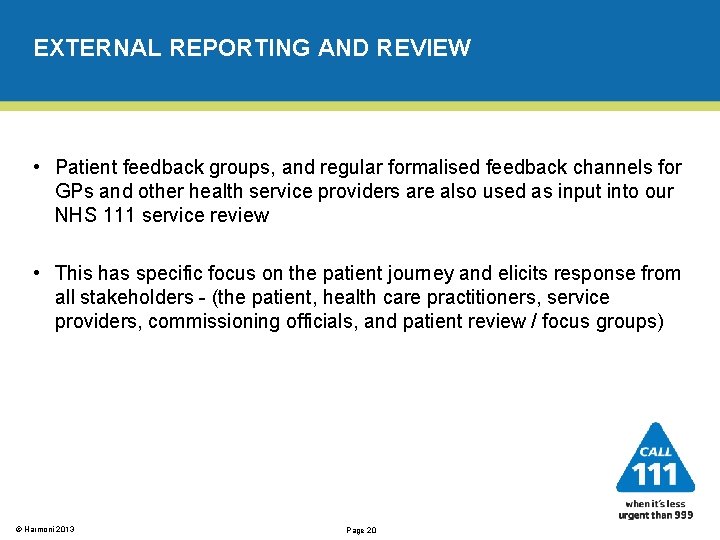
EXTERNAL REPORTING AND REVIEW • Patient feedback groups, and regular formalised feedback channels for GPs and other health service providers are also used as input into our NHS 111 service review • This has specific focus on the patient journey and elicits response from all stakeholders - (the patient, health care practitioners, service providers, commissioning officials, and patient review / focus groups) © Harmoni 2013 Page 20
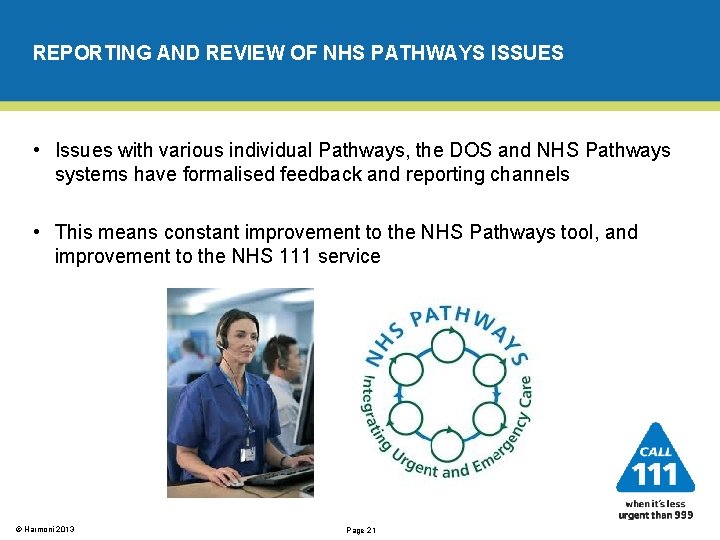
REPORTING AND REVIEW OF NHS PATHWAYS ISSUES • Issues with various individual Pathways, the DOS and NHS Pathways systems have formalised feedback and reporting channels • This means constant improvement to the NHS Pathways tool, and improvement to the NHS 111 service © Harmoni 2013 Page 21
DATA COLLECTED AND USED • CQI, Call Audits, and Patient, Stakeholder feedback allow for focused review of our overall operational delivery of the service, both on an individual level and on the service as a whole • This allows for improved training, coaching, processes and procedures, and the development of improved IT and Telephony systems and reporting / service management tools © Harmoni 2013 Page 22
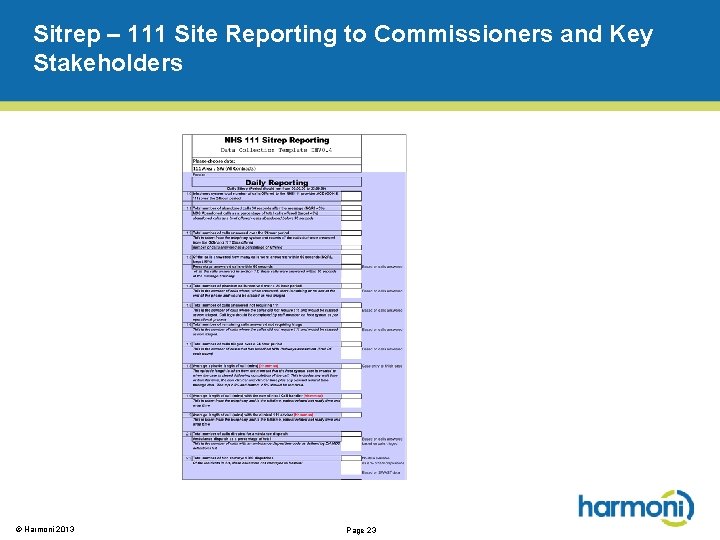
Sitrep – 111 Site Reporting to Commissioners and Key Stakeholders © Harmoni 2013 Page 23
DATA COLLECTED AND USED • The data collected by the singular point of access (NHS 111 service) allows for valuable information on service utilisation and specific skill set demands at the local level • This is a valuable tool which can be used when commissioning services in the NHS © Harmoni 2013 Page 24
OUR OVERALL COMMITMENT • Our focus is treating our patients as family • We want our patients to have not just the expected high levels of good service but to also have a truly positive and impactful experience during their patient journey while phoning 1 -1 -1 • Our focus is not only on improving service delivery and maintaining patient safety but also on developing a culture of empathy and compassion for all who call in on our NHS 111 service © Harmoni 2013 Page 25
Questions © Harmoni 2013 Page 26
Contact Details Lesley Boler - Director of Nursing and Education M: +44 (0) 7540902419 E: Lesley. boler@harmoni. co. uk Craig Atkinson- National Training Manager – 111 M: +44 (0) 7795159770 E: craig. atkinson@harmoni. co. uk © Harmoni 2013 Page 27