
NGSS The 3 D Assessment Challenge Craig T
- Slides: 29
NGSS: The 3 D Assessment Challenge Craig T. Gabler KDSL Global Science Specialist gablerct@gmail. com
Our Targets Analyze some assessment items Adapt items to be more 3 -D
Our Responsibilities • Assume best intentions • Listen carefully to one another • Be open to new ideas • Be open to working outside your comfort zone • Ask questions • Allow a chance for everyone to participate
Challenges of Developing 3 D Assessments How can we assess “three-dimensional learning”? How is it different from how we assess science learning now? How can we design tasks that elicit disciplinary core ideas, practices, and crosscutting concepts?
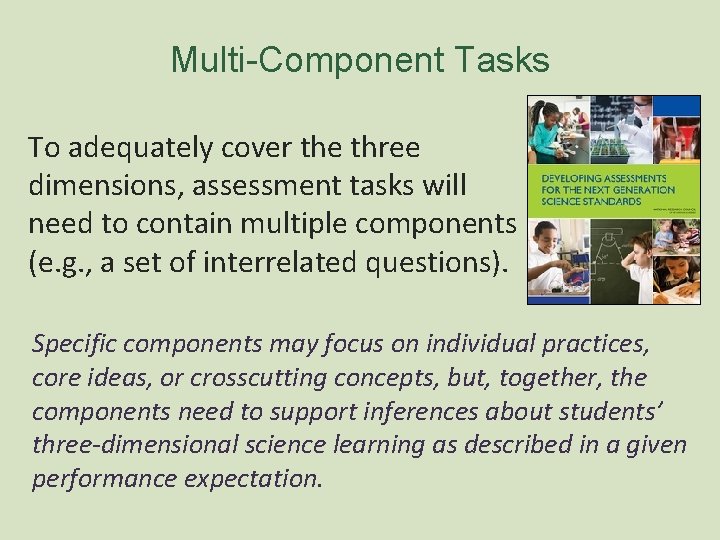
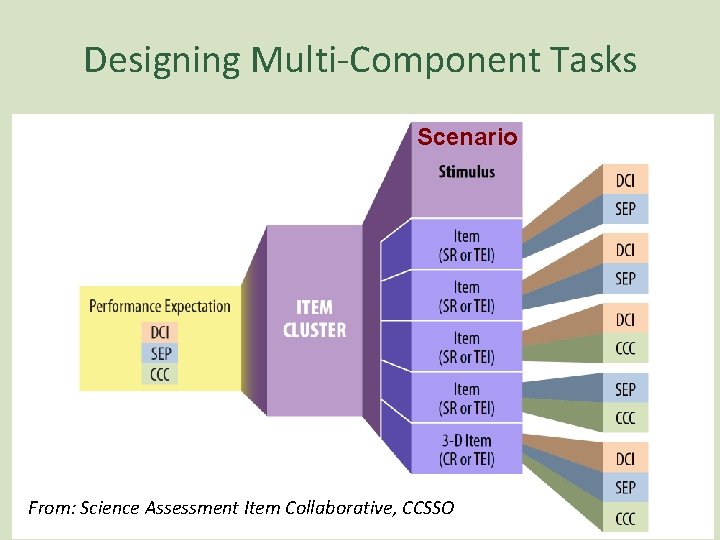
Multi-Component Tasks To adequately cover the three dimensions, assessment tasks will need to contain multiple components (e. g. , a set of interrelated questions). Specific components may focus on individual practices, core ideas, or crosscutting concepts, but, together, the components need to support inferences about students’ three-dimensional science learning as described in a given performance expectation.
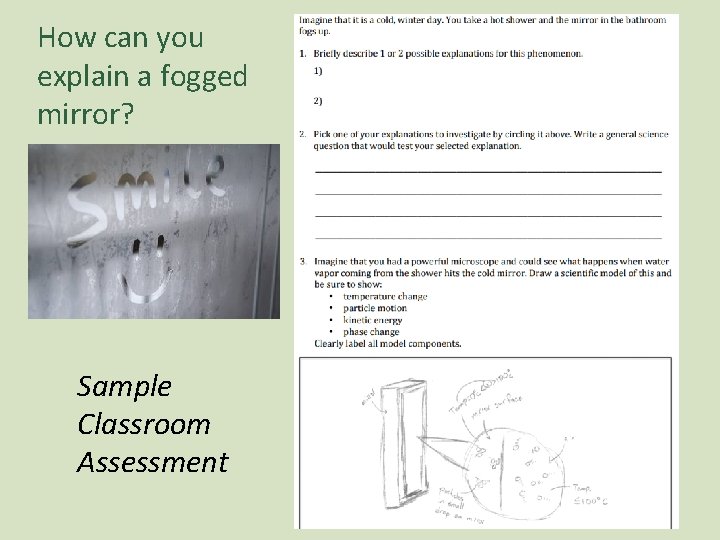
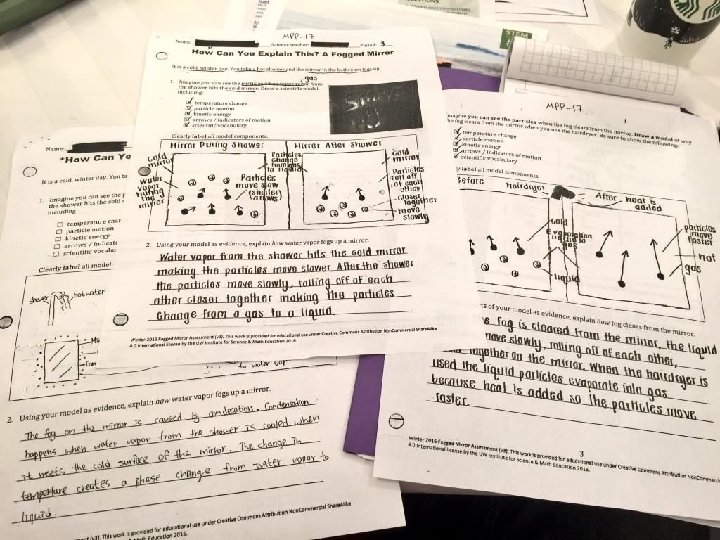
How can you explain a fogged mirror? Sample Classroom Assessment
Designing Multi-Component Tasks Scenario From: Science Assessment Item Collaborative, CCSSO
Activity: Analysis of Assessment Tasks + Debrief
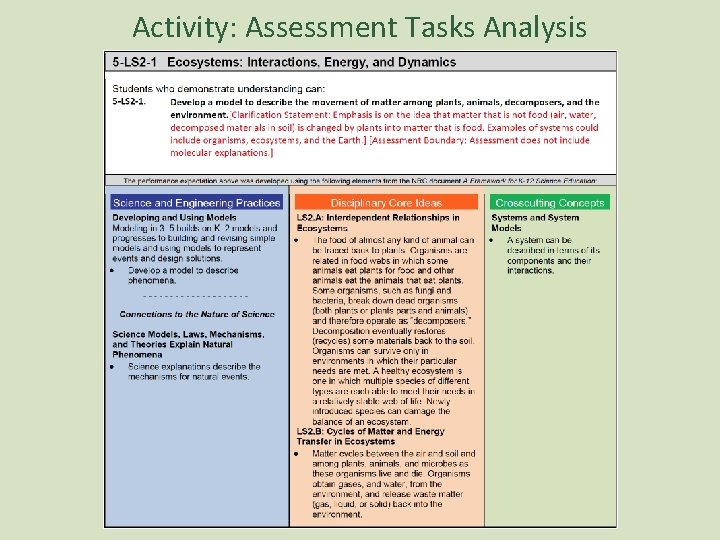
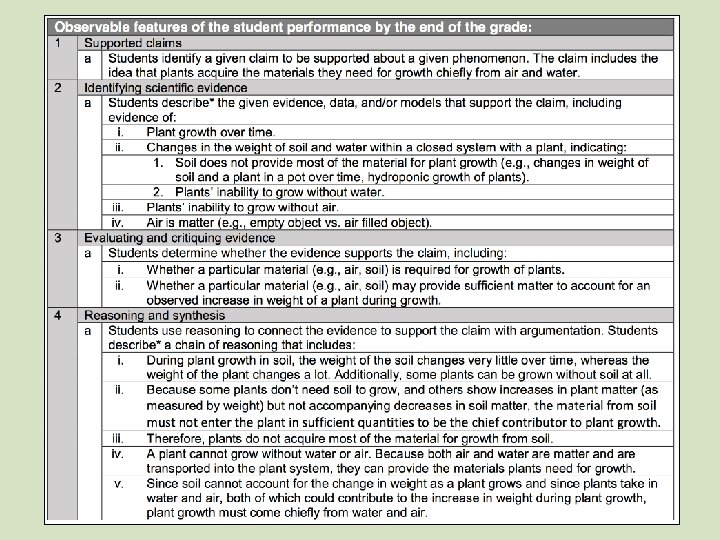
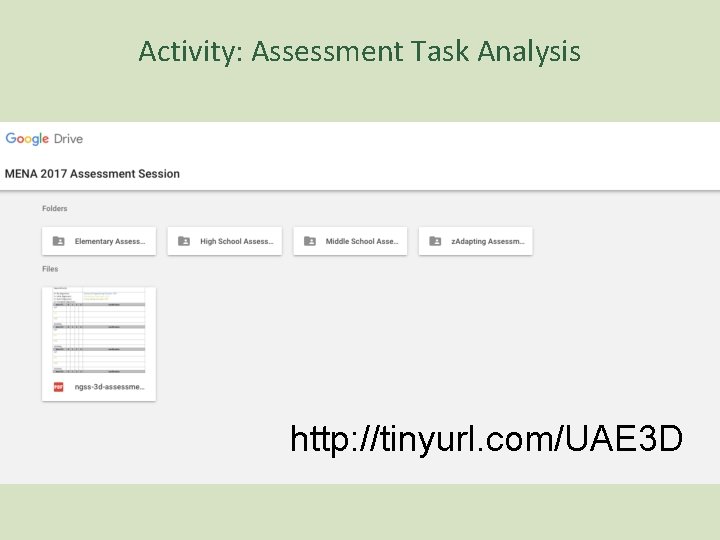
Activity: Assessment Tasks Analysis
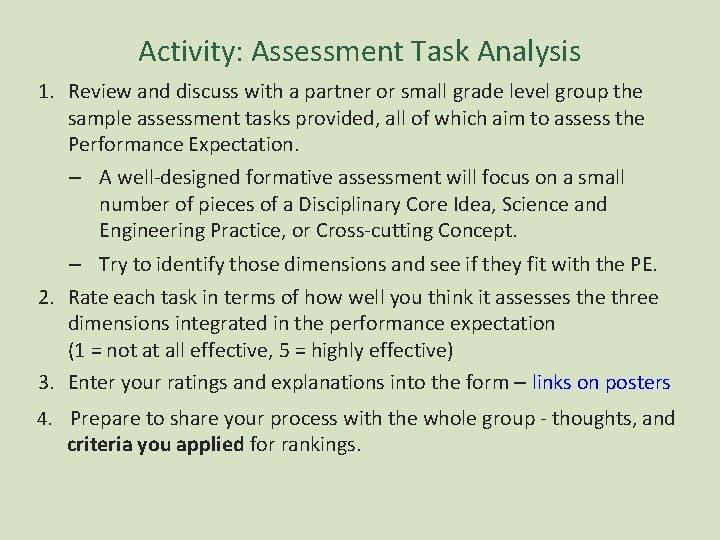
Activity: Assessment Task Analysis 1. Review and discuss with a partner or small grade level group the sample assessment tasks provided, all of which aim to assess the Performance Expectation. – A well-designed formative assessment will focus on a small number of pieces of a Disciplinary Core Idea, Science and Engineering Practice, or Cross-cutting Concept. – Try to identify those dimensions and see if they fit with the PE. 2. Rate each task in terms of how well you think it assesses the three dimensions integrated in the performance expectation (1 = not at all effective, 5 = highly effective) 3. Enter your ratings and explanations into the form – links on posters 4. Prepare to share your process with the whole group - thoughts, and criteria you applied for rankings.
Activity: Assessment Task Analysis http: //tinyurl. com/UAE 3 D
Whole Group Discussion: Assessment Task Analysis How did our ratings compare? (review the data) What are some criteria for deciding when a task is 3 D?
Steps to Designing 3 D Assessments
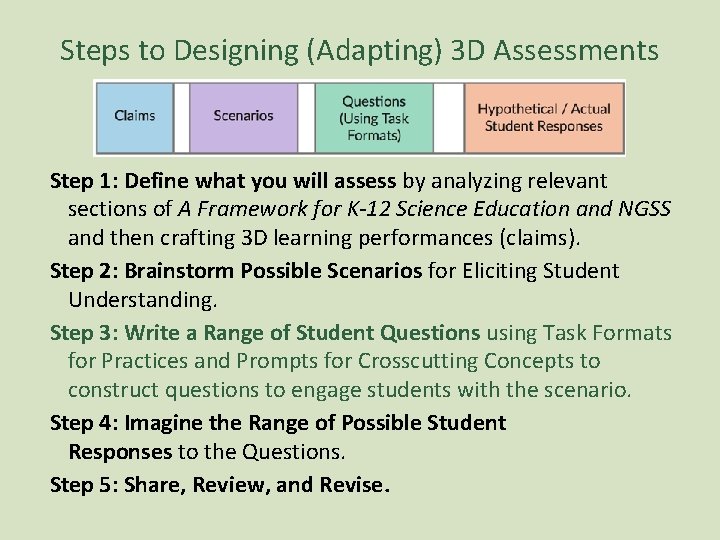
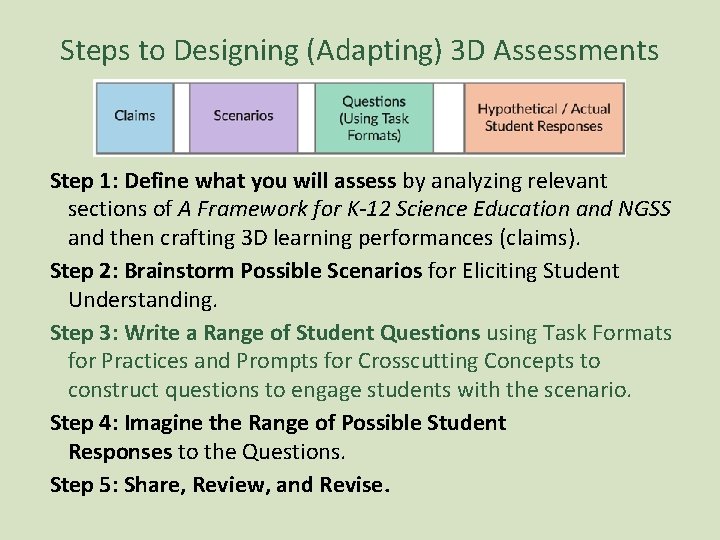
Steps to Designing (Adapting) 3 D Assessments Step 1: Define what you will assess by analyzing relevant sections of A Framework for K-12 Science Education and NGSS and then crafting 3 D learning performances (claims). Step 2: Brainstorm Possible Scenarios for Eliciting Student Understanding. Step 3: Write a Range of Student Questions using Task Formats for Practices and Prompts for Crosscutting Concepts to construct questions to engage students with the scenario. Step 4: Imagine the Range of Possible Student Responses to the Questions. Step 5: Share, Review, and Revise.
Tools to Support Assessment Item Development or Adaptation
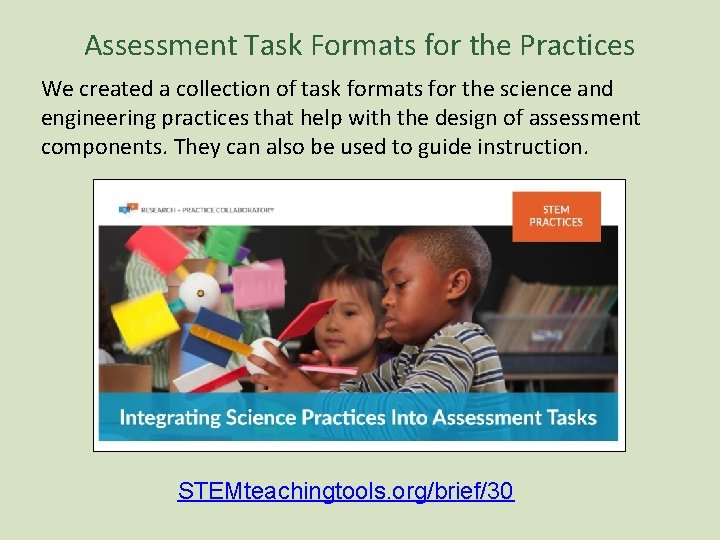
Assessment Task Formats for the Practices We created a collection of task formats for the science and engineering practices that help with the design of assessment components. They can also be used to guide instruction. STEMteachingtools. org/brief/30
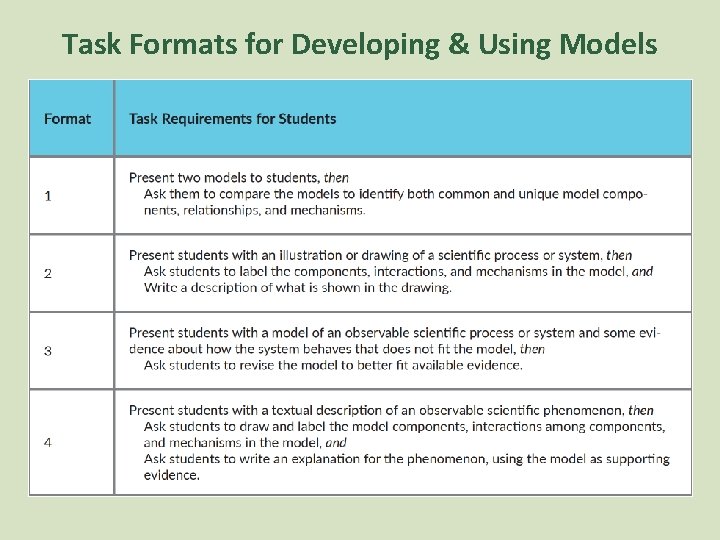
Task Formats for Developing & Using Models
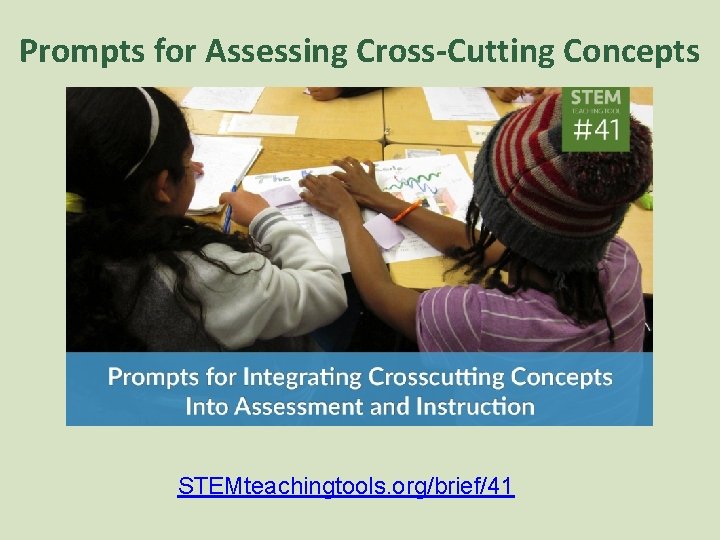
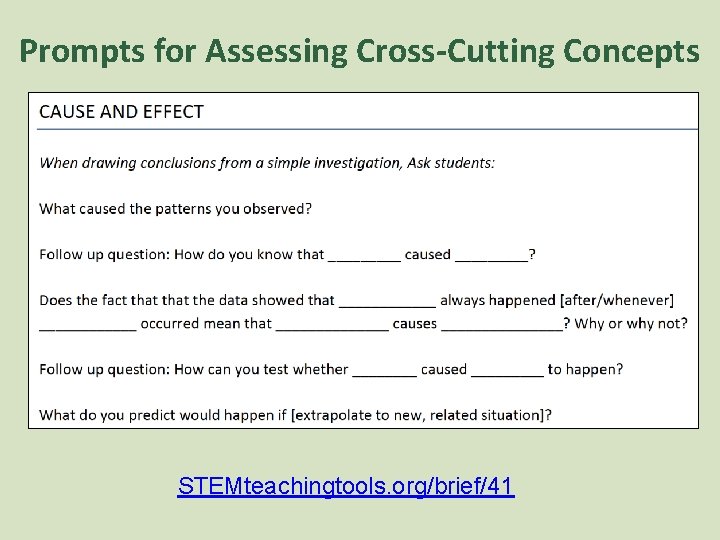
Prompts for Assessing Cross-Cutting Concepts STEMteachingtools. org/brief/41
Prompts for Assessing Cross-Cutting Concepts STEMteachingtools. org/brief/41
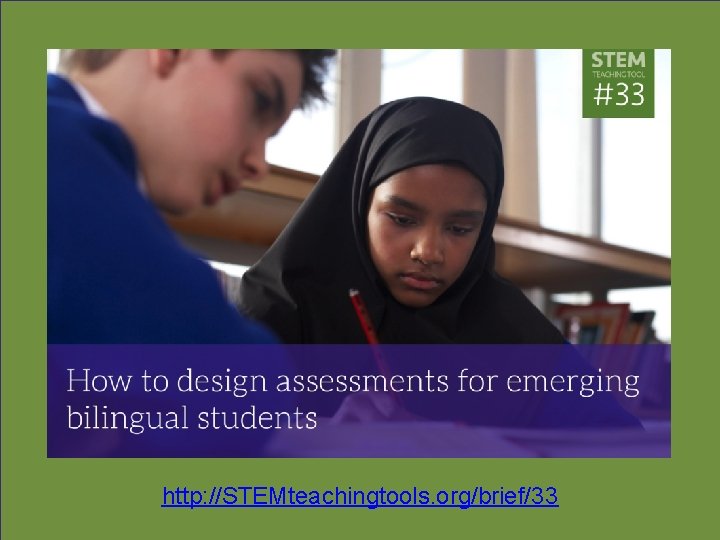
http: //STEMteachingtools. org/brief/33
Activity: Adapt an Existing Task + Debrief
Steps to Designing (Adapting) 3 D Assessments Step 1: Define what you will assess by analyzing relevant sections of A Framework for K-12 Science Education and NGSS and then crafting 3 D learning performances (claims). Step 2: Brainstorm Possible Scenarios for Eliciting Student Understanding. Step 3: Write a Range of Student Questions using Task Formats for Practices and Prompts for Crosscutting Concepts to construct questions to engage students with the scenario. Step 4: Imagine the Range of Possible Student Responses to the Questions. Step 5: Share, Review, and Revise.
Design (Adaptation) Work for Today Step 3: Build Questions to Engage Students With the Scenario a) Select one assessment item to improve from the set. b) Refine the assessment item to be more 3 D and more fair (i. e. , for ELL students). c) Use the tools—one at a time—to guide your improvement work: – Task Formats for Science & Engineering Practices – Prompts for Crosscutting Concepts – Assessment Design Guidance for Emerging Bilinguals d) Enter your modifications in the template provided.
Whole Group Discussion: Assessment Task Adaptation What did you come up with? You likely focused improvements on the practice(s) outlined in the PE. Did you add any additional items for other practices as well? Any engineering practices? Did you embed prompts to reveal reasoning about crosscutting concepts? How might you use this process for designing or adapting tasks in your school?
Criteria for Assessment Scenarios • • It should allow students from non-dominant communities (e. g. , ELLs, students from poverty-impacted communities) to fully engage with the task. We should design for them first! It should involve a compelling phenomena related to one or more of the DCIs being assessed—and not feel like a test-like task. It should beg for explanation! Make it more like an anchoring phenomena for an awesome, month-long unit. It should lend itself to a broad range of the science and engineering practices. It must be understandable quickly by students. For this reason, selecting everyday situations can be useful.