
NGS Workshop Variant Calling and Structural Variants from
- Slides: 26
NGS Workshop Variant Calling and Structural Variants from Exomes/WGS Ramesh Nair May 31, 2013
Outline • • • Types of genetic variation Framework for variant discovery Variant calling methods and variant callers Filtering of variants Structural variants 5/31/2013 Variant Calling 2
Why call variants? TCGA Program Overview “There at least 200 forms of cancer, and many more subtypes. Each of these is caused by errors in DNA that cause cells to grow uncontrolled. Identifying the changes in each cancer’s complete set of DNA – its genome – and understanding how such changes interact to drive the disease will lay the foundation for improving cancer prevention, early detection and treatment. ” 5/31/2013 Variant Calling 3
Types of Genetic Variation Cancer is driven by genomic alterations like: • Single Nucleotide Aberrations – Single Nucleotide Polymorphisms (SNPs) - mutations shared amongst a population – Single Nucleotide Variations (SNVs) - private mutations • Short Insertions or Deletions (indels) • Copy Number Variations (CNVs) • Larger Structural Variations (SVs) 5/31/2013 Variant Calling 4
SNPs vs. SNVs Both are aberrations at a single nucleotide • SNP – Aberration expected at the position for any member in the species (well-characterized) – Occur in population at some frequency so expected at a given locus – Validated in population – Catalogued in db. SNP (http: //www. ncbi. nlm. nih. gov/snp) • SNV – Aberration seen in only one individual (not well characterized) – Occur at low frequency so not common – Not validated in population Really a matter of frequency of occurrence 5/31/2013 Variant Calling 5
SNVs of interest • Non-synonymous mutations – Result in amino acid change – Impact protein sequence – Missense and nonsense mutations • Somatic mutations in cancer – Tumor-specific mutations 5/31/2013 Variant Calling 6
Catalogs of human genetic variation • • • The 1000 Genomes Project – http: //www. 1000 genomes. org/ – SNPs and structural variants – genomes of about 2500 unidentified people from about 25 populations around the world will be sequenced using NGS technologies Hap. Map – http: //hapmap. ncbi. nlm. nih. gov/ – identify and catalog genetic similarities and differences db. SNP – http: //www. ncbi. nlm. nih. gov/snp/ – Database of SNPs and multiple small-scale variations that include indels, microsatellites, and non-polymorphic variants COSMIC – http: //www. sanger. ac. uk/genetics/CGP/cosmic/ – Catalog of Somatic Mutations in Cancer TCGA – http: //cancergenome. nih. gov/ – The Cancer Genome Atlas researchers are mapping the genetic changes in 20 selected cancers 5/31/2013 Variant Calling 7
Challenges of accurate somatic variant calling Not as simple as identifying sites with a variant allele in the tumor not present in the normal • Artifacts from PCR amplification or targeted (exome) capture • Machine sequencing errors • Incorrect local alignment of reads • Tumor heterogeneity • Tumor-normal cross-contamination 5/31/2013 Variant Calling 8
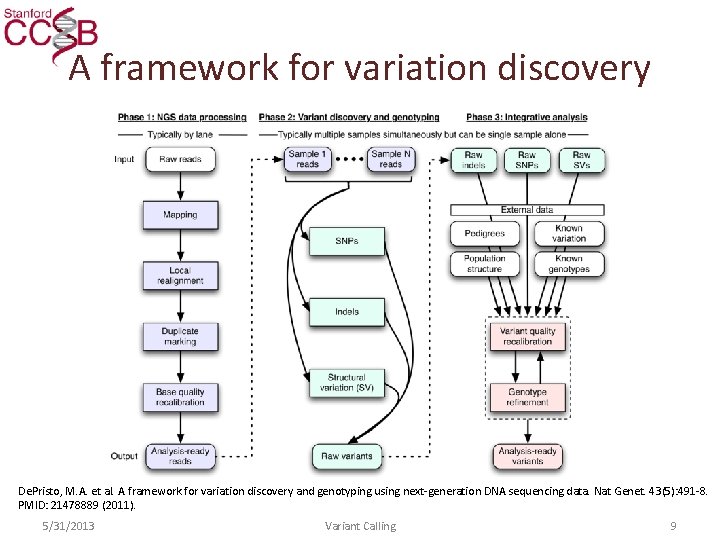
A framework for variation discovery De. Pristo, M. A. et al. A framework for variation discovery and genotyping using next-generation DNA sequencing data. Nat Genet. 43(5): 491 -8. PMID: 21478889 (2011). 5/31/2013 Variant Calling 9
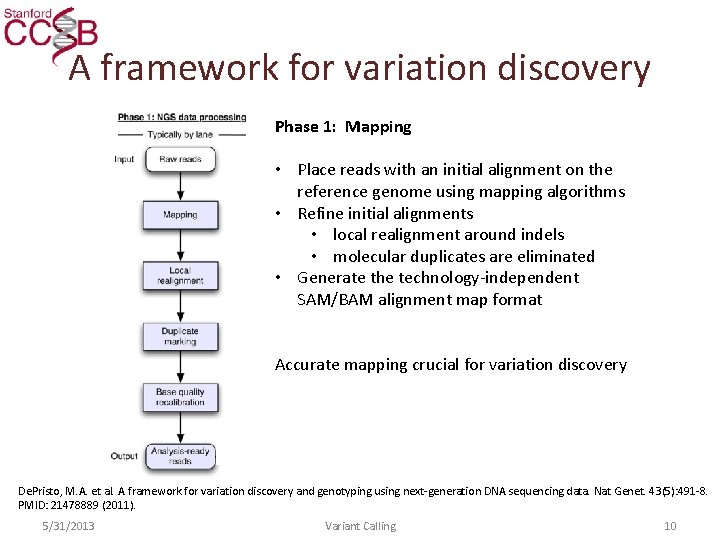
A framework for variation discovery Phase 1: Mapping • Place reads with an initial alignment on the reference genome using mapping algorithms • Refine initial alignments • local realignment around indels • molecular duplicates are eliminated • Generate the technology-independent SAM/BAM alignment map format Accurate mapping crucial for variation discovery De. Pristo, M. A. et al. A framework for variation discovery and genotyping using next-generation DNA sequencing data. Nat Genet. 43(5): 491 -8. PMID: 21478889 (2011). 5/31/2013 Variant Calling 10
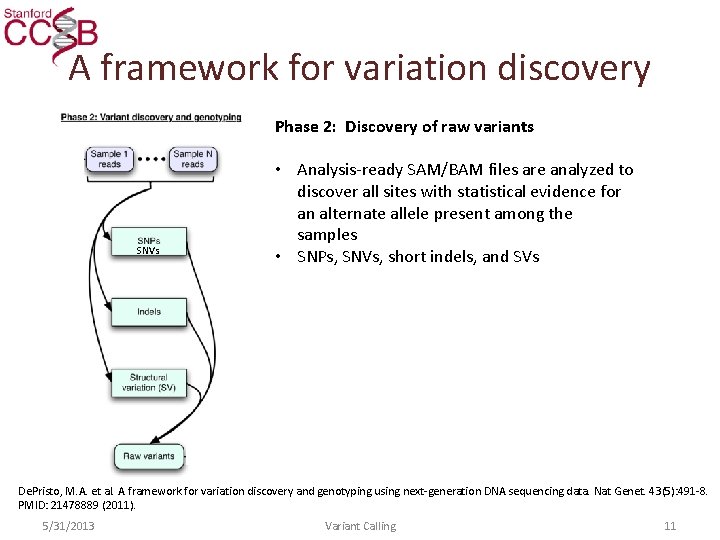
A framework for variation discovery Phase 2: Discovery of raw variants SNVs • Analysis-ready SAM/BAM files are analyzed to discover all sites with statistical evidence for an alternate allele present among the samples • SNPs, SNVs, short indels, and SVs De. Pristo, M. A. et al. A framework for variation discovery and genotyping using next-generation DNA sequencing data. Nat Genet. 43(5): 491 -8. PMID: 21478889 (2011). 5/31/2013 Variant Calling 11
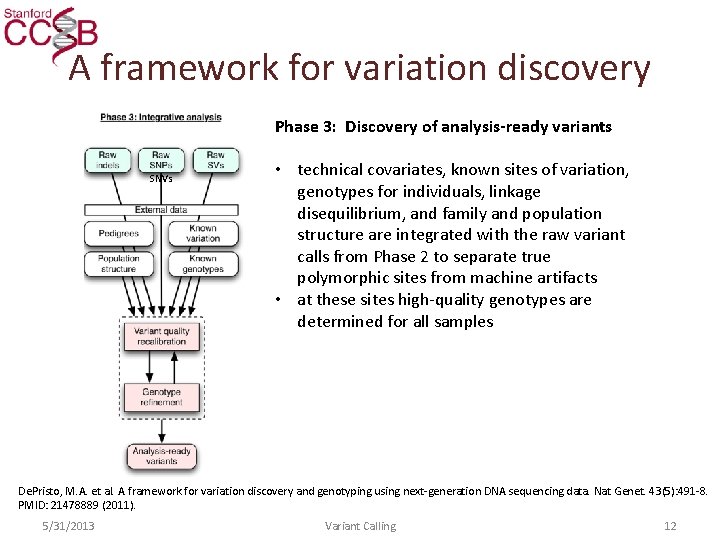
A framework for variation discovery Phase 3: Discovery of analysis-ready variants SNVs • technical covariates, known sites of variation, genotypes for individuals, linkage disequilibrium, and family and population structure are integrated with the raw variant calls from Phase 2 to separate true polymorphic sites from machine artifacts • at these sites high-quality genotypes are determined for all samples De. Pristo, M. A. et al. A framework for variation discovery and genotyping using next-generation DNA sequencing data. Nat Genet. 43(5): 491 -8. PMID: 21478889 (2011). 5/31/2013 Variant Calling 12
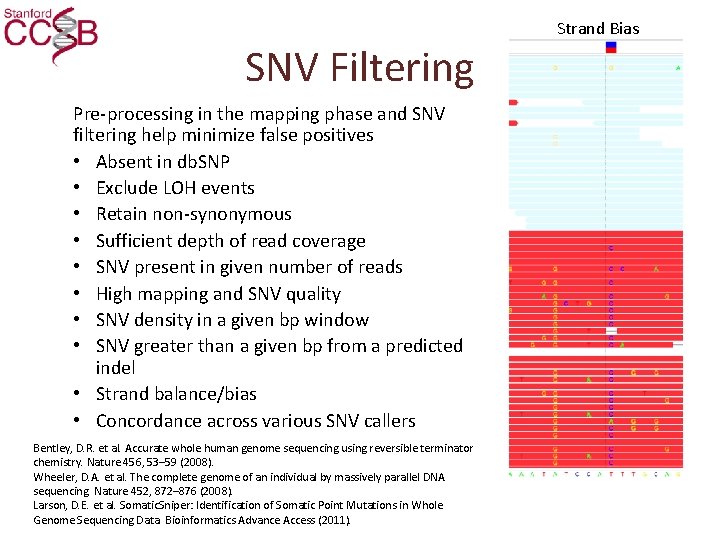
Strand Bias SNV Filtering Pre-processing in the mapping phase and SNV filtering help minimize false positives • Absent in db. SNP • Exclude LOH events • Retain non-synonymous • Sufficient depth of read coverage • SNV present in given number of reads • High mapping and SNV quality • SNV density in a given bp window • SNV greater than a given bp from a predicted indel • Strand balance/bias • Concordance across various SNV callers Bentley, D. R. et al. Accurate whole human genome sequencing using reversible terminator chemistry. Nature 456, 53– 59 (2008). Wheeler, D. A. et al. The complete genome of an individual by massively parallel DNA sequencing. Nature 452, 872– 876 (2008). Larson, D. E. et al. Somatic. Sniper: Identification of Somatic Point Mutations in Whole Genome Sequencing Data. Bioinformatics Advance Access (2011).
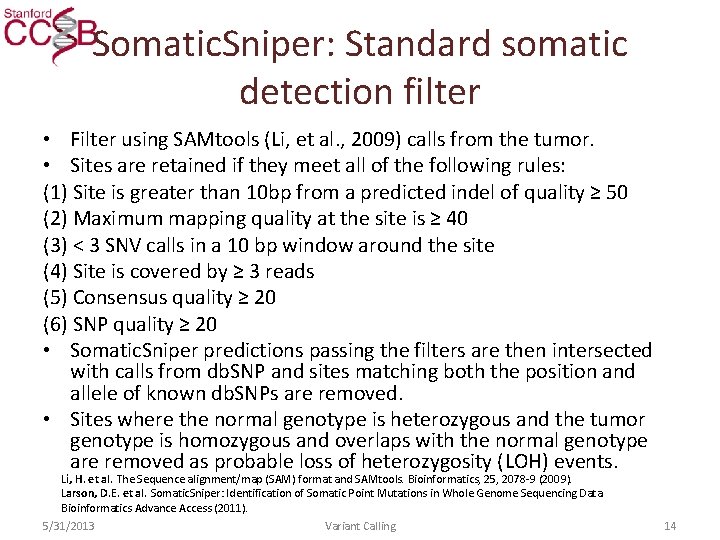
Somatic. Sniper: Standard somatic detection filter • Filter using SAMtools (Li, et al. , 2009) calls from the tumor. • Sites are retained if they meet all of the following rules: (1) Site is greater than 10 bp from a predicted indel of quality ≥ 50 (2) Maximum mapping quality at the site is ≥ 40 (3) < 3 SNV calls in a 10 bp window around the site (4) Site is covered by ≥ 3 reads (5) Consensus quality ≥ 20 (6) SNP quality ≥ 20 • Somatic. Sniper predictions passing the filters are then intersected with calls from db. SNP and sites matching both the position and allele of known db. SNPs are removed. • Sites where the normal genotype is heterozygous and the tumor genotype is homozygous and overlaps with the normal genotype are removed as probable loss of heterozygosity (LOH) events. Li, H. et al. The Sequence alignment/map (SAM) format and SAMtools. Bioinformatics, 25, 2078 -9 (2009). Larson, D. E. et al. Somatic. Sniper: Identification of Somatic Point Mutations in Whole Genome Sequencing Data. Bioinformatics Advance Access (2011). 5/31/2013 Variant Calling 14
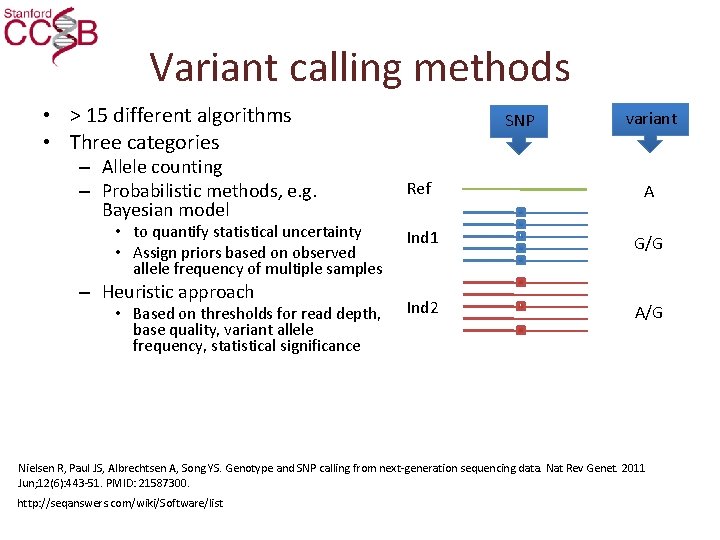
Variant calling methods • > 15 different algorithms • Three categories – Allele counting – Probabilistic methods, e. g. Bayesian model SNP variant Ref A • to quantify statistical uncertainty • Assign priors based on observed allele frequency of multiple samples Ind 1 G/G • Based on thresholds for read depth, base quality, variant allele frequency, statistical significance Ind 2 A/G – Heuristic approach Nielsen R, Paul JS, Albrechtsen A, Song YS. Genotype and SNP calling from next-generation sequencing data. Nat Rev Genet. 2011 Jun; 12(6): 443 -51. PMID: 21587300. http: //seqanswers. com/wiki/Software/list
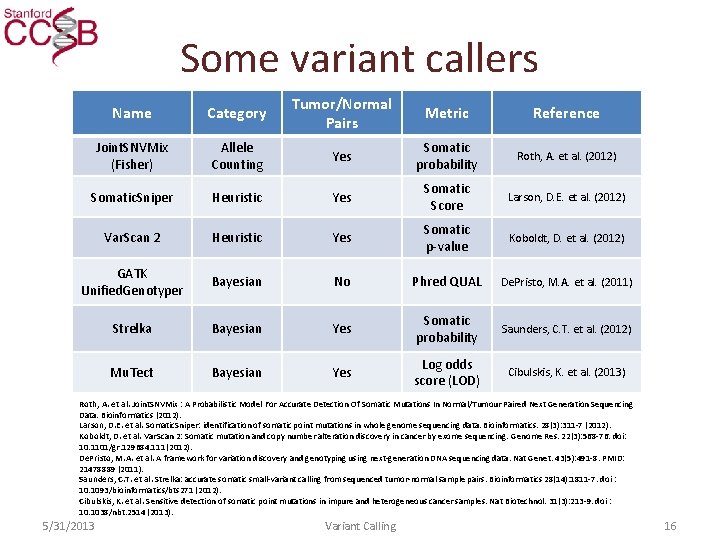
Some variant callers Name Category Tumor/Normal Pairs Metric Reference Joint. SNVMix (Fisher) Allele Counting Yes Somatic probability Roth, A. et al. (2012) Somatic. Sniper Heuristic Yes Somatic Score Larson, D. E. et al. (2012) Var. Scan 2 Heuristic Yes Somatic p-value Koboldt, D. et al. (2012) GATK Unified. Genotyper Bayesian No Phred QUAL De. Pristo, M. A. et al. (2011) Strelka Bayesian Yes Somatic probability Saunders, C. T. et al. (2012) Mu. Tect Bayesian Yes Log odds score (LOD) Cibulskis, K. et al. (2013) Roth, A. et al. Joint. SNVMix : A Probabilistic Model For Accurate Detection Of Somatic Mutations In Normal/Tumour Paired Next Generation Sequencing Data. Bioinformatics (2012). Larson, D. E. et al. Somatic. Sniper: identification of somatic point mutations in whole genome sequencing data. Bioinformatics. 28(3): 311 -7 (2012). Koboldt, D. et al. Var. Scan 2: Somatic mutation and copy number alteration discovery in cancer by exome sequencing. Genome Res. 22(3): 568 -76. doi: 10. 1101/gr. 129684. 111 (2012). De. Pristo, M. A. et al. A framework for variation discovery and genotyping using next-generation DNA sequencing data. Nat Genet. 43(5): 491 -8. PMID: 21478889 (2011). Saunders, C. T. et al. Strelka: accurate somatic small-variant calling from sequenced tumor-normal sample pairs. Bioinformatics 28(14): 1811 -7. doi : 10. 1093/bioinformatics/bts 271 (2012). Cibulskis, K. et al. Sensitive detection of somatic point mutations in impure and heterogeneous cancer samples. Nat Biotechnol. 31(3): 213 -9. doi : 10. 1038/nbt. 2514 (2013). 5/31/2013 Variant Calling 16
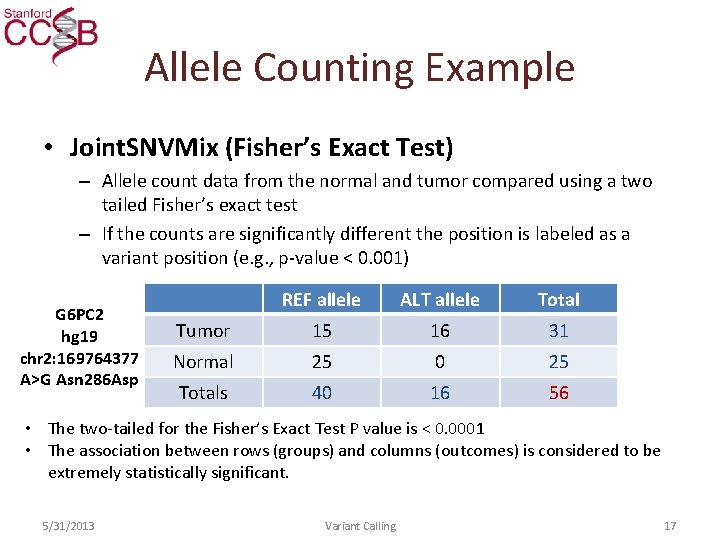
Allele Counting Example • Joint. SNVMix (Fisher’s Exact Test) – Allele count data from the normal and tumor compared using a two tailed Fisher’s exact test – If the counts are significantly different the position is labeled as a variant position (e. g. , p-value < 0. 001) G 6 PC 2 hg 19 chr 2: 169764377 A>G Asn 286 Asp Tumor REF allele ALT allele 2 x 2 Contingency Table 15 16 Total 31 Normal 25 0 25 Totals 40 16 56 • The two-tailed for the Fisher’s Exact Test P value is < 0. 0001 • The association between rows (groups) and columns (outcomes) is considered to be extremely statistically significant. 5/31/2013 Variant Calling 17
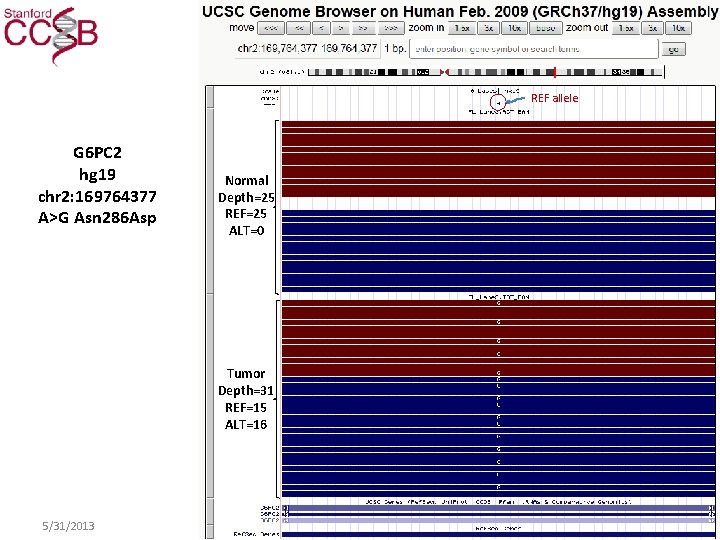
REF allele G 6 PC 2 hg 19 chr 2: 169764377 A>G Asn 286 Asp Normal Depth=25 REF=25 ALT=0 Tumor Depth=31 REF=15 ALT=16 5/31/2013 Variant Calling 18
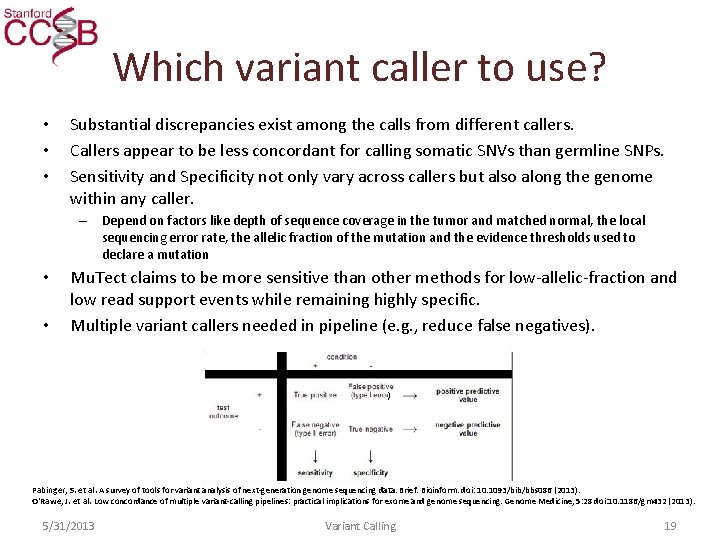
Which variant caller to use? • • • Substantial discrepancies exist among the calls from different callers. Callers appear to be less concordant for calling somatic SNVs than germline SNPs. Sensitivity and Specificity not only vary across callers but also along the genome within any caller. – Depend on factors like depth of sequence coverage in the tumor and matched normal, the local sequencing error rate, the allelic fraction of the mutation and the evidence thresholds used to declare a mutation • • Mu. Tect claims to be more sensitive than other methods for low-allelic-fraction and low read support events while remaining highly specific. Multiple variant callers needed in pipeline (e. g. , reduce false negatives). ) Pabinger, S. et al. A survey of tools for variant analysis of next-generation genome sequencing data. Brief. Bioinform. doi: 10. 1093/bib/bbs 086 (2013). O'Rawe, J. et al. Low concordance of multiple variant-calling pipelines: practical implications for exome and genome sequencing. Genome Medicine, 5: 28 doi: 10. 1186/gm 432 (2013). 5/31/2013 Variant Calling 19
Variant Annotation • Seattle. Seq – annotation of known and novel SNPs – includes db. SNP rs ID, gene names and accession numbers, SNP functions (e. g. , missense), protein positions and amino-acid changes, conservation scores, Hap. Map frequencies, Poly. Phen predictions, and clinical association • Annovar – Gene-based annotation – Region-based annotations – Filter-based annotation http: //snp. gs. washington. edu/Seattle. Seq. Annotation/ http: //www. openbioinformatics. org/annovar/ 5/31/2013 Variant Calling 20
Why study Structural Variation • Common in “normal” human genomes - major cause of phenotypic variation • Common in certain diseases, particularly cancer • Now showing up in rare disease; autism, schizophrenia Zang, Z. J. et al. Genetic and Structural Variation in the Gastric Cancer Kinome Revealed through Targeted Deep Sequencing. Cancer Res January 1, 71; 29 (2011). Shibayama, A. et al. MECP 2 Structural and 30 -UTR Variants in Schizophrenia, Autism and Other Psychiatric Diseases: A Possible Association With Autism. American Journal of Medical Genetics Part B (Neuropsychiatric Genetics) 128 B: 50– 53 (2004). 5/31/2013 Variant Calling 21
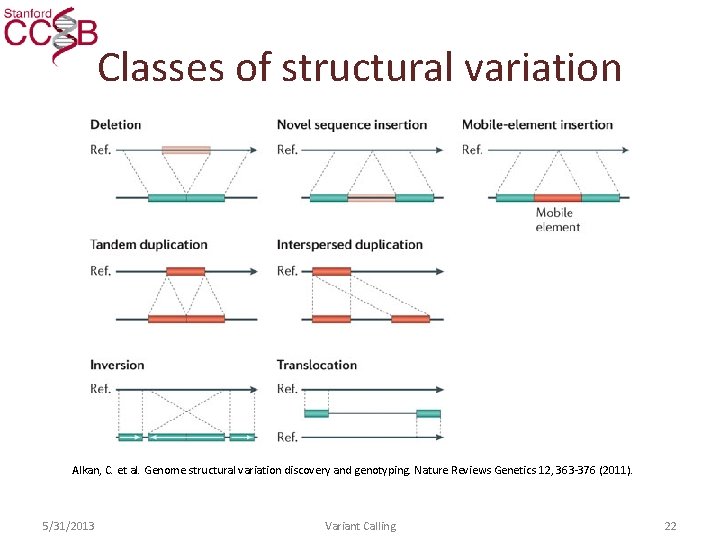
Classes of structural variation Alkan, C. et al. Genome structural variation discovery and genotyping. Nature Reviews Genetics 12, 363 -376 (2011). 5/31/2013 Variant Calling 22
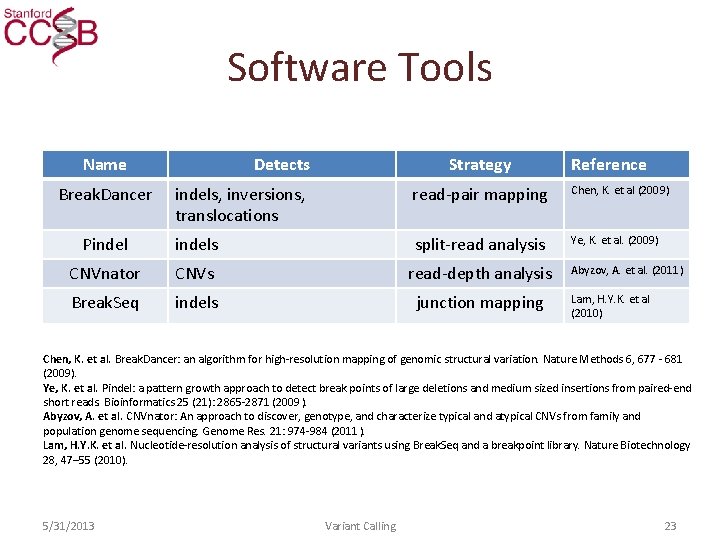
Software Tools Name Break. Dancer Detects Strategy Reference indels, inversions, translocations read-pair mapping Chen, K. et al (2009) Pindels split-read analysis Ye, K. et al. (2009) CNVnator CNVs read-depth analysis Break. Seq indels junction mapping Abyzov, A. et al. (2011) Lam, H. Y. K. et al (2010) Chen, K. et al. Break. Dancer: an algorithm for high-resolution mapping of genomic structural variation. Nature Methods 6, 677 - 681 (2009). Ye, K. et al. Pindel: a pattern growth approach to detect break points of large deletions and medium sized insertions from paired-end short reads. Bioinformatics 25 (21): 2865 -2871 (2009). Abyzov, A. et al. CNVnator: An approach to discover, genotype, and characterize typical and atypical CNVs from family and population genome sequencing. Genome Res. 21: 974 -984 (2011). Lam, H. Y. K. et al. Nucleotide-resolution analysis of structural variants using Break. Seq and a breakpoint library. Nature Biotechnology 28, 47– 55 (2010). 5/31/2013 Variant Calling 23
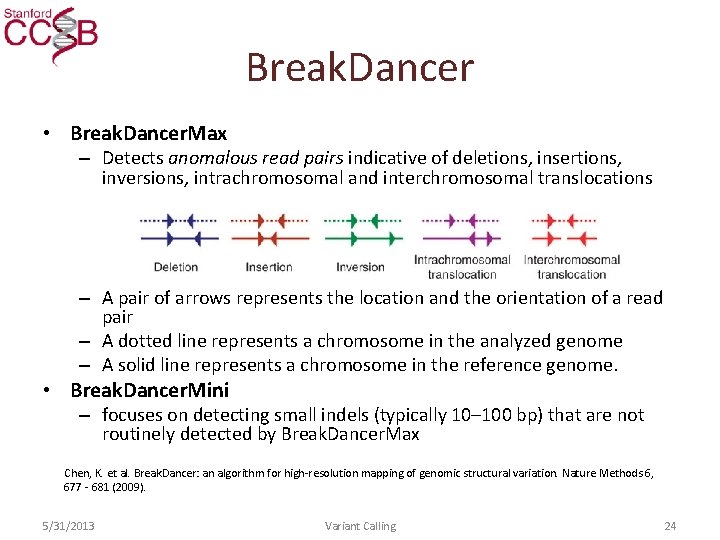
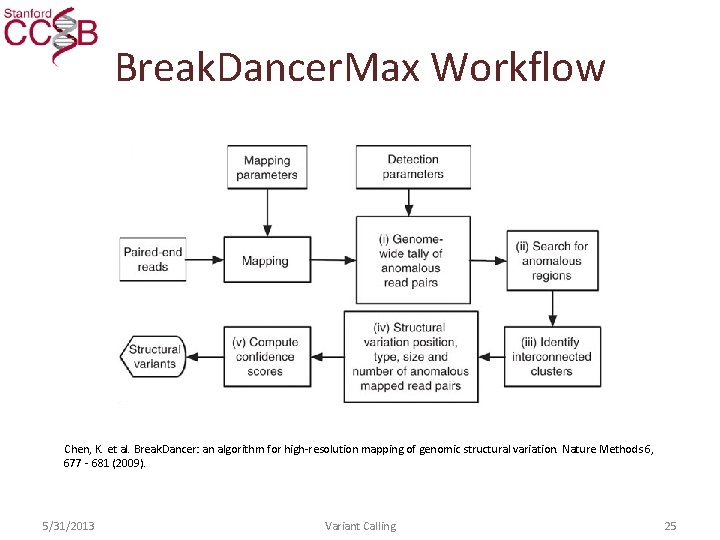
Break. Dancer • Break. Dancer. Max – Detects anomalous read pairs indicative of deletions, insertions, inversions, intrachromosomal and interchromosomal translocations – A pair of arrows represents the location and the orientation of a read pair – A dotted line represents a chromosome in the analyzed genome – A solid line represents a chromosome in the reference genome. • Break. Dancer. Mini – focuses on detecting small indels (typically 10– 100 bp) that are not routinely detected by Break. Dancer. Max Chen, K. et al. Break. Dancer: an algorithm for high-resolution mapping of genomic structural variation. Nature Methods 6, 677 - 681 (2009). 5/31/2013 Variant Calling 24
Break. Dancer. Max Workflow Chen, K. et al. Break. Dancer: an algorithm for high-resolution mapping of genomic structural variation. Nature Methods 6, 677 - 681 (2009). 5/31/2013 Variant Calling 25
Summary • Accurate mapping and processing of NGS data are critical for analysis-ready reads and for downstream variant calling. • Variant filtering is needed to reduce false positives. • Multiple variant callers are needed in pipeline to reduce false negatives. • Variant annotation helps determine biologically relevant variants. • Variant calling pipeline should include the right set of tools and filters for the job. 5/31/2013 Variant Calling 26