
NGO MANAGEMENT Session 2 Organizational Systems Mariam Memarsadeghi






- Slides: 36
NGO MANAGEMENT Session 2: Organizational Systems Mariam Memarsadeghi Thursday, 10 July 2014
Share! Attribution - This work requires author attribution. List “ECollaborative for Civic Education – Tavaana” as the source for any information used in this document as well as any original attribution provided in this document. Noncommercial - This work can only be used noncommercially. The information is not to be used for profit. Share Alike - You may not make derivative works from this work. If you alter, transform, or build upon this work, you may distribute the resulting work only under the same, similar or a compatible license. And share your alterations, etc. with Tavaana to continue to build the body of knowledge.
Quiz 1. Which of the following is an effective mission statement? a) “We implement our programs in four East African countries. ” b) “Our activists use traditional and nontraditional means to push for social change. ” c) “We help families in developing communities stay healthy by providing safe drinking water and education” d) “We are independent of any government, political ideology, economic interest, or religion. ” True or False? 2. NGOs are a 20 th century phenomenon. FALSE 3. An enabling legal environment exists when governments help to create NGOs. 4. NGOs are accountable to their board of directors only. FALSE 5. A good mission statement clearly limits the scope of an NGO’s activities. 6. Traditional or religious charities are not NGOs. TRUE FALSE
On the discussion forum… 1. What do you seek to achieve by taking this course? 2. How can Iranians be effective NGO leaders despite the restrictions on civil society? 3. In your opinion, what are some examples of effective Iranian NGOs? Why?
Impressions from the readings… What do you think?
Organizational Systems This session, we will address the following questions: What are the institutional building blocks of sound NGOs? What legal precautions and systems are necessary? How should the organization be administered to comply with regulations and donor expectations? How should financial strategies and day-to-day accounting be delineated? What operational systems are necessary? How should the organization maintain security for its staff, beneficiaries, communications and products?
An NGO’s systems To service programs, an NGO relies on sound systems, including: ü Governance, management, and staffing ü Administration ü Legal ü Finance ü Security üPublic relations, partnerships, and social networks ü Development and fundraising
Why are organizational systems important? • Although organizational systems may not be seen or felt like project activities are, organizational systems form the backbone of successful NGOs • Without institutionalization of strong procedures and policies, an effective NGO cannot take shape • Good systems also mean lean and efficient project operations • Having good organizational systems keeps your NGO disciplined and professional • Sound systems keep you accountable to your board, donors, stakeholders, beneficiaries, and/or membership
Good systems also mean a happy staff!
Maintaining good organizational systems requires skills. These skills can be learned and should be kept up to date!
How to start an NGO: Governance Good Governance • A strong system of organizational governance is necessary to provide good leadership, accountability, and transparency in organizational activities.
How to start an NGO: Governance Good governance: Establish a board of directors • The role of a board of directors is to: • Provide strategic direction and management • Oversee organizational activities through a framework of checks and balances • Ensure that financial and human resources are in place to achieve the organization’s goals • Confirm that beneficiaries are at the center of the organization’s work • The board should meet on a regular schedule, previously determined by the by-laws • Board activities and decisions must be clearly recorded
How to start an NGO: Bylaws • Establish bylaws. Bylaws define how your organization will operate. • Bylaws are organization specific, but should include: • Size of the board and how it functions • Roles and duties of directors and officers • Rules and procedures for holding meetings • Conflict of interest policies and procedures • How grant money is distributed • Other necessary corporate governance matters • By-law resources are available in this week’s supplementary readings
How to start an NGO: Advisors and Networks • In addition to your board, it’s important to find genuine, trusted advisors and support networks that will sustain your efforts
Policies and Procedures Create a policies and procedures manual • NGOs should have a manual detailing administrative and legal policies. • What is included in this manual differs for each NGO, depending on the size and needs of the organization • Policies need to be realistic and enforceable • Policies must reflect the requirements of your donors and/or prospective donors • Policies must affirm relevant laws and government requirements
How is this relevant to your activities?
How to start an NGO: Insurances • Insurances are one important way your organization can manage its risk and protect itself against losses • It is necessary to consider what type of insurances your organization needs, as well as what the law requires, for staff, premises, and assets. • General liability • Professional liability • Workers’ compensation, disability, employment benefits
Managing Finances Financial management is the planning, organizing, controlling, and reporting on the finances of an organization to achieve goals Good financial management practices… • Help managers allocate resources to achieve objectives in a timely, efficient manner • Help NGOs be accountable to donors • Gain respect and confidence of funding agencies and those served • Help NGOs be sustainable in the long-term
Accounting systems: key questions to consider ü Who will manage which aspects and how you will ensure proper oversight? ü How will your organization prevent fraud? ü How will your organization manage its bank accounts? ü How will cash transactions be managed? ü How will payments be made? ü How will fixed and consumable assets be managed? ü How will staff expenses be managed? What is the staff salary structure? Fringe benefits? ü How will the organization manage purchasing and procurement?
Budgeting A budget is. . . • A plan for the coming year • A financial statement prioritizing the organization’s activities • A forecast for the year that pinpoints areas of underfunding and resources, which can aid funding • A management tool for monitoring income and expenditures • A means to ensure timely implementation of various grants and allow for effective management of multiple, overlapping grants
How is this relevant to your activities?
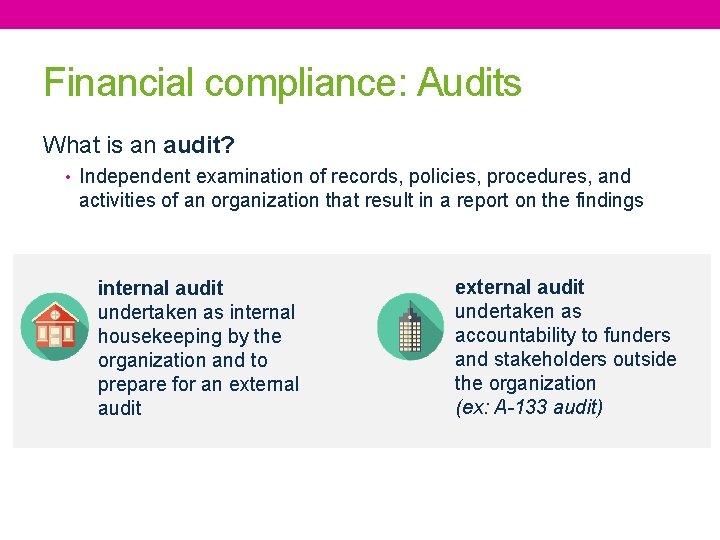
Financial compliance: Audits What is an audit? • Independent examination of records, policies, procedures, and activities of an organization that result in a report on the findings internal audit undertaken as internal housekeeping by the organization and to prepare for an external audit di external audit undertaken as accountability to funders and stakeholders outside the organization (ex: A-133 audit)
Legal precautions and protections • Registering your NGO with the • • • government Writing contracts and scopes of work Requiring non-disclosure agreements Vetting contractors and service providers Committing to clear and effective by-laws, as well as policy, accounting, and HR manuals Be organized, accurate, and on time with taxes and other government reporting
Contracts and Scopes of Work A well-written contract and scope of work will ensure that you and your consultants have the same vision of the desired outcome for the project and terms of employment. Important aspects of contracts and scopes of work include: ü Clear identification of the parties ü Nature of the contracting relationship ü Specific duties and services ü When the contract begins and ends ü Fees and payment terms ü Deadlines for all projects ü Indemnification clause ü Governing laws/venue ü Intellectual property clause ü Waiver of risk
Nondisclosure agreements (NDAs) A nondisclosure agreement creates a confidential relationship between you and your staff and contractors, protecting your organization’s sensitive information. A nondisclosure agreement should include terms protecting the use of and property of confidential information, including but not limited to written materials, systems, programs, strategies, and other information not generally known outside the organization. You should be especially sensitive to protecting your IT systems, proposals, budgets, and information related to your beneficiaries.
Accountability and fraud prevention Fraud involves using deception to dishonestly make a personal gain for oneself and create a loss for someone else. • Fraud includes theft, embezzlement, corruption, bribery, and extortion • Fraud risk assessments should be externally provided on a regular basis • Internal controls, checks, and balances safeguard an organization’s assets and help reduce the risk of fraud
Accountability and fraud prevention Fraud can mean the end of your NGO, so invest heavily in creating a clean and accountable operation, no matter how small or large.
Conflict of interest policy • A conflict of interest policy addresses situations where the interests of its officers and key staff come into conflict with the organization • A conflict of interest policy should at minimum (a) require those who believe they have a conflict to disclose the potential conflict and (b) prohibit interested board members in voting on any matter in which there is a conflict of interest • Organizations must decide how their boards will manage conflicts of interest • For US organizations, IRS Form 990 requires written conflict of interest policies and an explanation of the process by which conflict of interests are managed, and how organizations determine if board members have a conflict of interest
What are the key components of a good human resources policy?
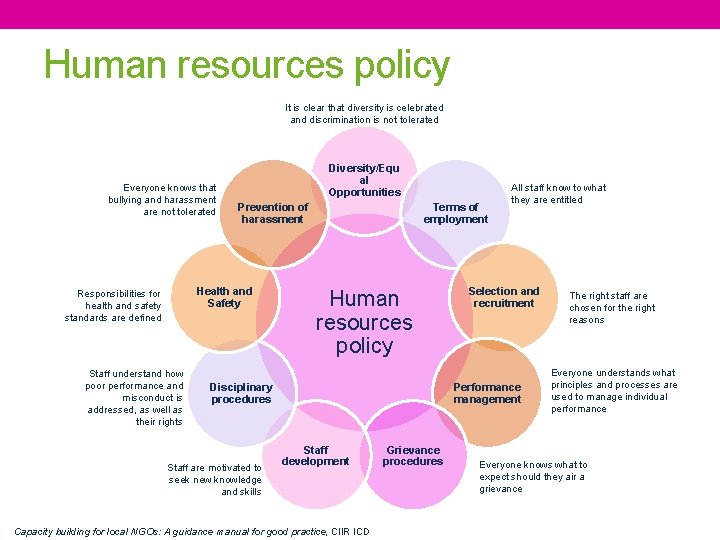
Human resources policy It is clear that diversity is celebrated and discrimination is not tolerated Everyone knows that bullying and harassment are not tolerated Diversity/Equ al Opportunities Prevention of harassment Health and Safety Responsibilities for health and safety standards are defined Staff understand how poor performance and misconduct is addressed, as well as their rights Terms of employment Human resources policy Disciplinary procedures Staff are motivated to seek new knowledge and skills All staff know to what they are entitled Selection and recruitment Performance management Staff development Capacity building for local NGOs: A guidance manual for good practice, CIIR ICD Grievance procedures The right staff are chosen for the right reasons Everyone understands what principles and processes are used to manage individual performance Everyone knows what to expect should they air a grievance
What are the primary security challenges Iranian NGOs face? Inside Iran? Outside Iran?
Security • Because NGOs differ, their safety and security risks and ways of dealing with these risks vary accordingly. • It’s necessary to assess and monitor your risks as an organization to know what sort of system should be implemented • Outside experts can help you see risks you cannot see on your own
Security – what’s needed? • Can you think of some security policies or precautions that an organization assisting runaway girls in Iran might consider? ü Keeping the location of facilities confidential ü Thoroughly vetting staff and contractors who interact with beneficiaries ü Securing personal information of beneficiaries to protect their identities and location ü Implementing security protocol to minimize risk for staff members working with families in the community
Security – what’s needed? • Can you think of some security policies or precautions that an organization that works primarily on online platforms might consider? ü Developing backup systems for important data ü Regularly updating anti-virus software and security patches ü Creating policies on acceptable use of IT systems, confidential data, and secure passwords ü Maintaining effective document storage and retention ü Educating staff on network security
Assignment • Read materials for Session 3: Seeking Donor Support • How to Build a Good Small NGO - Chapters 3 and 10. 2 • Write a sample Letter of Interest (LOI). If possible, write this in English, as if to an international organization.
Any questions?