
NGN siete sluby protokoly Introduction to SIP protocol
NGN siete, služby, protokoly Introduction to SIP protocol History SIP was initially defined within the framework of the MBONE for the establishment of multicast sessions (1996) Version 1 protocol issued by the IETF in 1997. SIP reaches the statute of "Standard Internet" with the version 2 of March 1999 (RFC 2543). Since June 2002, a new version has been in described in the RFC 3261 Session Initiation Protocol (SIP)

NGN siete, služby, protokoly Session Initiation Protocol (SIP)

NGN siete, služby, protokoly What is SIP? SIP supports 5 facets of establishing and terminating multimedia communications: n n n User location: determination of the end system to be used for communication User availability: determination of the willingness of the called party to engage in communications User capabilities: determination of the media and media parameters to be used Session setup: "ringing", establishment of session parameters at both called and calling party Session management: including transfer and termination of sessions, modifying session parameters, and invoking services Session Initiation Protocol (SIP)
NGN siete, služby, protokoly SIP Overview (RFC 2543 & 3261) n n n Application Layer Signaling Protocol Used to establish, modify, and terminate multimedia sessions Part of Internet Multimedia Architecture Based on HTTP (Web) ¨ Similar text-based structure ¨ Uses URIs (Uniform Resource Indicators) Applications include (but not limited to): ¨ Voice, video, gaming, instant messaging, presence, call control, etc. Session Initiation Protocol (SIP)
NGN siete, služby, protokoly SIP n Logically, there are several parts to a SIP system UA (User-Agent, Endpoint) – the phone itself – can also be a softphone – computer software (UA = User Client + User Server) ¨ Registrar – keeps track of where the user is within a system ¨ Redirect Server – used to inform devices when they need to contact different locations ¨ Proxy Server – used to relay messages back and forth within the system ¨ n In practice, several functions may actually be in the same server/program Session Initiation Protocol (SIP)

NGN siete, služby, protokoly SIP Architecture SIP Components • A server that accepts REGISTER requests. • The register server may support authentication. Location Server Redirect Server Registrar Server PSTN User Agent Gateway Proxy Server Session Initiation Protocol (SIP)

NGN siete, služby, protokoly SIP Uniform Resource Indicators • Same form as email addresses: user@domain • URI scheme: ¨ sip: user@domain. com is a SIP URI • Two types of SIP URIs: ¨ Address of Record (AOR) (identifies a user) sip: user@domain. com (Needs DNS SRV records to locate SIP Servers for domain. com domain) ¨ Contact (identifies a device) sip: user@130. 20. 10. 5 or sip: user@lab. domain. com (Which needs no resolution for routing) Session Initiation Protocol (SIP)

NGN siete, služby, protokoly Basic SIP Methods INVITE A user is being invited to participate in a session ACK confirms that the client has received a final response to an INVITE request OPTIONS The server is being queried as to its capabilities BYE The user agent client uses BYE to indicate to the server that it wishes to release the call CANCEL The CANCEL request cancels a pending request REGISTER A client uses the REGISTER method to register the address listed in the To header field with a SIP server Session Initiation Protocol (SIP)

NGN siete, služby, protokoly SIP Responses 1 xx informational - request received, continuing to process the request 2 xx success - the action was successfully received, understood, and accepted 3 xx redirection - further action needs to be taken in order to complete the request 4 xx request failure - the request contains bad syntax or cannot be fulfilled at this server 5 xx server failure - the server failed to fulfill an apparently valid request 6 xx global failure - the request cannot be fulfilled at any server Session Initiation Protocol (SIP)

NGN siete, služby, protokoly User Agent Alice Registration SIP Server REGISTER 401 Unauthorized REGISTER 200 OK Session Initiation Protocol (SIP)

NGN siete, služby, protokoly Basic Call SIP Server User Agent Alice User Agent Bob INVITE 100 Trying 180 Ringing 200 OK ACK Bi-directional Media between endpoints BYE 200 OK Session Initiation Protocol (SIP) 200 OK

NGN siete, služby, protokoly A server that accepts a SIP request, maps the address into zero or more new addresses and returns these addresses to the client. used by a SIP Request Response SIP Architecture Server + Client, Interprets, rewrites or translates a request An application that message before forwarding initiates, receives it and terminates calls redirect or proxy server to obtain information about a called party’s possible location(s). SIP Redirect Server 2 Location Service 3 Location Server 5 4 1 6 11 12 7 SIP Proxy 10 8 SIP Client (UAC: User Agent Client) Caller Application 9 SIP Client (User Agent Server) Accept, redirect, refuse call Session Initiation Protocol (SIP) SIP Proxy

NGN siete, služby, protokoly SIP Call Setup and Tear down Proxy Server User Agent INVITE Location/Redirect Server INVITE User Agent Proxy Server 302 (Moved Temporarily) ACK INVITE Call Setup INVITE 302 (Moved Temporarily) ACK 180 (Ringing) 200 (OK) ACK Media Path Call Teardown 180 (Ringing) 200 (OK) ACK INVITE 180 (Ringing) 200 (OK) ACK RTP MEDIA PATH BYE BYE 200 (OK) Session Initiation Protocol (SIP)
NGN siete, služby, protokoly Protokol SDP Tento protokol je určený k opisu multimediálnej relácie v prípade ohlásenia spojenia, požadovania spojenia a pri všetkých formách inicializácie multimediálneho spojenia. Pomocou SDP (Session Description Protocol) sa špecifikujú parametre prenosu, použité kódovanie a ďalšie parametre potrebné počas komunikácie. Samotná správa protokolu je umiestnená v tele správy protokolu SIP v podobe riadkov v tvare typ=hodnota. Session Initiation Protocol (SIP)

NGN siete, služby, protokoly INVITE message INVITE sip: bob@quickmart. com SIP/2. 0 Via: SIP/2. 0/TCP aliceua. phonecompany. com: 5060 From: Alice <sip: alice@phonecompany. com> To: Bob <sip: bob@quickmart. com> Call-ID: 3848276298220188511@phonecompany. com CSeq: 1 INVITE Contact: <sip: alice@aliceua. phonecompany. com; transport=tcp> Content-Type: application/sdp Content-Length: 151 v=0 o=Cisco-User. Agent 10010 605 IN IP 4 aliceua. phonecompany. com s=SIP Call c=IN IP 4 192. 0. 1. 1 t=0 0 m=audio 49172 RTP/AVP 0 8 16 Session Initiation Protocol (SIP)

NGN siete, služby, protokoly INVITE message - SIP INVITE sip: bob@quickmart. com SIP/2. 0 SIP request, method is INVITE – this message will start a new call Via: SIP/2. 0/TCP aliceua. phonecompany. com: 5060 Via header tracks where it has been – so far just Alice’s UA From: Alice <sip: alice@phonecompany. com> Message is from Alice, and this is the SIP URL for Alice To: Bob <sip: bob@quickmart. com> Alice is trying to contact Bob at his SIP URL Call-ID: 3848276298220188511@phonecompany. com Call-ID is a (hopefully) unique ID to track this particular call. Alice’s UA generated this CSeq: 1 INVITE We also count messages within a call to see what responses go with what messages. This first exchange is an INVITE exchange. The response to this will also have a CSeq of 1 INVITE Contact: <sip: alice@aliceua. phonecompany. com; transport=tcp> How to contact Alice directly – you can sometimes “skip” the proxy. <snip!> Session Initiation Protocol (SIP)

NGN siete, služby, protokoly INVITE message - SDP <snip!> Content-Type: application/sdp Content-Length: 151 The content of the message is SDP – to describe the media of the call. We have 151 bytes of SDP v=0 v is the SDP version number -- 0 o=Cisco-User. Agent 10010 605 IN IP 4 aliceua. phonecompany. com o is a description of the UA and a session ID s=SIP Call s is an string to encode a name for this session c=IN IP 4 192. 0. 1. 1 c tells the other side what address to send the media to t=0 0 t indicates start and end times. 0 and 0 don’t specify times in advance m=audio 49172 RTP/AVP 0 8 16 m describes the media. We are listening for audio of type RTP/AVP on port 49172 Session Initiation Protocol (SIP)
NGN siete, služby, protokoly Session Initiation Protocol (SIP)

NGN siete, služby, protokoly SIP Elements – User Agents Location Server DNS Server Capable of sending and receiving SIP requests. Ø UAC – User Agent Client Ø UAS – User Agent Server DNS Outbound Proxy Server SIP Inbound Proxy Server SIP SIP Media (RTP) User Agent A User Agent B Session Initiation Protocol (SIP) End Devices Ø SIP phone Ø PC/laptop with SIP Client Ø PDA Ø mobile phone PSTN Gateways are a type of User Agent

NGN siete, služby, protokoly SIP Elements – Proxy Servers DNS Server Location Server DNS Forward or “proxy” requests on behalf of User Agents Consult databases: DNS Ø Location Server Ø Outbound Proxy Server SIP Inbound Proxy Server SIP SIP Media (RTP) User Agent A User Agent B Session Initiation Protocol (SIP) No media capabilities Ø Ignore SDP Normally bypassed once dialog established, but can Record-Route to stay in path.

NGN siete, služby, protokoly SIP Elements – Other Servers Location Server DNS Server Location Server DNS Outbound Proxy Server SIP Inbound Proxy Server SIP DNS Server SRV (Service) Records used to locate Inbound Proxy Servers SIP Media (RTP) User Agent A Database of locations of SIP User Agents Queried by Proxies in routing Updated by User Agents by Registration User Agent B Session Initiation Protocol (SIP)

NGN siete, služby, protokoly SIP Call Flow - Scenarios Ø Call Attempt - Unsuccessful Ø Presence Subscription Ø Registration Ø Presence Notification Ø Instant Message Exchange Ø Call Setup – Successful Ø Call Hold Ø Call Transfer Call Flows and full message details: Ø “SIP Basic Call Flow Examples” I-D by A. Johnston et al. Ø “SIP Service Examples” I-D by A. Johnston et al. Session Initiation Protocol (SIP)

NGN siete, služby, protokoly SIP Call Setup Attempt Scenario DNS Server Location Server 1. A “dials” SIP AOR URI sip: B@wcom. Outbound Proxy Server 1. INVITE Contact: A SDP A User Agent A Inbound Proxy Server 2. 100 Trying User Agent B (Not Signed In) Session Initiation Protocol (SIP) User Agent A sends INVITE to outbound Proxy Server. 2. Outbound Proxy sends 100 Trying response.

NGN siete, služby, protokoly SIP Call Setup Attempt Scenario DNS Server 3. DNS Query: wcom. com? 4. Response: 1. 2. 3. 4 Outbound Proxy Server 1. INVITE Contact: A SDP A User Agent A 2. 100 Trying Location Server 3. Outbound Proxy does DNS query to find proxy server for Inbound Proxy Server wcom. com domain. 4. DNS responds with IP address of wcom. com Proxy Server. User Agent B (Not Signed In) Session Initiation Protocol (SIP)
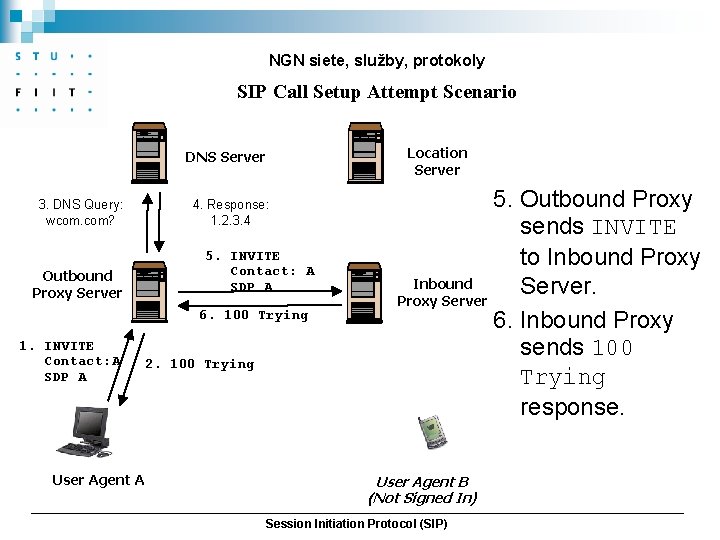
NGN siete, služby, protokoly SIP Call Setup Attempt Scenario DNS Server 3. DNS Query: wcom. com? Outbound Proxy Server 4. Response: 1. 2. 3. 4 5. INVITE Contact: A SDP A 6. 100 Trying 1. INVITE Contact: A SDP A User Agent A 2. 100 Trying Location Server 5. Outbound Proxy sends INVITE to Inbound Proxy Inbound Server. Proxy Server 6. Inbound Proxy sends 100 Trying response. User Agent B (Not Signed In) Session Initiation Protocol (SIP)

NGN siete, služby, protokoly SIP Call Setup Attempt Scenario DNS Server 3. DNS Query: wcom. com? Outbound Proxy Server 4. Response: 1. 2. 3. 4 Location Server 7. LS Query: B? 5. INVITE Contact: A SDP A 6. 100 Trying 1. INVITE Contact: A SDP A User Agent A 2. 100 Trying 8. Response: Not Signed In 7. Inbound Proxy Inbound consults Proxy Server Location Server. 8. Location Server responds with “Not Signed User Agent B In. ” (Not Signed In) Session Initiation Protocol (SIP)

NGN siete, služby, protokoly SIP Call Setup Attempt Scenario DNS Server 3. DNS Query: wcom. com? Outbound Proxy Server 1. INVITE Contact: A SDP A 2. 100 Trying User Agent A Location Server 9. Inbound Proxy sends 480 7. LS Query: 4. Response: 8. Response: B? 1. 2. 3. 4 Not Signed In Temporarily Unavailable 5. INVITE Contact: A Inbound response. SDP A Proxy Server 6. 100 Trying 10. Outbound 9. 480 Temporarily Unavailable Proxy sends 10. ACK response. User Agent B (Not Signed In) Session Initiation Protocol (SIP)

NGN siete, služby, protokoly SIP Call Setup Attempt Scenario DNS Server 3. DNS Query: wcom. com? Outbound Proxy Server 1. INVITE Contact: A SDP A 2. 100 Trying 4. Response: 1. 2. 3. 4 7. LS Query: B? 5. INVITE Contact: A SDP A 6. 100 Trying Location Server 8. Response: Not Signed In Inbound Proxy Server 9. 480 Temporarily Unavailable 10. ACK 11. 480 Temporarily Unavailable 12. ACK User Agent A User Agent B (Not Signed In) Session Initiation Protocol (SIP) 11. Outbound Proxy forwards 480 response to A. 12. A sends ACK response.

NGN siete, služby, protokoly SIP Presence Example Presence Server DNS Server 3. SUBSCRIBE Outbound Proxy Server 2. SUBSCRIBE Inbound Proxy Server 1. SUBSCRIBE User Agent A 1. A wants to be informed when B signs on, so sends a SUBSCRIBE User Agent B (Not Signed In) Session Initiation Protocol (SIP) 2. Outbound Proxy forwards to Inbound Proxy 3. Inbound Proxy forwards to B’s Presence Server
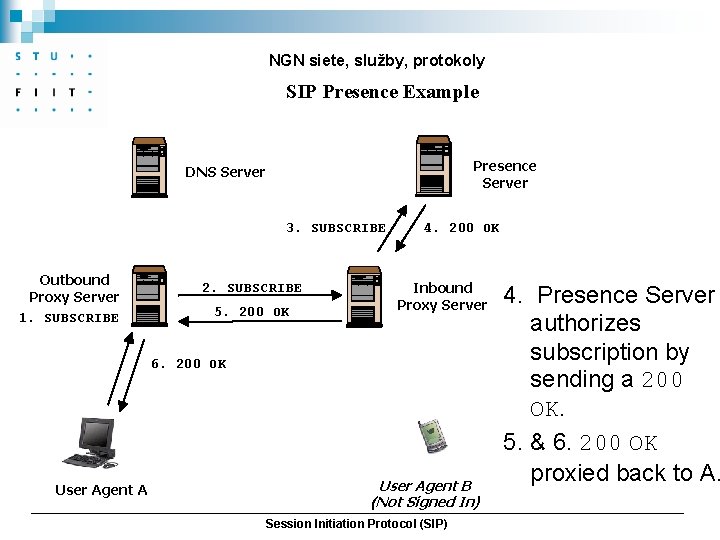
NGN siete, služby, protokoly SIP Presence Example Presence Server DNS Server 3. SUBSCRIBE Outbound Proxy Server 1. SUBSCRIBE 2. SUBSCRIBE 5. 200 OK 4. 200 OK Inbound Proxy Server 6. 200 OK User Agent A User Agent B (Not Signed In) Session Initiation Protocol (SIP) 4. Presence Server authorizes subscription by sending a 200 OK. 5. & 6. 200 OK proxied back to A.
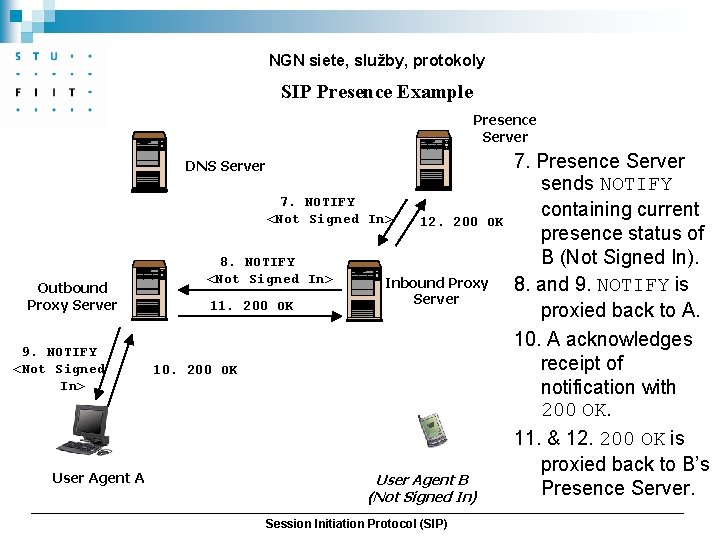
NGN siete, služby, protokoly SIP Presence Example Presence Server DNS Server 7. NOTIFY <Not Signed In> Outbound Proxy Server 9. NOTIFY <Not Signed In> User Agent A 8. NOTIFY <Not Signed In> 11. 200 OK 12. 200 OK Inbound Proxy Server 10. 200 OK User Agent B (Not Signed In) Session Initiation Protocol (SIP) 7. Presence Server sends NOTIFY containing current presence status of B (Not Signed In). 8. and 9. NOTIFY is proxied back to A. 10. A acknowledges receipt of notification with 200 OK. 11. & 12. 200 OK is proxied back to B’s Presence Server.

NGN siete, služby, protokoly SIP Presence Example Presence Server DNS Server 13. NOTIFY <Signed In> Outbound Proxy Server 15. NOTIFY <Signed In> User Agent A 14. NOTIFY <Signed In> 17. 200 OK 16. 200 OK 13. Presence Server learns of B’s new status from the Location Server and 18. 200 OK sends a NOTIFY containing new status of B (Signed In). Inbound Proxy Server 14. & 15. NOTIFY is proxied back to A. 16. A acknowledges receipt of notification with 200 OK. 17. & 18. 200 OK is proxied back to Presence Server. User Agent B Session Initiation Protocol (SIP)

NGN siete, služby, protokoly SIP Registration Example DNS Server Location Server 2. Update database: B = B@2. 3. 4. 5 Outbound Proxy Server 1. REGISTER Contact: B@2. 3. 4. 5 User Agent A User Agent B Session Initiation Protocol (SIP) 1. B signs on to his SIP Phone which sends a REGISTER message containing the FQDN URI of B’s User Agent. 2. Database update is sent to the Location Server
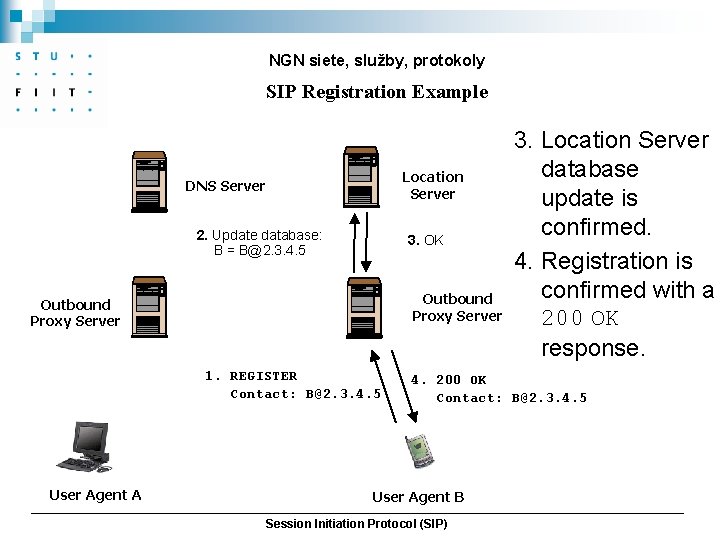
NGN siete, služby, protokoly SIP Registration Example Location Server DNS Server 2. Update database: B = B@2. 3. 4. 5 3. OK Outbound Proxy Server 1. REGISTER Contact: B@2. 3. 4. 5 User Agent A 3. Location Server database update is confirmed. 4. Registration is confirmed with a 200 OK response. 4. 200 OK Contact: B@2. 3. 4. 5 User Agent B Session Initiation Protocol (SIP)
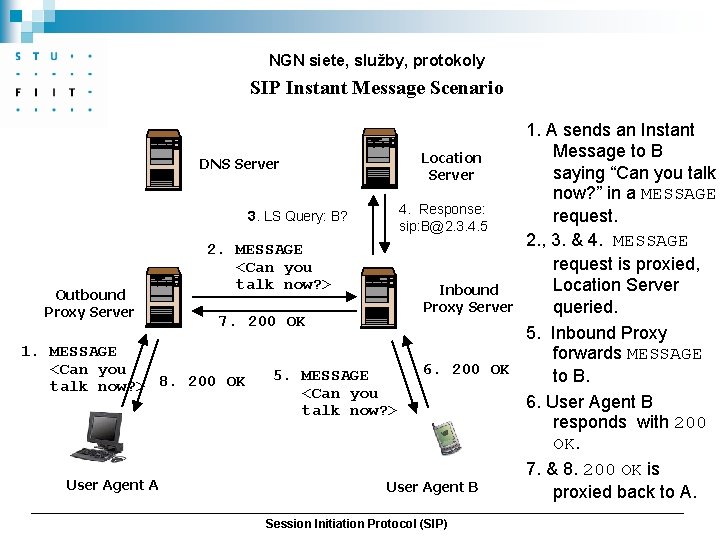
NGN siete, služby, protokoly SIP Instant Message Scenario 1. A sends an Instant Message to B Location DNS Server saying “Can you talk Server now? ” in a MESSAGE 4. Response: 3. LS Query: B? request. sip: B@2. 3. 4. 5 2. , 3. & 4. MESSAGE 2. MESSAGE request is proxied, <Can you talk now? > Location Server Inbound Outbound Proxy Server queried. Proxy Server 7. 200 OK 5. Inbound Proxy 1. MESSAGE forwards MESSAGE <Can you 6. 200 OK 5. MESSAGE to B. 8. 200 OK talk now? > <Can you 6. User Agent B talk now? > responds with 200 OK. 7. & 8. 200 OK is User Agent A User Agent B proxied back to A. Session Initiation Protocol (SIP)

NGN siete, služby, protokoly SIP Instant Message Scenario 1. B sends an Instant DNS Server Message to A saying Location “Sure. ” in a MESSAGE Server sent to A’s AOR URI. 6. Response: 5. LS Query: A? 2. DNS Query: 3. Response: 2. & 3. DNS Server is 5. 6. 7. 8 sip: A@4. 5. 3. 2 mci. com? queried. 4. Outbound Proxy 4. MESSAGE forwards MESSAGE to <Sure. > Outbound Inbound Server. Proxy Server 9. 200 OK 5. & 6. Location Server is queried. 7. MESSAGE 10. 200 OK 7. Inbound Proxy forwards <Sure. > 8. 200 OK 1. MESSAGE to A. <Sure. > 8. User Agent A responds with 200 OK. 9. & 10. 200 OK is proxied back to B. User Agent A User Agent B Session Initiation Protocol (SIP)
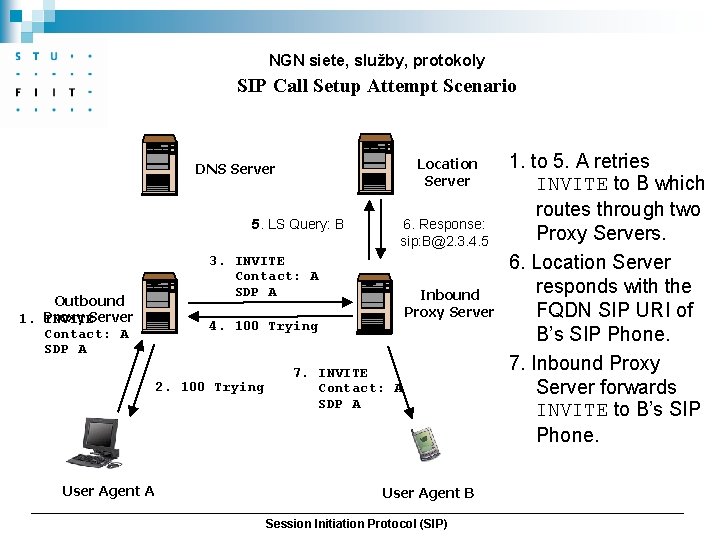
NGN siete, služby, protokoly SIP Call Setup Attempt Scenario Location Server DNS Server 5. LS Query: B Outbound 1. Proxy INVITEServer Contact: A SDP A 3. INVITE Contact: A SDP A Inbound Proxy Server 4. 100 Trying 2. 100 Trying User Agent A 6. Response: sip: B@2. 3. 4. 5 7. INVITE Contact: A SDP A User Agent B Session Initiation Protocol (SIP) 1. to 5. A retries INVITE to B which routes through two Proxy Servers. 6. Location Server responds with the FQDN SIP URI of B’s SIP Phone. 7. Inbound Proxy Server forwards INVITE to B’s SIP Phone.

NGN siete, služby, protokoly SIP Call Setup Scenario DNS Server Outbound Proxy Server Location Server 9. 180 Ringing Inbound Proxy Server 10. 180 Ringing 8. 180 Ringing User Agent A User Agent B Session Initiation Protocol (SIP) 8. User Agent B alerts B and sends 180 Ringing response. 9. & 10. 180 Ringing is proxied back to A.
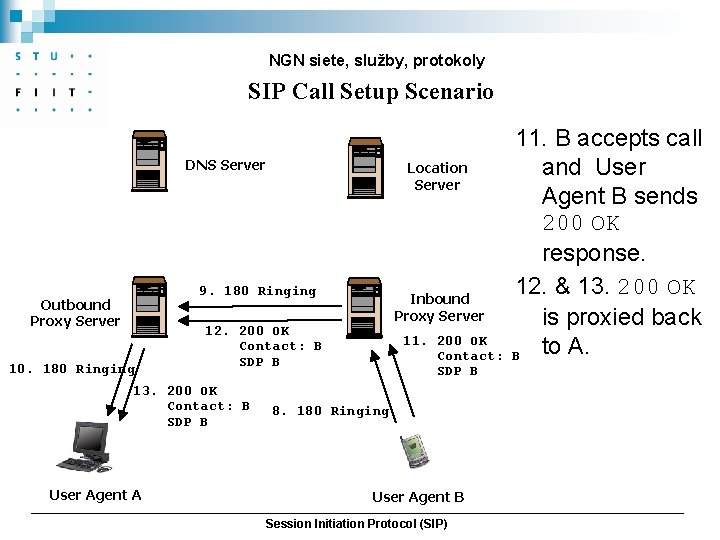
NGN siete, služby, protokoly SIP Call Setup Scenario DNS Server Location Server 9. 180 Ringing Outbound Proxy Server 10. 180 Ringing 12. 200 OK Contact: B SDP B 13. 200 OK Contact: B SDP B User Agent A Inbound Proxy Server 11. 200 OK Contact: SDP B 8. 180 Ringing User Agent B Session Initiation Protocol (SIP) 11. B accepts call and User Agent B sends 200 OK response. 12. & 13. 200 OK is proxied back B to A.
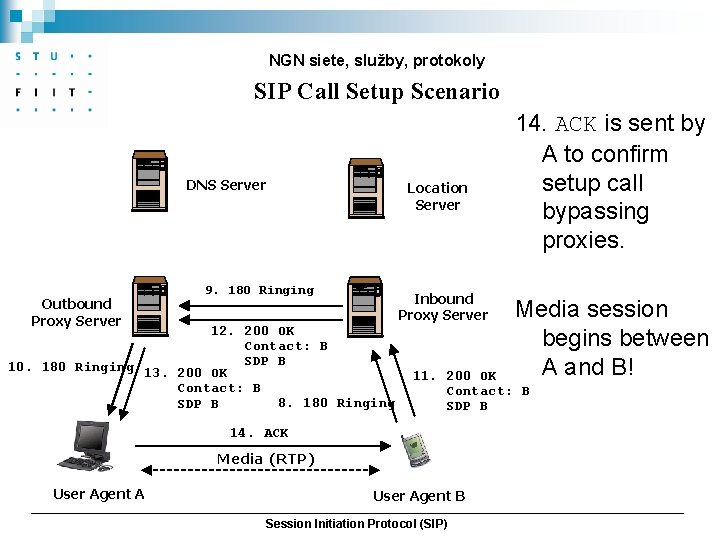
NGN siete, služby, protokoly SIP Call Setup Scenario DNS Server Outbound Proxy Server Location Server 9. 180 Ringing 12. 200 OK Contact: B 10. 180 Ringing 13. 200 OK SDP B Contact: B 8. 180 Ringing SDP B Inbound Proxy Server Media session begins between A and B! 11. 200 OK Contact: B SDP B 14. ACK Media (RTP) User Agent A 14. ACK is sent by A to confirm setup call bypassing proxies. User Agent B Session Initiation Protocol (SIP)
NGN siete, služby, protokoly For More Information IETF: ¨ IETF home page http: //www. ietf. org/ ¨ Internet-draft search engine http: //search. ietf. org/search/brokers/internet-drafts/query. html ¨ RFC search engine http: //www. rfc-editor. org/rfcsearch. html ¨ Megaco WG charter http: //ietf. org/html. charters/megaco-charter. html ¨ Megaco documents repository ftp: //standards. nortelnetworks. com/megaco/docs/latest/ ITU: ¨ ITU home page http: //www. itu. int/ITU-T/index. html ¨ SG-16 document repository (H. 323, H. 248) ftp: //standard. pictel. com/avc-site ¨ Most Megaco/H. 248 related documents should Megaco WG, above also be available through Session Initiation Protocol (SIP)
- Slides: 41