
NGA Project Review and Status Norm Abrahamson NGA
NGA Project Review and Status Norm Abrahamson NGA Workshop #5 March, 2004
Developer Scope • Ground Motion Model (median, standard dev) – Ground Motion Parameters: • Horizontal components (Ave Horiz, FN, and FP) • PGA, PGV, PGD • Pseudo spectral acc at 5% damping: 0 -10 sec – Applicable Magnitude Range: • 5. 0 - 8. 5 (SS) • 5. 0 - 8. 0 (RV) – Applicable Distance Range: • 0 - 200 km – Fault Types • Strike-slip, Reverse, Normal – Site Classification Scheme • Developers select their preferred classification scheme • Need not include soft-soil
Developer Scope (cont) • Ground Motion Data Set – Common data set provided to developers – Each developer selects applicable subset of data • Justify the exclusion of earthquakes and recording sites • Document any modification of independent parameters from PEER recommended values • Ground motion values are not modified (e. g. common set used by all developers), but developers select applicable period range of each recording – Final selected data to be listed in report
Developer Scope (cont) • Evaluate new predictive parameters – – – Directivity parameters Hanging wall / foot wall Static stress-drop Asperity depth Depth to bedrock (or Vs) Basin parameters • Each developer decides if new predictive parameter is to be included in their model – Justify the selection or rejection of each parameter evaluated
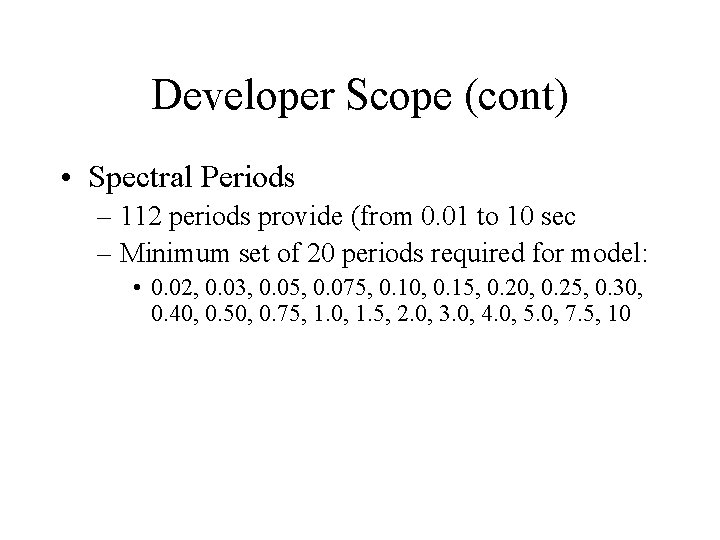
Developer Scope (cont) • Spectral Periods – 112 periods provide (from 0. 01 to 10 sec – Minimum set of 20 periods required for model: • 0. 02, 0. 03, 0. 05, 0. 075, 0. 10, 0. 15, 0. 20, 0. 25, 0. 30, 0. 40, 0. 50, 0. 75, 1. 0, 1. 5, 2. 0, 3. 0, 4. 0, 5. 0, 7. 5, 10
Developer Scope (cont) • Magnitude definition – All developers use moment magnitude • Distance definition – Developers select appropriate distance metric • Site classification – Developers select site classification • Clear definition of site classes – Provide a translation scheme to NERHP categories
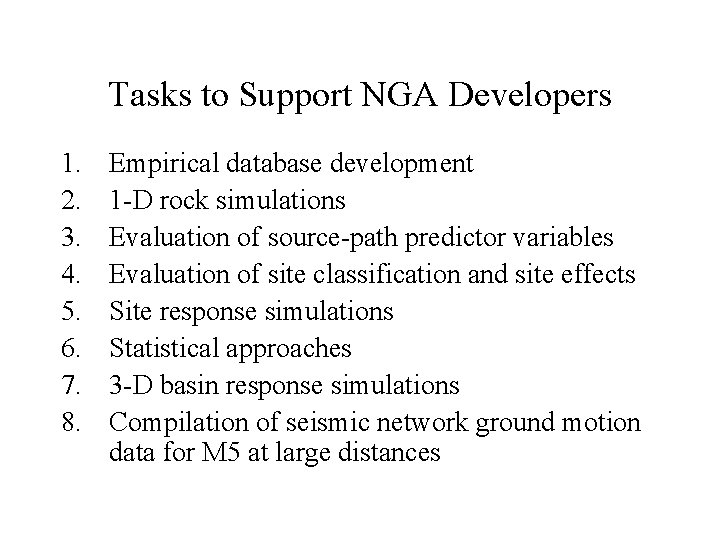
Tasks to Support NGA Developers 1. 2. 3. 4. 5. 6. 7. 8. Empirical database development 1 -D rock simulations Evaluation of source-path predictor variables Evaluation of site classification and site effects Site response simulations Statistical approaches 3 -D basin response simulations Compilation of seismic network ground motion data for M 5 at large distances
Working Groups 1. 2. 3. 4. 5. 6. Data Processing Ground Motion Database Validation of 1 -D Rock Motion Simul Source/Path Effects Site Classification & Site Effects Statistical Modeling of Data

NGA Tasks and Associated WGs Task Working Group 1. Database development WG#1 data proc WG#2 Database WG#4 Source/Path WG#5 Site Classification 2. 1 -D rock Simulation WG#3 Valid of 1 -D simulations WG#4 Source/Path 3. Evaluation source/Path Effects WG#4 Source/Path 4. Evaluation of site classification WG#5 Site Classification 5. Site Response Simulations WG#5 Site Classification 6. Statistical Approaches WG#6 Statistical Modeling 7. 3 -D basin Simulations WG#4 Source/Path WG#5 Site Classification 8. Network Data WG#4 Source/Path
Task 1 Empirical Database Development • Metadata – Version 1 released in November • Source and path parameters review by Somerville (complete) • Site parameters review by Wells (not complete) – Modifications • Incorporate review comments • Next version due April 23 • Includes rotations to FN and FP
Task 1 (cont) Empirical Database Development • Ground Motion Values – Evaluation of adequacy of processing in progress (comparison of PEER Sa values with CSMIP and USGS Sa values) – WG #1 • Meeting held March 17 • Summary to be given by Abrahamson – Evaluation of treatment of permanent displacements (fling step) – WG#1 • Update to be given by Graves
Task 2 1 -D Rock Motion Simulation • Validations – URS, Silva, Zeng (not complete) – Update to be presented • Simulations – Strike-slip scenarios • URS complete, Zeng nearly complete (missing SJ) • Silva results preliminary (to be updated) – Reverse-slip scenarios • URS complete, Zeng (7 events complete) • Silva results due March 31
Task 3 Evaluation of Source-Path Predictor Variables • Review of Metadata by WG#4 – Source and travel path parameters • Review completed (Somerville) • WG#4 – 1 -D rock simulations • Updated scaling results to be shown (Abrahamson) • Directivity model using Isochrons – Spudich working on model refinements – 3 -D basin simulations(mtg held Mar 5) • Scale factors to be discussed by Steve Day
Task 4 Evaluation of Site Classification and Site Effects • Review of Metadata (WG#5) – Recording site classification – Structure (building) classification – Review by Wells to be completed April 2 • Review alternative site classification schemes and functional forms for site effects (WG#5) – Evaluate site response simulations and empirical data • Develop method for translations among different site classification schemes (WG#5) – Not started
Task 5 Site Response Simulations • Simulation method – RASCALS with soil randomization • Simulations – Previous PEER-LL and NEHRP studies (Silva) – Augment previous simulations • Identify additional cases needed (April 5) • Results in May • Sensitivity analysis – Comparisons with RASCAL, SHAKE, and Non-linear models • Completed. To be shown by Sun
Task 6 Statistical Approaches • Issues (WG#6) – Review of alternative methods • Weights, two-step, random effects, … – Spatial correlation of ground motion – Correlation of spectra at different frequencies – Standard deviation • Dependence on magnitude, distance, and soil type – Incorporating measurement errors in predictor variables – Missing predictor variables – Censored data (non-triggered stations) – Combining empirical and simulated data in regression analyses (NGA-H) • WG#6 held initial meeting – Scope of work identified • WG#6 recommendations in May
Task 7 3 -D Bain Simulations • Program verification completed • Simulations completed • Evaluation of results – Will be presented Thursday
Task 8 Network Data Evaluation • Evaluation of attenuation at large distances using network data – Complete – Presented by Boatwright in WS#4
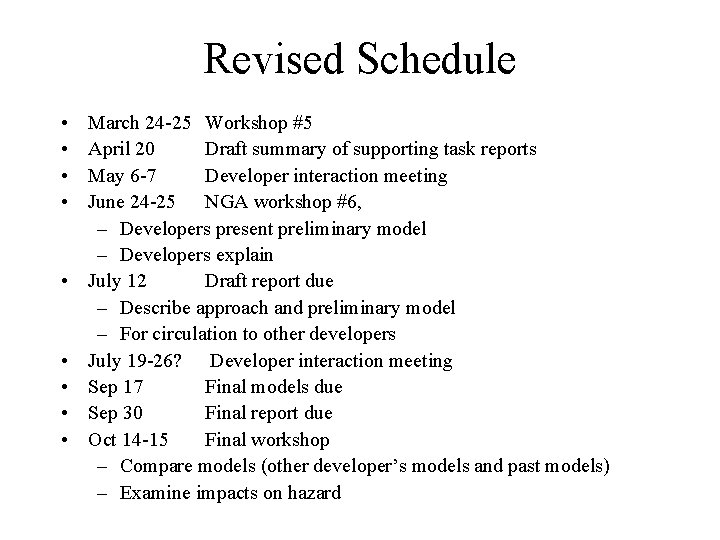
Revised Schedule • • • March 24 -25 Workshop #5 April 20 Draft summary of supporting task reports May 6 -7 Developer interaction meeting June 24 -25 NGA workshop #6, – Developers present preliminary model – Developers explain July 12 Draft report due – Describe approach and preliminary model – For circulation to other developers July 19 -26? Developer interaction meeting Sep 17 Final models due Sep 30 Final report due Oct 14 -15 Final workshop – Compare models (other developer’s models and past models) – Examine impacts on hazard
NGA Reports • Data Report – Documentation of data set in flat file • Resource Report – Documentation of results from supporting tasks and working groups • NGA Ground Motion Report – Documentation of the developers models • Summary, Overview, and Impacts
Data Report • Metadata – Documentation of magnitudes, source geometries, site conditions, distances, directivity parameters, HW/FW, etc • Ground motion processing – Causal vs acausal – Filter corners – Fling step removal • QA Efforts – Reviews of metadata and response spectra
Resource Report • • Working Group Activities Scaling factors based on 1 -D rock simulations Basin scaling factors based on 3 -D simulations Directivity functional form based on Isochron Site response amplification factors Attenuation rates from network data Statistical approaches
NGA Ground Motion Model Report • Synthesis of developer’s models • Model report from each developer • Fling step model – (for adding fling back into ground motion)
Summary and Impacts • General report summarizing NGA project • Focus on impacts of new models – How do the new models effects the design ground motions for future projects?
- Slides: 24