
NFPA 285 Assembly Test of Exterior Walls with
NFPA 285: Assembly Test of Exterior Walls with Combustible Components
AIA/CES LU Learning Objectives Understand the Impact of the NFPA 285 Test in Relation to the International Building Code Apply the NFPA 285 Assembly Test Components and Parameters to Successful Test Performance Identify Combustible Components in a Noncombustible Wall Assembly that Trigger NFPA 285 Testing Design Building Envelope Systems as Part of NFPA 285 Compliant Assembly Variations

Section 1: Impact of the NFPA 285 Test and the International Building Code (IBC)

SECTION 1 Construction Types (IBC ch 5, 6) Combustible Non. Combustible Type V Combustible Construction Type IV Heavy Timber Construction Type III Non-Combustible Exterior Type II Non-Combustible Exterior and Components Type I Non-Combustible Materials and Structure - Each Type has an “A” and a “B” sub-category - “A” has increased fire protection requirements

SECTION 1 Construction Types Examples http: //desource. uvu. edu/ctc/iaco_01. php Fitzgerald's Heavy Timber Construction, Inc. , 2006 Mark Martin @ http: //www. houstonrealestateobserver. com Type V Type IV Combustible Non-Combus Wikimedia Commons, © Daniel Schwen Type III Type II Firefightersenemy. com, dc 802

SECTION 1 Maximum Building Height (IBC Table 503) Including 1 -story sprinkler system increase Source: 2012 International Building Code

SECTION 1 IBC Fire Related Tests and Reports Product Properties ASTM E 84 Surface Burning Characteristics ASTM E 1354 Cone Calorimeter Test ICC ES Reports (compliance aid, not a test method) Assembly Properties ASTM E 119 or UL 263 Fire Rated Walls NFPA 268 Radiant Ignitibility of Assemblies NFPA 285 Walls With Combustible Components
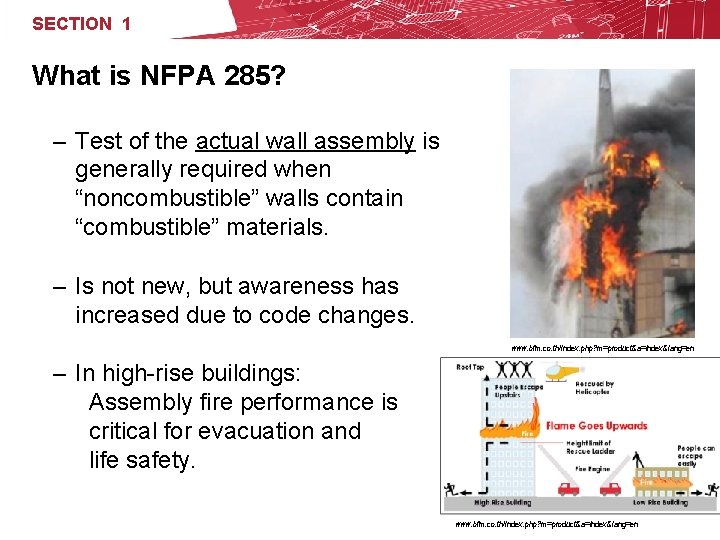
SECTION 1 What is NFPA 285? – Test of the actual wall assembly is generally required when “noncombustible” walls contain “combustible” materials. – Is not new, but awareness has increased due to code changes. www. bfm. co. th/index. php? m=product&a=index&lang=en – In high-rise buildings: Assembly fire performance is critical for evacuation and life safety. 8 www. bfm. co. th/index. php? m=product&a=index&lang=en

SECTION 1 History of NFPA 285 Energy Crisis: Leads to increased exterior insulation applications 1970’s 1988: 1997: 2000: Uniform Building IBC begins Code adopts requiring NFPA UBC 17 -6 UBC 26 -9 285 testing 1980’s 1990’s 2000’s 2010’s Late 70’s: 1998: 2012: SPI develops full -scale test NFPA adopts UBC 26 -9 as NFPA 285 IBC expands NFPA 285 testing to WRB Full-scale Fire Test UBC 17 -6 / UBC 26 -4 Reduced-scale Fire Test UBC 26 -9 / NFPA 285 Source: “NFPA 285: What you Need to Know” by Jesse J. Beitel – JBED Summer 2012 issue

SECTION 1 IBC NFPA 285 Testing - Material Triggers • Foam Plastic Insulation (Ch. 26) • • • Applies to Type I – IV construction (~1988) Applies to buildings of any height Combustible Exterior Cladding (Ch. 14) • • EIFS - (~2000 IBC) MCMs - (~2003 IBC) FRPs - (~2009 IBC) HPLs - (~2012 IBC) • Water-Resistive Barriers (Ch. 14) • • Applies to Type I, III, IV buildings over 40 ft Applies to combustible WRB’s - (2012 IBC) REQUIRED
Section 2: NFPA 285 Components and Parameters to Successful Test Performance

SECTION 2 NFPA 285 Multi-Story Test 2 Story Test with Interior & Exterior Burners Architectural Testing, Inc. – Informational Bulletin # 61
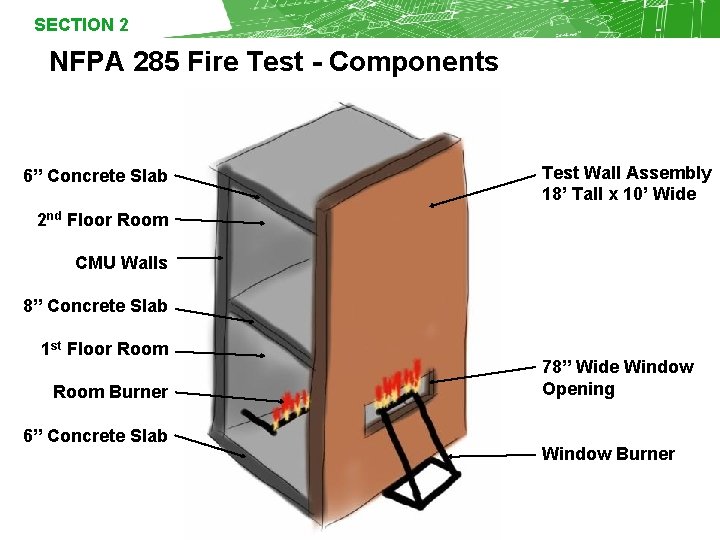
SECTION 2 NFPA 285 Fire Test - Components 6” Concrete Slab Test Wall Assembly 18’ Tall x 10’ Wide 2 nd Floor Room CMU Walls 8” Concrete Slab 1 st Floor Room Burner 6” Concrete Slab 78” Wide Window Opening Window Burner
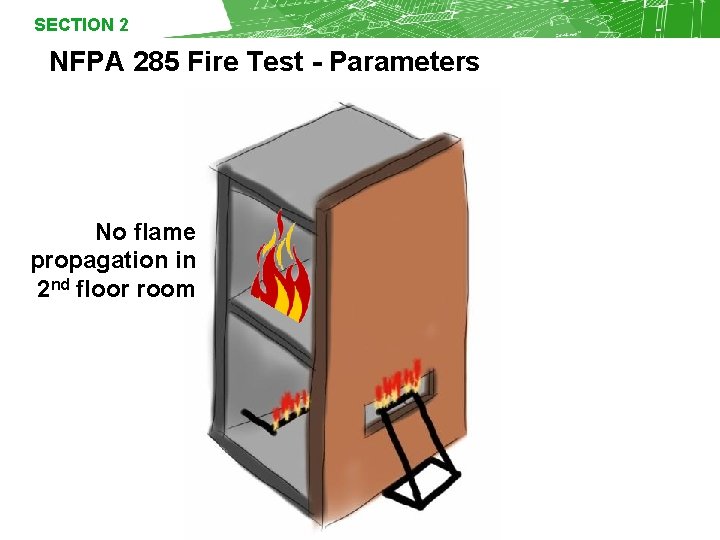
SECTION 2 NFPA 285 Fire Test - Parameters No flame propagation in 2 nd floor room
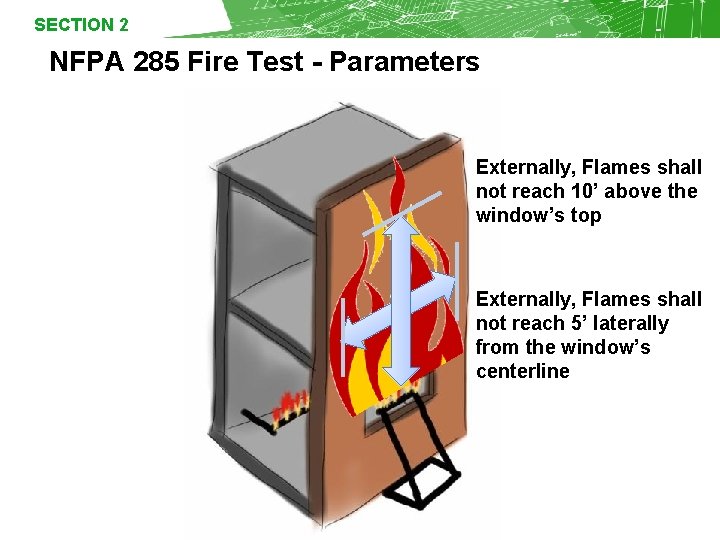
SECTION 2 NFPA 285 Fire Test - Parameters Externally, Flames shall not reach 10’ above the window’s top Externally, Flames shall not reach 5’ laterally from the window’s centerline

SECTION 2 NFPA 285 Fire Test - Parameters . . . Inside wall assembly, Thermocouples shall not exceed 1000 ºF during the test.

Section 3: Combustible Components in a Noncombustible Wall Assembly

SECTION 3 Building Envelope Assembly Components Interior Drywall Vapor Barrier* Exterior Sheathing Cavity Insulation Air & Water Barrier Base Wall Structure Exterior Insulation Exterior Cladding * Vapor Barrier’s use and location in the wall is climate specific
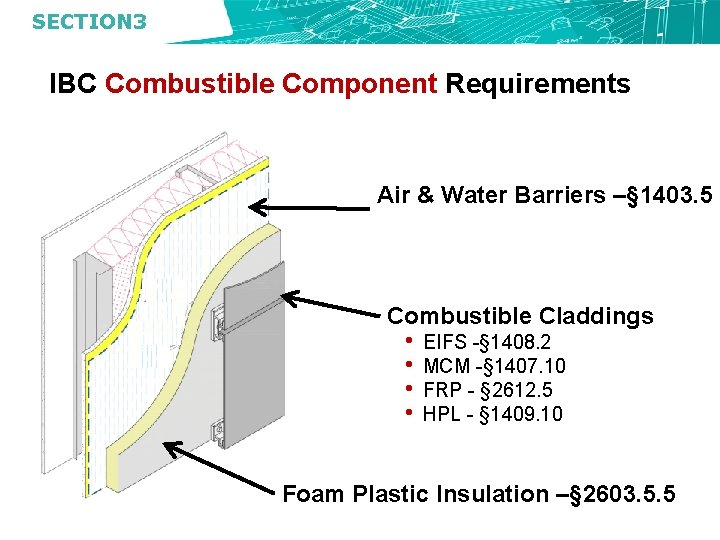
SECTION 3 IBC Combustible Component Requirements Air & Water Barriers –§ 1403. 5 Combustible Claddings • • EIFS -§ 1408. 2 MCM -§ 1407. 10 FRP - § 2612. 5 HPL - § 1409. 10 Foam Plastic Insulation –§ 2603. 5. 5

SECTION 3 IBC Combustible Component Requirements • Foam Plastic Insulation • Combustible Claddings (EIFS, MCM, FRP, HPL) • Air & Water Barriers Design Conditions Requiring NFPA 285 • Installations over 40’ (Type I, III, or IV) • “Foam Plastic” and “Foam Plastic” core materials

SECTION 3 IBC NFPA 285 Testing Requirements Is FOAM PLASTIC Insulation in the exterior wall assembly? YES REQUIRED NO YES Non-Combustible Construction Types I, III, or IV? (Per Commercial Building Code, IBC) Is EXTERIOR CLADDING Combustible? AND Installed greater than 40’ above grade YES NO Is WRB* Combustible? NO NO AND Installed greater than 40’ above grade YES *PER 2012 IBC REVISION, EXCEPTIONS APPROVED FOR 2015 IBC RELEASE NFPA 285 Compliance NOT REQUIRED

SECTION 3 IBC Combustible Component Requirements • Foam Plastic Insulation • Combustible Claddings (EIFS, MCM, FRP, HPL) • Air & Water Barriers Material Requirements, IBC Type I-IV Taller than 40’ • • • Products are Labeled and Identified by manufacturer Flame Spread Index ≤ 25 (ASTM E 84) Class A Smoke Development Index ≤ 450 (ASTM E 84) Maintain assembly fire rating (ASTM E 119 or UL 263) Separated from interior by a Thermal Barrier (gyp. bd)
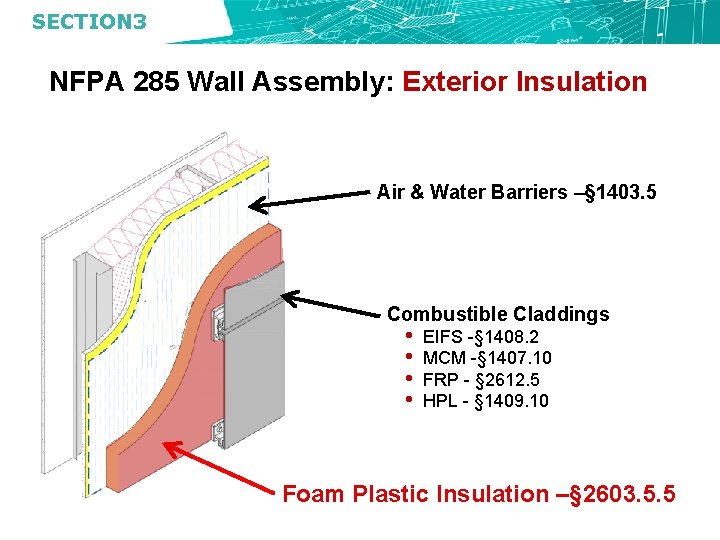
SECTION 3 NFPA 285 Wall Assembly: Exterior Insulation Air & Water Barriers –§ 1403. 5 Combustible Claddings • • EIFS -§ 1408. 2 MCM -§ 1407. 10 FRP - § 2612. 5 HPL - § 1409. 10 Foam Plastic Insulation –§ 2603. 5. 5

SECTION 3 Climate Zones & Continuous Insulation Requirement's Increasing Mandatory use of Continuous Insulation (ci) in EVERY climate zone ASHRAE 90. 1 2010

SECTION 3 Impact of Thermal Bridging 24” o. c. 16” o. c. on Effective Installed R-Value for Steel-Framed Walls
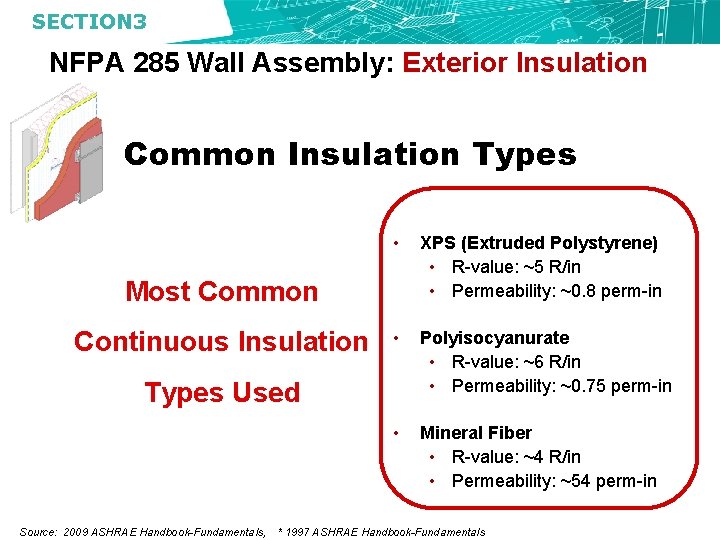
SECTION 3 NFPA 285 Wall Assembly: Exterior Insulation Common Insulation Types • Glass Fiber Batt – R-value: ~3. 3 R/in – Permeability: 118 perm-in • XPS (Extruded Polystyrene) • R-value: ~5 R/in • Permeability: ~0. 8 perm-in • Polyisocyanurate • R-value: ~6 R/in • Permeability: ~0. 75 perm-in • Mineral Fiber • R-value: ~4 R/in • Permeability: ~54 perm-in Most Common • Spray Polyurethane Foam Continuous Insulation – R-value: ~6 R/in (high density)* – Permeability: ~1. 9 perm-in Types Used • EPS (Expanded Polystyrene) – R-value: ~4 R/in – Permeability: ~2. 7 perm-in Source: 2009 ASHRAE Handbook-Fundamentals, * 1997 ASHRAE Handbook-Fundamentals
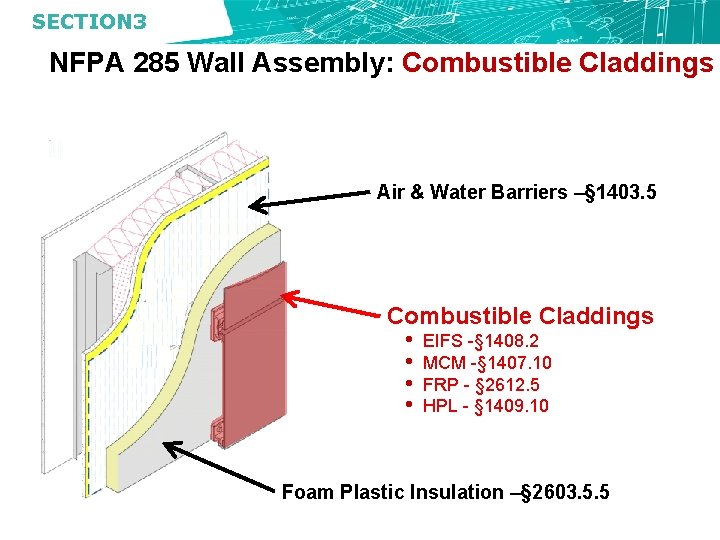
SECTION 3 NFPA 285 Wall Assembly: Combustible Claddings Air & Water Barriers –§ 1403. 5 Combustible Claddings • EIFS -§ 1408. 2 • MCM -§ 1407. 10 • FRP - § 2612. 5 • HPL - § 1409. 10 Foam Plastic Insulation –§ 2603. 5. 5
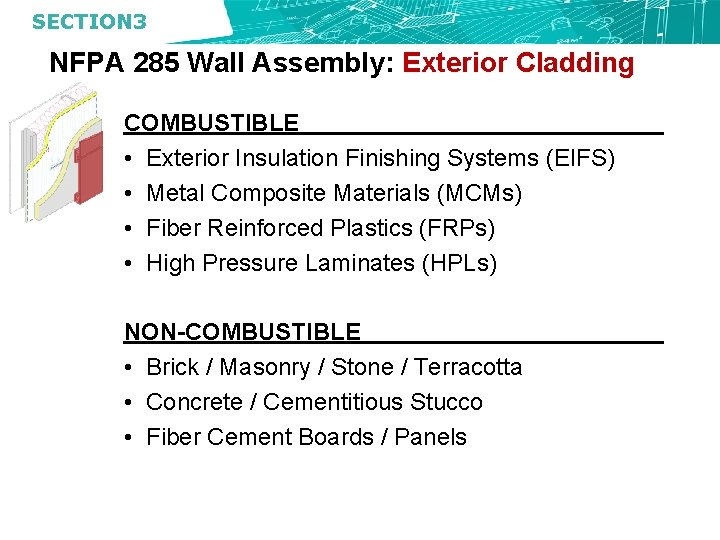
SECTION 3 NFPA 285 Wall Assembly: Exterior Cladding COMBUSTIBLE • Exterior Insulation Finishing Systems (EIFS) • Metal Composite Materials (MCMs) • Fiber Reinforced Plastics (FRPs) • High Pressure Laminates (HPLs) NON-COMBUSTIBLE • Brick / Masonry / Stone / Terracotta • Concrete / Cementitious Stucco • Fiber Cement Boards / Panels
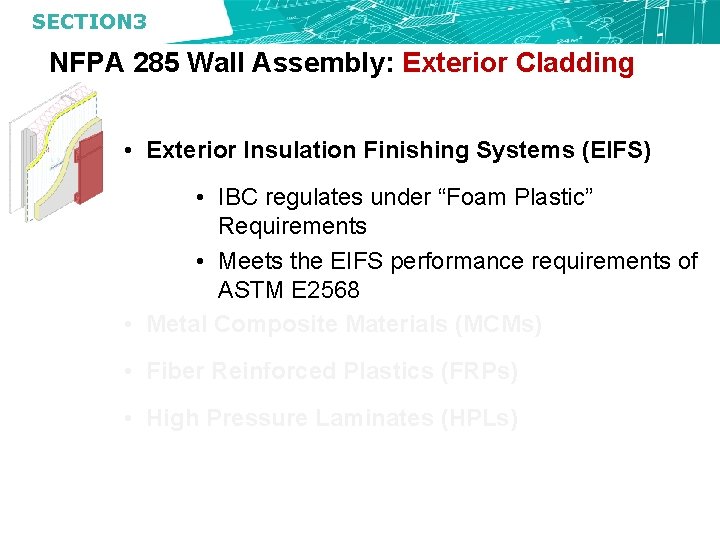
SECTION 3 NFPA 285 Wall Assembly: Exterior Cladding • Exterior Insulation Finishing Systems (EIFS) • IBC regulates under “Foam Plastic” Requirements • Meets the EIFS performance requirements of ASTM E 2568 • Metal Composite Materials (MCMs) • Fiber Reinforced Plastics (FRPs) • High Pressure Laminates (HPLs)

SECTION 3 NFPA 285 Wall Assembly: Exterior Cladding • Exterior Insulation Finishing Systems (EIFS) • Metal Composite Materials (MCMs) • Excludes “Foam Plastic” core materials • Different core materials have different fire performance characteristics • Available in Open and Closed Joint Systems • Approximate 4 mm-12 mm panel thickness • Fiber Reinforced Plastics (FRPs) • High Pressure Laminates (HPLs)
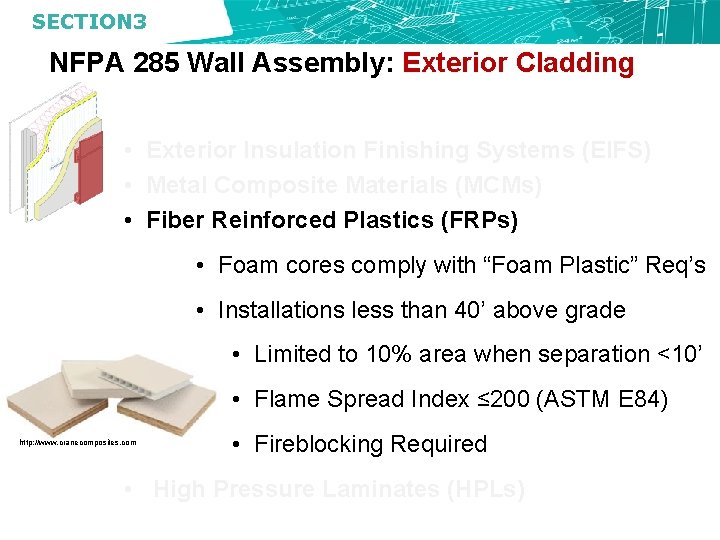
SECTION 3 NFPA 285 Wall Assembly: Exterior Cladding • Exterior Insulation Finishing Systems (EIFS) • Metal Composite Materials (MCMs) • Fiber Reinforced Plastics (FRPs) • Foam cores comply with “Foam Plastic” Req’s • Installations less than 40’ above grade • Limited to 10% area when separation <10’ • Flame Spread Index ≤ 200 (ASTM E 84) http: //www. cranecomposites. com • Fireblocking Required • High Pressure Laminates (HPLs)
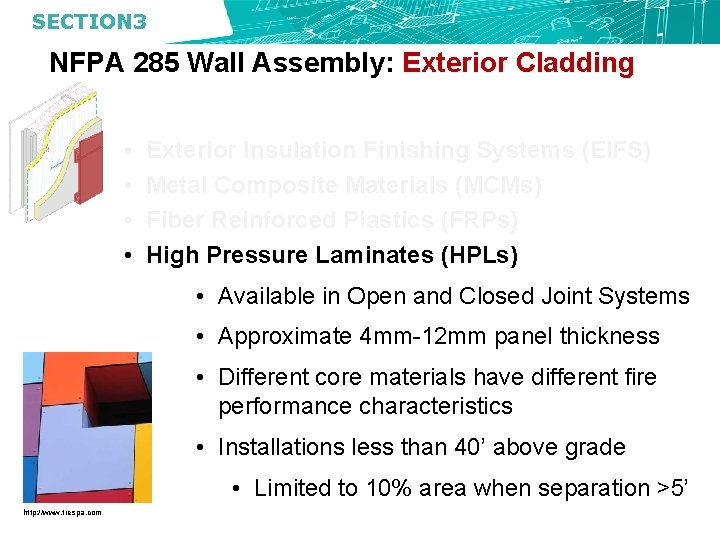
SECTION 3 NFPA 285 Wall Assembly: Exterior Cladding • • Exterior Insulation Finishing Systems (EIFS) Metal Composite Materials (MCMs) Fiber Reinforced Plastics (FRPs) High Pressure Laminates (HPLs) • Available in Open and Closed Joint Systems • Approximate 4 mm-12 mm panel thickness • Different core materials have different fire performance characteristics • Installations less than 40’ above grade • Limited to 10% area when separation >5’ http: //www. trespa. com

SECTION 3 NFPA 285 Wall Assembly: Air & Water Barriers –§ 1403. 5 Combustible Claddings • • EIFS -§ 1408. 2 MCM -§ 1407. 10 FRP - § 2612. 5 HPL - § 1409. 10 Foam Plastic Insulation –§ 2603. 5. 5
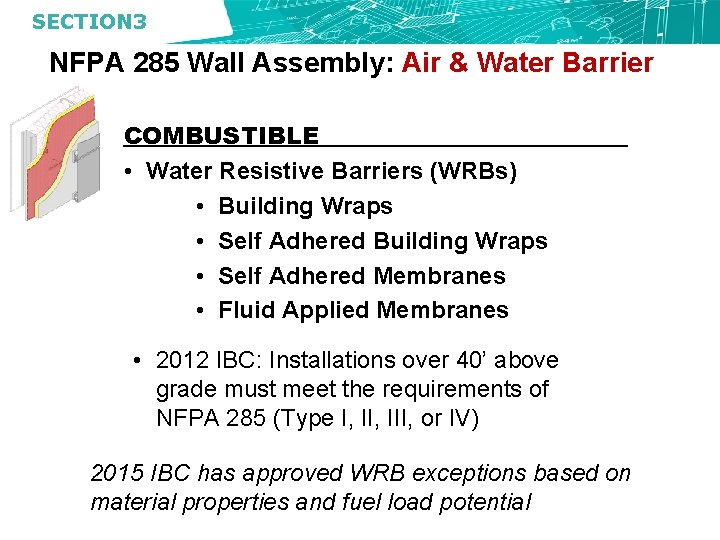
SECTION 3 NFPA 285 Wall Assembly: Air & Water Barrier COMBUSTIBLE • Water Resistive Barriers (WRBs) • Building Wraps • Self Adhered Membranes • Fluid Applied Membranes • 2012 IBC: Installations over 40’ above grade must meet the requirements of NFPA 285 (Type I, III, or IV) 2015 IBC has approved WRB exceptions based on material properties and fuel load potential
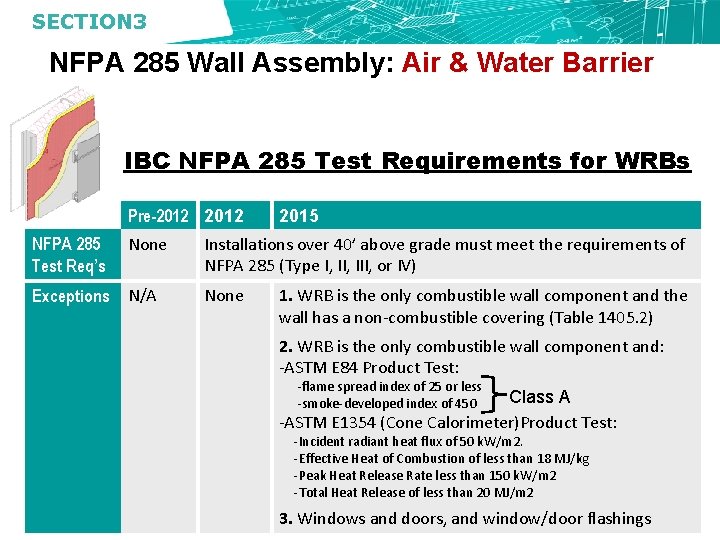
SECTION 3 NFPA 285 Wall Assembly: Air & Water Barrier IBC NFPA 285 Test Requirements for WRBs Pre-2012 NFPA 285 Test Req’s None Exceptions N/A 2015 Installations over 40’ above grade must meet the requirements of NFPA 285 (Type I, III, or IV) None 1. WRB is the only combustible wall component and the wall has a non-combustible covering (Table 1405. 2) 2. WRB is the only combustible wall component and: -ASTM E 84 Product Test: -flame spread index of 25 or less -smoke-developed index of 450 Class A -ASTM E 1354 (Cone Calorimeter)Product Test: -Incident radiant heat flux of 50 k. W/m 2. -Effective Heat of Combustion of less than 18 MJ/kg -Peak Heat Release Rate less than 150 k. W/m 2 -Total Heat Release of less than 20 MJ/m 2 3. Windows and doors, and window/door flashings

Section 4: Building Envelope Systems Part of NFPA 285 Compliant Assemblies
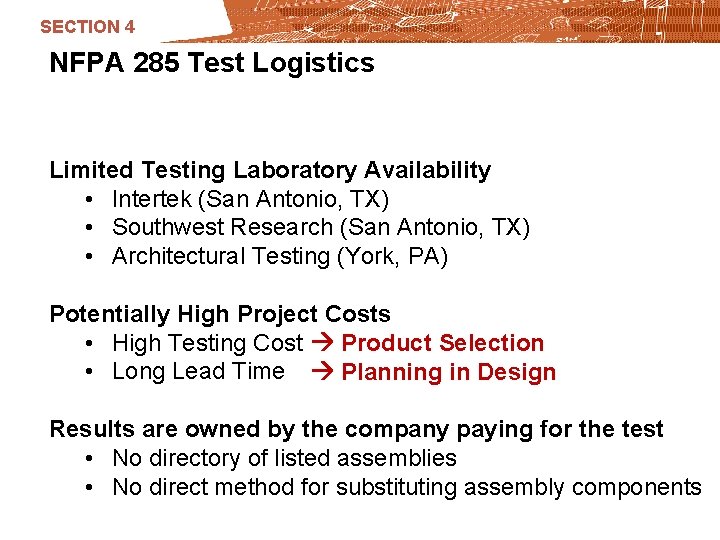
SECTION 4 NFPA 285 Test Logistics Limited Testing Laboratory Availability • Intertek (San Antonio, TX) • Southwest Research (San Antonio, TX) • Architectural Testing (York, PA) Potentially High Project Costs • High Testing Cost Product Selection • Long Lead Time Planning in Design Results are owned by the company paying for the test • No directory of listed assemblies • No direct method for substituting assembly components
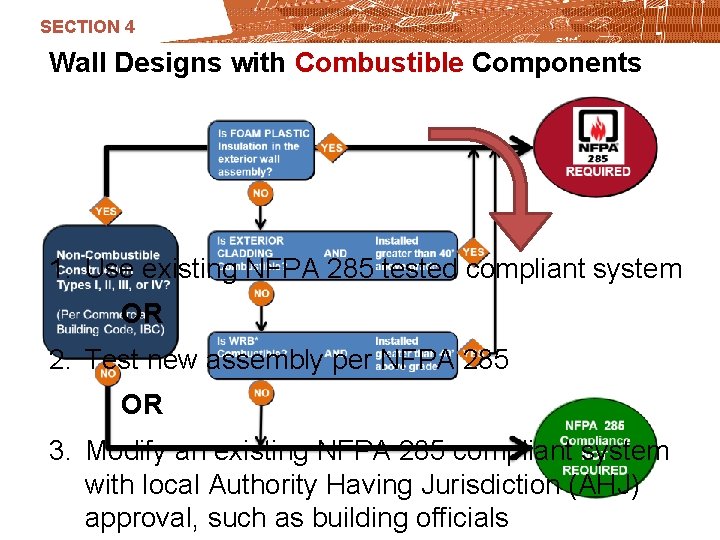
SECTION 4 Wall Designs with Combustible Components 1. Use existing NFPA 285 tested compliant system OR 2. Test new assembly per NFPA 285 OR 3. Modify an existing NFPA 285 compliant system with local Authority Having Jurisdiction (AHJ) approval, such as building officials
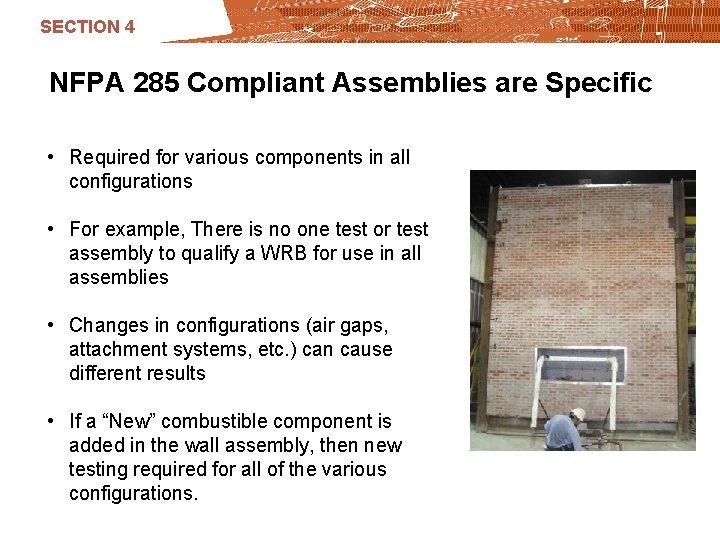
SECTION 4 NFPA 285 Compliant Assemblies are Specific • Required for various components in all configurations • For example, There is no one test or test assembly to qualify a WRB for use in all assemblies • Changes in configurations (air gaps, attachment systems, etc. ) can cause different results • If a “New” combustible component is added in the wall assembly, then new testing required for all of the various configurations.
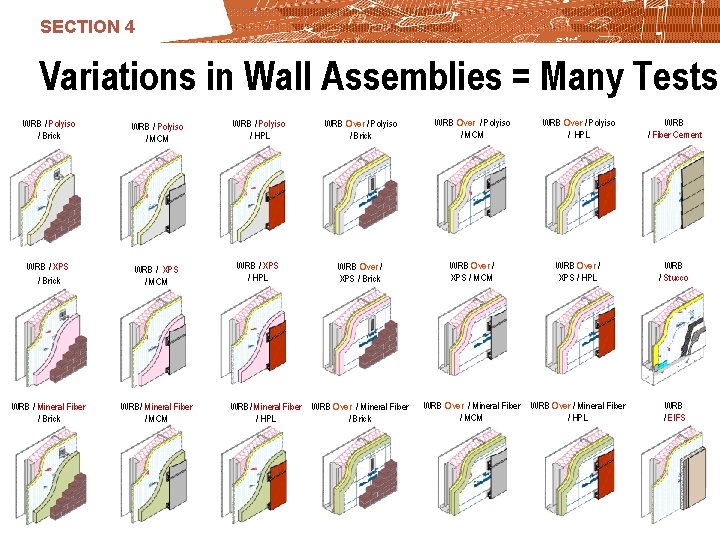
SECTION 4 Variations in Wall Assemblies = Many Tests WRB / Polyiso / Brick WRB / Polyiso / MCM WRB / Polyiso / HPL WRB Over / Polyiso / Brick WRB Over / Polyiso / MCM WRB Over / Polyiso / HPL WRB / Fiber Cement WRB / XPS / Brick WRB / XPS / MCM WRB / XPS / HPL WRB Over / XPS / Brick WRB Over / XPS / MCM WRB Over / XPS / HPL WRB / Stucco WRB / Mineral Fiber / Brick WRB/ Mineral Fiber / MCM WRB Over / Mineral Fiber / HPL WRB / EIFS WRB/ Mineral Fiber WRB Over / Mineral Fiber / HPL / Brick
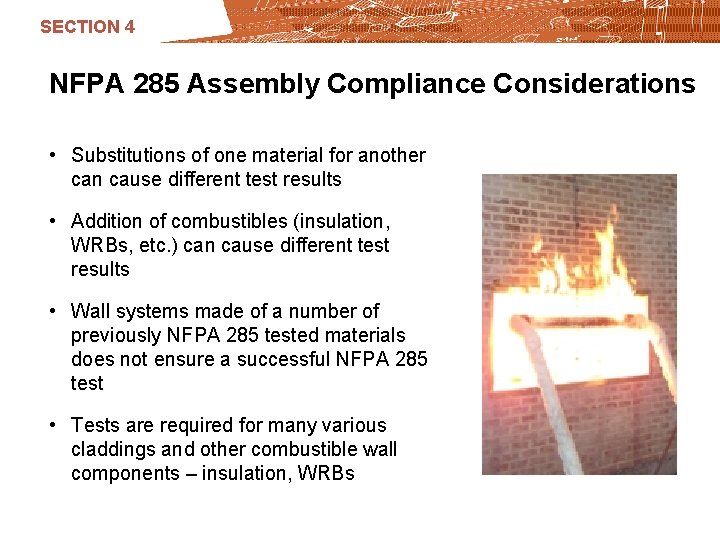
SECTION 4 NFPA 285 Assembly Compliance Considerations • Substitutions of one material for another can cause different test results • Addition of combustibles (insulation, WRBs, etc. ) can cause different test results • Wall systems made of a number of previously NFPA 285 tested materials does not ensure a successful NFPA 285 test • Tests are required for many various claddings and other combustible wall components – insulation, WRBs
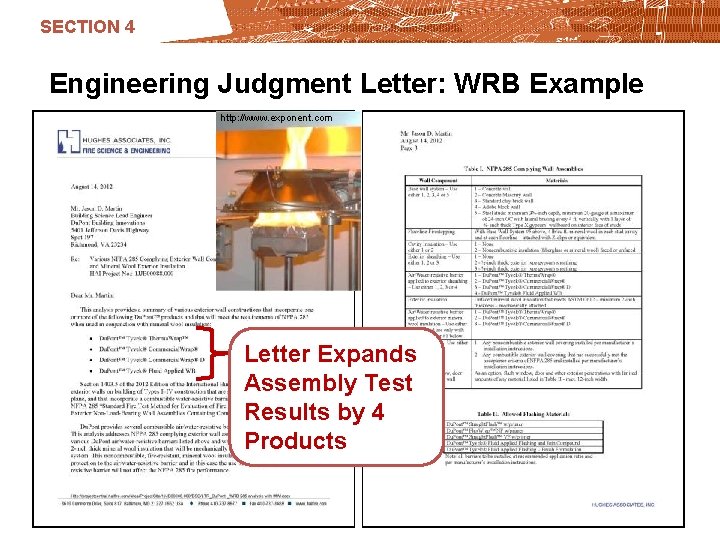
SECTION 4 Engineering Judgment Letter: WRB Example http: //www. exponent. com Letter Expands Assembly Test Results by 4 Products
AIA/CES LU Learning Objectives Understand the Impact of the NFPA 285 Test in Relation to the International Building Code Apply the NFPA 285 Components and Parameters to Successful Test Performance Identify Combustible Components in a Noncombustible Wall Assembly that Trigger NFPA 285 Testing Design Building Envelope Systems as Part of NFPA 285 Compliant Assembly Variations

AIA/CES LU This concludes the American Institute of Architects Continuing Education Systems Program Du. Pont Building Innovations ® ™ Du. Pont Tyvek Weatherization Systems
- Slides: 44