
Nextgeneration Channel Coding towards Terabits Wireless Communications Catherine
Next-generation Channel Coding towards Terabit/s Wireless Communications Catherine Douillard, IMT Atlantique on behalf of the EPIC partners The EPIC project has received funding from the European Union’s Horizon 2020 research and innovation programme under grant agreement No 760150. Enabling Technologies for sub-Tera. Hertz and Tera. Hertz communications Gd. R ISIS Workshop - 18 Sept. 2019 - Maisons-Alfort Enabling Practical Wireless Tb/s Communications with Next Generation Channel coding
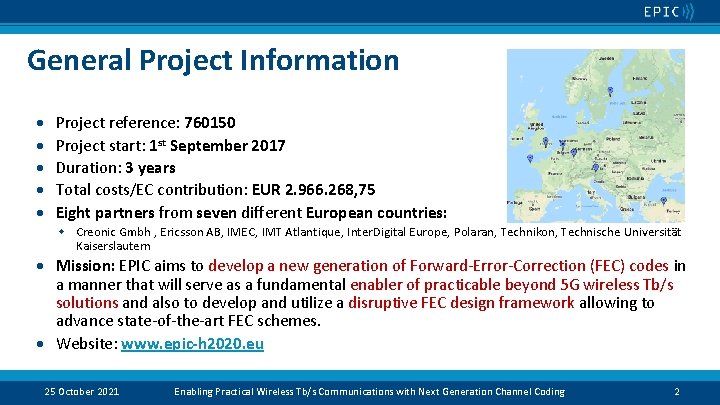
General Project Information • • • Project reference: 760150 Project start: 1 st September 2017 Duration: 3 years Total costs/EC contribution: EUR 2. 966. 268, 75 Eight partners from seven different European countries: w Creonic Gmbh , Ericsson AB, IMEC, IMT Atlantique, Inter. Digital Europe, Polaran, Technikon, Technische Universität Kaiserslautern • Mission: EPIC aims to develop a new generation of Forward-Error-Correction (FEC) codes in a manner that will serve as a fundamental enabler of practicable beyond 5 G wireless Tb/s solutions and also to develop and utilize a disruptive FEC design framework allowing to advance state-of-the-art FEC schemes. • Website: www. epic-h 2020. eu 25 October 2021 Enabling Practical Wireless Tb/s Communications with Next Generation Channel Coding 2
Project Goals • The EPIC consortium is dedicated to successfully reach the following objectives w Design and implementation of next generation FEC for wireless Tb/s technology and Beyond 5 G systems w Advancement of state-of-the-art channel codes and channel coding technology for wireless Tb/s technology w Holistic design approach that considers code design, decoding algorithms and efficient implementation on advanced silicon technologies in a cross-layer approach w Validation and demonstration of new FEC technology and corresponding implementations as virtual silicon tape-out using realistic use cases w Provide scientific excellence and contributions to wireless industry in the domain of B 5 G standardization and technology development 25 October 2021 Enabling Practical Wireless Tb/s Communications with Next Generation Channel Coding 3
Project methodology: phase 1 • Identification of relevant (B 5 G) Tb/s use-cases w Requiring new Forward Error Correction (FEC) coding techniques w Display a diverse set of FEC design challenges • Key Performance Indicator (KPI) analysis w System level requirements (error rate, throughput, latency, power consumption, cost and volume) FEC code level requirements (area, area efficiency, energy efficiency and power density) • Technology gap analysis w Comprehensive state-of-the-art study w Scaling to 7 nm CMOS technology w Comparison against FEC requirements 25 October 2021 Enabling Practical Wireless Tb/s Communications with Next Generation Channel Coding 4
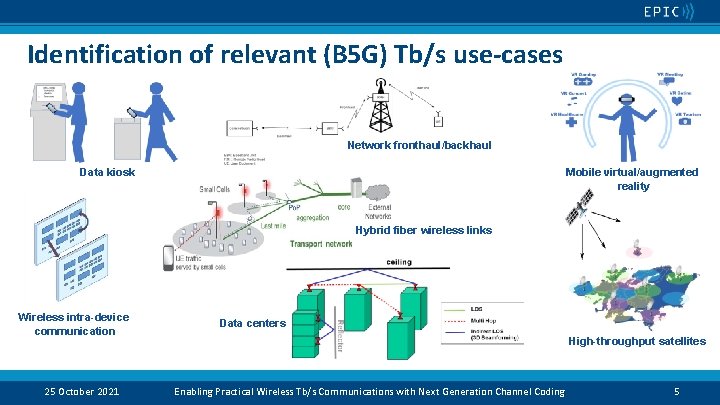
Identification of relevant (B 5 G) Tb/s use-cases Network fronthaul/backhaul Data kiosk Mobile virtual/augmented reality Hybrid fiber wireless links Wireless intra-device communication 25 October 2021 Data centers High-throughput satellites Enabling Practical Wireless Tb/s Communications with Next Generation Channel Coding 5
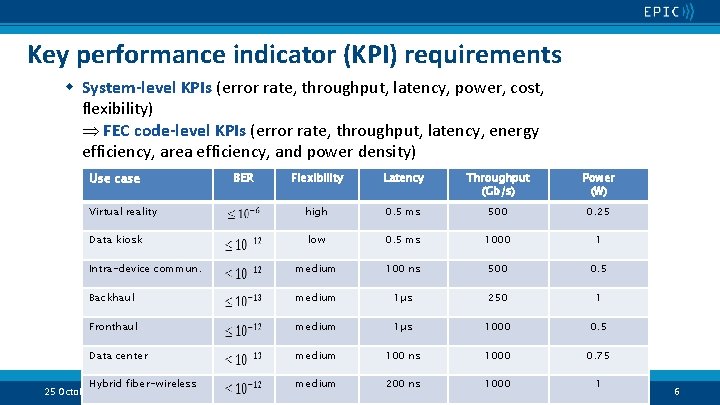
Key performance indicator (KPI) requirements w System-level KPIs (error rate, throughput, latency, power, cost, flexibility) FEC code-level KPIs (error rate, throughput, latency, energy efficiency, area efficiency, and power density) Use case BER Flexibility Latency Throughput (Gb/s) Power (W) Virtual reality high 0. 5 ms 500 0. 25 Data kiosk low 0. 5 ms 1000 1 Intra-device commun. medium 100 ns 500 0. 5 Backhaul medium 1µs 250 1 Fronthaul medium 1µs 1000 0. 5 Data center medium 100 ns 1000 0. 75 Hybrid fiber-wireless medium 200 ns 1000 25 October 2021 Enabling Practical Wireless Tb/s Communications with Next Generation Channel Coding 1 6
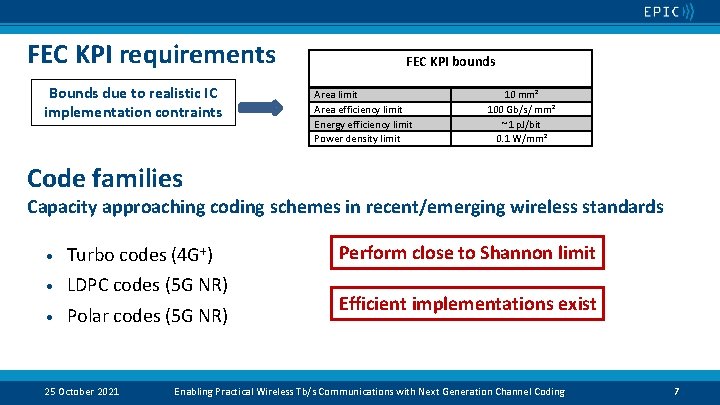
FEC KPI requirements Bounds due to realistic IC implementation contraints FEC KPI bounds Area limit Area efficiency limit Energy efficiency limit Power density limit 10 mm² 100 Gb/s/ mm² ~1 p. J/bit 0. 1 W/mm² Code families Capacity approaching coding schemes in recent/emerging wireless standards • Turbo codes (4 G+) • LDPC codes (5 G NR) • Polar codes (5 G NR) 25 October 2021 Perform close to Shannon limit Efficient implementations exist Enabling Practical Wireless Tb/s Communications with Next Generation Channel Coding 7
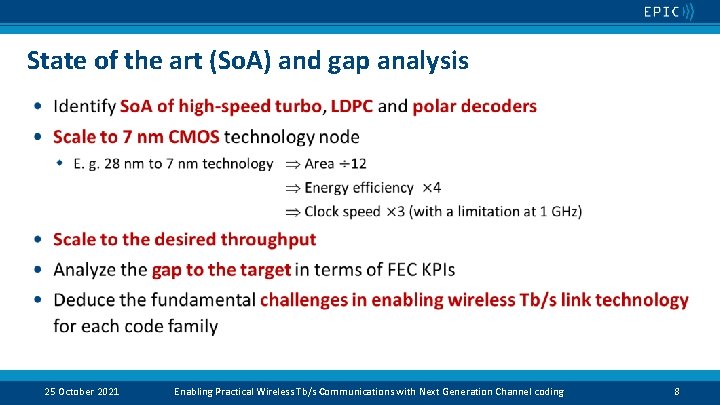
State of the art (So. A) and gap analysis 25 October 2021 Enabling Practical Wireless Tb/s Communications with Next Generation Channel coding 8
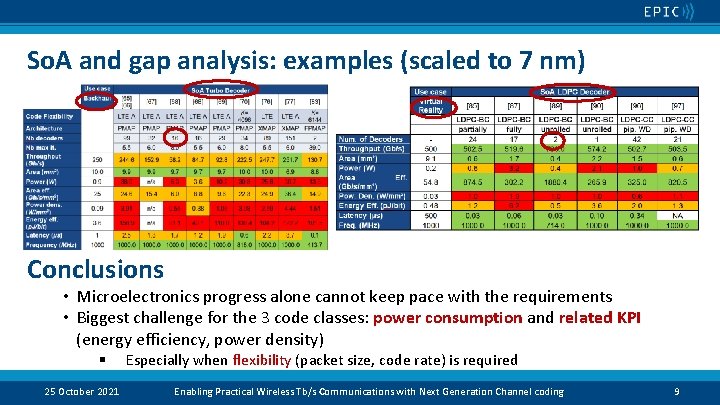
So. A and gap analysis: examples (scaled to 7 nm) Conclusions • Microelectronics progress alone cannot keep pace with the requirements • Biggest challenge for the 3 code classes: power consumption and related KPI (energy efficiency, power density) § 25 October 2021 Especially when flexibility (packet size, code rate) is required Enabling Practical Wireless Tb/s Communications with Next Generation Channel coding 9
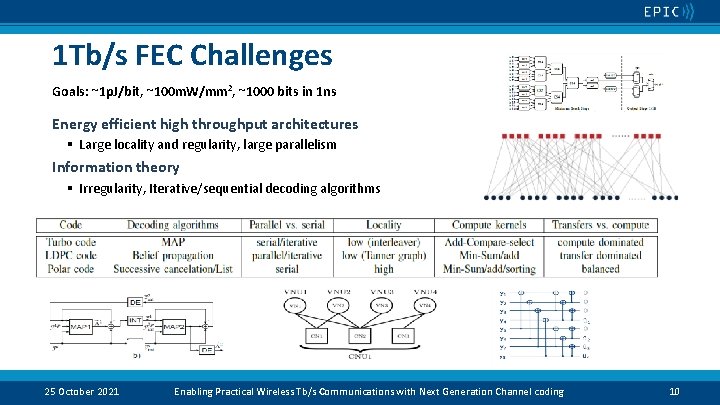
1 Tb/s FEC Challenges Goals: ~1 p. J/bit, ~100 m. W/mm 2, ~1000 bits in 1 ns Energy efficient high throughput architectures § Large locality and regularity, large parallelism Information theory § Irregularity, Iterative/sequential decoding algorithms 25 October 2021 Enabling Practical Wireless Tb/s Communications with Next Generation Channel coding 10
Bridging the gap between So. A and EPIC goals • Necessity to explore the interrelation between code structure, decoding algorithms, error correction performance and implementation • Deliver new code structures, decoding algorithms and architectures Design Space Exploration under EPIC KPIs w Set up design space for each code class w Prune the design space under EPIC KPI constraints w Select most promising candidates to derive new solutions to meet the 1 Tb/S challenges • Example: turbo codes w Turbo codes are the most challenging codes 25 October 2021 Enabling Practical Wireless Tb/s Communications with Next Generation Channel Coding 11
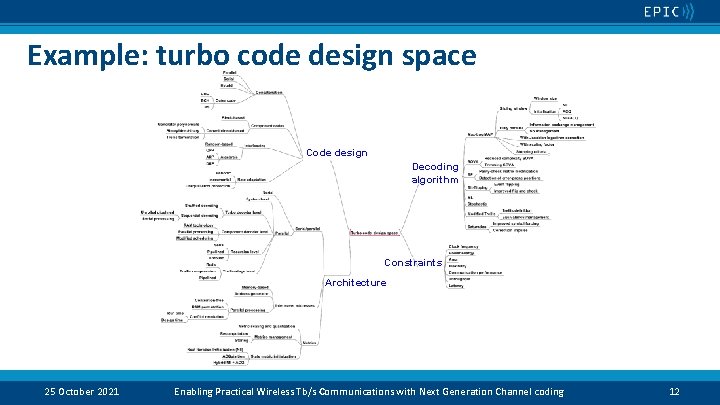
Example: turbo code design space Code design Decoding algorithm Constraints Architecture 25 October 2021 Enabling Practical Wireless Tb/s Communications with Next Generation Channel coding 12
EPIC Grant Agreement No. 760150 “The EPIC project has received funding from the European Union’s Horizon 2020 research and innovation programme under grant agreement No 760150. ” If you need further information, please contact the coordinator: TECHNIKON Forschungs- und Planungsgesellschaft mb. H Burgplatz 3 a, 9500 Villach, AUSTRIA Tel: +43 4242 233 55 Fax: +43 4242 233 55 77 E-Mail: coordination@epic-h 2020. eu The information in this document is provided “as is”, and no guarantee or warranty is given that the information is fit for any particular purpose. The content of this document reflects only the author`s view – the European Commission is not responsible for any use that may be made of the information it contains. The users use the information at their sole risk and liability. 25 October 2021 Enabling Practical Wireless Tb/s Communications with Next Generation Channel Coding 13
25 Octo ber 2021 ENABLING PRACTICAL WIRELESS TB/S COMMUNICATIONS WITH NEXT GENERATION CHANNEL CODING Towards 1 Tb/s decoding of turbo codes EPIC Grant Agreement No. 760150 14
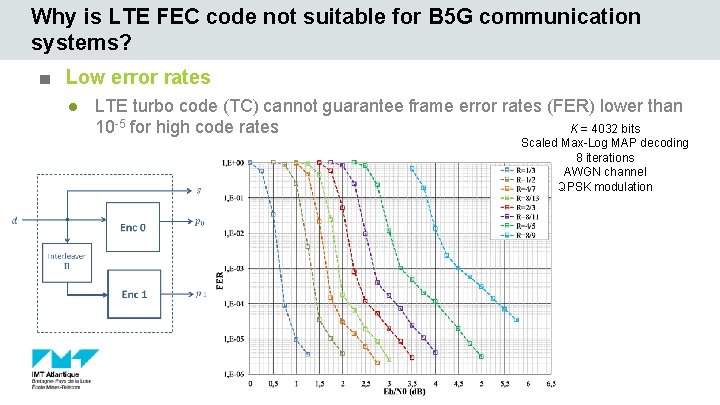
Why is LTE FEC code not suitable for B 5 G communication systems? ■ Low error rates LTE turbo code (TC) cannot guarantee frame error rates (FER) lower than K = 4032 bits 10 -5 for high code rates Scaled Max-Log MAP decoding 8 iterations AWGN channel QPSK modulation
Why is LTE FEC code not suitable for B 5 G communication systems? ■ High throughput QPP interleaver is contention free Maximum parallelism degree 64 Parallel processing on multiple sub-decoder cores Throughput: a few Gb/s with nowadays ASIC technologies, a few tens of Gb/s with next technology nodes (7 nm) Achieving beyond 100 Gb/s requires Pipelining the Max-Log-MAP recursions Unrolling the iterations hardwired interleavers/de-interleavers Shortcoming of LTE QPP interleaver for very high throughputs: No common parameters for different block sizes Issues with place and route of the interleaving network for all sizes
1. Code design ‒ Focus on interleaver design ‒ Joint puncturing pattern/interleaver design to support incremental redundancy (flexibility) OWHTC 19 - 27 -28 FEBRUARY 2019

Interleaver design criteria
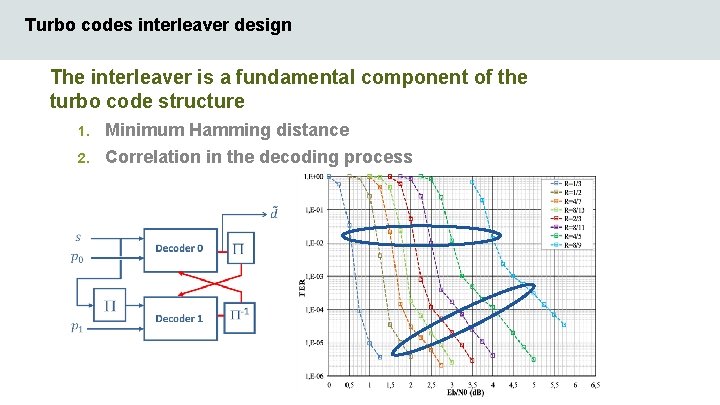
Turbo codes interleaver design The interleaver is a fundamental component of the turbo code structure 1. Minimum Hamming distance 2. Correlation in the decoding process
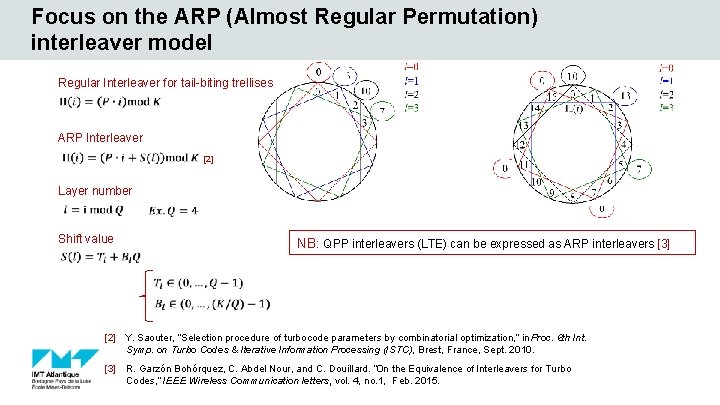
Focus on the ARP (Almost Regular Permutation) interleaver model Regular Interleaver for tail-biting trellises ARP Interleaver [2] Layer number Shift value NB: QPP interleavers (LTE) can be expressed as ARP interleavers [3] [2] Y. Saouter, “Selection procedure of turbocode parameters by combinatorial optimization, ” in Proc. 6 th Int. Symp. on Turbo Codes & Iterative Information Processing (ISTC), Brest, France, Sept. 2010. [3] R. Garzón Bohórquez, C. Abdel Nour, and C. Douillard. “On the Equivalence of Interleavers for Turbo Codes, ” IEEE Wireless Communication letters, vol. 4, no. 1, Feb. 2015.
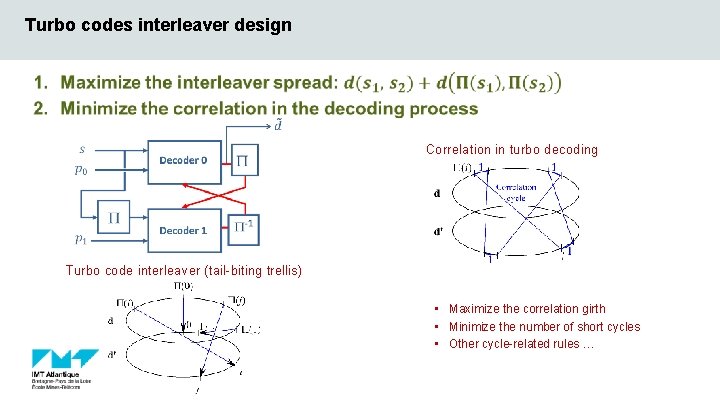
Turbo codes interleaver design Correlation in turbo decoding Turbo code interleaver (tail-biting trellis) • Maximize the correlation girth • Minimize the number of short cycles • Other cycle-related rules …

Joint design of interleaver parameters and puncturing patterns
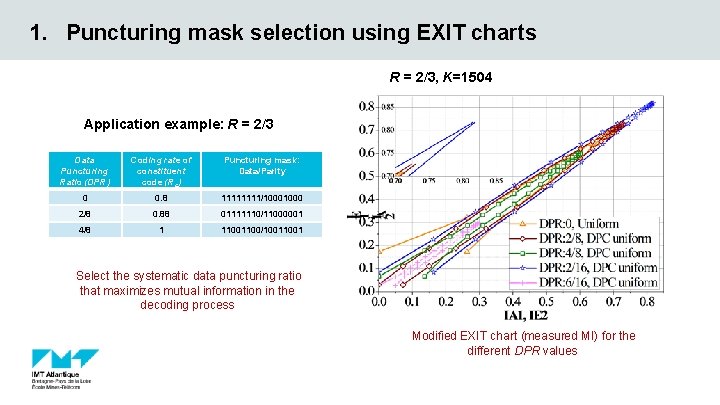
1. Puncturing mask selection using EXIT charts R = 2/3, K=1504 Application example: R = 2/3 Data Puncturing Ratio (DPR) Coding rate of constituent code (Rc) Puncturing mask: Data/Parity 0 0. 8 1111/1000 2/8 0. 88 01111110/11000001 4/8 1 1100/1001 Select the systematic data puncturing ratio that maximizes mutual information in the decoding process Modified EXIT chart (measured MI) for the different DPR values
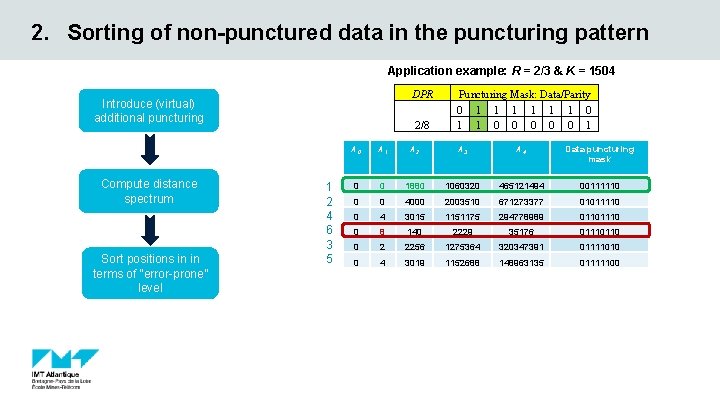
2. Sorting of non-punctured data in the puncturing pattern Application example: R = 2/3 & K = 1504 DPR Introduce (virtual) additional puncturing Compute distance spectrum Sort positions in in terms of “error-prone” level 2/8 1 2 4 6 3 5 Puncturing Mask: Data/Parity 0 1 1 1 0 0 0 1 A 0 A 1 A 2 A 3 A 4 Data puncturing mask 0 0 1880 1060320 465121494 00111110 0 0 4000 2003510 671273377 01011110 0 4 3015 1151175 294778989 01101110 0 8 140 2229 35176 01110110 0 2 2256 1275364 320347391 01111010 0 4 3019 1152688 148963135 01111100
![3. Cross connection strategy: protograph-based (PB) interleaver [5] Puncturing period [5] R. Garzon, C.](http://slidetodoc.com/presentation_image_h2/e55a89b14d913ba64a9a61763993e545/image-25.jpg "3. Cross connection strategy: protograph-based (PB) interleaver [5] Puncturing period [5] R. Garzon, C.")
3. Cross connection strategy: protograph-based (PB) interleaver [5] Puncturing period [5] R. Garzon, C. Abdel Nour, C. Douillard, “Protograph-Based Interleavers for Punctured Turbo Codes”, IEEE Trans. Commun. , vol. 66 no 5 , May 2018.
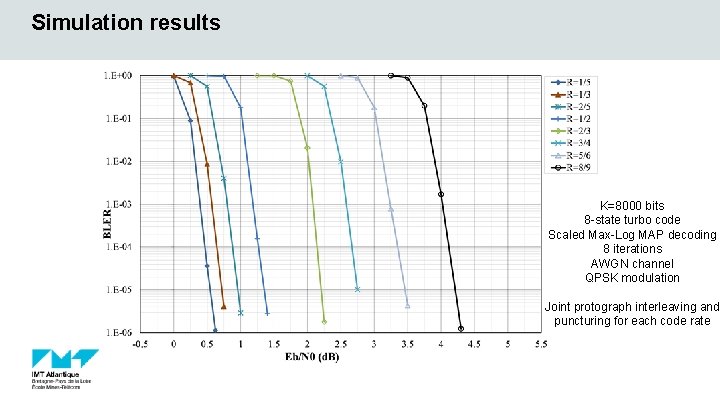
Simulation results K=8000 bits 8 -state turbo code Scaled Max-Log MAP decoding 8 iterations AWGN channel QPSK modulation Joint protograph interleaving and puncturing for each code rate
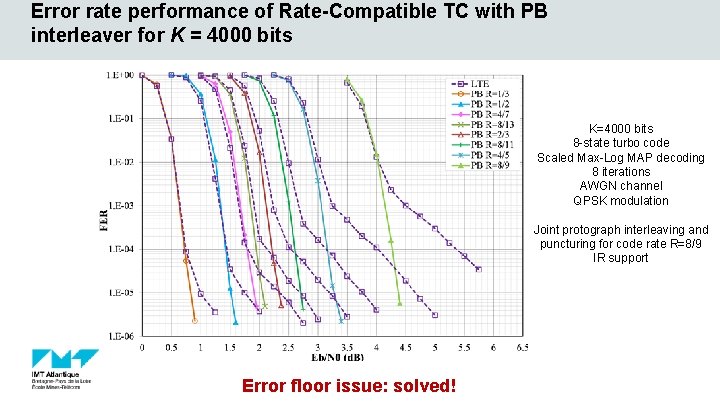
Error rate performance of Rate-Compatible TC with PB interleaver for K = 4000 bits K=4000 bits 8 -state turbo code Scaled Max-Log MAP decoding 8 iterations AWGN channel QPSK modulation Joint protograph interleaving and puncturing for code rate R=8/9 IR support Error floor issue: solved!

2. Decoder architecture New high-throughput frame flexible architecture OWHTC 19 27 -28 February 2019
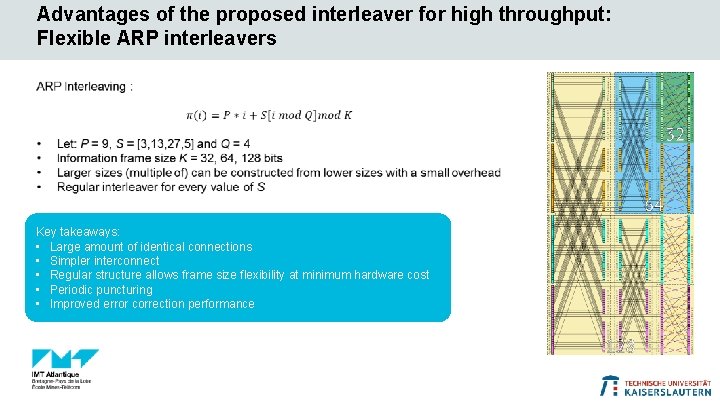
Advantages of the proposed interleaver for high throughput: Flexible ARP interleavers Key takeaways: • Large amount of identical connections • Simpler interconnect • Regular structure allows frame size flexibility at minimum hardware cost • Periodic puncturing • Improved error correction performance
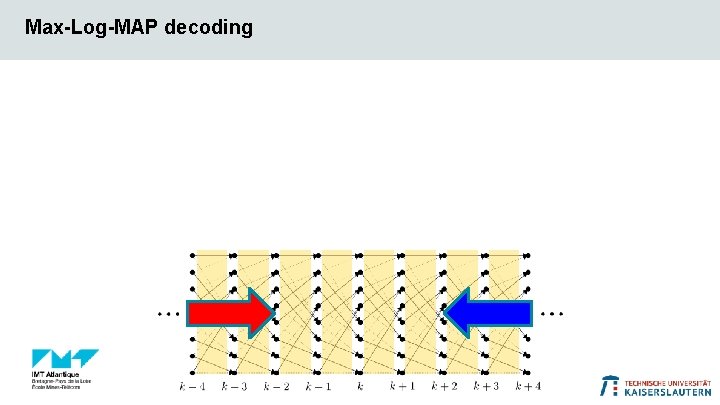
Max-Log-MAP decoding Branch Metrics Forward Recursion Backward Recursion Soft Output
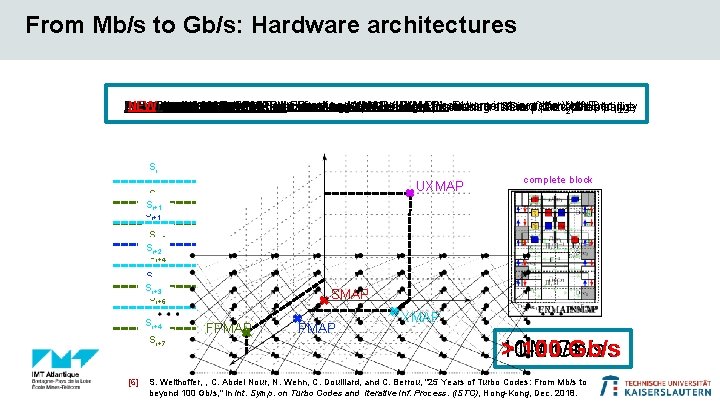
From Mb/s to Gb/s: Hardware architectures (NEW) Iteration Unrolled Fully Pipelined XMAP (UXMAP): Extreme case the Fully MAP (FPMAP): Extreme case of decoders the PMAP; hardware instances for. XMAP both Dec Serial. Parallel MAP (SMAP): One serial max-Log-MAP decoder functioning as Dec alternatingly Pipelined MAP (XMAP): decoder processing parts of the trellis in of a pipeline Parallel MAP (PMAP): P Pipelined serial max-Log-MAP processing different parts the trellis 1, 2 1 /X-shaped 2 of Iteration Unrolling Si Si complete block UXMAP Si+1 SSi+1 i+2 Si+3 Si+2 Si+4 SSi+2 i+5 Si+3 Si+6 Si+7 S Si+4 i+3 Si+7 [6] SMAP FPMAP Splitting the PMAP XMAP Recursion Unrolling 10 -40 >1 -5 100 Mb/s Gb/s S. Weithoffer, , C. Abdel Nour, N. Wehn, C. Douillard, and C. Berrou, "25 Years of Turbo Codes: From Mb/s to trellis beyond 100 Gb/s, " in Int. Symp. on Turbo Codes and Iterative Inf. Process. (ISTC), Hong-Kong, Dec. 2018.
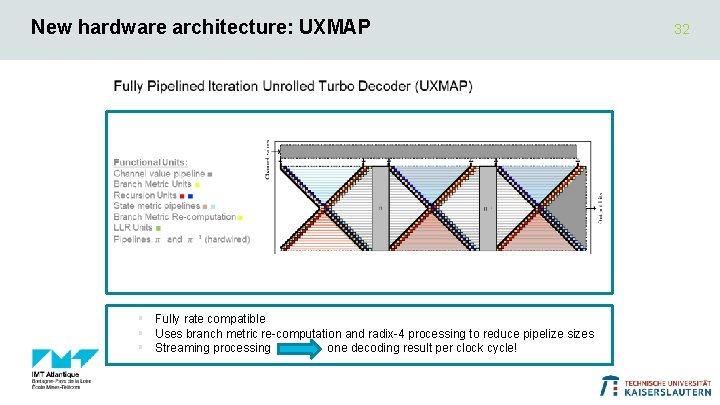
New hardware architecture: UXMAP § Fully rate compatible § Uses branch metric re-computation and radix-4 processing to reduce pipelize sizes § Streaming processing one decoding result per clock cycle! 32
Turbo code case: what’s next ? ■ Code design Study of non-binary turbo codes Spatially-coupled turbo codes ■ Decoding algorithm Revisiting the Max-Log-MAP decoding algorithm Decoding on the dual trellis (next talk) ■ Decoder architecture Pipelined and iteration unrolled architectures
- Slides: 33