
NEXTARCH Nanostructure Exploring by Xray Techniques with ARrays
NEXTARCH Nanostructure Exploring by X-ray Techniques with ARrays for CCD Holography (Nuova proposta per il gr 5 – in corso di definizione) Consiglio di Laboratorio Aperto M. Iliescu Frascati, July 2012

Qualitative comparison of X-ray imaging techniques Conventional X-ray imaging: -low contrast for samples with similar compositeness (absorption) (biological cells, multilayer nano lithography, etc. ) -bi-dimensional reconstruction using only the amplitude information -tri-dimensional info from long, multiple exposures (tomography) with low resolution (mm) and no timing information -large samples and organisms can be investigated XRF imaging: -bi-dimensional, micrometer resolution -provides elemental compositeness info X-ray holography : -additional (phase) contrast due to the phase shifting induced by small refractive index variations -> increased resolution -tri-dimensional reconstruction by taking advantage of the phase information (current resolutions down to 50 nm) -if done on FELs, allows femto-second time resolution, thus providing real-time info on the structure, possibility to monitor molecular processes -small samples (biologic cells, nanostructures) XRF holography -atomic resolution (~Å)
X-ray digital holography Experimental problems not encountered in optical holography: -X-ray coherent sources are very complex - high diffraction angles, so wide sensors should be used, while sample size is limited by the difficulty to obtain a strong illumination (~microns) -special optics, efficiency strongly drops with energy (X-ray mirrors, capillary lenses & waveguides) -pinholes are limiting the flux -samples might be altered during exposure, by ionization and heating (jets of quasi-identical particles, femtosecond pulses)
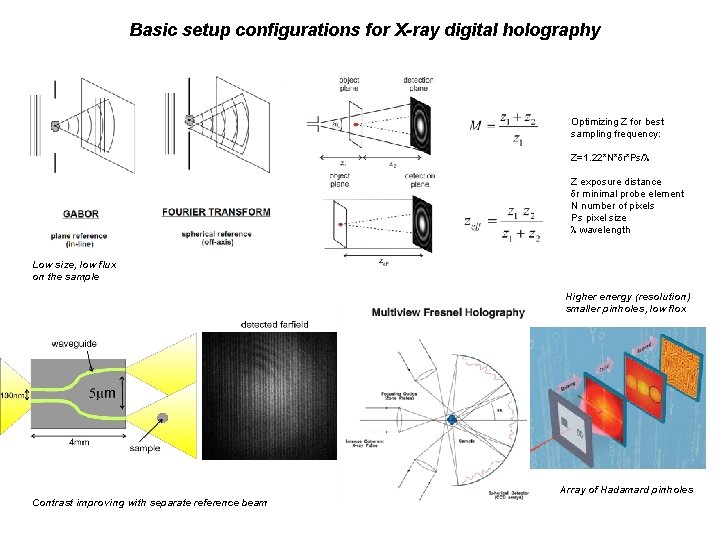
Basic setup configurations for X-ray digital holography Optimizing Z for best sampling frequency: Z=1. 22*N*dr*Ps/l Z exposure distance dr minimal probe element N number of pixels Ps pixel size l wavelength Low size, low flux on the sample Higher energy (resolution) smaller pinholes, low flox Array of Hadamard pinholes Contrast improving with separate reference beam

Coherent X-ray sources Standard X-ray tubes – monochromators – lenses - pinholes: very low flux Undulators on synchrotron beamlines – low coherence Pulsed X-ray fluorescence sources, activated by high power lasers FELs – high brilliance, 1020 -1032 photons/pulse - coherent - low divergence Currently, many FEL projects are under development: - LCLS at SLAC - FLASH at DESY (currently the best available) (LCLS and FLASH already realized XRH applications) - XFEL at PSI – 3 lines, energy up to 12. 4 ke. V and 1033 ph/pulse - FEL-C at LNF Frascati (1 -2 ke. V) - FERMI at ELETTRA Trieste (0. 12 ke. V) - European XFEL (DESY) –up to 24 ke. V, 5 x 1033 ph/pulse and 27000 pulses/s (> 1 GE project, ready in 2015) - others under design (Super. B)
NEXTARCH project Main goal: take advantage of the available DEAR/VIP apparatus, representing one of the biggest soft/mid X-ray camera ever built (116 cm 2, 22. 5 mm pixel size), in order to improve the XRH resolution from ~50 to ~20 nm, for the currently available sources. The layout, due to the detector segmentation, can follow a Fresnel configuration, thus providing a better reconstruction with respect to a flat detector. Perform a study on new X-ray optics (capillary x-ray lenses) to allow holographic imaging at higher energies and so to overcome the pinhole limitations, taking advantage of the natural resolution increase at shorter wavelength (from. 5 -2 ke. V to 10 -15 ke. V) Overall goal: to improve by one order of magnitude the current resolution limit of XRH, reaching the nm range.
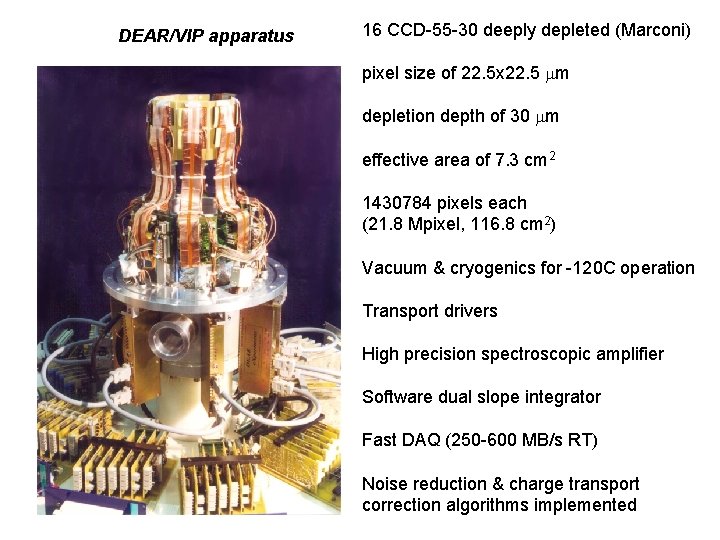
DEAR/VIP apparatus 16 CCD-55 -30 deeply depleted (Marconi) pixel size of 22. 5 x 22. 5 mm depletion depth of 30 mm effective area of 7. 3 cm 2 1430784 pixels each (21. 8 Mpixel, 116. 8 cm 2) Vacuum & cryogenics for -120 C operation Transport drivers High precision spectroscopic amplifier Software dual slope integrator Fast DAQ (250 -600 MB/s RT) Noise reduction & charge transport correction algorithms implemented
Upgrades to be done for XRH Full setup upgrade: -drivers and amplifiers must be replaced by non spectroscopic, fast ones, to allow imaging with high repetition rate -mechanics and cryogenics must be redone, to match the approximate Fourier configuration (spherical disposition) -X-ray lenses (standard and capillary), bent crystals, etc. -Hadamard pinhole arrays -beam shutters -dumping systems -new acquisition system -sample handling micrometric stage, sample conditioning system, microscope First step: a 2 -4 CCD prototype In the first phase, the main part of old electronics will be used (1 min/image) Needed: new mechanics, controls, a small set of lenses, a precision bench or moving mechanism, beam shutter, dumper, vacuum chamber & vacuum system.
Struttura del gruppo e richiesta di finaziamento al Gruppo V 0 (preliminary) Personale: Iliescu Mihail Antoniu (ricercatore), Coordinatore Sergio Bartalucci (ricercatore) Ivana Tucakovich (dottoranda) Alessandro Scordo (assegnista), Diana Sirghi (tecnologo) Alessandro D’Uffizi (tecnologo) Massimiliano Bazzi (ing. elettronico), Flavio Lucibello (tecn. elettronico), per un totale di cca. 2, 3 FTE; Richieste per servizi LNF: 0. 5 mese-uomo Progettazione; 1 mesi-uomo officina meccanica Richiesta al gruppo V 0 Inventariale: sistema da vuoto, ottica per raggi X, sistema di muovimento micrometrico, moduli elettronica DAQ 20 KE Consumi: cryo gas, circuiti stampati & componenti elettronici per controlli (pressione, temperatura), componenti meccanici 15 KE Missioni estere (test beam/collaboration DESY/PSI) 5 KE Missioni interne (Trieste, altro) 2 KE
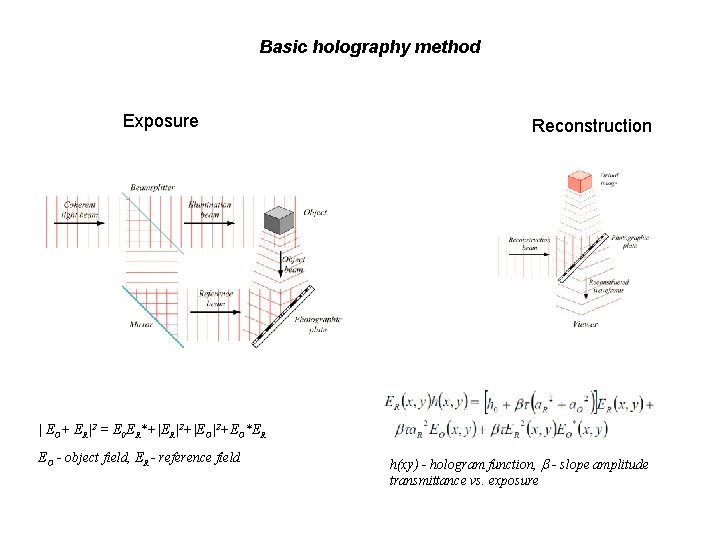
Basic holography method Exposure Reconstruction | EO+ ER|2 = E 0 ER*+|ER|2+|EO|2+EO*ER EO - object field, ER - reference field h(xy) - hologram function, b - slope amplitude transmittance vs. exposure
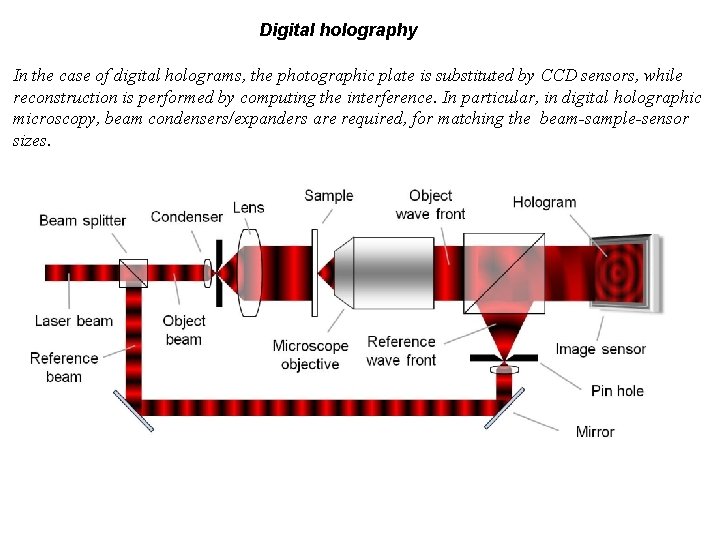
Digital holography In the case of digital holograms, the photographic plate is substituted by CCD sensors, while reconstruction is performed by computing the interference. In particular, in digital holographic microscopy, beam condensers/expanders are required, for matching the beam-sample-sensor sizes.
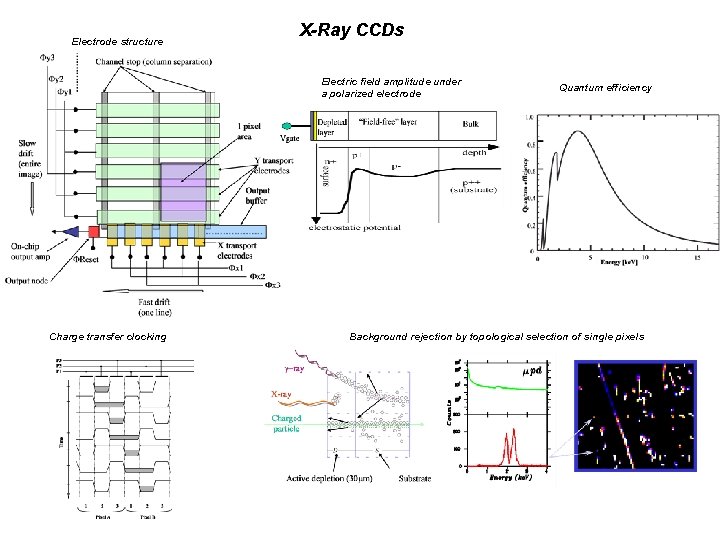
Electrode structure X-Ray CCDs Electric field amplitude under a polarized electrode Charge transfer clocking Quantum efficiency Background rejection by topological selection of single pixels
- Slides: 12