
NEXT SPACE VLBI MISSION ASTROG VSOP2 AND ITS
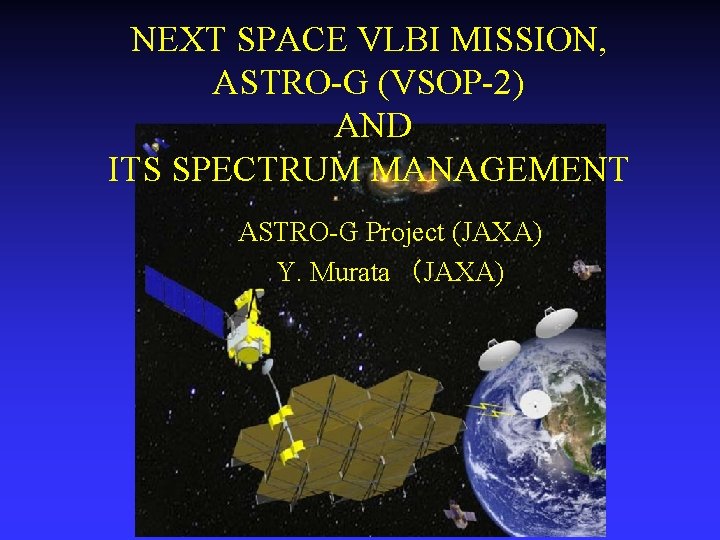
NEXT SPACE VLBI MISSION, ASTRO-G (VSOP-2) AND ITS SPECTRUM MANAGEMENT ASTRO-G Project (JAXA) Y. Murata (JAXA)
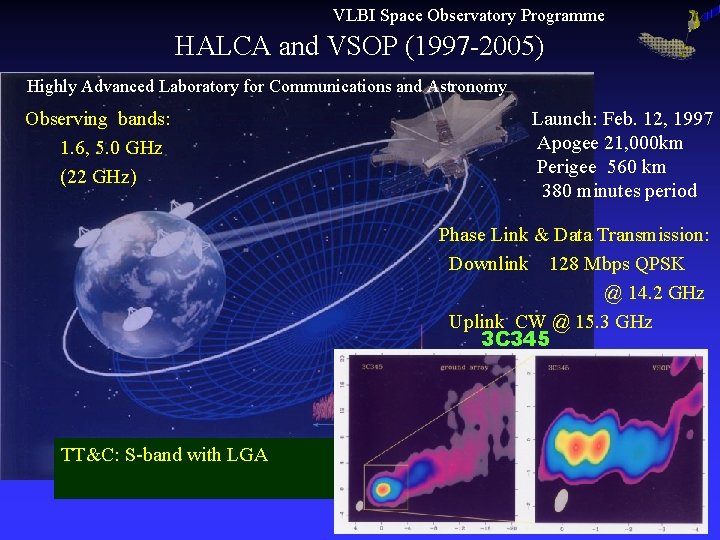
VLBI Space Observatory Programme HALCA and VSOP (1997 -2005) Highly Advanced Laboratory for Communications and Astronomy Observing bands: 1. 6, 5. 0 GHz (22 GHz) Launch: Feb. 12, 1997 Apogee 21, 000 km Perigee 560 km 380 minutes period Phase Link & Data Transmission: Downlink 128 Mbps QPSK @ 14. 2 GHz Uplink CW @ 15. 3 GHz 3 C 345 VLBA TT&C: S-band with LGA VSOP
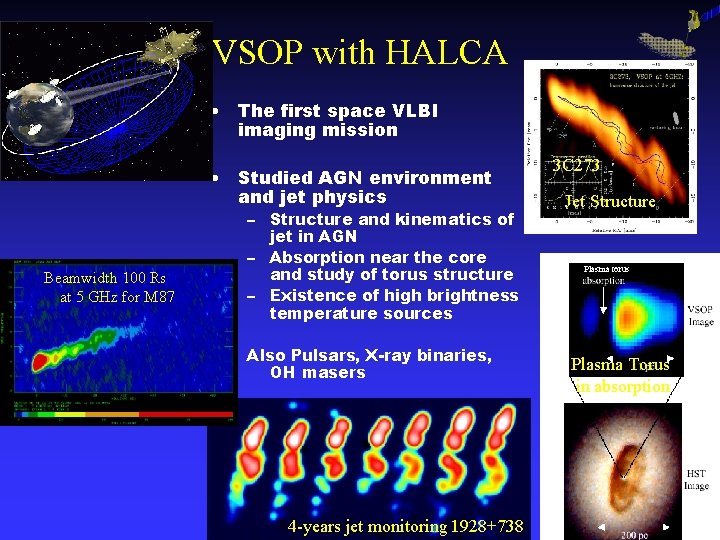
VSOP with HALCA • The first space VLBI imaging mission • Studied AGN environment and jet physics Beamwidth 100 Rs at 5 GHz for M 87 – Structure and kinematics of jet in AGN – Absorption near the core and study of torus structure – Existence of high brightness temperature sources Also Pulsars, X-ray binaries, OH masers 4 -years jet monitoring 1928+738 3 C 273 Jet Structure Plasma torus Plasma Torus in absorption
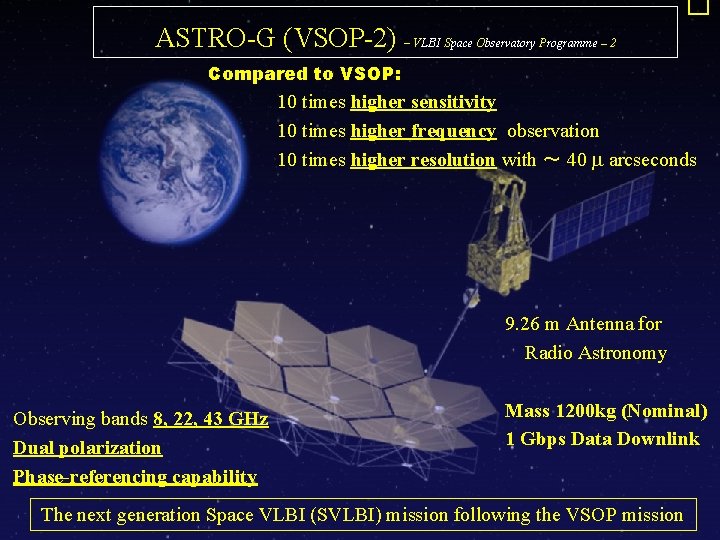
� ASTRO-G (VSOP-2) – VLBI Space Observatory Programme – 2 Compared to VSOP: 10 times higher sensitivity 10 times higher frequency observation 10 times higher resolution with ~ 40 m arcseconds 9. 26 m Antenna for Radio Astronomy Observing bands 8, 22, 43 GHz Dual polarization Phase-referencing capability Mass 1200 kg (Nominal) 1 Gbps Data Downlink The next generation Space VLBI (SVLBI) mission following the VSOP mission
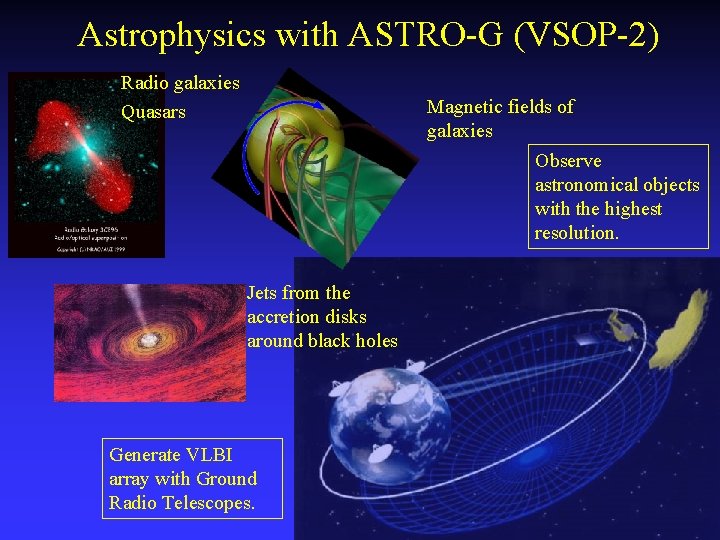
Astrophysics with ASTRO-G (VSOP-2) Radio galaxies Quasars Magnetic fields of galaxies Observe astronomical objects with the highest resolution. Jets from the accretion disks around black holes Generate VLBI array with Ground Radio Telescopes.
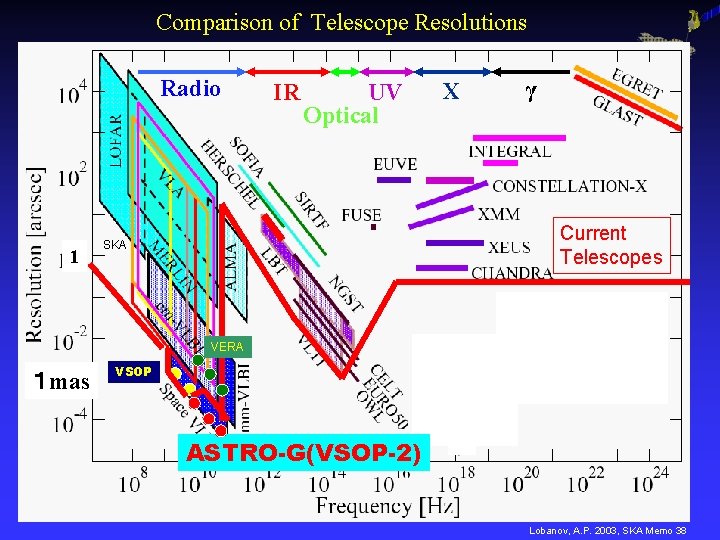
Comparison of Telescope Resolutions Radio 1 IR UV Optical X γ Current Telescopes SKA VERA 1 mas VSOP ASTRO-G(VSOP-2) Lobanov, A. P. 2003, SKA Memo 38

Comparison of ASTRO-G/VSOP-2 and HALCA/VSOP • More information on fine structure and magnetic field from AGN jets and cores – Higher resolution with polarization capability • Higher sensitivity – With 2 polarization, 8 times wider bandwidth (only continuum sources) • High agility attitude control system using control moment gyros – Improved calibration capability (ASTRO-G can observe calibrators, HALCA could not) – Phase-referencing observations enabled Allows weaker source detection by extending integration time and astrometry observations • High accuracy navigation using onboard GPSR and SLR Required for phase-referencing

ASTRO-G Satellite Configuration • 9. 3 -m offset Cassegrain antenna with module structures – Light weight – gimbal adjuster – focusing system – Mass (wet) 1200 Kg – Power 2000 W
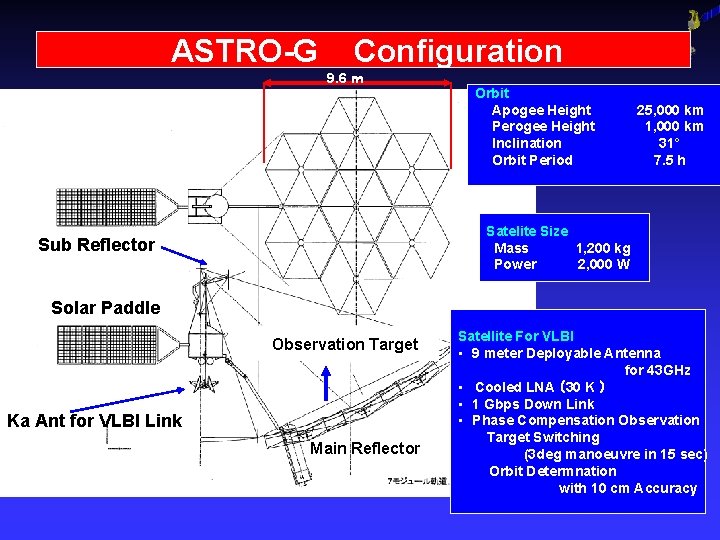
ASTRO-G 第22号科学衛星 SOLAR-B Configuration 9. 6 m 主鏡 Solar Paddle 副鏡 Orbit Apogee Height Perogee Height Inclination Orbit Period 25, 000 km 1, 000 km 31° 7. 5 h Satelite Size Mass 1, 200 kg Power 2, 000 W Sub Reflector r. Solar Paddle 天体方向 Observation Target Ka Ant for VLBI Link Main Reflector Satellite For VLBI • 9 meter Deployable Antenna for 43 GHz • Cooled LNA (30 K ) • 1 Gbps Down Link • Phase Compensation Observation Target Switching (3 deg manoeuvre in 15 sec) Orbit Determnation with 10 cm Accuracy
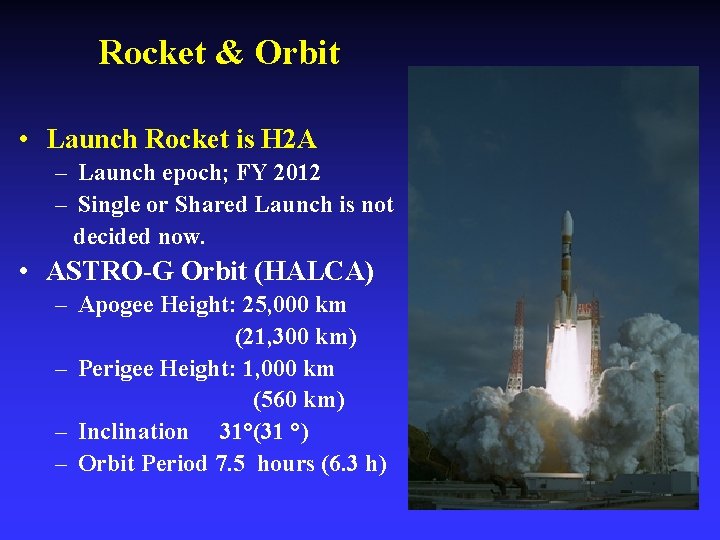
Rocket & Orbit • Launch Rocket is H 2 A – Launch epoch; FY 2012 – Single or Shared Launch is not decided now. • ASTRO-G Orbit (HALCA) – Apogee Height: 25, 000 km (21, 300 km) – Perigee Height: 1, 000 km (560 km) – Inclination 31°(31 °) – Orbit Period 7. 5 hours (6. 3 h)

Key Technology: Large Deployable Antenna Module-type offset-Cassegrain antenna (use ETS-VIII deployment mechanism) HALCA (1997) Mesh + Tension Truss Need higher accuracy module Offset-cassegrain antenna ETS-VIII (Dec. 2006)
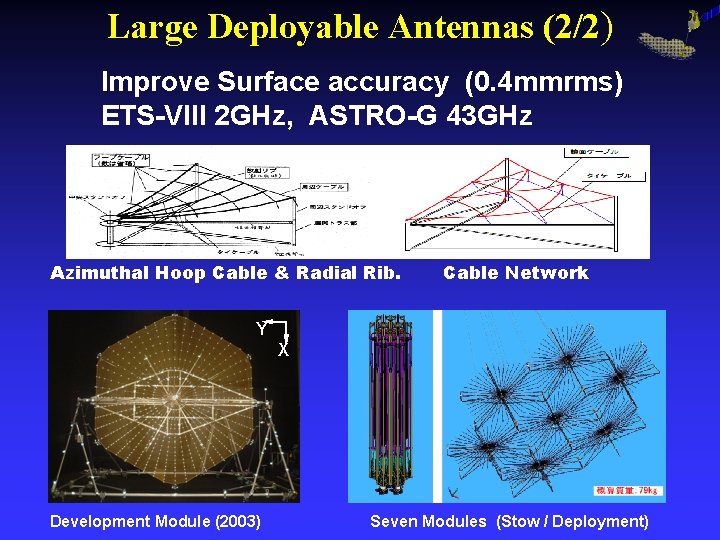
Large Deployable Antennas (2/2) Improve Surface accuracy (0. 4 mmrms) ETS-VIII 2 GHz, ASTRO-G 43 GHz Azimuthal Hoop Cable & Radial Rib. Cable Network Y X Development Module (2003) Seven Modules (Stow / Deployment)
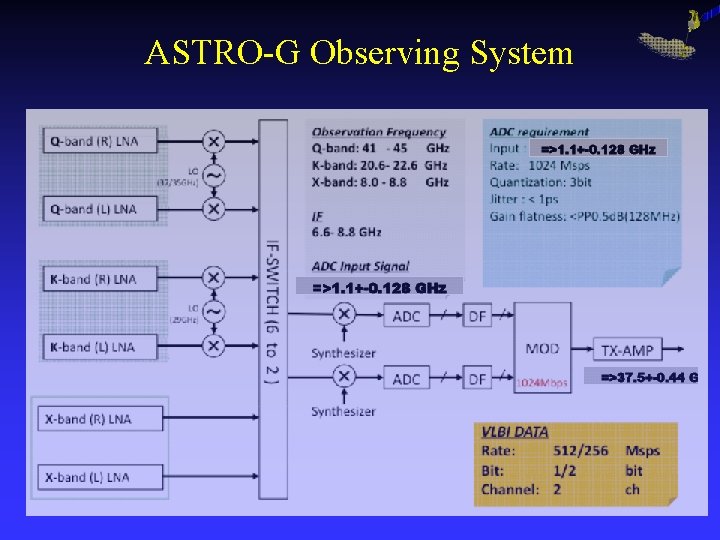
ASTRO-G Observing System
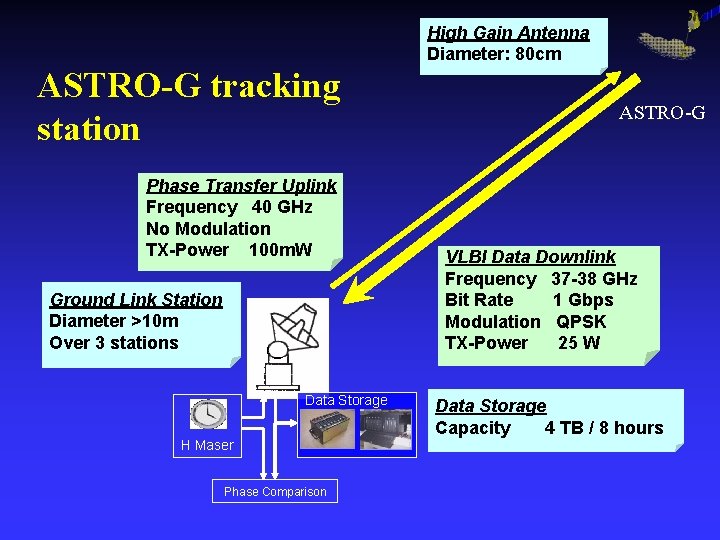
High Gain Antenna Diameter: 80 cm ASTRO-G tracking station Phase Transfer Uplink Frequency 40 GHz No Modulation TX-Power 100 m. W Ground Link Station Diameter >10 m Over 3 stations Data Storage H Maser Phase Comparison ASTRO-G VLBI Data Downlink Frequency 37 -38 GHz Bit Rate 1 Gbps Modulation QPSK TX-Power 25 W Data Storage Capacity 4 TB / 8 hours
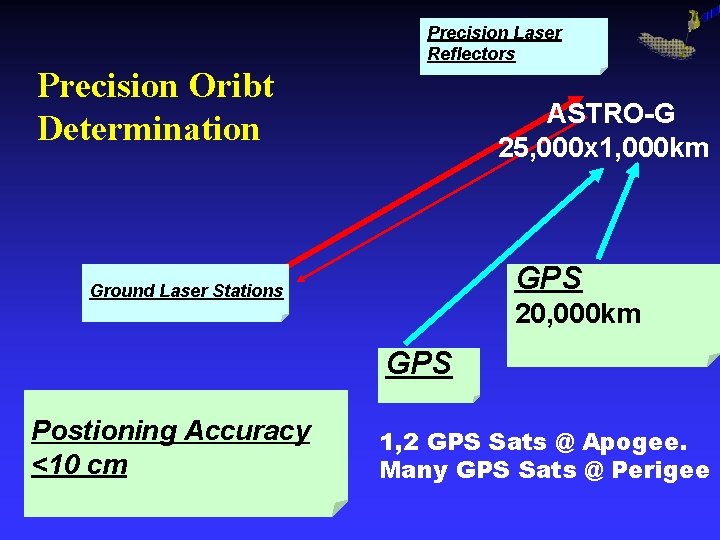
Precision Laser Reflectors Precision Oribt Determination ASTRO-G 25, 000 x 1, 000 km GPS Ground Laser Stations 20, 000 km GPS Postioning Accuracy <10 cm 1, 2 GPS Sats @ Apogee. Many GPS Sats @ Perigee
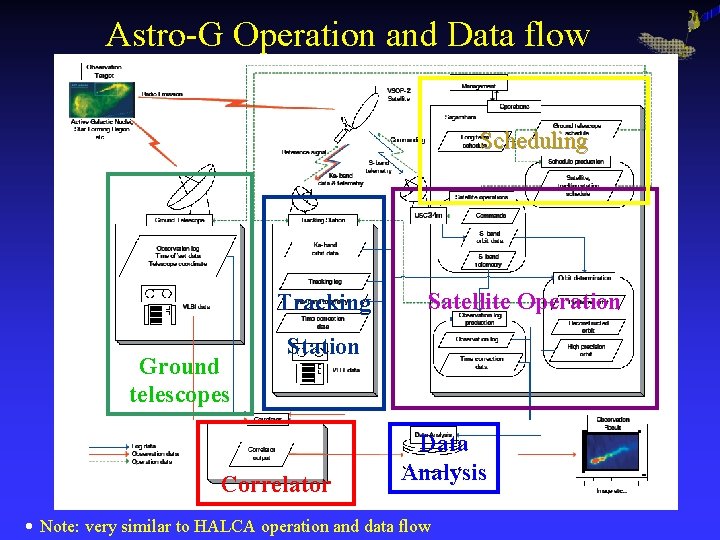
Astro-G Operation and Data flow Scheduling Tracking Ground telescopes Satellite Operation Station Correlator Data Analysis • Note: very similar to HALCA operation and data flow
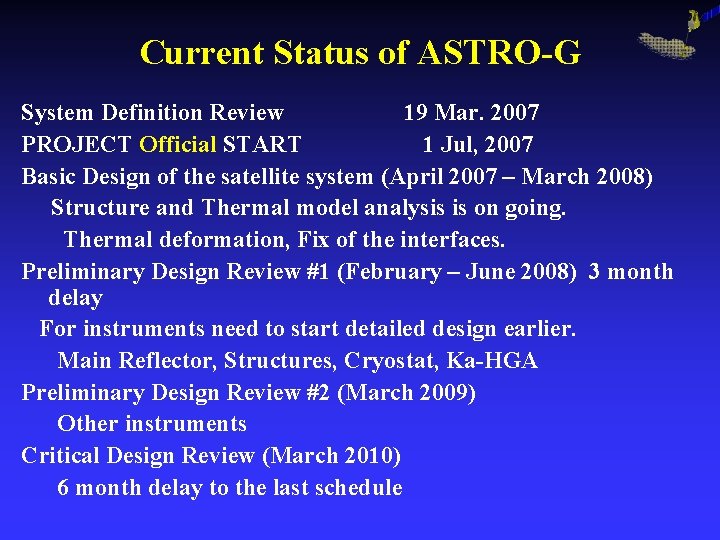
Current Status of ASTRO-G System Definition Review 19 Mar. 2007 PROJECT Official START 1 Jul, 2007 Basic Design of the satellite system (April 2007 – March 2008) Structure and Thermal model analysis is on going. Thermal deformation, Fix of the interfaces. Preliminary Design Review #1 (February – June 2008) 3 month delay For instruments need to start detailed design earlier. Main Reflector, Structures, Cryostat, Ka-HGA Preliminary Design Review #2 (March 2009) Other instruments Critical Design Review (March 2010) 6 month delay to the last schedule
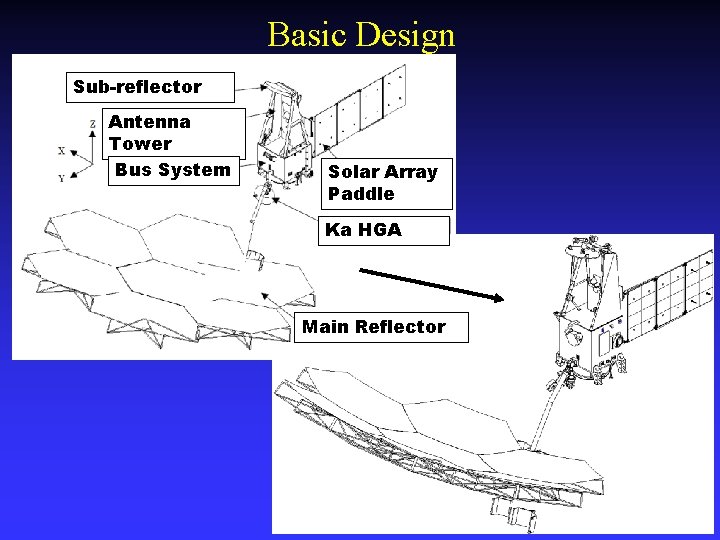
Basic Design Sub-reflector Antenna Tower Bus System Solar Array Paddle Ka HGA Main Reflector
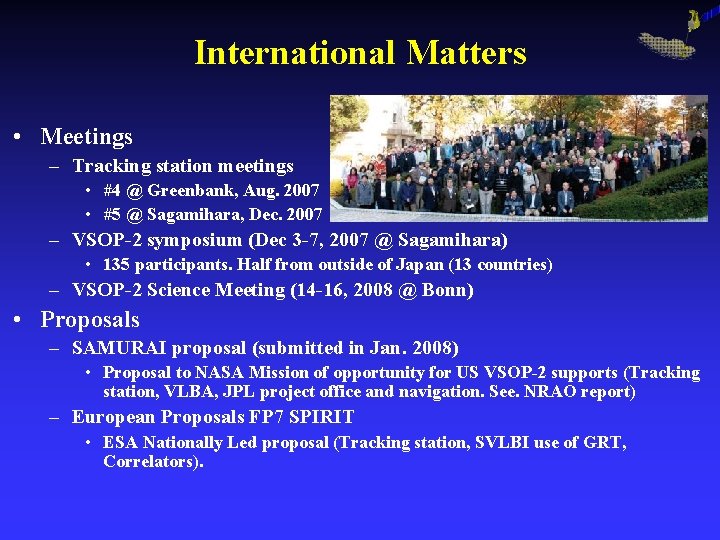
International Matters • Meetings – Tracking station meetings • #4 @ Greenbank, Aug. 2007 • #5 @ Sagamihara, Dec. 2007 – VSOP-2 symposium (Dec 3 -7, 2007 @ Sagamihara) • 135 participants. Half from outside of Japan (13 countries) – VSOP-2 Science Meeting (14 -16, 2008 @ Bonn) • Proposals – SAMURAI proposal (submitted in Jan. 2008) • Proposal to NASA Mission of opportunity for US VSOP-2 supports (Tracking station, VLBA, JPL project office and navigation. See. NRAO report) – European Proposals FP 7 SPIRIT • ESA Nationally Led proposal (Tracking station, SVLBI use of GRT, Correlators).
International Matters (2) • VISC-2 Formation – VISC-2(VSOP-2 International Science Council) We form VISC-2 to make consensus related to scientific operations of VSOP-2. Possible VISC-2 functions are selection of KSPs, scientific scheduling, decisions of international relations, scientific operations. (Finally decided in the first VISC-2 meeting in Bonn in May, 2008) – pre-meeting • Dec. 2007 @ Sagamihara • April, 2009 @Telecon • May, 2009 First F-F Meeting in Bonn – Members: • Ex-officio(ISAS/JAXA): H. Saito, M. Tsuboi • Institutional members (12): ISAS(1): Y. Murata (co-chair), NAOJ(1): M. Inoue, JVN(1): K. Fujisawa EAVN (1): H. Kobayashi, KVN/KASI (1): S. -H. Cho, NRAO(1): J. Ulvestad ( JPL(1): D. Murphy ), JIVE(1): L. Gurvits, EVN(1): A. Zensus (co-chair) OAN(1): R. Bachiller, ATNF(1): P. Edwards, GVWG(1): J. Romney (NRAO) • At-large members (3): D. Gabuzda (Univ. Collage Cork, Ireland), S. Kameno (Kagoshima Univ. ), + Astrometry person (TBD) • VISC 2 adviser (2): D. Jauncey, H. Hirabayashi • Liaison (1): R. Schilizzi (ISPO (International SKA Project Office)) • Secretary(1): Y. Hagiwara (NAOJ)
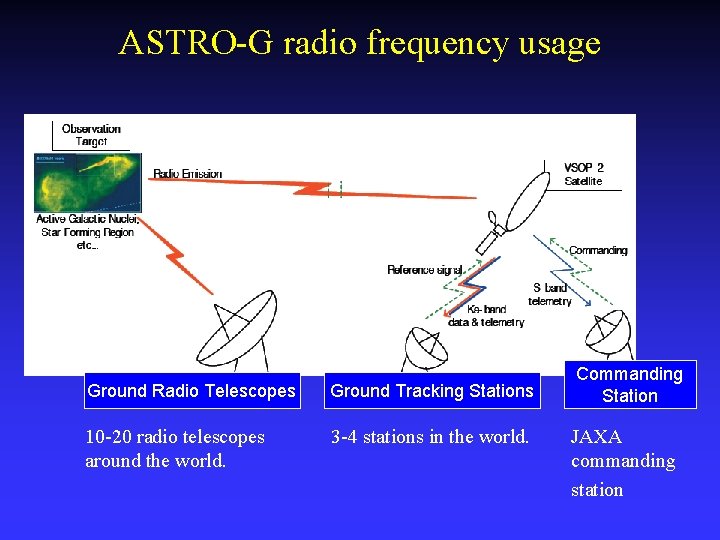
ASTRO-G radio frequency usage 40 GHz 37 -38 GHz Ground Radio Telescopes Ground Tracking Stations 10 -20 radio telescopes around the world. 3 -4 stations in the world. Commanding Station JAXA commanding station
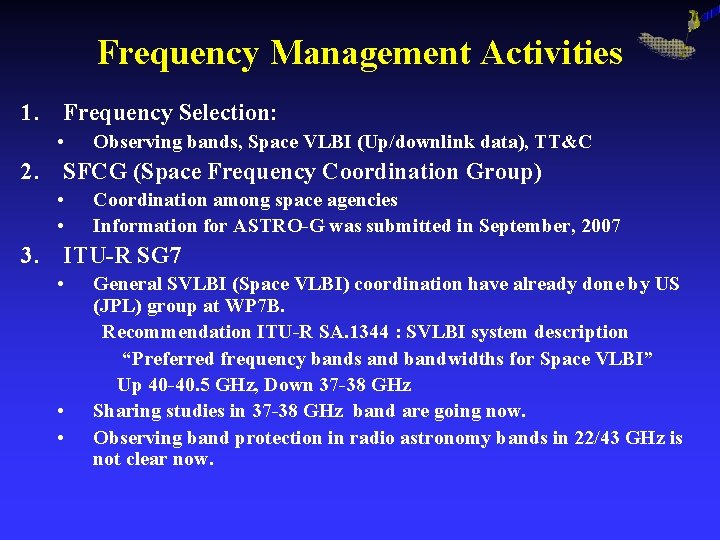
Frequency Management Activities 1. Frequency Selection: • Observing bands, Space VLBI (Up/downlink data), TT&C 2. SFCG (Space Frequency Coordination Group) • • Coordination among space agencies Information for ASTRO-G was submitted in September, 2007 3. ITU-R SG 7 • • • General SVLBI (Space VLBI) coordination have already done by US (JPL) group at WP 7 B. Recommendation ITU-R SA. 1344 : SVLBI system description “Preferred frequency bands and bandwidths for Space VLBI” Up 40 -40. 5 GHz, Down 37 -38 GHz Sharing studies in 37 -38 GHz band are going now. Observing band protection in radio astronomy bands in 22/43 GHz is not clear now.
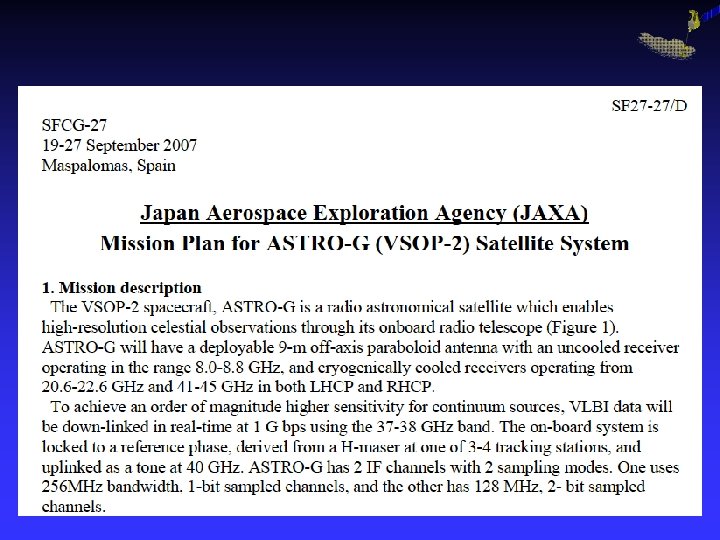
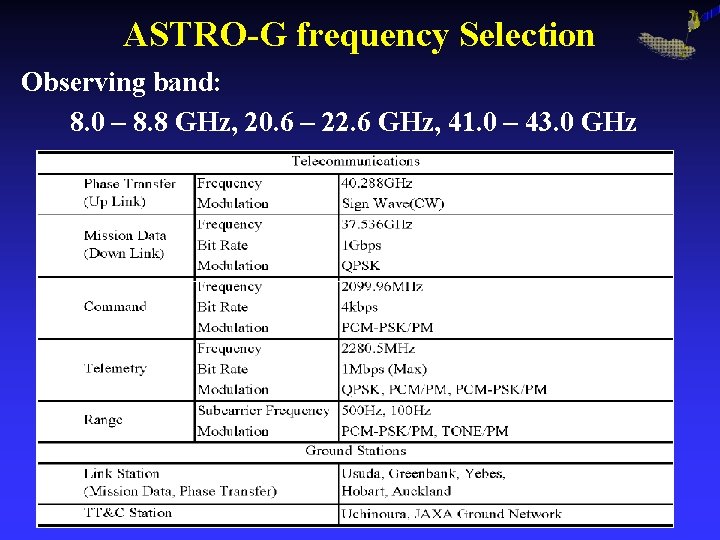
ASTRO-G frequency Selection Observing band: 8. 0 – 8. 8 GHz, 20. 6 – 22. 6 GHz, 41. 0 – 43. 0 GHz
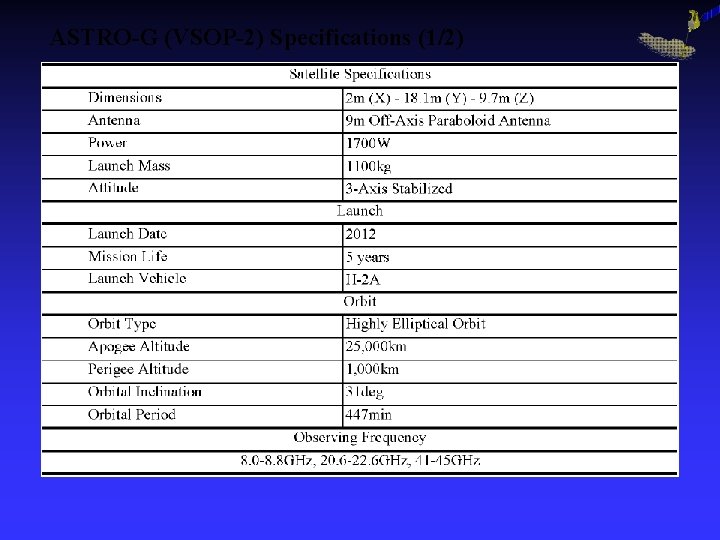
ASTRO-G (VSOP-2) Specifications (1/2)
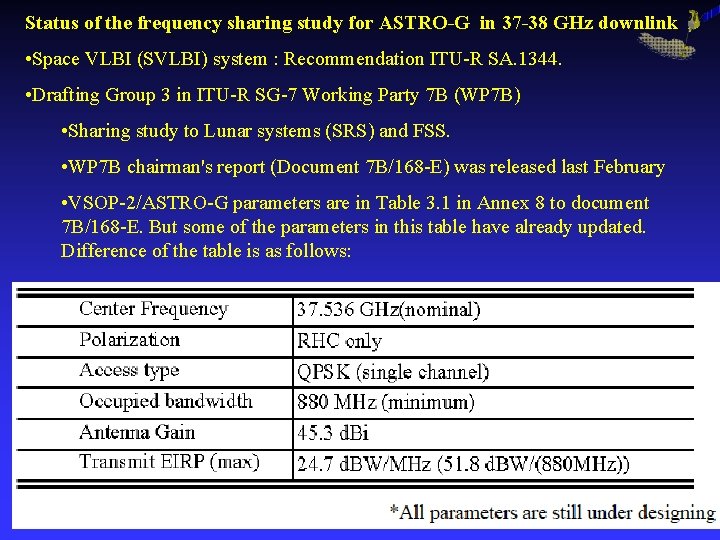
Status of the frequency sharing study for ASTRO-G in 37 -38 GHz downlink • Space VLBI (SVLBI) system : Recommendation ITU-R SA. 1344. • Drafting Group 3 in ITU-R SG-7 Working Party 7 B (WP 7 B) • Sharing study to Lunar systems (SRS) and FSS. • WP 7 B chairman's report (Document 7 B/168 -E) was released last February • VSOP-2/ASTRO-G parameters are in Table 3. 1 in Annex 8 to document 7 B/168 -E. But some of the parameters in this table have already updated. Difference of the table is as follows:
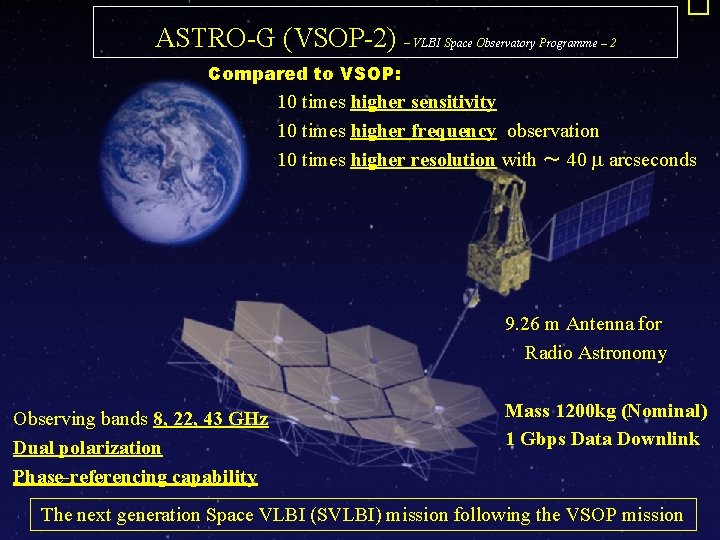
� ASTRO-G (VSOP-2) – VLBI Space Observatory Programme – 2 Compared to VSOP: 10 times higher sensitivity 10 times higher frequency observation 10 times higher resolution with ~ 40 m arcseconds 9. 26 m Antenna for Radio Astronomy Observing bands 8, 22, 43 GHz Dual polarization Phase-referencing capability Mass 1200 kg (Nominal) 1 Gbps Data Downlink The next generation Space VLBI (SVLBI) mission following the VSOP mission
- Slides: 27