
Next Move from underground water flow to Surface


- Slides: 50
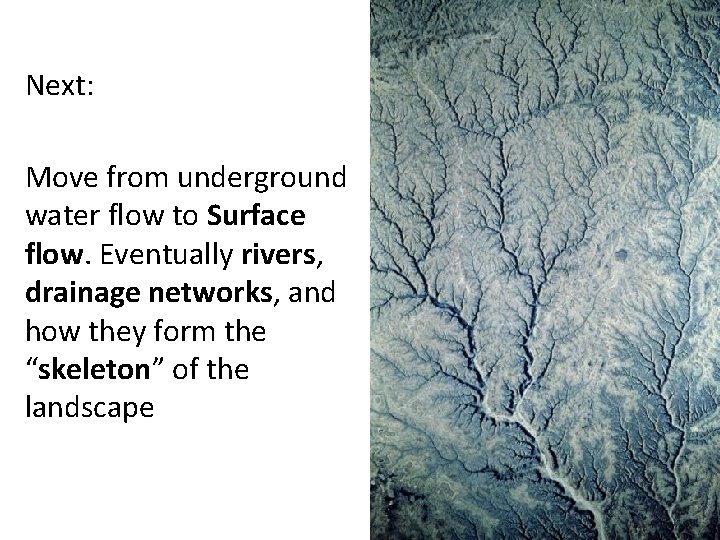
Next: Move from underground water flow to Surface flow. Eventually rivers, drainage networks, and how they form the “skeleton” of the landscape
First key step is sediment transport and deposition, because it is action of water on sediments that makes channel forms http: //www. youtube. com/watch? v=jpex. S 4 -9 IF 0
First key step is sediment transport and deposition, because it is action of water on sediments that makes channel forms 4 key physical aspects control sediment transport and deposition: • gravity (g) • shear stress (t) – component of gravity parallel to surface • normal stress (s) – component of gravity normal to surface • friction (F) – parallel but opposite direction to t
But first we have to think about the FLUID the particles are moving in. • That’s going to affect the normal stresses because of the buoyancy contrast of fluid and particle. • Affects shear stresses that fluid exerts on a particle. • By definition, fluids change shape continuously in response to small applied external stress.
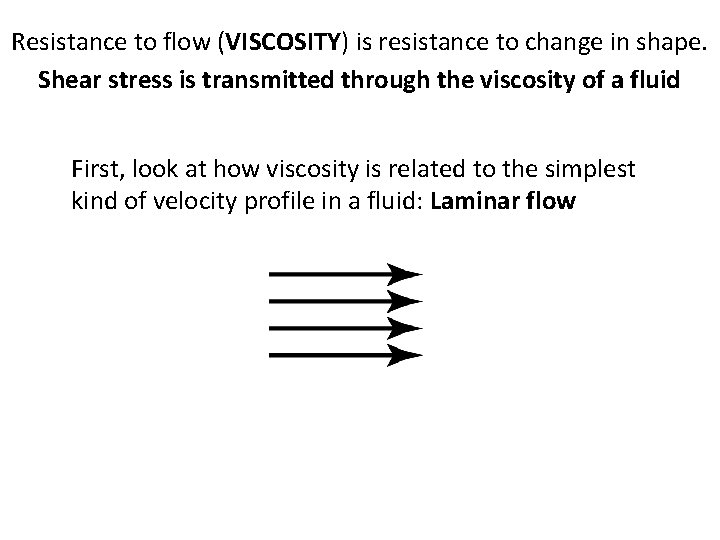
Resistance to flow (VISCOSITY) is resistance to change in shape. Shear stress is transmitted through the viscosity of a fluid First, look at how viscosity is related to the simplest kind of velocity profile in a fluid: Laminar flow
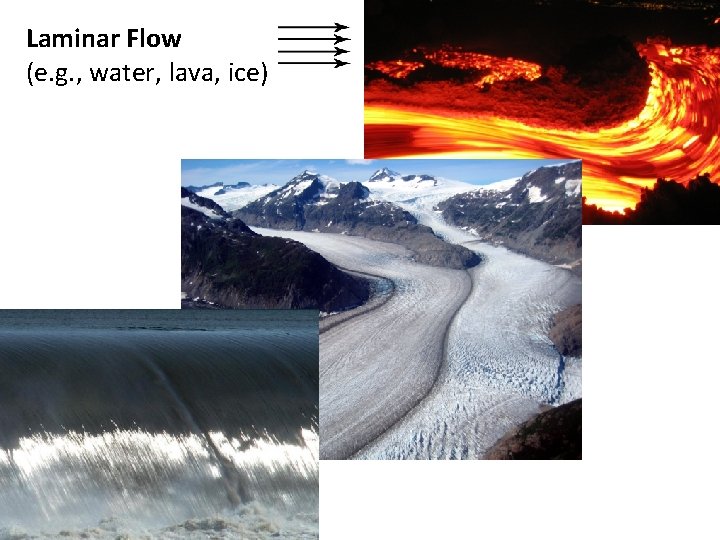
Laminar Flow (e. g. , water, lava, ice)
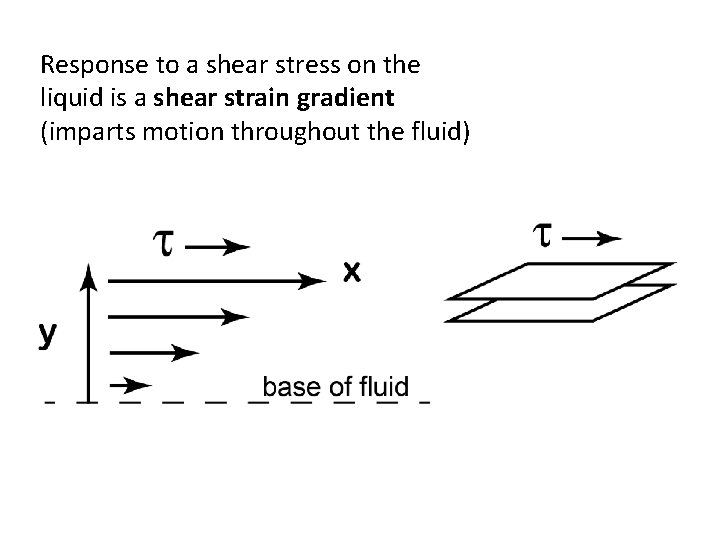
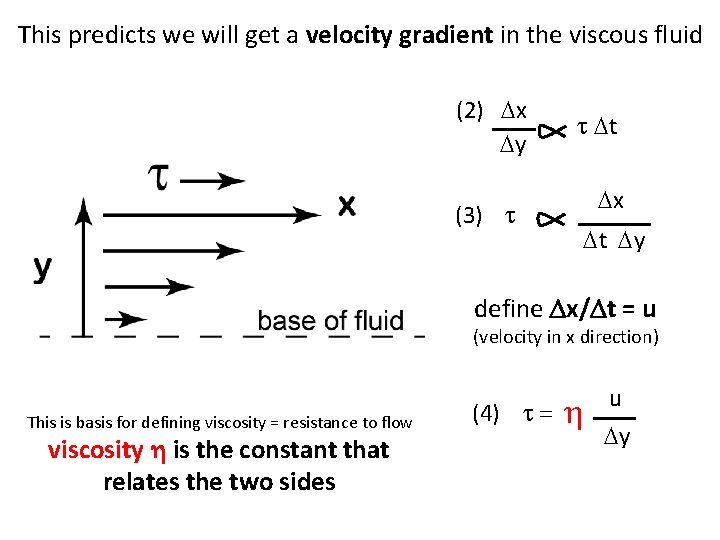
Laminar Flow (e. g. , water, lava, ice) Fluid moving over a flat surface can act as a series of thin “layers” sliding over each other, or plates in a viscous fluid Shear stress is transmitted through the viscosity of the fluid (exert drag on top layer and next layer will move also)
Response to a shear stress on the liquid is a shear strain gradient (imparts motion throughout the fluid)
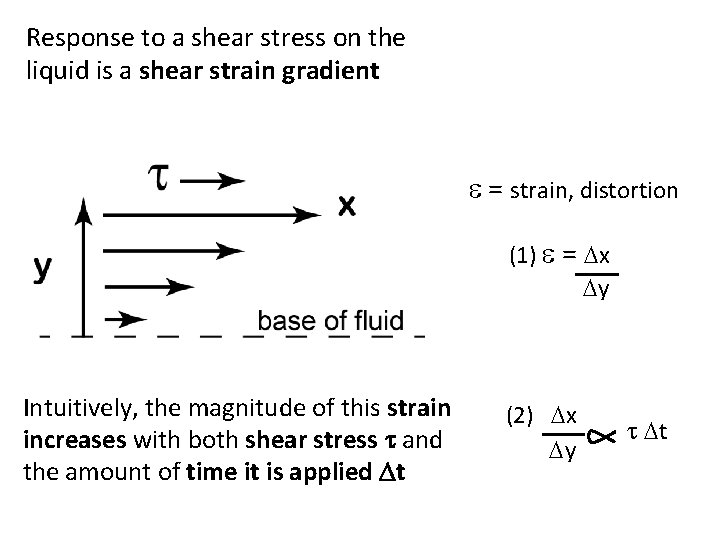
Response to a shear stress on the liquid is a shear strain gradient e = strain, distortion (1) e = Dx Dy Intuitively, the magnitude of this strain (2) Dx increases with both shear stress t and Dy the amount of time it is applied Dt t Dt
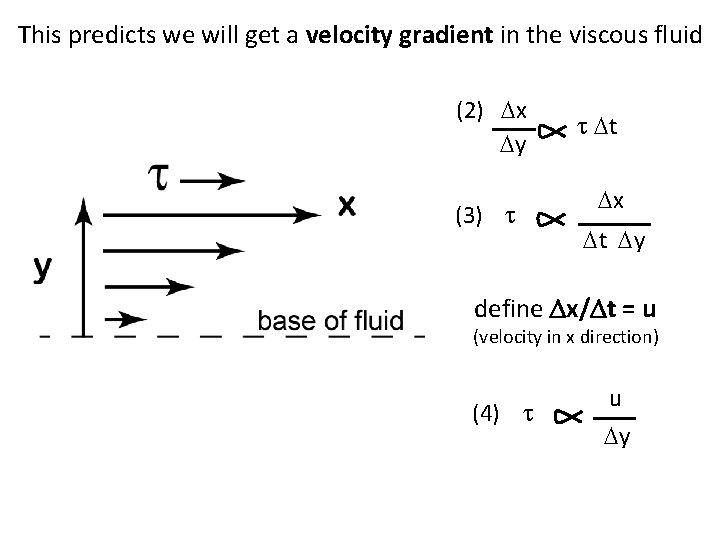
This predicts we will get a velocity gradient in the viscous fluid (2) Dx Dy (3) t t Dt Dx Dt Dy define Dx/Dt = u (velocity in x direction) (4) t u Dy
This predicts we will get a velocity gradient in the viscous fluid (2) Dx Dy (3) t t Dt Dx Dt Dy define Dx/Dt = u (velocity in x direction) This is basis for defining viscosity = resistance to flow viscosity is the constant that relates the two sides (4) t = h u Dy
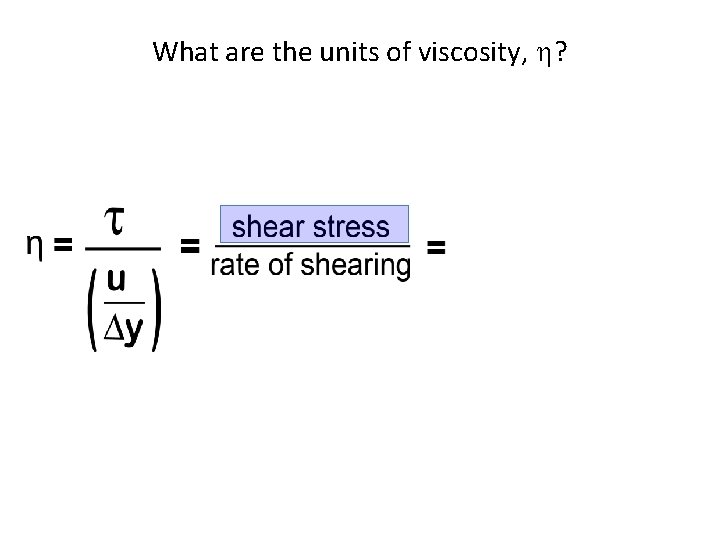
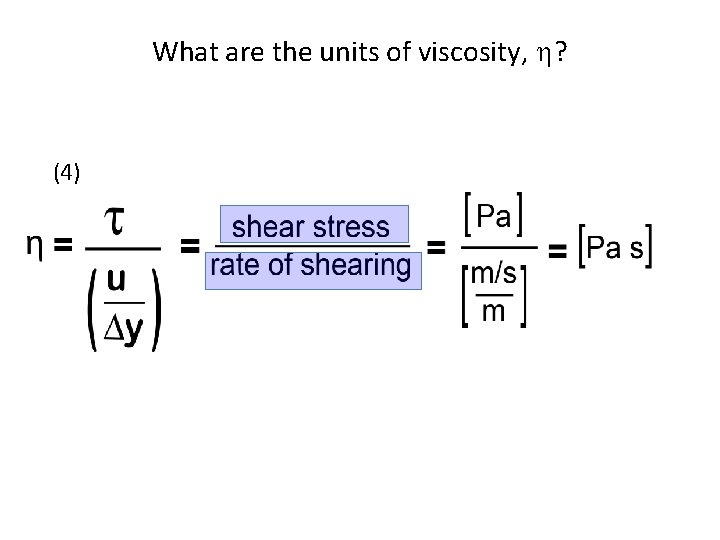
What are the units of viscosity, h?
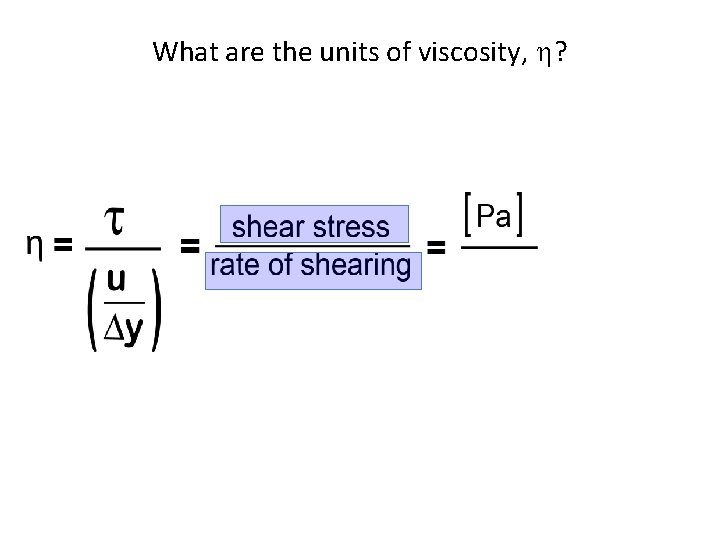
What are the units of viscosity, h?
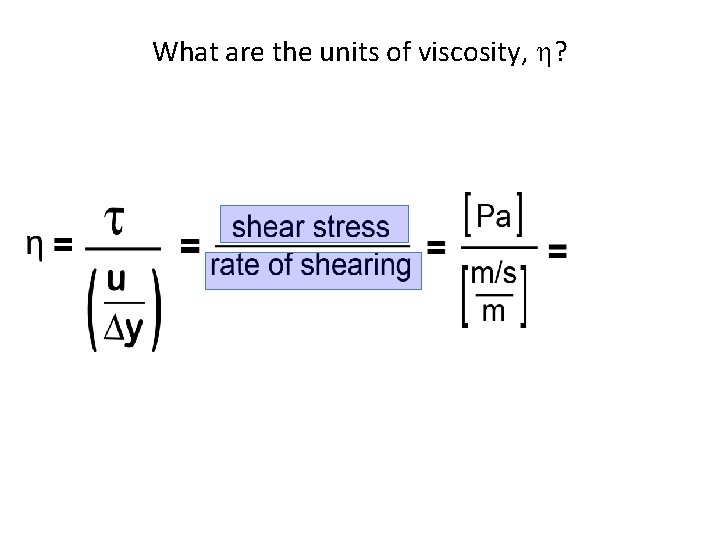
What are the units of viscosity, h?
What are the units of viscosity, h? (4)
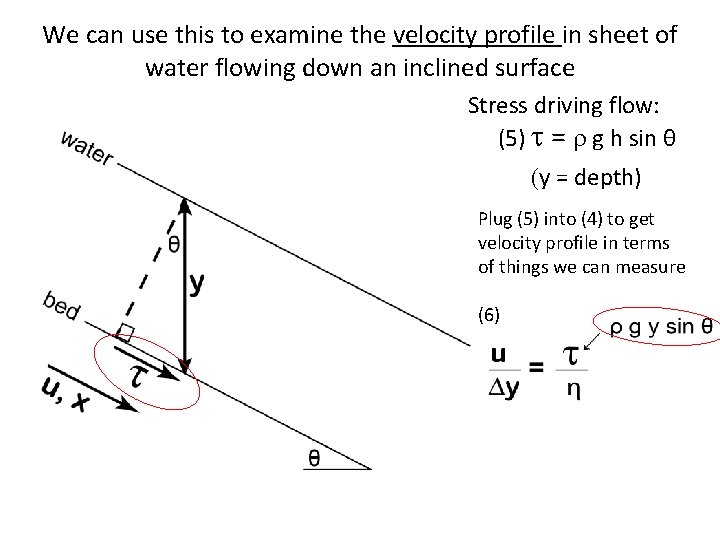
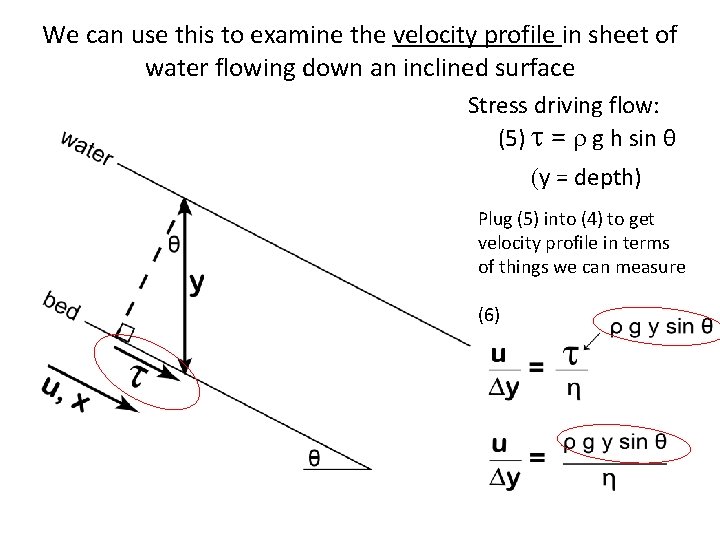
We can use this to examine the velocity profile in sheet of water flowing down an inclined surface Stress driving flow: (5) t = r g h sin θ (y = depth) Plug (5) into (4) to get velocity profile in terms of things we can measure (6)
We can use this to examine the velocity profile in sheet of water flowing down an inclined surface Stress driving flow: (5) t = r g h sin θ (y = depth) Plug (5) into (4) to get velocity profile in terms of things we can measure (6)
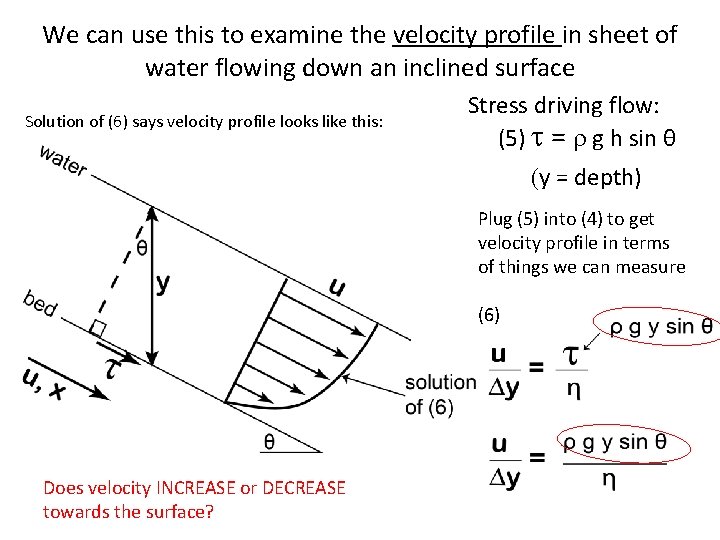
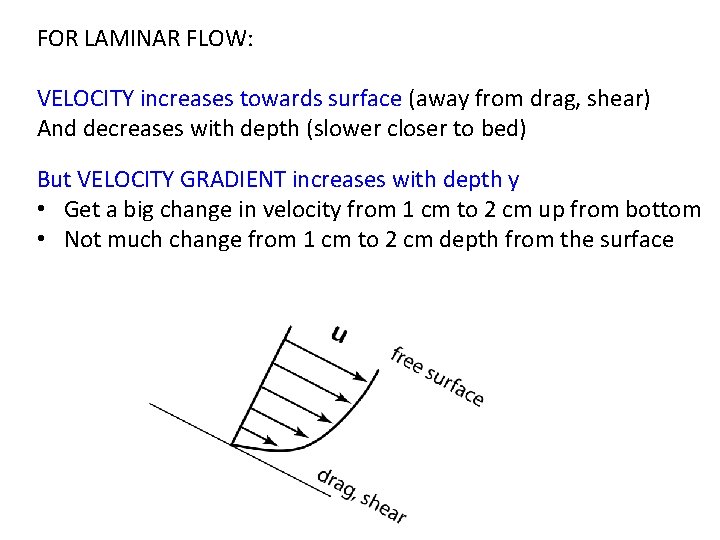
We can use this to examine the velocity profile in sheet of water flowing down an inclined surface Solution of (6) says velocity profile looks like this: Stress driving flow: (5) t = r g h sin θ (y = depth) Plug (5) into (4) to get velocity profile in terms of things we can measure (6) Does velocity INCREASE or DECREASE towards the surface?
FOR LAMINAR FLOW: VELOCITY increases towards surface (away from drag, shear) And decreases with depth (slower closer to bed) But VELOCITY GRADIENT increases with depth y • Get a big change in velocity from 1 cm to 2 cm up from bottom • Not much change from 1 cm to 2 cm depth from the surface
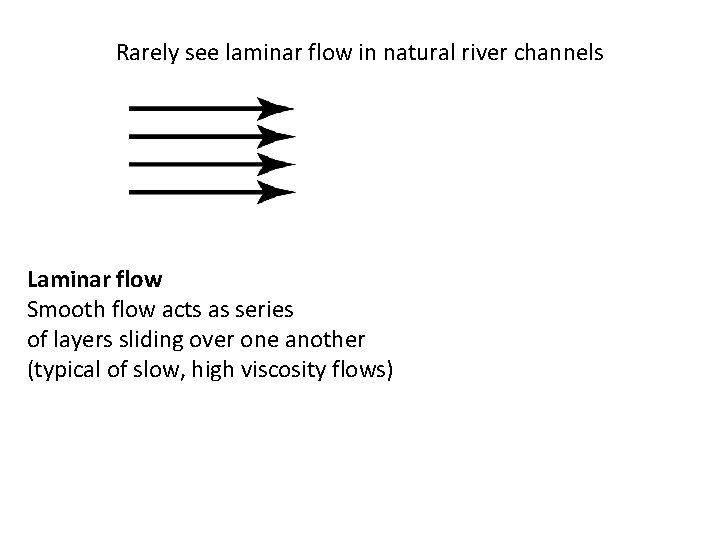
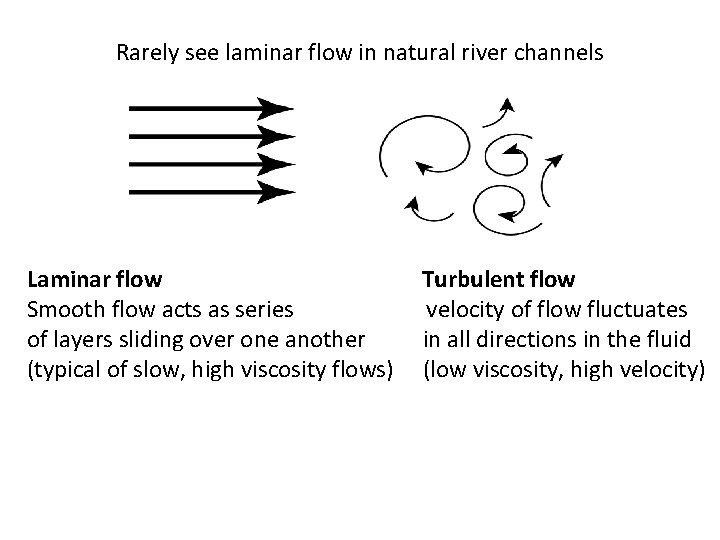
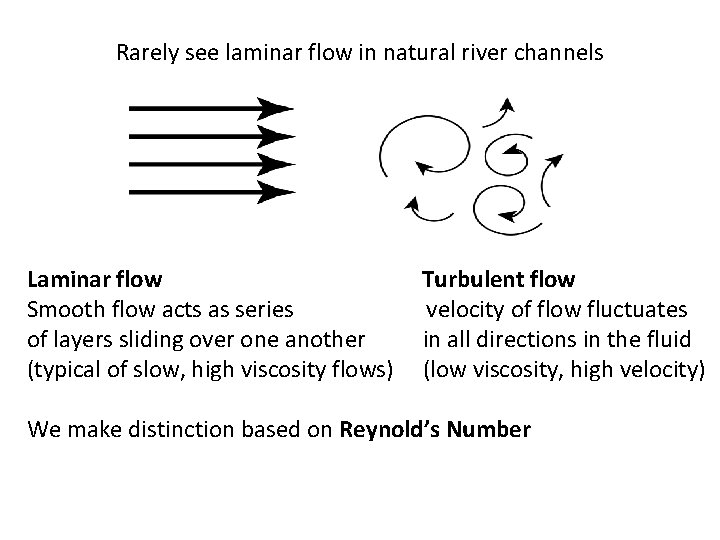
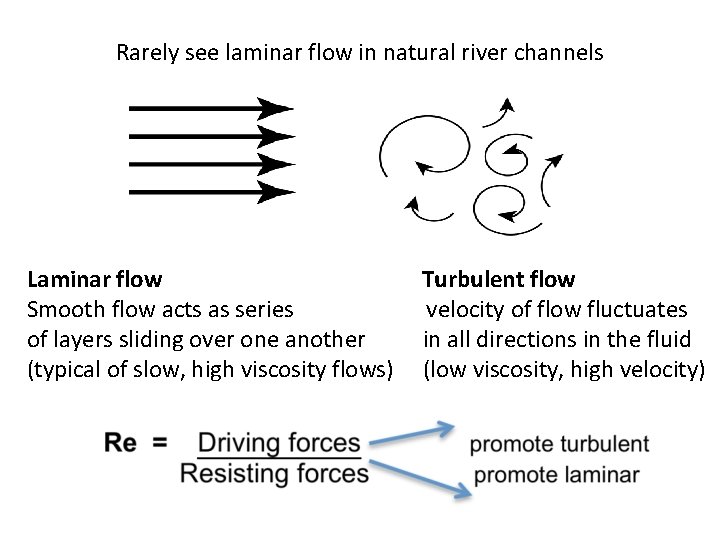
Rarely see laminar flow in natural river channels Laminar flow Turbulent flow Smooth flow acts as series velocity of flow fluctuates of layers sliding over one another in all directions in the fluid (typical of slow, high viscosity flows) (low viscosity, high velocity) We make distinction based on Reynold’s Number
Rarely see laminar flow in natural river channels Laminar flow Turbulent flow Smooth flow acts as series velocity of flow fluctuates of layers sliding over one another in all directions in the fluid (typical of slow, high viscosity flows) (low viscosity, high velocity) We make distinction based on Reynold’s Number
Rarely see laminar flow in natural river channels Laminar flow Turbulent flow Smooth flow acts as series velocity of flow fluctuates of layers sliding over one another in all directions in the fluid (typical of slow, high viscosity flows) (low viscosity, high velocity) We make distinction based on Reynold’s Number
Rarely see laminar flow in natural river channels Laminar flow Turbulent flow Smooth flow acts as series velocity of flow fluctuates of layers sliding over one another in all directions in the fluid (typical of slow, high viscosity flows) (low viscosity, high velocity) We make distinction based on Reynold’s Number
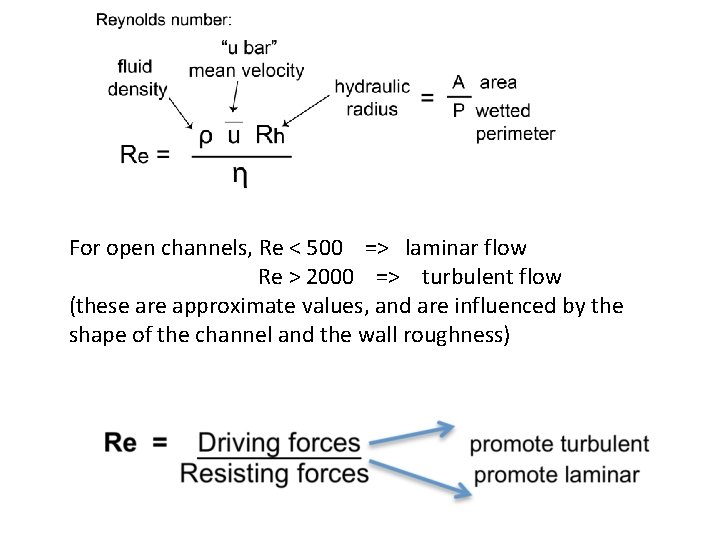
For open channels, Re < 500 => laminar flow Re > 2000 => turbulent flow (these are approximate values, and are influenced by the shape of the channel and the wall roughness)
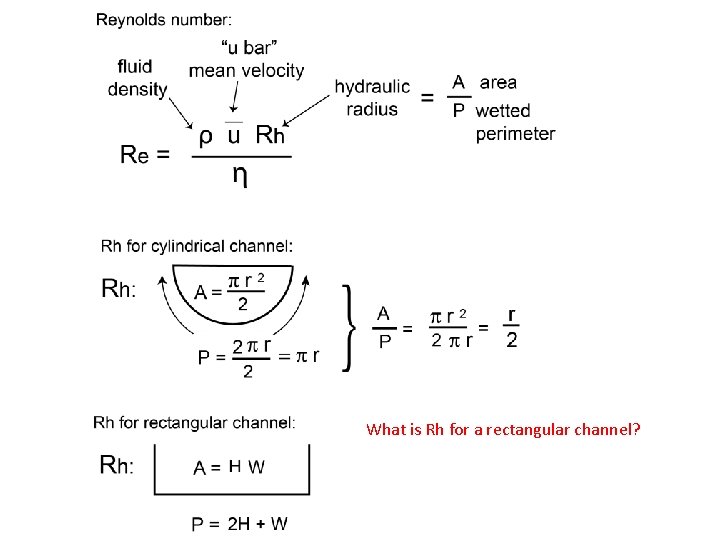
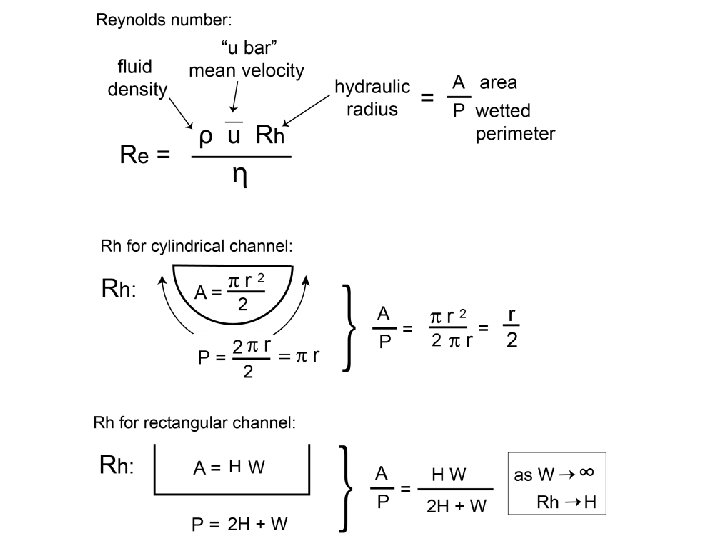
What is Rh for a rectangular channel?
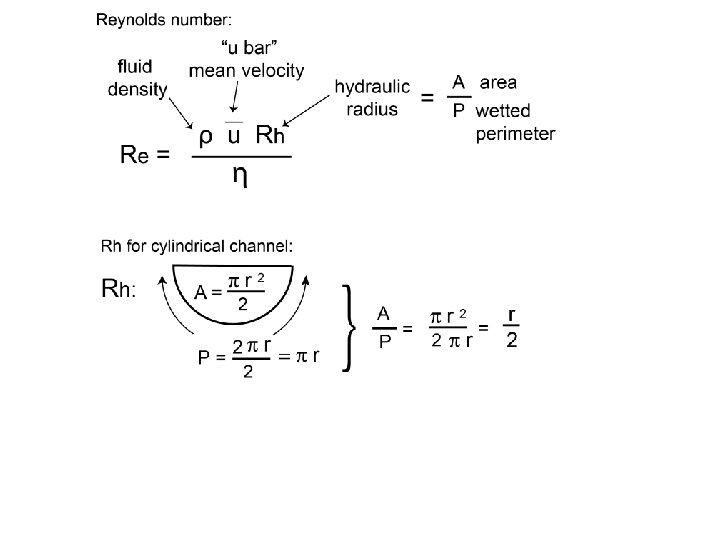
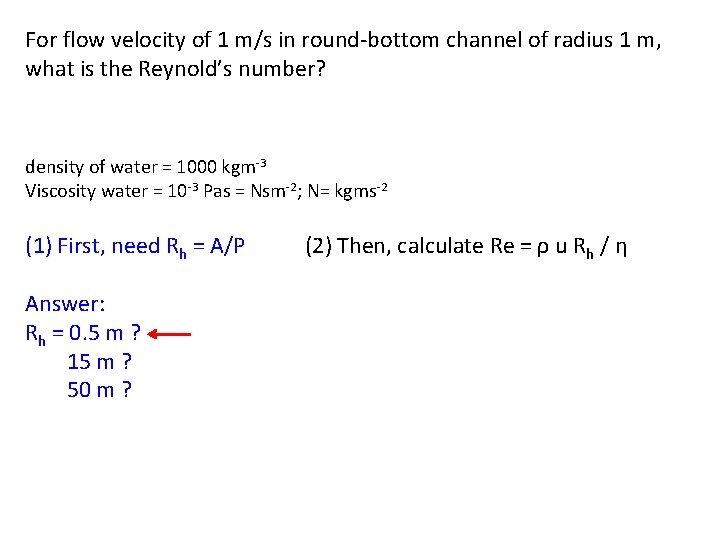
For flow velocity of 1 m/s in round-bottom channel of radius 1 m, what is the Reynold’s number? Is the flow laminar or turbulent? Re < 500 laminar Re > 2000 turbulent 500 to 2000 elements of both density of water = 1000 kgm-3 Viscosity water = 10 -3 Pas = Nsm-2; N= kgms-2 (1) First, need Rh = A/P (2) Then, calculate Re = ρ u Rh / η Answer: Rh = 0. 5 m ? 15 m ? 50 m ?
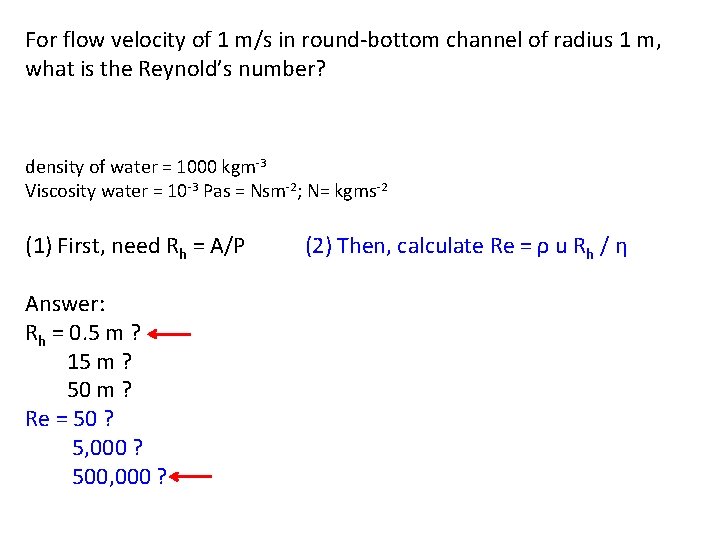
For flow velocity of 1 m/s in round-bottom channel of radius 1 m, what is the Reynold’s number? Is the flow laminar or turbulent? Re < 500 laminar Re > 2000 turbulent 500 to 2000 elements of both density of water = 1000 kgm-3 Viscosity water = 10 -3 Pas = Nsm-2; N= kgms-2 (1) First, need Rh = A/P (2) Then, calculate Re = ρ u Rh / η Answer: Rh = 0. 5 m ? 15 m ? 50 m ? Re = 50 ? 5, 000 ? 500, 000 ?
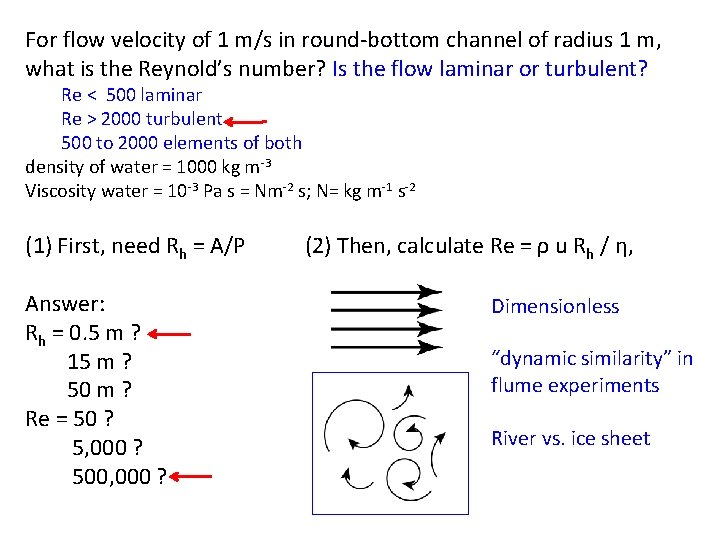
For flow velocity of 1 m/s in round-bottom channel of radius 1 m, what is the Reynold’s number? Is the flow laminar or turbulent? Re < 500 laminar Re > 2000 turbulent 500 to 2000 elements of both density of water = 1000 kg m-3 Viscosity water = 10 -3 Pa s = Nm-2 s; N= kg m-1 s-2 (1) First, need Rh = A/P (2) Then, calculate Re = ρ u Rh / η, Answer: Rh = 0. 5 m ? 15 m ? 50 m ? Re = 50 ? 5, 000 ? 500, 000 ? Dimensionless “dynamic similarity” in flume experiments River vs. ice sheet
www. youtube. com/watch? v=RJx. OI 0 u. UIAw (St Anthony Falls experimental lab sediment transport video)
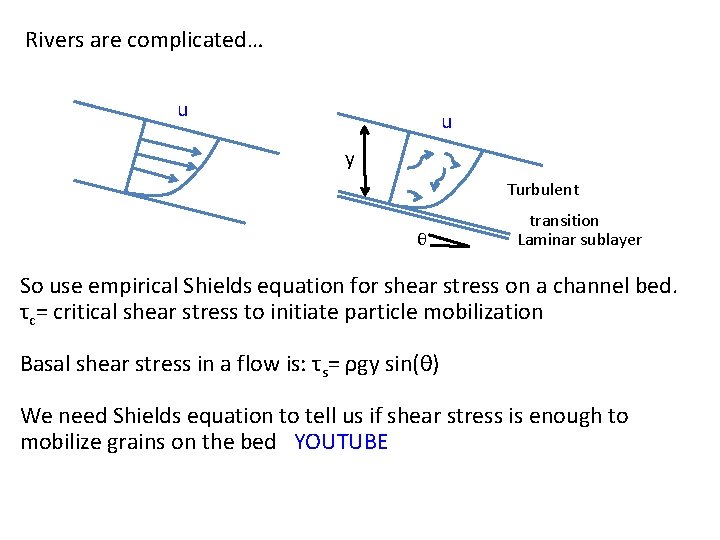
Rivers are complicated… u u y Turbulent θ transition Laminar sublayer So use empirical Shields equation for shear stress on a channel bed. τc= critical shear stress to initiate particle mobilization Basal shear stress in a flow is: τs= ρgy sin(θ) We need Shields equation to tell us if shear stress is enough to mobilize grains on the bed YOUTUBE
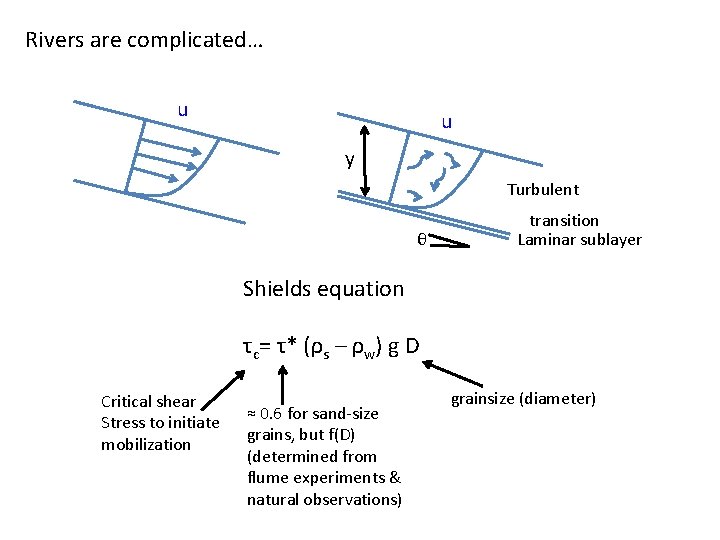
Rivers are complicated… u u y Turbulent θ transition Laminar sublayer Shields equation τc= τ* (ρs – ρw) g D Critical shear Stress to initiate mobilization ≈ 0. 6 for sand-size grains, but f(D) (determined from flume experiments & natural observations) grainsize (diameter)
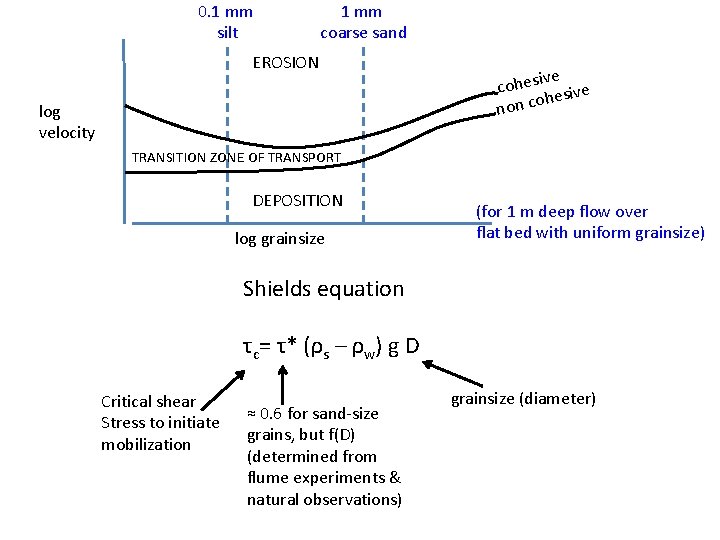
0. 1 mm silt 1 mm coarse sand EROSION log velocity ive cohes esive h non co TRANSITION ZONE OF TRANSPORT DEPOSITION log grainsize (for 1 m deep flow over flat bed with uniform grainsize) Shields equation τc= τ* (ρs – ρw) g D Critical shear Stress to initiate mobilization ≈ 0. 6 for sand-size grains, but f(D) (determined from flume experiments & natural observations) grainsize (diameter)
Bedload – coarse material/larger particles move by rolling in a shearing fluid. Sedimentary particles supported by the bed. Also saltation – “saltare = jump. ” skipping where an impacted grain bounces high enough to pass through laminar sublayer Suspended load – suspended particles are kept aloft by turbulent eddies which transfer momentum from fluid to particle, moving it upward at a rate that is faster than its settling velocity - typically 90 -95% of sed moved by rivers - clay, silt, sometimes fine sand settling velocity: Stoke’s Law - viscosity, denisty of fluid (uniform in a river) - size, shape, density of particles (not uniform in a river) (dissolved load – ions from chemical weathering reactions)
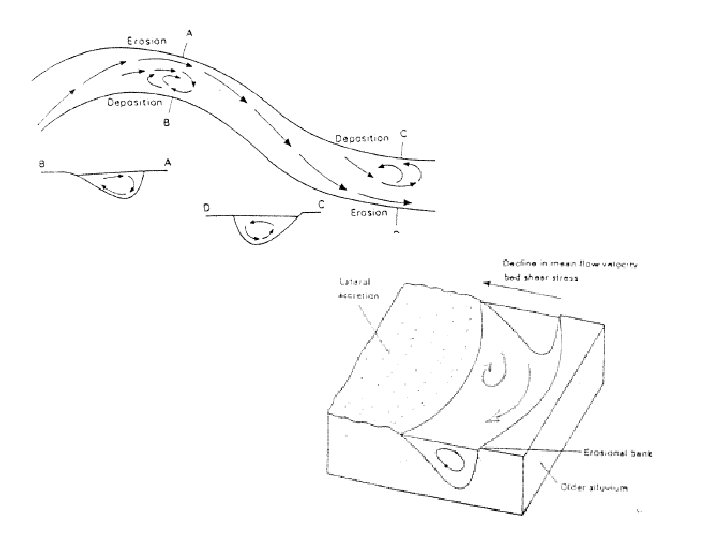
Depositional, transporting, erosional and entrainment regimes in a channel are determined by the flow regime (laminar, turbulent), flow velocity, and particle sizes making up the bed. Net result of particle motion by flow is… Beds acquire ripples from particles moving by rolling in a shearing fluid. Grains transported up upstream side (erosion), cascade down the slip face of downstream side (deposition). Not just vertical velocity structure, but 3 -D velocity field in rivers affects sediment transport and gives rivers the morphologies and behaviors we observe.
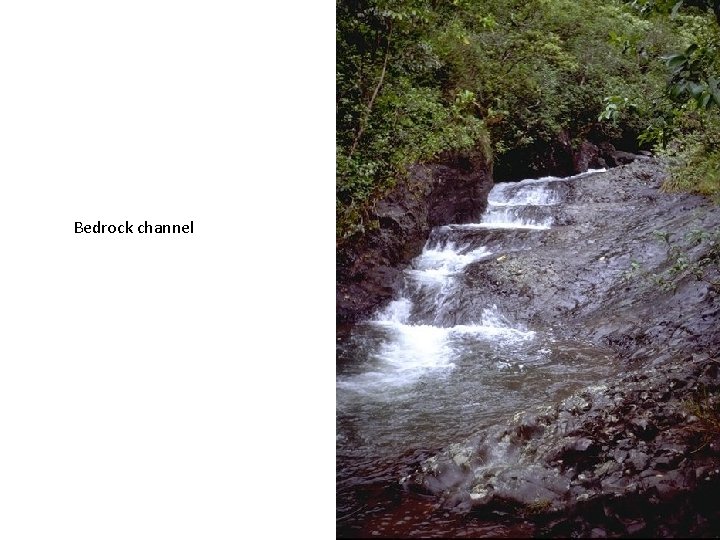
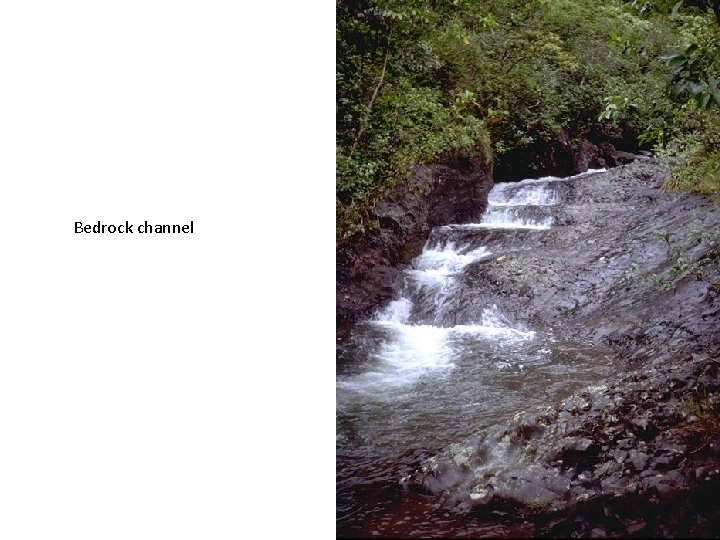
Bedrock channel
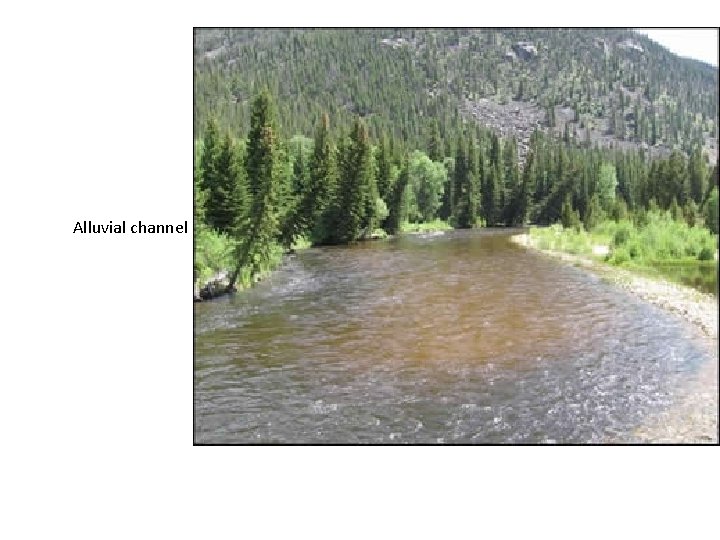
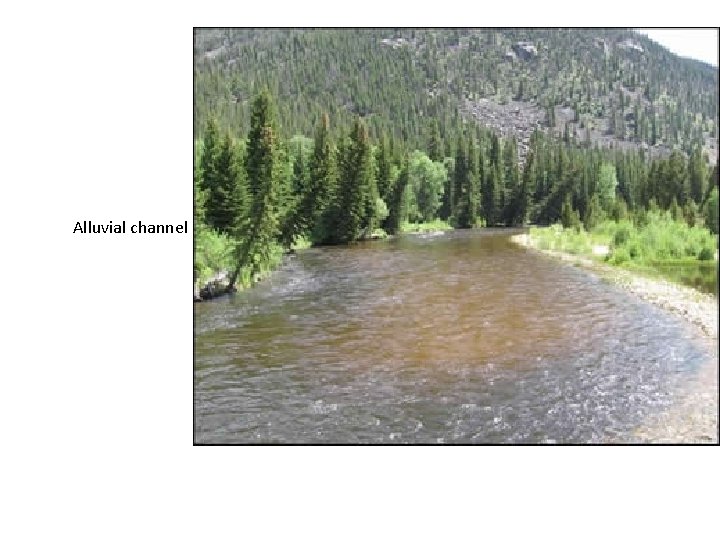
Alluvial channel
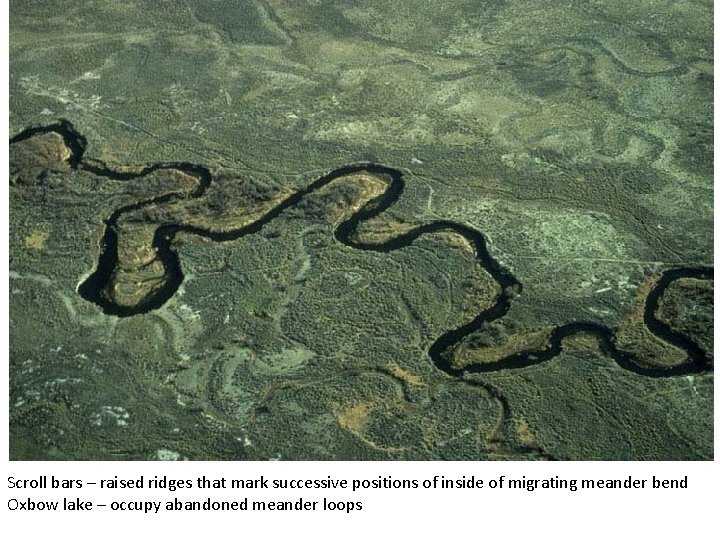
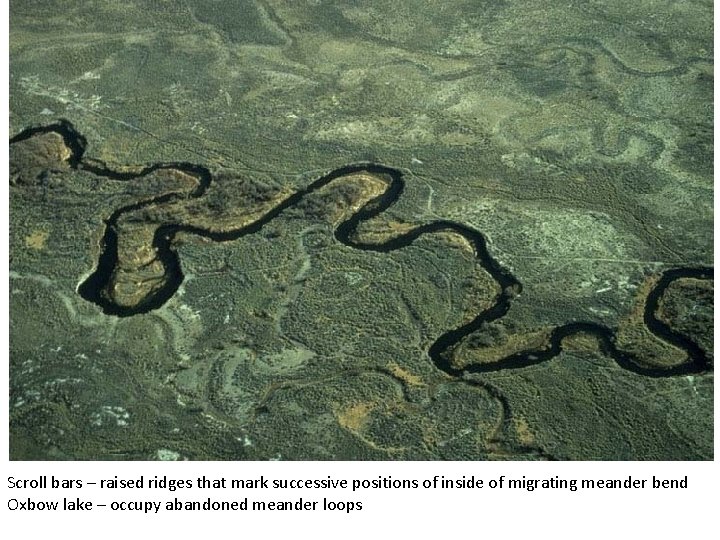
Scroll bars – raised ridges that mark successive positions of inside of migrating meander bend Oxbow lake – occupy abandoned meander loops
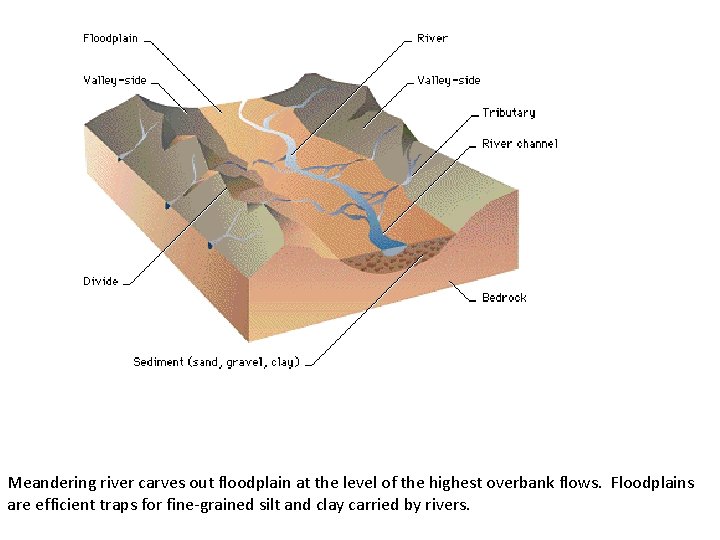
Meandering river carves out floodplain at the level of the highest overbank flows. Floodplains are efficient traps for fine-grained silt and clay carried by rivers.
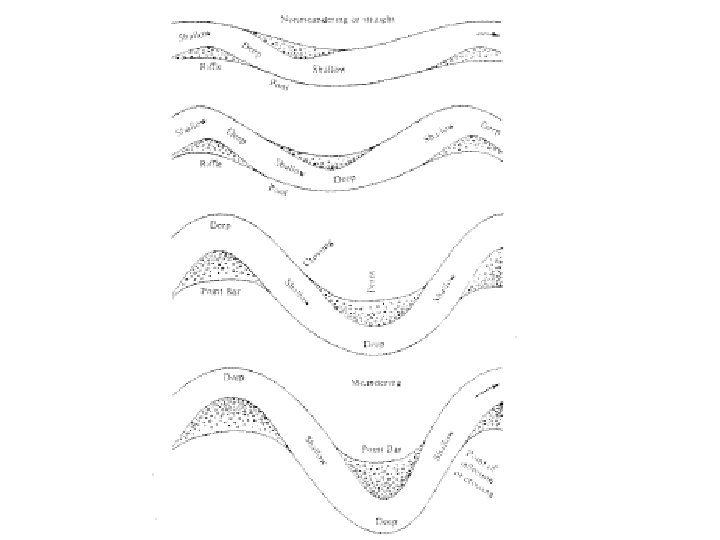
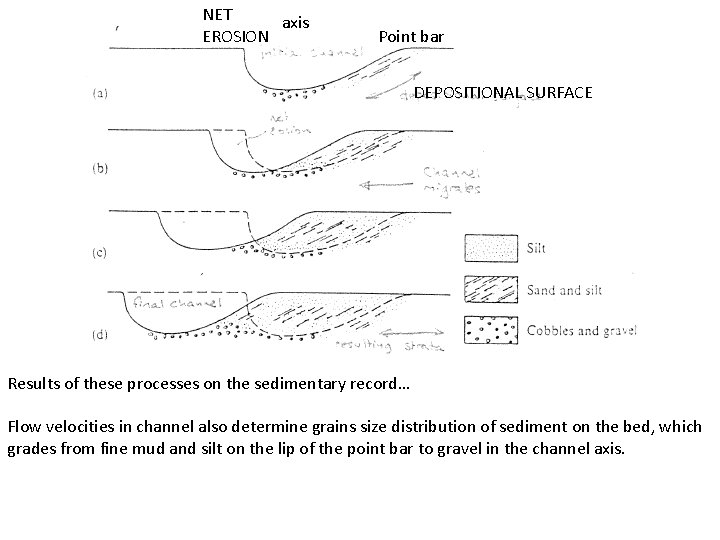
NET axis EROSION Point bar DEPOSITIONAL SURFACE Results of these processes on the sedimentary record… Flow velocities in channel also determine grains size distribution of sediment on the bed, which grades from fine mud and silt on the lip of the point bar to gravel in the channel axis.
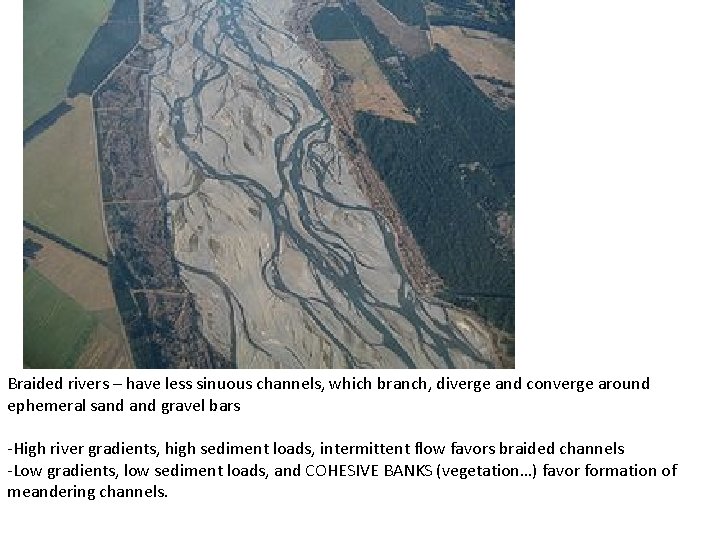
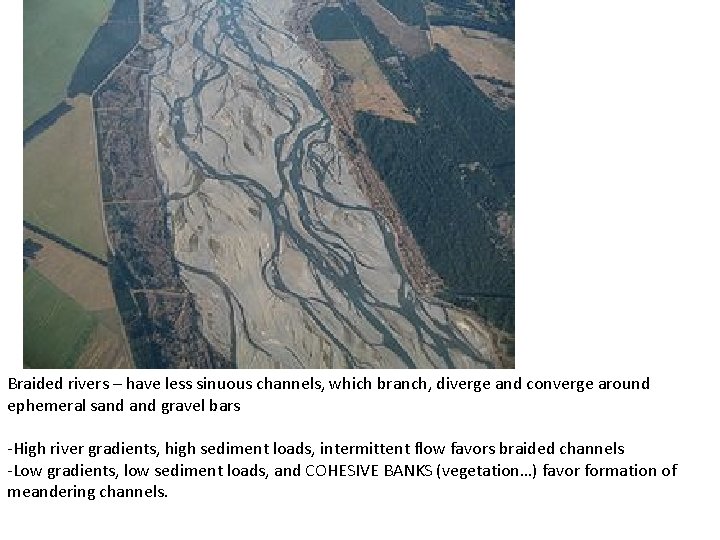
Braided rivers – have less sinuous channels, which branch, diverge and converge around ephemeral sand gravel bars -High river gradients, high sediment loads, intermittent flow favors braided channels -Low gradients, low sediment loads, and COHESIVE BANKS (vegetation…) favor formation of meandering channels.
Bedrock channel
Alluvial channel
Braided rivers – have less sinuous channels, which branch, diverge and converge around ephemeral sand gravel bars -High river gradients, high sediment loads, intermittent flow favors braided channels -Low gradients, low sediment loads, and COHESIVE BANKS (vegetation…) favor formation of meandering channels.
Scroll bars – raised ridges that mark successive positions of inside of migrating meander bend Oxbow lake – occupy abandoned meander loops
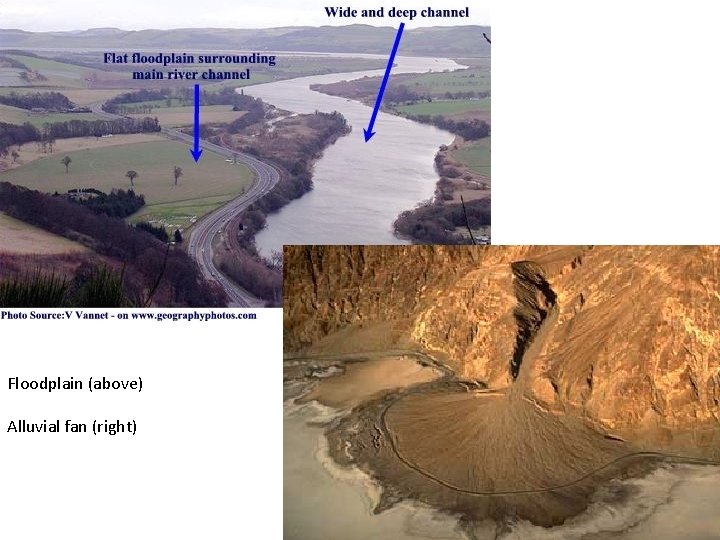
Floodplain (above) Alluvial fan (right)
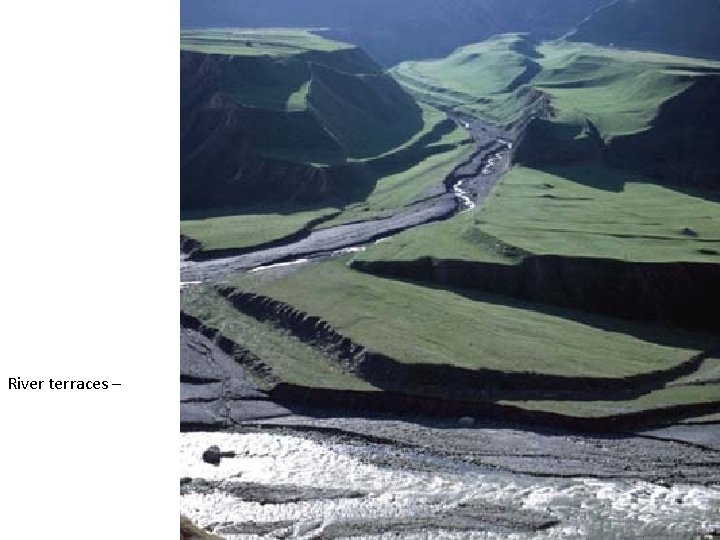
River terraces –