
Next Horizons Dr Paul A Daniels Guildford Astronomical

- Slides: 12
Next Horizons? Dr Paul A Daniels, Guildford Astronomical Society
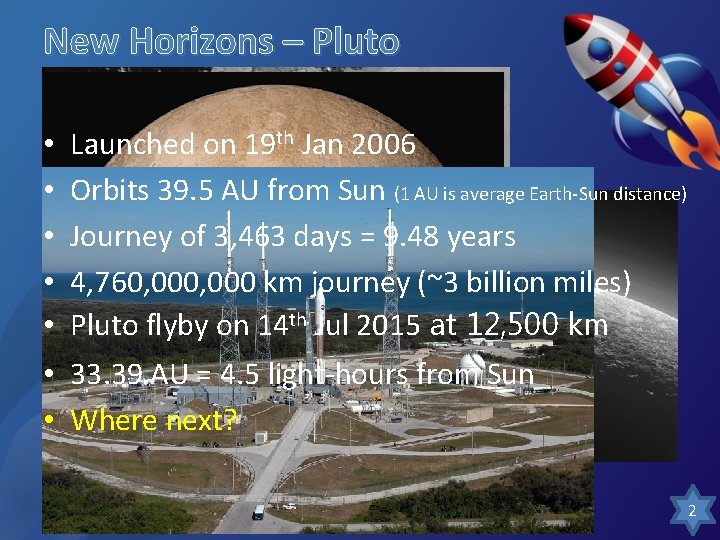
New Horizons – Pluto • • • Launched on 19 th Jan 2006 Orbits 39. 5 AU from Sun (1 AU is average Earth-Sun distance) Journey of 3, 463 days = 9. 48 years 4, 760, 000 km journey (~3 billion miles) Pluto flyby on 14 th Jul 2015 at 12, 500 km • 33. 39 AU = 4. 5 light-hours from Sun • Where next? 2
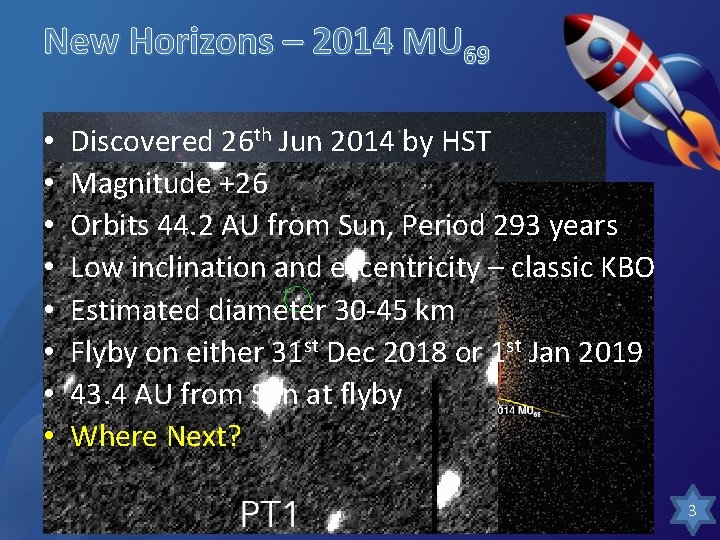
New Horizons – 2014 MU 69 • • Discovered 26 th Jun 2014 by HST Magnitude +26 Orbits 44. 2 AU from Sun, Period 293 years Low inclination and eccentricity – classic KBO Estimated diameter 30 -45 km Flyby on either 31 st Dec 2018 or 1 st Jan 2019 43. 4 AU from Sun at flyby Where Next? 3
To Infinity and Beyond? • Where would we like to go? – Nearest star! – ‘Interesting’ star!! – Earth-like exoplanet!!! – Across the galaxy!!!! – Another galaxy!!!!! • Can we? 4
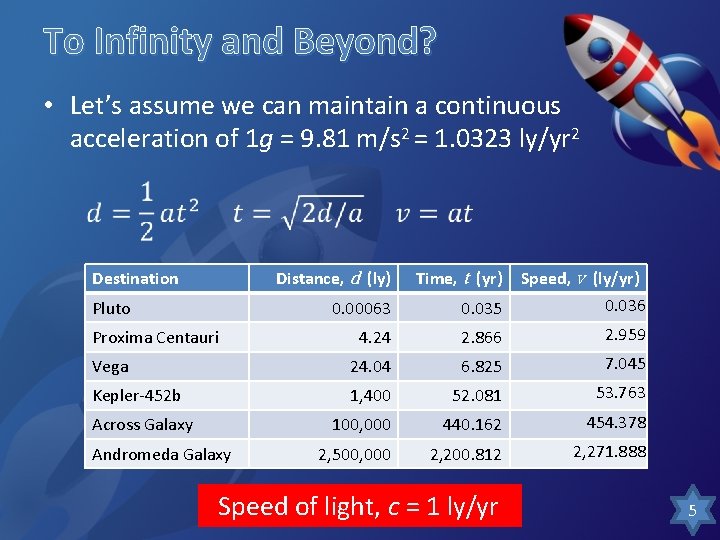
To Infinity and Beyond? • Let’s assume we can maintain a continuous acceleration of 1 g = 9. 81 m/s 2 = 1. 0323 ly/yr 2 Distance, d (ly) Time, t (yr) 0. 00063 0. 035 Speed, v (ly/yr) 0. 036 4. 24 2. 866 2. 959 Vega 24. 04 6. 825 7. 045 Kepler-452 b 1, 400 52. 081 53. 763 100, 000 440. 162 454. 378 2, 500, 000 2, 200. 812 2, 271. 888 Destination Pluto Proxima Centauri Across Galaxy Andromeda Galaxy Speed of light, c = 1 ly/yr 5
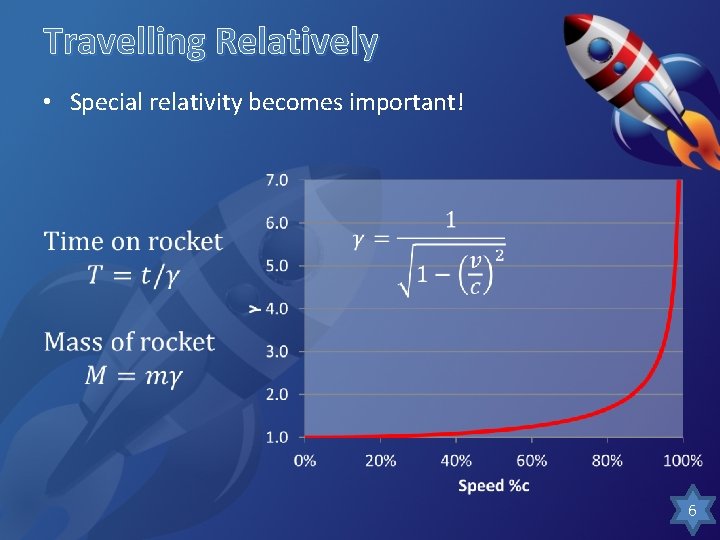
Travelling Relatively • Special relativity becomes important! 6
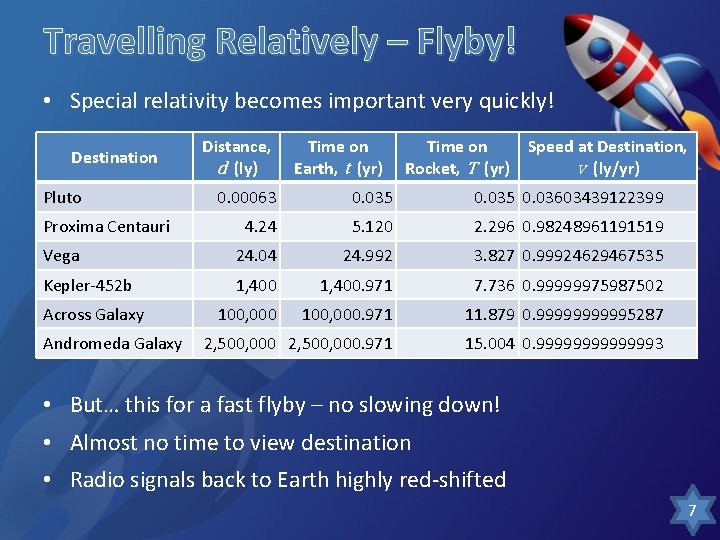
Travelling Relatively – Flyby! • Special relativity becomes important very quickly! Destination Pluto Distance, d (ly) Time on Earth, t (yr) Time on Speed at Destination, Rocket, T (yr) v (ly/yr) 0. 00063 0. 035 0. 03603439122399 4. 24 5. 120 2. 296 0. 98248961191519 Vega 24. 04 24. 992 3. 827 0. 99924629467535 Kepler-452 b 1, 400. 971 7. 736 0. 99999975987502 100, 000. 971 11. 879 0. 999995287 2, 500, 000. 971 15. 004 0. 99999993 Proxima Centauri Across Galaxy Andromeda Galaxy • But… this for a fast flyby – no slowing down! • Almost no time to view destination • Radio signals back to Earth highly red-shifted 7
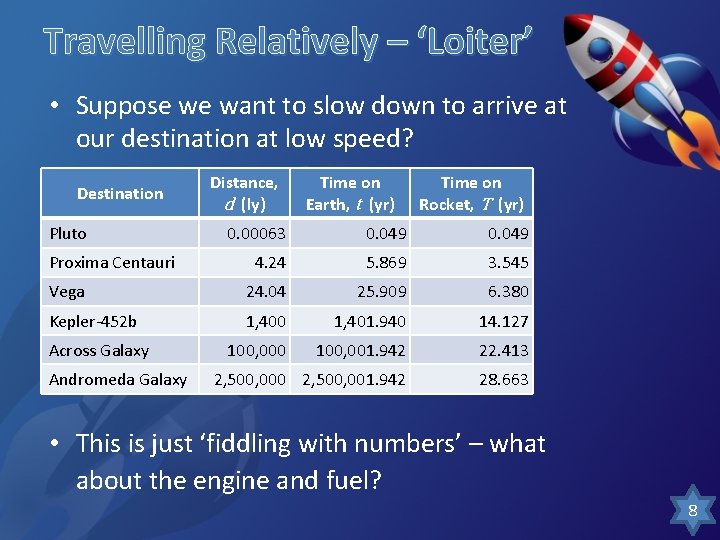
Travelling Relatively – ‘Loiter’ • Suppose we want to slow down to arrive at our destination at low speed? Destination Pluto Distance, d (ly) Time on Earth, t (yr) Time on Rocket, T (yr) 0. 00063 0. 049 4. 24 5. 869 3. 545 Vega 24. 04 25. 909 6. 380 Kepler-452 b 1, 400 1, 401. 940 14. 127 100, 000 100, 001. 942 22. 413 2, 500, 000 2, 500, 001. 942 28. 663 Proxima Centauri Across Galaxy Andromeda Galaxy • This is just ‘fiddling with numbers’ – what about the engine and fuel? 8
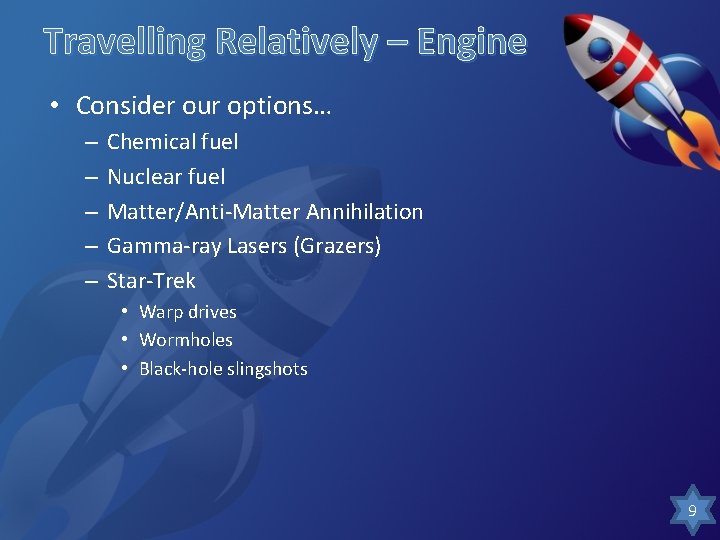
Travelling Relatively – Engine • Consider our options… – – – Chemical fuel Nuclear fuel Matter/Anti-Matter Annihilation Gamma-ray Lasers (Grazers) Star-Trek • Warp drives • Wormholes • Black-hole slingshots 9
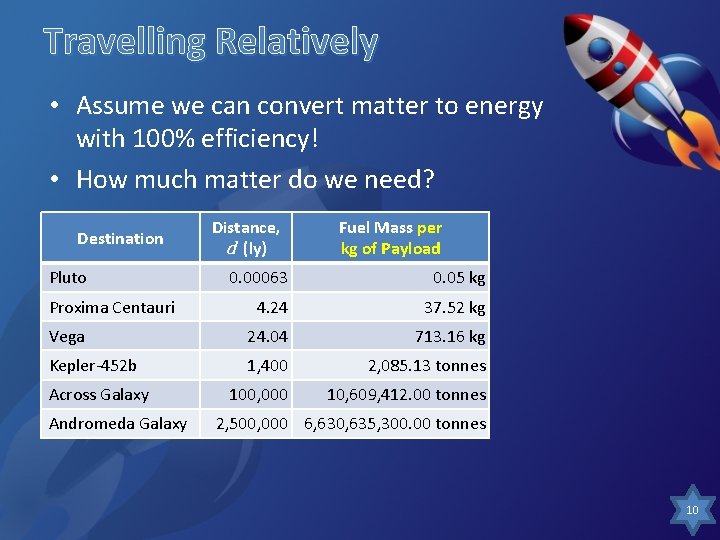
Travelling Relatively • Assume we can convert matter to energy with 100% efficiency! • How much matter do we need? Destination Pluto Distance, d (ly) Fuel Mass per kg of Payload 0. 00063 0. 05 kg 4. 24 37. 52 kg Vega 24. 04 713. 16 kg Kepler-452 b 1, 400 2, 085. 13 tonnes 100, 000 10, 609, 412. 00 tonnes Proxima Centauri Across Galaxy Andromeda Galaxy 2, 500, 000 6, 630, 635, 300. 00 tonnes 10
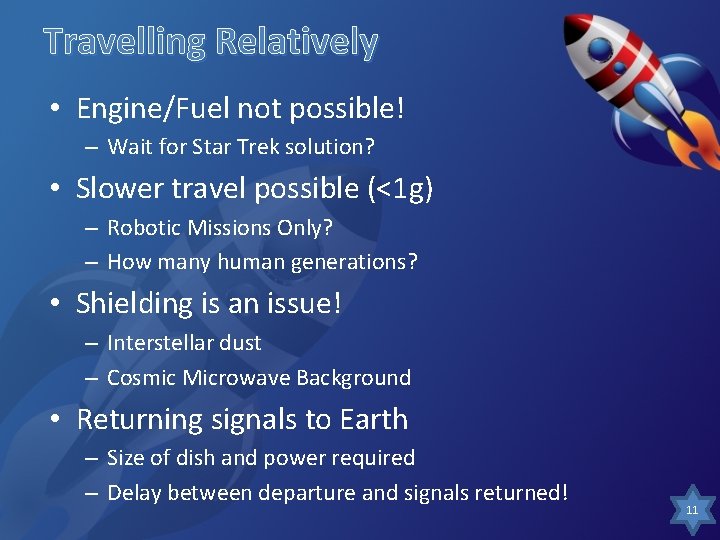
Travelling Relatively • Engine/Fuel not possible! – Wait for Star Trek solution? • Slower travel possible (<1 g) – Robotic Missions Only? – How many human generations? • Shielding is an issue! – Interstellar dust – Cosmic Microwave Background • Returning signals to Earth – Size of dish and power required – Delay between departure and signals returned! 11
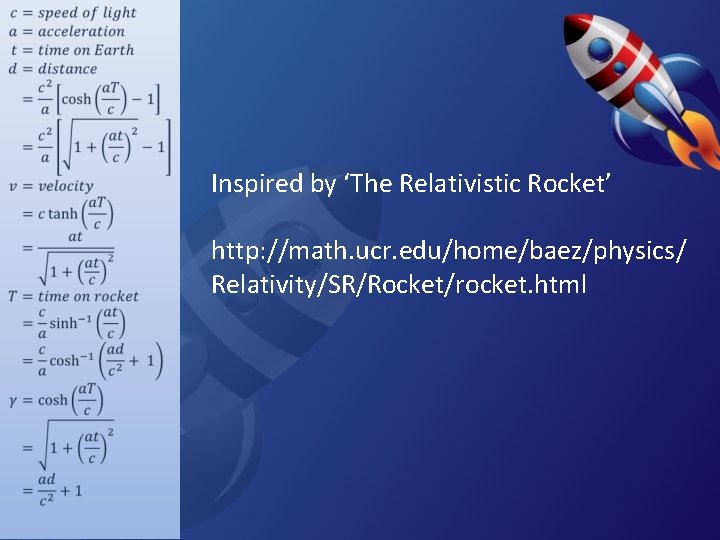
Inspired by ‘The Relativistic Rocket’ http: //math. ucr. edu/home/baez/physics/ Relativity/SR/Rocket/rocket. html