
Next Generation Water Recovery for a Sustainable Closed
Next Generation Water Recovery for a Sustainable Closed Loop Living Dan Wang Santosh H. Vijapur Timothy D. Hall E. Jennings Taylor Stephen T. Snyder Carlos. R. Cabrera (University of Puerto Rico) May 15, 2018
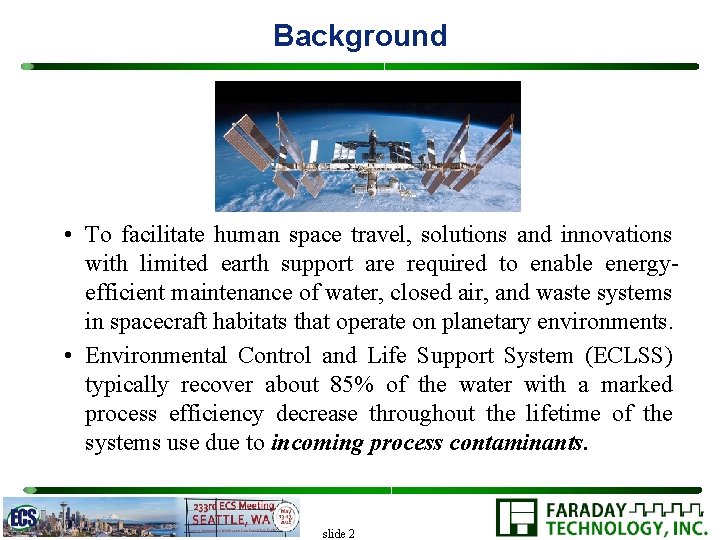
Background • To facilitate human space travel, solutions and innovations with limited earth support are required to enable energyefficient maintenance of water, closed air, and waste systems in spacecraft habitats that operate on planetary environments. • Environmental Control and Life Support System (ECLSS) typically recover about 85% of the water with a marked process efficiency decrease throughout the lifetime of the systems use due to incoming process contaminants. slide 2

Life Support System (LSS) Architecture for the International Space Station (ISS) Anderson, Sargusingh and Perry, NASA John Space Center & NASA Marshall Spaceflight Center. 47 th International Conference on Environmental Systems, July 2017. slide 3

Water Recovery System for ISS URINE PROCESSOR ASSEMBLY (UPA) Brine (waste) Vapor Compression Distillation (VCD) Distillate WATER PROCESSOR ASSEMBLY (WPA) o o Gas Separator Particulate filter Multifiltration bed Volatile removal assembly Water Recovery System (WRS) R. L. Carrasquillo “Status of the Node 3 Regenerative ECLSS Water Recovery and Oxygen Generation Systems”. 33 rd Intl Conf on Environmental Systems, SAE: Vancouver, Canada, 2003; Vol. 2003 -01 -2590. § Stabilized through the addition of pretreatment chemicals (Cr. O 3, H 2 SO 4, etc) § Water is recovered from the pretreated urine by VCD § Reverse osmosis (RO) removes other components § With time water recovery efficiency reduces due to RO membrane durability, fouling, and VCD contamination § Reduced efficiency leads to higher costs and increased need for ground support § ~95% of urine is water with 2% urea slide 4
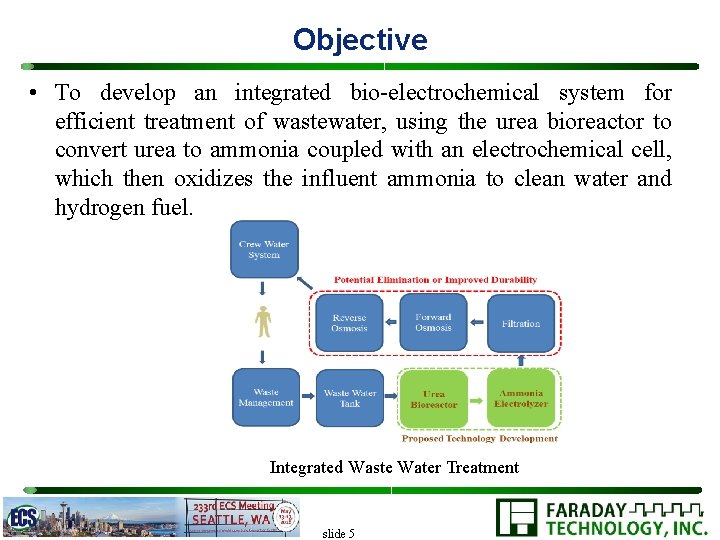
Objective • To develop an integrated bio-electrochemical system for efficient treatment of wastewater, using the urea bioreactor to convert urea to ammonia coupled with an electrochemical cell, which then oxidizes the influent ammonia to clean water and hydrogen fuel. Integrated Waste Water Treatment slide 5
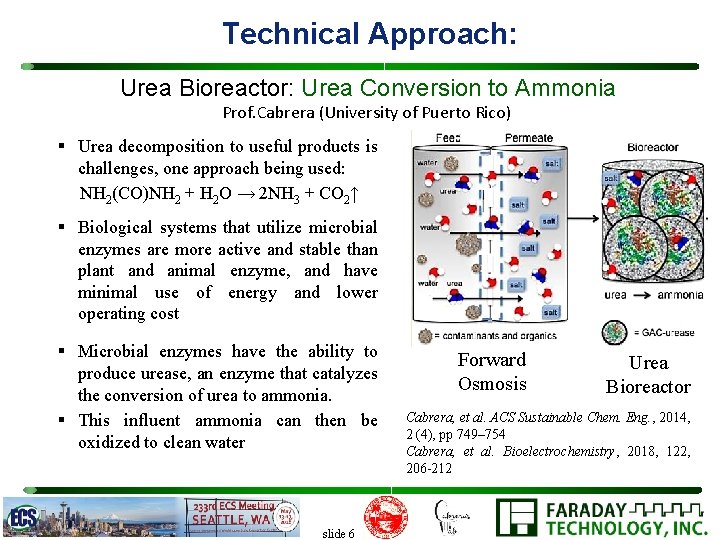
Technical Approach: Urea Bioreactor: Urea Conversion to Ammonia Prof. Cabrera (University of Puerto Rico) § Urea decomposition to useful products is challenges, one approach being used: NH 2(CO)NH 2 + H 2 O → 2 NH 3 + CO 2↑ § Biological systems that utilize microbial enzymes are more active and stable than plant and animal enzyme, and have minimal use of energy and lower operating cost § Microbial enzymes have the ability to produce urease, an enzyme that catalyzes the conversion of urea to ammonia. § This influent ammonia can then be oxidized to clean water slide 6 Forward Osmosis Urea Bioreactor Cabrera, et al. ACS Sustainable Chem. Eng. , 2014, 2 (4), pp 749– 754 Cabrera, et al. Bioelectrochemistry, 2018, 122, 206 -212
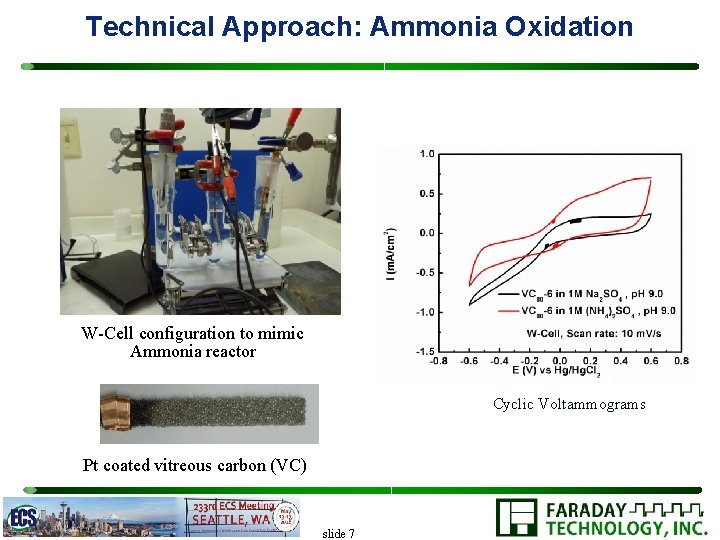
Technical Approach: Ammonia Oxidation W-Cell configuration to mimic Ammonia reactor Cyclic Voltammograms Pt coated vitreous carbon (VC) slide 7
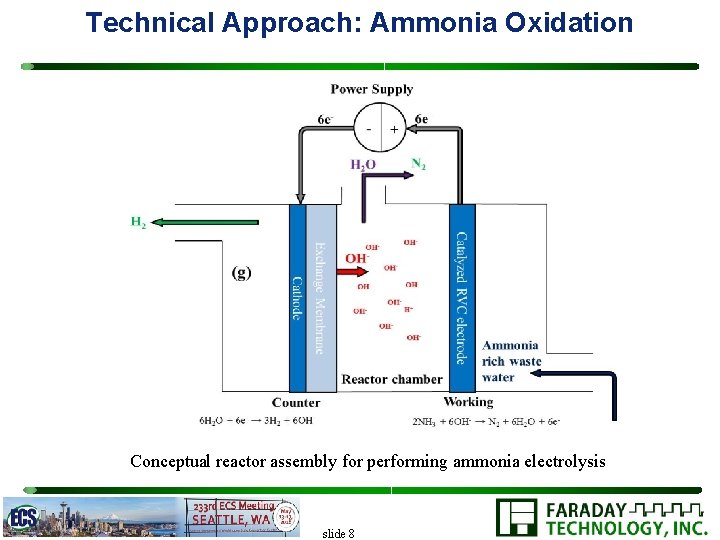
Technical Approach: Ammonia Oxidation Conceptual reactor assembly for performing ammonia electrolysis slide 8
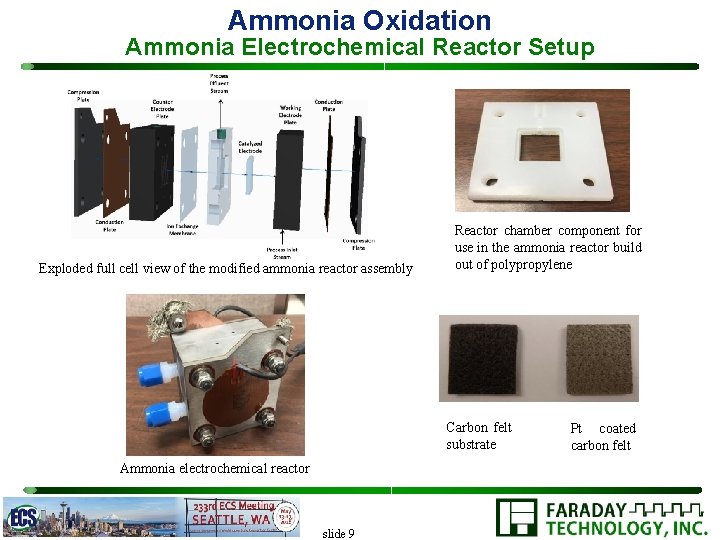
Ammonia Oxidation Ammonia Electrochemical Reactor Setup Exploded full cell view of the modified ammonia reactor assembly Reactor chamber component for use in the ammonia reactor build out of polypropylene Carbon felt substrate Ammonia electrochemical reactor slide 9 Pt coated carbon felt
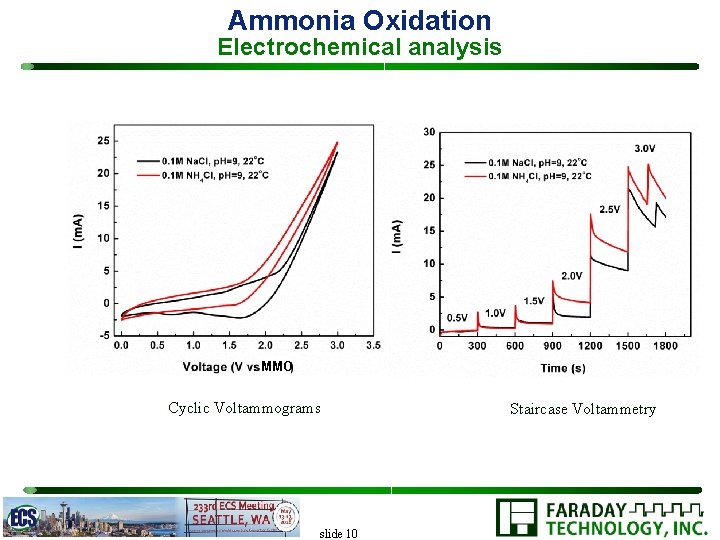
Ammonia Oxidation Electrochemical analysis MMO Cyclic Voltammograms slide 10 Staircase Voltammetry

Ammonia Oxidation Electrochemical analysis MMO Cyclic Voltammograms Staircase Voltammetry slide 11

Summary • Efficiently convert urea to ammonia using laboratory scale urea bioreactor • Successfully demonstrated ammonia oxidation using fabricated Pt working electrodes in electrochemical ammonia reactor system slide 12
Next Steps Demonstrate the integrated bio-electrochemical approach for determining and improving the ammonia conversion efficiency, by: • Optimizing the urea bioreactor conversion of urea to ammonia. for efficient • Utilizing the ammonia effluent, from the bioreactor, to feed ammonia reactor • Optimizing ammonia reactor operations with simulant process feed streams slide 13

The financial support of NASA Contract No. NNX 17 CA 30 P is acknowledged. Special thanks to all our team members for their support THANK YOU FOR YOUR ATTENTION! QUESTIONS? Contact Information: Dan Wang, Santosh Vijapur, Tim Hall, or EJ Taylor Ph: 937 -836 -7749 Email: jenningstaylor@faradaytechnology. com danwang@faradaytechnology. com santoshvijapur@faradaytechnology. com timhall@faradaytechnology. com
- Slides: 14