
Next Generation Science Standards 2 nd Draft Review
- Slides: 13
Next Generation Science Standards 2 nd Draft Review January 11, 2013 The Elementary Science Program Staff Members: Kathy Arminio, Director Mary Thomas, Assistant Director Antonietta Quinn, Resource Teacher Nancy Shellenberger, Resource Teacher
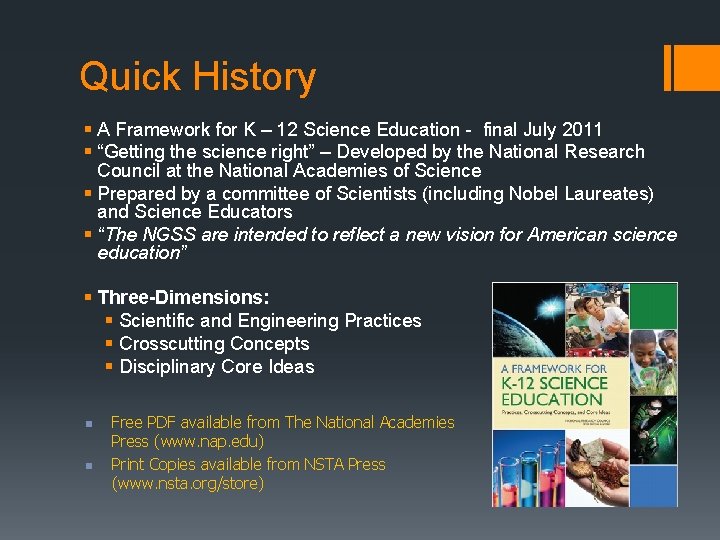
Quick History § A Framework for K – 12 Science Education - final July 2011 § “Getting the science right” – Developed by the National Research Council at the National Academies of Science § Prepared by a committee of Scientists (including Nobel Laureates) and Science Educators § “The NGSS are intended to reflect a new vision for American science education” § Three-Dimensions: § Scientific and Engineering Practices § Crosscutting Concepts § Disciplinary Core Ideas n n Free PDF available from The National Academies Press (www. nap. edu) Print Copies available from NSTA Press (www. nsta. org/store)
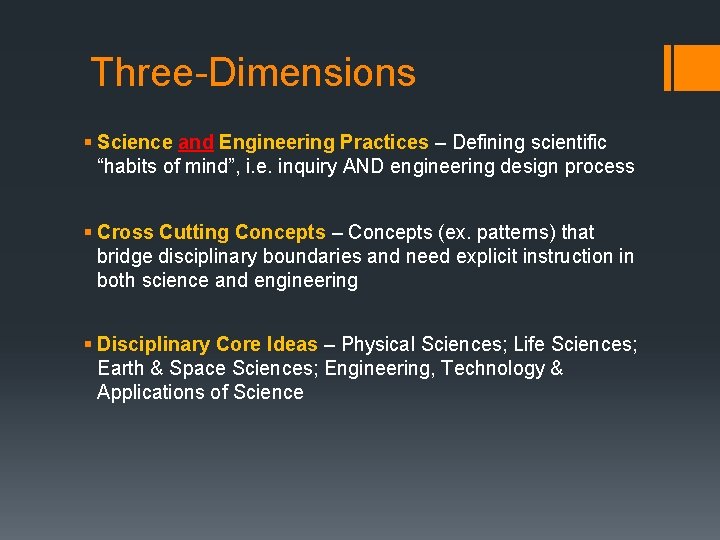
Three-Dimensions § Science and Engineering Practices – Defining scientific “habits of mind”, i. e. inquiry AND engineering design process § Cross Cutting Concepts – Concepts (ex. patterns) that bridge disciplinary boundaries and need explicit instruction in both science and engineering § Disciplinary Core Ideas – Physical Sciences; Life Sciences; Earth & Space Sciences; Engineering, Technology & Applications of Science
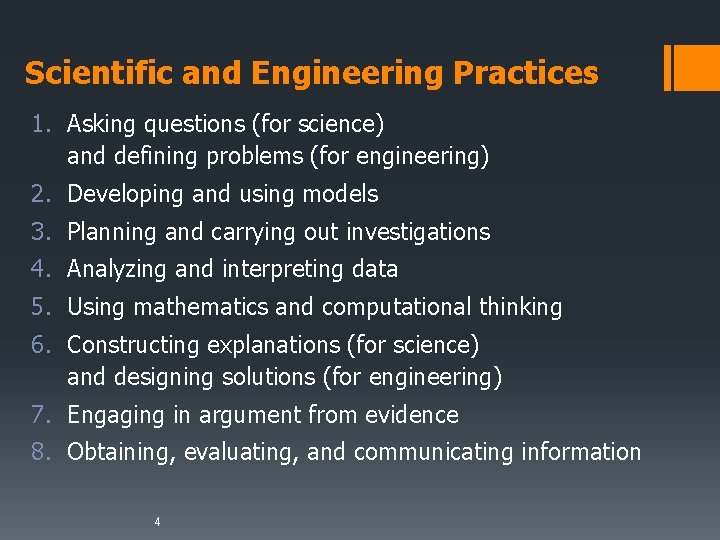
Scientific and Engineering Practices 1. Asking questions (for science) and defining problems (for engineering) 2. Developing and using models 3. Planning and carrying out investigations 4. Analyzing and interpreting data 5. Using mathematics and computational thinking 6. Constructing explanations (for science) and designing solutions (for engineering) 7. Engaging in argument from evidence 8. Obtaining, evaluating, and communicating information 4
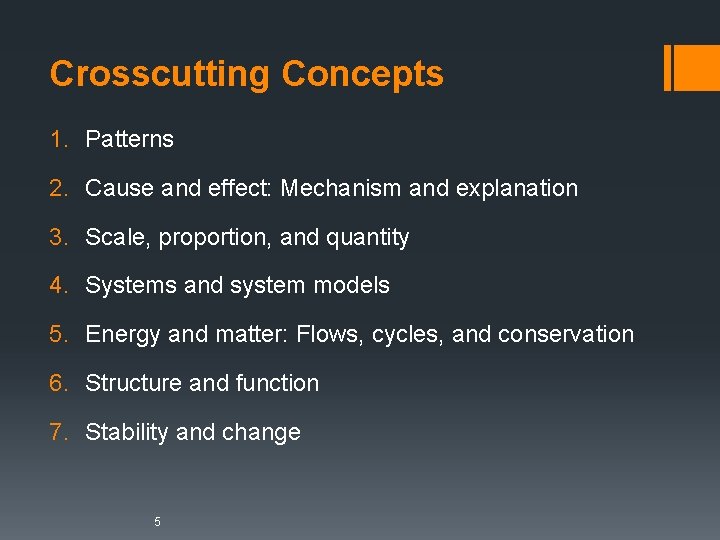
Crosscutting Concepts 1. Patterns 2. Cause and effect: Mechanism and explanation 3. Scale, proportion, and quantity 4. Systems and system models 5. Energy and matter: Flows, cycles, and conservation 6. Structure and function 7. Stability and change 5
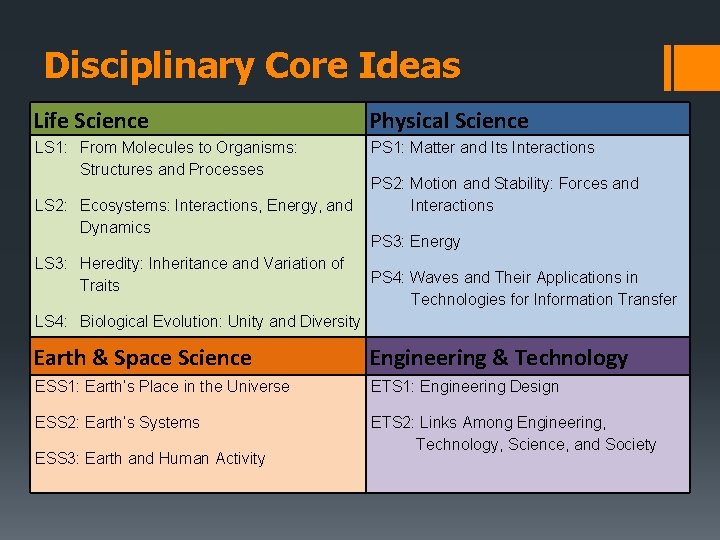
Disciplinary Core Ideas Life Science Physical Science LS 1: From Molecules to Organisms: Structures and Processes PS 1: Matter and Its Interactions LS 2: Ecosystems: Interactions, Energy, and Dynamics LS 3: Heredity: Inheritance and Variation of Traits PS 2: Motion and Stability: Forces and Interactions PS 3: Energy PS 4: Waves and Their Applications in Technologies for Information Transfer LS 4: Biological Evolution: Unity and Diversity Earth & Space Science Engineering & Technology ESS 1: Earth’s Place in the Universe ETS 1: Engineering Design ESS 2: Earth’s Systems ETS 2: Links Among Engineering, Technology, Science, and Society ESS 3: Earth and Human Activity
Developing the Standards 7
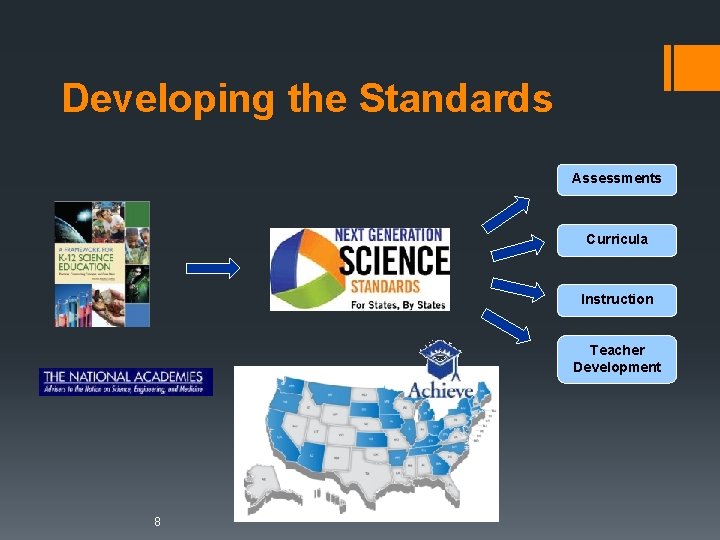
Developing the Standards Assessments Curricula Instruction Teacher Development 2011 -2013 8
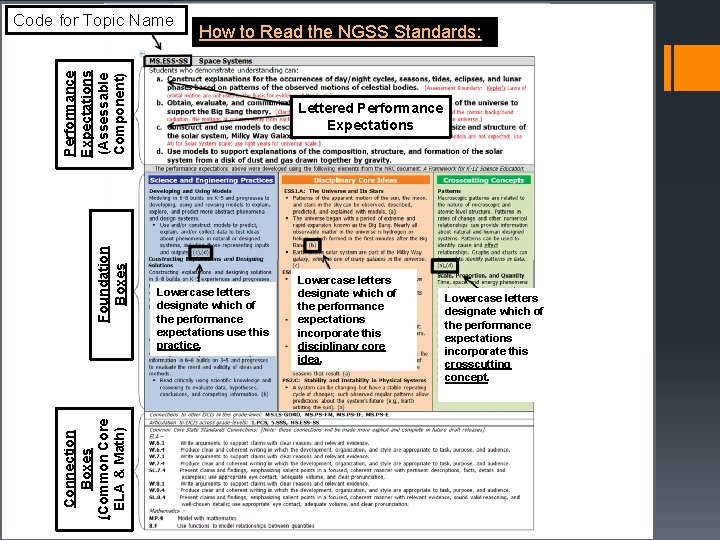
How to Read the NGSS Standards: Connection Boxes (Common Core ELA & Math) Foundation Boxes Performance Expectations (Assessable Component) Code for Topic Name Lettered Performance Expectations Lowercase letters designate which of the performance expectations use this practice. Lowercase letters designate which of the performance expectations incorporate this disciplinary core idea. Lowercase letters designate which of the performance expectations incorporate this crosscutting concept.
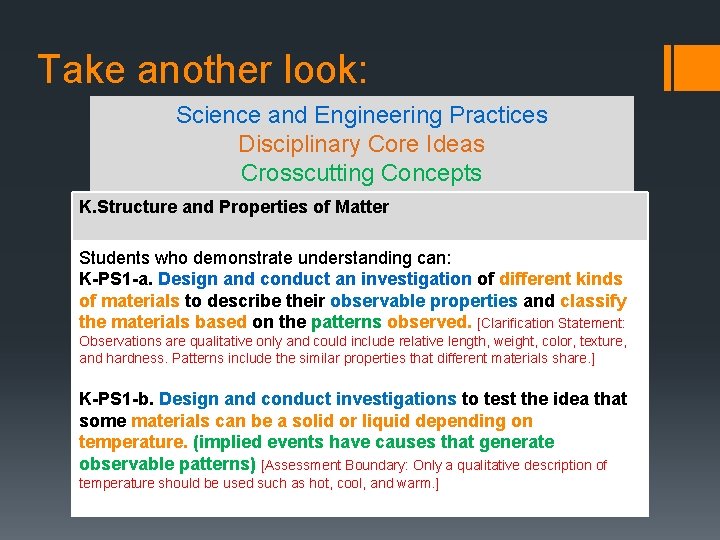
Take another look: Science and Engineering Practices Disciplinary Core Ideas Crosscutting Concepts K. Structure and Properties of Matter Students who demonstrate understanding can: K-PS 1 -a. Design and conduct an investigation of different kinds of materials to describe their observable properties and classify the materials based on the patterns observed. [Clarification Statement: Observations are qualitative only and could include relative length, weight, color, texture, and hardness. Patterns include the similar properties that different materials share. ] K-PS 1 -b. Design and conduct investigations to test the idea that some materials can be a solid or liquid depending on temperature. (implied events have causes that generate observable patterns) [Assessment Boundary: Only a qualitative description of temperature should be used such as hot, cool, and warm. ]
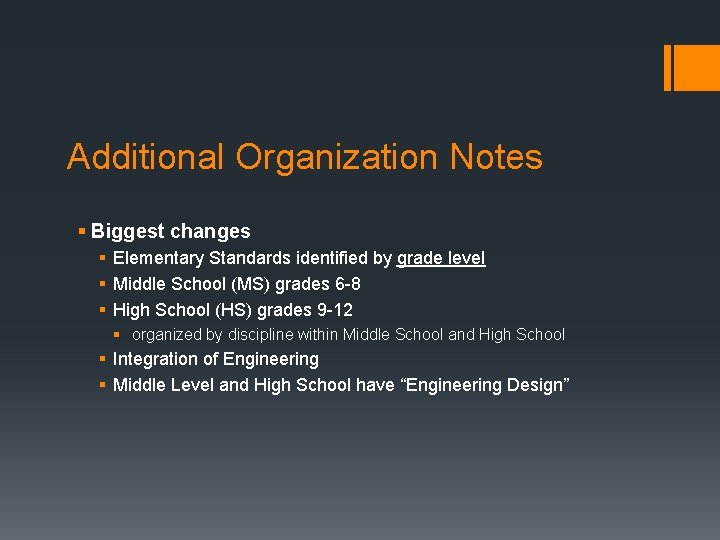
Additional Organization Notes § Biggest changes § Elementary Standards identified by grade level § Middle School (MS) grades 6 -8 § High School (HS) grades 9 -12 § organized by discipline within Middle School and High School § Integration of Engineering § Middle Level and High School have “Engineering Design”
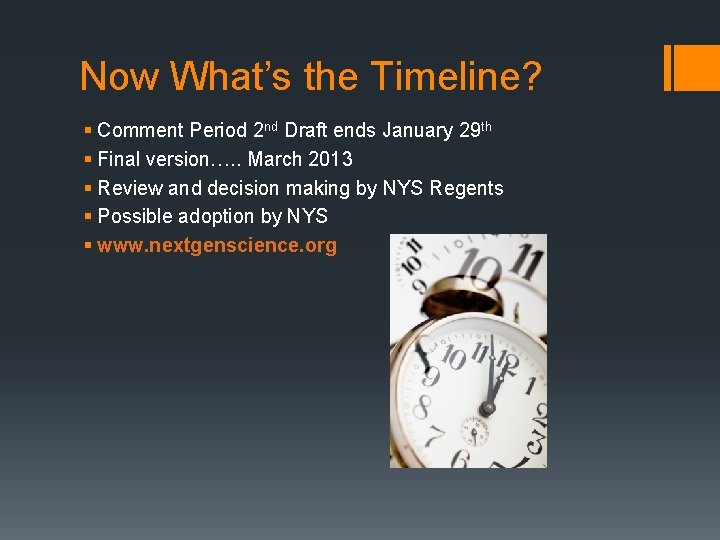
Now What’s the Timeline? § Comment Period 2 nd Draft ends January 29 th § Final version…. . March 2013 § Review and decision making by NYS Regents § Possible adoption by NYS § www. nextgenscience. org
ESP Contact Information § Kathy Arminio, karminio@monroe 2 boces. org § Mary Thomas, mthomas@monroe 2 boces. org § Antonietta Quinn, aquinn@monroe 2 boces. org § Nancy Shellenberger, nshellen@monroe 2 boces. org § ESP Main Phone: (585) 352 -1140