
Next Generation Grid Integrating Parallel and Distributed Computing
Next Generation Grid: Integrating Parallel and Distributed Computing Runtimes for an HPC Enhanced Cloud and Fog Spanning Io. T Big Data and Big Simulations Geoffrey Fox, Supun Kamburugamuve, Judy Qiu, Shantenu Jha June 28, 2017 IEEE Cloud 2017 Honolulu Hawaii gcf@indiana. edu ` http: //www. dsc. soic. indiana. edu/, http: //spidal. org/ Department of Intelligent Systems Engineering School of Informatics and Computing, Digital Science Center Indiana University Bloomington 1
“Next Generation Grid – HPC Cloud” Problem Statement • Design a dataflow event-driven Faa. S (microservice) framework running across application and geographic domains. • Build on Cloud best practice but use HPC wherever possible and useful to get high performance • Smoothly support current paradigms Hadoop, Spark, Flink, Heron, MPI, DARMA … • Use interoperable common abstractions but multiple polymorphic implementations. • i. e. do not require a single runtime • Focus on Runtime but this implicitly suggests programming and execution model • This next generation Grid based on data and edge devices – not computing as in old Grid 2
Important Trends I • Data gaining in importance compared to simulations • Data analysis techniques changing with old and new applications • All forms of IT increasing in importance; both data and simulations increasing • Internet of Things and Edge Computing growing in importance • Exascale initiative driving large supercomputers • Use of public clouds increasing rapidly • Clouds becoming diverse with subsystems containing GPU’s, FPGA’s, high performance networks, storage, memory … • They have economies of scale; hard to compete with • Serverless computing attractive to user: “No server is easier to manage than no server” 3

Important Trends II • Rich software stacks: • HPC for Parallel Computing • Apache for Big Data including some edge computing (streaming data) • On general principles parallel and distributed computing has different requirements even if sometimes similar functionalities • Apache stack typically uses distributed computing concepts • For example, Reduce operation is different in MPI (Harp) and Spark • Important to put grain size into analysis • Its easier to make dataflow efficient if grain size large • Streaming Data ubiquitous including data from edge • Edge computing has some time-sensitive applications • Choosing a good restaurant can wait seconds • Avoiding collisions must be finished in milliseconds 4
Important Trends III • HPC needed for some Big Data processing • Deep Learning needs small HPC systems • Big Data requirements are not clear but current workloads have substantial pleasingly parallel or modestly synchronized applications that are well suited to current clouds • Maybe will change as users get more sophisticated • Such as change happened in simulation as increased computer power led to ability to do much larger and different problems (2 D in 1980 became fully realistic 3 D) • Data should not be moved unless essential • Supported by Fog computing • Fog is a well establish idea but no agreement on architecture • Need Security and Fault Tolerance!! 5
Academic (Research) Big Data Applications • Applications ought to drive new-generation big data software stacks but (at many universities) academic applications lag commercial use in big data area and needs are quite modest • This will change and we can expect big data software stacks to become more important and broadly used in academia • Note importance of plethora of small (pleasingly parallel) jobs • Note University compute systems historically offer HPC and not Big Data Expertise. • We could anticipate users moving to public clouds (away from university systems) but • Users will still want support • Need a Requirements Analysis that builds in application changes that might occur as users get more sophisticated • Need to help (train) users to explore big data opportunities 6
Motivation Summary • Explosion of Internet of Things and Cloud Computing • Clouds will continue to grow and will include more use cases • Edge Computing is adding an additional dimension to Cloud Computing • Device --- Fog ---Cloud • Event driven computing is becoming dominant • Signal generated by a Sensor is an edge event • Accessing a HPC linear algebra function could be event driven and replace traditional libraries by Faa. S (as Net. Solve Grid. Solve Neos did in old Grid) • Services will be packaged as a powerful Function as a Service Faa. S • Serverless must be important: users not interested in low level details of Iaa. S or even Paa. S? • Applications will span from Edge to Multiple Clouds 7
Predictions/Assumptions • Supercomputers will continue for large simulations and may run other applications but these codes will be developed on HPC Clouds or • Next-Generation Commodity Systems which are dominant force • Merge Cloud HPC and Edge computing • Clouds running in multiple giant datacenters offering all types of computing • Distributed data sources associated with device and Fog processing resources • Server-hidden computing for user pleasure • Support a distributed event driven dataflow computing model covering batch and streaming data • Needing parallel and distributed (Grid) computing ideas 8
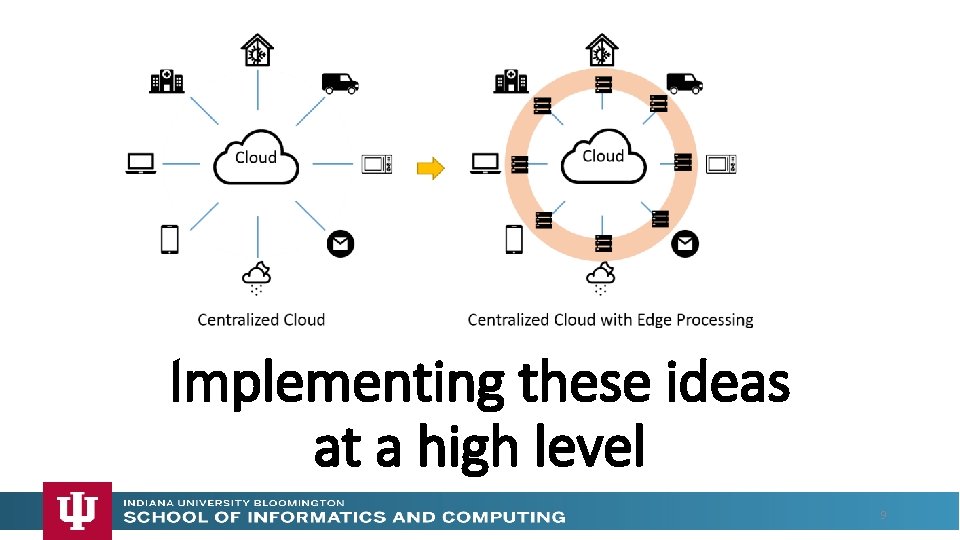
Implementing these ideas at a high level 9
What is the challenge? • Integrate systems that offer full capabilities Scheduling Storage “Database” Programming Model (dataflow and/or “in-place” control-flow) and corresponding runtime • Analytics • Workflow • Function as a Service and Event-based Programming • • • With a broad scope • For both Batch and Streaming • Distributed and Centralized (Grid versus Cluster) • Pleasingly parallel (Local machine learning) and Global machine learning (large scale parallel codes) • How do we do this? 10
Proposed Approach I • Unit of Processing is an Event driven Function (a service) • Can have state that may need to be preserved in place (Iterative Map. Reduce) • Can be hierarchical as in invoking a parallel job • Functions can be single or 1 of 100, 000 maps in large parallel code • Processing units run in clouds, fogs or devices but these all have similar architecture • Fog (e. g. car) looks like a cloud to a device (radar sensor) while public cloud looks like a cloud to the fog (car) • Use polymorphic runtime that uses different implementations depending on environment e. g. on fault-tolerance – latency (performance) tradeoffs • Data locality (minimize explicit dataflow) properly supported as in HPF alignment commands (specify which data and computing needs to be kept together) • Support the federation of the heterogeneous (in function – not just interface that characterized old Grid) resources that form the new Grid 11
Proposed Approach II • Analyze the runtime of existing systems • Hadoop, Spark, Flink, Naiad Big Data Processing • Storm, Heron Streaming Dataflow • Kepler, Pegasus, Ni. Fi workflow systems • Harp Map-Collective, MPI and HPC AMT runtime like DARMA • And approaches such as Grid. FTP and CORBA/HLA (!) for wide area data links • Propose polymorphic unification (given function can have different implementations) • Choose powerful scheduler (Mesos? ) • Support processing locality/alignment including MPI’s never move model with grain size consideration • This should integrate HPC and Clouds 12
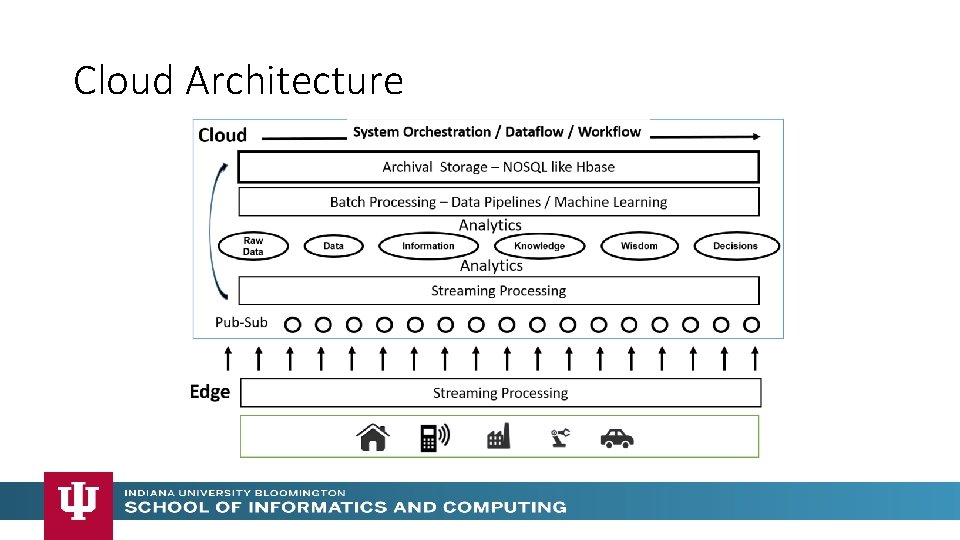
Cloud Architecture
Implementing these ideas in detail 14
Components of Big Data Stack • • • • Google likes to show a timeline; we can build on (Apache version of) this 2002 Google File System GFS ~HDFS 2004 Map. Reduce Apache Hadoop 2006 Big Table Apache Hbase 2008 Dremel Apache Drill 2009 Pregel Apache Giraph 2010 Flume. Java Apache Crunch 2010 Colossus better GFS 2012 Spanner horizontally scalable New. SQL database ~Cockroach. DB 2013 F 1 horizontally scalable SQL database 2013 Mill. Wheel ~Apache Storm, Twitter Heron (Google not first!) 2015 Cloud Dataflow Apache Beam with Spark or Flink (dataflow) engine Functionalities not identified: Security, Data Transfer, Scheduling, Dev. Ops, serverless computing (assume Open. Whisk will improve to handle robustly lots of large functions) 15
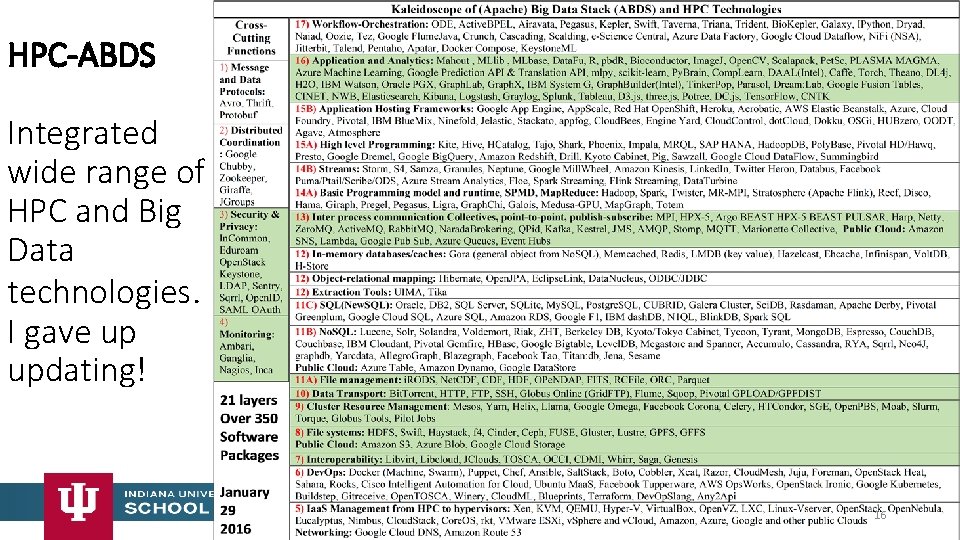
HPC-ABDS Integrated wide range of HPC and Big Data technologies. I gave up updating! 16
Why use Spark Hadoop Flink rather than HPC? • Yes if you value ease of programming over performance. • This could be the case for most companies where they can find people who can program in Spark/Hadoop much more easily than people who can program in MPI. • Most of the complications including data, communications are abstracted away to hide the parallelism so that average programmer can use Spark/Flink easily and doesn't need to manage state, deal with file systems etc. • RDD data support very helpful • For large data problems involving heterogeneous data sources such as HDFS with unstructured data, databases such as HBase etc • Yes if one needs fault tolerance for our programs. • Our 13 -node Moe “big data” (Hadoop twitter analysis) cluster at IU faces such problems around once per month. One can always restart the job, but automatic fault tolerance is convenient. 17
Why use HPC and not Spark, Flink, Hadoop? • The performance of Spark, Flink, Hadoop on classic parallel data analytics is poor/dreadful whereas HPC (MPI) is good • One way to understand this is to note most Apache systems deliberately support a dataflow programming model • e. g. for Reduce, Apache will launch a bunch of tasks and eventually bring results back • MPI runs a clever All. Reduce interleaved “in-place” tree • Maybe can preserve Spark, Flink programming model but change implementation “under the hood” where optimization important. • Note explicit dataflow is efficient and preferred at coarse scale as used in workflow systems • Need to change implementations for different problems 18
Big Data Applications I • Big Data • Large data • Heterogeneous sources • Unstructured data in raw storage • Semi-structured data in No. SQL databases • Raw streaming data • Important characteristics affecting processing requirements • Data can be too big to load into even a large cluster • Data may not be load balanced • Streaming data needs to be analyzed before storing to disk 19
Big Data Applications II • Streaming applications • High rate of data • Low latency processing requirements • Simple queries to complex online analytics • Data pipelines • Raw data or semi structured data in in No. SQL databases • Extract, transform and load (ETL) operations • Machine learning • Mostly deal with curated data • Complex algebraic operations • Iterative computations with tight synchronizations 20
What do we need in runtime for distributed HPC Faa. S • Finish examination of all the current tools Handle Events Handle State Handle Scheduling and Invocation of Function Define data-flow graph that needs to be analyzed Handle data flow execution graph with internal event-driven model Handle geographic distribution of Functions and Events Design dataflow collective and P 2 P communication model Decide which streaming approach to adopt and integrate Design in-memory dataset model for backup and exchange of data in data flow (fault tolerance) • Support Dev. Ops and server-hidden cloud models • Support elasticity for Faa. S (connected to server-hidden) • • • 21
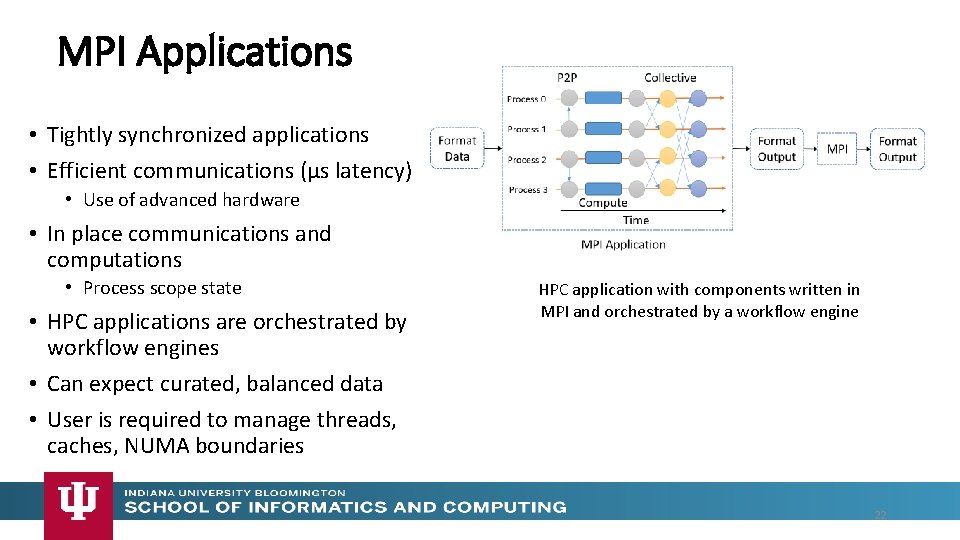
MPI Applications • Tightly synchronized applications • Efficient communications (µs latency) • Use of advanced hardware • In place communications and computations • Process scope state • HPC applications are orchestrated by workflow engines • Can expect curated, balanced data • User is required to manage threads, caches, NUMA boundaries HPC application with components written in MPI and orchestrated by a workflow engine 22
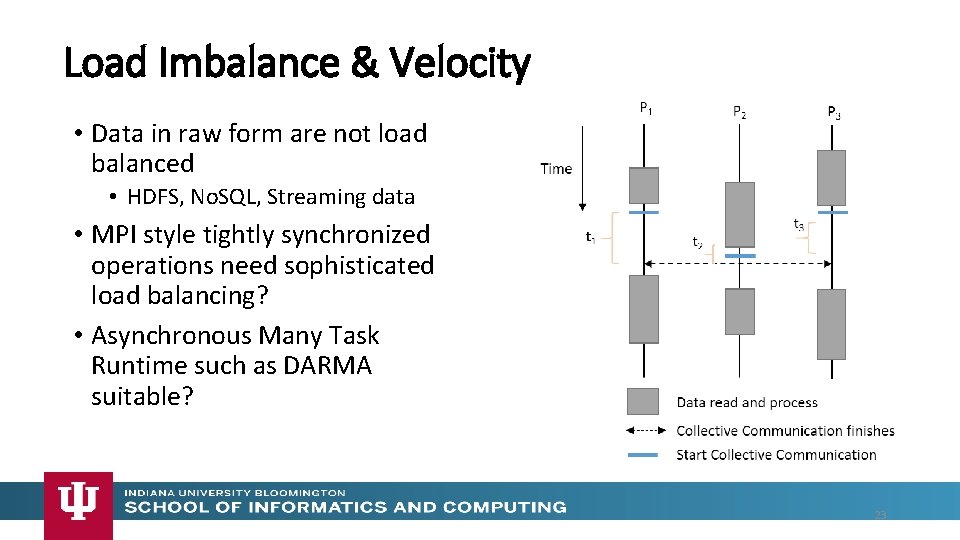
Load Imbalance & Velocity • Data in raw form are not load balanced • HDFS, No. SQL, Streaming data • MPI style tightly synchronized operations need sophisticated load balancing? • Asynchronous Many Task Runtime such as DARMA suitable? 23
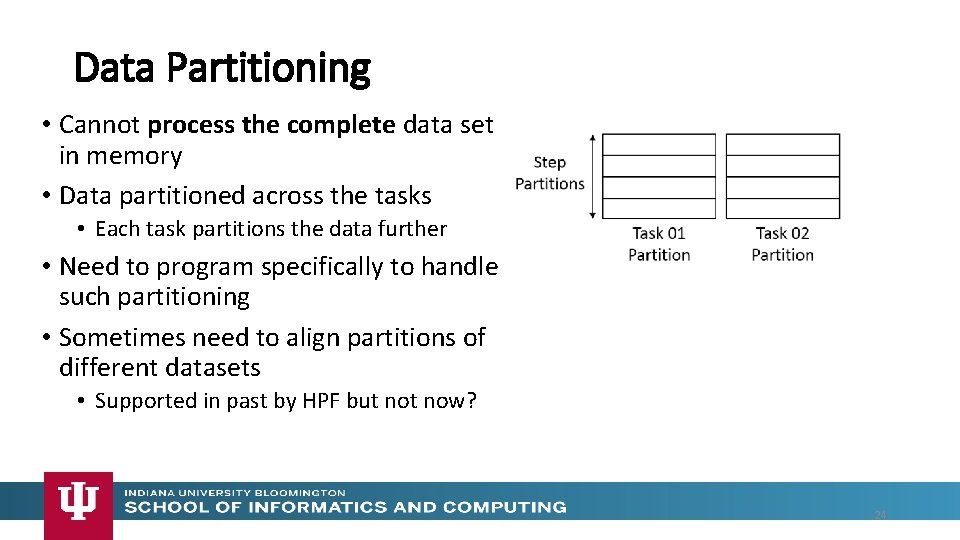
Data Partitioning • Cannot process the complete data set in memory • Data partitioned across the tasks • Each task partitions the data further • Need to program specifically to handle such partitioning • Sometimes need to align partitions of different datasets • Supported in past by HPF but now? 24
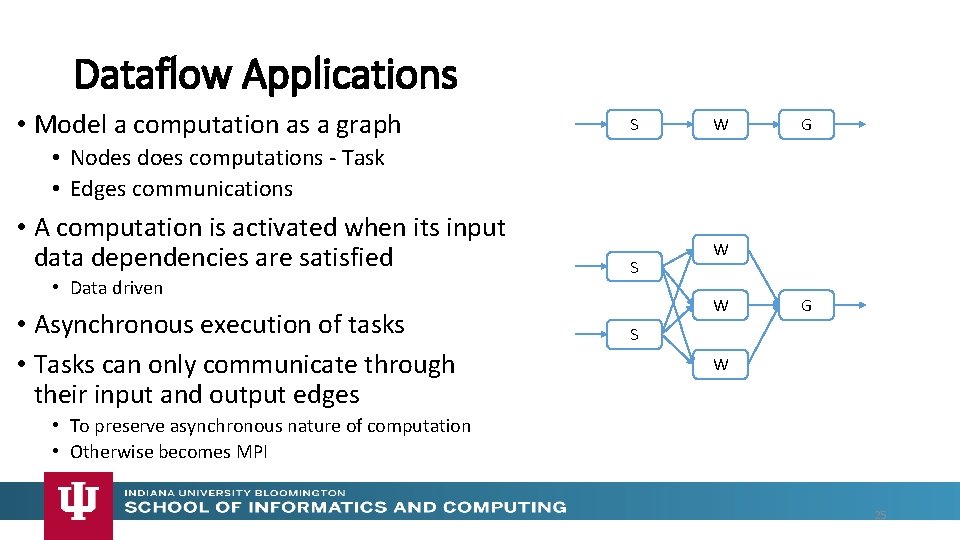
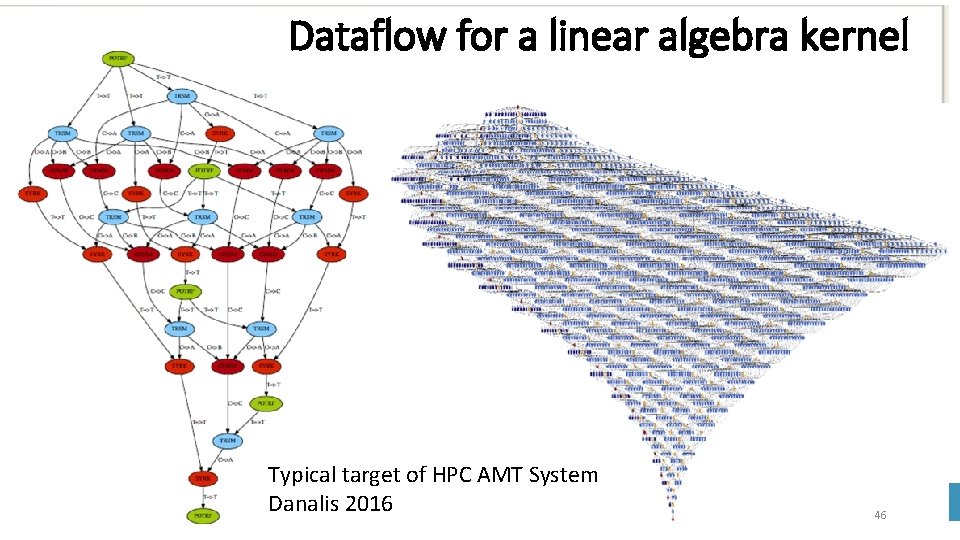
Dataflow Applications • Model a computation as a graph S W G • Nodes does computations - Task • Edges communications • A computation is activated when its input data dependencies are satisfied • Data driven • Asynchronous execution of tasks • Tasks can only communicate through their input and output edges S W W G S W • To preserve asynchronous nature of computation • Otherwise becomes MPI 25
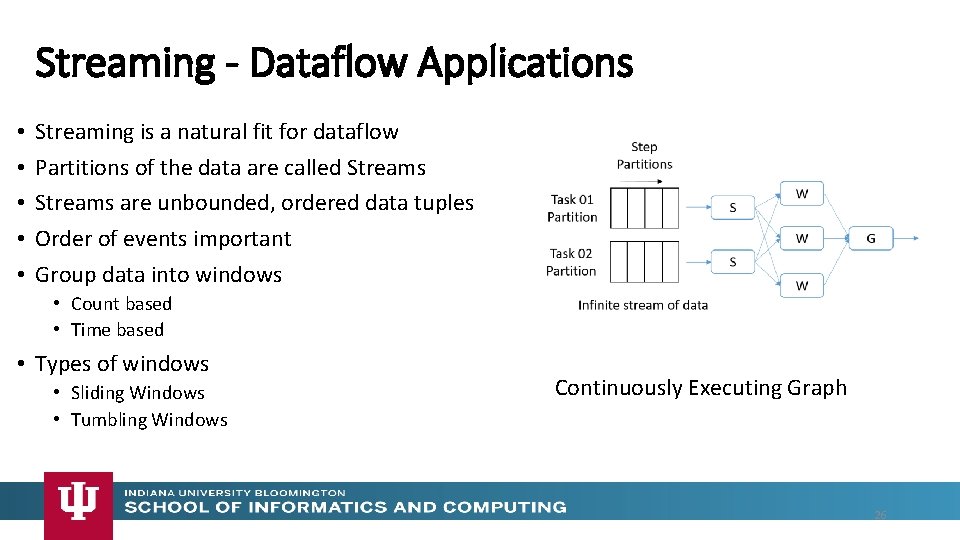
Streaming - Dataflow Applications • • • Streaming is a natural fit for dataflow Partitions of the data are called Streams are unbounded, ordered data tuples Order of events important Group data into windows • Count based • Time based • Types of windows • Sliding Windows • Tumbling Windows Continuously Executing Graph 26
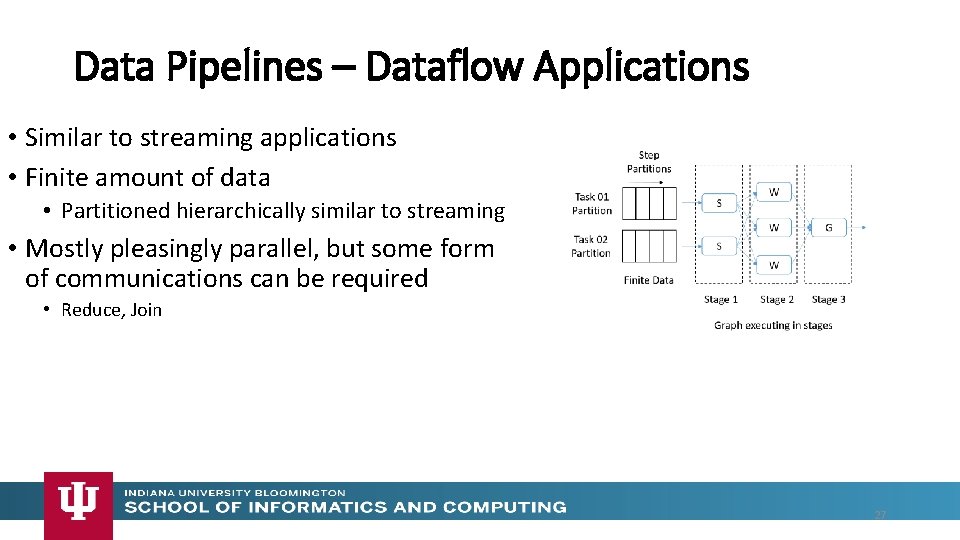
Data Pipelines – Dataflow Applications • Similar to streaming applications • Finite amount of data • Partitioned hierarchically similar to streaming • Mostly pleasingly parallel, but some form of communications can be required • Reduce, Join 27
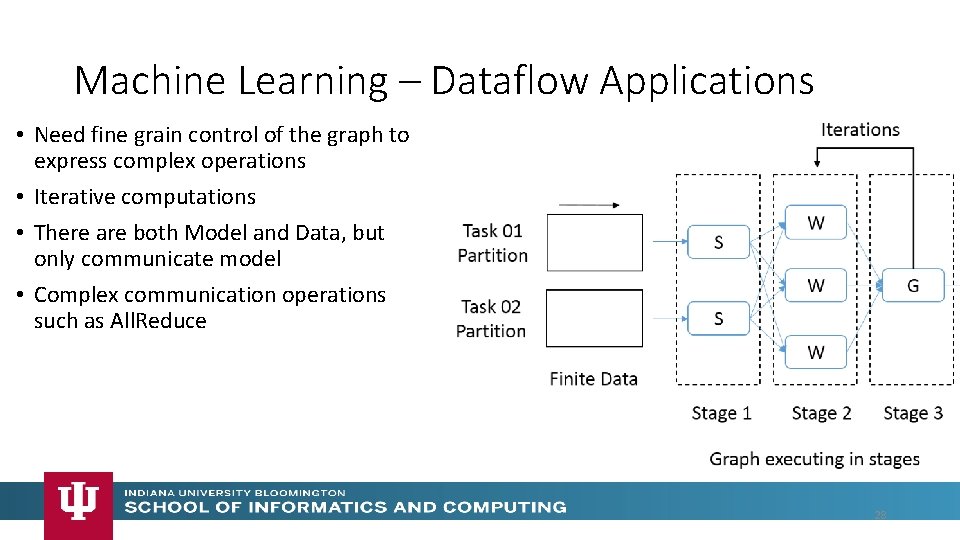
Machine Learning – Dataflow Applications • Need fine grain control of the graph to express complex operations • Iterative computations • There are both Model and Data, but only communicate model • Complex communication operations such as All. Reduce 28
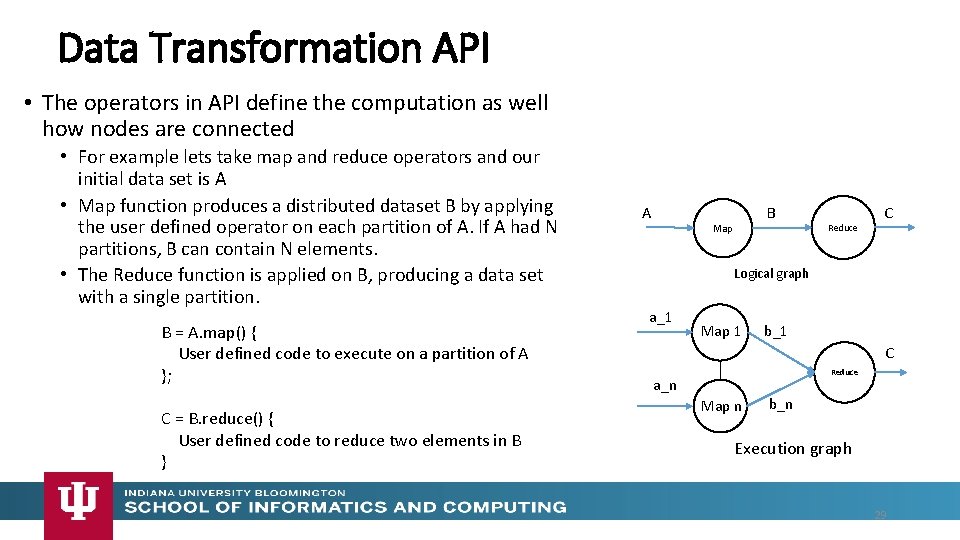
Data Transformation API • The operators in API define the computation as well how nodes are connected • For example lets take map and reduce operators and our initial data set is A • Map function produces a distributed dataset B by applying the user defined operator on each partition of A. If A had N partitions, B can contain N elements. • The Reduce function is applied on B, producing a data set with a single partition. B = A. map() { User defined code to execute on a partition of A }; C = B. reduce() { User defined code to reduce two elements in B } A B Map Reduce C Logical graph a_1 Map 1 b_1 C Reduce a_n Map n b_n Execution graph 29
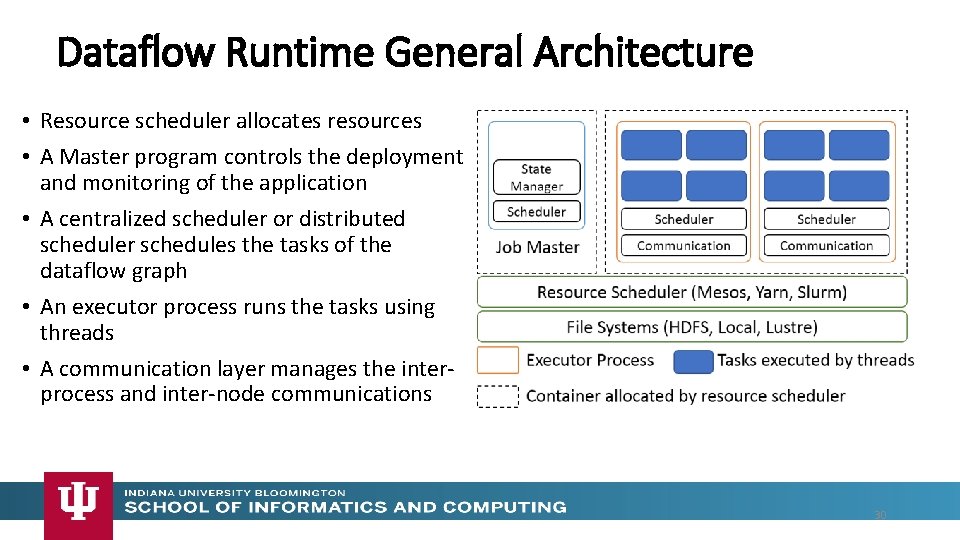
Dataflow Runtime General Architecture • Resource scheduler allocates resources • A Master program controls the deployment and monitoring of the application • A centralized scheduler or distributed scheduler schedules the tasks of the dataflow graph • An executor process runs the tasks using threads • A communication layer manages the interprocess and inter-node communications 30
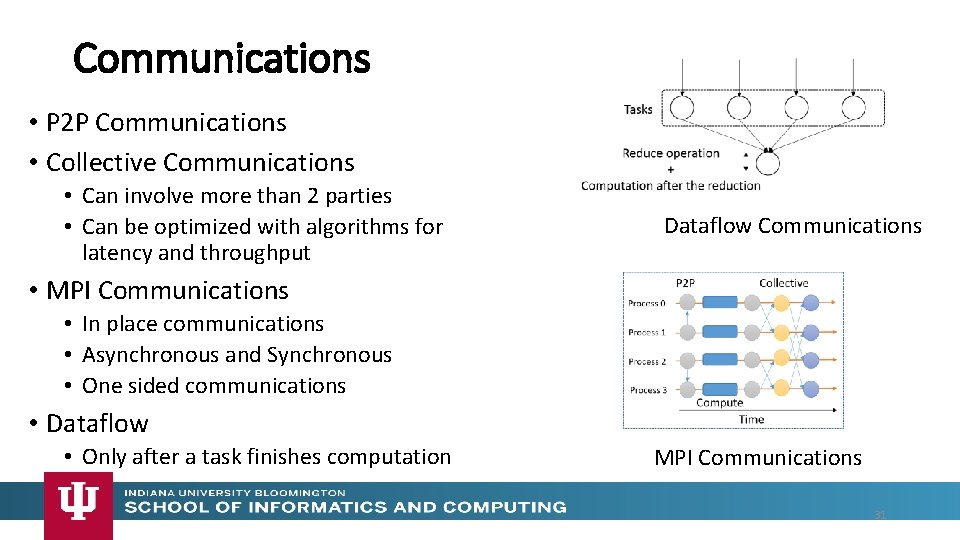
Communications • P 2 P Communications • Collective Communications • Can involve more than 2 parties • Can be optimized with algorithms for latency and throughput Dataflow Communications • MPI Communications • In place communications • Asynchronous and Synchronous • One sided communications • Dataflow • Only after a task finishes computation MPI Communications 31
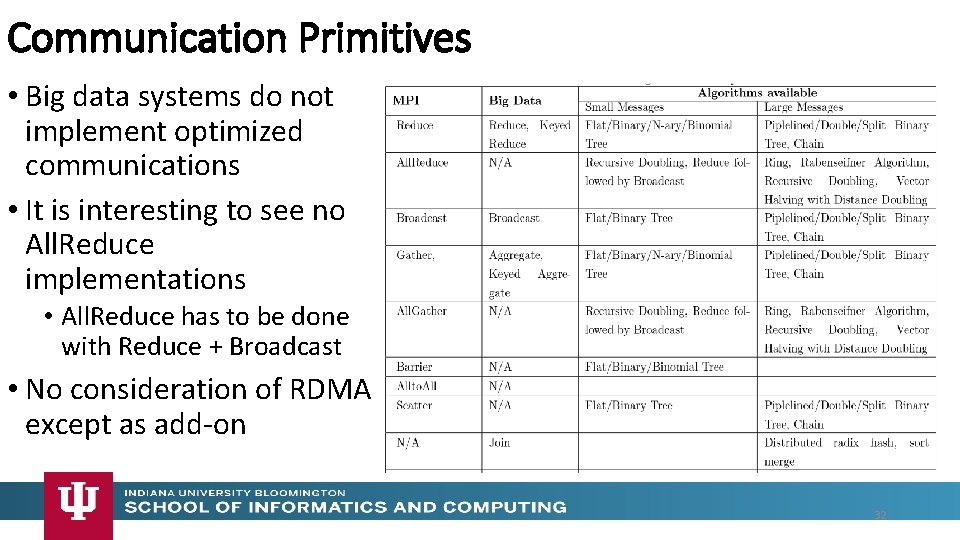
Communication Primitives • Big data systems do not implement optimized communications • It is interesting to see no All. Reduce implementations • All. Reduce has to be done with Reduce + Broadcast • No consideration of RDMA except as add-on 32
High Performance Interconnects • MPI excels in RDMA (Remote direct memory access) communications and with optimized algorithms for collectives • µs latency for communications involving large number of nodes • Big data systems have not taken RDMA seriously • There are some implementations as plugins to existing systems • Open source High Performance Libraries such as Libfabric and Photon should make the integration easy 33
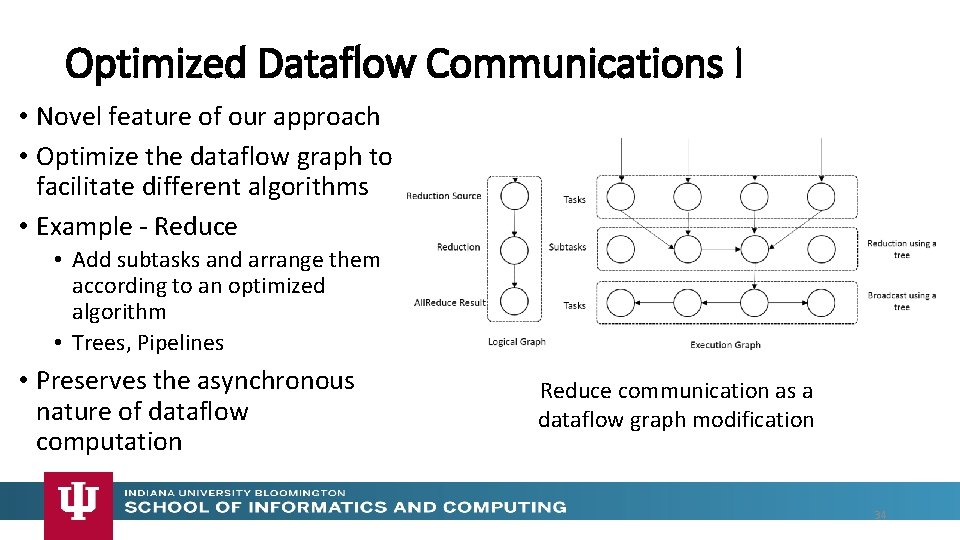
Optimized Dataflow Communications I • Novel feature of our approach • Optimize the dataflow graph to facilitate different algorithms • Example - Reduce • Add subtasks and arrange them according to an optimized algorithm • Trees, Pipelines • Preserves the asynchronous nature of dataflow computation Reduce communication as a dataflow graph modification 34
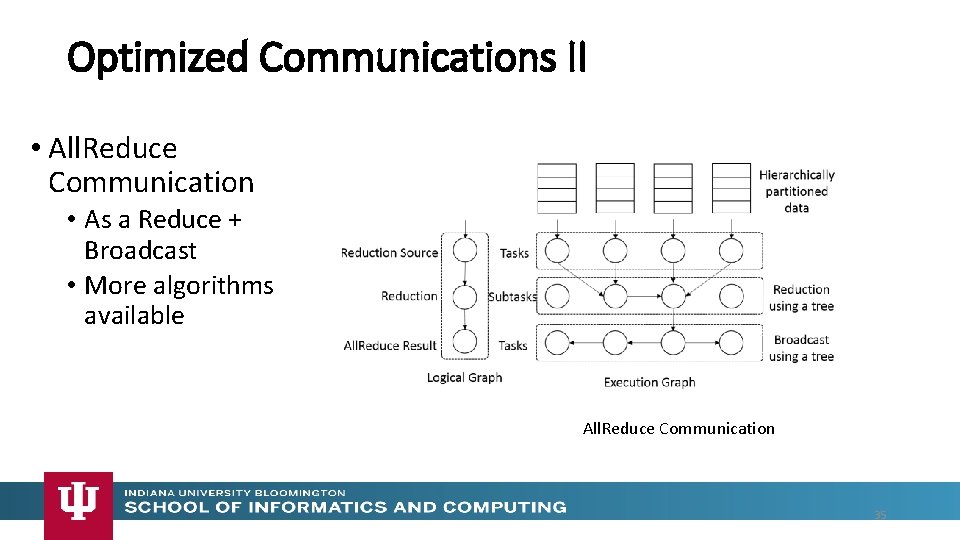
Optimized Communications II • All. Reduce Communication • As a Reduce + Broadcast • More algorithms available All. Reduce Communication 35
Requirements of Dataflow Collectives • The communication and the underlying algorithm should be driven by data • The algorithm should be able to use disks when the amount of data is larger than the available memory • The collective communication should handle partitions of data • In batch case the communication should finish after the partitions are handled 36
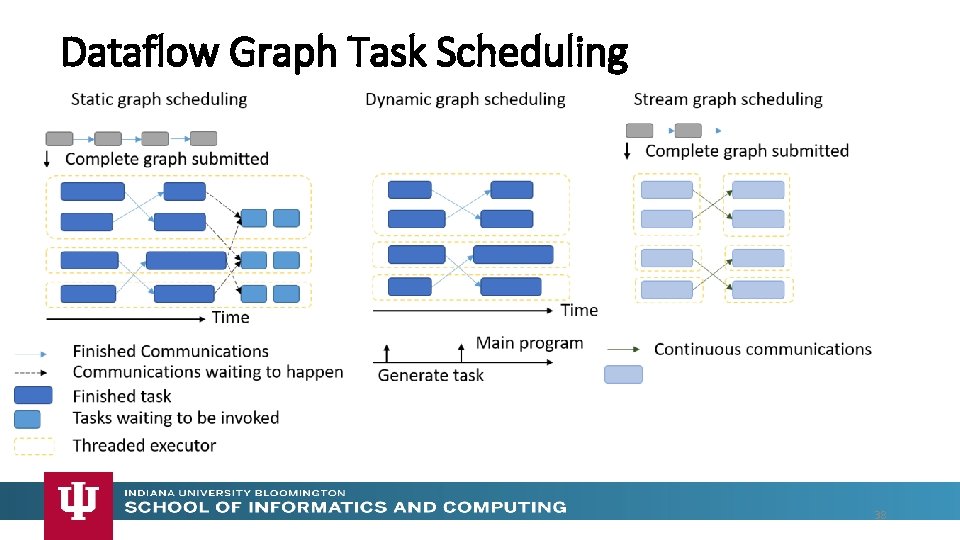
Dataflow Graph State and Scheduling • State is a key issue and handled differently in systems • CORBA, AMT, MPI and Storm/Heron have long running tasks that preserve state • Spark and Flink preserve datasets across dataflow node • All systems agree on coarse grain dataflow; only keep state in exchanged data. • Scheduling is one key area where dataflow systems differ • Dynamic Scheduling • Fine grain control of dataflow graph • Graph cannot be optimized • Static Scheduling • Less control of the dataflow graph • Graph can be optimized 37
Dataflow Graph Task Scheduling 38
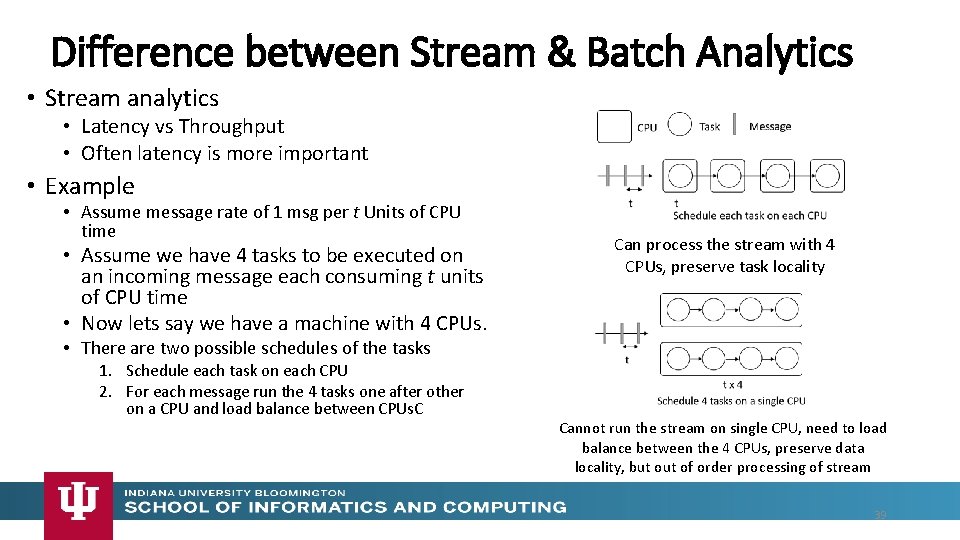
Difference between Stream & Batch Analytics • Stream analytics • Latency vs Throughput • Often latency is more important • Example • Assume message rate of 1 msg per t Units of CPU time • Assume we have 4 tasks to be executed on an incoming message each consuming t units of CPU time • Now lets say we have a machine with 4 CPUs. Can process the stream with 4 CPUs, preserve task locality • There are two possible schedules of the tasks 1. Schedule each task on each CPU 2. For each message run the 4 tasks one after other on a CPU and load balance between CPUs. C Cannot run the stream on single CPU, need to load balance between the 4 CPUs, preserve data locality, but of order processing of stream 39
Fault Tolerance • Similar form of check-pointing mechanism is used in HPC and Big Data • MPI, Flink, Spark • Flink and Spark do better than MPI due to use of database technologies; MPI is a bit harder due to richer state • Checkpoint after each stage of the dataflow graph • Natural synchronization point • Generally allows user to choose when to checkpoint (not every stage) • Executors (processes) don’t have external state, so can be considered as coarse grained operations 40
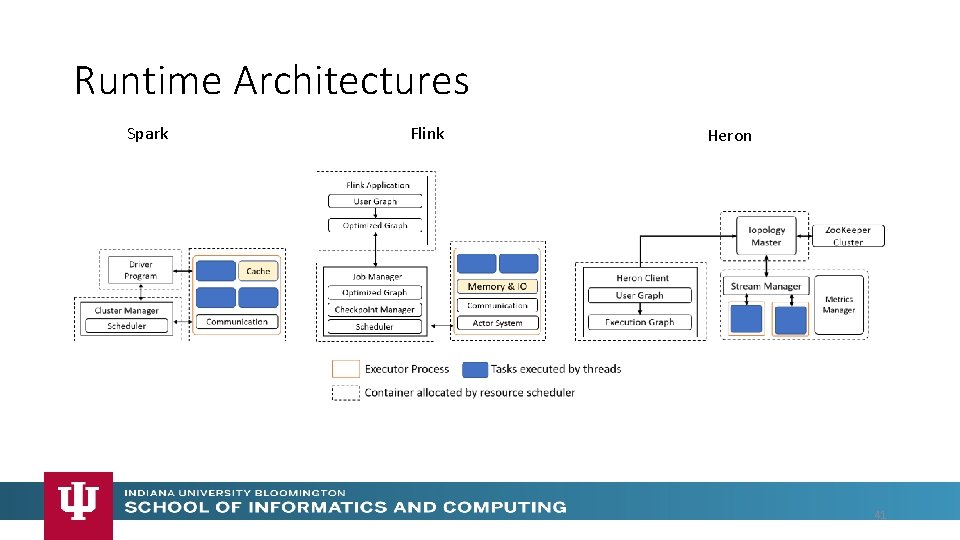
Runtime Architectures Spark Flink Heron 41
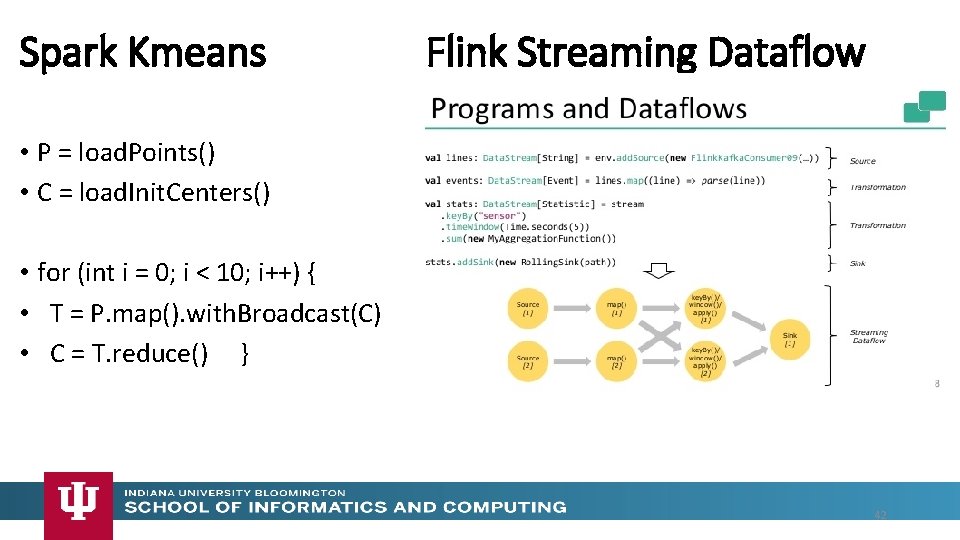
Spark Kmeans Flink Streaming Dataflow • P = load. Points() • C = load. Init. Centers() • for (int i = 0; i < 10; i++) { • T = P. map(). with. Broadcast(C) • C = T. reduce() } 42
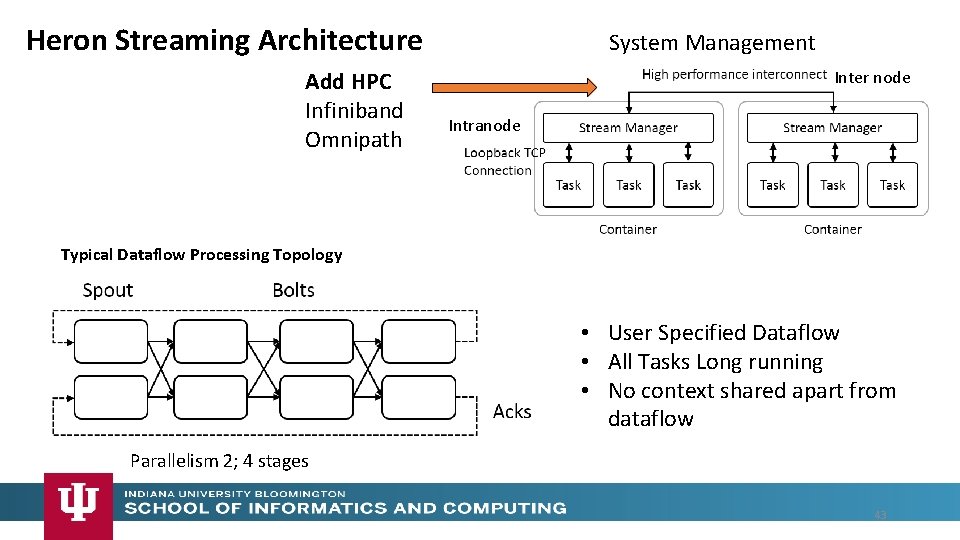
Heron Streaming Architecture Add HPC Infiniband Omnipath System Management Inter node Intranode Typical Dataflow Processing Topology • User Specified Dataflow • All Tasks Long running • No context shared apart from dataflow Parallelism 2; 4 stages 43
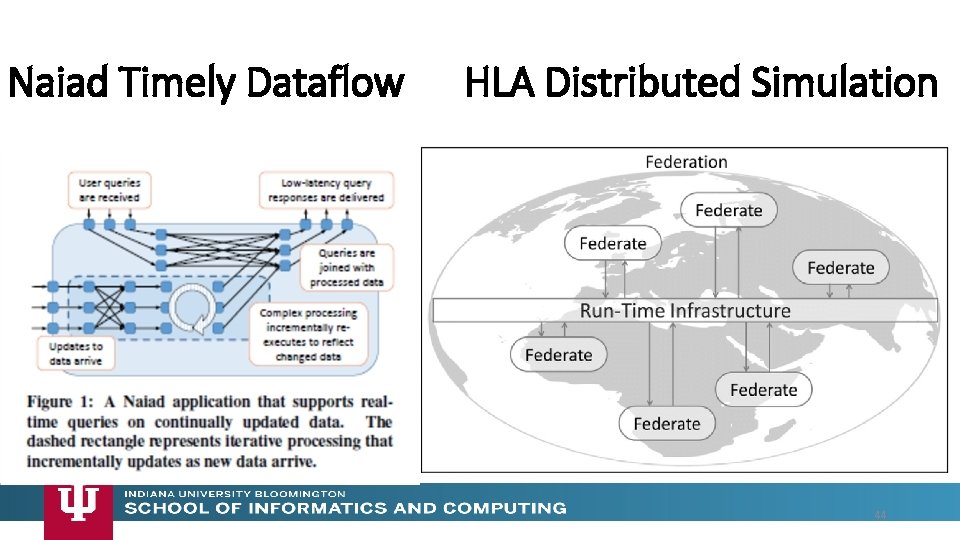
Naiad Timely Dataflow HLA Distributed Simulation 44
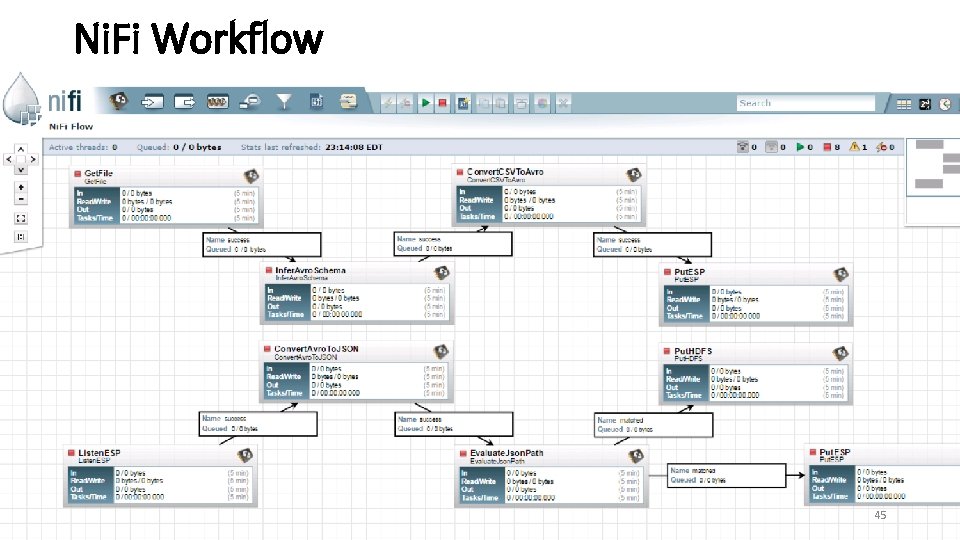
Ni. Fi Workflow 45
Dataflow for a linear algebra kernel Typical target of HPC AMT System Danalis 2016 46
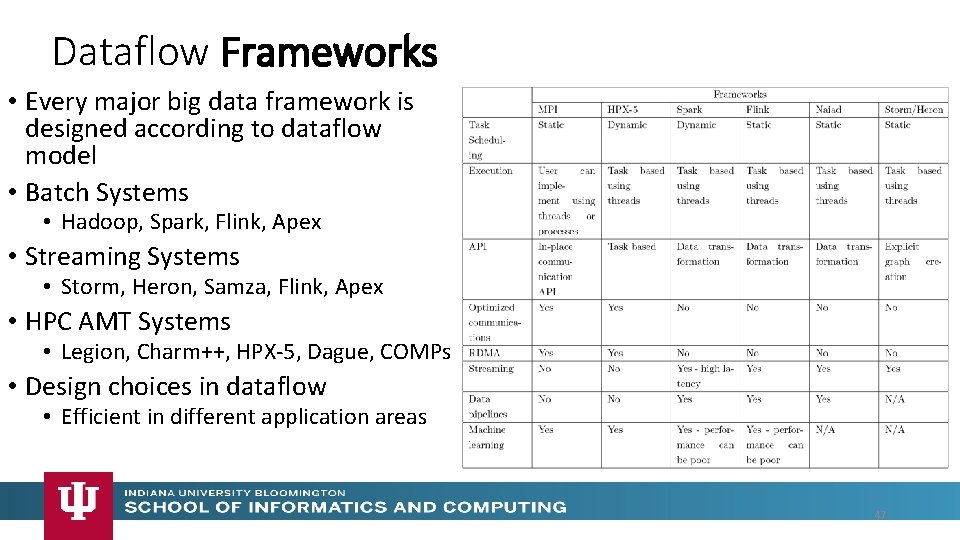
Dataflow Frameworks • Every major big data framework is designed according to dataflow model • Batch Systems • Hadoop, Spark, Flink, Apex • Streaming Systems • Storm, Heron, Samza, Flink, Apex • HPC AMT Systems • Legion, Charm++, HPX-5, Dague, COMPs • Design choices in dataflow • Efficient in different application areas 47
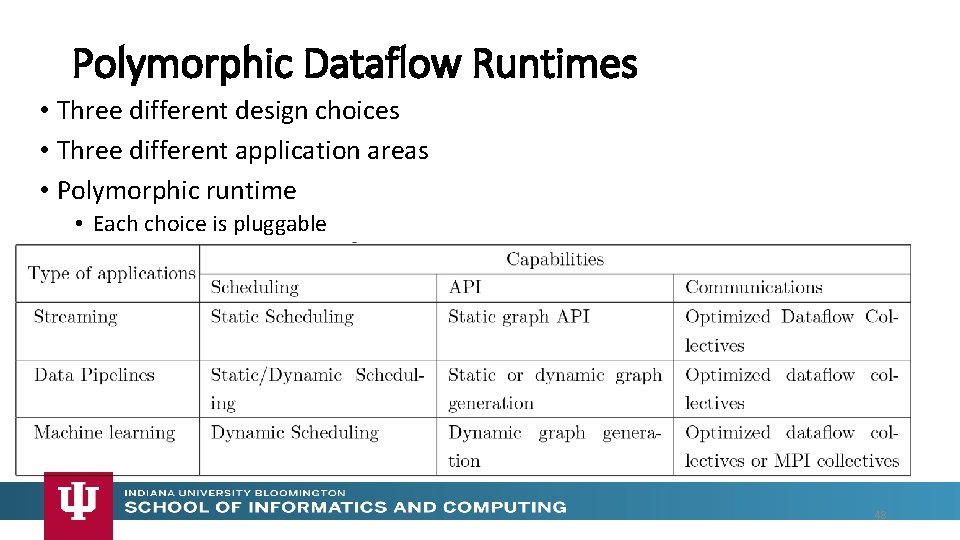
Polymorphic Dataflow Runtimes • Three different design choices • Three different application areas • Polymorphic runtime • Each choice is pluggable 48
Machine Learning with MPI, Spark and Flink • Three algorithms implemented in three runtimes • Multidimensional Scaling (MDS) • Terasort • K-Means • Implementation in Java • MDS is the most complex algorithm - three nested parallel loops • K-Means - one parallel loop • Terasort - no iterations 49
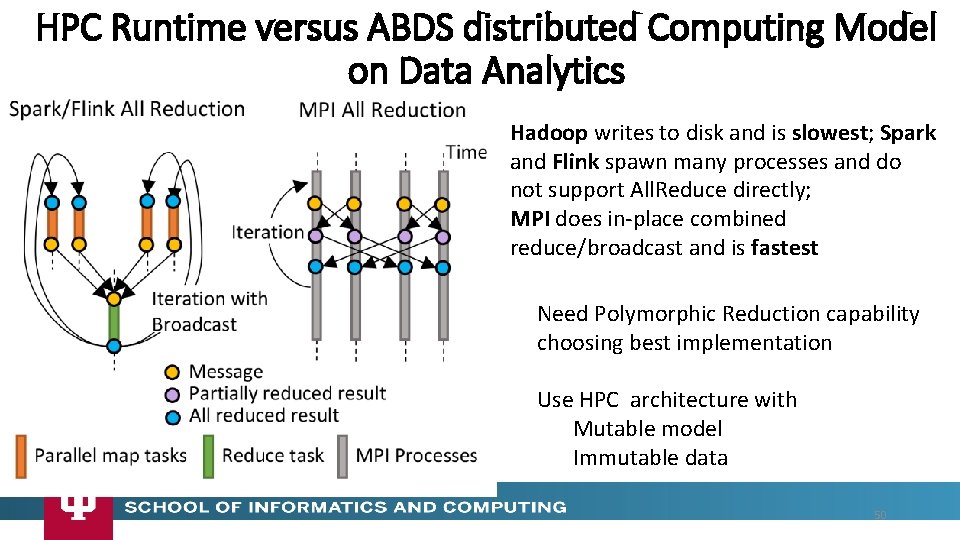
HPC Runtime versus ABDS distributed Computing Model on Data Analytics Hadoop writes to disk and is slowest; Spark and Flink spawn many processes and do not support All. Reduce directly; MPI does in-place combined reduce/broadcast and is fastest Need Polymorphic Reduction capability choosing best implementation Use HPC architecture with Mutable model Immutable data 50
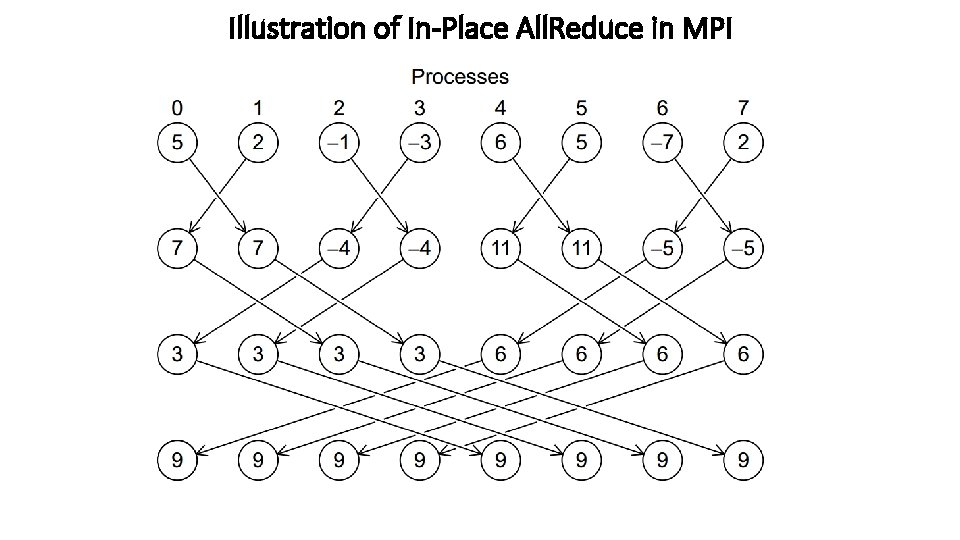
Illustration of In-Place All. Reduce in MPI
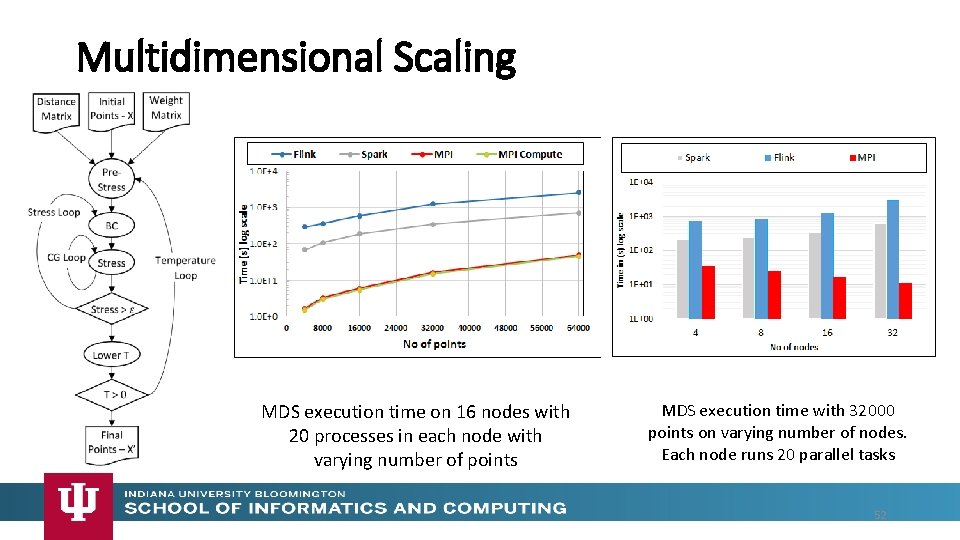
Multidimensional Scaling MDS execution time on 16 nodes with 20 processes in each node with varying number of points MDS execution time with 32000 points on varying number of nodes. Each node runs 20 parallel tasks 52
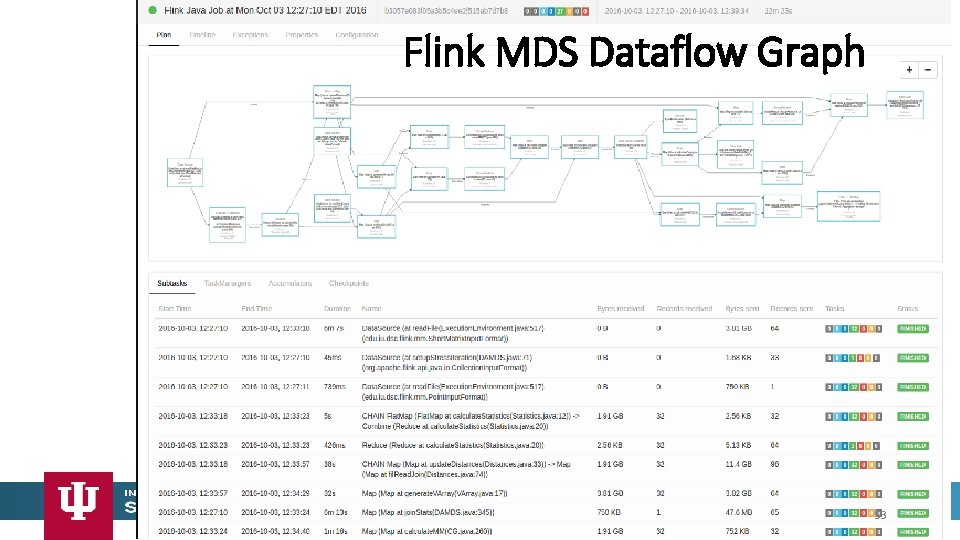
Flink MDS Dataflow Graph 53
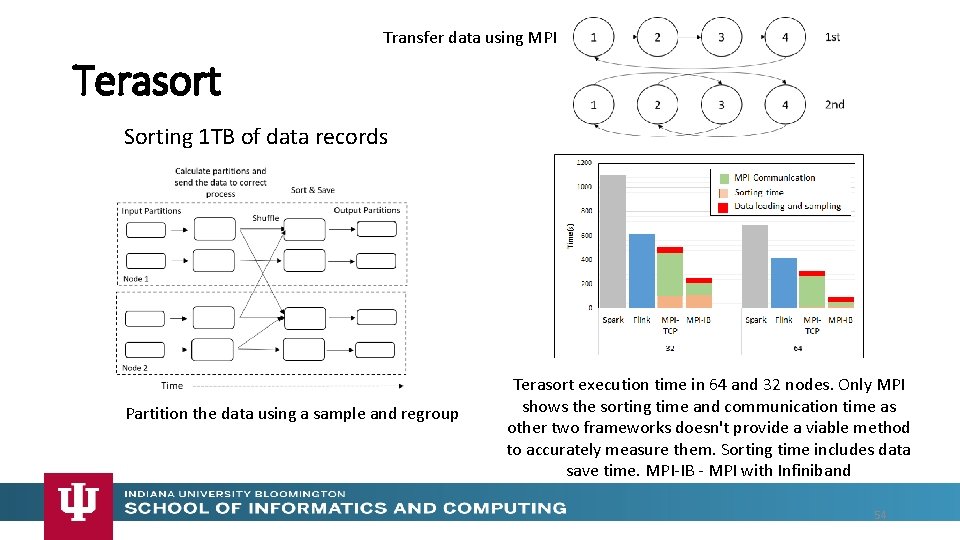
Transfer data using MPI Terasort Sorting 1 TB of data records Partition the data using a sample and regroup Terasort execution time in 64 and 32 nodes. Only MPI shows the sorting time and communication time as other two frameworks doesn't provide a viable method to accurately measure them. Sorting time includes data save time. MPI-IB - MPI with Infiniband 54
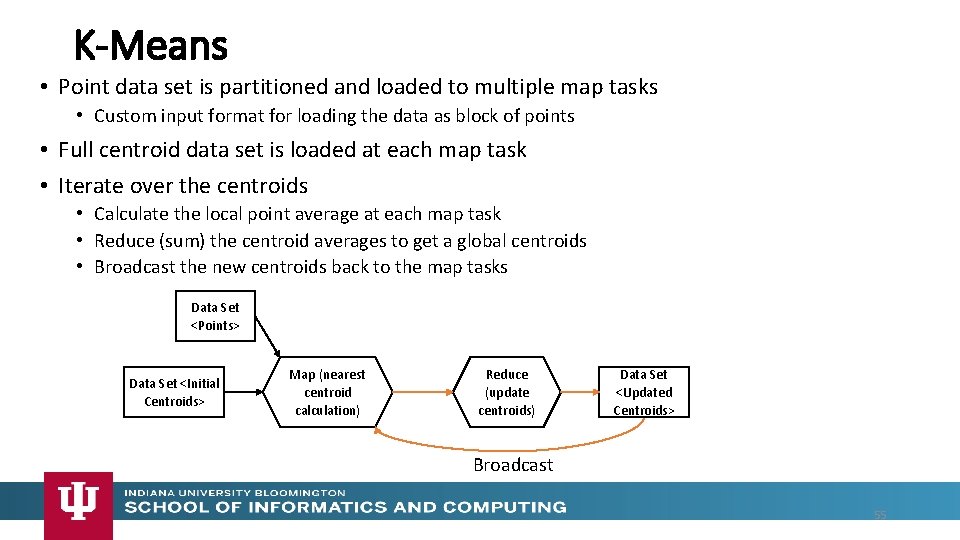
K-Means • Point data set is partitioned and loaded to multiple map tasks • Custom input format for loading the data as block of points • Full centroid data set is loaded at each map task • Iterate over the centroids • Calculate the local point average at each map task • Reduce (sum) the centroid averages to get a global centroids • Broadcast the new centroids back to the map tasks Data Set <Points> Data Set <Initial Centroids> Map (nearest centroid calculation) Reduce (update centroids) Data Set <Updated Centroids> Broadcast 55
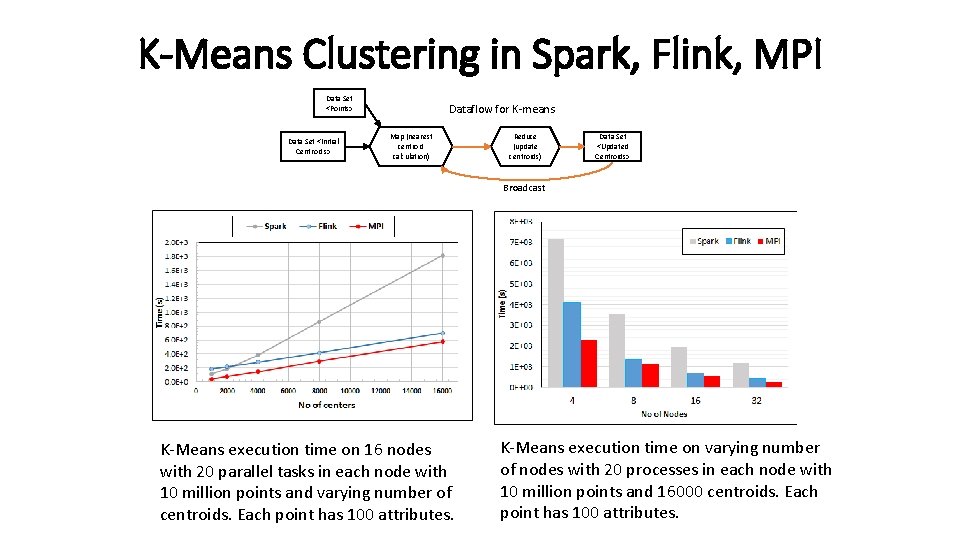
K-Means Clustering in Spark, Flink, MPI Data Set <Points> Data Set <Initial Centroids> Dataflow for K-means Map (nearest centroid calculation) Reduce (update centroids) Data Set <Updated Centroids> Broadcast K-Means execution time on 16 nodes with 20 parallel tasks in each node with 10 million points and varying number of centroids. Each point has 100 attributes. K-Means execution time on varying number of nodes with 20 processes in each node with 10 million points and 16000 centroids. Each point has 100 attributes.
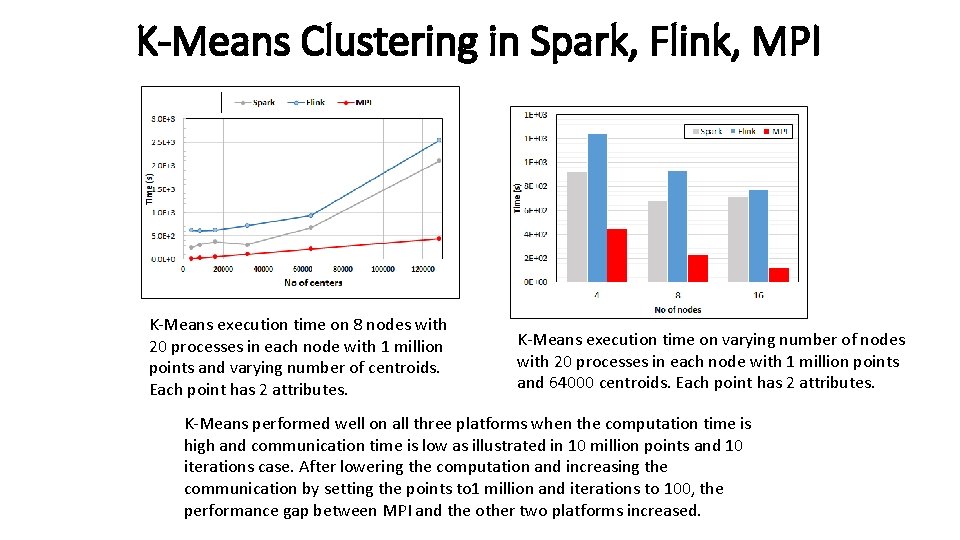
K-Means Clustering in Spark, Flink, MPI K-Means execution time on 8 nodes with 20 processes in each node with 1 million points and varying number of centroids. Each point has 2 attributes. K-Means execution time on varying number of nodes with 20 processes in each node with 1 million points and 64000 centroids. Each point has 2 attributes. K-Means performed well on all three platforms when the computation time is high and communication time is low as illustrated in 10 million points and 10 iterations case. After lowering the computation and increasing the communication by setting the points to 1 million and iterations to 100, the performance gap between MPI and the other two platforms increased.
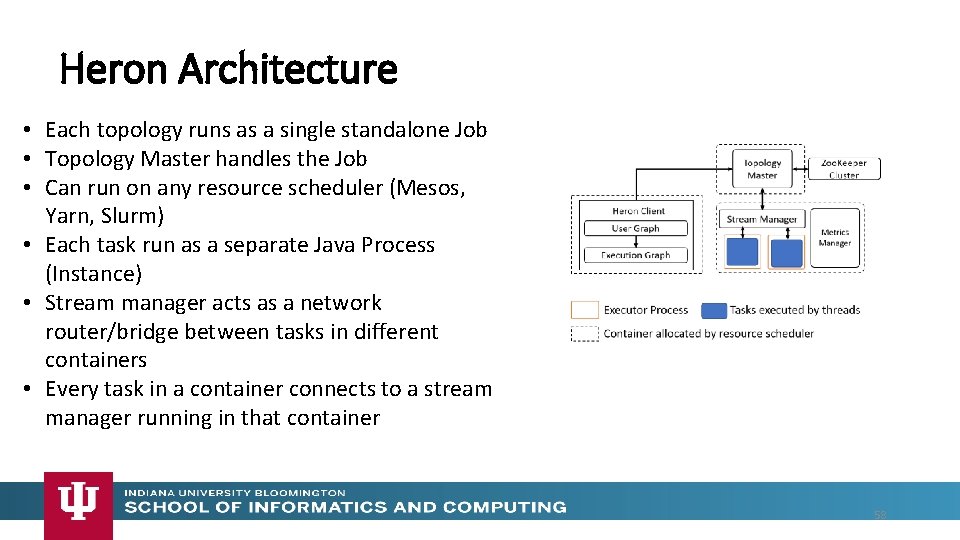
Heron Architecture • Each topology runs as a single standalone Job • Topology Master handles the Job • Can run on any resource scheduler (Mesos, Yarn, Slurm) • Each task run as a separate Java Process (Instance) • Stream manager acts as a network router/bridge between tasks in different containers • Every task in a container connects to a stream manager running in that container 58
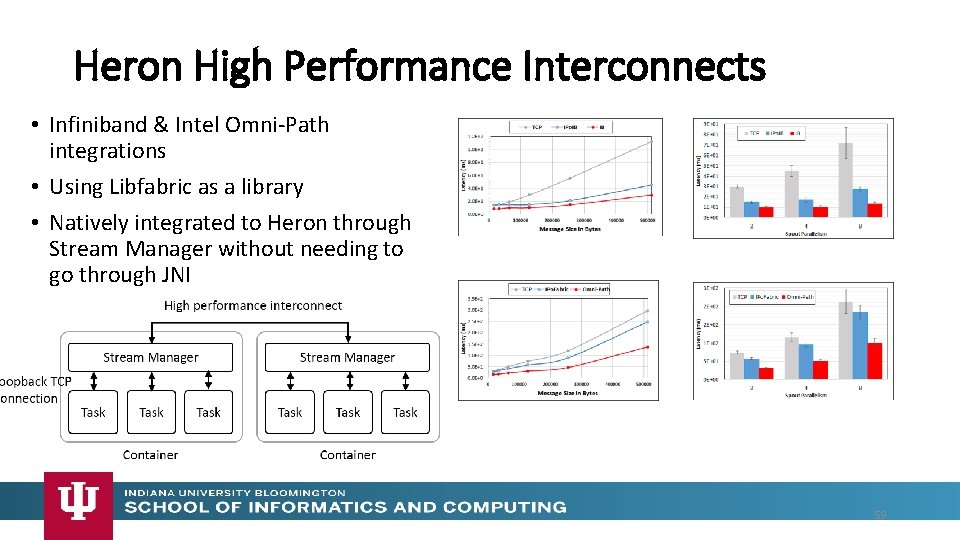
Heron High Performance Interconnects • Infiniband & Intel Omni-Path integrations • Using Libfabric as a library • Natively integrated to Heron through Stream Manager without needing to go through JNI 59
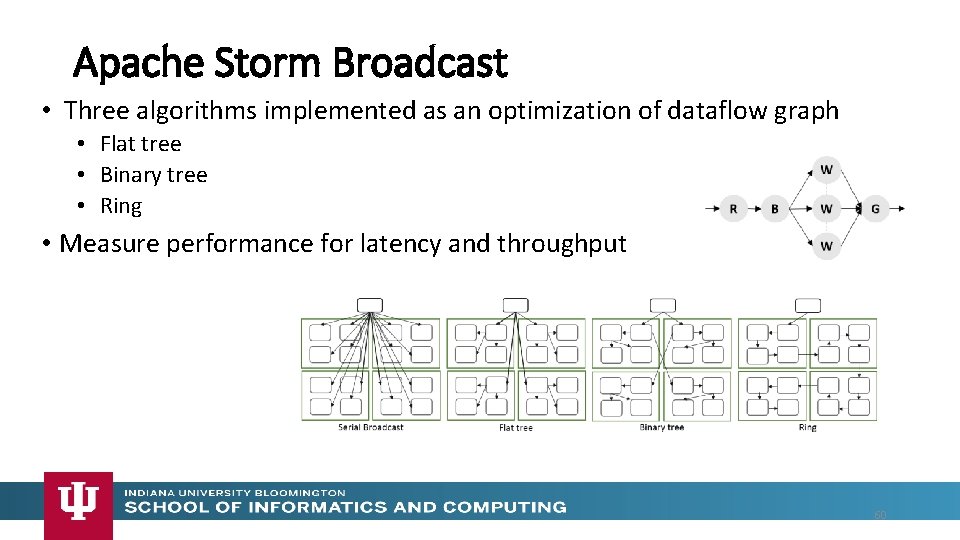
Apache Storm Broadcast • Three algorithms implemented as an optimization of dataflow graph • Flat tree • Binary tree • Ring • Measure performance for latency and throughput 60
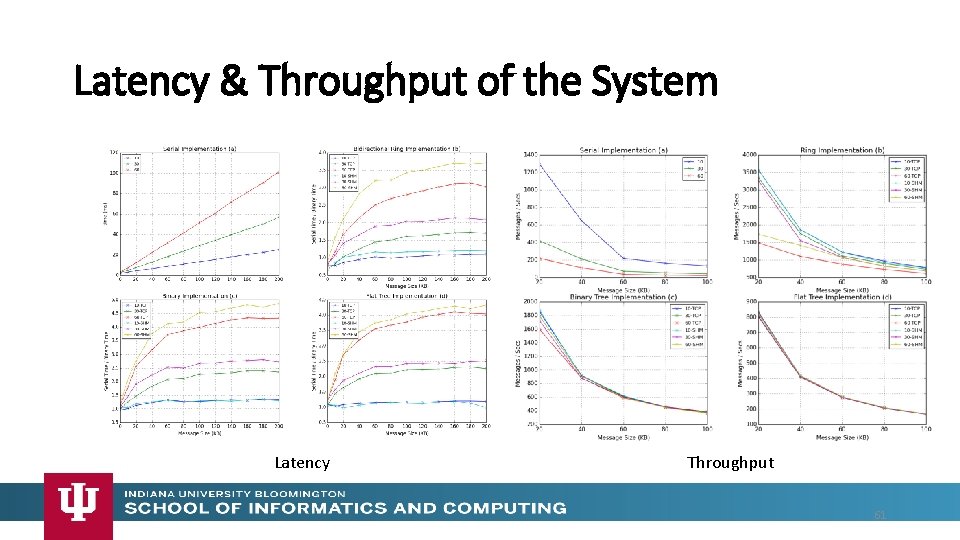
Latency & Throughput of the System Latency Throughput 61
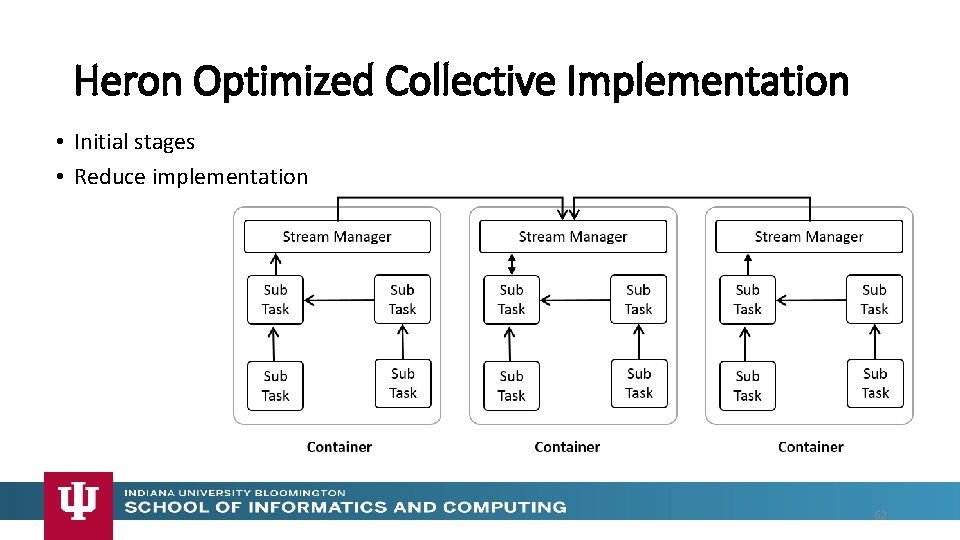
Heron Optimized Collective Implementation • Initial stages • Reduce implementation 62
Summary of HPC Cloud – Next Generation Grid • We suggest an event driven computing model built around Cloud and HPC and spanning batch, streaming, batch and edge applications • Expand current technology of Faa. S (Function as a Service) and serverhidden computing • We have integrated HPC into many Apache systems with HPC-ABDS • We have analyzed the different runtimes of Hadoop, Spark, Flink, Storm, Heron, Naiad, DARMA (HPC Asynchronous Many Task) • There are different technologies for different circumstances but can be unified by high level abstractions such as communication collectives • Need to be careful about treatment of state – more research needed 63
- Slides: 63