
Next Generation Distribution System Platform DSPx A Collaboration
Next Generation Distribution System Platform (DSPx) A Collaboration with State Commissions & Industry to Define Grid Modernization in Context of States’ Policies January 24, 2017 CPUC Workshop

DSPx Objectives (focus on objectives) Initiated by regulatory commissions (CA, DC, HI, MN, NY & DC) • Inform decision makers; policy makers, utilities, and technology providers on capabilities and related technologies needed over time to meet customer needs and state policy objectives • Clarity needed on grid capabilities & functions to deploy the next generation distribution system platform (DSPx) to satisfy states’ policy objectives • Consistency in terminology, descriptions • Identify status & gaps in commercial technology to enable development of DSPx over 5 year period as envisioned in the jurisdictions • Collaborate with regulators, utility industry, and national laboratories to help address key barrier issues for development & adoption of identified advanced distribution planning, operations and market technologies (Phase 2) 2
Grid Modernization Challenges facing an increasing number of states across the US • Given the rapid advancement in technology, business practices and policies: • What is the best strategy for integrating distributed energy resources and DER provided services into the distribution system? • Encompasses technological, business and policy considerations • What are the implications for planning, operations and markets? • 3 Immediate concerns: • Planning guidelines for hosting capacity, interconnection, DER valuation, T-D coordination • Low-regrets decisions on grid modernization investments • Coordination frameworks (DSO) and participant rules (grid codes) • Effectively utilizing DER services as non-wires alternatives reliably and affordably

DSPx Phase I Deliverables Volume I DSPx Functional Reference Document • ‒ Introduce DSPx Taxonomy & Planning/Grid/Market Frameworks ‒ Organize capabilities, functions and elements based on states’ grid modernization policy objectives and system attributes • ‒ Priority scenarios identified by sponsoring state commissions • DSPx Market Assessment DSPx Decision Maker Guide DSPx technology maturity in relation to Vol I functions and elements ‒ Provides overview of current DSPx commercial technology availability and adoption ‒ Identifies potential gaps between existing commercial technologies and needed DSPx functions and elements (Draft 1/31 Final 2/28) Volume III Grid Architecture context ‒ Comparative assessment of industry architectural applications (Final 1/31) Volume II Defines DSPx functional scope • Guide for DSPx Implementation ‒ Support decisions related to implementing DSPx functionality in relation to customer, policy and business drivers ‒ Based on best practices for technology adoption (Draft 1/31 Final 2/28) 4 ‒ Examples based on priority scenarios included 4
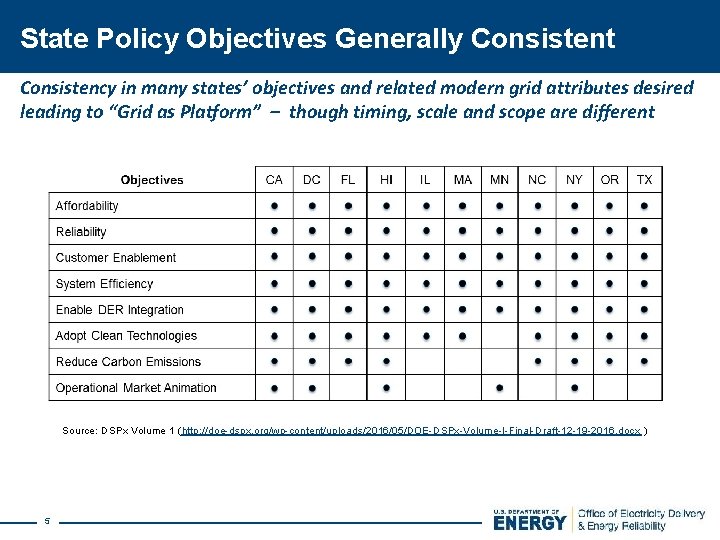
State Policy Objectives Generally Consistent Consistency in many states’ objectives and related modern grid attributes desired leading to “Grid as Platform” – though timing, scale and scope are different Source: DSPx Volume 1 (http: //doe-dspx. org/wp-content/uploads/2016/05/DOE-DSPx-Volume-I-Final-Draft-12 -19 -2016. docx ) 5

DSPx Capabilities State’s Objectives & Attributes List adapted from 2014 More Than Smart & 2015 PNNL Grid Architecture reports 6
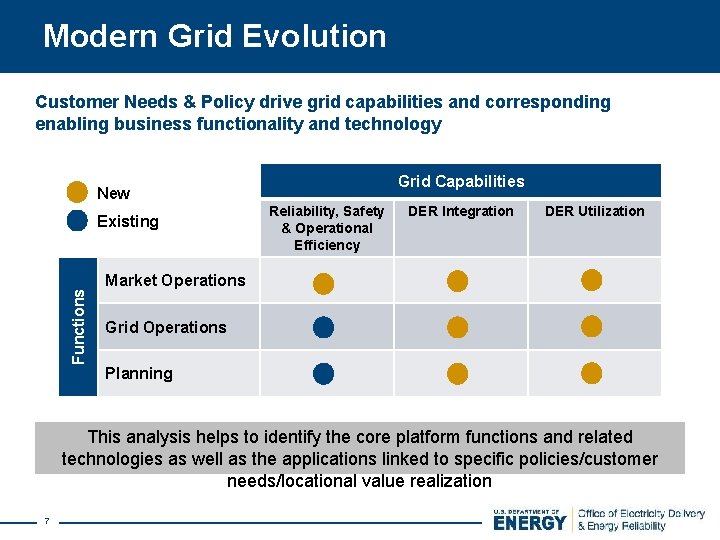
Modern Grid Evolution Customer Needs & Policy drive grid capabilities and corresponding enabling business functionality and technology Grid Capabilities New Functions Existing Reliability, Safety & Operational Efficiency DER Integration DER Utilization Market Operations Grid Operations Planning This analysis helps to identify the core platform functions and related technologies as well as the applications linked to specific policies/customer needs/locational value realization 7
Architectural Based Considerations 1. Take a systems view to make sure things work well together – a piecemeal approach will result in a less effective and more costly distribution system The grid is a collection of interacting structures and networks - decisions about one affects the others 2. Define roles and responsibilities to understand how to coordinate all the pieces which enables increasing clarity on subsequent decisions – including what investments are needed and who needs to make them For example: if a utility will be the buyer of distribution grid services then DER Providers’ sensing, communications & controls do not replace the need for utility investment in grid sensing, communications and controls – they serve different functions and are necessarily complementary 8
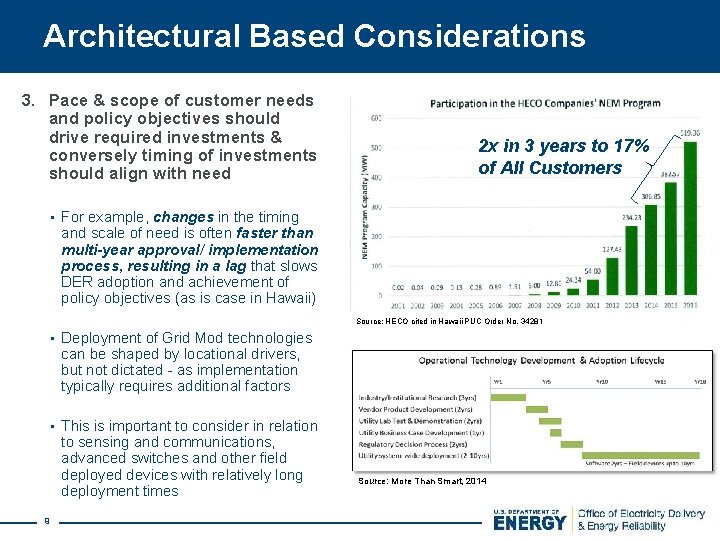
Architectural Based Considerations 3. Pace & scope of customer needs and policy objectives should drive required investments & conversely timing of investments should align with need • 2 x in 3 years to 17% of All Customers For example, changes in the timing and scale of need is often faster than multi-year approval/ implementation process, resulting in a lag that slows DER adoption and achievement of policy objectives (as is case in Hawaii) Source: HECO cited in Hawaii PUC Order No. 34281 9 • Deployment of Grid Mod technologies can be shaped by locational drivers, but not dictated - as implementation typically requires additional factors • This is important to consider in relation to sensing and communications, advanced switches and other field deployed devices with relatively long deployment times Source: More Than Smart, 2014
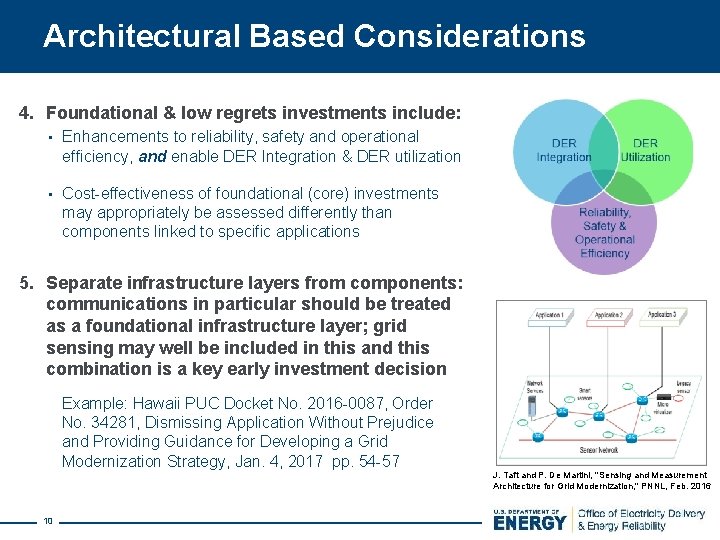
Architectural Based Considerations 4. Foundational & low regrets investments include: • Enhancements to reliability, safety and operational efficiency, and enable DER Integration & DER utilization • Cost-effectiveness of foundational (core) investments may appropriately be assessed differently than components linked to specific applications 5. Separate infrastructure layers from components: communications in particular should be treated as a foundational infrastructure layer; grid sensing may well be included in this and this combination is a key early investment decision Example: Hawaii PUC Docket No. 2016 -0087, Order No. 34281, Dismissing Application Without Prejudice and Providing Guidance for Developing a Grid Modernization Strategy, Jan. 4, 2017 pp. 54 -57 10 J. Taft and P. De Martini, "Sensing and Measurement Architecture for Grid Modernization, " PNNL, Feb. 2016
References doe-dspx. org gridarchitecture. pnnl. gov Contact us at DOE. DSPx@gmail. com 11
- Slides: 11