
Next Generation 9 1 1 Considerations for PSAP
- Slides: 9
Next Generation 9 -1 -1 Considerations for PSAP Governing Authorities June 11, 2020 1
Introduction What is Next Generation 9 -1 -1? • NG 9 -1 -1 is a replacement of the current Enhanced 9 -1 -1 infrastructure and systems. Why is NG 9 -1 -1 so Important? • The current 9 -1 -1 system has reached end of life, and cannot keep up with evolving technologies OR public expectations of a modern 9 -1 -1 system. • NG 9 -1 -1 is not just about new technology. It provides enhanced situational awareness and new opportunities for collaboration and transformational change in 9 -1 -1 service delivery and emergency services operations. Impacts and Timelines? • Starting today, the entire 9 -1 -1 emergency services ecosystem, including 9 -1 -1 communications and dispatch / operations for police, fire, and EMS, is affected. Immediate Action? • Stakeholder engagement, technical and operational needs assessments, funding, and coordinated planning must start now. 2
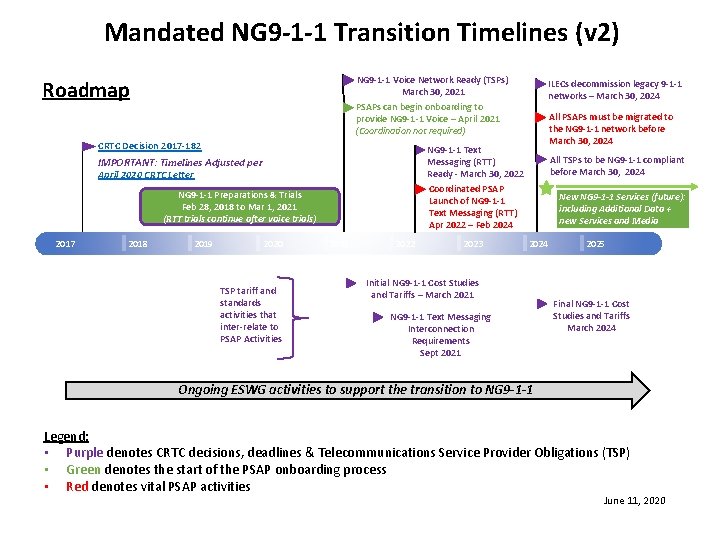
National NG 9 -1 -1 Implementation Process CRTC NG 9 -1 -1 Regulatory Policy / Approved Standards • Decision 2017 -182 mandates Telephone Service Providers (TSPs) to: – Establish NG 9 -1 -1 voice-capable networks by March 30 th 2021* – Establish real-time text (RTT) capability by March 30 th 2022*, and – Decommission the legacy 9 -1 -1 network by March 30, 2024*. • Decision 2018 -188 by the Commission confirms that NG 9 -1 -1 related connections will include secondary PSAPs in future NG 9 -1 -1 network access tariffs. • To ensure all participants move to an NG 9 -1 -1 ecosystem in a coordinated fashion, the standards-based NENA i 3 Architecture is the NG 9‑ 1‑ 1 standard that will be followed in Canada based on CRTC Decision 2015 -531. • The CRTC ESWG continues to work on the evolving NG 9 -1 -1 standards and best practices to assist PSAPs and Governing Authorities with the multi-year transition logistics. * Updated dates per CRTC Letter Direction (8 April 2020) – pending proceeding to confirm 3
What does this mean for PSAPs and 9 -1 -1 Governing Authorities? • Status quo is NOT an option and timelines are very short. • NG 9 -1 -1 voice rollout starting in April 2021 (coordination not required) • Coordinated NG 9 -1 -1 text (aka Real-Time Text) implementation by Province/Territory is planned for April 2022 to February 2024. – NOW is the time to raise the red flag with agency authorities and engage your 9 -1 -1 service provider. • PSAP management and authorities must start planning and budgeting for NG 9 -1 -1 NOW. • Business assessments, gap analysis, and transformation planning is required NOW. • Resource planning – both human and capital - is required NOW. • PSAPs and authoritative stakeholders need to engage with NG 9 -1 -1 solution providers and equipment vendor, to strategically and cost-effectively design and support NG 9 -1 -1 transition and implementation. • Legislation, standards, training, policies and procedures, and new roles and responsibilities will need to be reviewed, defined, amended and implemented in time for the NG 9 -1 -1 transition and implementation. The transition will be gradual but intense for a significant period of time (1 to 5+ years). 4
Mandated NG 9 -1 -1 Transition Timelines (v 2) NG 9 -1 -1 Voice Network Ready (TSPs) March 30, 2021 Roadmap PSAPs can begin onboarding to provide NG 9 -1 -1 Voice – April 2021 (Coordination not required) CRTC Decision 2017 -182 2019 2020 TSP tariff and standards activities that inter-relate to PSAP Activities All TSPs to be NG 9 -1 -1 compliant before March 30, 2024 Coordinated PSAP Launch of NG 9 -1 -1 Text Messaging (RTT) Apr 2022 – Feb 2024 NG 9 -1 -1 Preparations & Trials Feb 28, 2018 to Mar 1, 2021 (RTT trials continue after voice trials) 2018 All PSAPs must be migrated to the NG 9 -1 -1 network before March 30, 2024 NG 9 -1 -1 Text Messaging (RTT) Ready - March 30, 2022 IMPORTANT: Timelines Adjusted per April 2020 CRTC Letter 2017 ILECs decommission legacy 9 -1 -1 networks – March 30, 2024 2021 2022 2023 New NG 9 -1 -1 Services (future): including Additional Data + new Services and Media 2024 Initial NG 9 -1 -1 Cost Studies and Tariffs – March 2021 NG 9 -1 -1 Text Messaging Interconnection Requirements Sept 2021 2025 Final NG 9 -1 -1 Cost Studies and Tariffs March 2024 Ongoing ESWG activities to support the transition to NG 9 -1 -1 Legend: • Purple denotes CRTC decisions, deadlines & Telecommunications Service Provider Obligations (TSP) • Green denotes the start of the PSAP onboarding process • Red denotes vital PSAP activities June 11, 2020
Key Strategic Action Plan Activities • Determine, assess, and plan for business transformation needs. – See the Action Plan (attached) • Develop a change management strategy, especially related to call handling and IS/IT resources. • Develop a 5 -year (minimum) strategic roadmap envisioning your Provincial/Territorial end-to-end 9 -1 -1 emergency response ecosystem that includes NG 9 -1 -1 data and service capabilities. • Develop an NG 9 -1 -1 governance and emergency services delivery model. • Work with PSAP partners to update MOUs and coordinate training delivery to ensure a coordinated, logical rollout of NG 9 -1 -1 in your Province/Territory. • PSAPs and their governing authorities should work with provincial / territorial governments to create or amend 9 -1 -1 legislation based on NG 9 -1 -1 impacts. • Understand action the information being provided by ESWG. This is a paradigm shift in which innovation and improvement opportunities need to be considered for a modern, efficient and effective 9 -1 -1 emergency services delivery model. 6
Cost and Resource Implications • Determine, assess, and plan resource requirements (human & capital) for major 9 -1 -1 infrastructure and operational upgrades and changes. • Identify new roles and responsibilities for both technical and operations staff that considers initial and future-state NG 9 -1 -1 environments. • Determine, assess, and plan procurement requirements. • Identify existing and new funding sources for short, medium, and longterm NG 9 -1 -1 and related emergency response ecosystem capabilities. • Define a sustainable future-state 9 -1 -1 emergency services delivery model. New funding requirements, evolving cost information, short timelines, and scarce/new specialized expertise requires action and planning now. 7
Technology Considerations • Determine, assess, and plan for the following: – New options for NG 9 -1 -1 compliant call handling equipment – on site, managed and/or hosted services – From a closed system to a secure IP network – From analog to IP-based multi-media communications – Use of open standards – Systems integration and interface upgrade requirements (e. g. Phone, Logging, CAD) – New data about the call, the caller and the location (providing much better situational awareness) – New mapping standards and requirements (GIS) – New logging, storage, retention, and disclosure requirements – New collaboration and coordination opportunities • Develop a technology plan for the new call handling requirements; define best practices for presenting and managing the NG 9 -1 -1 features and functions. • Develop methods to ensure a secure environment: – Cybersecurity (hackers, intrusion detection, cyber terrorism, data protection) – Reliability, resiliency, and redundancy – Physical security Specialized NG 9 -1 -1 technical expertise is scarce, yet PSAP technologies and processes need to be assessed and possibly upgraded, overhauled, redesigned and/or replaced to meet public and CRTC expectations of a PSAP in a modern NG 9 -1 -1 emergency services ecosystem. 8
In Summary • PSAPs and their governing authorities must engage with their 9 -1 -1 network providers and industry stakeholders to PLAN, FUND, and EXECUTE the technological and operational changes required for an effective transition between NOW and February 2024. • Coordinated NG 9 -1 -1 implementation by Province/ Territory is critical to ensure that the expectations of the public, 9 -1 -1 stakeholders, and the CRTC are met. Stakeholders need to envision, plan, and execute work to establish a NEW, world-class 9 -1 -1 emergency services ecosystem. 9