
Next Gen Sequencing Files and pysam BCHB 524
Next Gen. Sequencing Files and pysam BCHB 524 Lecture 13 BCHB 524 - Edwards

Next Gen. Sequencing BCHB 524 - Edwards Wiki: Genomics 2

Next Gen. Sequencing Nature Biotechnology 29, 24– 26 (2011) BCHB 524 - Edwards 3
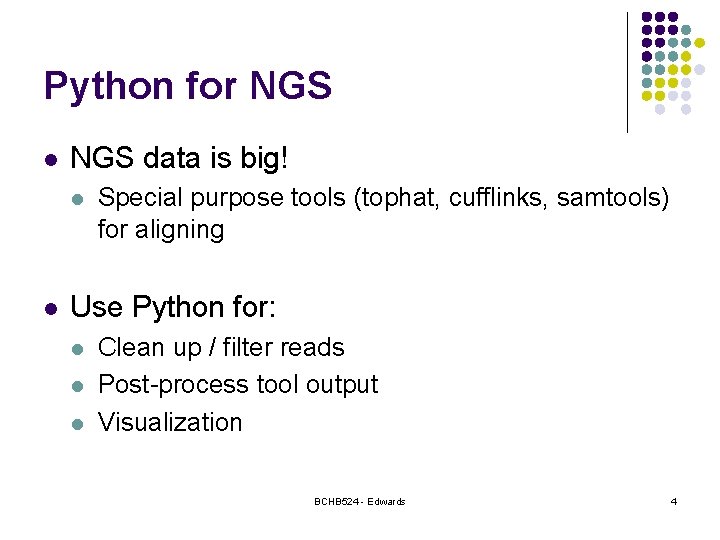
Python for NGS l NGS data is big! l l Special purpose tools (tophat, cufflinks, samtools) for aligning Use Python for: l l l Clean up / filter reads Post-process tool output Visualization BCHB 524 - Edwards 4
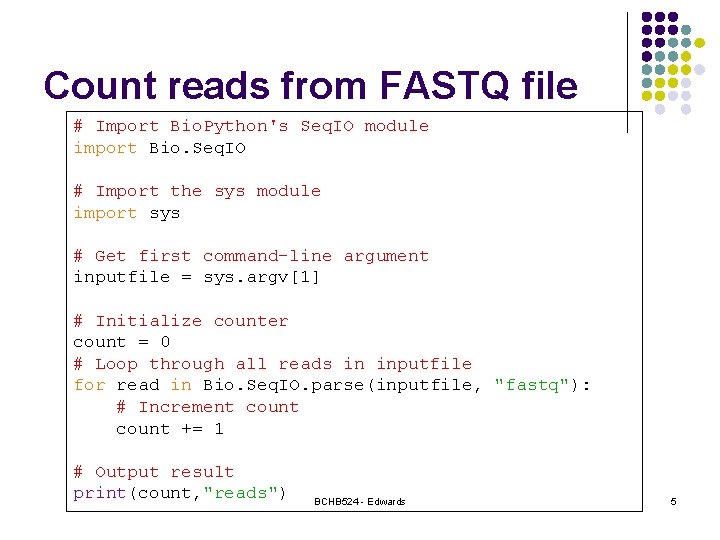
Count reads from FASTQ file # Import Bio. Python's Seq. IO module import Bio. Seq. IO # Import the sys module import sys # Get first command-line argument inputfile = sys. argv[1] # Initialize counter count = 0 # Loop through all reads in inputfile for read in Bio. Seq. IO. parse(inputfile, "fastq"): # Increment count += 1 # Output result print(count, "reads") BCHB 524 - Edwards 5

Filter reads in FASTQ file import Bio. Seq. IO import sys # Get command-line arguments inputfile = sys. argv[1] minlength = int(sys. argv[2]) # Loop through all reads in inputfile for read in Bio. Seq. IO. parse(inputfile, "fastq"): # Check the length if len(read. seq) > minlength: # Output to standard-out print(read. format("fastq"), end="") BCHB 524 - Edwards 6
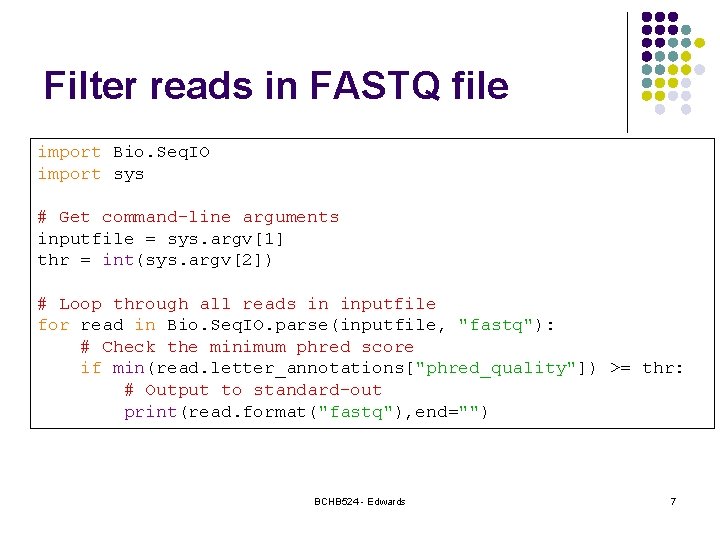
Filter reads in FASTQ file import Bio. Seq. IO import sys # Get command-line arguments inputfile = sys. argv[1] thr = int(sys. argv[2]) # Loop through all reads in inputfile for read in Bio. Seq. IO. parse(inputfile, "fastq"): # Check the minimum phred score if min(read. letter_annotations["phred_quality"]) >= thr: # Output to standard-out print(read. format("fastq"), end="") BCHB 524 - Edwards 7
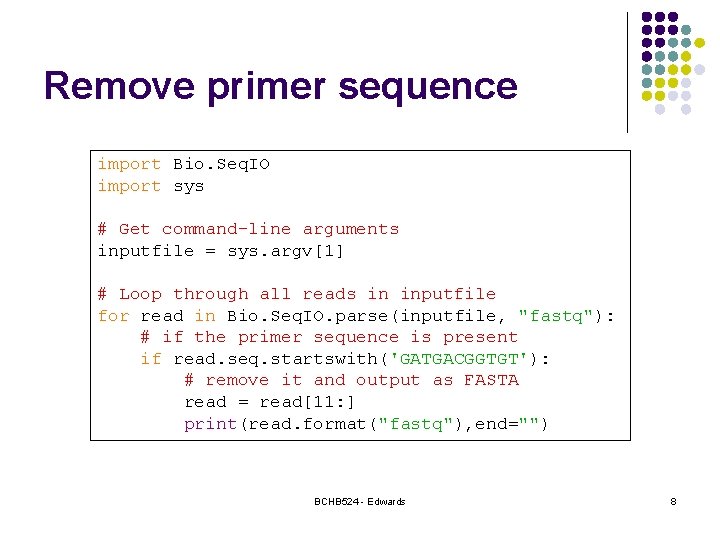
Remove primer sequence import Bio. Seq. IO import sys # Get command-line arguments inputfile = sys. argv[1] # Loop through all reads in inputfile for read in Bio. Seq. IO. parse(inputfile, "fastq"): # if the primer sequence is present if read. seq. startswith('GATGACGGTGT'): # remove it and output as FASTA read = read[11: ] print(read. format("fastq"), end="") BCHB 524 - Edwards 8
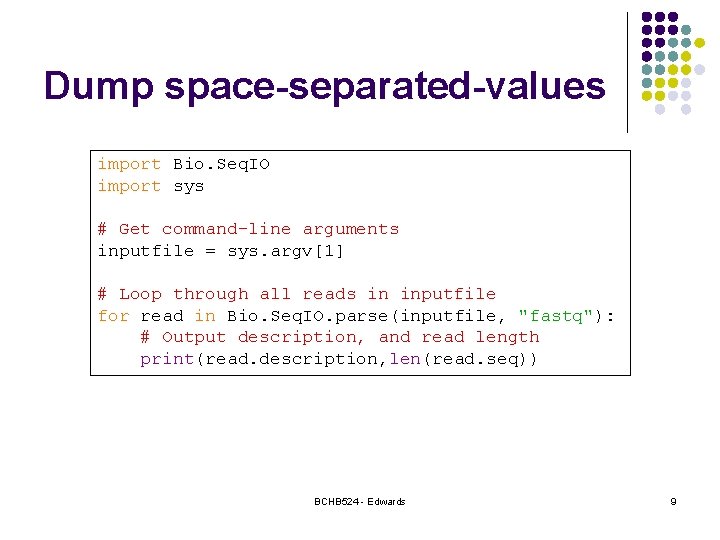
Dump space-separated-values import Bio. Seq. IO import sys # Get command-line arguments inputfile = sys. argv[1] # Loop through all reads in inputfile for read in Bio. Seq. IO. parse(inputfile, "fastq"): # Output description, and read length print(read. description, len(read. seq)) BCHB 524 - Edwards 9
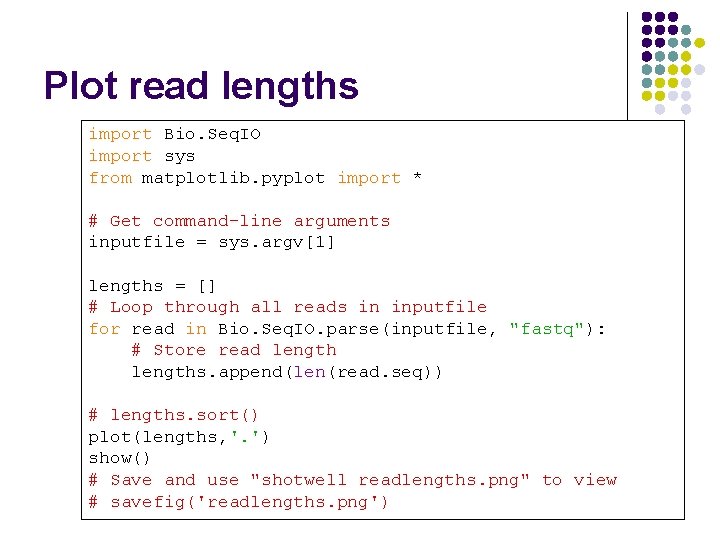
Plot read lengths import Bio. Seq. IO import sys from matplotlib. pyplot import * # Get command-line arguments inputfile = sys. argv[1] lengths = [] # Loop through all reads in inputfile for read in Bio. Seq. IO. parse(inputfile, "fastq"): # Store read lengths. append(len(read. seq)) # lengths. sort() plot(lengths, '. ') show() # Save and use "shotwell readlengths. png" to view BCHB 524 - Edwards # savefig('readlengths. png') 10
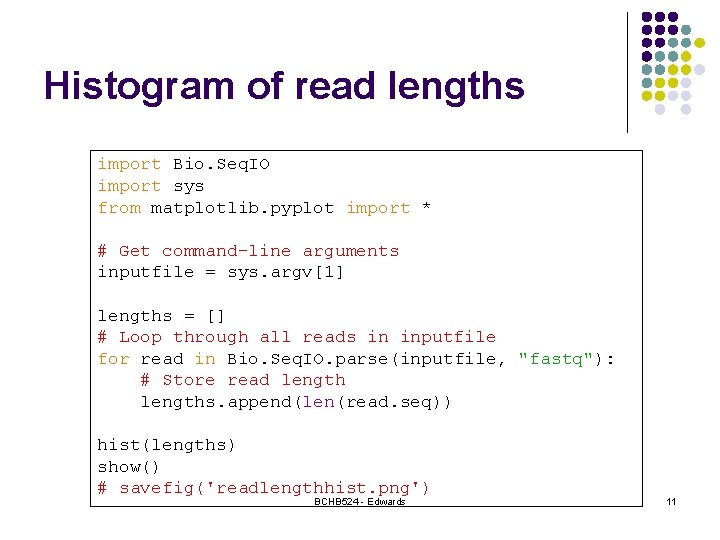
Histogram of read lengths import Bio. Seq. IO import sys from matplotlib. pyplot import * # Get command-line arguments inputfile = sys. argv[1] lengths = [] # Loop through all reads in inputfile for read in Bio. Seq. IO. parse(inputfile, "fastq"): # Store read lengths. append(len(read. seq)) hist(lengths) show() # savefig('readlengthhist. png') BCHB 524 - Edwards 11

Plot read lengths and quality import Bio. Seq. IO import sys from matplotlib. pyplot import * # Get command-line arguments inputfile = sys. argv[1] lengths 1 = [] lengths 2 = [] # Loop through all reads in inputfile for read in Bio. Seq. IO. parse(inputfile, "fastq"): phred_scores = read. letter_annotations["phred_quality"] l = 0 for phsc in phred_scores: if phsc < 30: break l += 1 lengths 1. append(l) lengths 2. append(len(read. seq)) plot(lengths 2, lengths 1, '. ') show() # savefig('readlengths. png') BCHB 524 - Edwards 12
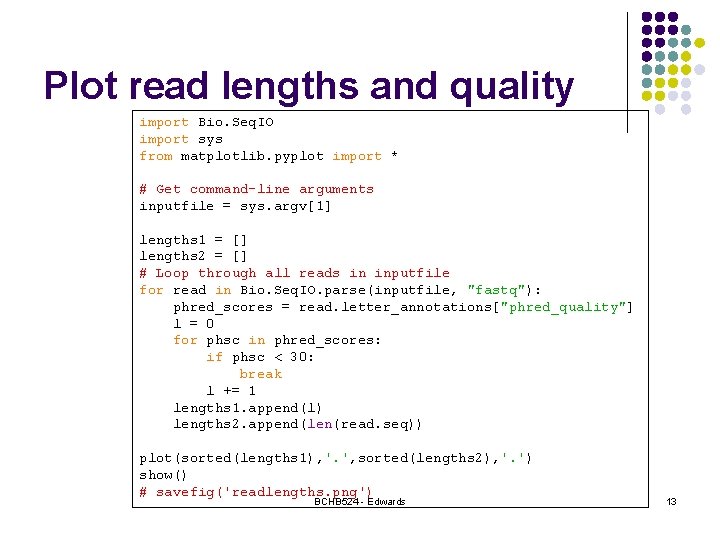
Plot read lengths and quality import Bio. Seq. IO import sys from matplotlib. pyplot import * # Get command-line arguments inputfile = sys. argv[1] lengths 1 = [] lengths 2 = [] # Loop through all reads in inputfile for read in Bio. Seq. IO. parse(inputfile, "fastq"): phred_scores = read. letter_annotations["phred_quality"] l = 0 for phsc in phred_scores: if phsc < 30: break l += 1 lengths 1. append(l) lengths 2. append(len(read. seq)) plot(sorted(lengths 1), '. ', sorted(lengths 2), '. ') show() # savefig('readlengths. png') BCHB 524 - Edwards 13
Samtools using pysam l l Popular format for alignment records pysam is a lightweight wrapper around the samtools code l l l Need to understand samtools alignment datastructures BAM indexes permit random access by locus Direct access to mate-pairs BCHB 524 - Edwards 14
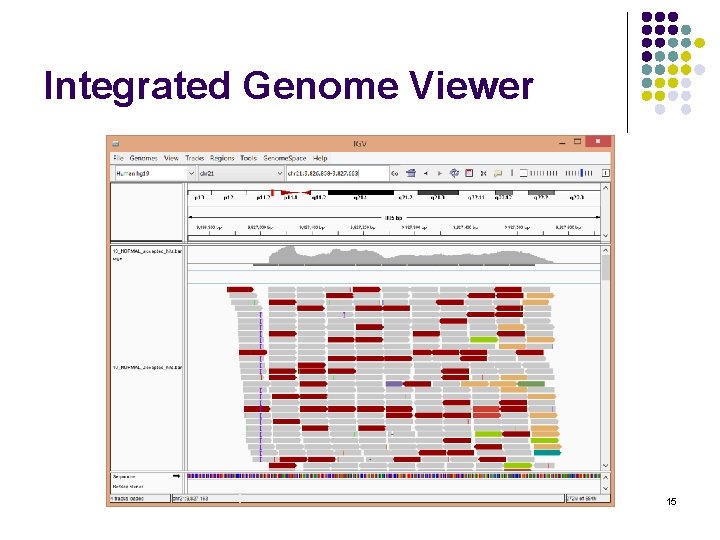
Integrated Genome Viewer BCHB 524 - Edwards 15
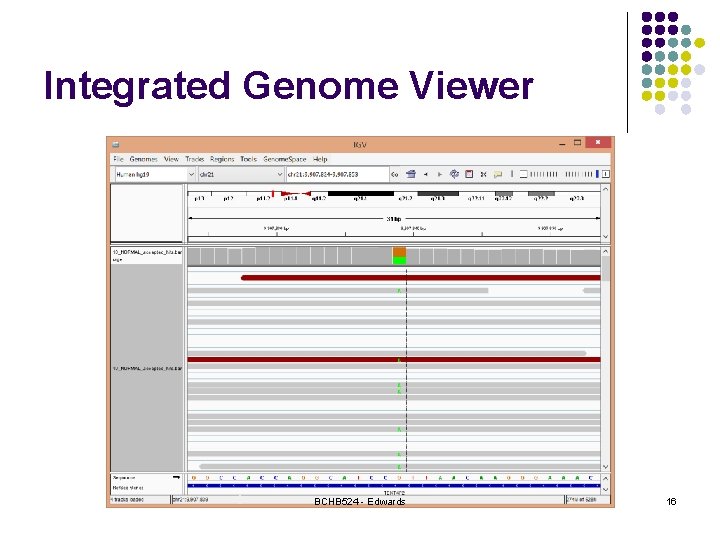
Integrated Genome Viewer BCHB 524 - Edwards 16
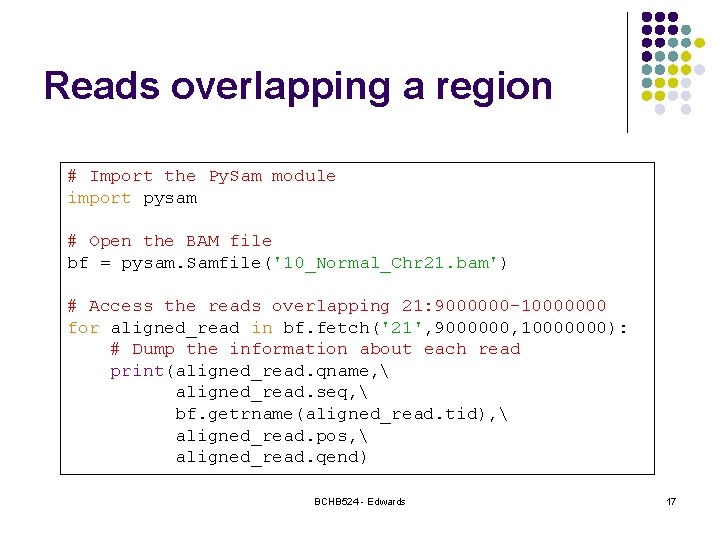
Reads overlapping a region # Import the Py. Sam module import pysam # Open the BAM file bf = pysam. Samfile('10_Normal_Chr 21. bam') # Access the reads overlapping 21: 9000000 -10000000 for aligned_read in bf. fetch('21', 9000000, 10000000): # Dump the information about each read print(aligned_read. qname, aligned_read. seq, bf. getrname(aligned_read. tid), aligned_read. pos, aligned_read. qend) BCHB 524 - Edwards 17
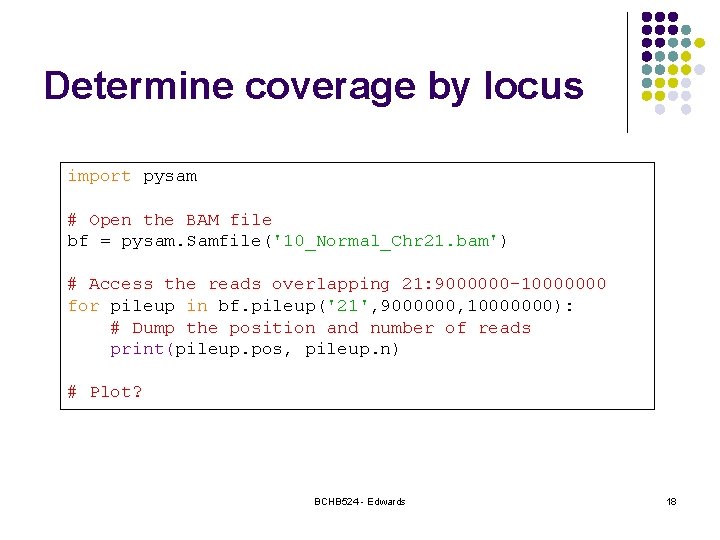
Determine coverage by locus import pysam # Open the BAM file bf = pysam. Samfile('10_Normal_Chr 21. bam') # Access the reads overlapping 21: 9000000 -10000000 for pileup in bf. pileup('21', 9000000, 10000000): # Dump the position and number of reads print(pileup. pos, pileup. n) # Plot? BCHB 524 - Edwards 18
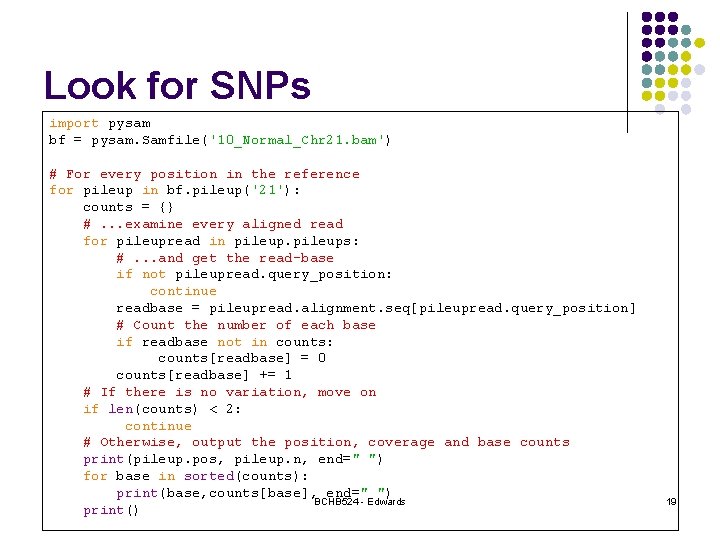
Look for SNPs import pysam bf = pysam. Samfile('10_Normal_Chr 21. bam') # For every position in the reference for pileup in bf. pileup('21'): counts = {} #. . . examine every aligned read for pileupread in pileups: #. . . and get the read-base if not pileupread. query_position: continue readbase = pileupread. alignment. seq[pileupread. query_position] # Count the number of each base if readbase not in counts: counts[readbase] = 0 counts[readbase] += 1 # If there is no variation, move on if len(counts) < 2: continue # Otherwise, output the position, coverage and base counts print(pileup. pos, pileup. n, end=" ") for base in sorted(counts): print(base, counts[base], end=" ") BCHB 524 - Edwards print() 19
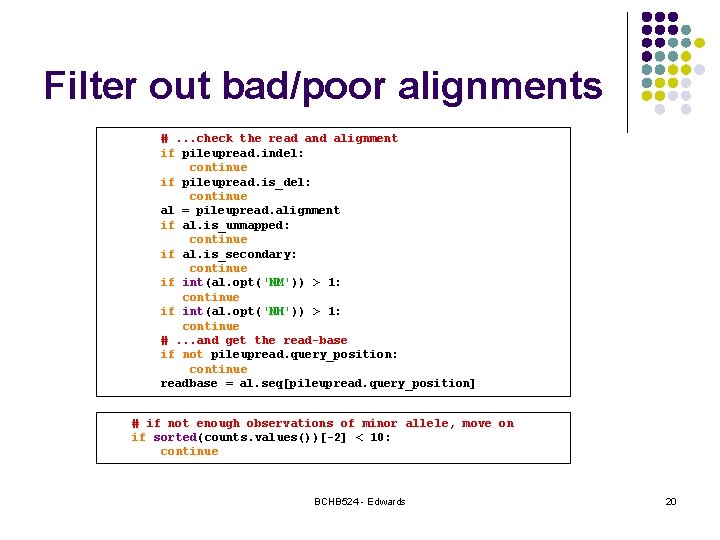
Filter out bad/poor alignments #. . . check the read and alignment if pileupread. indel: continue if pileupread. is_del: continue al = pileupread. alignment if al. is_unmapped: continue if al. is_secondary: continue if int(al. opt('NM')) > 1: continue if int(al. opt('NH')) > 1: continue #. . . and get the read-base if not pileupread. query_position: continue readbase = al. seq[pileupread. query_position] # if not enough observations of minor allele, move on if sorted(counts. values())[-2] < 10: continue BCHB 524 - Edwards 20
- Slides: 20